Pruning rhododendrons and azaleas at the wrong time can cost you a whole season of flowers. Discover exactly when to prune, how to shape young shrubs, rescue overgrown plants, and remove faded blooms without damaging new growth. Learn the differences between evergreen, deciduous, and reblooming varieties.


The best time to prune most rhododendrons and azaleas is immediately after flowering, usually in late spring or early summer. Pruning at this stage gives new shoots time to develop before the plant forms next year’s flower buds. Heavy renovation is different: it may be better done in late winter or early spring, even though it means sacrificing flowers.
One badly timed haircut can leave a rhododendron looking healthy but almost flowerless the following spring. Fortunately, these spectacular shrubs rarely need much pruning. A few well-placed cuts are usually enough to remove awkward branches, improve their shape, and maintain vigorous growth.
The challenge is knowing where to cut and how far to go. A compact evergreen rhododendron, a large-leaved hybrid, and a deciduous azalea may all belong to the genus Rhododendron, but they do not necessarily respond to pruning in the same way. Understanding those differences is particularly important when an older shrub needs serious renovation.
The most important pruning rule: Shape spring-flowering rhododendrons and azaleas as soon as their flowers fade. Remove dead or dangerous branches whenever necessary. Before cutting an old shrub back hard, check whether its type can regenerate from bare wood.
| Pruning task | Best time | What to remember |
|---|---|---|
| Light shaping | Immediately after flowering | Avoid removing next year’s developing buds |
| Thinning crowded branches | After flowering | Remove selected branches at their origin |
| Deadheading | When flowers fade | Protect tender new shoots beneath the flowers |
| Dead or broken wood | Any time | Cut back to healthy wood or a suitable junction |
| Major renovation | Often late winter or early spring | Regrowth varies; flowering may be lost temporarily |
| Reblooming azaleas | After the main spring display | Late pruning may reduce subsequent blooms |
For routine pruning, follow the flowers rather than the calendar. Early-flowering rhododendrons may finish blooming in March or April in mild climates, while later cultivars can still be flowering in June. Prune when your particular plant has finished its main display.
Most traditional spring-flowering rhododendrons and azaleas bloom on growth produced the previous year. After flowering, they develop new shoots and begin forming buds for the following season, generally during summer.
Cutting those shoots in late summer or fall removes potential flowers. The plant may remain perfectly healthy, but the spring display can be disappointing.
There is an important distinction between maintenance and renovation. Light shaping belongs immediately after flowering. Major renovation of a suitable overgrown plant may be undertaken in late winter or early spring, allowing a full growing season for recovery. In that case, losing flowers is an accepted trade-off.
What about fall pruning? Avoid routine trimming in fall. Flower buds may already be present, and cutting them off can mean fewer blooms next spring. Dead, broken, or hazardous branches are exceptions and can be removed when necessary.
Before picking up your pruning shears, look at the whole shrub. Is it healthy and naturally well-shaped? Are a few branches growing awkwardly? Has it become crowded inside, or is it simply much too large for the space?
Gardenia’s Pruning Decision Check helps distinguish problems that need a few selective cuts from those requiring major changes.
| What you see | Recommended action | Flowering impact |
|---|---|---|
| Healthy, attractive shrub | Little or no pruning | Minimal |
| A few branches stick out | Selective heading cuts | Usually limited when timed correctly |
| Branches cross or rub | Thinning cuts | Flowers on removed wood are lost |
| Old and badly overgrown | Assess renovation potential | One or more reduced blooming seasons possible |
| Permanently too large | Consider moving or replacing | Avoids repeated heavy cutting |
Gardenia’s plant profiles illustrate why mature size and growth habit matter. The following plants are all rhododendrons, yet their natural dimensions suggest very different management strategies.
| Plant | Mature size | Practical pruning approach |
|---|---|---|
| Rhododendron ‘Ramapo’ | 1-2 ft. tall, 2-3 ft. wide (30-60 x 60-90 cm) | Naturally compact; preserve its dense habit with minimal pruning |
| Rhododendron ‘PJM Elite’ | 5-6 ft. tall and wide (1.5-1.8 m) | Allow room for its rounded evergreen form; shorten occasional overlong branches after flowering |
| Rhododendron ‘Gibraltar’ | 4-5 ft. tall and wide (1.2-1.5 m) | Preserve its naturally open, deciduous habit; thin selectively when necessary |
What does this tell you? A compact ‘Ramapo’ generally needs little size control, while ‘PJM Elite’ requires substantially more room as it matures. ‘Gibraltar’, a deciduous azalea with a naturally open habit, is better treated with selective pruning than repeated tight clipping.
These recommendations follow documented dimensions and growth habits, not claims that the three cultivars have been experimentally compared for pruning response. Before attempting severe renovation, the plant’s health and capacity to regenerate from old wood must be assessed separately.
Explore Gardenia’s Rhododendron and Azalea Comparison Tool to compare other selections, or browse Azaleas and Rhododendrons for Small Gardens if yours has outgrown its space.
Is your rhododendron too big for its space? Before cutting it back again, compare compact varieties that naturally fit your garden.
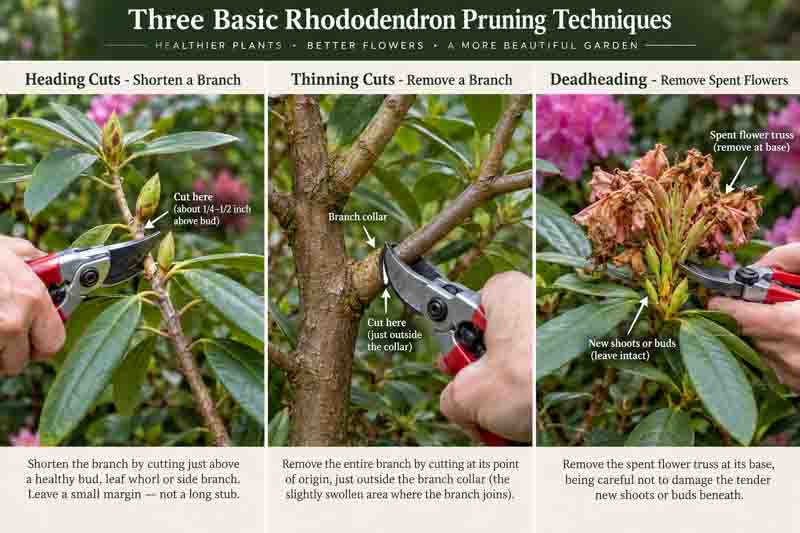
Knowing exactly where to place your pruners is more useful than following a general instruction to “cut back after flowering.” Three basic techniques cover most routine pruning.
A heading cut shortens a shoot without removing it entirely. Find a healthy leaf whorl, bud, or suitable side branch facing the direction you want future growth to take. Cut just above it, leaving a small margin without creating a long stub.
This technique is useful when one branch extends beyond the shrub’s natural outline. New growth may develop below the cut, depending on the age and condition of the stem.
A thinning cut removes a whole branch at its origin or where it joins a larger branch. Cut just outside the branch collar, the slightly swollen area around the attachment. Do not leave a long stub or cut flush into the supporting stem.
Thinning is particularly valuable for crossing, damaged, or badly positioned branches. It preserves a more natural appearance than shearing the entire shrub.
On large-flowered rhododendrons, gently remove faded flower trusses at their base without damaging the tender shoots or buds immediately beneath them. If the truss does not break away easily, use small clean pruners.
Where should the cut go? Shorten an overlong shoot above healthy growth. Remove an unwanted branch at its junction. Remove a faded flower cluster just above the new shoots beneath it. These are three different jobs, and cutting at the wrong point can damage the plant’s natural shape.
Choose a dry day when the plant is not suffering from extreme heat or drought. Use sharp bypass pruners for small shoots, loppers for thicker branches, and a pruning saw for larger wood.
Inspect the whole shrub. Walk around it and identify dead, damaged, crossing, or overlong branches. Decide what needs removing before making the first cut.
Remove dead or damaged wood. Cut to a healthy branch junction or living wood. If uncertain whether a branch is dead, inspect its buds and make a small bark scratch to look for living tissue.
Thin crowded growth selectively. Remove rubbing or badly positioned branches at their origin while preserving the shrub’s overall structure.
Shorten overlong shoots. Make heading cuts just above suitable healthy growth rather than cutting every shoot to the same height.
Step back and reassess. Look at the plant from several angles. Stop when its shape looks balanced; further cutting is rarely necessary simply for the sake of pruning.
Clean tools before starting and when moving between diseased and healthy plants. Wear gloves, and keep clippings away from pets and livestock because rhododendrons and azaleas are poisonous if eaten.
There is no need to remove a set percentage of growth annually. Healthy, well-shaped rhododendrons often perform best with little interference.
Large-leaved evergreen rhododendrons develop an attractive framework of woody stems carrying clusters of leathery leaves. Their natural rounded or spreading shape is worth preserving.
Remove dead wood, crossing branches, and shoots that spoil the outline. Avoid indiscriminate shearing, which can produce dense growth at the tips while leaving the interior increasingly bare.
Some rhododendrons produce new shoots readily from older stems, while others do not. Rough-barked types such as Rhododendron ponticum often regenerate more successfully than certain smooth-barked types, but bark texture alone is not a sufficient guarantee for an individual plant.
For an established, valuable specimen, test its response on a small section before attempting major reduction. This is particularly prudent when branches have been leafless for many years.
For reblooming azaleas: The period immediately after spring flowering is your main opportunity for shaping. Avoid repeated summer trimming if enjoying later flowers is a priority.
An old rhododendron that blocks a window or overwhelms a border presents a different challenge from a shrub needing light shaping. Before making major cuts, assess its health and regeneration potential.
Look for vigorous new shoots, healthy foliage, and sound branches. Plants weakened by root rot, poor drainage, drought, or chronic stress are less likely to tolerate heavy pruning.
For a valuable shrub, reduce selected older or overlong branches over successive growing seasons. Cut back to suitable lateral growth where possible, and retain healthy foliage while replacement shoots develop.
Watch how the plant responds before making further cuts. If vigorous new growth appears, additional branches may be reduced in subsequent seasons. This approach is slower but reduces the risk of leaving an entire shrub unable to regenerate.
Some vigorous rhododendrons and azaleas can recover from severe cutting, including cuts into older wood. Late winter or early spring often gives suitable plants a long recovery period.
However, the loss of flower buds is unavoidable on branches removed at this time. Some plants may take several seasons to regain their former appearance, while others may fail to produce satisfactory replacement growth.
Do not cut an old rhododendron back to bare stumps without first confirming that its type is capable of regenerating. Large or particularly valuable specimens may justify advice from an experienced horticulturist or arborist.
If the underlying problem is a naturally large cultivar planted in a narrow space, replacement with a compact selection may be more satisfactory than repeated renovation.
Deadheading is optional, not essential. Removing spent trusses improves appearance and prevents seed formation, but mature rhododendrons can remain healthy and flower well without it.
On young plants, deadheading may help direct resources away from seed production. However, it does not guarantee a larger flower display the following year. Light, soil moisture, plant maturity, and weather also affect bud development.
Remove faded trusses carefully, especially on large-flowered rhododendrons. The new shoots immediately beneath them are easily damaged. Small-flowered rhododendrons and many azaleas usually need no individual deadheading.
The most damaging mistakes are often simple: pruning after next year’s buds have formed, shearing an entire shrub unnecessarily, or assuming old bare stems will automatically produce new shoots.
If a rhododendron is not flowering, pruning may not be the cause. Excessive shade, summer drought during bud formation, frost injury, or excessive nitrogen can also reduce blooms. Diagnose the problem before making further cuts.
After light pruning, an established rhododendron generally needs no special treatment. Continue normal care, maintaining acidic, moist but well-drained soil and a suitable layer of organic mulch.
Following heavier renovation, monitor soil moisture carefully. Avoid excessive fertilizer intended to force rapid growth; concentrated fertilizer can damage the shallow, fine roots.
Allow new shoots time to develop before undertaking additional pruning. If the plant remains weak, investigate root condition, drainage, planting depth, and growing conditions rather than repeatedly cutting it back.
The easiest way to avoid constant pruning is to choose a rhododendron whose natural size and habit suit its position.
Gardenia’s small-garden rhododendron guide features compact selections, while its rock-garden guide highlights plants suited to smaller-scale planting.
You can also explore the Gardenia Rhododendron and Azalea Collection and use the Garden Design Tool to assess plant compatibility, mature dimensions, and quantities before making permanent changes to your garden.
For established shrubs that have become too large, this may be the most useful next step. Instead of repeatedly cutting back a vigorous plant, you can compare varieties naturally suited to your available space.
Gardenia’s long-term pruning principle: Choose plants that fit their space when mature. Use pruning to refine their natural form, not to fight their growth habit year after year.
Prune most spring-flowering rhododendrons immediately after flowering, often between late spring and early summer. Exact timing depends on the cultivar and climate. Major renovation may be done earlier if some flowering loss is acceptable.
Some rhododendrons recover well from hard pruning, especially certain rough-barked types and deciduous azaleas. Others regenerate poorly from old wood. Check the particular plant and consider gradual renovation before making severe cuts.
Most azaleas should be pruned shortly after their spring flowers fade. Reblooming varieties are also generally shaped after the main spring display to avoid reducing later flowers.
Deadheading is optional. Removing spent flower clusters improves appearance and prevents seed production, but it is not essential for mature shrubs. Take care not to damage developing shoots beneath the flowers.
Avoid routine fall pruning because flower buds for the following spring may already have formed. Dead, broken, or hazardous branches can be removed whenever necessary.
Pruning after flower buds develop can remove the following year’s blossoms. Heavy renovation may also encourage vegetative growth at the expense of flowering. Shade, drought, and frost injury are other possible causes.
Light pruning can control the size of suitable varieties, but repeatedly cutting back a naturally large rhododendron may reduce flowers and spoil its shape. Choosing a compact cultivar is usually the better long-term solution.
Most rhododendrons and azaleas reward a light hand. Prune soon after flowering, remove unwanted branches thoughtfully, and preserve the plant’s natural form whenever possible. If an old shrub needs more drastic attention, establish how well it can regenerate before cutting into mature wood.
And if pruning has become an annual struggle, consider whether the plant simply needs more space. The right rhododendron, growing in the right position, should provide years of beautiful flowers without demanding constant correction.
Updated by Gardenia: October 2026
| Hardiness |
3 - 10 |
|---|---|
| Plant Type | Shrubs |
| Genus | Rhododendron |
| Exposure | Full Sun, Partial Sun |
| Season of Interest | Spring (Early, Mid, Late), Summer (Early), Fall, Winter |
| Maintenance | Low |
| Water Needs | Average |
| Soil Type | Clay, Loam, Sand |
| Soil pH | Acid |
| Soil Drainage | Moist but Well-Drained |
| Tolerances | Rabbit |
| Attracts | Butterflies, Hummingbirds |
| Landscaping Ideas | Beds And Borders, Patio And Containers, Small Gardens |
| Garden Styles | City and Courtyard, Gravel and Rock Garden, Informal and Cottage, Japanese Garden, Traditional Garden |
Create a membership account to save your garden designs and to view them on any device.
Becoming a contributing member of Gardenia is easy and can be done in just a few minutes. If you provide us with your name, email address and the payment of a modest $25 annual membership fee, you will become a full member, enabling you to design and save up to 25 of your garden design ideas.
Join now and start creating your dream garden!