White leaves, black shoots, wilting branches, yellow foliage, or sudden dieback? Learn how to diagnose common lilac diseases by symptom pattern, distinguish powdery mildew from bacterial blight, root rot, Verticillium wilt, Armillaria, and witches'-broom, and recognize when frost, borers, drainage, or drought may be the real problem.


A lilac can look perfectly healthy one week and suddenly develop black shoots, spotted leaves, white powder, wilting branches, or an alarming patch of dieback. The temptation is to search for a disease name immediately. That is often where diagnosis goes wrong.
Several problems affecting lilacs (Syringa) produce similar symptoms, and not everything that looks like disease actually is one. A branch wilting from lilac borer can resemble vascular disease. Frost-blackened shoots can look like bacterial blight. Yellow leaves may point toward damaged roots rather than a leaf infection. And the familiar white coating of powdery mildew can look dramatic while doing relatively little lasting harm.
The quickest route to a useful diagnosis is therefore not simply to ask, “What disease does my lilac have?” Start with what the plant is actually doing: where the symptoms began, what they look like, how quickly they appeared, and what happened just before them.
Before trying to name the disease, answer four questions:
Gardenia’s diagnostic rule: Diagnose the pattern before treating the pathogen. The location, speed, and context of the damage often narrow the cause more reliably than a single discolored leaf.
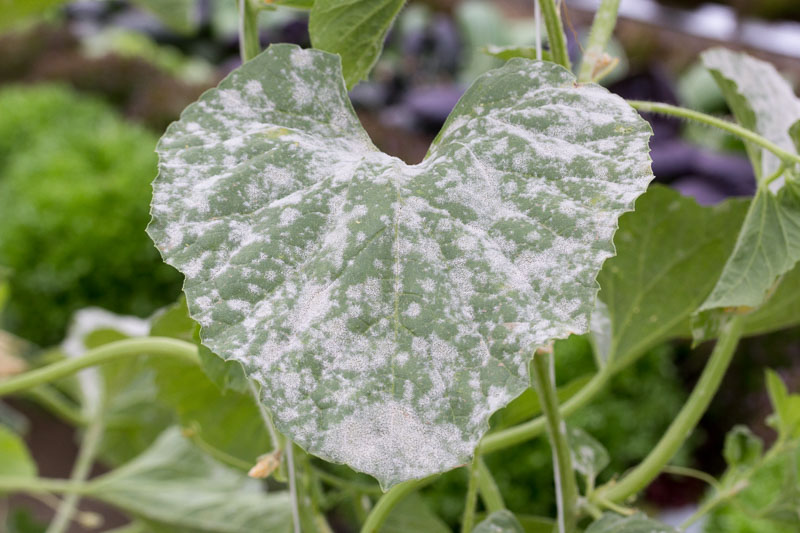 Powdery mildew on cucurbits
Powdery mildew is one of the most familiar problems on common lilac. Leaves develop patches of dry white or grayish fungal growth that can eventually make the plant look as though it has been dusted with flour. For a complete lilac-specific diagnosis and management guide, see Powdery Mildew on Lilacs: Causes, Prevention and Treatment.
It often becomes most noticeable later in summer, particularly on susceptible common lilacs (Syringa vulgaris). Dense growth, reduced air movement, and favorable weather can encourage infection.
Look for powdery white or gray patches on the surface of the leaves. Heavy infections may cover much of a leaf, and young foliage can sometimes become distorted.
The appearance can be alarming, but late-season powdery mildew on lilacs is often primarily cosmetic rather than a threat to the life of an otherwise healthy shrub.
Improve sunlight and airflow around the shrub. Avoid creating an unnecessarily dense interior with repeated shearing, and remove severely crowded stems when appropriate.
Keep the lilac otherwise healthy and avoid automatically treating every late-summer infection as an emergency. Where powdery mildew is repeatedly severe, choosing a less-susceptible lilac may be the better long-term strategy.
Key clue: White surface growth on otherwise living leaves points toward powdery mildew, not root rot or bacterial blight.
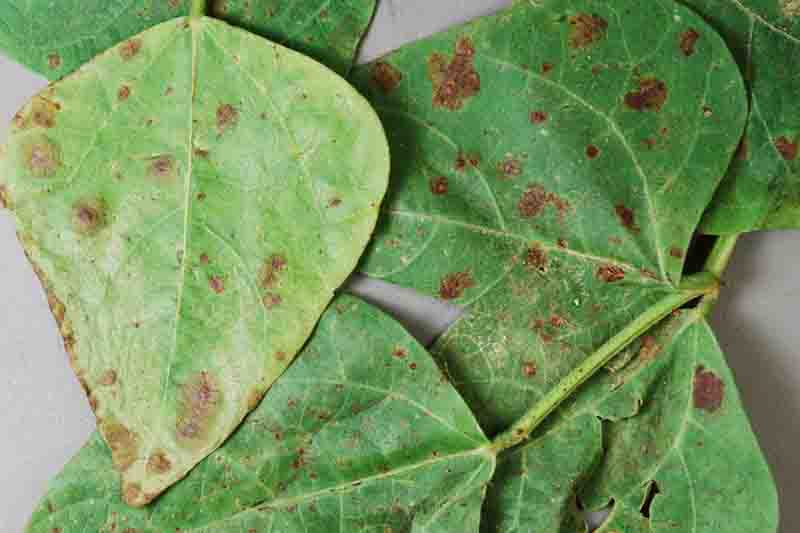 bacterial brown spot of bean/canker of stone fruit, twig blight (Pseudomonas syringae pv. syringae
Lilac bacterial blight, caused by Pseudomonas syringae pv. syringae, is much more serious-looking than powdery mildew. It is favored by cool, wet conditions and commonly becomes evident as tender spring growth develops.
Young shoots may suddenly blacken, flower buds can fail to open, flower clusters may turn limp and brown, and leaves can develop dark brown or black spots, sometimes surrounded by yellow halos.
The defining pattern is rapid blackening or browning of succulent new growth. Leaves near affected shoot tips may turn dark and remain attached. Buds can blacken before opening, while young stems may develop dark lesions and die back.
Rain and splashing water can help spread the bacterium, and injury from cold or frost may make tender tissue more vulnerable.
Prune affected shoots back into healthy tissue during dry weather. Remove infected debris and clean pruning tools appropriately between affected cuts.
Avoid unnecessary overhead irrigation in spring and excessive nitrogen fertilization that produces very soft, succulent growth.
Where bacterial blight is recurrent and severe, plant susceptibility and growing conditions become important parts of long-term management. Chemical options vary by location and should only be considered after the disease has been correctly identified.
Do not confuse blight with frost: Black shoots immediately after a hard late freeze may simply be weather injury. Blackening that develops with leaf spots, stem lesions, or progressive shoot death during cool wet weather deserves closer investigation for bacterial blight.
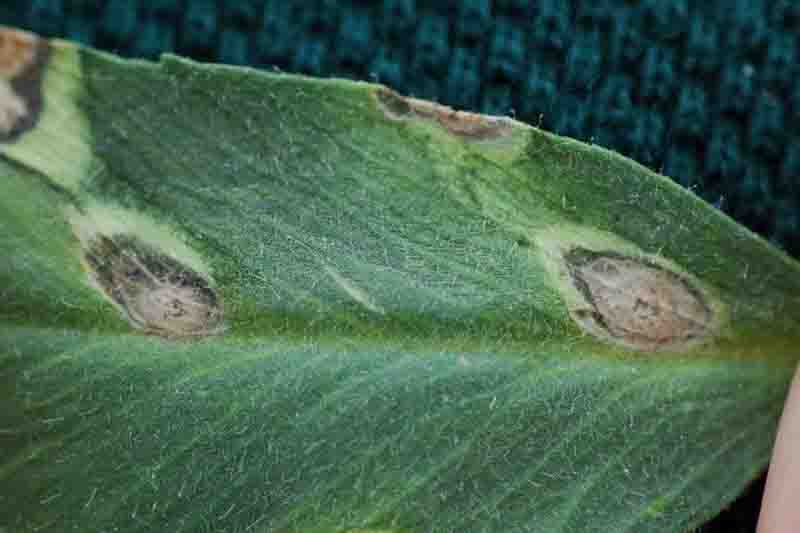 Ascochyta blight of chickpea
Ascochyta blight, caused by Ascochyta syringae, can resemble bacterial blight because current-season shoots and flower stalks may wilt and die.
The details help separate the two. Infected stems may become tan and shrunken and develop tiny gray to pale orange spore-producing structures. Later in the season, leaves can develop water-soaked or olive-colored blotches that enlarge and merge.
Young shoots and flower stalks wilt, turn brown, and may bend into a shepherd’s-crook shape. Tan, shriveled stem tissue and visible tiny fruiting structures are useful diagnostic clues.
Leaf blotches tend to become more obvious later in summer and may eventually merge until a substantial portion of the leaf is brown.
Prune out infected shoots, improve air circulation, and avoid unnecessary overhead watering that repeatedly wets foliage and young stems.
Because bacterial and fungal shoot blights can look similar, persistent or severe cases are good candidates for diagnosis by a local extension service or plant diagnostic laboratory before repeated pesticide treatment.
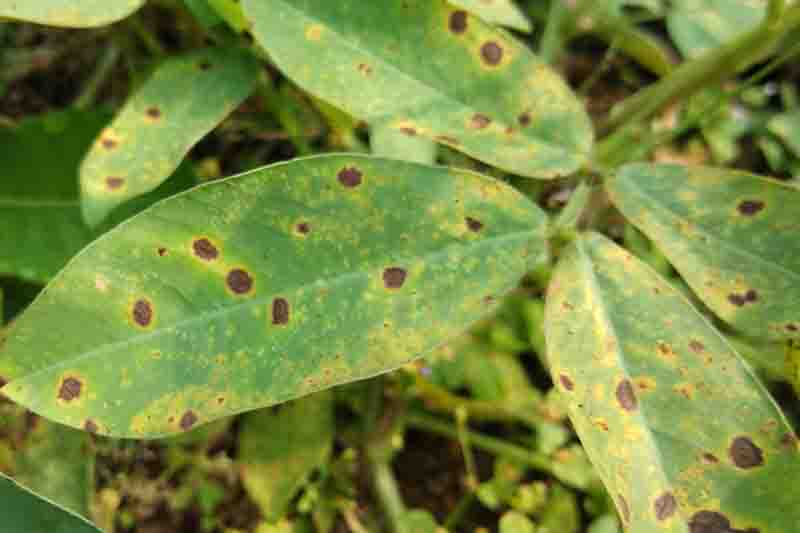 Early Leaf Spot of groundnut
Lilac foliage can develop several types of fungal or bacterial leaf spots. A few scattered spots are rarely enough to explain major decline, but their shape, distribution, and progression can help diagnose broader disease problems.
Bacterial spots may begin dark brown to black and sometimes develop yellow halos. In some cases, dead centers fall away, creating a shot-hole appearance. Fungal leaf spots may be tan, brown, olive, or gray and can contain tiny fruiting structures.
Ask whether the spots remain isolated or begin merging into larger dead areas. Also check whether the same plant has blackened shoots, wilting tips, or damaged buds. Spots accompanied by shoot blight are more diagnostically significant than a handful of blemished leaves late in the season.
Remove heavily affected fallen foliage where practical, improve airflow, and avoid repeatedly wetting leaves with overhead irrigation.
Do not choose a spray solely because the leaves have spots. Bacterial and fungal leaf diseases require different management, while weather injury, chemical damage, and other stresses can also produce spotting.
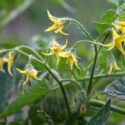
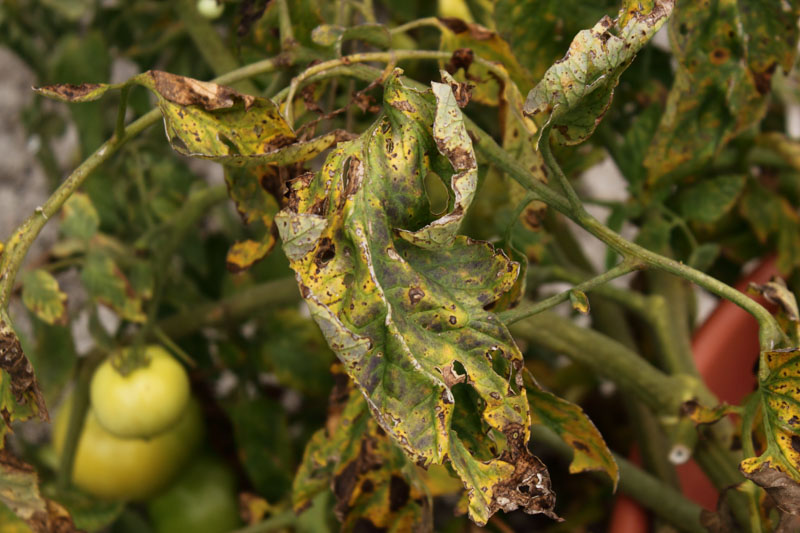 Verticillium wilt of a tomato plant
Verticillium wilt is a soilborne vascular disease. Instead of beginning as a coating or a cluster of leaf spots, it interferes with the plant’s internal water-conducting tissues.
This creates a very different pattern from powdery mildew. One or several branches may yellow, wilt, and die while other portions of the shrub initially remain relatively normal.
Leaves on affected branches may turn yellow or reddish, wilt, and fall. If bark is peeled from symptomatic wood, dark olive, gray, or brownish streaking may be visible in the sapwood.
Decline may occur quickly or progress over more than one growing season.
There is no simple curative treatment for established Verticillium infection. Correct diagnosis is therefore important before removing a valuable shrub or changing the planting.
Reduce additional stress, remove dead wood, and seek diagnostic confirmation where symptoms are severe or progressive.
Diagnostic clue: Wilting concentrated on one side or individual branches plus vascular discoloration deserves investigation for wilt disease rather than a foliar infection.
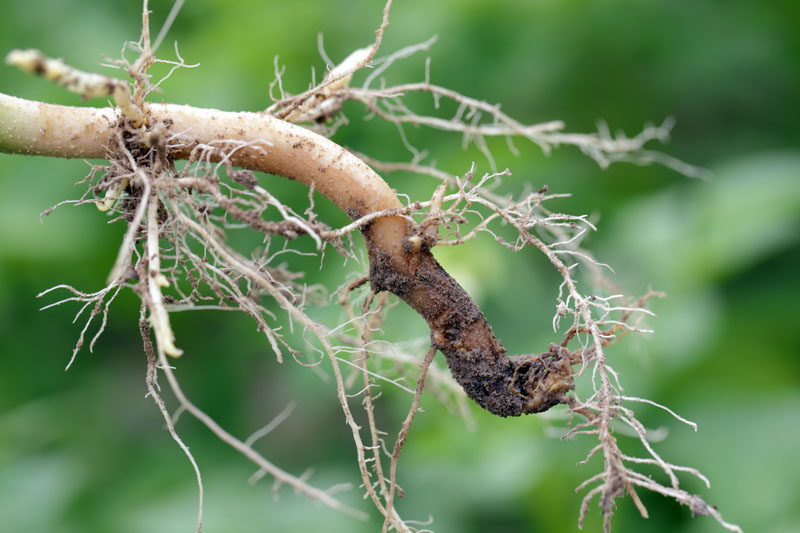
Not every lilac with yellowing leaves, weak growth, wilting, or dieback has a leaf disease. Some of the most serious problems begin in roots, crown tissue, or young shoots.
Lilacs can be affected by Phytophthora diseases as well as other root and crown problems, particularly where soil remains excessively wet. Depending on the pathogen and the infection site, symptoms can include shoot blight, root or crown decline, yellowing foliage, wilting, and branch dieback.
Root rot is a broader category rather than a single disease. Poor drainage and persistent saturation greatly increase the risk of root injury and several root-rotting pathogens.
When roots or crown tissues are involved, the whole shrub may gradually lose vigor rather than developing a neat cluster of symptoms on one leaf. Foliage may yellow, shoots weaken, and branches begin dying back. Soil around the root zone may stay wet long after rain or irrigation.
Root and crown tissues may become discolored or decayed. Above-ground symptoms often become obvious only after significant damage has occurred below the soil line.
Phytophthora can also cause blighting of shoots in lilac, so shoot death should not automatically be assumed to be bacterial without considering the complete symptom pattern.
Correct excessive irrigation and drainage problems rather than automatically fertilizing a declining shrub. Do not pile mulch or additional soil against the base.
Where Phytophthora or another root/crown disease is suspected, accurate diagnosis matters because treatment and replanting decisions depend on the pathogen and site conditions.
A badly affected lilac in chronically waterlogged soil may not recover. Address the drainage problem before placing another susceptible shrub in the same site.
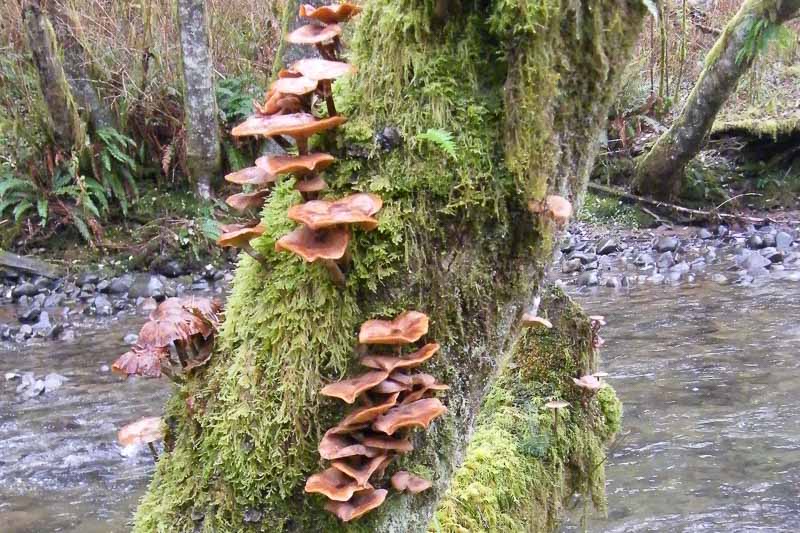
Armillaria root rot, commonly called honey fungus, is another serious root and lower-stem disease. Lilacs can be notably susceptible.
The fungus can persist in infected roots, stumps, and other woody material in the soil and spread through underground fungal structures.
Above ground, symptoms can be frustratingly nonspecific: reduced vigor, yellowing foliage, wilting, thinning growth, and branch dieback.
More distinctive evidence may occur near the base. White or creamy fan-like fungal tissue can sometimes be found beneath bark, while dark root-like fungal cords may occur around affected roots. Honey-colored mushrooms may appear near infected woody tissue under favorable conditions.
Armillaria is not a disease to treat as ordinary leaf yellowing. Once root systems are seriously infected, management is difficult.
If you find characteristic white fungal fans beneath bark or bootlace-like rhizomorphs around the roots, investigate Armillaria specifically before deciding what to replant.
 Candidatus Phytoplasma fraxini
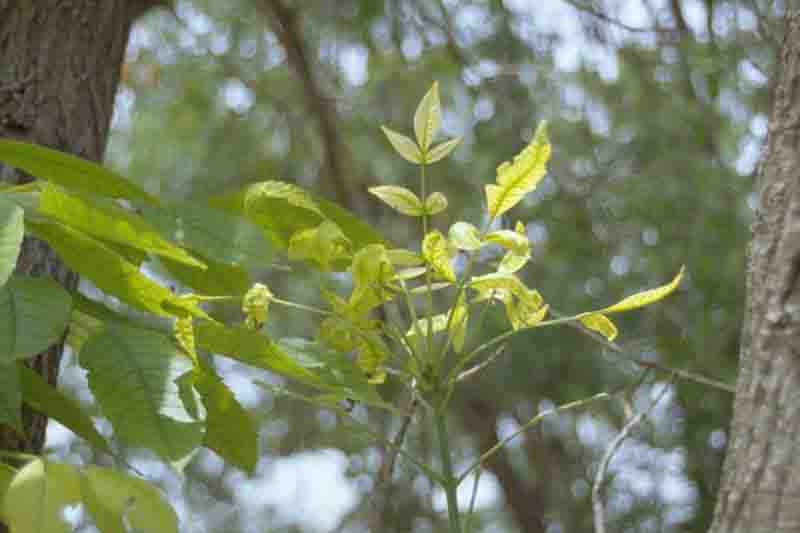
Some lilac problems produce such unusual growth that they look completely different from a typical fungal leaf disease. Lilac witches’-broom is associated with a phytoplasma, Candidatus Phytoplasma fraxini.
Dense clusters of short, thin, abnormally upright twigs emerge from one area. Leaves may be unusually small, distorted, pale green, or yellow. Internodes can become shortened, creating the characteristic broom-like appearance.
Affected branches may decline and die back as the disorder progresses.
Remove affected branches where infection is limited. Severely affected plants may eventually need to be removed.
Because witches’-broom can have different causes on different plants, do not diagnose a phytoplasma simply from the phrase “broom-like growth.” Lilac symptoms should match the characteristic clustered, shortened, abnormal shoots.
 Lilac leaf chlorosis virus (LLCV)
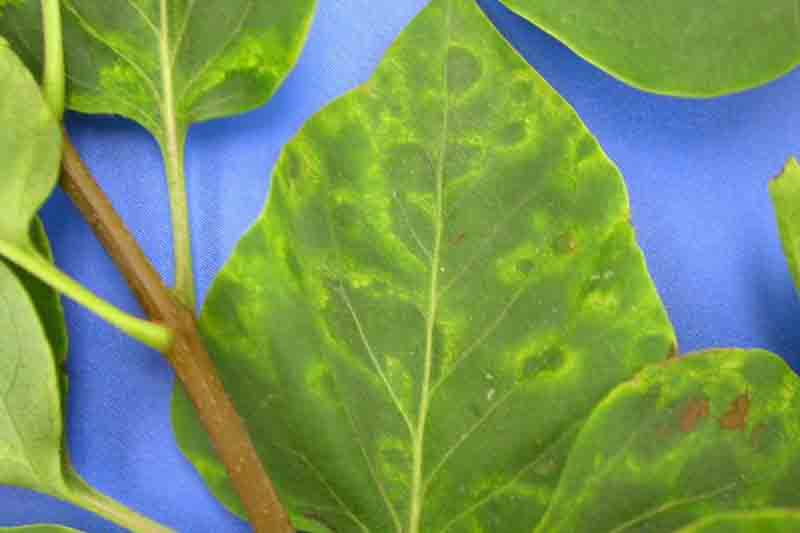
Lilacs can also be affected by viral diseases, including viruses associated with rings, line patterns, mottling, and other unusual leaf markings.
Viral symptoms can be difficult to diagnose visually because nutrient problems, herbicide injury, mites, environmental stress, and other disorders can also distort or discolor foliage.
Look for repeated ring patterns, irregular line patterns, mottling, or unusual systemic discoloration appearing across multiple leaves rather than isolated spots created by dead tissue.
There is no spray that cures a virus inside an infected lilac. If viral disease is strongly suspected, professional or laboratory diagnosis is preferable to guessing from leaf markings.
Severely affected plants may ultimately need removal, particularly when growth and vigor are substantially impaired.
This may be the most important section in the article. Dead branches do not automatically equal disease.
Lilac/ash borers can cause individual stems to wilt or die. Look for swollen areas, exit holes, sap, sawdust-like frass, or pupal cases around affected stems.
Late freezes can blacken new shoots and destroy flower buds. Severe drought can lead to leaf scorch, wilting, premature leaf drop, and weakened growth. Waterlogging can suffocate roots even before a root pathogen is confirmed. Improper pruning can remove flower buds without causing disease at all.
That is why a lilac that fails to bloom but otherwise looks healthy should be diagnosed differently from one with genuine dieback. Gardenia’s Why Is My Lilac Not Blooming? 10 Causes and How to Fix Them focuses specifically on that distinction.
Gardenia’s disease checkpoint: Before treating a lilac for disease, check for insect entry holes, recent frost, drought, saturated soil, pruning history, and physical damage. A convincing diagnosis should explain the whole symptom pattern, not just one damaged leaf.
| What You See | Check Next | Likely Direction |
|---|---|---|
| White or gray powder on leaves | Surface fungal growth, season, airflow | Powdery mildew |
| Black young shoots, buds, and flower clusters | Cool wet weather, leaf spots, stem lesions | Bacterial blight |
| Wilted young shoots plus tan shrunken stems | Tiny fungal structures, olive leaf blotches | Ascochyta blight |
| One branch or one side wilts and yellows | Sapwood discoloration | Verticillium wilt or another branch-level problem |
| Whole shrub weak, yellow, wet root zone | Drainage, crown, and roots | Root/crown decline including possible Phytophthora |
| Decline plus white fungal fans beneath bark | Rhizomorphs, roots, mushrooms | Armillaria/honey fungus |
| Dense broom-like clusters of short shoots | Small yellow or distorted leaves | Lilac witches’-broom/phytoplasma |
| Wilted stem with holes, sap, or sawdust-like debris | Stem base and insect evidence | Lilac borer, not primarily disease |
Gardenia’s diagnostic priority: Start with the most distinctive physical clue. Powder, black young growth, vascular streaking, root-zone decline, abnormal shoot proliferation, and insect holes lead to very different diagnoses and should not receive the same treatment.
Not every disease can be prevented, but growing conditions strongly influence how much trouble lilacs experience.
Give lilacs good light and enough space for air to circulate. Avoid planting into chronically saturated soil. Water the root zone rather than repeatedly wetting foliage when bacterial or foliar disease is a concern.
Do not overfertilize. Excess nitrogen can create very soft growth that may be more vulnerable to some shoot diseases and can also reduce flowering.
Remove clearly diseased material where recommended, work with clean tools, and avoid unnecessary injuries to trunks and roots.
When replacing a chronically diseased lilac, consider species and cultivar susceptibility rather than automatically planting the same type again. Gardenia’s Lilac Comparison Tool can help compare Syringa by mature size, hardiness, growing conditions, bloom season, and other characteristics.
For complete planting, watering, pruning, and cultural guidance, see Gardenia’s How to Grow and Care for Lilacs.
Some lilac problems can be recognized confidently from a classic symptom pattern. Others cannot.
Consider professional diagnosis when a valuable mature lilac is rapidly declining, when Verticillium wilt or a virus is suspected, when several plants in the same area begin dying, or when you are considering removing and replacing a shrub because of a potentially persistent soilborne disease.
A plant diagnostic laboratory can sometimes distinguish problems that look nearly identical in photographs. This is particularly valuable before repeatedly treating with pesticides or replanting into soil that may contain a persistent pathogen.
Know when not to guess: A professional plant diagnosis can be far more useful than several seasons of treating the wrong problem, particularly when the result will determine whether a mature lilac is removed or what can safely be replanted.
Common lilac problems include powdery mildew, bacterial lilac blight, fungal leaf spots and blights, Verticillium wilt, Phytophthora diseases and other root or crown problems, Armillaria root rot, witches’-broom phytoplasma, and occasional viral diseases. Susceptibility varies among lilac species and cultivars.
White or gray powder on lilac foliage is usually powdery mildew. It is extremely common on susceptible common lilacs and is often mainly cosmetic when it develops late in summer. Improve light and air circulation and consider less-susceptible cultivars where mildew is severe every year.
Blackened young shoots, buds, flowers, and leaves during cool wet spring weather can indicate bacterial lilac blight. However, late-frost injury can also blacken tender growth, so recent weather and the presence of leaf spots, stem lesions, or progressive dieback help distinguish the two.
Bacterial blight can produce brown or black leaf spots, sometimes with yellow halos, blackened flower buds, wilted flower clusters, dark lesions on young stems, and rapid dieback of tender shoots. It is especially associated with cool, wet spring conditions.
Powdery mildew usually does not kill an otherwise healthy lilac. On common lilacs it can seriously affect appearance, but late-season infections are often primarily cosmetic. Repeated heavy infection may justify improving airflow or choosing less-susceptible plants.
Wilting confined to one branch or one side of a lilac can suggest Verticillium wilt, especially when dark discoloration is visible in the sapwood. Borers, root damage, branch injury, and other problems can create similar symptoms, so examine the entire stem before diagnosing a vascular disease.
Yellowing plus general decline can result from root or crown problems, waterlogging, Phytophthora, Armillaria root rot, Verticillium wilt, severe drought, or other stress. Check the soil moisture, roots, base of the stems, and distribution of dieback rather than assuming the leaves themselves are diseased.
Lilac witches’-broom is associated with a phytoplasma. It causes dense clusters of short, thin, unusually upright shoots, often accompanied by small, distorted, or yellowish leaves. Severely affected branches or plants may decline over time.
Yes. Lilacs can suffer root and crown diseases, including diseases involving Phytophthora and Armillaria. Risk increases where drainage is poor or soil remains persistently wet. Symptoms may include yellowing, poor growth, wilting, and branch dieback.
Lilac borer often causes individual stems to wilt or die, but close inspection may reveal exit holes, swelling, sap, sawdust-like frass, or pupal cases around the stem. These physical signs point toward insect damage rather than a leaf or vascular disease.
Not automatically. Leaf spots can be fungal, bacterial, or environmental. A fungicide will not control bacterial disease, root problems, viruses, frost injury, or borers. Identify the symptom pattern and likely cause before deciding whether any pesticide treatment is appropriate.
Removal may be appropriate when a shrub is extensively affected by an incurable systemic or root disease, when most of the framework has died, or when the plant is unlikely to recover. Confirm serious diagnoses such as Verticillium wilt, viral disease, or persistent root disease before removing a valuable mature lilac.
Updated: September 2026 • Reviewed by Gardenia Editors
| Hardiness |
3 - 7 |
|---|---|
| Plant Type | Shrubs, Trees |
| Plant Family | Oleaceae |
| Genus | Syringa |
| Exposure | Full Sun |
| Season of Interest | Spring (Mid, Late) |
| Maintenance | Low |
| Water Needs | Average |
| Soil Type | Chalk, Clay, Loam, Sand |
| Soil pH | Alkaline, Neutral |
| Soil Drainage | Moist but Well-Drained, Well-Drained |
| Characteristics | Cut Flowers, Fragrant, Showy |
| Landscaping Ideas | Beds And Borders, Hedges And Screens, Patio And Containers |
| Garden Styles | City and Courtyard, Informal and Cottage |
| Hardiness |
3 - 7 |
|---|---|
| Plant Type | Shrubs, Trees |
| Plant Family | Oleaceae |
| Genus | Syringa |
| Exposure | Full Sun |
| Season of Interest | Spring (Mid, Late) |
| Maintenance | Low |
| Water Needs | Average |
| Soil Type | Chalk, Clay, Loam, Sand |
| Soil pH | Alkaline, Neutral |
| Soil Drainage | Moist but Well-Drained, Well-Drained |
| Characteristics | Cut Flowers, Fragrant, Showy |
| Landscaping Ideas | Beds And Borders, Hedges And Screens, Patio And Containers |
| Garden Styles | City and Courtyard, Informal and Cottage |
Create a membership account to save your garden designs and to view them on any device.
Becoming a contributing member of Gardenia is easy and can be done in just a few minutes. If you provide us with your name, email address and the payment of a modest $25 annual membership fee, you will become a full member, enabling you to design and save up to 25 of your garden design ideas.
Join now and start creating your dream garden!
Create a membership account to save your garden designs and to view them on any device.
Becoming a contributing member of Gardenia is easy and can be done in just a few minutes. If you provide us with your name, email address and the payment of a modest $25 annual membership fee, you will become a full member, enabling you to design and save up to 25 of your garden design ideas.
Join now and start creating your dream garden!