Brown spots, yellow leaves, strange mottling, or a collapsing hosta? Learn how to distinguish anthracnose, foliar nematodes, Hosta Virus X, petiole rot, Fusarium crown rot, bacterial soft rot, and environmental damage. Gardenia's diagnostic framework helps you identify the pattern, inspect the right plant tissue, and choose the correct response.
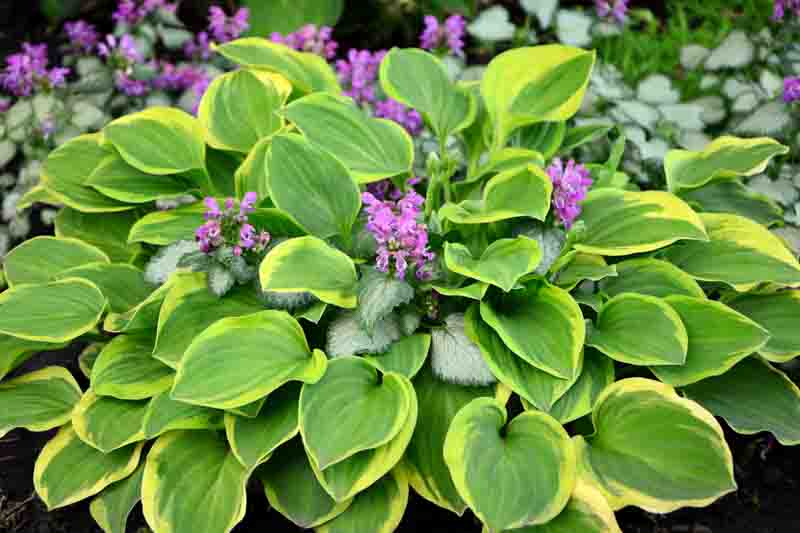


Your hosta is turning yellow. Or perhaps the leaves have brown spots, strange streaks, holes, puckering, or an entire section of the plant has suddenly collapsed. The temptation is to reach for a fungicide – but with hostas, the pattern and location of the damage matter far more than the color alone.
Hosta diseases include fungal leaf spots such as anthracnose, petiole and crown rot, Fusarium root and crown rot, bacterial soft rot, Hosta Virus X, and several other viral diseases. Foliar and root-knot nematodes can also cause disease-like symptoms. Yet drought, sun scorch, frost, slugs, and normal autumn dormancy may imitate disease surprisingly well.
The fastest route to a useful diagnosis is therefore not simply to ask, “Why is my hosta brown?” Instead ask: Where did the damage begin? What shape does it have? Does it follow or stop at the veins? Is the tissue dry or wet? Is the crown involved?
Tan spots with dark borders: Think anthracnose or another fungal leaf spot.
Yellow or brown areas trapped between major veins: Suspect foliar nematodes.
Mottling, puckering, ringspots, or color bleeding along veins: Consider Hosta Virus X or another virus.
Petiole rotting at soil level with white fungal growth: Petiole and crown rot is a major possibility.
Late emergence, stunting, and dry brown-to-black crown decay: Investigate Fusarium root and crown rot.
Wet, mushy, foul-smelling crown tissue: Bacterial soft rot is strongly suspect.
Crisp brown margins without lesions: Check drought, heat, strong sun, drying wind, and root competition before assuming disease.
Best first step: Diagnose the pattern before treating the plant.
Gardenia’s Hosta Disease Triage: Diagnose in this order: location → pattern → tissue condition → progression. Where did the problem begin? Does it follow veins or form separate spots? Is the tissue dry, papery, mushy, sunken, or missing? Is the damage spreading gradually, collapsing rapidly, or linked to a weather event? These four observations often narrow the possibilities before treatment begins.
Jump to the Symptom You See
Brown or tan spots | Leaves collapsing at soil level | Dry dark crown decay | Wet or foul-smelling crown | Mottled or puckered leaves | Brown between veins | Crisp or bleached leaves
A yellow hosta leaf may result from drought, saturated soil, root disease, crown rot, nematodes, viral infection, or ordinary seasonal decline. A brown leaf may be scorched, infected, chewed, or simply reaching the end of the season.
Before treating a hosta, inspect four areas:
This matters because fungal leaf spots, viruses, nematodes, bacterial rots, and crown diseases require very different responses.
Gardenia diagnostic shortcut: A spot, a vein-bounded band, a virus-like color pattern, and a rotting crown may all eventually become brown – but they represent four completely different diagnostic directions.
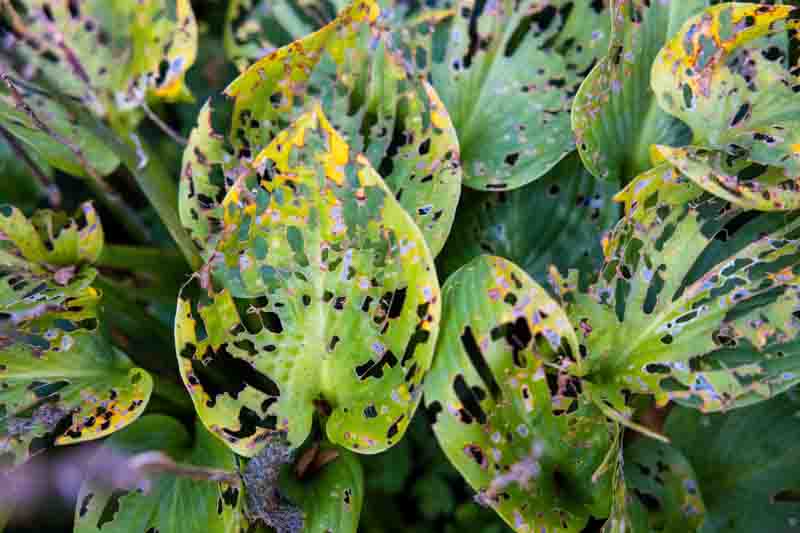
Anthracnose is an important fungal leaf disease of hostas. It typically produces irregular to rounded tan or brown lesions with darker margins. Small fungal structures may sometimes be visible in affected tissue.
As the lesions age, dead centers may fall away. This produces holes and tattered foliage that can easily be mistaken for slug or insect feeding.
Other fungi, including species of Alternaria, Cercospora, and Phyllosticta, can also produce leaf spots on hostas. Warm conditions and prolonged leaf wetness favor many fungal foliage diseases.
Look for:
Remove badly affected foliage when practical, improve airflow, and avoid irrigation that repeatedly leaves the foliage wet. Fungicides cannot repair existing damage and, where their use is justified, are generally more useful preventively than after extensive spotting has developed.
For more detail, see Gardenia’s Anthracnose identification and treatment guide.
If a hole is surrounded by tan or brown lesion tissue, the center of a fungal leaf spot may have fallen away. Slug holes usually lack the bordered dead tissue that preceded the opening.
Hosta petiole and crown rot is caused by Sclerotium rolfsii, a soil-borne fungus that attacks the crown and bases of the petioles.
The disease often begins with yellowing and browning of lower leaves. The base of the petiole softens and rots where it meets the soil. Eventually, affected leaves wilt, collapse around the crown, and may pull away unusually easily.
The most useful clues are found at ground level:
The sclerotia begin pale and gradually darken to reddish brown or brick red. These survival structures allow the fungus to persist in contaminated soil and plant debris.
Remove confirmed infected plants carefully and avoid moving contaminated soil or sclerotia elsewhere in the garden. Avoid piling deep mulch against hosta crowns, particularly where crown rot has previously occurred.
For broader information about crown diseases, see Gardenia’s Crown Rot guide.
Fusarium root and crown rot can be harder to recognize because much of the damage begins underground. Fusarium hostae is a documented cause of hosta root and crown rot.
Affected hostas may emerge unusually late in spring, remain stunted, turn yellow, then brown, and gradually lose vigor. At the soil line, infected tissues typically develop a dry brown-to-black decay.
That dry texture is an important clue. Bacterial soft rot, by contrast, produces wet, soft, often foul-smelling tissue.
Suspect Fusarium when you see:
Badly affected plants should be removed. Avoid unnecessary crown and root injury during transplanting or division, and investigate drainage if root diseases recur.
Gardenia’s Root Rot guide explains the wider group of root diseases and why drainage matters.
If the crown or lower petioles become wet, watery, mushy, and unpleasant-smelling, bacterial soft rot moves high on the diagnostic list.
On hostas, bacterial soft rot is associated with Pectobacterium. Instead of drying, infected tissues break down into soft, wet decay. Leaves yellow and wilt as the crown and petiole bases deteriorate.
The combination of wet decay + softness + odor is particularly useful because it separates bacterial soft rot from the drier crown decay associated with Fusarium.
Remove badly infected plants, discard decayed material, and disinfect tools used around affected crowns before moving to healthy hostas. Wounds can provide entry points for soft-rot bacteria, so take particular care when dividing and transplanting.
See Gardenia’s Bacterial Soft Rot guide for more information.
Gardenia’s crown check: Dry dark decay points toward Fusarium. Wet foul-smelling decay points toward bacterial soft rot. White fungal growth plus collapsing petioles strongly raises suspicion of petiole and crown rot. When the entire hosta is failing, inspect the crown before treating the leaves.
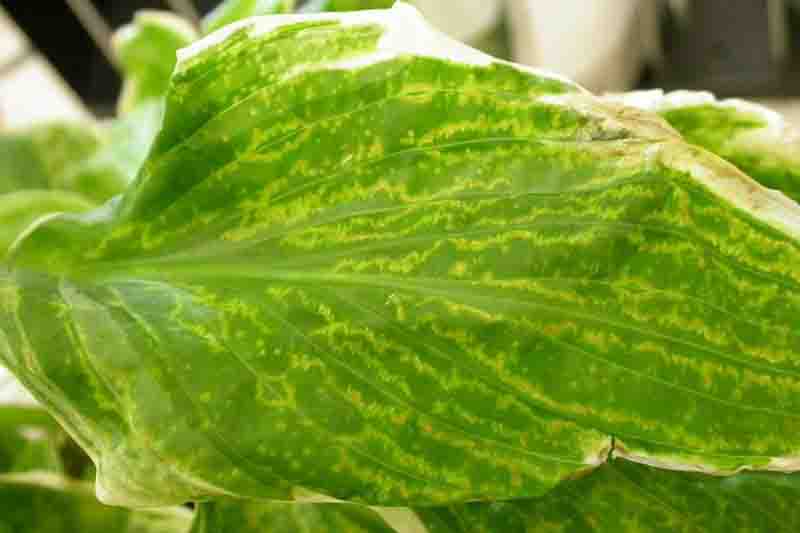
Hosta Virus X (HVX) is a systemic viral disease that may cause irregular green or yellow mottling, puckering, ringspots, sunken tissue, distortion, and characteristic color bleeding along leaf veins.
Symptoms vary considerably by cultivar, and infected hostas may remain symptomless for years. Appearance is therefore useful for screening but cannot reliably prove infection.
HVX spreads primarily through infected propagation material and mechanical transfer of virus-containing sap into wounded hosta tissue. There is no cure.
Do not divide or deliberately wound a hosta you suspect of carrying HVX and then work on healthy hostas with the same equipment. Testing is valuable when symptoms are ambiguous or when the plant is valuable.
See Gardenia’s Hosta Virus X guide for symptoms, spread, testing, disposal, tool sanitation, and prevention.
Gardenia’s HVX rule: Think sap + wound = transmission opportunity. Suspicious mottling is a reason to stop cutting first and diagnose second.
HVX is not the only virus documented in hostas. Other viruses reported from hostas include, among others, Tomato ringspot virus, Tomato spotted wilt virus, Impatiens necrotic spot virus, Arabis mosaic virus, and Tobacco rattle virus.
Depending on the virus, symptoms may include:
This is why a negative HVX-specific test does not automatically mean a hosta with persistent virus-like symptoms is healthy. A plant diagnostic laboratory can test for other pathogens when rings, mosaics, puckering, or unexplained distortion continue.
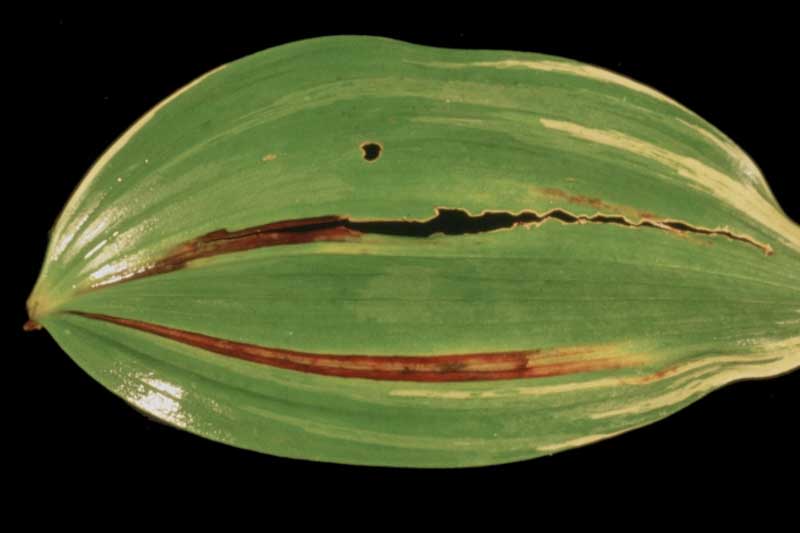
Foliar nematodes are microscopic plant-parasitic roundworms rather than fungi or bacteria, but they belong in any serious hosta disease diagnosis because their symptoms can be remarkably distinctive.
Damage usually begins as pale green or yellow tissue between major leaf veins. These areas gradually turn tan or brown while the veins restrict further spread, producing stripes, wedges, or angular patches.
The veins are the clue. Fungal leaf spots generally form individual lesions that do not respect every major vein. Foliar nematode injury frequently stops sharply at them.
Water splash and prolonged leaf wetness can help foliar nematodes move across foliage. Avoid overhead irrigation around infested plants, remove badly affected foliage and debris, and do not distribute divisions from affected hostas.
Read Gardenia’s complete Foliar Nematodes identification and management guide.
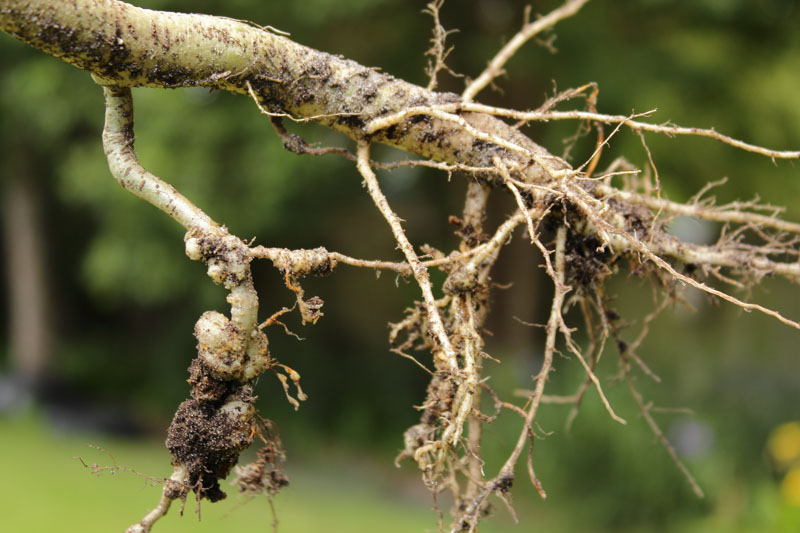
Root-knot nematodes are less obvious because most of the diagnostic evidence lies below ground. They can produce swellings or galls on hosta roots while the foliage above ground simply appears stunted, wilts easily, or resembles a plant suffering from poor nutrition.
If a hosta repeatedly wilts despite adequate soil moisture or fails to thrive without an obvious leaf or crown disease, inspect the roots.
Root galls are an important clue. Where root-knot nematodes are confirmed, removing affected hostas and avoiding immediate replanting with susceptible plants may be necessary.
Some of the most alarming hosta symptoms are not infectious at all.
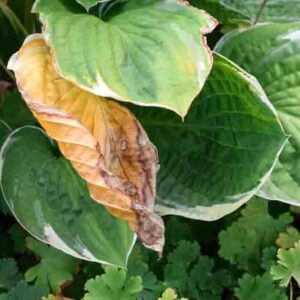
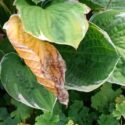
Too much intense sun can bleach exposed foliage to yellow or white, followed by thin, papery tan tissue. Damage is usually strongest on the most exposed parts of the plant rather than appearing as scattered infectious lesions.
Crisp brown leaf margins commonly point toward insufficient root-zone moisture, heat, drying wind, or competition from nearby tree roots. The damaged tissue is dry rather than rotting.
A late freeze can leave newly emerged hosta foliage translucent, distorted, wilted, or darkened. Sudden damage immediately after a cold night is an important clue.
Irregular holes, shredded edges, and missing leaf tissue often indicate feeding rather than disease, particularly when there are no surrounding lesions or vein-confined discoloration.
For help controlling them, see Gardenia’s guide to protecting hostas from slugs and snails.
In autumn, hostas naturally yellow and collapse as they enter dormancy. A whole clump declining in step with cooling temperatures is very different from isolated yellowing during active summer growth.
Disease or General Hosta Problem?
If the damage may involve watering, sun, heat, slugs, browsing, weather, or poor growth rather than disease alone, use Gardenia’s Hosta Problems diagnostic guide to work from the symptom.
When a hosta looks wrong, use the visible symptom to decide what to inspect next.
| What You See | Check Next | Likely Direction |
|---|---|---|
| Tan spots with dark borders | Do the centers dry and fall out? | Anthracnose / fungal leaf spot |
| Yellow-brown bands stopped by veins | Does damage remain sharply between major veins? | Foliar nematodes |
| Mottling, puckering, vein discoloration | Look for repeated abnormal patterns; consider testing | HVX or another virus |
| Leaves collapse from soil level | Look for white growth, sclerotia, and rotted petiole bases | Petiole/crown rot |
| Dry dark crown decay | Check for late emergence and stunting | Fusarium root/crown rot |
| Wet foul-smelling crown | Is the tissue soft, wet, and watery? | Bacterial soft rot |
| Crisp brown margins | Check soil moisture, heat, wind, and afternoon sun | Environmental scorch |
| Bleached papery patches | Is damage concentrated on exposed foliage? | Sun scorch |
| Irregular holes without bordered lesions | Look for feeding damage and slug activity | Slugs or other chewing pests |
Why this works: Gardenia’s decoder does not begin with leaf color. It separates hosta problems by where the damage occurs, whether veins contain it, whether tissue is wet or dry, and whether the crown is involved. Those characteristics are usually more diagnostic than “yellow,” “brown,” or “wilting” on their own.
Not every diseased leaf means the entire hosta should be discarded.
Leaf spots such as anthracnose are often primarily cosmetic. Removing badly affected foliage and improving growing conditions may be enough.
Confirmed systemic viruses such as HVX are different. The infection cannot be pruned out, and keeping an infected hosta creates an ongoing transmission risk.
Severe crown and root rots may also justify removal because the tissues supporting the plant are already damaged and infected material can remain a source of disease.
The practical distinction is between localized foliage damage and systemic or crown-level disease.
No single practice prevents every hosta disease, but several habits reduce multiple risks at once:
For complete planting, watering, dividing, seasonal care, and troubleshooting information, see Gardenia’s How to Grow Hostas: Planting, Care and Problems.
Visual diagnosis works well when symptoms are distinctive, but it has limits. Consider a university or professional plant diagnostic laboratory when:
The goal is not laboratory testing for every brown spot. It is confirmation when the result will materially change what you do next.
Hosta diagnosis becomes much easier when you stop treating “brown leaves” as a disease category.
Gardenia’s approach uses four diagnostic layers:
Those layers lead to practical decisions. A tan bordered lesion directs attention toward leaf disease. A brown band trapped between veins points toward foliar nematodes. Virus-like mottling raises a completely different question. A failing crown means it is time to stop looking only at the leaves.
Gardenia’s final diagnostic rule: Pattern tells you where to look; tissue condition tells you what kind of damage is occurring; the crown tells you how serious it may be. Diagnose those three things before choosing a treatment.
Still Not Sure What Is Wrong With Your Hosta?
Start with Gardenia’s Hosta Problems guide if the symptoms could involve watering, sun, pests, weather, or cultural stress. For planting, watering, dividing, and long-term health, continue with Gardenia’s complete Hosta care guide, or browse the Hosta collection.
Important hosta diseases include anthracnose and other fungal leaf spots, petiole and crown rot, Fusarium root and crown rot, bacterial soft rot, Hosta Virus X, and other viral diseases. Foliar and root-knot nematodes can also produce important disease-like symptoms.
Tan or brown spots with darker borders commonly suggest anthracnose or another fungal leaf spot. Brown tissue confined between major veins points more strongly toward foliar nematodes, while crisp brown margins usually indicate drought, heat, sun, wind, or root competition.
A hosta that yellows and collapses from the soil line may have petiole and crown rot. Check for soft brown petiole bases, white fungal growth, and small sclerotia around the crown. Wet foul-smelling decay suggests bacterial soft rot, while dry dark crown decay points more toward Fusarium.
Foliar nematode damage commonly forms yellow then brown bands, wedges, or angular patches that stop at major leaf veins. Fungal leaf spots such as anthracnose generally form separate tan or brown lesions, often with darker borders, that are not consistently confined between major veins.
Hosta Virus X can cause green or yellow mottling, puckering, ringspots, sunken tissue, distorted leaves, and color bleeding along veins. Symptoms vary by cultivar and infected plants can remain symptomless, so testing may be necessary when the diagnosis matters.
It depends on the disease. Fungal leaf spots can often be managed culturally, while systemic viral infections such as Hosta Virus X cannot be cured. Severe bacterial, root, or crown rots may require removal of the infected plant.
Removing badly spotted or dead foliage can reduce diseased debris and improve appearance, but pruning does not cure systemic viruses or crown diseases. Diagnose virus-like symptoms before cutting because contaminated tools can spread Hosta Virus X between plants.
Start with healthy plants, provide moist but well-drained soil, avoid burying crowns in deep mulch, reduce unnecessary leaf wetness, maintain airflow, clean tools between plants, remove heavily diseased debris, and do not propagate hostas showing suspicious disease symptoms.
Updated: September 2026 – Reviewed by Gardenia Editors
| Hardiness |
3 - 9 |
|---|---|
| Heat Zones |
1 - 8 |
| Climate Zones | 1, 1A, 1B, 2, 2A, 2B, 3, 3A, 3B, 4, 5, 6, 7, 8, 9, 10, 14, 15, 16, 17, 18, 19, 20, 21 |
| Plant Type | Perennials |
| Plant Family | Asparagaceae |
| Genus | Hosta |
| Exposure | Partial Sun, Shade |
| Season of Interest | Spring (Mid, Late), Summer (Early, Mid, Late), Fall |
| Maintenance | Low |
| Soil Drainage | Moist but Well-Drained |
Two additional thick-leaved selections worth considering are Hosta ‘Abiqua Drinking Gourd’, with heavily puckered, deeply cupped foliage, and Hosta ‘Silver Bullet’, noted for its exceptionally substantial leaves.
Slug-resistant does not mean slug-proof. Use leaf substance to reduce risk, not as a promise that a cultivar will never be eaten. Local slug pressure, weather, plant age, and alternative food sources still matter.
Older gardening advice often describes certain plants as “slug repellents.” That claim is too strong. There is not good evidence that planting one species beside a Hosta reliably creates a protective barrier that drives slugs away from the neighboring plant.
There is, however, a useful planting-design principle behind the idea. Slugs and snails feed much more heavily on some plants than others. A border containing plants with tougher, less palatable foliage can be less dependent on highly susceptible plants and may remain attractive even when some Hosta leaves are damaged.
Think resilience, not repellency. Less-palatable companion plants should not be expected to “guard” a Hosta. Their value is in creating a more diverse border in which fewer plants are highly attractive to mollusks.
The best companions are not merely plants that slugs tend to avoid. They must also tolerate the light, soil, and moisture conditions of the particular Hosta bed.
Several plants in Gardenia’s original slug-resistant association list remain useful selections, but they generally need more sun, sharper drainage, or drier conditions than the typical shaded Hosta bed. They make more sense on a brighter border edge than mixed directly into deep shade.
The distinction matters. A plant can be relatively unattractive to slugs and still be a poor companion if its light or moisture requirements conflict with those of the Hosta.
For broader design guidance, see Companion Plants for Your Hostas.
Containers can make slug protection easier because access routes are more limited and easier to inspect.
keep pots away from dense vegetation that provides easy access;
check beneath containers and saucers regularly;
inspect drainage holes and pot rims;
remove dead leaves trapped between neighboring containers;
consider copper as an additional physical barrier while remembering that evidence for copper is mixed.
Do not compromise watering simply to discourage mollusks. Container-grown Hostas dry more rapidly than plants in the ground and still require reliable moisture.
Holes do not make a green leaf useless. If most of a damaged leaf remains healthy, it can continue photosynthesizing and supporting the underground crown.
Remove individual leaves when they are:
badly shredded or largely destroyed;
yellowing or collapsing;
diseased rather than simply chewed;
forming decaying material around the crown.
Do not cut an otherwise healthy Hosta to the ground simply because the leaves look unattractive. Existing holes will not heal, but the plant may produce additional foliage if conditions and the time of year allow.
Instead of trying every remedy at once, work through the problem in order.
| Priority | Question | Best First Response |
|---|---|---|
| 1 | Are slugs or snails definitely causing the damage? | Inspect after dark; look for slime trails and fresh feeding |
| 2 | Is tender Hosta growth emerging? | Increase monitoring immediately |
| 3 | Where are the pests sheltering? | Remove unnecessary refuges beside vulnerable Hostas |
| 4 | Can local numbers be reduced directly? | Hand-pick and use refuge or fermentation traps |
| 5 | Is one plant or container particularly valuable? | Add targeted physical protection |
| 6 | Is damage still unacceptable? | Consider suitable biological control or legally labeled bait, depending on location and gardening goals |
| 7 | Does severe damage return every year? | Favor tougher Hostas and redesign the planting with less-palatable, site-compatible companions |
This sequence prevents two common mistakes: treating before confirming the cause and escalating to stronger controls while leaving abundant shelter and highly vulnerable planting unchanged.
Gardenia’s three-layer Hosta slug strategy: reduce pest pressure + reduce Hosta vulnerability + design a more resilient planting. Start by managing the mollusks, choose Hostas that tend to withstand feeding better, and surround them with plants that suit the site without making the entire border dependent on soft, highly palatable foliage.
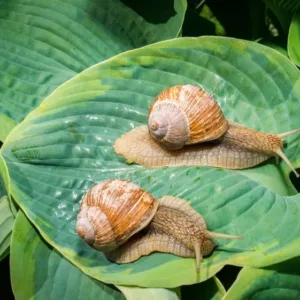
Slugs usually make irregular holes through Hosta leaves and may leave silvery slime trails. Damage is often freshest after damp nights. Check beneath leaves, pots, boards, stones, and other cool hiding places after dark or early in the morning.
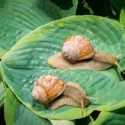
Yes. Snails and slugs both feed on Hosta foliage, especially tender young growth. Their damage is similar, although snails carry an external shell and may also be found resting on walls, pots, stems, or other sheltered surfaces.
Hostas are particularly vulnerable as new shoots emerge and leaves begin to unfurl in spring. Feeding at this stage can leave foliage badly perforated or distorted, so early monitoring is especially valuable.
Used coffee grounds should not be relied on as a dependable slug barrier. Their composition and caffeine content vary, and weather quickly changes the material. More reliable strategies include removing nearby shelters, hand-picking, trapping, targeted protection, and integrated controls.
Crushed eggshells should not be relied upon as dependable slug control. Slugs can cross rough surfaces, particularly in damp conditions, and garden trials have not demonstrated reliable protection.
Yes. Beer and yeast-based traps can catch nearby slugs and snails because fermentation odors attract them. Their effective range is limited, however, and traps need regular emptying and replenishment. They work best as part of a broader control strategy.
Evidence is mixed. UC IPM recommends sufficiently wide, properly installed copper barriers, while RHS garden trials found copper tape did not significantly reduce slug damage. Copper is best treated as a supplementary barrier rather than guaranteed protection.
No Hosta should be considered completely slug-proof. Cultivars with thick, substantial, puckered, corrugated, or waxy foliage often suffer less damage than thin-leaved Hostas, but they can still be eaten when mollusk pressure is high.
Gardenia highlights 18 tougher-leaved Hostas that tend to suffer less slug damage, including ‘Autumn Frost’, ‘Big Daddy’, ‘Blue Angel’, ‘Brother Stefan’, ‘Diamond Lake’, ‘Sagae’, ‘Sum and Substance’, and Hosta sieboldiana ‘Elegans’. Resistance is relative, not immunity.
There is not strong evidence that companion plants reliably repel slugs from neighboring Hostas. However, combining Hostas with less-palatable plants suited to the same conditions can create a more resilient border in which fewer plants are highly attractive to mollusks.
No. Hostas need dependable root-zone moisture. Instead, water deeply at soil level, favor morning or drip irrigation where practical, and reduce unnecessary damp shelter around vulnerable plants.
Not necessarily. Green leaves with holes can still photosynthesize and support the crown. Remove leaves that are largely destroyed, dying, diseased, or collapsing, but cosmetic slug holes do not require cutting the entire plant to the ground.
No single bait should be treated as the complete solution. UC IPM includes certain labeled baits within integrated pest management, while RHS currently favors cultural and biological approaches in wildlife-friendly gardens. Always follow local regulations and the current product label.
Royal Horticultural Society – Slugs and Snails
Royal Horticultural Society – How to Stop Slugs and Snails: What Works?
University of California Statewide IPM Program – Snails and Slugs
Hosta Problems: Yellow Leaves, Brown Edges, Holes, Wilting and Poor Growth
Companion Plants for Your Hostas
Miniature and Very Small Hostas for Gardens and Containers
Striking Blue Hostas for Gardens and Containers
Slugs – Identification, Prevention and Control
Snails – Identification, Prevention and Control
Anthracnose – Identification and Control
Updated: August 2026 • Reviewed by Gardenia Editors
| Hardiness |
3 - 9 |
|---|---|
| Heat Zones |
1 - 8 |
| Climate Zones | 1, 1A, 1B, 2, 2A, 2B, 3, 3A, 3B, 4, 5, 6, 7, 8, 9, 10, 14, 15, 16, 17, 18, 19, 20, 21 |
| Plant Type | Perennials |
| Plant Family | Asparagaceae |
| Genus | Hosta |
| Exposure | Partial Sun, Shade |
| Season of Interest | Spring (Mid, Late), Summer (Early, Mid, Late), Fall |
| Maintenance | Low |
| Soil Drainage | Moist but Well-Drained |
Create a membership account to save your garden designs and to view them on any device.
Becoming a contributing member of Gardenia is easy and can be done in just a few minutes. If you provide us with your name, email address and the payment of a modest $25 annual membership fee, you will become a full member, enabling you to design and save up to 25 of your garden design ideas.
Join now and start creating your dream garden!
Create a membership account to save your garden designs and to view them on any device.
Becoming a contributing member of Gardenia is easy and can be done in just a few minutes. If you provide us with your name, email address and the payment of a modest $25 annual membership fee, you will become a full member, enabling you to design and save up to 25 of your garden design ideas.
Join now and start creating your dream garden!