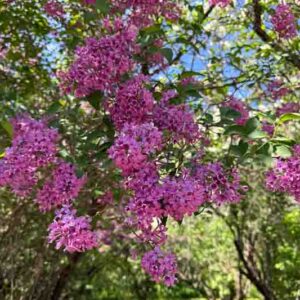
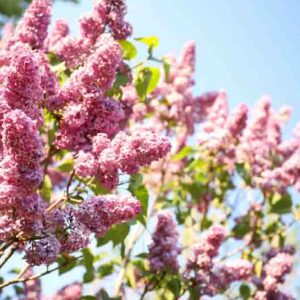
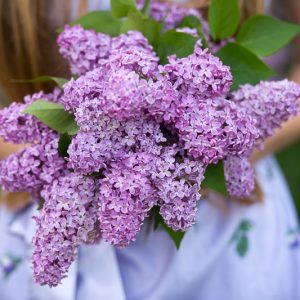
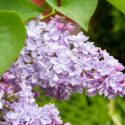
White, dusty leaves can make a healthy lilac look seriously ill. Learn how to identify powdery mildew on lilacs, why it develops, when it is mostly cosmetic, and when action is worthwhile. Discover practical prevention, pruning and treatment strategies, plus mildew-resistant lilacs for gardens where the disease returns every summer.



Your lilac looked perfectly healthy in spring. It flowered beautifully, leafed out normally, and then sometime in summer its green leaves began turning dusty white. Within a few weeks, parts of the shrub looked as though someone had sprinkled them with flour.
The good news is that this familiar problem – powdery mildew on lilacs – usually looks much worse than it actually is.
Powdery mildew is one of the most common diseases of lilacs (Syringa), particularly common lilac (Syringa vulgaris). On an otherwise vigorous shrub, a late-summer coating of white or gray fungal growth is usually an aesthetic problem rather than a threat to the plant’s survival.
That does not mean it should always be ignored. Repeated severe infections, early-season disease, substantial premature leaf loss, poor growing conditions, or a valuable specimen with a history of serious mildew deserve closer attention.
The key is knowing when to tolerate the disease, when to improve growing conditions, and when treatment is actually worth considering.
Before reaching for a fungicide, answer four questions:
Gardenia’s treatment rule: Diagnose first, judge severity second, correct the growing conditions third, and use fungicide only when the expected benefit justifies preventive treatment.
Powdery mildew is a fungal disease characterized by white to gray, powder-like growth on leaves and sometimes other green plant tissues.
On lilacs, one important causal fungus is Erysiphe syringae, formerly known as Microsphaera syringae. Other powdery mildew fungi have also been reported on Syringa, so powdery mildew on lilac is best understood as a disease category rather than assuming every case everywhere is caused by one identical fungus.
The fungus grows largely over the leaf surface. It produces fine fungal threads and masses of spores that create the characteristic whitish coating, while specialized feeding structures penetrate surface cells to obtain nutrients.
This superficial growth helps explain why mildew can dramatically change the appearance of the foliage without necessarily causing serious injury to the woody shrub beneath it.
Reassuring clue: If an established lilac develops white powder on otherwise living leaves late in summer but the stems remain vigorous and the shrub bloomed normally, the problem is usually more cosmetic than life-threatening.
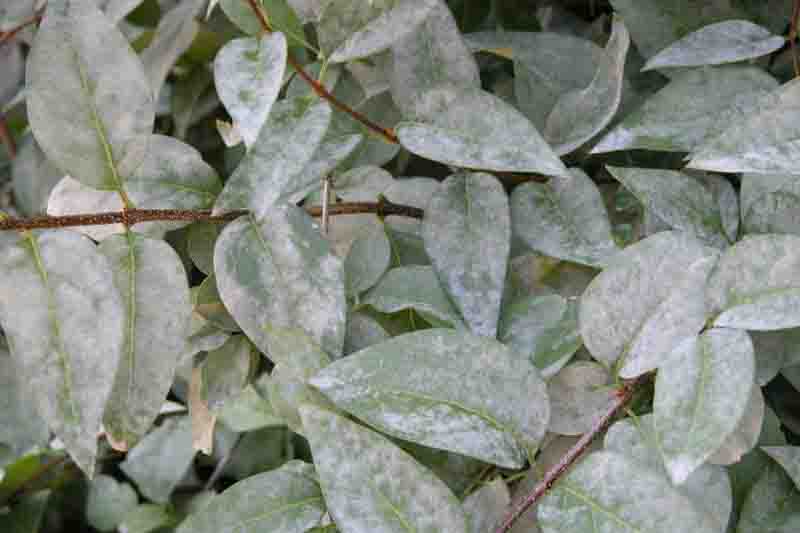
The first sign may be a few pale white or gray patches on the upper surface of individual leaves. These spots expand and merge as the fungus produces more growth and spores.
Eventually, much of a leaf – and sometimes much of the shrub – can acquire a dull white-gray coating. Heavily affected foliage may look dusty, faded, or prematurely aged.
Symptoms can include:
The disease is often most noticeable in summer, after the spectacular spring flowers have disappeared and the lilac’s foliage becomes the dominant visual feature.
Usually, no.
That is one of the most important differences between powdery mildew and some of the more serious lilac diseases.
On common lilac, powdery mildew can severely reduce the ornamental quality of the foliage, but it usually causes little permanent injury to an established, otherwise healthy shrub.
A lilac that becomes white every August may look terrible, but that does not necessarily mean its roots, crown, or branches are dying.
Severity still matters. Infection beginning early enough to interfere with a substantial portion of the growing season is more important than mildew appearing shortly before normal autumn leaf drop. Repeated severe disease accompanied by significant defoliation may weaken a plant over time, especially when drought, poor drainage, excessive shade, or other stresses are present as well.
Timing changes the diagnosis: A healthy mature lilac turning white in late August usually does not need the same response as a valuable shrub developing severe mildew early in summer year after year.
Powdery mildew develops when a susceptible lilac and the pathogen meet under favorable environmental conditions.
High humidity around the foliage favors disease development. Humid nights followed by warmer, drier days can be particularly favorable because humidity encourages fungal growth while drier air helps spores disperse.
Shade is another important factor. Powdery mildew tends to be more severe where light is limited, and common lilacs also flower less successfully when they receive inadequate sun.
Poor air circulation compounds the problem. An old lilac with dozens of crowded stems creates a more sheltered canopy than an open, selectively renewed shrub.
Lush succulent growth can also be more susceptible. Excessive nitrogen fertilization may encourage soft, dense foliage and should not be used as an automatic response to a shrub with mildew.
Finally, genetics matter enormously. Common lilac (Syringa vulgaris) is notably susceptible to powdery mildew, although susceptibility varies among cultivars. Other lilac species and hybrids can show substantially better resistance. If mildew returns severely every summer, cultivar choice may be just as important as pruning, sunlight, and airflow.
If you are planting a new lilac – or replacing one that becomes severely mildewed every summer – genetics can provide a much more durable solution than repeated spraying.
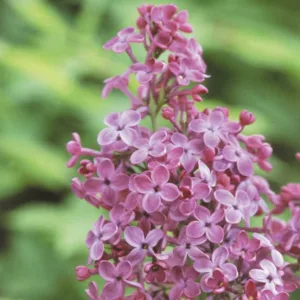
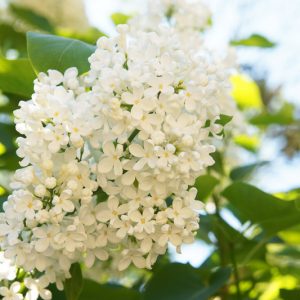
Common lilac (Syringa vulgaris) is notably susceptible to powdery mildew, although resistance varies among its cultivars. In gardens where mildew is a persistent problem, it can make sense to consider lilac groups with a better record of summer foliage quality.
Syringa meyeri ‘Palibin’ is a compact Meyer lilac whose foliage is highly resistant to powdery mildew. ‘Miss Kim’ is another compact lilac noted for excellent powdery mildew resistance.
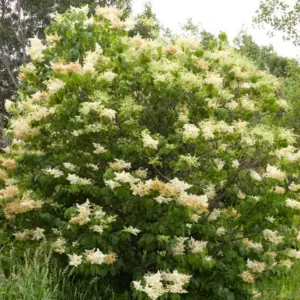
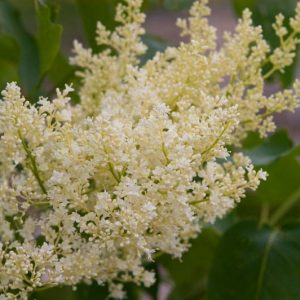
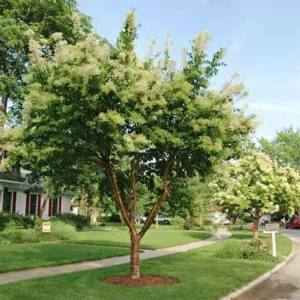
Japanese tree lilac (Syringa reticulata) is highly resistant to mildew, and cultivars such as ‘Ivory Silk’ and ‘Snowdance’ are useful choices where clean summer foliage is a priority.
Early-flowering lilacs (Syringa × hyacinthiflora) are also valued for foliage that is highly resistant to powdery mildew. Gardenia selections include ‘Declaration’, ‘Mount Baker’, and ‘Pocahontas’.
Resistance does not mean immunity. Even resistant or less-susceptible lilacs can occasionally develop mildew under unusually favorable disease conditions. The advantage is a substantially lower risk of the severe, recurring gray-white summer foliage typical of highly susceptible plants.
| Hardiness |
3 - 7 |
|---|---|
| Plant Type | Shrubs, Trees |
| Plant Family | Oleaceae |
| Genus | Syringa |
| Exposure | Full Sun |
| Season of Interest | Spring (Mid, Late) |
| Maintenance | Low |
| Water Needs | Average |
| Soil Type | Chalk, Clay, Loam, Sand |
| Soil pH | Alkaline, Neutral |
| Soil Drainage | Moist but Well-Drained, Well-Drained |
| Characteristics | Cut Flowers, Fragrant, Showy |
| Landscaping Ideas | Beds And Borders, Hedges And Screens, Patio And Containers |
| Garden Styles | City and Courtyard, Informal and Cottage |
This disease behaves differently from many familiar leaf diseases.
Powdery mildew fungi generally do not require free water sitting on the leaf surface to germinate and infect. In fact, prolonged liquid water can inhibit spores of many powdery mildew fungi.
What they do appreciate is atmospheric humidity around susceptible foliage combined with suitable temperatures, shade, and reduced air movement.
This means the usual explanation – “your lilac got mildew because its leaves were wet” – is too simplistic.
There are still good reasons to water a lilac at the root zone rather than routinely soaking its canopy. Other lilac diseases can benefit from prolonged leaf wetness or splashing water, and root-zone irrigation is generally more efficient. But keeping leaves dry should not be presented as the central biological explanation for preventing powdery mildew.
Powdery mildew needs favorable humidity, not a film of water on the leaf. Focus prevention on sunlight, airflow, plant spacing, cultivar resistance, and balanced growth rather than assuming that every wet leaf creates powdery mildew.
Many gardeners are surprised because their lilac can look pristine through flowering and early summer, then rapidly develop white foliage later.
Several things are happening at once. The shrub’s canopy is fully developed, creating more shade within the plant. Warm days and humid or cooler nights may favor disease. Spores accumulate and cycle through repeated infections, and a susceptible cultivar becomes progressively more conspicuous as the season advances.
By late summer, the difference between a susceptible and a more resistant lilac can be dramatic.
This seasonal timing is also why treatment decisions should be proportional. If the plant has already completed most of its annual growth and normal leaf drop is approaching, starting an intensive fungicide program may offer very little practical benefit.
White foliage is strongly suggestive of powdery mildew, but do not use one symptom to diagnose every struggling lilac.
| What You See | More Likely Problem | Key Difference |
|---|---|---|
| White-gray powder on living leaves | Powdery mildew | Superficial fungal coating, often later in summer |
| Blackened young shoots and flower buds | Bacterial blight or frost injury | Rapid death of tender tissue rather than white surface growth |
| Discrete brown, tan, olive, or black spots | Leaf spot or blight | Defined lesions rather than a powdery coating |
| One branch wilting or dying | Borer, wilt, or branch injury | Branch-level decline rather than widespread white foliage |
| Whole shrub yellowing and declining | Root, crown, drainage, or systemic problem | Loss of vigor cannot be explained by cosmetic late-season mildew alone |
For a complete symptom-based diagnosis, use Gardenia’s Lilac Diseases: What’s Wrong With My Lilac?.
If powdery mildew returns every year, look at the shrub before looking at a spray bottle.
Lilacs perform and flower best with abundant direct sunlight. A shrub that has gradually become shaded by growing trees or nearby plants may now be living in very different conditions from those present when it was planted.
Next examine the interior. Old common lilacs often develop dense clusters of mature stems and congested twiggy growth.
Selective thinning and renewal pruning can improve light penetration and airflow. Remove old stems strategically rather than shearing the outside of the shrub into a dense shell.
Because lilacs form the next season’s flower buds on growth produced after flowering, major routine pruning is normally performed soon after bloom. Gardenia’s When and How to Prune Lilacs Without Losing Next Year’s Flowers explains the timing and the difference between thinning, renewal, and hard renovation.
Do not shear for mildew control: Repeatedly clipping the outer surface can produce dense twiggy growth. Selective thinning is more useful when the goal is to open an overcrowded lilac.
A lilac with powdery mildew does not automatically need fertilizer.
Excess nitrogen can encourage lush, soft growth that is more vulnerable to powdery mildew and can create a denser canopy. Heavy nitrogen fertilization may also favor foliage at the expense of the flower display gardeners actually want.
If an established lilac is growing normally, do not fertilize simply because its leaves have mildew. Correct light, spacing, pruning, and general plant stress first.
This is particularly important around lawns. Lilacs growing beside heavily fertilized turf may receive nutrients even when the shrub itself is never deliberately fed.
You do not need to strip every affected leaf from a large lilac.
Removing a few severely affected leaves early in a small outbreak may reduce visible disease on a compact plant, but manually defoliating a mature shrub can cause more stress than leaving cosmetic mildew alone.
At the end of the season, normal garden sanitation is reasonable. Rake fallen diseased foliage where practical and dispose of it with other garden debris according to local recommendations.
But sanitation should be considered one supporting measure, not the main control strategy. Powdery mildew spores can arrive by wind, and disease severity depends heavily on weather, cultivar susceptibility, sunlight, airflow, and canopy conditions.
Cleaning up leaves may reduce some overwintering inoculum near the plant, but it cannot guarantee a mildew-free shrub the following year.
For most mature lilacs with ordinary late-season powdery mildew, fungicide is unnecessary.
Treatment becomes more reasonable when a highly valued shrub has a documented history of severe early infection, substantial premature defoliation, or unacceptable ornamental damage year after year.
The crucial point is timing.
Most fungicides work best by protecting healthy tissue before or very early in infection. Spraying a lilac after most of its foliage is already covered in white fungal growth will not return those leaves to pristine green condition.
If treatment is justified, monitoring should begin early in the season on a plant with a known history of serious mildew. Applications may need to be repeated according to the product label while disease-favorable conditions continue.
Fungicides protect better than they erase. If nearly every leaf is already white late in summer, the useful treatment window has largely passed. Decide whether next year’s disease history justifies earlier preventive management instead.
Products used for powdery mildew management on ornamentals may contain active ingredients such as sulfur, potassium bicarbonate, horticultural oils, or other registered fungicides.
Product registrations vary by country, state, plant, formulation, and year. Never assume that a product labeled for powdery mildew on one crop is automatically labeled for lilacs or ornamental shrubs.
Read the pesticide label completely. The plant or use site must be included, and rates, intervals, temperature restrictions, protective equipment, and other instructions must be followed.
Horticultural oils and sulfur also require care. Some combinations or applications during inappropriate temperatures can injure foliage. Follow the specific label rather than combining home remedies or products by guesswork.
Gardenia does not recommend treating an otherwise healthy late-summer lilac merely because the foliage is unattractive. Start with disease severity and history, not the existence of a spray.
Skip improvised chemistry: Do not assume that stronger concentrations, homemade mixtures, or combining fungicides will provide better control. They can damage foliage and may violate product directions. The pesticide label is the controlling instruction.
Seeing mildew on phlox, roses, squash, bee balm, and lilac at the same time can make it look as though one infected plant has spread the disease throughout the garden.
Usually, that is not what is happening.
Powdery mildew fungi tend to be host-specific or limited to related groups of plants. The powdery mildew infecting a squash is not automatically capable of infecting a lilac, and the fungus on one unrelated ornamental may be a different species from the one on another.
What multiple outbreaks often reveal is that the weather is favorable for powdery mildew generally. Several susceptible plants can develop their own compatible mildew diseases at the same time.
Garden clue: Mildew appearing simultaneously on several unrelated plants often tells you more about the weather and microclimate than about one plant infecting everything around it.
| Your Lilac | Best Response | Why |
|---|---|---|
| Healthy shrub, mildew appears late summer | Usually tolerate it | Mostly cosmetic and little season remains |
| Mildew every year in deepening shade | Increase light if practical | Shade favors mildew and reduces lilac flowering |
| Old, very congested lilac | Selective thinning or renewal pruning | Improves airflow and light penetration |
| Repeated severe early-season mildew | Consider preventive treatment next season | Fungicides work best before disease is widespread |
| Shrub is already almost completely white | Do not expect spraying to restore existing foliage | Existing infected tissue is not simply cured back to pristine green |
| Planting a new lilac in a mildew-prone area | Choose less-susceptible or resistant genetics | Long-term prevention can outperform repeated treatment |
Gardenia’s priority: Treat the reason the disease keeps succeeding, not just the white leaves you can see today.
Once autumn arrives, use this year’s outbreak as information for next year’s strategy.
For complete cultural guidance, see Gardenia’s How to Grow and Care for Lilacs.
A white coating can attract attention so effectively that gardeners overlook more important symptoms elsewhere on the plant.
If your lilac also has extensive branch dieback, blackened young shoots, persistent wilt, discolored vascular tissue, borer holes, a damaged crown, or symptoms of root decline, do not assume powdery mildew explains everything.
One shrub can experience more than one problem at the same time.
Powdery mildew on the leaves may be incidental while drought, root damage, Verticillium wilt, bacterial blight, borers, or poor drainage explains the actual decline.
Diagnostic warning: Powdery mildew readily explains white leaves. It does not adequately explain major stem death, root decay, blackened spring shoots, or progressive whole-plant wilt. When those symptoms are present, keep investigating.
Powdery mildew on lilacs is caused by specialized fungi, including Erysiphe syringae. Disease is favored by susceptible lilac genetics, high atmospheric humidity, moderate temperatures, shade, dense growth, and poor air circulation. Unlike many leaf diseases, powdery mildew does not require a film of water on the leaves to infect.
Usually not seriously. Powdery mildew can make lilac foliage unattractive, and severe infection can cause yellowing, distortion, or premature leaf drop, but late-season mildew on an otherwise healthy established lilac is generally considered primarily cosmetic and rarely kills the shrub.
Powdery mildew rarely kills an otherwise healthy established lilac. Investigate other causes if the shrub has major branch dieback, severe wilting, root decline, blackened shoots, or progressive loss of vigor, because those symptoms are not adequately explained by ordinary late-summer powdery mildew.
Recurring mildew often reflects a combination of cultivar susceptibility and favorable growing conditions. Common lilac is particularly susceptible. Shade, a congested canopy, poor air circulation, excessive nitrogen, and recurring periods of favorable humidity can increase disease severity.
Not in the same way that leaf wetness encourages many other fungal diseases. Powdery mildew generally does not require free water on the leaf surface to germinate. High atmospheric humidity, shade, moderate temperatures, and poor airflow are more important factors. Root-zone watering is still sensible because other lilac diseases can be encouraged by prolonged leaf wetness.
You do not need to strip a mature lilac of all affected foliage. Removing a few badly affected leaves early in a small outbreak may be reasonable, but extensive manual defoliation can stress the plant. Rake fallen diseased leaves at the end of the season where practical.
Usually not when mildew appears late in summer on an otherwise healthy shrub. Fungicide may be considered for a valuable plant with a history of severe early-season disease or significant repeated defoliation. Preventive timing is important because fungicides generally protect healthy tissue better than they restore foliage already covered with mildew.
Depending on local registrations, products containing sulfur, potassium bicarbonate, horticultural oils, or other fungicides may be labeled for powdery mildew on ornamentals. Always verify that the product is labeled for the intended plant and use, and follow all label directions for rates, intervals, temperature restrictions, and application.
Usually not. Powdery mildew fungi are generally host-specific or restricted to related groups of plants. Mildew appearing simultaneously on unrelated plants often indicates that weather conditions are favorable for several different powdery mildew fungi rather than one infected plant spreading the same fungus throughout the garden.
Meyer lilac, including ‘Palibin’, is known for good powdery mildew resistance. Many Syringa × hyacinthiflora selections also show good to strong resistance, while Japanese tree lilac is generally resistant. ‘Miss Kim’ is another lilac with very good reported mildew resistance. Resistance varies among species and cultivars and should not be interpreted as complete immunity.
Yes. Common lilac, Syringa vulgaris, is notably susceptible to powdery mildew. The disease frequently develops on its foliage during summer but usually causes much more cosmetic damage than permanent injury.
It may. Recurrence depends on cultivar susceptibility, weather, local inoculum, sunlight, plant density, and other growing conditions. A lilac that develops severe mildew every year is a better candidate for changes in site conditions, selective thinning, resistant cultivar selection, or planned preventive management than repeated late-season rescue treatments.
Powdery mildew on lilacs is one of those garden problems where the most dramatic-looking symptom does not necessarily signal the most dangerous disease.
For a healthy common lilac that turns powdery white near the end of summer, the most sensible treatment may be no fungicide at all. Observe the plant, improve sunlight and airflow where practical, avoid excessive nitrogen, and accept that a susceptible old lilac may never have flawless foliage in every season.
If mildew repeatedly begins early, becomes severe, or causes significant premature defoliation, the strategy changes. Improve the growing environment, monitor the shrub early the following year, consider appropriately labeled preventive products where justified, and remember that replacing an extremely susceptible shrub with a more resistant lilac may ultimately provide better control than spraying indefinitely.
Gardenia’s Lilac Mildew Decision Test: Confirm the Powder → Check the Timing → Judge Plant Health → Look for Recurrence → Correct the Cause Before Escalating Treatment.
That distinction is the key to managing powdery mildew intelligently: not every white lilac needs treatment, and not every declining lilac with white leaves is declining because of powdery mildew.
For a broader diagnosis of leaf spots, black shoots, wilt, root problems, and branch dieback, continue with Gardenia’s Lilac Diseases: What’s Wrong With My Lilac?. For general information about the disease across garden plants, see Gardenia’s Powdery Mildew Guide.
Updated: September 2026 • Reviewed by Gardenia Editors
| Hardiness |
3 - 7 |
|---|---|
| Plant Type | Shrubs, Trees |
| Plant Family | Oleaceae |
| Genus | Syringa |
| Exposure | Full Sun |
| Season of Interest | Spring (Mid, Late) |
| Maintenance | Low |
| Water Needs | Average |
| Soil Type | Chalk, Clay, Loam, Sand |
| Soil pH | Alkaline, Neutral |
| Soil Drainage | Moist but Well-Drained, Well-Drained |
| Characteristics | Cut Flowers, Fragrant, Showy |
| Landscaping Ideas | Beds And Borders, Hedges And Screens, Patio And Containers |
| Garden Styles | City and Courtyard, Informal and Cottage |
Create a membership account to save your garden designs and to view them on any device.
Becoming a contributing member of Gardenia is easy and can be done in just a few minutes. If you provide us with your name, email address and the payment of a modest $25 annual membership fee, you will become a full member, enabling you to design and save up to 25 of your garden design ideas.
Join now and start creating your dream garden!
Create a membership account to save your garden designs and to view them on any device.
Becoming a contributing member of Gardenia is easy and can be done in just a few minutes. If you provide us with your name, email address and the payment of a modest $25 annual membership fee, you will become a full member, enabling you to design and save up to 25 of your garden design ideas.
Join now and start creating your dream garden!