Why are your tomato leaves turning yellow? The cause may be normal aging, watering stress, nutrient imbalance, pests, early blight, Septoria or vascular wilt. Learn how to read the yellowing pattern and use Gardenia's five-clue diagnostic test to distinguish harmless changes from problems that need action.
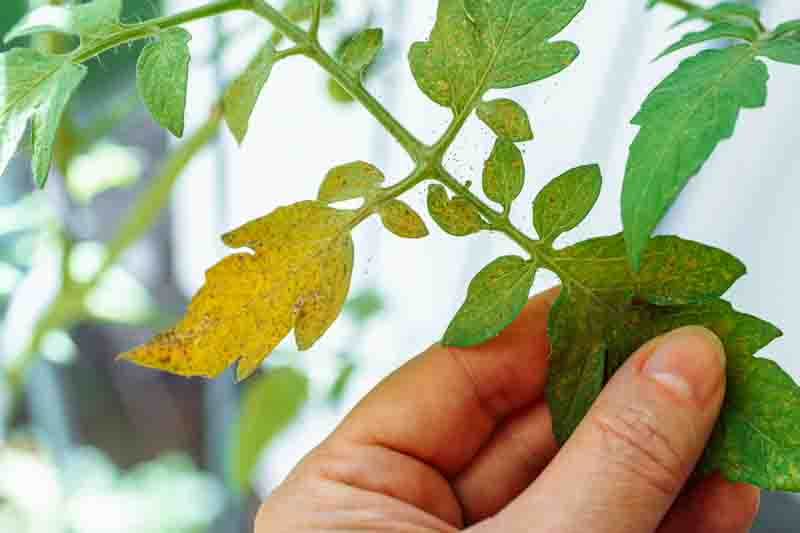


Yellow leaves on a tomato plant can mean almost anything from normal aging to a serious vascular disease. The difficult part is that many completely different problems begin with the same symptom: green foliage starts losing color.
The fastest way to narrow down the cause is not to ask only, “Why is my tomato turning yellow?” Instead, look at which leaves turned yellow first, what pattern the yellowing follows, whether spots or lesions are present, whether the plant is wilting or stunted, and what has been happening around the roots.
A few old leaves yellowing at the bottom of a vigorous tomato may be harmless. Lower leaves turning yellow around dark, target-like spots suggest something very different. Yellow tissue between green veins points in another direction again, while one-sided yellowing followed by wilting deserves prompt investigation.
Gardenia yellow-leaf principle: Yellow is a symptom, not a diagnosis. Start with leaf age + yellowing pattern + spots or lesions + wilt or stunting + root-zone history. Those five clues are far more useful than leaf color alone.
Use the pattern below as a starting point before fertilizing, spraying, pruning, or removing the plant.
| What You See | Possible Cause | What to Check Next |
|---|---|---|
| A few old lower leaves yellow | Normal aging or shading | New growth and overall plant vigor |
| Older leaves uniformly pale or yellow | Possible nitrogen deficiency | Plant vigor, soil fertility, feeding history |
| Yellow tissue between green veins | Possible nutrient or root-zone problem | Leaf age, soil pH, roots, nutrient history |
| Yellow leaves with brown target-like spots | Early blight | Older lower foliage, concentric rings |
| Many small pale-centered spots; leaves yellow | Septoria leaf spot | Lower leaves, dark-edged lesions |
| Tiny yellow stippling, then bronzing | Spider mites | Leaf undersides, webbing, hot dry weather |
| Yellowing plus sticky foliage | Whiteflies or aphids | Honeydew, insects, ants, sooty mold |
| Lower leaves yellow, then plant wilts | Possible Fusarium or Verticillium wilt | One-sided symptoms, vascular discoloration |
Start with the oldest yellow leaf. Where yellowing begins often tells you more than how yellow the plant looks. Older leaves, young leaves, spotted leaves, and wilting leaves point toward very different diagnoses.
Not every yellow tomato leaf represents a problem.
As a tomato grows taller and develops a dense canopy, its oldest lower leaves receive less light. Some naturally age, yellow, and eventually die. This is especially common later in the season when the plant is carrying fruit and producing new growth higher in the canopy.
Normal aging is more likely when:
Only a few of the oldest leaves are yellow.
New growth is vigorous and green.
There are no suspicious spots or lesions.
The plant is not wilting or stunted.
Flowering and fruit development remain normal.
Fully yellow or dead lower leaves can usually be removed, particularly when they touch the soil. But do not repeatedly strip healthy green foliage simply because it is low on the plant.
Too much water is one of the first explanations gardeners reach for when tomato leaves turn yellow, and sometimes it is correct.
Tomato roots need oxygen as well as moisture. When soil remains saturated for long periods, air spaces fill with water and root function declines. Nutrient uptake can suffer, roots may become damaged, and foliage can begin yellowing even though plenty of water surrounds the roots.
Clues include:
Soil stays wet for days after irrigation or rain.
Lower leaves yellow without obvious drought.
Growth slows or appears weak.
The plant may wilt despite wet soil.
Poor drainage is obvious in the bed or container.
If the root zone is saturated, do not respond to yellow leaves by adding more water or fertilizer. Allow excess moisture to drain and determine why the soil is staying wet.
Possible causes include poorly drained clay, excessive irrigation, blocked drainage holes, dense container mix, or prolonged rainfall.
Yellow leaves do not tell you whether the soil is too wet or too dry. Check the root zone before changing your watering. Guessing from foliage alone can turn a manageable problem into a worse one.
Severe or repeated drought can also lead to yellowing, especially when older leaves have repeatedly wilted and the plant can no longer maintain all of its foliage.
Drought is more likely when:
The soil is dry several inches below the surface.
The plant repeatedly wilts during the day.
Leaf margins become dry or scorched.
Growth slows during prolonged dry periods.
Plants are growing in containers that dry rapidly.
Water deeply enough to moisten the active root zone rather than repeatedly wetting only the surface. Mulching around plants can moderate soil temperature and slow moisture loss.
For a complete irrigation strategy, see Gardenia’s How Often Should You Water Tomato Plants?.
Nitrogen is mobile within the plant. When supplies become inadequate, tomatoes can move nitrogen from older leaves toward developing young growth.
That is why nitrogen deficiency typically begins on older lower leaves.
Look for:
Uniform pale-green or yellow older foliage.
Yellowing that gradually progresses upward when deficiency becomes severe.
Reduced overall vigor.
Smaller or slower new growth.
No distinctive spots, rings, or water-soaked lesions to explain the yellowing.
Do not diagnose nitrogen deficiency merely because the bottom leaves are yellow. Normal aging, shading, poor roots, waterlogging, and several tomato diseases can begin in the same part of the plant.
If the plant is genuinely nitrogen deficient, feed according to soil fertility, growth stage, and product directions. Avoid trying to make every tomato dark green with repeated high-nitrogen feeding. Excess nitrogen can produce vigorous leafy growth at the expense of balanced flowering and fruit production.
See Gardenia’s How to Fertilize Tomatoes: What to Feed & When before adding more fertilizer.
When tissue between the veins turns yellow while the veins remain greener, the pattern is called interveinal chlorosis.
This pattern can occur with several nutrient or root-zone problems, so leaf position becomes particularly useful.
Older leaves affected first: magnesium or potassium deficiency becomes more plausible.
Youngest leaves affected first: iron or manganese deficiency becomes more plausible.
Interveinal yellowing with marginal scorch: potassium deficiency deserves particular attention.
These patterns are clues rather than laboratory diagnoses. Root damage, waterlogging, unusual soil pH, excess fertilizer salts, or competition among nutrients can interfere with uptake even when a nutrient is physically present in the soil.
Do not automatically reach for Epsom salts. Magnesium deficiency is only one possible cause of interveinal chlorosis, and adding magnesium where it is not needed can create another imbalance.
Because nutrient symptoms overlap, use soil testing or, where appropriate, plant tissue testing when the diagnosis matters rather than repeatedly correcting suspected deficiencies by appearance alone.
Read the pattern before choosing the fertilizer. Uniform yellowing and yellow-between-green-veins are not the same symptom, and they should not automatically receive the same treatment.
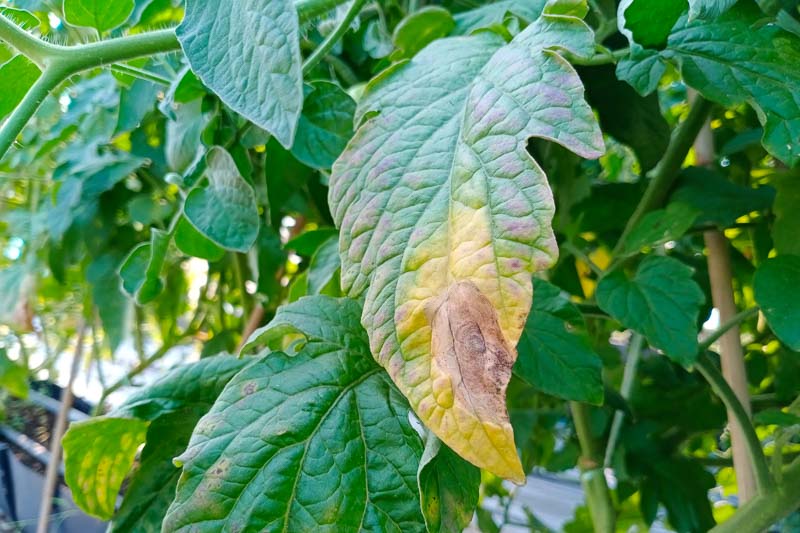
If older lower tomato leaves develop brown lesions with visible concentric rings followed by surrounding yellowing, suspect early blight.
The disease commonly begins near the base of the plant and can progress upward as conditions remain favorable.
Look for:
Brown to dark-brown leaf spots.
Concentric rings creating a target-like appearance.
Yellow tissue surrounding the lesions.
Symptoms beginning on older lower foliage.
Increasing defoliation if disease becomes severe.
Do not confuse early blight with simple nitrogen deficiency. Nitrogen deficiency tends to produce broader, more uniform yellowing rather than distinct lesions with concentric rings.
See Gardenia’s Early Blight guide for identification, prevention, and management.
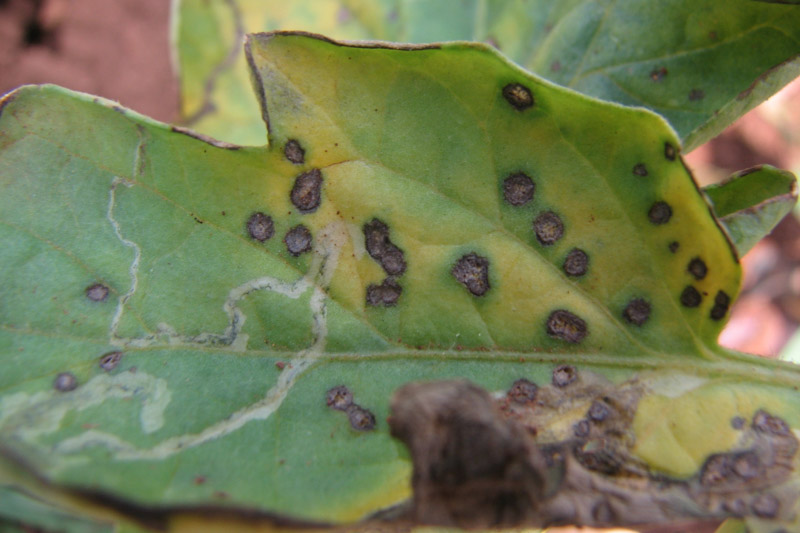
Septoria leaf spot also usually begins on lower tomato foliage, but its lesions differ noticeably from early blight.
Typical clues include:
Numerous small circular spots.
Pale gray or tan centers.
Darker brown margins.
Tiny black fruiting structures sometimes visible inside older lesions.
Leaves yellowing as spots multiply and merge.
Septoria can cause heavy defoliation even though the tomato fruit itself is not usually infected directly.
Mulch beneath plants, reduce splashing irrigation, avoid unnecessary leaf wetness, and selectively remove badly affected foliage while preserving enough healthy canopy to support the crop.
For a side-by-side comparison with early blight, bacterial diseases, late blight, and vascular wilts, use Gardenia’s Tomato Diseases: Identification, Treatment & Prevention.
Other tomato leaf diseases can also cause yellow foliage, particularly as lesions become numerous.
Bacterial spot can create small dark or water-soaked lesions, sometimes surrounded by yellow tissue. As infection becomes severe, larger portions of foliage can yellow and die.
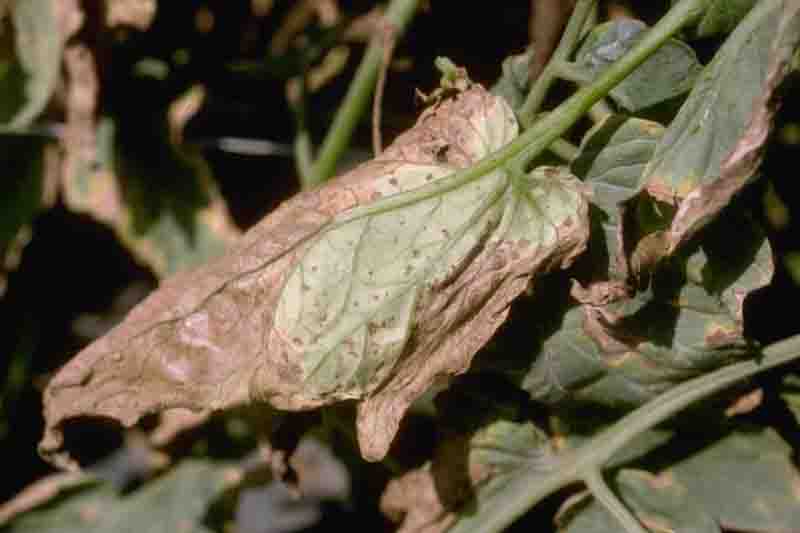
Late blight behaves quite differently. It can produce rapidly expanding irregular, water-soaked lesions that turn olive-brown or dark brown and spread quickly through foliage, stems, and fruit during cool, wet, humid weather.
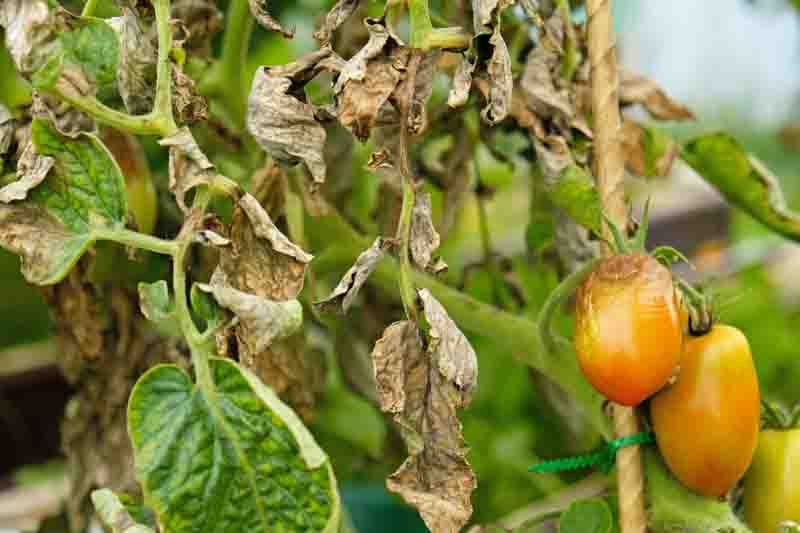
Disease-related yellowing usually comes with more information than the color yellow:
Distinct spots or lesions.
Water-soaked tissue.
Dark margins or pale centers.
Rapid spread.
Stem or fruit symptoms.
Do not apply a fungicide simply because leaves are yellow. First establish whether an infectious leaf disease is actually present and whether the product is appropriate for that specific problem.
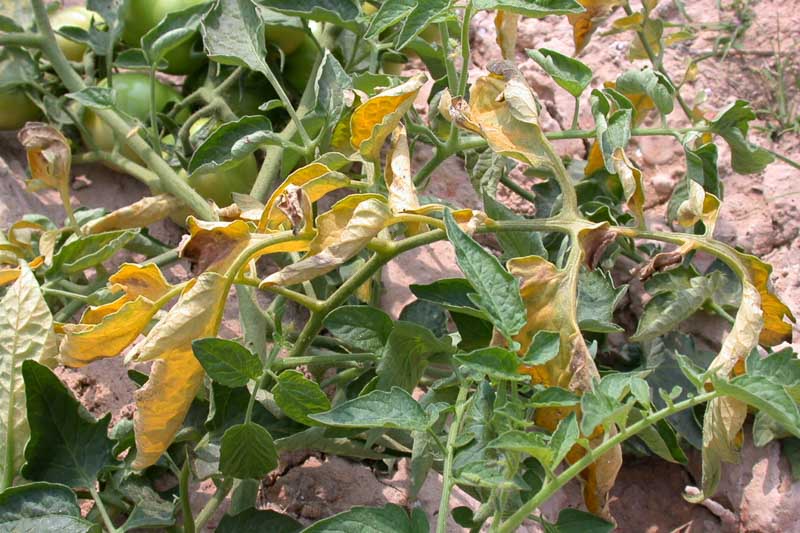
Fusarium wilt is more serious than ordinary lower-leaf yellowing because the pathogen colonizes the tomato’s vascular system.
Typical clues can include:
Yellowing beginning on lower foliage.
Symptoms developing first on one branch or one side of the plant.
Wilting during the hottest part of the day.
Temporary nighttime recovery early in disease development.
Progressive yellowing and wilting as disease advances.
Brown vascular discoloration inside the lower stem.
A fungicide will not restore a tomato once systemic Fusarium wilt has colonized its vascular tissue.
Resistant cultivars are among the most useful preventive measures where Fusarium wilt is a recurring garden problem.
Yellow + wilt is more concerning than yellow alone. When lower leaves yellow and the plant begins losing turgor despite adequate soil moisture, investigate root and vascular problems rather than automatically adding fertilizer.
Verticillium wilt can resemble Fusarium wilt because both may begin on older foliage and cause yellowing, wilting, and internal vascular discoloration.
Verticillium may produce:
Older leaves turning yellow.
Yellow wedge-shaped or V-shaped areas, sometimes developing brown tissue.
One-sided yellowing on individual leaves or portions of the plant.
Progressive loss of lower foliage.
Tan or brown vascular discoloration inside the lower stem.
Fusarium and Verticillium can be difficult to distinguish confidently from photographs alone.
If yellowing is accompanied by persistent wilt and internal stem discoloration, a diagnostic laboratory or local Extension service may be more useful than trying several treatments at random.
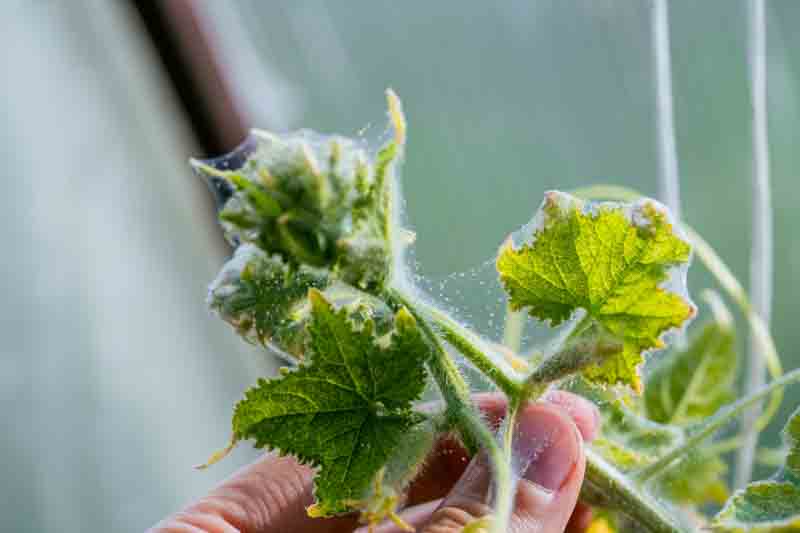
Spider mite damage is often described simply as yellowing, but the early pattern is more specific.
Look closely for fine stippling – numerous tiny pale or yellow dots created as mites feed on plant cells.
As infestations become heavier:
Leaves look finely speckled.
Yellowing becomes more widespread.
Foliage may turn bronze.
Leaves eventually dry and die.
Fine webbing may appear beneath or between leaves.
Spider mites often become especially troublesome during hot, dry weather.
Inspect leaf undersides before assuming a pale tomato simply needs fertilizer.
For identification and management, see Gardenia’s Tomato Pests: Identification, Control & Prevention.
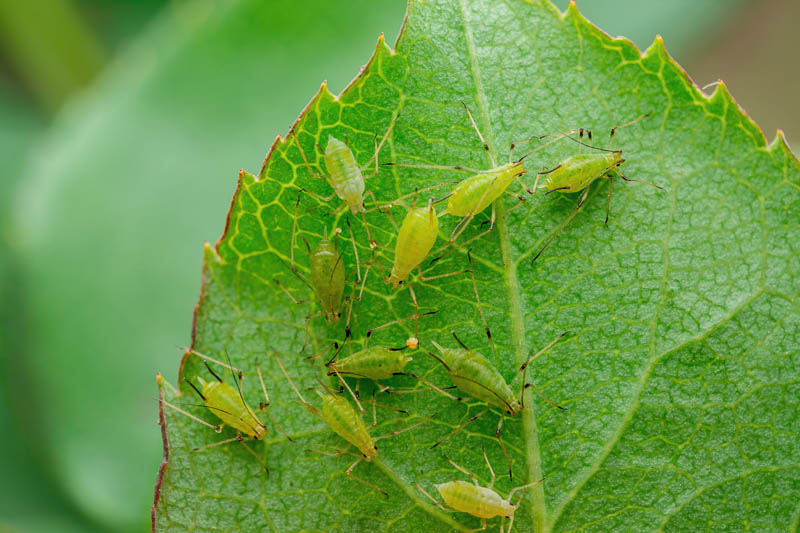
Large populations of sap-feeding insects can also contribute to yellow tomato foliage.
Whiteflies feed mainly on leaf undersides. Heavy infestations can produce:
Yellowing.
Leaf weakening or distortion.
Sticky honeydew.
Black sooty mold growing on honeydew.
Clouds of tiny white adults when foliage is disturbed.
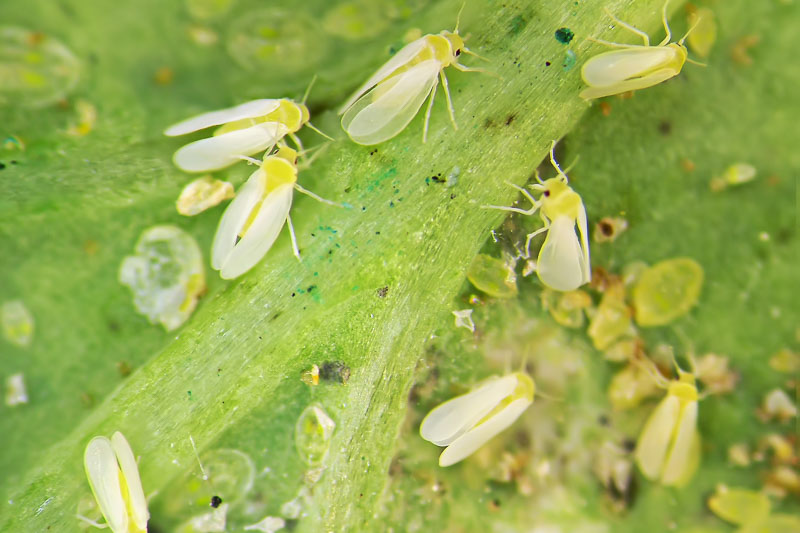
Aphids are more likely to cluster around tender growing points. Large populations may distort foliage and produce honeydew, but a small colony does not usually explain an entire tomato plant turning yellow.
Psyllids can also cause yellowing, curling, and stunting.
The insect itself or convincing feeding evidence should be present before pest treatment is justified. Do not treat yellow foliage with insecticide simply because pests are one possible cause.
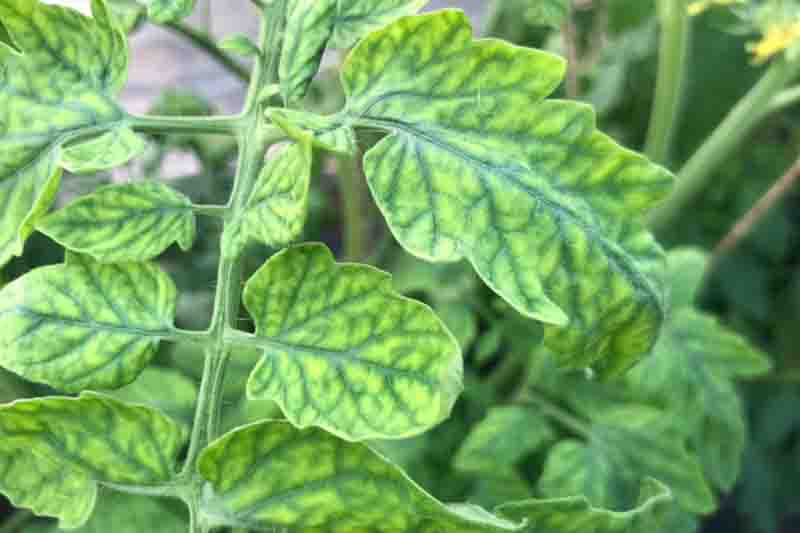
Viruses can produce yellow tomato foliage, but simple yellowing is not enough to diagnose a viral disease.
A virus becomes more plausible when yellowing occurs with:
Light-green and dark-green mottling.
Mosaic patterns.
Curled, narrow, or distorted leaves.
Severe stunting.
Shortened internodes.
Abnormal rings, blotches, or discoloration on fruit.
A plant that looks dramatically different from healthy neighboring tomatoes.
Tomato yellow leaf curl virus, mosaic viruses, tomato spotted wilt virus, and curly top can all involve yellow foliage, but their complete symptom patterns, vectors, and regional importance differ.
In some regions, whitefly-transmitted viruses such as Tomato infectious chlorosis virus can also cause interveinal yellowing, thickened or brittle foliage, and leaf rolling, often beginning on older leaves.
Viruses cannot be cured with fungicides or fertilizer.
If symptoms strongly suggest infection, use Gardenia’s Tomato Diseases: Identification, Treatment & Prevention to compare the complete symptom pattern before deciding what to do.
Young tomatoes deserve a slightly different diagnostic approach because their root systems are small and recently disturbed.
Common causes of yellow seedling or transplant foliage include:
Overwatering: saturated potting mix limits oxygen around young roots.
Nutrient depletion: small cells and low-fertility seed-starting mixes can run short as seedlings grow.
Root crowding: seedlings kept too long in small cells can become stressed.
Cold root zones: low temperatures can slow root activity and nutrient uptake.
Transplant shock: some older leaves may yellow while disturbed roots re-establish.
Poor hardening: abrupt exposure to sun, wind, or temperature changes can damage foliage.
The most reassuring sign is healthy new growth. If young leaves are developing normally while one or two older transplant leaves yellow and fall, the plant may simply be adjusting.
Container tomatoes experience many of the same pests and diseases as garden tomatoes, but their restricted root volume creates additional reasons for foliage to yellow.
Check for:
Rapid drying: pots may need much more frequent irrigation during hot weather.
Waterlogging: poor drainage can leave roots chronically saturated.
Nutrient depletion: nutrients are removed by the crop and gradually lost through repeated drainage.
Salt buildup: repeated fertilizer applications or mineral-rich irrigation water can stress roots.
Root restriction: vigorous tomatoes can become increasingly difficult to support in undersized containers.
A container tomato should not automatically be fertilized whenever it turns yellow. Moisture, drainage, root volume, fertilizer history, and disease symptoms should be considered together.
Gardenia’s Growing Tomatoes in Containers: Complete Guide covers root volume, watering, feeding, support, and common container problems in detail.
When a tomato begins turning yellow, work through these five questions before choosing a treatment.
Which leaves yellowed first? Old lower leaves point toward normal aging, nitrogen stress, lower-leaf diseases, or vascular wilt. Yellow young growth shifts attention toward nutrient availability, root conditions, viruses, or other active growth problems.
What is the yellowing pattern? Uniform yellow, interveinal chlorosis, fine stippling, mottling, and yellow halos surrounding lesions are different diagnostic patterns.
Are there spots or lesions? Concentric rings, small pale-centered spots, dark bacterial lesions, or rapidly expanding water-soaked tissue move the diagnosis toward disease.
Is the plant wilting or stunted? Yellowing plus persistent wilt, one-sided decline, or severe stunting is more concerning than yellowing alone.
What is happening around the roots? Dry soil, waterlogging, small containers, recent transplanting, root damage, soil pH, excess salts, and fertilizer history can all change water and nutrient uptake.
Gardenia Five-Clue Yellow Leaf Test: Leaf age → Yellowing pattern → Spots or lesions → Wilt or stunting → Root-zone history. When all five clues are considered together, many apparently similar yellow-leaf problems become much easier to separate.
For example, an old leaf that is uniformly pale on a vigorous tomato tells a very different story from an old leaf covered with target-like lesions, or from a yellowing branch that is also beginning to wilt.
Before treating the plant, spend a few minutes gathering evidence.
Find the first affected leaves. Are they old or young?
Study the yellowing. Is it uniform, between the veins, stippled, mottled, or concentrated around spots?
Look for lesions. Examine both sides of the leaves.
Check the soil. Is the root zone dry, comfortably moist, or saturated?
Inspect for pests. Look for stippling, webbing, insects, honeydew, or sooty mold.
Check the whole plant. Is it vigorous, stunted, or wilting?
Review recent care. Consider watering, fertilizer, transplanting, weather, herbicide exposure, and container size.
Then treat the cause rather than the color.
If the symptom pattern remains unclear, use Gardenia’s Tomato Problems: What Is Wrong With My Plant? for a broader symptom-first diagnosis.
Fully yellow or dead leaves can usually be removed, especially when they are low on the plant, touching the soil, or clearly diseased.
But removal should follow diagnosis.
Normal old leaves: remove once they are mostly yellow or dead.
Spotted diseased leaves: selective removal may reduce infected tissue when disease is still limited.
Nutrient-stressed leaves: correcting the underlying nutrient or root problem matters more than stripping foliage.
Wilt disease: removing individual yellow leaves will not cure a systemic vascular infection.
Do not remove large quantities of healthy or partly green foliage simply because a few lower leaves are yellow. Tomatoes need enough canopy to support fruit development and protect fruit from sunscald.
Yellow foliage deserves faster investigation when it occurs with:
Rapid spread through the plant.
Persistent wilting despite adequate soil moisture.
One-sided yellowing or wilt.
Brown or tan vascular tissue inside the stem.
Numerous expanding leaf spots.
Water-soaked lesions.
Strong mottling or mosaic patterns.
Severe stunting or distorted growth.
Heavy spider-mite or whitefly infestations.
Abnormal fruit or stem symptoms.
When vascular wilt, virus, or an unusually aggressive disease is suspected, diagnostic confirmation may save more time than repeatedly changing fertilizer, irrigation, or pesticides.
The goal is not to make every tomato leaf dark green. The goal is to determine whether yellowing represents normal aging, a correctable growing problem, pest feeding, or a disease that requires a completely different response.
For complete planting, watering, fertilizing, pruning, support, and harvest guidance, continue with Gardenia’s How to Grow Tomatoes: Complete Planting & Care Guide.
Tomato leaves can turn yellow because of normal aging, overwatering, drought, root stress, nutrient problems, early blight, Septoria leaf spot, vascular wilts, spider mites, whiteflies, viruses, or container stress. The location and pattern of yellowing are more useful diagnostically than color alone.
A few old lower leaves may yellow naturally, especially on large mature plants. Widespread lower-leaf yellowing can also indicate nitrogen deficiency, overwatering, early blight, Septoria leaf spot, Fusarium wilt, or Verticillium wilt. Look for spots, wilting, and changes in overall plant vigor.
They can, but yellowing alone does not prove overwatering. Check whether the root zone remains saturated for days, whether the plant is wilting despite wet soil, and whether drainage is poor before changing irrigation.
Yes. Repeated drought stress can cause older foliage to yellow and die, especially when plants wilt frequently. Check moisture several inches into the soil rather than judging by the dry surface alone.
Nitrogen deficiency typically causes relatively uniform yellowing beginning on older leaves. Interveinal yellowing can involve magnesium, potassium, iron, manganese, or root-zone problems. Which leaves are affected first and the exact yellowing pattern help narrow the cause.
Nitrogen deficiency typically begins on older lower leaves, which become uniformly pale green or yellow. As deficiency progresses, yellowing can move upward and overall plant growth becomes less vigorous.
Yellow tissue between greener veins is called interveinal chlorosis. Older-leaf symptoms can point toward magnesium or potassium problems, while young-leaf symptoms can make iron or manganese problems more plausible. Soil pH and root health should also be considered.
Yes. Early blight commonly begins on older lower leaves with brown lesions that often develop concentric rings. Yellow tissue forms around the spots, and heavily infected leaves eventually die and fall.
Septoria usually causes many small circular lesions with pale gray or tan centers and darker margins. It often begins on lower leaves, which turn yellow as lesions multiply and eventually die.
Yellowing with wilting can result from severe water stress, damaged roots, Fusarium wilt, Verticillium wilt, or other root and vascular problems. If soil moisture is adequate but wilting persists, investigate the root system and lower stem.
Yes. Spider mites create fine pale or yellow stippling that can progress to widespread yellowing and bronzing. Heavy infestations may produce fine webbing, particularly on leaf undersides.
Heavy whitefly feeding can weaken tomato plants and contribute to yellowing. Look for tiny white adults beneath leaves, sticky honeydew, and black sooty mold. Some whiteflies can also transmit important tomato viruses.
Fully yellow or dead leaves can generally be removed, particularly low foliage touching the soil or leaves badly affected by disease. But diagnose the cause first. Leaf removal will not correct nutrient deficiency, damaged roots, or systemic wilt disease.
Tomato seedlings can yellow because of overwatering, depleted nutrients, root crowding, cold root conditions, transplant shock, or poor hardening. Healthy new growth after transplanting is reassuring when only older seedling leaves are affected.
Yes. Excess fertilizer salts can injure roots and interfere with water and nutrient uptake, particularly in containers. Heavy fertilization can also create nutrient imbalances. Review the feeding history and root conditions before adding more fertilizer.
Severely yellowed leaves often remain yellow even after the underlying problem is corrected. Watch the new growth instead. Healthy green new leaves and improved plant vigor are better signs of recovery than whether an old damaged leaf regains its color.
Updated: September 2026 • Reviewed by Gardenia Editors
| Hardiness |
2 - 11 |
|---|---|
| Climate Zones | 1, 1A, 1B, 2, 2A, 2B, 3, 3A, 3B, 4, 5, 6, 7, 8, 9, 10, 11, 12, 13, 14, 15, 16, 17, 18, 19, 20, 21, 22, 23, 24, A1, A2, A3, H1, H2 |
| Plant Type | Fruits |
| Plant Family | Solanaceae |
| Genus | Solanum, Tomatoes |
| Common names | Love Apple, Tomato |
| Exposure | Full Sun |
| Season of Interest | Spring (Late), Summer (Early, Mid, Late), Fall |
| Height | 3' - 10' (90cm - 3m) |
| Spread | 1' - 4' (30cm - 120cm) |
| Spacing | 24" - 36" (60cm - 90cm) |
| Maintenance | Average, High |
| Water Needs | Average |
| Soil Type | Clay, Loam, Sand |
| Soil pH | Acid, Neutral |
| Soil Drainage | Moist but Well-Drained |
| Tolerance | Rabbit, Clay Soil |
| Attracts | Bees |
| Landscaping Ideas | Patio And Containers |
| Garden Styles | City and Courtyard, Informal and Cottage, Pollinator Garden |
| Hardiness |
2 - 11 |
|---|---|
| Climate Zones | 1, 1A, 1B, 2, 2A, 2B, 3, 3A, 3B, 4, 5, 6, 7, 8, 9, 10, 11, 12, 13, 14, 15, 16, 17, 18, 19, 20, 21, 22, 23, 24, A1, A2, A3, H1, H2 |
| Plant Type | Fruits |
| Plant Family | Solanaceae |
| Genus | Solanum, Tomatoes |
| Common names | Love Apple, Tomato |
| Exposure | Full Sun |
| Season of Interest | Spring (Late), Summer (Early, Mid, Late), Fall |
| Height | 3' - 10' (90cm - 3m) |
| Spread | 1' - 4' (30cm - 120cm) |
| Spacing | 24" - 36" (60cm - 90cm) |
| Maintenance | Average, High |
| Water Needs | Average |
| Soil Type | Clay, Loam, Sand |
| Soil pH | Acid, Neutral |
| Soil Drainage | Moist but Well-Drained |
| Tolerance | Rabbit, Clay Soil |
| Attracts | Bees |
| Landscaping Ideas | Patio And Containers |
| Garden Styles | City and Courtyard, Informal and Cottage, Pollinator Garden |
Create a membership account to save your garden designs and to view them on any device.
Becoming a contributing member of Gardenia is easy and can be done in just a few minutes. If you provide us with your name, email address and the payment of a modest $25 annual membership fee, you will become a full member, enabling you to design and save up to 25 of your garden design ideas.
Join now and start creating your dream garden!
Create a membership account to save your garden designs and to view them on any device.
Becoming a contributing member of Gardenia is easy and can be done in just a few minutes. If you provide us with your name, email address and the payment of a modest $25 annual membership fee, you will become a full member, enabling you to design and save up to 25 of your garden design ideas.
Join now and start creating your dream garden!