Brown spots, yellow leaves, sudden wilt, or diseased fruit? Tomato diseases can look frustratingly similar. Gardenia's Disease Fingerprint compares symptom location, lesion pattern, weather, speed of spread, and plant system - helping you distinguish blights, Septoria, bacterial diseases, vascular wilts, viruses, and common noninfectious look-alikes before choosing a treatment.
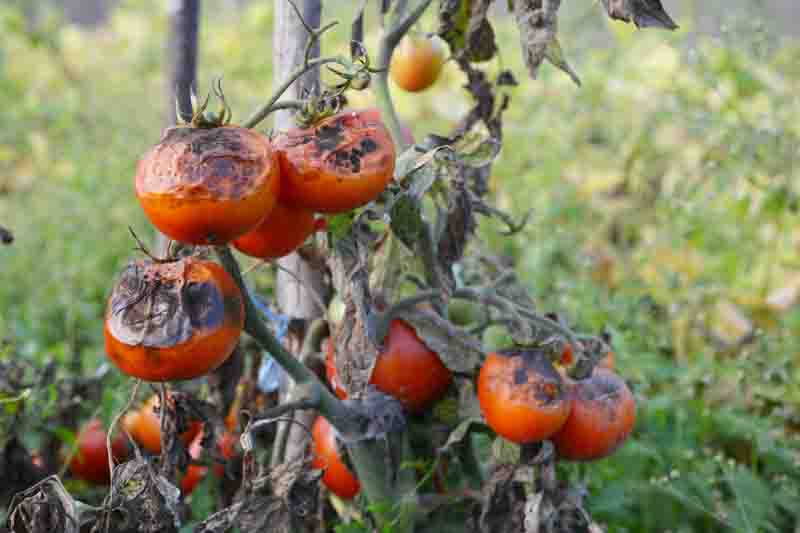


Tomato diseases can be frustratingly difficult to identify because many begin with the same warning signs: yellow leaves, brown spots, wilting, poor growth, damaged stems, or blemished fruit. Yet early blight, Septoria leaf spot, bacterial spot, Fusarium wilt, and tomato viruses require very different responses.
The safest approach is to diagnose the pattern, not simply react to a damaged leaf. Where did symptoms begin? What do the lesions actually look like? Has the weather been warm and wet or cool and rainy? Is the disease moving slowly from the bottom of the plant or appearing rapidly throughout the canopy? Is the damage confined to leaves, or is the entire plant wilting?
This guide covers the major tomato diseases home gardeners are likely to encounter, how to distinguish common look-alikes, what treatment can realistically accomplish, and when removing an infected tomato is more sensible than trying to save it.
The first rule of tomato disease treatment: Not every disease is curable. Some leaf diseases can be slowed and healthy foliage protected. Viruses and systemic vascular wilts generally cannot be cured once a plant is infected. Identification tells you whether your goal is to manage, contain, remove, or prevent.
| Disease | Key Clue | Favored Conditions | Typical Response |
|---|---|---|---|
| Early blight | Target-like rings on older lower leaves | Warm, wet, humid weather | Often manageable if caught early |
| Septoria leaf spot | Many small pale-centered spots with dark margins | Prolonged leaf wetness and humidity | Often manageable |
| Late blight | Rapidly expanding water-soaked lesions | Cool, wet, humid weather | Prompt action and often plant removal |
| Bacterial spot or speck | Small dark lesions, often with yellow halos | Wet weather and splashing water | Limit spread; difficult to cure |
| Fusarium wilt | Lower-leaf yellowing, wilt, brown vascular tissue | Warm soil | No curative treatment |
| Verticillium wilt | Progressive lower-leaf yellowing and wilt | Moderate temperatures | No curative treatment |
| Bacterial wilt | Rapid persistent wilt, sometimes while foliage is still green | Warm soils in regions where pathogen occurs | Remove infected plant |
| Mosaic and other viruses | Mottling, distortion, curling, stunting | Varies with virus and vector | No cure |
A photograph of one brown leaf is rarely enough for a confident tomato diagnosis. Gardenia’s Tomato Disease Fingerprint combines five clues that are much more useful together than any one symptom alone.
Location: Did symptoms begin on old lower leaves, young upper growth, stems, roots, or fruit?
Lesion pattern: Are spots large or tiny? Do they contain concentric rings, pale centers, yellow halos, water-soaked margins, corky tissue, or fuzzy growth?
Weather: Was the period before symptom development warm and rainy, cool and wet, persistently humid, or unusually hot and dry?
Speed: Is the problem slowly progressing upward from old foliage or moving through the plant within days?
Plant system: Is the disease primarily affecting leaf surfaces, or is the plant’s vascular system involved, causing persistent wilt?
Gardenia disease rule: Location + lesion pattern + weather + speed + plant system is more reliable than leaf color alone. “My tomato has brown leaves” describes a symptom. It does not identify the disease.
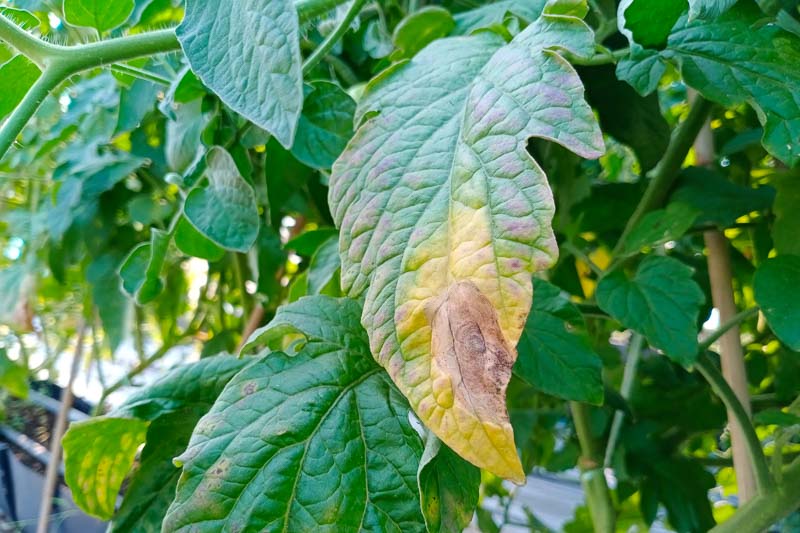
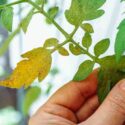
Early blight is one of the most recognizable tomato leaf diseases. It usually begins on older foliage near the base of the plant, where brown lesions enlarge and often develop characteristic concentric rings.
Yellow tissue may surround the lesions. As infection advances, affected leaves die and the disease progresses upward. Severe defoliation reduces plant vigor and exposes developing tomatoes to sunscald. Stems and fruit can also become infected.
Early blight is most likely when you see older leaves + relatively large brown lesions + target-like rings, particularly during warm periods with rain, irrigation splash, or prolonged leaf wetness.
Remove heavily infected lower foliage when practical, while preserving enough healthy canopy to support fruit and prevent sunscald. Mulch beneath plants, avoid unnecessary leaf wetness, and remove infected crop debris after the season.
Where early blight is recurrent or severe, a fungicide specifically labeled for early blight on tomatoes may help protect healthy tissue when applied according to label directions. Fungicides work best preventively or early in disease development. They do not turn infected leaves healthy again.
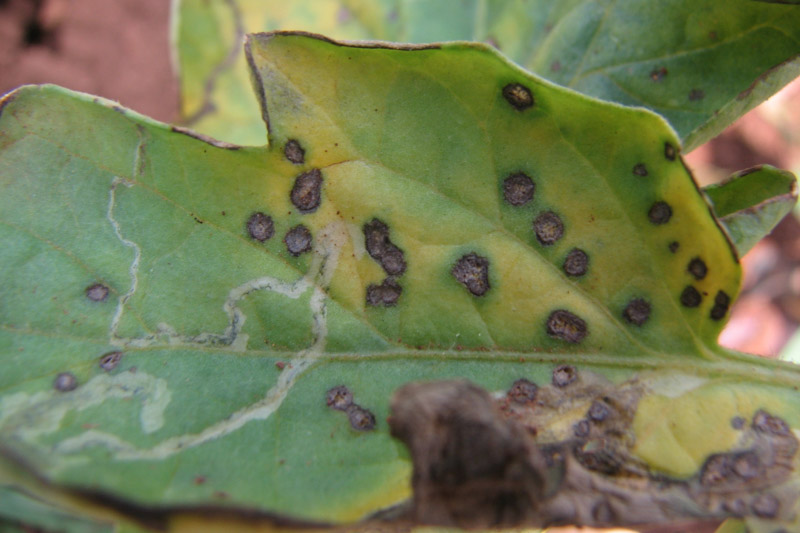
Septoria leaf spot also typically begins on lower leaves, which makes it easy to confuse with early blight.
The lesions provide the strongest distinction. Septoria usually produces numerous small circular spots rather than the larger target-like lesions of early blight. Spots often have dark borders and pale gray or tan centers. Tiny black fruiting bodies may eventually become visible within the centers.
As infections multiply, foliage turns yellow, dies, and drops. Heavy defoliation can greatly reduce plant vigor and leave fruit vulnerable to sunscald.
Remove badly affected leaves, avoid working among wet plants, reduce splashing irrigation, and keep the soil mulched. Labeled protective fungicides may help where Septoria pressure is high, particularly when used before large portions of the canopy are infected.
Early blight vs. Septoria: Both often start low on the plant. Early blight usually produces larger lesions with concentric target rings. Septoria usually produces many smaller spots with pale centers and dark margins.
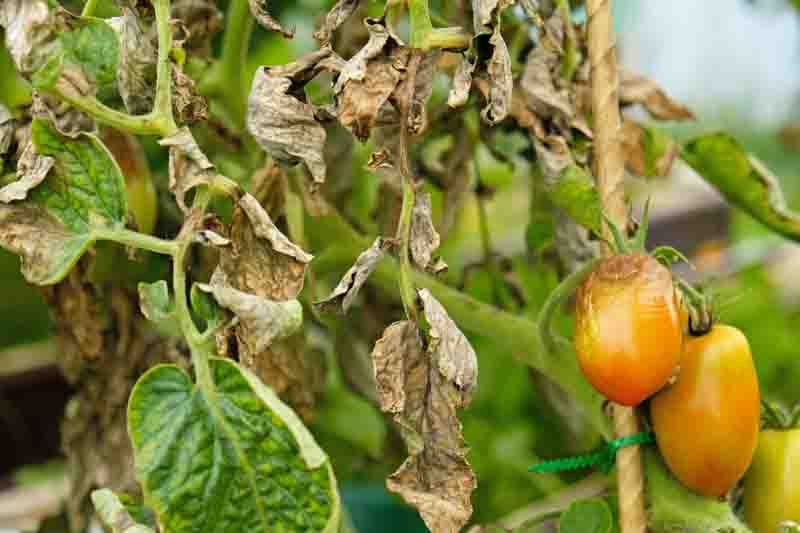
Late blight, caused by the oomycete Phytophthora infestans, is not simply a later version of early blight. It is a different disease with a very different pattern.
Irregular, water-soaked lesions develop on leaves and rapidly become brown or black. Young upper foliage may be affected as well as older leaves. During humid weather, pale or whitish pathogen growth may be visible near lesion margins, particularly on leaf undersides.
Stems can develop dark lesions, while fruit may develop firm, greasy-looking areas that become brown and leathery.
The combination of rapid progression + water-soaked lesions + cool, wet conditions should raise immediate concern for late blight.
Home-garden recommendations vary somewhat by region and current outbreak conditions, but infected plants generally require prompt action because late blight can produce abundant spores and spread rapidly to nearby tomatoes and potatoes.
When late blight is strongly suspected, consult local extension or plant-health guidance, particularly during a regional outbreak. Removing infected plants is commonly recommended in home gardens. Avoid transporting actively diseased material in a way that could disperse spores.
Speed is part of the diagnosis. Early blight usually advances progressively from older foliage. Late blight can attack younger growth and move through a planting very quickly when weather favors infection.
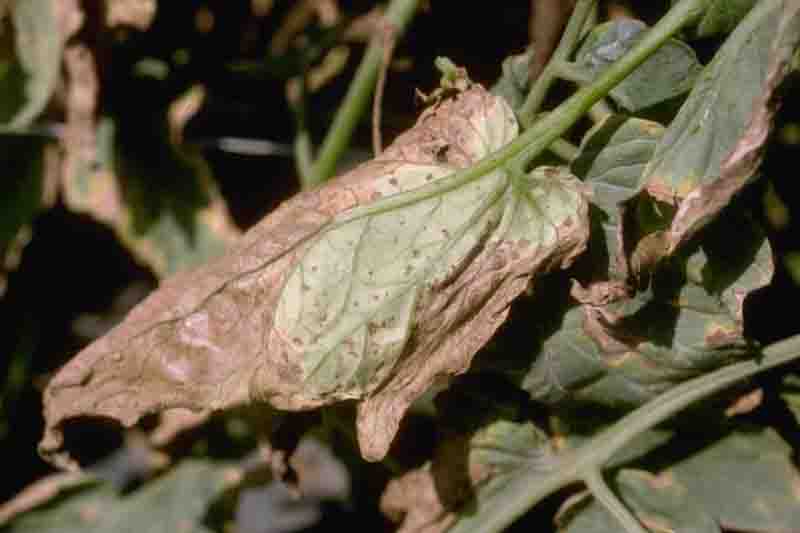 Bacterial spot on tomato
Bacterial tomato diseases can resemble fungal leaf spots, but they behave differently and are difficult to reverse once established.
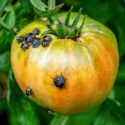
Bacterial spot can cause small dark or water-soaked lesions on leaves. Yellow halos may develop around the spots, and affected foliage can eventually die. Fruit may develop raised or corky lesions. Warm, wet weather and splashing water favor spread.
Bacterial speck tends to produce very small black leaf spots, often surrounded by yellow tissue. Fruit lesions are generally tiny, dark, and superficial. Speck tends to be favored by cooler wet weather than bacterial spot.
Bacterial canker deserves separate attention because it can become systemic rather than remaining a superficial leaf-spot problem. Symptoms may include marginal leaf scorch, wilting, stem cankers, vascular discoloration, and small fruit lesions with pale halos often called bird’s-eye spots.
A combination of wilting, internal stem discoloration, cankers, and distinctive fruit spotting should raise more concern for bacterial canker than ordinary bacterial spot.
Begin with disease-free seed or healthy transplants. Avoid pruning and handling wet plants, disinfect tools when bacterial disease is suspected, reduce splashing water, and remove seriously infected plants.
Copper products may be labeled for suppression of certain bacterial diseases, but they are protective rather than curative and effectiveness varies. Copper-resistant bacterial populations also occur. Follow local recommendations and the pesticide label rather than assuming copper will rescue an infected tomato.
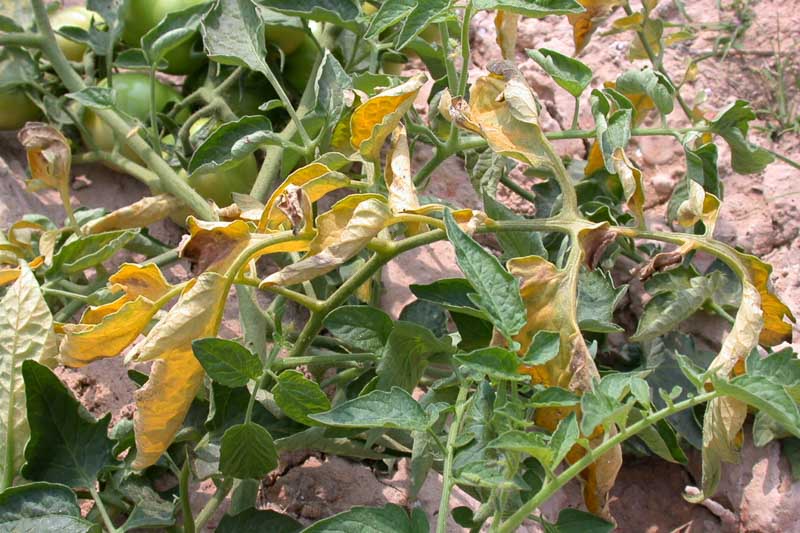
Fusarium wilt (Fusarium oxysporum f.sp. lycopersici)
Wilt diseases are different from ordinary leaf spots because the pathogen interferes with the plant’s ability to move water. A tomato can therefore wilt even when the soil is moist.
Fusarium wilt typically begins with yellowing and wilting of older lower leaves. Symptoms may initially appear on one side of the plant or even one side of an individual leaf.
As disease progresses, the tomato becomes progressively weaker and wilted. Cutting lengthwise through the lower stem may reveal brown discoloration of the vascular tissue. Fusarium wilt is generally favored by warm soil.
Verticillium wilt can produce similar lower-leaf yellowing, wilting, reduced growth, and internal vascular discoloration. Compared with Fusarium wilt, Verticillium tends to be favored by more moderate temperatures.
Because the two diseases overlap in appearance, visual symptoms alone may not always provide a definitive diagnosis.
Bacterial wilt can produce dramatic, persistent wilting as bacteria colonize the plant’s water-conducting tissues. Plants may wilt rapidly while foliage remains relatively green at first, a useful contrast with some slower yellowing wilt syndromes.
The disease is especially important in warm regions where the causal bacterium is established. Internal stem discoloration and bacterial ooze may occur, but reliable confirmation can require diagnostic testing.
There is no practical curative spray once Fusarium, Verticillium, or bacterial wilt has become systemic. Remove severely affected plants and focus on prevention, resistant cultivars where available, sanitation, crop rotation, and avoiding movement of contaminated soil or plant material.
Wilt does not automatically mean “add water.” A tomato wilting in dry soil may need irrigation. A plant that remains wilted despite adequate moisture may have damaged roots or blocked vascular tissue. More water can make poorly drained soil even worse.
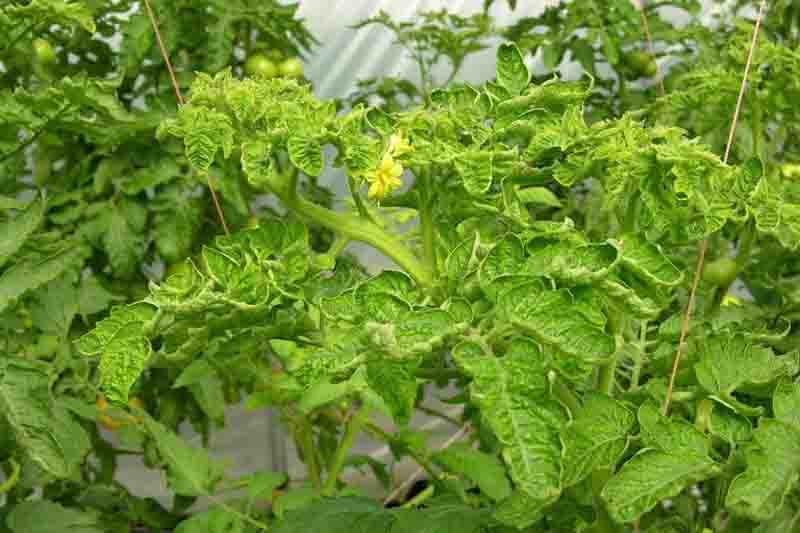 Tomato yellow leaf curl virus (TYLCV) (Begomovirus TYLCV)
Viral diseases often look different from classic fungal leaf spots. Instead of neat circular lesions, infected tomatoes may develop irregular color patterns and distorted growth.
Mosaic viruses can produce alternating light and dark green foliage, yellow mottling, crinkling, curling, narrow leaves, stunting, and reduced fruit production.
Other tomato viruses may cause bronzing, rings, necrotic spotting, severe leaf distortion, or unusual fruit symptoms. Transmission differs among viruses. Some are spread by insect vectors, while others can move through contaminated seed, plant sap, tools, hands, or infected transplants.
Viruses cannot be cured with fungicides or other garden sprays. Remove clearly infected plants when appropriate, control relevant insect vectors, start with healthy planting material, and use resistant cultivars where available.
Do not diagnose virus from leaf curl alone. Herbicide injury, physiological leaf roll, nutritional problems, and other stresses can mimic viral symptoms. If the diagnosis has important implications for the rest of the garden, laboratory confirmation may be worthwhile.
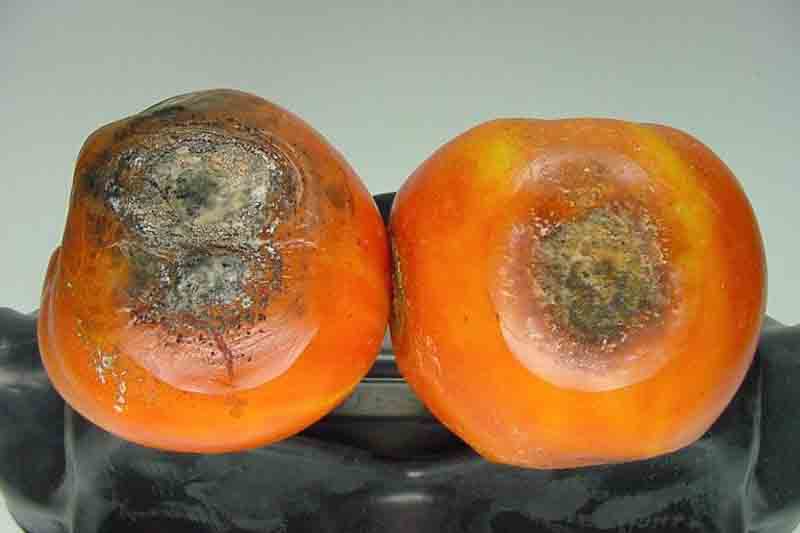 Anthracnose (Colletotrichum spp.)
Gray mold, caused by Botrytis cinerea, can infect leaves, stems, flowers, and fruit. The characteristic gray fuzzy growth is most obvious on dying or infected tissue during humid conditions. Dense plants, poor ventilation, wounds, and persistent moisture increase risk.
Remove affected tissue where practical and improve airflow. Gray mold is especially important in protected or humid growing environments.
Powdery mildew may appear as pale or powdery fungal growth on tomato foliage. Unlike many foliar pathogens, powdery mildew does not require free water sitting on leaves to infect.
It is generally less central to home tomato disease management than early blight, Septoria, or late blight, but can become significant under favorable conditions.
Anthracnose is particularly important on ripe tomato fruit. Small sunken lesions enlarge as fruit ripens and can develop darker centers or fungal structures. Warm, wet weather favors infection and fruit decay.
Harvest ripe fruit promptly, keep fruit off wet soil, and remove diseased tomatoes rather than allowing them to remain in the planting.
Southern blight attacks tomatoes near the soil line, particularly under warm conditions. The lower stem develops water-soaked or rotting tissue, followed by white fungal growth. Small round sclerotia resembling mustard seeds may appear around the crown.
Once the stem has been girdled, the plant usually collapses and should be removed.
One of the easiest ways to mistreat a tomato is to assume every damaged leaf or fruit has an infectious disease.
Blossom-end rot: A dark, sunken patch develops at the blossom end of fruit because calcium is not reaching developing tissue adequately. Irregular water supply and root stress are common contributors. It is not an infectious disease.
Physiological leaf roll: Mature green leaves curl upward during heat, drought, root disturbance, or other stress without an infectious pathogen.
Sunscald: Exposed fruit develops pale, bleached, or papery patches after intense sun exposure.
Herbicide injury: New leaves may become narrow, twisted, cupped, or distorted and can resemble viral disease.
Root or nutrient stress: Waterlogging, restricted roots, drought, extreme soil conditions, or nutrient imbalance can cause yellowing and poor growth without an infectious pathogen.
If symptoms do not clearly fit a disease pattern, use Gardenia’s Tomato Problems: What Is Wrong With My Plant? guide to work from the symptom outward.
Do not spray first and diagnose later. Fungicides will not correct blossom-end rot, sunscald, drought, herbicide injury, nutrient stress, or a virus. Identification determines whether a pesticide is relevant at all.
“Treatment” sounds as though an infected tomato can simply be sprayed back to health. In reality, tomato disease management has several very different goals.
| Disease Situation | Realistic Goal | Typical Response |
|---|---|---|
| Localized foliar fungal disease | Protect healthy foliage and slow spread | Sanitation, dry foliage, airflow, labeled protectant where appropriate |
| Bacterial leaf disease | Limit spread | Sanitation, avoid wet handling, remove severe infection, preventive products if recommended |
| Systemic wilt | Protect future plants | Remove affected plants, resistance, sanitation, rotation where useful |
| Virus | Prevent transmission | Remove infected plants when appropriate, control vectors, sanitize |
| Physiological problem | Correct the growing condition | Adjust water, roots, temperature, light, or fertility rather than spraying |
Gardenia’s treatment decision: Ask whether your goal is to protect healthy tissue, slow spread, prevent transmission, or prevent recurrence. For many tomato diseases, successful treatment means one of those four things rather than repairing tissue that is already infected.
Prevention is usually more effective than trying to rescue a heavily diseased plant.
Start with healthy seed and transplants. Avoid plants already showing unexplained spots, wilting, distortion, or stem damage.
Choose resistant cultivars when useful. Tomato labels commonly use resistance abbreviations such as F for certain Fusarium wilt races and V for Verticillium wilt, while other codes may indicate resistance to specific viruses or additional diseases. Codes vary among breeders and suppliers, so check the cultivar description.
Space plants appropriately. Better airflow helps foliage dry more quickly.
Water at soil level. Drip irrigation or careful root-zone watering reduces splash and prolonged leaf wetness.
Mulch beneath plants. Mulch limits soil splash onto lower leaves and helps stabilize moisture.
Support tomatoes early. Stakes, cages, and trellises help keep foliage and fruit away from damp soil.
Avoid handling wet plants. Bacteria and fungal spores can move more easily when foliage is wet.
Sanitize tools when disease is suspected. This is especially important with mechanically transmitted pathogens.
Remove diseased debris. Do not leave heavily infected foliage and fruit beneath healthy plants.
Rotate crops where practical. This can help reduce pressure from some soilborne pathogens, although rotation is not equally effective for every disease.
Control volunteer tomatoes and related weeds. They can sometimes maintain pathogens between crops.
Not every spotted leaf requires removing the entire tomato. Early foliar infections may still leave enough healthy foliage to produce a worthwhile crop. Systemic or rapidly spreading diseases are different.
Removal becomes more appropriate when:
Late blight is strongly suspected or confirmed and local guidance recommends removal.
A virus is causing severe systemic symptoms.
Fusarium, Verticillium, bacterial wilt, or another systemic vascular disease is causing progressive decline.
Bacterial disease is severe and continuing to spread.
Southern blight has girdled the stem near soil level.
The plant has lost so much healthy canopy that useful production is unlikely.
Think you know the disease? Follow the linked Gardenia disease page for deeper identification details, prevention strategies, and management options specific to that pathogen.
For tomato growing requirements and broader plant information, see the Gardenia profile for Tomato (Solanum lycopersicum).
Common tomato diseases include early blight, Septoria leaf spot, late blight, bacterial spot, Fusarium wilt, Verticillium wilt, and several viruses. Which diseases are most important depends on climate, weather, cultivar, and local pathogen pressure.
Both often begin on lower leaves. Early blight usually produces larger brown lesions with concentric target-like rings. Septoria typically produces many smaller circular spots with pale gray or tan centers and darker margins.
Early blight usually begins on older lower foliage and develops target-like rings. Late blight produces irregular water-soaked lesions and can spread rapidly during cool, wet weather, including on younger growth, stems, and fruit.
There is no practical curative treatment once these pathogens have colonized the plant’s vascular system. Management focuses on removing declining plants and using resistant cultivars, sanitation, and other preventive measures in future plantings.
No. Viral infections cannot be cured with fungicides or other sprays. Management focuses on healthy planting material, resistant cultivars where available, vector control, sanitation, and removing infected plants when appropriate.
Removing heavily infected lower foliage can help reduce disease pressure for some leaf diseases, but avoid stripping excessive healthy foliage. Leaves fuel fruit development and shade tomatoes from sunscald. Remove leaves selectively according to the disease involved.
Not until the problem is identified. Brown spots can result from fungal disease, bacterial infection, or noninfectious injury. Fungicides only help with certain diseases and generally protect healthy tissue rather than cure damaged leaves. Use only products labeled for the diagnosed disease and tomatoes.
Blossom-end rot is a physiological disorder rather than an infectious disease. It develops when calcium does not reach rapidly growing fruit tissue adequately, often because of irregular moisture or root stress. Fungicides will not prevent or cure it.
Persistent wilting in adequately moist soil can result from damaged or waterlogged roots, Fusarium wilt, Verticillium wilt, bacterial wilt, or another vascular problem. Check drainage and root health rather than automatically adding more water.
Use healthy seed and transplants, choose resistant cultivars when appropriate, provide good spacing, mulch, water at soil level, support plants, avoid working among wet foliage, remove infected debris, sanitize tools when necessary, and rotate crops where rotation is useful for the disease involved.
Updated: September 2026 • Reviewed by Gardenia Editors
| Hardiness |
2 - 11 |
|---|---|
| Climate Zones | 1, 1A, 1B, 2, 2A, 2B, 3, 3A, 3B, 4, 5, 6, 7, 8, 9, 10, 11, 12, 13, 14, 15, 16, 17, 18, 19, 20, 21, 22, 23, 24, A1, A2, A3, H1, H2 |
| Plant Type | Fruits |
| Plant Family | Solanaceae |
| Genus | Solanum, Tomatoes |
| Common names | Love Apple, Tomato |
| Exposure | Full Sun |
| Season of Interest | Spring (Late), Summer (Early, Mid, Late), Fall |
| Height | 3' - 10' (90cm - 3m) |
| Spread | 1' - 4' (30cm - 120cm) |
| Spacing | 24" - 36" (60cm - 90cm) |
| Maintenance | Average, High |
| Water Needs | Average |
| Soil Type | Clay, Loam, Sand |
| Soil pH | Acid, Neutral |
| Soil Drainage | Moist but Well-Drained |
| Tolerance | Rabbit, Clay Soil |
| Attracts | Bees |
| Landscaping Ideas | Patio And Containers |
| Garden Styles | City and Courtyard, Informal and Cottage, Pollinator Garden |
| Hardiness |
2 - 11 |
|---|---|
| Climate Zones | 1, 1A, 1B, 2, 2A, 2B, 3, 3A, 3B, 4, 5, 6, 7, 8, 9, 10, 11, 12, 13, 14, 15, 16, 17, 18, 19, 20, 21, 22, 23, 24, A1, A2, A3, H1, H2 |
| Plant Type | Fruits |
| Plant Family | Solanaceae |
| Genus | Solanum, Tomatoes |
| Common names | Love Apple, Tomato |
| Exposure | Full Sun |
| Season of Interest | Spring (Late), Summer (Early, Mid, Late), Fall |
| Height | 3' - 10' (90cm - 3m) |
| Spread | 1' - 4' (30cm - 120cm) |
| Spacing | 24" - 36" (60cm - 90cm) |
| Maintenance | Average, High |
| Water Needs | Average |
| Soil Type | Clay, Loam, Sand |
| Soil pH | Acid, Neutral |
| Soil Drainage | Moist but Well-Drained |
| Tolerance | Rabbit, Clay Soil |
| Attracts | Bees |
| Landscaping Ideas | Patio And Containers |
| Garden Styles | City and Courtyard, Informal and Cottage, Pollinator Garden |
Create a membership account to save your garden designs and to view them on any device.
Becoming a contributing member of Gardenia is easy and can be done in just a few minutes. If you provide us with your name, email address and the payment of a modest $25 annual membership fee, you will become a full member, enabling you to design and save up to 25 of your garden design ideas.
Join now and start creating your dream garden!
Create a membership account to save your garden designs and to view them on any device.
Becoming a contributing member of Gardenia is easy and can be done in just a few minutes. If you provide us with your name, email address and the payment of a modest $25 annual membership fee, you will become a full member, enabling you to design and save up to 25 of your garden design ideas.
Join now and start creating your dream garden!