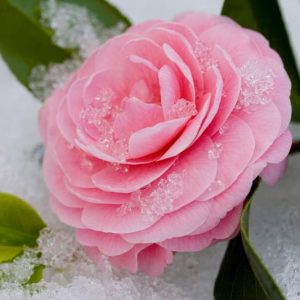
Which camellia will thrive in your garden? Compare flower forms, bloom sizes, fragrance, flowering seasons, mature habits, hardiness, and landscape uses. This practical expert guide helps you move beyond flower color and select a beautiful camellia that fits your climate, available space, and long-term garden design.
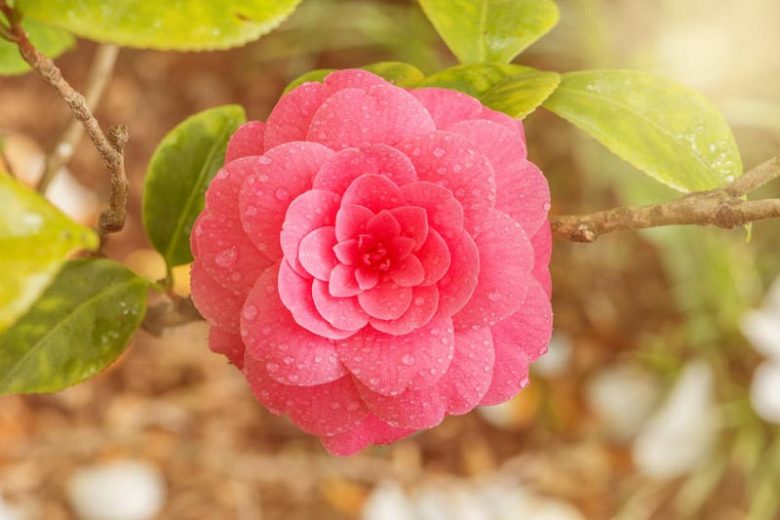


Camellias are among the most rewarding evergreen shrubs for fall, winter, and spring color. Their polished foliage provides structure throughout the year, while their flowers can appear when much of the garden is dormant. Depending on the cultivar and climate, camellias may bloom from fall into late spring, offering everything from simple, open flowers with golden stamens to perfectly arranged formal doubles.
Choosing the right camellia requires more than finding a beautiful flower. A cultivar may have the color you love but eventually outgrow its position. Another may open its flowers too early for a frost-prone site, need more shade than your garden provides, or produce enormous blooms when you really need a compact hedge.
The best camellia for your garden is the cultivar whose mature size, growth habit, hardiness, light requirements, flower form, and bloom season match your site. Flower color matters, but it should be one part of the decision rather than the entire decision.
This guide focuses on choosing an individual camellia cultivar. For a detailed explanation of Japanese, sasanqua, Williamsii, Hiemalis, Vernalis, Reticulata, fragrant, and tea camellias, see Gardenia’s guide to camellia types, including japonica vs sasanqua.
Before comparing flower photographs, evaluate the planting site. The right conditions matter more than flower color alone:
Cold-climate strategy: In areas with frequent late freezes, choose a hardy cultivar with a later bloom season and place it where morning sun will not rapidly thaw frozen flower buds.
Gardeners near the colder edge of camellia-growing regions should explore Gardenia’s selection of cold-hardy camellias. For planting and maintenance guidance, see How to Plant, Care for, and Grow Camellias.
Camellia flowers are commonly classified into six principal forms. The distinction depends on the number and arrangement of petals, petaloids, and stamens. Flower form affects the mood of the plant: single flowers look light and natural, while formal doubles appear architectural and highly refined.
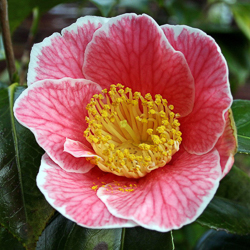 |
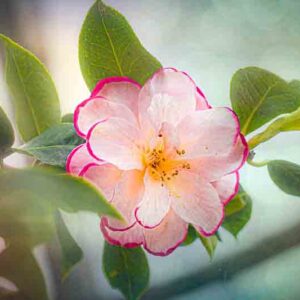
Single One row of five to eight petals surrounds a conspicuous center of stamens and pistils. Single camellias have an open, natural appearance and make pollen more accessible to visiting insects. Great camellia pick: ‘Minato-No-Akebono’ |
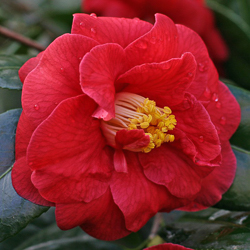 |
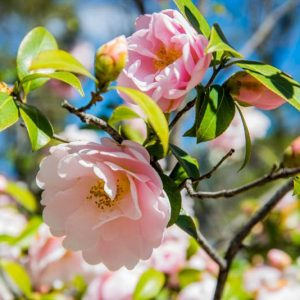
Semi-double Two or more rows of petals surround a visible center of stamens. Semi-double flowers combine fullness with a lively golden center and often retain a graceful, less formal appearance. Great camellia picks: ‘Apple Blossom’, ‘April Remembered’, ‘Bob Hope’, ‘Drama Girl’, and ‘Spring Mist’ |
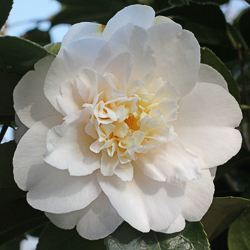 |
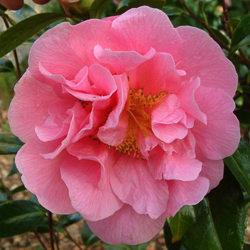
Anemone form One or more rows of broad outer petals surround a raised central mass of petaloids and stamens. The contrasting center gives these flowers texture and a distinctive two-level appearance. Great camellia picks: ‘Bonnie Marie’, ‘Elegans’, and ‘Elegant Beauty’ |
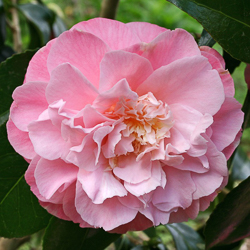 |
Peony form or informal double A rounded, full flower with irregular petals, petaloids, and occasional stamens. Peony-form blooms look lush and romantic rather than perfectly symmetrical. Great camellia picks: ‘Annie Wylam’, ‘Australis’, ‘Bonanza’, ‘Cinnamon Cindy’, ‘Debutante’, and ‘Kramer’s Supreme’ |
 |
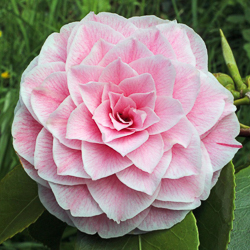
Rose-form double Overlapping petals initially resemble a formal double, but the flower opens more fully to reveal stamens in a concave center. This form combines symmetry with a changing appearance as the bloom matures. Great camellia picks: ‘April Rose’ and ‘Lady Campbell’ |
 |
Formal double Many rows of evenly arranged petals overlap in a symmetrical pattern and conceal the stamens. Formal doubles offer the most precise and architectural camellia flower form. Great camellia picks: ‘Alba Plena’, ‘Bonomiana’, ‘Desire’, ‘Lavinia Maggi’, ‘Pink Perfection’, and ‘Les Jury’ |
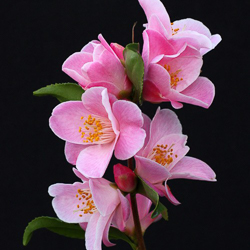
Flower size changes how a camellia reads in the landscape. Small flowers often appear in greater numbers and suit informal hedges, espaliers, and finely textured shrubs. Large and very large flowers create dramatic focal points but may be more vulnerable to wind, rain, and frost.
 |
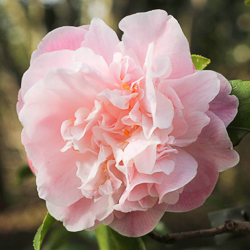
Miniature: 2.5 inches or less (6.4 cm or less) Small: More than 2.5 inches and up to 3 inches (6.4-7.6 cm) Small flowers can be exceptionally charming when produced in abundance. They work particularly well on fragrant hybrids, graceful shrubs, espaliers, and plants viewed at close range. Great picks: ‘Cinnamon Cindy’, ‘Fragrant Pink’, ‘Minato-No-Akebono’, ‘Scentuous’, and ‘Spring Mist’ |
 |
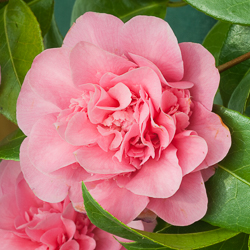
Medium: More than 3 inches and up to 4 inches (7.6-10.2 cm) Medium flowers provide an excellent balance of visual impact, weather resistance, and abundance. This versatile category includes many popular garden camellias. Great picks: ‘Polar Ice’, ‘Sparkling Burgundy’, ‘Sweet Emily Kate’, ‘Chansonette’, ‘Apple Blossom’, and ‘Debutante’ |
 |
Large: More than 4 inches and up to 5 inches (10.2-12.7 cm) Very large: More than 5 inches (over 12.7 cm) Large flowers command attention and are ideal for specimens, protected courtyards, and locations where blooms can be admired up close. Shelter them from strong wind, pounding rain, and exposed frost pockets. Great picks: ‘Bonnie Marie’, ‘Pink Icicle’, ‘April Remembered’, ‘Drama Girl’, ‘Anticipation’, and ‘Debbie’ |
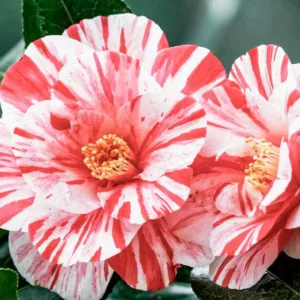
Camellias flower primarily in white, blush, pink, rose, red, and combinations of these colors. Some blooms are striped, spotted, edged, marbled, or splashed with contrasting tones. Color and markings may vary slightly with weather, flower age, genetic instability, or occasional sporting within a cultivar.
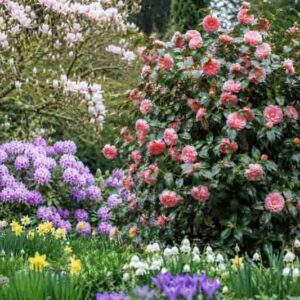
Always view the foliage and whole plant as well as the bloom. A striking flower is less useful if the shrub’s eventual size, density, or habit does not suit the intended location.
Most traditional camellias have little or no noticeable fragrance. Gardeners who want perfume must choose carefully because a spectacular flower does not automatically indicate a scented cultivar.
Many fragrant camellias have been bred using scented species such as Camellia lutchuensis. Their flowers are often smaller than the largest japonica blooms, but they compensate with sweet fragrance, abundant flowering, delicate branching, and finely textured foliage.
Explore Gardenia’s selection of fragrant camellias for fall, winter, and spring gardens. Place scented cultivars near a doorway, path, patio, or frequently used seating area where their fragrance can be appreciated.
Camellia bloom dates vary with cultivar, latitude, elevation, and winter weather. For this reason, camellias are most reliably compared using relative season classifications rather than one fixed calendar month.
Rather than planting several shrubs that flower simultaneously, combine cultivars from different season groups. An early sasanqua, a midseason japonica, and a late Williamsii or japonica cultivar can provide successive color for months.
Climate warning: Calendar ranges are approximate. Compare local nursery records, botanical garden observations, and regional experience before predicting exact flowering dates.
Camellias are often sold as tidy container plants, but many eventually become large shrubs or small trees. Mature dimensions vary enormously by cultivar, and plants may continue growing for decades under favorable conditions.
Use Gardenia’s camellia comparison tool to evaluate cultivars side by side, or use the Gardenia Plant Finder to filter plants by height, spread, exposure, hardiness, flower color, and bloom season.
The right camellia should fit your garden before it flowers. Start with hardiness, light, drainage, available space, and intended landscape use. Then choose the flower form, size, color, fragrance, and bloom season you find most appealing.
A thoughtfully chosen cultivar can provide handsome evergreen structure for decades and return each year with flowers precisely when your garden needs them most.
Begin with your hardiness zone, light conditions, soil drainage, available space, and intended landscape use. Then compare mature size, growth habit, bloom season, flower form, flower size, color, and fragrance.
The best flower form depends on the effect you want. Single and semi-double flowers look natural and expose their stamens, peony and anemone forms appear lush and informal, while formal doubles provide precise symmetry.
Simpler single and semi-double flowers often weather rain more gracefully than very dense doubles. Smaller or medium flowers may also be less vulnerable to wind, heavy rain, and frost than exceptionally large blooms.
No. Camellias are classified as early-, mid-, or late-season bloomers relative to other camellias. Exact dates vary with cultivar, latitude, elevation, and seasonal weather.
Yes. Combine early-, mid-, and late-season cultivars rather than choosing several plants with the same flowering period. In suitable climates, a carefully planned collection can provide successive flowers from fall through spring, although weather may create occasional gaps.
No. Most traditional camellias have little or no noticeable fragrance. Choose a cultivar specifically described as fragrant, often one bred using a scented species such as Camellia lutchuensis.
Choose a cultivar documented as naturally compact, with a mature height and spread appropriate to the site. Do not assume a young container plant will remain small or rely on constant hard pruning to control a vigorous cultivar.
Flower color is important, but it should not be the first criterion. Hardiness, light, soil drainage, mature size, growth habit, bloom season, and intended garden use determine whether the cultivar will perform well long term.
Updated: July 2026 • Reviewed by Gardenia Editors
| Hardiness |
6 - 9 |
|---|---|
| Heat Zones |
7 - 8 |
| Climate Zones | 4, 5, 6, 7, 8, 9, 12, 14, 15, 16, 17, 18, 19, 20, 21, 22, 23, 24 |
| Plant Type | Shrubs |
| Genus | Camellia |
| Exposure | Full Sun, Partial Sun, Shade |
| Season of Interest | Spring (Early, Mid), Fall, Winter |
| Maintenance | Low |
| Water Needs | Average |
| Soil Type | Clay, Loam, Sand |
| Soil pH | Acid, Neutral |
| Soil Drainage | Moist but Well-Drained, Well-Drained |
| Characteristics | Cut Flowers, Fragrant, Plant of Merit, Showy |
| Landscaping Ideas | Beds And Borders, Hedges And Screens, Patio And Containers, Wall-Side Borders |
| Garden Styles | City and Courtyard, Informal and Cottage, Japanese Garden, Traditional Garden |
serjio74 / 123RF Stock Photo
| Hardiness |
6 - 9 |
|---|---|
| Heat Zones |
7 - 8 |
| Climate Zones | 4, 5, 6, 7, 8, 9, 12, 14, 15, 16, 17, 18, 19, 20, 21, 22, 23, 24 |
| Plant Type | Shrubs |
| Genus | Camellia |
| Exposure | Full Sun, Partial Sun, Shade |
| Season of Interest | Spring (Early, Mid), Fall, Winter |
| Maintenance | Low |
| Water Needs | Average |
| Soil Type | Clay, Loam, Sand |
| Soil pH | Acid, Neutral |
| Soil Drainage | Moist but Well-Drained, Well-Drained |
| Characteristics | Cut Flowers, Fragrant, Plant of Merit, Showy |
| Landscaping Ideas | Beds And Borders, Hedges And Screens, Patio And Containers, Wall-Side Borders |
| Garden Styles | City and Courtyard, Informal and Cottage, Japanese Garden, Traditional Garden |
Create a membership account to save your garden designs and to view them on any device.
Becoming a contributing member of Gardenia is easy and can be done in just a few minutes. If you provide us with your name, email address and the payment of a modest $25 annual membership fee, you will become a full member, enabling you to design and save up to 25 of your garden design ideas.
Join now and start creating your dream garden!
Create a membership account to save your garden designs and to view them on any device.
Becoming a contributing member of Gardenia is easy and can be done in just a few minutes. If you provide us with your name, email address and the payment of a modest $25 annual membership fee, you will become a full member, enabling you to design and save up to 25 of your garden design ideas.
Join now and start creating your dream garden!