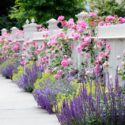
Create a low-maintenance front yard prairie of coneflowers, goldenrod, Veronicastrum and switchgrass for four-season color and wildlife.


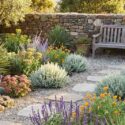
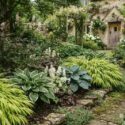
I will use the 2nd picture – please update the garden description accordingly:
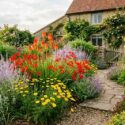
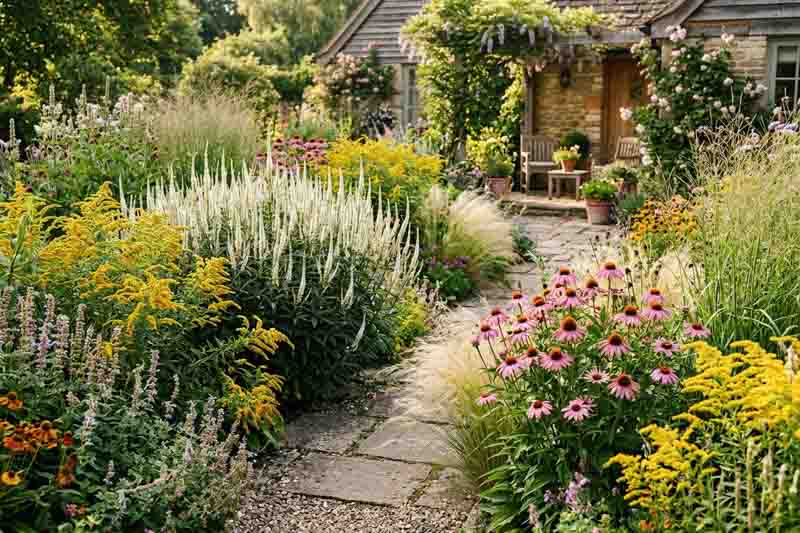
This sunny border follows a gravel path toward a cottage, combining the loose character of a prairie planting with the scale and intimacy of a front garden. Echinacea purpurea fills much of the foreground with rosy-purple flowers and dark central cones, while Veronicastrum virginicum rises behind it in tall, pale spires. Broad sweeps of Solidago rugosa bring warm yellow through the middle of the planting, and Panicum virgatum forms the taller grassy framework around them.
The garden feels generous rather than formal. The plants repeat in irregular groups along both sides of the path, with grasses and flower stems leaning naturally toward neighboring clumps. Roses and other perennials continue near the house, but the four featured plants are strong enough to define the main character of the border.
Main plants used: Echinacea purpurea, Veronicastrum virginicum, Solidago rugosa, and Panicum virgatum
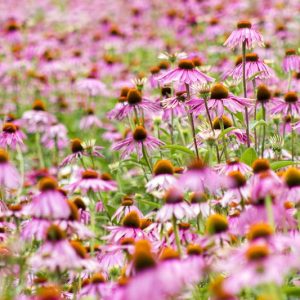
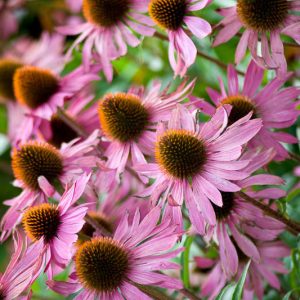
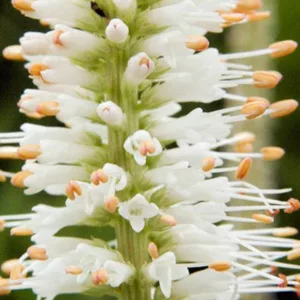
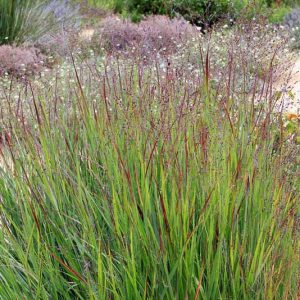
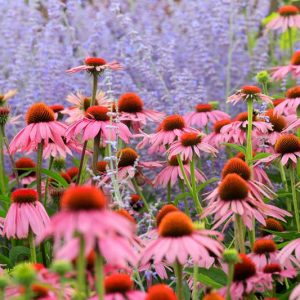
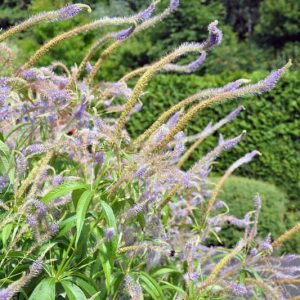
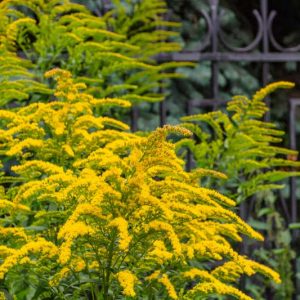
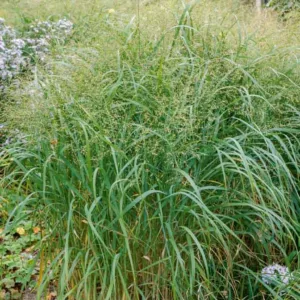
The four plants differ strongly in both flower shape and habit. Purple Coneflower has broad daisy-like flowers with prominent cones, Culver’s Root produces narrow vertical spikes, Rough Goldenrod carries branching yellow flower clusters, and Switchgrass contributes fine leaves and airy panicles rather than showy flowers.
Those differences keep the border interesting without making it chaotic. The coneflowers provide the strongest pink color, Goldenrod introduces warmth, and Culver’s Root adds pale verticals that break up the larger flower masses. Switchgrass holds everything together once the flowers begin to fade.
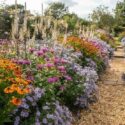
The photograph also shows why this planting should not be arranged in four equal blocks. Coneflowers dominate some areas, Goldenrod spreads in broader sweeps, Culver’s Root is more selective, and Switchgrass repeats through the middle and back. That variation gives the border depth and keeps the path feeling integrated into the planting.
Echinacea purpurea, or Purple Coneflower, provides the most recognizable summer flowers. It grows well in full sun to light shade and tolerates a range of soils as long as drainage is reasonable. Leave some seedheads standing after flowering if you want winter structure and food for seed-eating birds.
Veronicastrum virginicum, or Culver’s Root, adds height without forming a dense wall. Its pale flower spikes rise well above the surrounding foliage and are especially effective when repeated in small groups. It generally performs best where the soil does not become excessively dry.
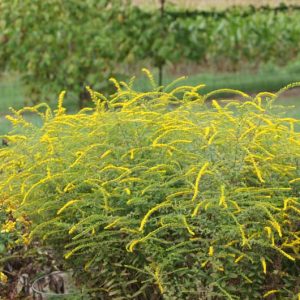
Solidago rugosa, or Rough Goldenrod, brings the strongest late-summer yellow. Its branching flower clusters are highly attractive to pollinating insects and work well in broad, irregular groups. Some forms can spread, so allow enough room and thin plants if they begin to crowd neighboring perennials.
Panicum virgatum, or Switchgrass, provides the main grass framework. Upright clumps remain attractive through summer, then develop warm fall tones and airy seedheads. Leave the stems standing through winter before cutting them back ahead of new spring growth.
Create a full summer border where broad flowering groups are supported by tall vertical accents and a permanent grass framework.
These percentages describe the overall balance of the four featured plants rather than four separate blocks or equal numbers of individual plants.
Begin with repeated clumps of Switchgrass through the middle and back so the border has a permanent framework even outside the flowering season.
Add Purple Coneflower in broad groups through the front and middle, then repeat Rough Goldenrod in looser sweeps rather than a single large mass.
Place Culver’s Root in smaller groups where its tall pale spires can rise clearly above the surrounding plants. Keep the path open enough for comfortable access, but allow some stems to lean naturally toward the edges.
This combination should not be treated as uniformly drought tolerant. Purple Coneflower and established Switchgrass cope well with dry periods, while Culver’s Root generally performs better with more consistent moisture. Rough Goldenrod is adaptable, but flowering is usually strongest where plants are not under prolonged stress.
Some of the plants can also expand with age. Goldenrod may spread into larger colonies, Switchgrass clumps broaden, and Coneflower can self-seed. Occasional thinning will help preserve the layered structure rather than allowing one species to take over.
Finally, resist cutting everything down in fall. The coneflower cones, Goldenrod stems, and Switchgrass seedheads remain useful long after flowering has finished and provide winter structure and wildlife value. A late-winter cutback is usually the better approach.
| Hardiness |
5 - 8 |
|---|---|
| Heat Zones |
5 - 8 |
| Exposure | Full Sun |
| Season of Interest | Summer (Mid, Late), Fall |
| Maintenance | Low |
| Water Needs | Average |
| Soil Type | Loam, Sand |
| Soil pH | Acid, Neutral |
| Soil Drainage | Moist but Well-Drained |
| Characteristics | Cut Flowers, Showy |
| Native Plants | Georgia, Illinois, Iowa, Kentucky, Louisiana, Midwest, Missouri, Southeast, Southwest, Tennessee, Texas, United States |
| Tolerances | Deer, Clay Soil |
| Attracts | Bees, Butterflies, Birds |
| Landscaping Ideas | Beds And Borders |
| Garden Styles | Butterfly Garden, City and Courtyard, Informal and Cottage, Pollinator Garden, Prairie and Meadow |
| Hardiness |
5 - 8 |
|---|---|
| Heat Zones |
5 - 8 |
| Exposure | Full Sun |
| Season of Interest | Summer (Mid, Late), Fall |
| Maintenance | Low |
| Water Needs | Average |
| Soil Type | Loam, Sand |
| Soil pH | Acid, Neutral |
| Soil Drainage | Moist but Well-Drained |
| Characteristics | Cut Flowers, Showy |
| Native Plants | Georgia, Illinois, Iowa, Kentucky, Louisiana, Midwest, Missouri, Southeast, Southwest, Tennessee, Texas, United States |
| Tolerances | Deer, Clay Soil |
| Attracts | Bees, Butterflies, Birds |
| Landscaping Ideas | Beds And Borders |
| Garden Styles | Butterfly Garden, City and Courtyard, Informal and Cottage, Pollinator Garden, Prairie and Meadow |
Recreate this garden. Specify the percentages you would like to have of each plant and input the dimensions of your garden space.We'll give you a shopping list so you know how many plants you need.
| Plant | Quantity | |
|---|---|---|
| Echinacea purpurea (Purple Coneflower) | N/A | Buy Plants |
| Veronicastrum virginicum (Culver's Root) | N/A | Buy Plants |
| Solidago rugosa (Rough Goldenrod) | N/A | Buy Plants |
| Panicum virgatum (Switchgrass) | N/A | Buy Plants |
Create a membership account to save your garden designs and to view them on any device.
Becoming a contributing member of Gardenia is easy and can be done in just a few minutes. If you provide us with your name, email address and the payment of a modest $25 annual membership fee, you will become a full member, enabling you to design and save up to 25 of your garden design ideas.
Join now and start creating your dream garden!
Create a membership account to save your garden designs and to view them on any device.
Becoming a contributing member of Gardenia is easy and can be done in just a few minutes. If you provide us with your name, email address and the payment of a modest $25 annual membership fee, you will become a full member, enabling you to design and save up to 25 of your garden design ideas.
Join now and start creating your dream garden!