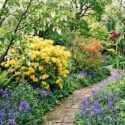
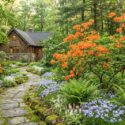
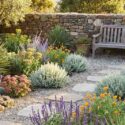
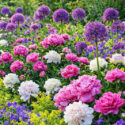
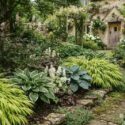
Create a secluded garden retreat with a spectacular flowering privacy screen. Evergreen Rhododendron 'English Roseum' and 'Roseum Elegans' produce masses of pink and lavender blooms in late spring to early summer. Graceful Leucothoe and woodland ferns soften the planting, providing lush foliage, natural beauty, and year-round garden structure.
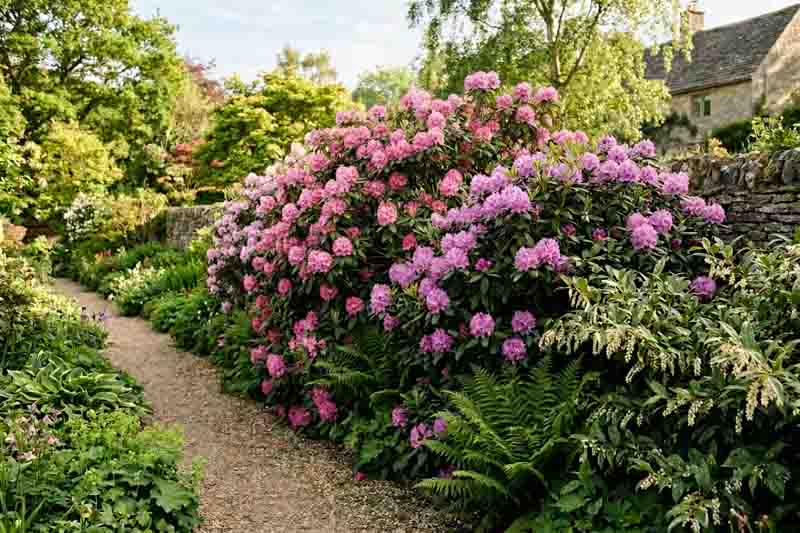


Who says a privacy screen has to be a plain green hedge? This beautiful garden transforms a simple gravel path into a secluded woodland retreat, with magnificent pink-flowering rhododendrons providing both privacy and a spectacular late-spring display.
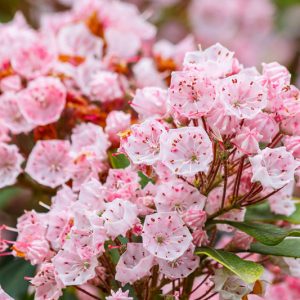
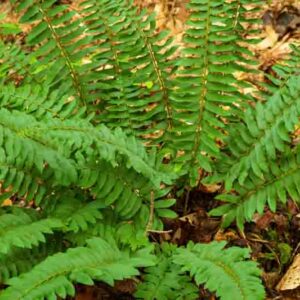
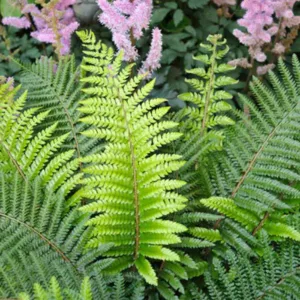
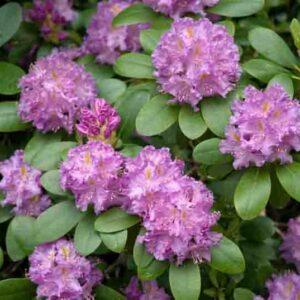
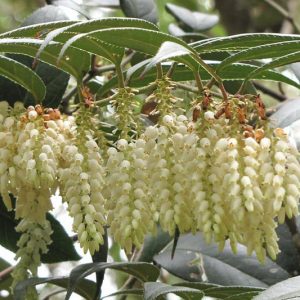
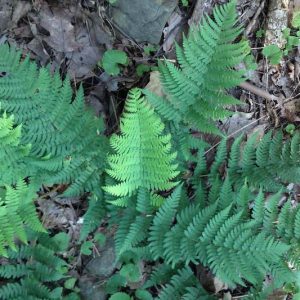
Two classic evergreen varieties, Rhododendron ‘English Roseum’ and ‘Roseum Elegans’, form a generous screen of glossy, dark green foliage and billowing pink blossoms. Beneath them, Leucothoe fontanesiana adds graceful, arching branches, while Dryopteris marginalis brings the quiet beauty of woodland ferns.
A rustic stone wall, mature trees, and a softly curving gravel path complete the picture. The result is a romantic, informal garden that feels wonderfully private without looking enclosed.
Main plants used: Rhododendron ‘English Roseum’, Rhododendron ‘Roseum Elegans’, Leucothoe fontanesiana, and Dryopteris marginalis.
The secret is using rhododendrons as living architecture. Unlike deciduous flowering shrubs, these broadleaf evergreens retain their foliage through winter, helping screen neighboring properties and create a sense of enclosure long after their flowers have faded.
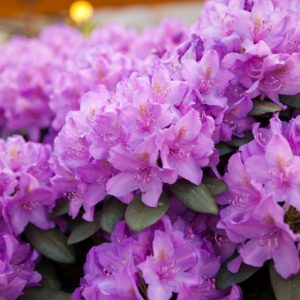
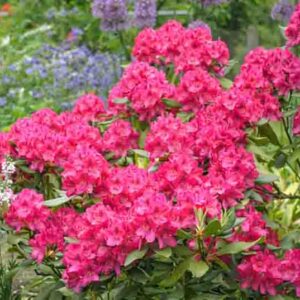
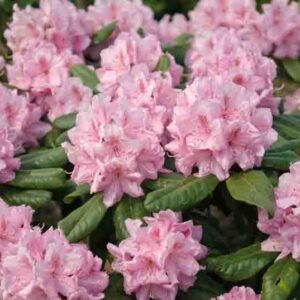
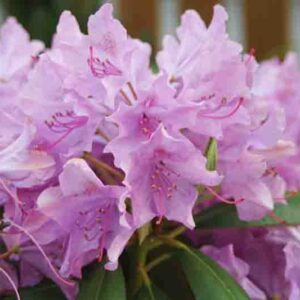
‘English Roseum’ produces generous clusters of rosy-lilac flowers, while ‘Roseum Elegans’ offers lovely lavender-pink blooms. Their similar colors create a harmonious display rather than a patchwork of competing shades.
Just as important, the planting is arranged in layers. The tallest rhododendrons form the backdrop, Leucothoe fills the middle ground, and ferns soften the lower edge. This prevents the shrubs from looking like a solid wall of foliage.
The curving gravel path adds another clever touch. Instead of revealing the entire garden at once, it draws the eye gradually around the planting, making the space feel deeper and more intriguing.
Rhododendron ‘English Roseum’ is a vigorous, cold-hardy evergreen rhododendron with large clusters of rosy-lilac flowers in late spring. Its dense, broad habit makes it a wonderful choice for informal privacy screens. Given suitable conditions, mature plants may reach approximately 6-10 ft. tall (1.8-3 m), sometimes more over time.
Rhododendron ‘Roseum Elegans’ is another exceptionally popular evergreen selection. Its abundant lavender-pink flowers appear in late spring to early summer, creating a particularly beautiful display against its deep green leaves. It can eventually develop into a large, spreading shrub approximately 6-10 ft. tall (1.8-3 m) or more, depending on age and growing conditions.
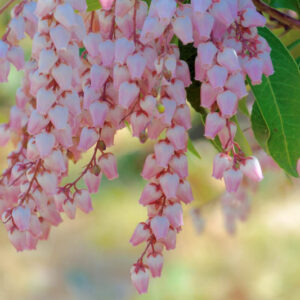
Leucothoe fontanesiana, commonly called Drooping Leucothoe, is a shade-tolerant evergreen shrub with arching branches and elegant, narrow leaves. Small, white, urn-shaped flowers hang beneath the foliage in spring. It provides a softer transition between the substantial rhododendrons and the lower woodland planting.
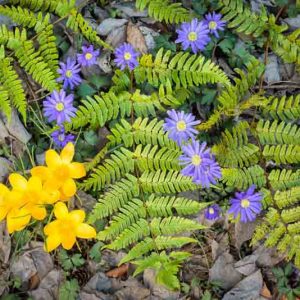
Dryopteris marginalis, or Marginal Wood Fern, forms handsome clumps of blue-green to dark green fronds. Native to eastern North America, this hardy fern is typically evergreen to semi-evergreen, depending on climate. Its tidy, vase-shaped habit makes it particularly useful along pathways and beneath shrubs.
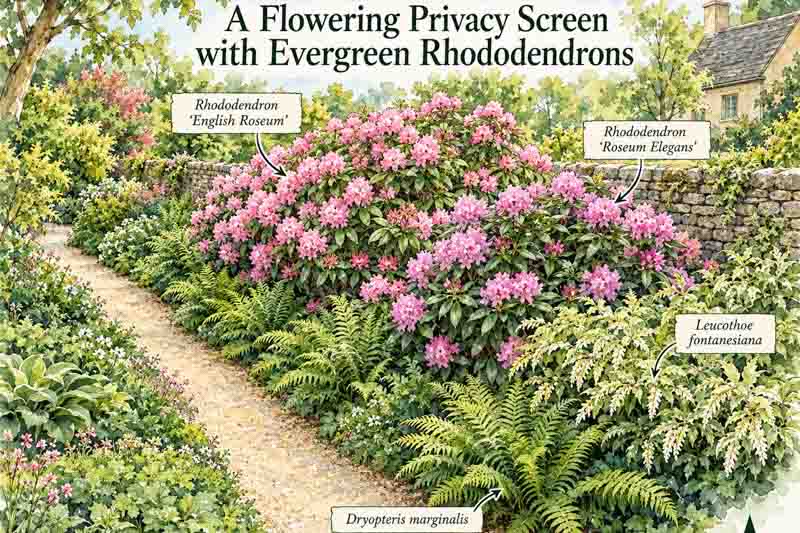
Create a flowering evergreen privacy screen with sweeping masses of pink rhododendrons, softer evergreen underplanting, and ferns that blend the shrubs into a natural woodland setting.
These are approximate visual proportions, not percentages of ground area or plant quantities.
Adjust spacing for local growing conditions, the selected plants’ expected mature spread, and the desired screening density.
Begin with the rhododendrons along the boundary, choosing positions where their eventual width will not crowd the path or neighboring property. Alternate small, irregular groups of ‘English Roseum’ and ‘Roseum Elegans’ for subtle variations in flower color. Add Leucothoe toward the foreground, allowing its arching foliage to soften the shrubs’ lower branches. Finish with repeating groups of Marginal Wood Fern along the path, creating a continuous woodland effect.
Absolutely, provided you have the right growing conditions and enough space. Large evergreen rhododendrons can create beautiful, substantial screens, particularly in gardens where a formal clipped hedge would feel out of place.
There are a few practical considerations. Rhododendrons grow relatively slowly compared with many conventional screening plants, so establishing privacy takes patience. Their naturally broad habit also makes them better suited to generous borders than very narrow property lines.
For an informal flowering screen, allow the shrubs to develop their natural shapes. Heavy, repeated clipping can sacrifice flowers and spoil their graceful outlines.
One important distinction: rhododendrons create an attractive visual screen, but their foliage may not provide completely solid, ground-level privacy, particularly beneath older shrubs. Underplanting helps fill those lower gaps.
Spring: clusters of pink and lavender flowers transform the rhododendrons into a spectacular flowering boundary. Leucothoe adds delicate white blossoms, while the ferns unfurl fresh fronds beneath the shrubs.
Summer: the flowers give way to handsome evergreen foliage. The combination of broad rhododendron leaves, arching Leucothoe, and finely divided ferns creates a lush, restful retreat.
Autumn and winter: the rhododendrons continue screening the garden. Leucothoe may develop attractive reddish or bronze winter tones, while Marginal Wood Fern often retains much of its foliage in sheltered conditions.
Check your soil pH before investing in a long rhododendron screen. These acid-loving shrubs are not a good choice for naturally alkaline or poorly drained sites unless suitable conditions can be created and maintained.
Think about mature size, too. A lovely young rhododendron can eventually become a substantial shrub, so position the screen far enough from walls, windows, and paths to allow for future growth.
For gardens with deer pressure, remember that rhododendrons are not reliably deer-resistant, particularly when young.
| Hardiness |
5 - 8 |
|---|---|
| Exposure | Full Sun, Partial Sun |
| Season of Interest | Spring (Late), Summer (Early) |
| Maintenance | Low |
| Water Needs | Average |
| Soil Type | Loam, Sand |
| Soil pH | Acid |
| Soil Drainage | Moist but Well-Drained |
| Characteristics | Showy, Evergreen |
| Attracts | Bees, Butterflies, Hummingbirds |
| Landscaping Ideas | Beds And Borders, Hedges And Screens |
| Garden Styles | Informal and Cottage, Pollinator Garden, Woodland Garden |

| Hardiness |
5 - 8 |
|---|---|
| Exposure | Full Sun, Partial Sun |
| Season of Interest | Spring (Late), Summer (Early) |
| Maintenance | Low |
| Water Needs | Average |
| Soil Type | Loam, Sand |
| Soil pH | Acid |
| Soil Drainage | Moist but Well-Drained |
| Characteristics | Showy, Evergreen |
| Attracts | Bees, Butterflies, Hummingbirds |
| Landscaping Ideas | Beds And Borders, Hedges And Screens |
| Garden Styles | Informal and Cottage, Pollinator Garden, Woodland Garden |
Recreate this garden. Specify the percentages you would like to have of each plant and input the dimensions of your garden space.We'll give you a shopping list so you know how many plants you need.
| Plant | Quantity | |
|---|---|---|
| Rhododendron 'English Roseum' | N/A | Buy Plants |
| Rhododendron 'Roseum Elegans' | N/A | Buy Plants |
| Leucothoe fontanesiana (Dog Hobble) | N/A | Buy Plants |
| Dryopteris marginalis (Marginal Wood Fern) | N/A | Buy Plants |
Create a membership account to save your garden designs and to view them on any device.
Becoming a contributing member of Gardenia is easy and can be done in just a few minutes. If you provide us with your name, email address and the payment of a modest $25 annual membership fee, you will become a full member, enabling you to design and save up to 25 of your garden design ideas.
Join now and start creating your dream garden!