A white, flour-like coating on your crape myrtle can twist new leaves and stop flower buds from opening. Learn how to identify powdery mildew, decide whether treatment is necessary, choose effective fungicides safely, correct the conditions encouraging infection, and select resistant cultivars for healthier foliage and spectacular summer flowers.
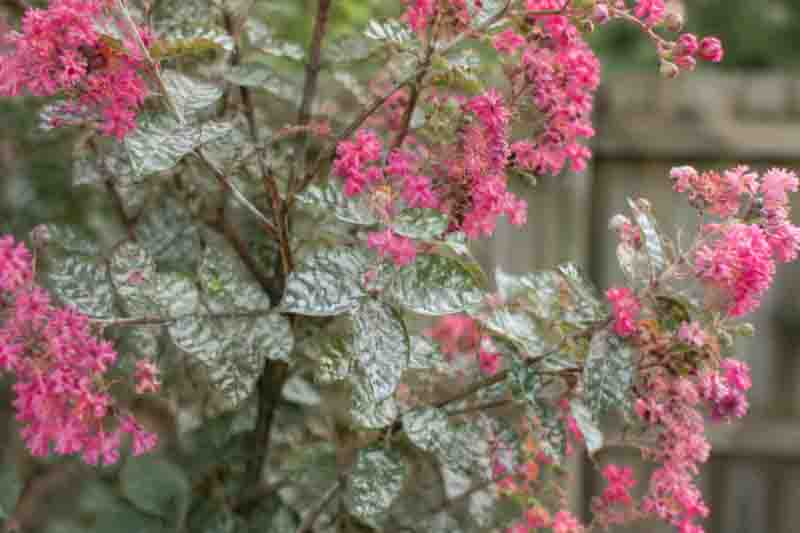


Your crape myrtle should be preparing a spectacular summer display. Instead, its fresh green leaves, tender shoots, and flower buds look as though someone dusted them with flour.
That white coating is probably powdery mildew, one of the most common diseases of crape myrtle. Although it rarely kills a healthy, established tree, a serious infection can twist young leaves, stunt new shoots, coat flower buds, and reduce or prevent blooming.
The good news is that powdery mildew is manageable. The best response is not always an immediate spray. Effective control begins with correct identification, an honest assessment of severity, better sunlight and airflow, removal of infected basal suckers, and – when treatment is justified – a fungicide applied early enough to protect healthy new growth.
This guide explains how to recognize powdery mildew on crape myrtle, why it develops, when it can safely be tolerated, which treatments may help, and how to prevent the disease from returning year after year.
Fast answer: Improve sunlight and airflow, remove infected suckers and a few badly affected shoots, avoid excessive nitrogen, and treat early with a product specifically labeled for powdery mildew on ornamental plants when the disease threatens new growth or flower buds.
Powdery mildew usually begins as small, pale, powdery spots on young leaves or tender shoot tips. The spots enlarge and merge until sections of the plant appear covered with a gray-white film.
On crape myrtle, the disease often attacks the newest and most valuable growth. Inspect:
As the infection progresses, young leaves may curl, pucker, twist, or remain unusually small. Shoots can become stunted. Flower buds may be coated with mildew, develop abnormally, or fail to open.
Older leaves may develop broad white patches without severe distortion. A heavily infected plant can look dull, gray, and prematurely aged even though much of the fungal growth remains on the plant surface.
Early warning: Do not wait for the whole canopy to turn white. Curling, puckering, or stunting of new leaves may appear before the powdery coating becomes dramatic.
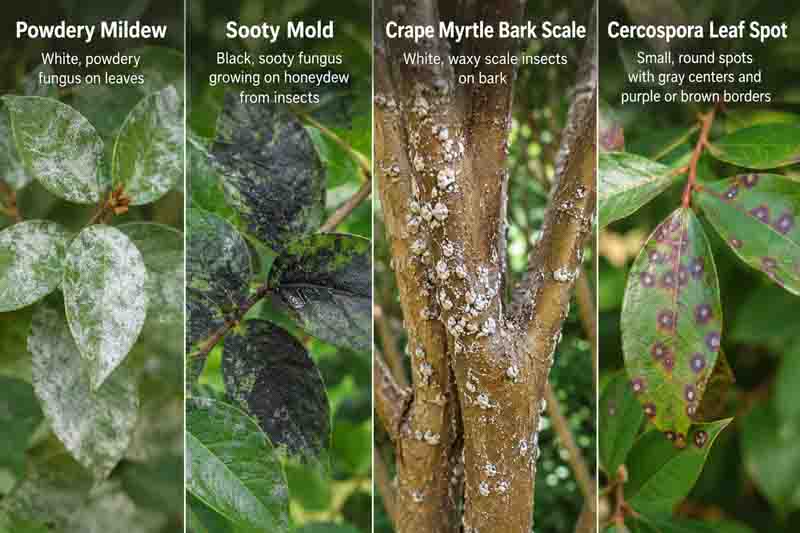
Powdery mildew is sometimes confused with sooty mold, crape myrtle bark scale, or Cercospora leaf spot. Correct identification matters because each problem requires a different response.
| What You See | Likely Problem | What It Means |
|---|---|---|
| White or gray powder on leaves, shoots, and buds | Powdery mildew | A fungal infection of susceptible plant tissue |
| Black coating on leaves, stems, bark, or surfaces below the tree | Sooty mold | Fungus growing on sticky honeydew produced by sap-feeding insects |
| White, gray, or felted bumps attached to trunks and branches | Crape myrtle bark scale | A sap-feeding insect infestation |
| Brown or dark leaf spots followed by yellowing and premature leaf drop | Cercospora leaf spot | A different fungal disease, often more noticeable later in summer |
Powdery mildew may look as though it can simply be wiped away. Rubbing the surface may remove some visible spores, but it does not cure the infected tissue.
Powdery mildew on crape myrtle is caused by Erysiphe lagerstroemiae. Its spores travel on air currents and infect susceptible tissue when temperature, humidity, and plant conditions are favorable.
The disease is often most noticeable in spring and fall, when nights are humid and temperatures are moderate. Unlike many fungal leaf diseases, powdery mildew does not require rain, dew, or continuously wet foliage to infect.
High nighttime humidity favors fungal development and spore production. Mild, relatively dry daytime conditions help spores disperse to fresh leaves, shoots, and flower buds.
Humid nights: Favor fungal growth and spore production.
Mild, drier days: Help spores disperse through the canopy.
Shade and crowding: Create a protected microclimate around tender leaves and buds.
Recurring powdery mildew usually means the cultivar, the planting site, or both strongly favor infection.
Crape myrtles perform best in full sun. A tree planted beside a building, beneath taller trees, or behind a dense hedge may receive bright ambient light without enough direct sunlight.
Shade creates a cooler, more humid canopy and often produces softer growth. It can also reduce flowering even when mildew is absent.
Crowded trunks, dense suckers, nearby shrubs, walls, fences, and tightly packed branches restrict air movement. Humid air remains around young tissue longer, allowing infection to intensify.
Resistance varies greatly among crape myrtles. Many older Lagerstroemia indica selections are susceptible, while numerous hybrids involving Lagerstroemia fauriei show much stronger resistance.
Heavy fertilization encourages rapid production of soft, succulent shoots. This tender growth is highly vulnerable to mildew and may create an overly dense canopy.
Suckers growing from the base of the plant are often among the first tissues infected. They remain shaded and crowded near the trunks and can become a local source of spores for the upper canopy.
Powdery mildew rarely kills a healthy, established crape myrtle. A light infection on mature foliage may be largely cosmetic, particularly late in the season.
Severe or repeated outbreaks can still cause meaningful damage. They may:
The location and timing of the infection matter. A few powdery spots on older leaves are less concerning than mildew covering new shoots and unopened flower buds.
Judge the damage, not just the color: Mildew affecting young growth and flower buds deserves more attention than a light late-season coating on mature leaves.
A light outbreak appearing late in the growing season on a mature, otherwise vigorous crape myrtle may not justify fungicide treatment. By then, most annual growth and flowering may already be complete, and the deciduous plant will soon shed its leaves naturally.
In that situation, concentrate on removing infected suckers, cleaning up heavily affected debris, improving sunlight and spacing where possible, and preparing a preventive plan for the following spring.
Spraying a large tree after the canopy is extensively infected may provide little visible improvement because fungicides protect healthy tissue more effectively than they restore already damaged leaves.
Consider treatment: Disease appears early, spreads rapidly, distorts new growth, or threatens flower buds.
Consider tolerating it: Infection is light, appears late, and the mature tree remains vigorous and has already completed most flowering.
If mildew is concentrated on basal suckers or a few young shoots, remove those stems promptly. Cut suckers close to their point of origin rather than leaving short stubs.
Do not strip large portions of the canopy. Excessive pruning can stimulate a flush of tender replacement growth that is highly susceptible to reinfection.
Remove unnecessary crowding around the plant. Thin only crossing, rubbing, congested, or badly positioned branches. Do not top the tree or hollow out the canopy.
If a young crape myrtle is permanently trapped in heavy shade, moving it during dormancy may provide a more lasting solution than annual spraying.
Explore crape myrtle care and growing requirements to help correct light, spacing, and planting-site problems.
Do not apply fertilizer merely because infected leaves look unhealthy. If the crape myrtle is already producing long, soft shoots, additional nitrogen may worsen susceptibility.
Fertilize only when weak growth, leaf color, or a soil test indicates a genuine nutrient need.
Water deeply enough to maintain healthy roots, preferably at soil level. Powdery mildew does not require wet foliage, so keeping leaves dry will not eliminate the disease.
Root-zone watering is generally more efficient and avoids creating conditions favorable to other leaf diseases. If overhead irrigation is necessary, water early enough for the canopy to dry during the day.
Avoid both prolonged drought and constantly saturated soil. Healthy, moderately growing plants tolerate disease pressure better than stressed plants.
Fungicides work best preventively or at the first signs of infection. They protect clean, expanding tissue more effectively than they restore leaves already covered with mildew.
Products and approved uses vary by location and change over time. Always select a product whose label permits use on ornamental trees or shrubs and specifically lists powdery mildew.
Systemic or locally systemic products may provide longer protection and can be useful when disease pressure is high. Labeled active ingredients may include:
Follow the application interval, coverage directions, and maximum number of treatments printed on the label.
Contact products must thoroughly cover susceptible foliage and often require more frequent reapplication. Depending on the label, options may include:
Contact products generally perform best before infection becomes severe. New growth may remain unprotected unless repeat applications are made as directed.
When repeated systemic fungicide applications are necessary, alternate active ingredients with different modes of action or fungicide-group numbers as directed by the labels. Repeatedly using the same active ingredient can encourage the development of fungicide resistance.
Read and follow the entire product label. Do not exceed application rates, repeat intervals, or seasonal limits.
Horticultural and neem oils can injure drought-stressed foliage or leaves treated during hot weather. Many labels restrict use when temperatures approach or exceed approximately 85°F, but the temperature limit on the specific product always takes priority.
Do not apply sulfur and horticultural oil together or within the separation period required by either label. Closely spaced oil and sulfur treatments can cause serious leaf injury.
Avoid spraying open flowers while pollinators are active, prevent drift, and keep all pesticides away from waterways.

Neem oil may help suppress early or mild powdery mildew when the product is labeled for fungal disease control and applied thoroughly according to schedule.
It is not an instant cure for a canopy already covered with disease. Neem performs best as part of an integrated approach that includes better sunlight, airflow, sucker removal, and early treatment.
Apply during the cooler part of the day, avoid drought-stressed plants, and never make the mixture stronger than the label allows. More oil does not mean better control and may burn the foliage.
Homemade baking-soda mixtures are widely recommended online, but their concentration, effectiveness, and plant safety are inconsistent. A strong mixture can scorch leaves, while a weak or poorly prepared spray may provide little control.
A commercially formulated potassium bicarbonate product labeled for ornamental powdery mildew offers more predictable concentration and directions than an improvised kitchen recipe.
Whatever product you choose, timing and coverage matter more than repeatedly increasing the strength of a homemade mixture.
A resistant cultivar planted in full sun with adequate room to grow is easier to maintain than a susceptible plant crowded into shade. Correct the conditions favoring mildew rather than treating only the white coating.
No cultivar should be considered completely immune under every possible growing condition, but many modern crape myrtles offer strong resistance and require far less intervention than highly susceptible selections.
Many hybrids involving Lagerstroemia fauriei are known for improved mildew resistance. Widely grown resistant selections include:
These cultivars vary greatly in mature height, flower color, growth habit, and cold tolerance. Disease resistance should be only one part of the selection process.
Gardenia profiles describing strong or high resistance include:
Browse crape myrtle varieties to compare mature size, flower color, foliage, hardiness, and disease resistance before choosing a replacement.
Home treatment may be impractical when a large tree has a canopy-wide infection beyond safe spraying reach. Contact a qualified arborist, plant-health professional, or local extension service when:
Never climb a ladder while carrying spraying equipment, and do not spray into a tall canopy when drift and coverage cannot be controlled.
Powdery mildew on crape myrtle is easy to recognize, but not every outbreak requires aggressive treatment. A light, late-season infection on a mature tree may be tolerated. Early disease coating young shoots and flower buds deserves a faster response.
Provide full sun, improve airflow, remove infected basal suckers, avoid excessive nitrogen, and choose resistant cultivars for new plantings. When fungicides are justified, apply them early, follow the label, distinguish systemic products from contact treatments, and rotate modes of action when repeated applications are required.
Powdery mildew on crape myrtle is caused by the fungus Erysiphe lagerstroemiae. It is favored by shade, poor air circulation, crowded growth, humid nights, and mild, relatively dry daytime conditions.
Powdery mildew rarely kills a healthy, established crape myrtle. Severe or repeated infections can distort leaves, stunt shoots, reduce vigor, and prevent flower buds from opening, particularly on young or susceptible plants.
Remove infected suckers and a few badly affected shoots, improve sunlight and airflow, stop excessive nitrogen fertilization, and use a fungicide labeled for ornamental powdery mildew if the infection threatens young growth or flower buds. Treat early for the best results.
Yes. Powdery mildew can infect developing flower buds and panicles, causing them to become distorted or fail to open. Early control is most important when mildew appears on tender shoots and unopened buds.
No. Powdery mildew does not require free water on the foliage to infect. High humidity is sufficient, and disease often develops during humid nights followed by mild, relatively dry days.
Neem oil may help suppress early or mild powdery mildew when the product is labeled for fungal disease control and applied thoroughly on schedule. It is less effective after severe infection and can injure hot or drought-stressed foliage if misapplied.
Remove a few heavily infected leaves or shoots when disease is localized, especially infected basal suckers. Do not strip large portions of the canopy, because excessive pruning can stress the plant and stimulate vulnerable new growth.
A light infection appearing late in the season on a mature, vigorous crape myrtle may not require fungicide treatment, especially after flowering is complete. Focus on sanitation, sucker removal, sunlight, airflow, and prevention the following spring.
Plant a resistant cultivar in full sun, provide enough room for air movement, remove basal suckers, avoid excess nitrogen, maintain healthy roots, and begin preventive treatment early if the disease has been severe in previous years.
Updated: July 2026 • Reviewed by Gardenia Editors
| Hardiness |
6 - 10 |
|---|---|
| Plant Type | Shrubs, Trees |
| Plant Family | Lythraceae |
| Genus | Lagerstroemia |
| Exposure | Full Sun |
| Season of Interest | Spring (Late), Summer (Early, Mid, Late), Fall |
| Height | 2' - 30' (60cm - 9.1m) |
| Spread | 2' - 30' (60cm - 9.1m) |
| Maintenance | Low |
| Water Needs | Average |
| Soil Type | Chalk, Loam, Sand |
| Soil pH | Acid, Neutral |
| Soil Drainage | Well-Drained |
| Characteristics | Showy |
| Tolerances | Deer, Drought, Clay Soil |
| Landscaping Ideas | Beds And Borders, Patio And Containers, Wall-Side Borders |
| Garden Styles | City and Courtyard, Informal and Cottage, Mediterranean Garden |
| Hardiness |
6 - 10 |
|---|---|
| Plant Type | Shrubs, Trees |
| Plant Family | Lythraceae |
| Genus | Lagerstroemia |
| Exposure | Full Sun |
| Season of Interest | Spring (Late), Summer (Early, Mid, Late), Fall |
| Height | 2' - 30' (60cm - 9.1m) |
| Spread | 2' - 30' (60cm - 9.1m) |
| Maintenance | Low |
| Water Needs | Average |
| Soil Type | Chalk, Loam, Sand |
| Soil pH | Acid, Neutral |
| Soil Drainage | Well-Drained |
| Characteristics | Showy |
| Tolerances | Deer, Drought, Clay Soil |
| Landscaping Ideas | Beds And Borders, Patio And Containers, Wall-Side Borders |
| Garden Styles | City and Courtyard, Informal and Cottage, Mediterranean Garden |
Create a membership account to save your garden designs and to view them on any device.
Becoming a contributing member of Gardenia is easy and can be done in just a few minutes. If you provide us with your name, email address and the payment of a modest $25 annual membership fee, you will become a full member, enabling you to design and save up to 25 of your garden design ideas.
Join now and start creating your dream garden!
Create a membership account to save your garden designs and to view them on any device.
Becoming a contributing member of Gardenia is easy and can be done in just a few minutes. If you provide us with your name, email address and the payment of a modest $25 annual membership fee, you will become a full member, enabling you to design and save up to 25 of your garden design ideas.
Join now and start creating your dream garden!