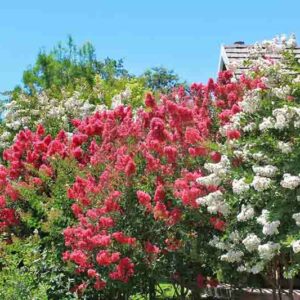
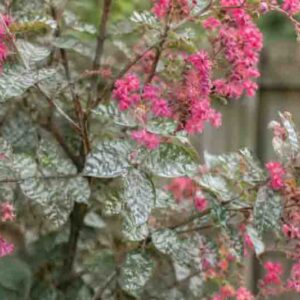
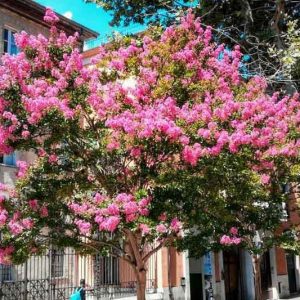
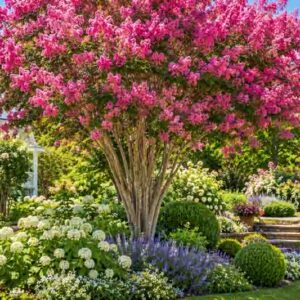
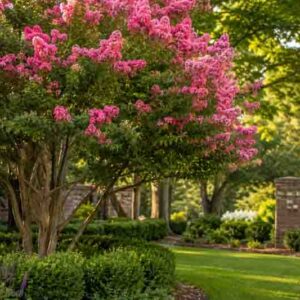
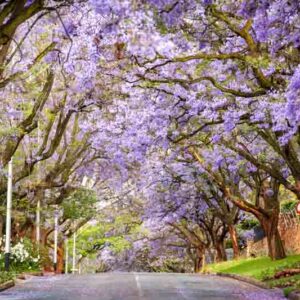
From patio-sized shrubs to magnificent flowering trees, crape myrtles come in a remarkable range of sizes. Discover the best dwarf, medium, and tree-form varieties, compare their mature dimensions, colors, habits, and landscape uses, and choose a cultivar that fits beautifully without constant pruning or future crowding.
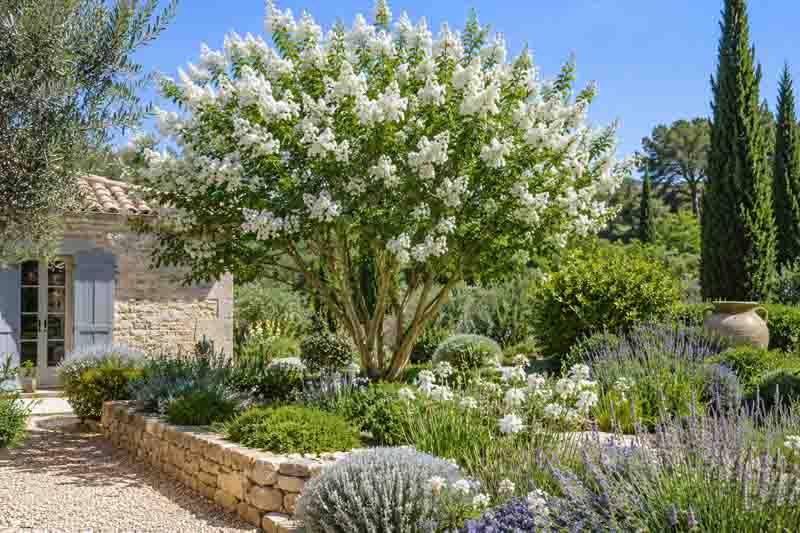


Crape myrtles are among the most rewarding flowering shrubs and trees for warm, sunny landscapes. Their ruffled summer flowers appear in shades of white, pink, lavender, purple, coral, magenta, and red, while colorful fall foliage, sculptural trunks, and peeling bark extend their beauty beyond the blooming season.
Bloom time varies with cultivar and climate, but many crape myrtles flower for several weeks and may produce additional flushes during a long, warm summer.
Yet the most important feature to consider is not flower color. It is mature size.
Crape myrtle, also commonly spelled crepe myrtle, includes miniature shrubs under 2 ft. tall, compact selections for patios and residential gardens, and substantial flowering trees with broad canopies. Choosing the correct cultivar from the beginning prevents blocked windows, crowded paths, interference with roofs and utility lines, and the severe annual topping commonly called “crape murder.”
This guide compares outstanding traditional and modern crape myrtle cultivars by mature height and spread, flower color, foliage, disease resistance, growth habit, and landscape use. The selection is not limited to plants currently profiled in Gardenia. Cultivars without Gardenia pages are included when they offer exceptional size, color, habit, breeding history, or landscape performance.
Use Gardenia’s crape myrtle comparison tool to explore additional Gardenia-listed cultivars and refine your shortlist.
Quick answer: Which crape myrtle size should you choose?
Crape myrtle size groups are practical landscape categories rather than strict botanical divisions. Nurseries, breeders, and horticultural references may describe the same cultivar as miniature, dwarf, semi-dwarf, medium, intermediate, or small tree size.
The ranges also overlap. A cultivar that matures at 12-15 ft. may be grown as a large shrub in one landscape and trained as a small multi-trunk tree in another. Always plan for the upper end of the published range, especially in climates with long, hot growing seasons.
Final dimensions vary with plant age, winter temperatures, growing-season length, soil fertility, irrigation, pruning history, and local conditions. A selection may become a substantial tree in the Deep South yet remain smaller or experience winter dieback near the colder edge of its range.
“Tree form” describes habit and training, not a precise size. Many medium crape myrtles can be trained with one or several exposed trunks. Training changes the silhouette, but it does not permanently reduce the plant’s genetically determined height and spread.
Choose the cultivar, not the pruning strategy
A crape myrtle capable of reaching 25 ft. will not become a healthy 8-ft. shrub through annual topping. Select a naturally compact cultivar for a small site instead of repeatedly cutting back a large tree.
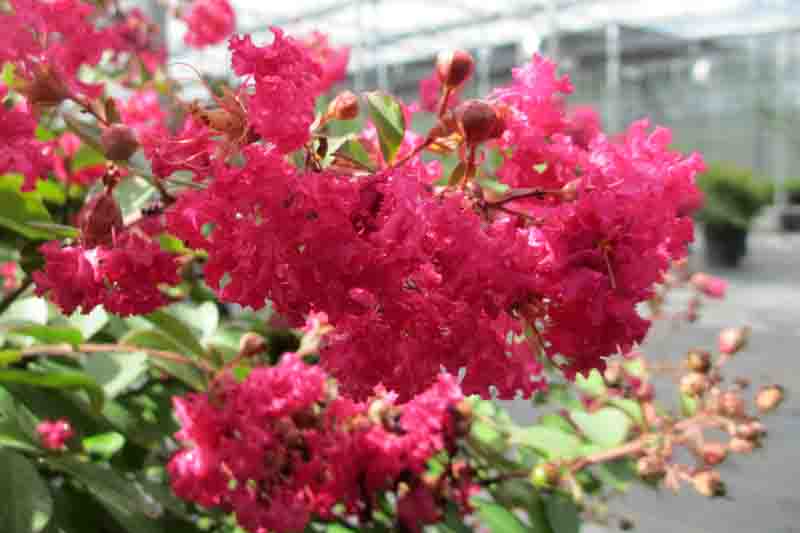
Dwarf crape myrtles grow primarily as compact flowering shrubs. They do not develop the tall trunks or spreading canopy of traditional tree forms, but they bring vivid summer color to containers, low borders, foundation beds, patios, and small urban gardens.
‘Chickasaw’ is among the smallest recognized crape myrtles, generally forming a low, spreading shrub approximately 1.5-2 ft. tall and 3-3.5 ft. wide. Lavender-pink flowers rise above dense foliage, creating a colorful ground-level display.
This miniature U.S. National Arboretum hybrid is highly tolerant of powdery mildew. Its broad, low habit suits path edges, rock gardens, low beds, containers, and the front of sunny borders. It should be treated as a flowering shrub rather than trained as a miniature tree.
‘Pocomoke’ forms a dense, rounded mound approximately 2-5 ft. tall and wide. Deep rose-pink flowers rise above glossy dark green foliage, which may develop bronze-red to reddish tones in fall.
This miniature U.S. National Arboretum hybrid is highly resistant to powdery mildew and resistant to leaf spot. It generally maintains its compact habit without annual size-control pruning.
‘Pocomoke’ is one of the best dwarf crape myrtles for planting below windows, lining a patio, creating a low flowering hedge, or adding summer color to a large container. It also works well in rock gardens and at the front of a sunny mixed border.
Infinitini® Magenta generally reaches approximately 2-4 ft. tall and wide. Saturated magenta flowers create a rich summer display above a naturally rounded shrub.
Its manageable dimensions suit containers, compact foundation beds, low flowering hedges, and repeated groups along a sunny path. Planting several together produces a more cohesive sweep of color than scattering single plants throughout the landscape.
Infinitini® Purple grows approximately 3-5 ft. tall and wide. Its vivid purple flowers and compact, rounded habit make it an excellent choice for gardeners who want rich purple color without planting a full-sized tree.
Use it in containers, small front gardens, mass plantings, low hedges, or sunny mixed borders. Its scale allows it to combine comfortably with perennials, roses, ornamental grasses, and lower evergreen shrubs.
Infinitini® Watermelon typically reaches about 2-4 ft. tall and wide. Brilliant watermelon-pink flowers cover its rounded canopy in summer, creating a cheerful accent in compact landscapes.
It works well in containers, mass plantings, patio beds, and sunny foundation borders. Infinitini® crape myrtles are promoted for disease-resistant foliage, although performance can still vary with cultivar, climate, air circulation, and local disease pressure.
Rikki Tikki® Rouge grows approximately 3-5 ft. tall and wide. Cherry-red flowers contrast with silvery green foliage and burgundy-purple new growth, providing ornamental color even before flowering begins.
Its mounded, shrubby habit and good disease resistance make it useful in patio containers, low hedges, foundation beds, mass plantings, and mixed borders. It is particularly effective where colorful foliage is as important as summer flowers.
Best crape myrtles for containers
Choose ‘Chickasaw’, ‘Pocomoke’, an Infinitini® cultivar, or Rikki Tikki® Rouge. Provide full sun, excellent drainage, and regular water during hot weather. Container-grown plants dry out faster and may be more vulnerable to winter cold than crape myrtles growing in the ground.
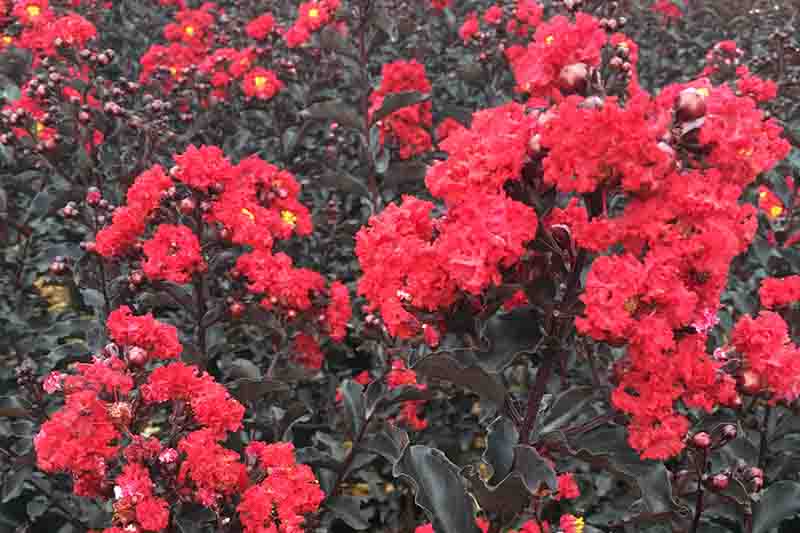
Medium crape myrtles are among the most versatile choices for residential landscapes. They provide enough height to anchor a border, soften a building, or screen a view without creating the scale of a large canopy tree.
Early Bird™ White grows approximately 5-6 ft. tall and 3-4 ft. wide. It is valued for beginning its display relatively early and producing additional flushes of clean white flowers during the growing season.
Its upright, compact habit makes it useful in foundation beds, small courtyards, narrow borders, large containers, and low seasonal screens. Its white flowers also combine easily with purple, blue, pink, silver, or deep green companion plants.
‘Hopi’ generally reaches approximately 7-10 ft. tall and wide, forming a rounded shrub or compact multi-trunk tree. Medium pink flowers are complemented by attractive bark and warm fall foliage.
This U.S. National Arboretum hybrid offers strong powdery mildew resistance. Its restrained dimensions suit courtyards, patios, entrance gardens, foundation corners, flowering hedges, and small lawns.
‘Zuni’ typically reaches approximately 8-10 ft. tall and wide. Medium lavender flowers appear above a vase-shaped canopy, followed by attractive fall color and smooth, ornamental bark.
It is an excellent choice where a lavender-flowering small tree is desired but a large cultivar such as ‘Muskogee’ would overwhelm the site. Use it in courtyards, entrance gardens, small lawns, or mixed borders.
‘Tonto’ commonly reaches approximately 8-15 ft. tall and 6-10 ft. wide. Vivid magenta-red to fuchsia flowers appear above dark green foliage that may turn red and orange in fall.
This U.S. National Arboretum hybrid offers excellent powdery mildew resistance and attractive bark. It can be grown as a large shrub or trained into a compact multi-trunk tree.
Use ‘Tonto’ as a courtyard specimen, flowering screen, foundation-corner accent, small lawn tree, or structural plant at the back of a mixed border. Because it can reach 15 ft., it should not be planted directly beneath low windows or utility lines.
‘Ebony Flame’ grows approximately 10-12 ft. tall and 7-8 ft. wide. Brilliant red flowers contrast dramatically with glossy purple-black foliage.
Its dark leaves provide strong color even before the flowers open. This makes ‘Ebony Flame’ particularly effective in contemporary gardens, entrance plantings, and borders featuring silver, chartreuse, white, or pale green companions.
It is highly resistant to powdery mildew and Cercospora leaf spot, adding reliable performance to its dramatic foliage and flower color.
Center Stage® Red grows approximately 6-12 ft. tall and 8 ft. wide. It combines nearly black foliage with vivid cherry-red flowers and an upright, vigorous habit.
This modern cultivar was selected for excellent disease resistance. It works well as a bold focal point, dark-foliaged hedge, informal screen, or dramatic backdrop for light-colored plants. Although upright, its mature width means it should not be treated as a narrow-columnar selection.
Delta Moonlight™ reaches approximately 8-12 ft. tall and 4-6 ft. wide. Crisp white flowers contrast strongly with deep burgundy foliage, producing a clean, high-contrast display.
Its relatively narrow habit suits side yards, fences, patios, compact screens, and small gardens. It is promoted for disease and pest resistance, heat tolerance, reblooming, and an upright habit. Like other Delta selections, it can also be trained as a small multi-trunk tree.
‘Plum Magic’ reaches approximately 12-14 ft. tall and 8-10 ft. wide. New leaves emerge plum-purple before becoming greener, while bright fuchsia-pink flowers create a vivid summer display.
Its dense, upright-rounded growth makes it especially useful as a flowering screen, informal hedge, front-yard specimen, or large shrub-border anchor. It can also be selectively trained to display several main trunks.
‘Lipan’ generally grows approximately 8-15 ft. tall and 6-10 ft. wide. Lavender flowers rise above an upright canopy, followed by colorful fall foliage and attractive bark.
This National Arboretum hybrid offers strong powdery mildew resistance and adapts well to hot, sunny landscapes. Its proportions suit small lawns, entrance plantings, patios, flowering screens, and mixed borders requiring a vertical accent.
‘Acoma’ generally reaches approximately 10-15 ft. tall and 6-10 ft. wide. Its pure white flowers are displayed on graceful, arching branches, giving the plant a broader and more softly weeping silhouette than most upright crape myrtles.
This mildew-resistant National Arboretum hybrid is particularly effective beside a patio, on a gentle slope, in a broad foundation bed, or as a small flowering specimen. Allow sufficient width for its naturally spreading branches.
Medium-size planning tip
A cultivar listed at 8-15 ft. should be given space for the full 15 ft. Plant it beside a window, at the corner of a building, or farther into the landscape rather than directly beneath a low sill.
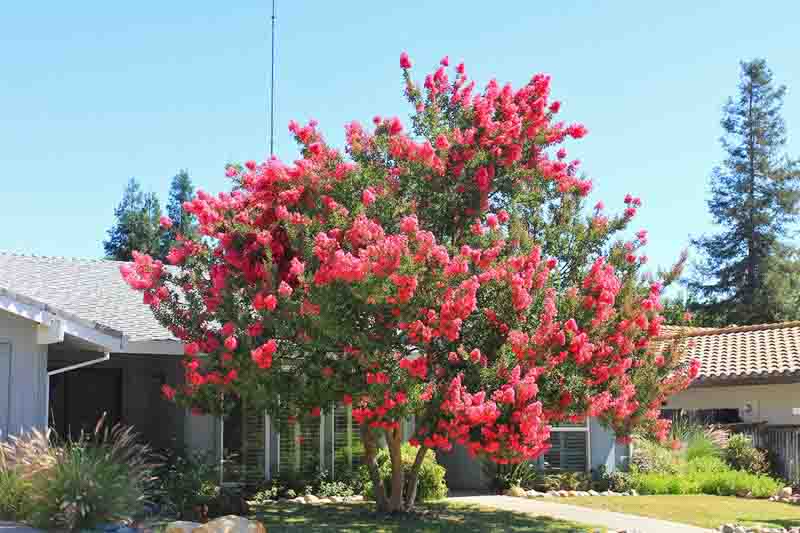
Tree-form crape myrtles generally reach 15 ft. or more and need open space for their trunks, roots, and canopies. Their greatest value comes from the combination of summer flowers, fall color, ornamental bark, branching structure, and winter silhouette.
‘Catawba’ commonly reaches approximately 10-15 ft. tall and 10-15 ft. wide. Its deep violet-purple flowers make it one of the strongest traditional choices for gardeners seeking saturated purple rather than pale lavender blooms.
The rounded to vase-shaped canopy, warm fall color, and good powdery mildew resistance make ‘Catawba’ useful as a small lawn tree, flowering screen, front-yard specimen, or colorful anchor in a large mixed border.
‘Sioux’ generally grows approximately 15-20 ft. tall and 10-15 ft. wide. Deep pink flowers crown an upright canopy, followed by vivid orange-red fall foliage and attractive bark.
Its relatively upright habit and excellent powdery mildew resistance make it one of the best small tree-form crape myrtles for medium-sized lawns, driveways, broad patios, entrance gardens, and street-side planting where adequate clearance is available.
‘Tuscarora’ commonly reaches approximately 15-25 ft. tall and 15-20 ft. wide. Dark coral-pink to watermelon-pink flowers crown a vigorous, broadly vase-shaped canopy.
Developed by the U.S. National Arboretum, ‘Tuscarora’ combines improved powdery mildew resistance with red-orange fall foliage and attractive mottled bark. Its mature dimensions place it firmly in the small-to-medium tree category rather than the foundation-shrub category.
‘Tuskegee’ generally reaches approximately 20-25 ft. tall and develops a broad, spreading crown. Deep pink to coral-pink flowers are followed by warm fall color and ornamental bark.
This substantial U.S. National Arboretum hybrid offers strong disease resistance and works well as a lawn tree, large flowering screen, street tree, or specimen in a spacious landscape. Its broad canopy requires generous lateral clearance.
‘Miami’ commonly grows approximately 20-25 ft. tall and 12-15 ft. wide. Dark pink to dark coral-pink flowers appear above an upright canopy, followed by russet-red to orange fall foliage.
As the tree matures, its bark exfoliates to reveal richly colored chestnut-brown trunks and branches. It also offers very good powdery mildew resistance and fairly good tolerance of Cercospora leaf spot.
‘Miami’ is excellent as a lawn tree, street tree, avenue specimen, tall seasonal screen, or focal point in a spacious front garden. Its upright habit is somewhat narrower than the broad canopy of ‘Natchez’, but it still requires generous clearance.
‘Muskogee’ commonly reaches approximately 20-30 ft. tall and 15-25 ft. wide, with older specimens potentially becoming larger in favorable southern climates.
Its pale lavender-pink flowers are carried above a high, upright crown that can provide useful summer shade. The soft flower color is noticeably lighter than the deep violet-purple of many cultivars marketed as purple crape myrtles.
This vigorous National Arboretum hybrid also offers excellent powdery mildew resistance, attractive fall color, and exfoliating bark. It is best suited to large lawns, driveways, avenues, broad medians, and expansive borders.
‘Natchez’ grows approximately 25-30 ft. tall and 15-25 ft. wide. Large clusters of pure white flowers cover its vase-shaped canopy from midsummer into early fall.
Dark green foliage may develop warm autumn color, but the bark is one of the plant’s greatest assets. Mature trunks exfoliate to reveal smooth cinnamon-brown surfaces that bring exceptional interest to the winter landscape.
‘Natchez’ also offers excellent powdery mildew resistance. Use it as a lawn specimen, flowering canopy tree, avenue tree, or focal point in a spacious garden where its broad crown and beautiful trunks can develop naturally.
Red Rocket® reaches approximately 20-30 ft. tall and 15-20 ft. wide. Its brilliant cherry-red flowers and vigorous growth create a dramatic summer focal point.
This fast-growing selection can be used as a lawn specimen, flowering avenue, large seasonal screen, or bold entrance tree. It is highly resistant to powdery mildew, although full sun, open air circulation, and appropriate spacing remain important for healthy growth.
Common tree-size mistake
A young tree-form crape myrtle may look small at the nursery. Before planting, visualize a mature canopy 20-30 ft. high and potentially 15-25 ft. wide. That simple step prevents future conflicts with roofs, paths, and overhead wires.
| Variety | Approximate Size | Flower Color | Disease-Resistance Notes | Best Use |
|---|---|---|---|---|
| ‘Chickasaw’ | 1.5-2 by 3-3.5 ft. | Lavender-pink | Highly tolerant of powdery mildew | Edging, containers, rock gardens |
| ‘Pocomoke’ | 2-5 by 2-5 ft. | Deep rose-pink | Highly resistant to powdery mildew | Containers, low hedges, foundations |
| Infinitini® Magenta | 2-4 by 2-4 ft. | Magenta | Promoted for disease-resistant foliage | Containers and mass planting |
| Infinitini® Purple | 3-5 by 3-5 ft. | Purple | Promoted for disease-resistant foliage | Low beds, hedges, containers |
| Rikki Tikki® Rouge | 3-5 by 3-5 ft. | Cherry-red | Good disease and pest resistance | Containers, low hedges, mass planting |
| Early Bird™ White | 5-6 by 3-4 ft. | White | Good disease and pest resistance | Small yards and compact screens |
| ‘Hopi’ | 7-10 by 7-10 ft. | Pink | Strong powdery mildew resistance | Courtyards and small lawns |
| ‘Zuni’ | 8-10 by 8-10 ft. | Lavender | Strong disease resistance | Small trees and courtyards |
| ‘Tonto’ | 8-15 by 6-10 ft. | Magenta-red | Excellent powdery mildew resistance | Courtyards, small trees, screens |
| Delta Moonlight™ | 8-12 by 4-6 ft. | White | Disease and pest resistant | Narrow screens and small trees |
| ‘Ebony Flame’ | 10-12 by 7-8 ft. | Red | Highly resistant to powdery mildew and Cercospora leaf spot | Dark-foliage focal points |
| Center Stage® Red | 6-12 by 8 ft. | Cherry-red | Promoted for excellent disease resistance | Screens and dark-foliage accents |
| ‘Acoma’ | 10-15 by 6-10 ft. | White | Strong powdery mildew resistance | Patios and arching specimens |
| ‘Plum Magic’ | 12-14 by 8-10 ft. | Fuchsia-pink | Good general disease resistance | Screens, hedges, large borders |
| ‘Lipan’ | 8-15 by 6-10 ft. | Lavender | Strong powdery mildew resistance | Entrances and small trees |
| ‘Catawba’ | 10-15 by 10-15 ft. | Deep purple | Good powdery mildew resistance | Small lawns and flowering screens |
| ‘Sioux’ | 15-20 by 10-15 ft. | Deep pink | Excellent powdery mildew resistance | Driveways and small trees |
| ‘Tuscarora’ | 15-25 by 15-20 ft. | Coral-pink | Very good powdery mildew resistance | Lawns, avenues, flowering screens |
| ‘Tuskegee’ | 20-25 ft. tall; broad crown | Deep coral-pink | Strong disease resistance | Large screens and lawn trees |
| ‘Miami’ | 20-25 by 12-15 ft. | Dark coral-pink | Very good powdery mildew resistance | Lawns, streets, avenues |
| ‘Muskogee’ | 20-30 by 15-25 ft. | Pale lavender-pink | Excellent powdery mildew resistance | Flowering canopies, lawns, avenues |
| ‘Natchez’ | 25-30 by 15-25 ft. | White | Excellent powdery mildew resistance | Large lawns and avenues |
| Red Rocket® | 20-30 by 15-20 ft. | Cherry-red | Highly resistant to powdery mildew | Large focal points and screens |

Use the Gardenia Plant Finder to narrow your choices by mature height, spread, hardiness, flower color, foliage color, sun exposure, soil, water needs, tolerance, and garden use.
Then use the Gardenia Design Tool to test mature spacing and see how each crape myrtle will relate to buildings, paths, neighboring plants, and the overall composition.
Planning at mature scale is essential. The slender plant purchased at a nursery may eventually become a broad multi-trunk tree with a canopy extending 20 ft. or more.
‘Chickasaw’ is among the smallest recognized crape myrtles, generally forming a shrub approximately 1.5-2 ft. tall and 3-3.5 ft. wide. ‘Pocomoke’ and Infinitini® cultivars are slightly larger dwarf alternatives.
‘Chickasaw’, ‘Pocomoke’, Infinitini® Magenta, Infinitini® Purple, Infinitini® Watermelon, and Rikki Tikki® Rouge are strong container choices. Provide full sun, excellent drainage, regular summer water, and a suitably large container.
‘Hopi’, ‘Zuni’, Delta Moonlight™, ‘Ebony Flame’, Center Stage® Red, and some plants of ‘Tonto’ or ‘Lipan’ commonly remain near 10 ft. Plan for the upper end of each published range in warm climates.
Choose ‘Pocomoke’ or an Infinitini® selection for a very small yard. Where there is room for a larger shrub or compact tree, consider Early Bird™ White, ‘Hopi’, ‘Zuni’, Center Stage® Red, ‘Ebony Flame’, ‘Tonto’, or ‘Lipan’.
‘Muskogee’ and ‘Natchez’ are among the best choices for substantial flowering canopies and light summer shade. ‘Miami’ and ‘Tuskegee’ are also excellent where a large ornamental tree will fit.
Annual topping may temporarily reduce height, but it cannot change a cultivar’s genetic size. Repeated severe pruning creates large wounds, dense weak shoots, delayed flowers, and an unnatural form. Choose a naturally compact cultivar instead.
Well-documented mildew-resistant cultivars include ‘Chickasaw’, ‘Pocomoke’, ‘Hopi’, ‘Zuni’, ‘Tonto’, ‘Acoma’, ‘Lipan’, ‘Sioux’, ‘Tuscarora’, ‘Tuskegee’, ‘Miami’, ‘Muskogee’, and ‘Natchez’. Full sun, adequate spacing, and good air circulation further reduce disease pressure.
No. Mature size varies with cultivar, climate, winter temperatures, growing-season length, soil, irrigation, fertility, age, and pruning history. Plants often grow larger in warm climates and may remain smaller or experience winter dieback in colder regions.
Shrub forms are naturally shorter, denser, and often branched close to the ground. Tree-form plants have exposed trunks and larger crowns. Training changes appearance, but it cannot turn a miniature cultivar into a large tree or permanently keep a tall cultivar dwarf.
The best crape myrtle is not simply the cultivar with the brightest flowers. It is the one whose mature height, spread, habit, foliage, disease resistance, and seasonal character suit the planting site.
Dwarf crape myrtles bring long-lasting color to containers and compact beds. Medium selections provide structure for patios, foundations, screens, and small yards. Tree forms offer dramatic flowering canopies, handsome bark, fall color, and light summer shade in spacious landscapes.
Choose by mature size from the beginning, and your crape myrtle can grow naturally, flower generously, and remain attractive for decades without severe annual pruning.
Updated: July 2026 – Reviewed by Gardenia Editors
| Hardiness |
6 - 10 |
|---|---|
| Plant Type | Shrubs, Trees |
| Plant Family | Lythraceae |
| Genus | Lagerstroemia |
| Exposure | Full Sun |
| Season of Interest | Spring (Late), Summer (Early, Mid, Late), Fall |
| Height | 2' - 30' (60cm - 9.1m) |
| Spread | 2' - 30' (60cm - 9.1m) |
| Maintenance | Low |
| Water Needs | Average |
| Soil Type | Chalk, Loam, Sand |
| Soil pH | Acid, Neutral |
| Soil Drainage | Well-Drained |
| Characteristics | Showy |
| Tolerances | Deer, Drought, Clay Soil |
| Landscaping Ideas | Beds And Borders, Patio And Containers, Wall-Side Borders |
| Garden Styles | City and Courtyard, Informal and Cottage, Mediterranean Garden |
| Hardiness |
6 - 10 |
|---|---|
| Plant Type | Shrubs, Trees |
| Plant Family | Lythraceae |
| Genus | Lagerstroemia |
| Exposure | Full Sun |
| Season of Interest | Spring (Late), Summer (Early, Mid, Late), Fall |
| Height | 2' - 30' (60cm - 9.1m) |
| Spread | 2' - 30' (60cm - 9.1m) |
| Maintenance | Low |
| Water Needs | Average |
| Soil Type | Chalk, Loam, Sand |
| Soil pH | Acid, Neutral |
| Soil Drainage | Well-Drained |
| Characteristics | Showy |
| Tolerances | Deer, Drought, Clay Soil |
| Landscaping Ideas | Beds And Borders, Patio And Containers, Wall-Side Borders |
| Garden Styles | City and Courtyard, Informal and Cottage, Mediterranean Garden |
Create a membership account to save your garden designs and to view them on any device.
Becoming a contributing member of Gardenia is easy and can be done in just a few minutes. If you provide us with your name, email address and the payment of a modest $25 annual membership fee, you will become a full member, enabling you to design and save up to 25 of your garden design ideas.
Join now and start creating your dream garden!
Create a membership account to save your garden designs and to view them on any device.
Becoming a contributing member of Gardenia is easy and can be done in just a few minutes. If you provide us with your name, email address and the payment of a modest $25 annual membership fee, you will become a full member, enabling you to design and save up to 25 of your garden design ideas.
Join now and start creating your dream garden!