Tuscarora Crape Myrtle, Tuscarora Crepe Myrtle, Tuscarora Crapemyrtle, Coral Pink Crape Myrtle, Coral Pink Crepe Myrtle, Hybrid Crape Myrtle, Crape Myrtle, Crepe Myrtle, Crapemyrtle, Lagerstroemia × egolfii 'Tuscarora', Lagerstroemia x egolfii 'Tuscarora'
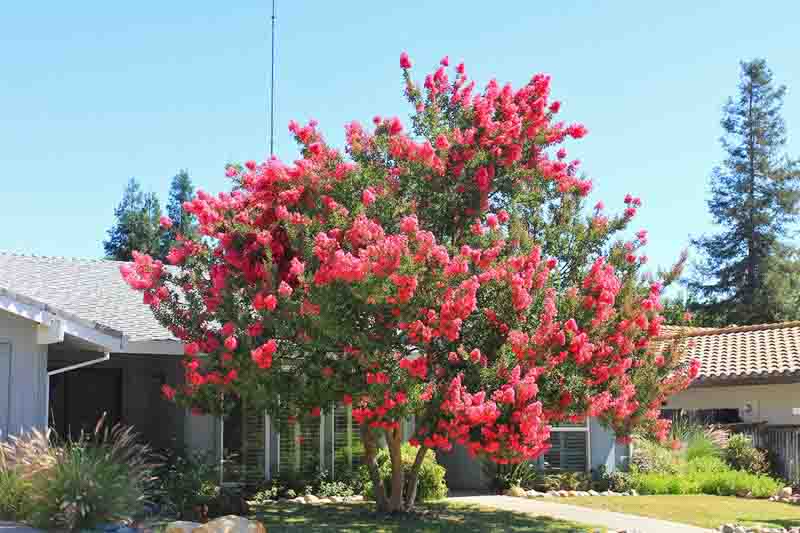


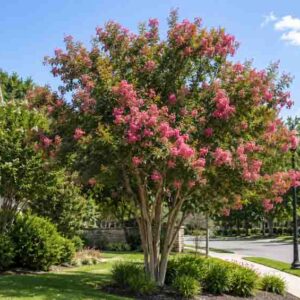
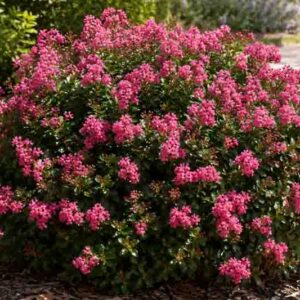
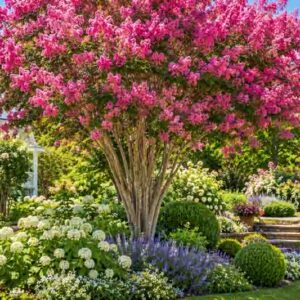
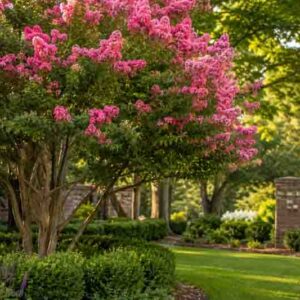
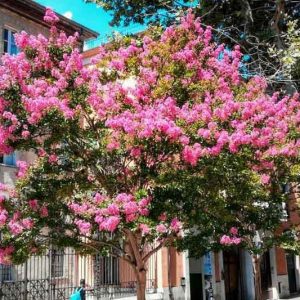
Lagerstroemia ‘Tuscarora’, commonly called Tuscarora crape myrtle or Tuscarora crepe myrtle, is a vigorous deciduous flowering tree celebrated for its abundant dark coral-pink blooms, broad vase-shaped crown, reddish-orange fall color, and attractive exfoliating bark. It creates a vivid summer focal point while remaining smaller than the largest tree-form crape myrtles.
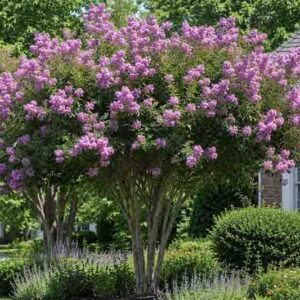
Developed by the U.S. National Arboretum, ‘Tuscarora’ is a hybrid crape myrtle selected for ornamental bark and improved disease resistance. In warm climates it commonly grows about 15 to 25 ft. tall and 15 to 20 ft. wide (4.5-7.5 m by 4.5-6 m), although regional sources report mature heights from approximately 16 to 23 ft. Its substantial canopy requires more room than a narrow foundation bed.
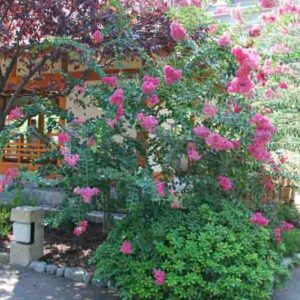
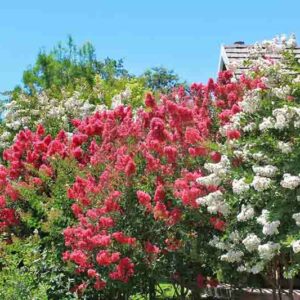
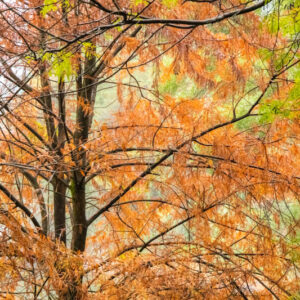
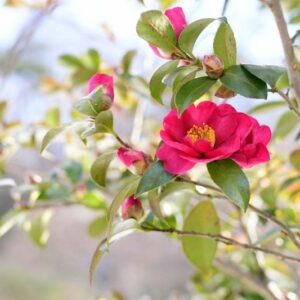
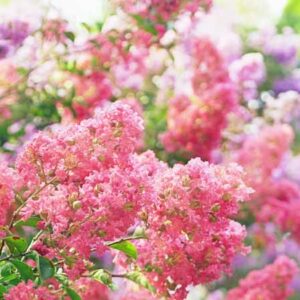
The crinkled flowers range from deep coral pink to watermelon pink and appear in large terminal panicles from midsummer into early fall. Dark green foliage may turn orange-red or reddish orange in autumn, while the light brown to tan bark gradually exfoliates to reveal a mottled trunk and branches with year-round visual interest.
Summary: Vigorous coral-pink crape myrtle with a broad vase-shaped crown, ornamental bark, and strong summer-to-fall color.
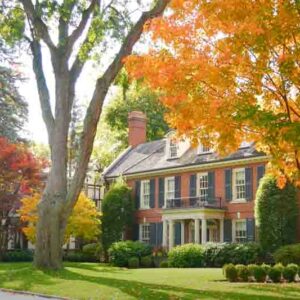
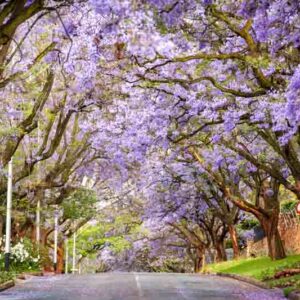
Use: Excellent as a specimen tree, lawn tree, avenue tree, flowering screen, large border accent, or street tree where space permits.
Highlight: Rich coral-pink flowers combine with reddish-orange fall color and mottled light-brown bark for multi-season impact.
Note: Give this tree enough room to develop naturally. Severe annual pruning destroys the graceful canopy and is unnecessary for flowering.
| Botanical Name | Lagerstroemia ×egolfii ‘Tuscarora’; often listed as Lagerstroemia ‘Tuscarora’ or Lagerstroemia indica ‘Tuscarora’ |
|---|---|
| Family | Lythraceae |
| Common Names | Tuscarora crape myrtle, Tuscarora crepe myrtle, hybrid crape myrtle |
| Origin | U.S. National Arboretum hybrid introduced in 1981 |
| Plant Type and Habit | Deciduous large shrub or small to medium-sized tree; broad vase-shaped, upright-spreading, arching, and commonly multi-stemmed |
| Hardiness (USDA) | Zones 6 to 9; top growth may suffer winter injury in colder Zone 6 locations |
| Size | Commonly 15-25 ft. tall and 15-20 ft. wide (4.5-7.5 m by 4.5-6 m) |
| Growth Rate | Moderate to fast in warm, favorable conditions |
| Sun and Exposure | Full sun; at least 6 hours of direct sunlight, with 8 or more hours ideal |
| Soil | Average, moderately fertile, well-drained clay, loam, or sandy soil; slightly acidic to neutral conditions are ideal |
| Bloom Time | Midsummer through early fall |
| Flower Color | Dark coral pink, coral-red, or watermelon pink |
| Foliage and Fall Color | Dark green summer foliage that may turn orange-red or reddish orange in fall |
| Bark | Mottled light brown to tan bark that exfoliates with age |
| Disease Resistance | Very good powdery mildew resistance and demonstrated field resistance to Cercospora leaf spot |
| Wildlife Value | Flowers may be visited by bees and other insects; best regarded as a supplemental floral resource |
| Deer Resistance | Not usually preferred by deer, but young growth may be browsed and trunks may be rubbed |
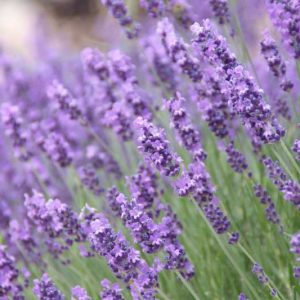
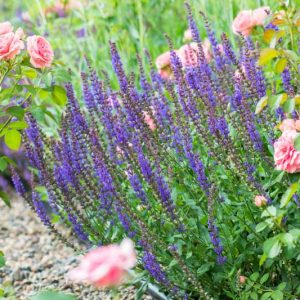
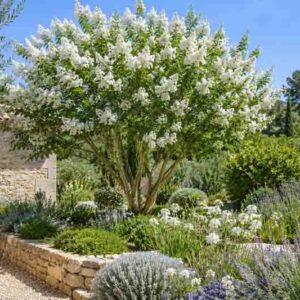
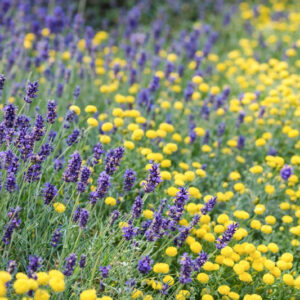
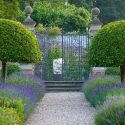
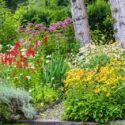
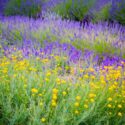
Set ‘Tuscarora’ against deep green evergreens, pale stone, or a soft blue sky to intensify its coral-pink flowers. At ground level, use silver foliage, ornamental grasses, and restrained yellow or lavender-blue flowers to keep the tree as the dominant focal point.
‘Tuscarora’ is one of the influential hybrid crape myrtles developed through the U.S. National Arboretum breeding program. Introduced in 1981, it combines ornamental qualities associated with common crape myrtle and Japanese crape myrtle ancestry, including richly colored flowers, exfoliating bark, improved cold tolerance, and strong resistance to powdery mildew.
The modern hybrid name Lagerstroemia ×egolfii ‘Tuscarora’ reflects its interspecific background. Nursery catalogs and older references frequently list it as Lagerstroemia indica ‘Tuscarora’. For general horticultural use, Lagerstroemia ‘Tuscarora’ remains clear and widely understood.
‘Tuscarora’ forms a broad vase-shaped crown with upright main branches and gracefully arching outer growth. It is usually grown as a multi-trunked tree, although young plants can be trained to three to five main stems or a single trunk where a more formal silhouette is desired.
Published dimensions vary with region and climate. Clemson lists approximately 23 ft. tall, NC State notes about 16 ft., and Missouri Botanical Garden reports up to 16-20 ft. in warmer areas. A practical landscape expectation is 15-25 ft. tall and 15-20 ft. wide, with smaller growth where winter injury is frequent. Provide ample clearance from roofs, wires, narrow paths, and neighboring trees.
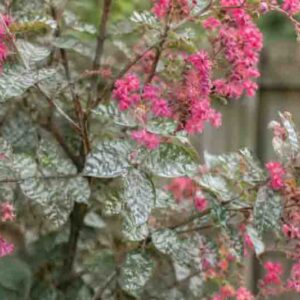
The large terminal panicles carry abundant crinkled flowers in shades described as dark coral pink, coral-red, or watermelon pink. The flowers are brighter and warmer than the pale pink of many traditional crape myrtles and can appear almost red under intense summer light.
Bloom generally begins in midsummer and continues through late summer, often reaching early fall in warm climates. Heat, full sun, healthy new growth, and adequate moisture during establishment support the heaviest display. Deadheading is unnecessary on mature trees and becomes impractical once the canopy develops.
The foliage matures to dark green and provides a dense backdrop for the coral flowers. Autumn color may include orange, red, and reddish-orange tones, although the intensity varies with weather, soil, and regional climate. Round seed capsules may persist after flowering and add fine winter detail.
The light brown to tan bark becomes increasingly ornamental with age. As the outer bark exfoliates, it reveals a softly mottled trunk and branches. The bark is less cinnamon-colored than that of ‘Natchez‘ but contributes strong winter interest when the natural multi-trunked framework is preserved.
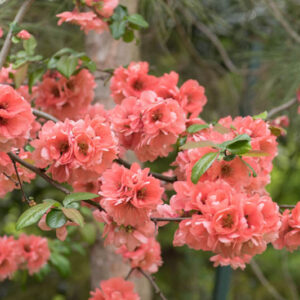
‘Tuscarora’ is usually described as coral pink rather than true red. Flower color can appear warmer, deeper, or more watermelon-red depending on light, heat, camera settings, and the stage of bloom.
‘Tuscarora’ is generally grown in USDA Zones 6 to 9 and performs best where summers are hot and long. In colder Zone 6 locations, top growth may be damaged or killed back during severe winters, resulting in a smaller, more shrub-like plant and later flowering. A sunny, protected site and a broad mulch layer help protect the root zone.
The flowers may be visited by bees and other insects, but ‘Tuscarora’ is best considered a supplemental floral resource. Combine it with native trees, grasses, and long-blooming perennials that provide a broader range of nectar, pollen, seeds, and shelter.
Crape myrtles are not usually the first woody plants selected by deer, but they are not completely deer-proof. Tender shoots may be browsed, and young trunks can be damaged by rubbing where deer pressure is high.
Once established, ‘Tuscarora’ tolerates heat and moderate drought. Newly planted trees need deep, regular irrigation while roots expand into the surrounding soil. Mature specimens bloom and retain foliage better when watered during prolonged dry periods, but poorly drained ground should be avoided.
Crape myrtle is not commonly regarded as toxic to people, cats, dogs, or horses. Nevertheless, ornamental plant material should not be intentionally eaten, and any concerning ingestion should be discussed with an appropriate medical or veterinary professional.
‘Tuscarora’ is not an aggressive spreading tree. Related Lagerstroemia indica material has naturalized in parts of the southeastern United States, however. Remove unwanted seedlings near sensitive natural areas and follow current regional guidance.
Full sun is strongly recommended. Provide at least six hours of direct sunlight daily; eight or more hours generally produce the heaviest flowering, densest canopy, strongest fall color, and lowest fungal disease pressure. Shade can result in fewer flowers, thinner growth, and branches that lean toward available light.
‘Tuscarora’ adapts to clay, loam, and sandy soil provided drainage is adequate. Slightly acidic to neutral conditions are ideal, although established plants tolerate a broader pH range. Alkaline soil may cause iron chlorosis, visible as yellow leaves with greener veins.
Water deeply after planting and whenever the developing root zone begins to dry. Deep irrigation encourages broad root development, while frequent shallow sprinkling does not. Once established, water during prolonged drought rather than keeping the soil continuously moist.
Excess nitrogen can produce lush leafy growth, delay flowering, increase aphid activity, and reduce winter hardiness. Apply compost or a modest slow-release fertilizer in spring only when soil fertility or plant performance indicates a need. A soil test is preferable to routine heavy feeding.
Plant in spring or fall with the root flare visible at or slightly above grade. Dig a hole wider than the root ball but no deeper, backfill with the existing soil, water thoroughly, and mulch over a broad area. Keep mulch several inches away from the trunks and allow for a mature spread of 15-20 ft.
Crape myrtles bloom on new wood, so necessary structural pruning is best completed in late winter or early spring. Remove dead, damaged, rubbing, crossing, or inward-growing branches and unwanted basal shoots. To develop a tree form, retain three to five strong trunks and gradually remove lower lateral branches as the plant matures.
Never top ‘Tuscarora’ or cut every branch back to large stubs. Severe annual pruning destroys the broad vase-shaped crown, creates clusters of weak shoots, hides the ornamental bark, and commits the owner to repeated corrective work. If the site is too small, select a more compact cultivar.
Preserve the graceful arching framework. Remove only what is dead, damaged, crowded, or necessary for clearance so the coral flowers, fall color, and exfoliating bark remain the focus.
Propagate ‘Tuscarora’ vegetatively from cuttings to preserve its flower color, growth habit, bark, and disease resistance. Seedlings will not reliably reproduce the cultivar and may differ substantially in size, bloom color, and performance.
‘Tuscarora’ has very good resistance to powdery mildew and has shown resistance to Cercospora leaf spot in field trials. Resistance lowers the likelihood and severity of disease but does not guarantee completely symptom-free foliage in every climate or site. Clemson also lists ‘Tuscarora’ among hybrid cultivars with moderate resistance to crape myrtle aphids.
These companions tolerate full sun, summer heat, and well-drained soil while providing enough contrast to showcase the coral-pink canopy. Plant them beyond the immediate trunk zone and account for increasing shade beneath the tree as it matures.
Tuscarora crape myrtle commonly grows about 15 to 25 feet tall and 15 to 20 feet wide. Mature size varies with climate, winter injury, soil, and pruning history, so the tree should be given generous space.
The flowers are dark coral pink, coral-red, or watermelon pink. They may appear warmer or deeper depending on sunlight, heat, camera settings, and the age of the flower cluster.
Tuscarora generally blooms from midsummer through late summer and often continues into early fall in warm climates. Full sun, summer heat, and adequate establishment watering support the best display.
Yes. Tuscarora has very good resistance to powdery mildew and has also shown resistance to Cercospora leaf spot in field trials. Full sun, airflow, and proper spacing remain beneficial.
Yes. Give Tuscarora at least six hours of direct sunlight each day, with eight or more hours ideal. Full sun supports heavier flowering, denser growth, stronger fall color, and lower fungal disease pressure.
Established Tuscarora trees tolerate summer heat and moderate drought. Newly planted specimens need regular deep watering, and mature trees flower and retain foliage better when irrigated during prolonged dry periods.
Prune selectively in late winter or early spring, removing dead, damaged, crossing, crowded, or inward-growing branches and unwanted suckers. Never top the tree or cut all branches back to large stubs.
Good companions include switchgrass, Russian sage, black-eyed Susan, pink muhly grass, threadleaf coreopsis, and purple coneflower. Their lighter foliage and blue, yellow, pink, or purple flowers complement the coral-pink canopy.
U.S. National Arboretum – International Cultivar Registration Authority, Lagerstroemia cultivars T-U: https://www.usna.usda.gov/science/icra/lagerstroemia/tu/
Clemson Cooperative Extension – Crape Myrtle Cultivars: https://hgic.clemson.edu/factsheet/crape-myrtle-varieties/
Clemson Cooperative Extension – Crape Myrtle Diseases and Insect Pests: https://hgic.clemson.edu/factsheet/crape-myrtle-diseases-insect-pests/
Clemson Cooperative Extension – Crape Myrtle Pruning: https://hgic.clemson.edu/factsheet/crape-myrtle-pruning/
Missouri Botanical Garden – Lagerstroemia indica ‘Tuscarora’: https://www.missouribotanicalgarden.org/PlantFinder/PlantFinderDetails.aspx?taxonid=261536
NC State Extension Plant Toolbox – Lagerstroemia indica and cultivars: https://plants.ces.ncsu.edu/plants/lagerstroemia-indica/
Updated: July 2026 • Reviewed by Gardenia Editors
| Hardiness |
6 - 9 |
|---|---|
| Heat Zones |
7 - 9 |
| Climate Zones | 7, 8, 9, 10, 12, 13, 14, 15, 18, 19, 20, 21, H1, H2 |
| Plant Type | Shrubs, Trees |
| Plant Family | Lythraceae |
| Genus | Lagerstroemia |
| Common names | Crepe Myrtle |
| Exposure | Full Sun |
| Season of Interest | Summer (Mid, Late), Fall |
| Height | 15' - 25' (4.6m - 7.6m) |
| Spread | 15' - 20' (4.6m - 6.1m) |
| Spacing | 180" - 300" (4.6m - 7.6m) |
| Maintenance | Low |
| Water Needs | Average |
| Soil Type | Chalk, Loam, Sand |
| Soil pH | Acid, Neutral |
| Soil Drainage | Well-Drained |
| Characteristics | Showy |
| Tolerances | Drought, Deer, Clay Soil, Heat |
| Attracts | Bees, Birds |
| Garden Uses | Beds And Borders, Hedges And Screens, Patio And Containers, Wall-Side Borders |
| Garden Styles | City and Courtyard, Informal and Cottage, Mediterranean Garden, Pollinator Garden |
| Toxic to Humans | No known toxicity |
| Toxic to Cats | Not toxic |
| Toxic to Dogs | Not toxic |
| Toxic to Horses | Not toxic |


| Hardiness |
6 - 9 |
|---|---|
| Heat Zones |
7 - 9 |
| Climate Zones | 7, 8, 9, 10, 12, 13, 14, 15, 18, 19, 20, 21, H1, H2 |
| Plant Type | Shrubs, Trees |
| Plant Family | Lythraceae |
| Genus | Lagerstroemia |
| Common names | Crepe Myrtle |
| Exposure | Full Sun |
| Season of Interest | Summer (Mid, Late), Fall |
| Height | 15' - 25' (4.6m - 7.6m) |
| Spread | 15' - 20' (4.6m - 6.1m) |
| Spacing | 180" - 300" (4.6m - 7.6m) |
| Maintenance | Low |
| Water Needs | Average |
| Soil Type | Chalk, Loam, Sand |
| Soil pH | Acid, Neutral |
| Soil Drainage | Well-Drained |
| Characteristics | Showy |
| Tolerances | Drought, Deer, Clay Soil, Heat |
| Attracts | Bees, Birds |
| Garden Uses | Beds And Borders, Hedges And Screens, Patio And Containers, Wall-Side Borders |
| Garden Styles | City and Courtyard, Informal and Cottage, Mediterranean Garden, Pollinator Garden |
| Toxic to Humans | No known toxicity |
| Toxic to Cats | Not toxic |
| Toxic to Dogs | Not toxic |
| Toxic to Horses | Not toxic |
How many Lagerstroemia ‘Tuscarora’ (Crape Myrtle) do I need for my garden?
| Plant | Quantity | |
|---|---|---|
| Lagerstroemia ‘Tuscarora’ (Crape Myrtle) | N/A | Buy Plants |
Create a membership account to save your garden designs and to view them on any device.
Becoming a contributing member of Gardenia is easy and can be done in just a few minutes. If you provide us with your name, email address and the payment of a modest $25 annual membership fee, you will become a full member, enabling you to design and save up to 25 of your garden design ideas.
Join now and start creating your dream garden!
Create a membership account to save your garden designs and to view them on any device.
Becoming a contributing member of Gardenia is easy and can be done in just a few minutes. If you provide us with your name, email address and the payment of a modest $25 annual membership fee, you will become a full member, enabling you to design and save up to 25 of your garden design ideas.
Join now and start creating your dream garden!