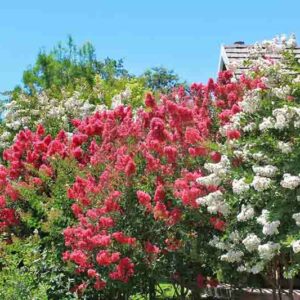
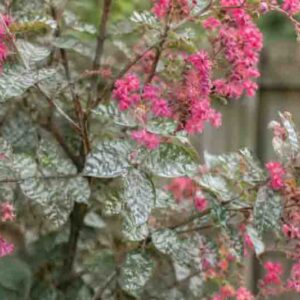
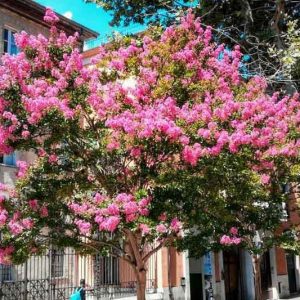
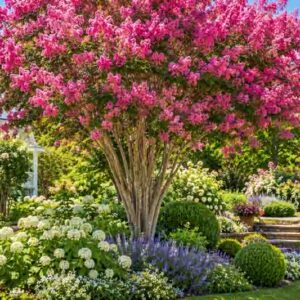
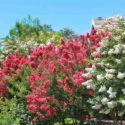
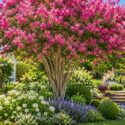
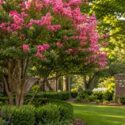
From luminous white and delicate lavender to vivid pink, purple, coral, and red, crape myrtles offer a remarkable summer palette. Compare outstanding classic and modern cultivars by flower color, mature size, foliage, disease resistance, and landscape use to find the right combination for your sunny garden.
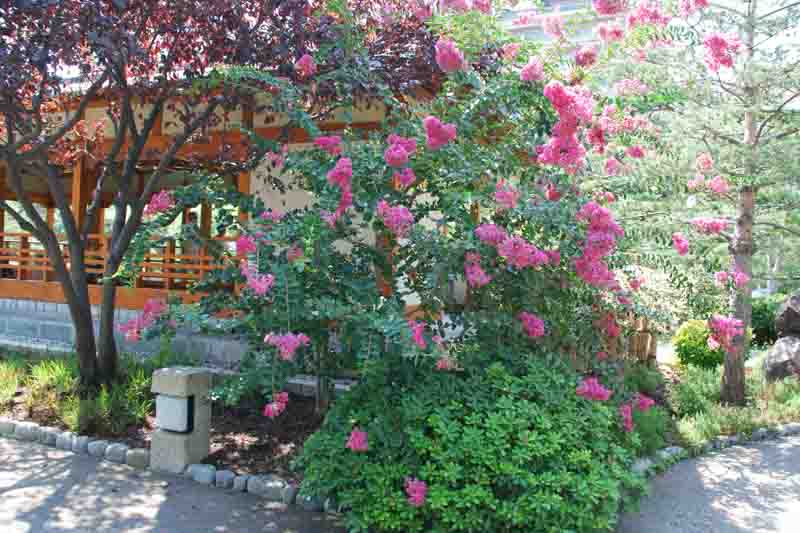


Crape myrtles are celebrated for their long-lasting summer flowers, which range from luminous white and pale blush to coral, magenta, crimson, lavender, violet, and deep purple. Modern breeding has expanded the palette even further by pairing colorful blooms with green, burgundy, plum, silver-green, or nearly black foliage.
Flower color is often the first feature gardeners notice, but it should never be considered alone. Mature height and spread, foliage color, growth habit, disease resistance, bark, and the surrounding landscape all determine whether a cultivar will look and perform well.
A white crape myrtle may remain a compact 6-ft. shrub or develop into a broad 30-ft. tree. A red-flowering cultivar may have traditional green leaves or glossy black foliage. Purple and lavender are not interchangeable either: some cultivars produce saturated violet-purple flowers, while others bloom in softer blue-lavender or lavender-pink shades.
This guide compares outstanding white, pink, coral, red, purple, and lavender crape myrtles, including classic U.S. National Arboretum hybrids and modern compact or dark-foliaged introductions. The selection is not limited to plants currently profiled in Gardenia. Cultivars without Gardenia pages are included when they offer exceptional color, habit, size, disease resistance, or landscape performance.
Use Gardenia’s crape myrtle comparison tool to compare additional Gardenia-listed selections by flower color, mature dimensions, foliage, hardiness, and growing requirements.
Quick guide: Which crape myrtle color should you choose?
Crape myrtle flower colors are useful selection guides, but they are not perfectly fixed. The same cultivar may look different depending on the light, weather, flower age, moisture, photography, and surrounding colors.
Color names are useful, not absolute
Whenever possible, compare photographs of established plants in natural light and verify the cultivar name. A plant sold simply as “purple crape myrtle” may produce lavender, violet, or magenta-purple flowers rather than the deep purple you expect.
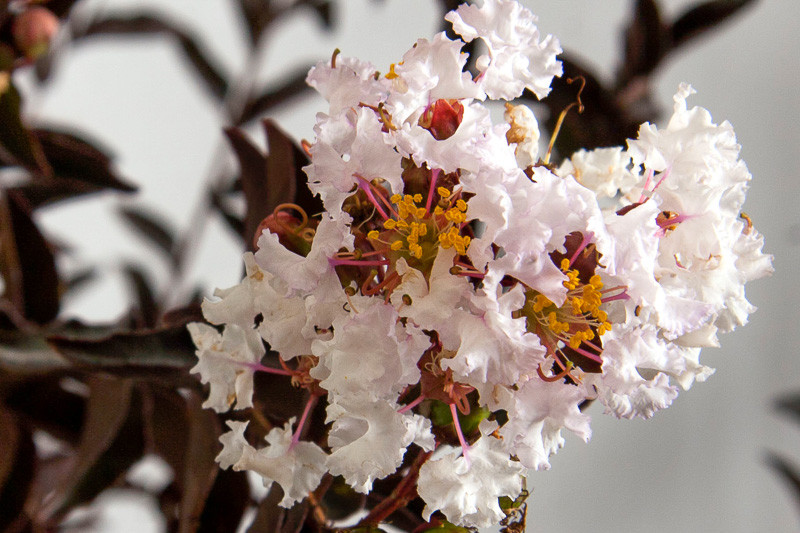
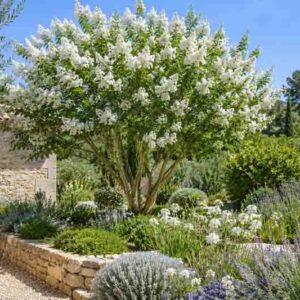
White crape myrtles bring clarity and brightness to summer landscapes. Their flowers are especially striking against dark evergreen backgrounds, brick walls, burgundy foliage, and shaded woodland edges.
Early Bird™ White grows approximately 5-6 ft. tall and 3-4 ft. wide. Clean white flowers appear on a compact, upright plant that begins blooming relatively early and may produce additional flushes during the growing season.
Its restrained dimensions make it an excellent white crape myrtle for small gardens, narrow foundation beds, courtyards, large containers, and compact screens.
‘Acoma’ generally reaches approximately 10-15 ft. tall and 6-10 ft. wide. Pure white flowers line graceful, arching branches, producing a broader and more softly weeping silhouette than most upright crape myrtles.
This mildew-resistant U.S. National Arboretum hybrid is particularly effective beside a patio, on a gentle slope, in a broad foundation bed, or as a small flowering specimen. Allow enough width for its natural form.
Delta Moonlight™ reaches approximately 8-12 ft. tall and 4-6 ft. wide. Crisp white flower panicles glow against deep burgundy foliage, creating one of the strongest light-and-dark contrasts among medium crape myrtles.
Its relatively narrow, upright habit suits side yards, compact screens, fence lines, patios, and contemporary gardens. It is promoted for disease and pest resistance, heat tolerance, and reblooming.
Thunderstruck™ White Flash™ grows approximately 12-15 ft. tall and 8-12 ft. wide. Its white to softly blushed flowers stand out against glossy purple-black foliage.
This vigorous selection makes a dramatic specimen, flowering screen, small lawn tree, or large border focal point. The blooms may show a faint pink blush rather than remaining uniformly pure white throughout their display.
Thunderstruck™ White Lightning™ grows approximately 20-30 ft. tall and 10-15 ft. wide. White flowers contrast with dark purple foliage on a vigorous, upright tree.
It is best suited to lawns, tall screens, driveways, and spacious borders rather than confined foundation beds. Its narrower spread can be useful where a tall white-flowering tree is desired without the broad canopy of ‘Natchez’.
‘Natchez’ grows approximately 25-30 ft. tall and 15-25 ft. wide. Large clusters of pure white flowers cover its broad, vase-shaped canopy from midsummer into early fall.
This National Arboretum hybrid is equally valued for its cinnamon-brown exfoliating bark, elegant trunks, and excellent powdery mildew resistance. It is one of the finest white crape myrtles for lawns, avenues, and large gardens.
Best white crape myrtle by size
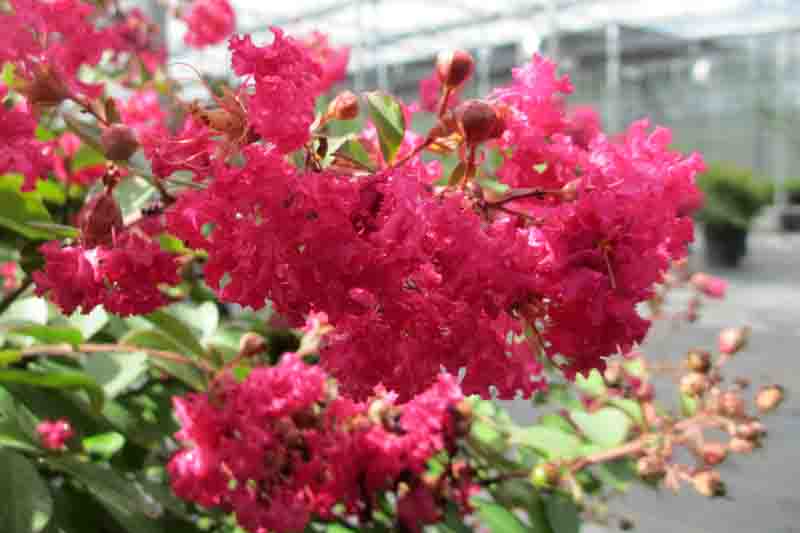
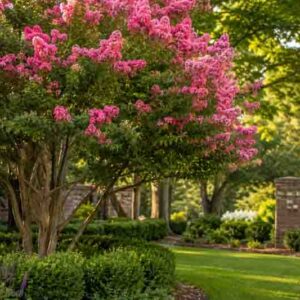
Pink is the broadest crape myrtle color family. It includes blush, rose, watermelon, fuchsia, magenta, salmon, and coral-pink cultivars. Look beyond the general label and consider the exact shade, foliage, and mature size.
Infinitini® Watermelon grows approximately 2-4 ft. tall and wide. Brilliant watermelon-pink flowers cover its compact, rounded canopy in summer.
This dwarf shrub is ideal for patio containers, low hedges, mass plantings, and small foundation beds.
‘Pocomoke’ forms a dense mound approximately 2-5 ft. tall and wide. Deep rose-pink flowers rise above glossy green foliage that may develop bronze-red tones in fall.
This miniature National Arboretum hybrid is highly resistant to powdery mildew and resistant to leaf spot. It suits containers, low hedges, foundation beds, and planting below windows.
Infinitini® Magenta grows approximately 2-4 ft. tall and wide. Saturated magenta flowers create a rich display above a naturally rounded dwarf shrub.
Its compact habit works well in containers, low flowering hedges, mass plantings, and small sunny borders. It offers a warmer, pinker effect than a true purple cultivar.
‘Hopi’ generally reaches approximately 7-10 ft. tall and wide. Medium pink flowers are accompanied by attractive bark and warm fall foliage.
Its manageable size and strong powdery mildew resistance make it a dependable choice for courtyards, patios, entrance gardens, foundation corners, and small lawns.
‘Tonto’ grows approximately 8-15 ft. tall and 6-10 ft. wide. Its flowers are commonly described as magenta-red, fuchsia-red, or dark pink, illustrating how crape myrtle color categories can overlap.
This National Arboretum hybrid offers excellent powdery mildew resistance, colorful fall foliage, and attractive bark. It works well as a compact tree, courtyard specimen, or flowering screen.
Center Stage® Pink grows approximately 6-12 ft. tall and 8 ft. wide. Bright pink flowers appear above glossy black foliage, providing strong contrast from spring through summer.
This vigorous cultivar was selected for improved disease resistance and works well as a specimen, flowering hedge, screen, or dark-foliaged backdrop.
Center Stage® Coral reaches approximately 6-12 ft. tall and 8 ft. wide. Its coral flowers carry peach, salmon, orange, pink, and red undertones above black-purple foliage.
The warm coloring is especially effective beside gold, blue, silver, or pale green plants. Use it as a focal point, informal hedge, or sunny screen.
‘Plum Magic’ reaches approximately 12-14 ft. tall and 8-10 ft. wide. Bright fuchsia-pink flowers appear above foliage that emerges plum-purple before becoming greener.
Its dense, upright-rounded habit makes it useful as a flowering screen, informal hedge, large border anchor, or front-yard specimen.
Delta Fusion™ grows approximately 8-12 ft. tall and 4-6 ft. wide. Dark pink flowers contrast vividly with burgundy foliage on a relatively narrow, upright plant.
It is well suited to compact screens, side yards, contemporary borders, and small multi-trunk trees.
Delta Fuchsia™ grows approximately 8-12 ft. tall and 4-6 ft. wide. Vivid fuchsia flowers rise above dark burgundy foliage.
Its narrow habit makes it useful along fences, beside patios, or wherever a medium crape myrtle must fit within limited width.
‘Sioux’ grows approximately 15-20 ft. tall and 10-15 ft. wide. Deep pink flowers crown an upright canopy, followed by vivid orange-red fall foliage and ornamental bark.
Its excellent powdery mildew resistance makes it one of the best pink tree-form crape myrtles for medium lawns, driveways, entrance gardens, and street-side planting.
‘Tuscarora’ reaches approximately 15-25 ft. tall and 15-20 ft. wide. Dark coral-pink to watermelon-pink flowers crown a vigorous, broadly vase-shaped canopy.
This National Arboretum hybrid combines improved powdery mildew resistance with red-orange fall color and attractive mottled bark.
‘Tuskegee’ generally reaches approximately 20-25 ft. tall and develops a broad crown. Deep pink to coral-pink flowers are followed by warm fall color and ornamental bark.
Its substantial canopy and strong disease resistance suit large lawns, seasonal screens, streets, and open landscapes.
‘Miami’ grows approximately 20-25 ft. tall and 12-15 ft. wide. Its flowers are dark pink to dark coral-pink rather than true red.
The upright canopy, orange-red fall foliage, chestnut-brown bark, and very good powdery mildew resistance make it an outstanding large pink-flowering tree.
Choosing among pink, coral, and magenta
Choose Infinitini® Watermelon for bright compact color, Infinitini® Magenta for a richer dwarf selection, ‘Hopi’ for classic pink, ‘Plum Magic’ for fuchsia, Center Stage® Coral for peachy coral, or ‘Tuscarora’ for a large watermelon-coral tree.
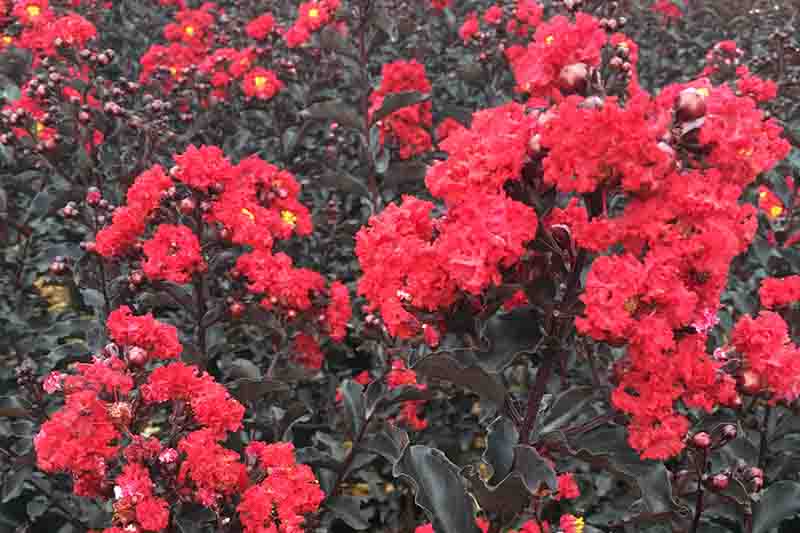
True red is among the most sought-after crape myrtle colors, but descriptions often blur cherry-red, crimson, cerise, magenta-red, and deep pink. The following cultivars create the clearest red effect.
Rikki Tikki® Rouge grows approximately 3-5 ft. tall and wide. Cherry-red flowers contrast with silver-green leaves and burgundy-purple new growth.
Its compact habit makes it an excellent red crape myrtle for containers, low hedges, mass planting, and small gardens.
Center Stage® Red grows approximately 6-12 ft. tall and 8 ft. wide. Cherry-red to cerise flowers stand out against nearly black foliage.
This upright, vigorous cultivar was selected for excellent disease resistance and makes a bold specimen, hedge, screen, or dark-foliaged anchor.
‘Ebony Flame’ grows approximately 10-12 ft. tall and 7-8 ft. wide. Brilliant red flowers contrast with glossy purple-black foliage.
It is highly resistant to powdery mildew and Cercospora leaf spot, making it an outstanding red selection for contemporary gardens, entrance plantings, informal screens, and mixed borders.
Delta Flame™ generally grows approximately 8-12 ft. tall and 4-6 ft. wide. Dark red flowers rise above deep burgundy foliage on an upright, relatively narrow plant.
It is useful for narrow flowering screens, fence lines, contemporary borders, and small multi-trunk specimens.
‘Miss Frances’ grows approximately 15-20 ft. tall and 10-15 ft. wide. Large deep red flowers appear over an extended summer period above lustrous green foliage.
Its rounded habit and ornamental bark make it a valuable tree-form red selection for lawns, privacy screens, large borders, and streets.
Red Rocket® reaches approximately 20-30 ft. tall and 15-20 ft. wide. Brilliant cherry-red flowers crown a vigorous, fast-growing tree.
It is highly resistant to powdery mildew and makes a dramatic lawn specimen, flowering avenue, large seasonal screen, or entrance tree.
Best red crape myrtle by size
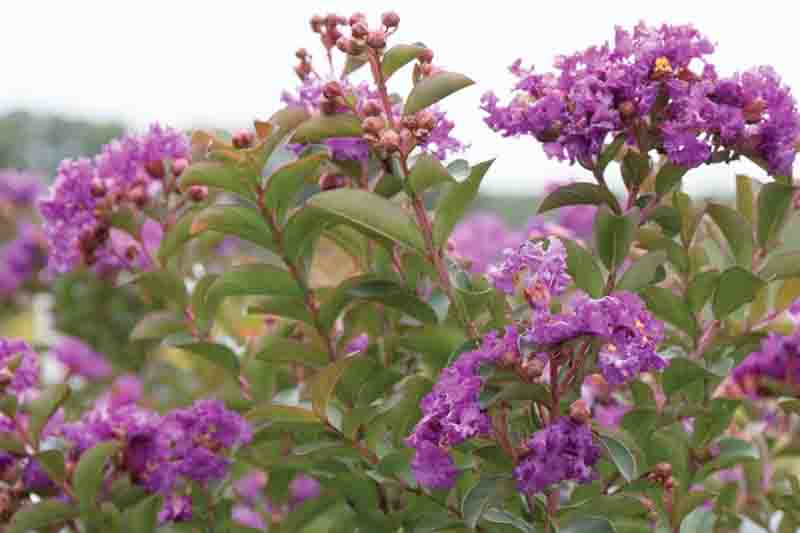
Purple-flowering crape myrtles range from vivid violet to deep purple and purple-magenta. They pair especially well with silver foliage, chartreuse grasses, white flowers, pale stone, and light-colored buildings.
Infinitini® Purple grows approximately 2-4 ft. tall and wide. Brilliant purple flowers cover a compact, rounded shrub.
Its dwarf size makes it one of the best choices for purple color in containers, low beds, mass plantings, and small urban gardens.
‘Catawba’ grows approximately 10-15 ft. tall and 10-15 ft. wide. Deep violet-purple flowers appear above a rounded to vase-shaped canopy.
Its saturated color, warm fall foliage, and good powdery mildew resistance make it one of the best traditional purple crape myrtles for small lawns, flowering screens, and front-yard specimens.
Infinitini® Orchid belongs to the warmer boundary between purple, orchid, and magenta. It forms a compact shrub, 2-4 ft. tall and wide, and produces bright orchid-purple flowers rather than the deep violet of ‘Catawba’.
It is useful where a warmer purple is desired in a container, low hedge, or compact border.
For the strongest purple effect
Choose Infinitini® Purple for a dwarf shrub or ‘Catawba’ for a substantial shrub or small tree. Orchid and magenta cultivars create a warmer, pinker version of purple.
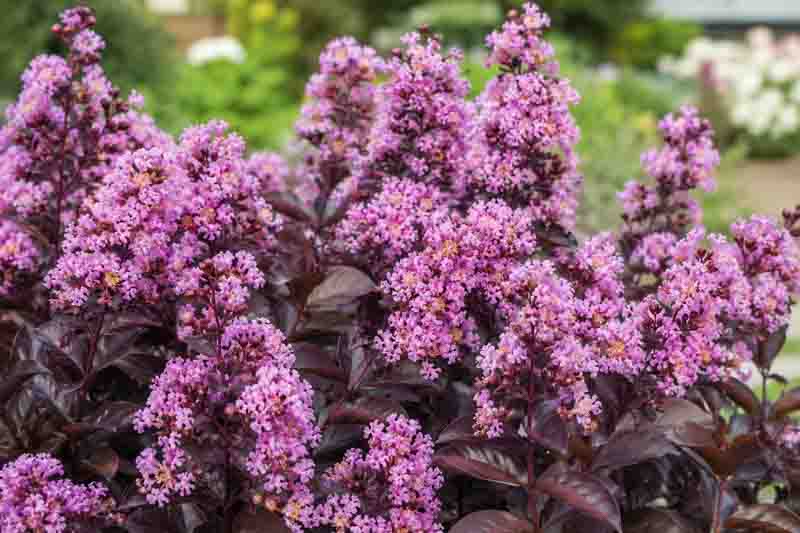
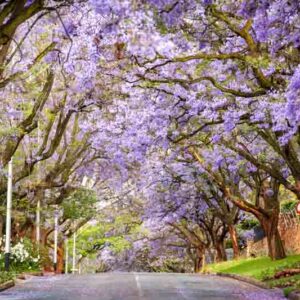
Lavender crape myrtles create a softer, cooler effect than true purple cultivars. Their flowers may appear pale violet, blue-lavender, lilac, or lavender-pink depending on the selection and light.
‘Zuni’ reaches approximately 8-10 ft. tall and wide. Medium lavender flowers appear above a compact, vase-shaped canopy, followed by fall color and ornamental bark.
It is an excellent choice for courtyards, small lawns, entrance gardens, and mixed borders where ‘Muskogee’ would become too large.
‘Lipan’ grows approximately 8-15 ft. tall and 6-10 ft. wide. Lavender flowers rise above an upright canopy, followed by colorful fall foliage and attractive bark.
This National Arboretum hybrid offers strong powdery mildew resistance and suits patios, entrance plantings, flowering screens, and small lawns.
Delta Eclipse™ grows approximately 8-12 ft. tall and 4-6 ft. wide. Lavender flowers contrast vividly with dark burgundy foliage on a narrow, upright plant.
It is a strong choice for compact screens, side yards, patio borders, contemporary gardens, and small multi-trunk trees.
Thunderstruck™ Lavender Blast™ grows approximately 12-15 ft. tall and 8-12 ft. wide. Soft lavender flowers contrast with glossy gray-purple to nearly black foliage.
Its vigorous, freely branching habit makes it useful as a specimen, flowering screen, hedge, or small lawn tree.
‘Muskogee’ grows approximately 20-30 ft. tall and 15-25 ft. wide. Its flowers are pale lavender-pink rather than deep purple.
This vigorous National Arboretum hybrid offers a high flowering canopy, excellent powdery mildew resistance, fall color, and exfoliating bark. It is best suited to large lawns, avenues, driveways, and broad medians.
Purple or lavender?
Choose Infinitini® Purple or ‘Catawba’ for saturated purple. Choose ‘Zuni’, ‘Lipan’, Delta Eclipse™, Thunderstruck™ Lavender Blast™, or ‘Muskogee’ for a softer lavender effect.
| Cultivar | Flower Color | Approximate Size | Foliage | Best Use |
|---|---|---|---|---|
| Early Bird™ White | White | 5-6 by 3-4 ft. | Green | Compact gardens and narrow beds |
| ‘Acoma’ | White | 10-15 by 6-10 ft. | Green | Arching specimens and patios |
| Delta Moonlight™ | White | 8-12 by 4-6 ft. | Dark burgundy | Narrow screens |
| White Flash™ | White to blush | 12-15 by 8-12 ft. | Purple-black | Specimens and screens |
| White Lightning™ | White | 20-30 by 10-15 ft. | Dark purple | Tall screens and lawns |
| ‘Natchez’ | Pure white | 25-30 by 15-25 ft. | Green | Large lawns and avenues |
| Infinitini® Watermelon | Watermelon-pink | 2-4 by 2-4 ft. | Green | Containers and low hedges |
| ‘Pocomoke’ | Deep rose-pink | 2-5 by 2-5 ft. | Glossy green | Low hedges and foundations |
| Infinitini® Magenta | Magenta | 2-4 by 2-4 ft. | Green | Containers and mass planting |
| ‘Tonto’ | Magenta-red | 8-15 by 6-10 ft. | Green | Courtyards and screens |
| Center Stage® Pink | Bright pink | 6-12 by 8 ft. | Black | Screens and focal points |
| Center Stage® Coral | Coral | 6-12 by 8 ft. | Black-purple | Bold sunny accents |
| Delta Fusion™ | Dark pink | 8-12 by 4-6 ft. | Burgundy | Narrow screens |
| Delta Fuchsia™ | Fuchsia | 8-12 by 4-6 ft. | Burgundy | Patios and narrow beds |
| ‘Plum Magic’ | Fuchsia-pink | 12-14 by 8-10 ft. | Plum, then greener | Screens and large borders |
| ‘Sioux’ | Deep pink | 15-20 by 10-15 ft. | Green | Driveways and small trees |
| ‘Tuscarora’ | Coral-pink | 15-25 by 15-20 ft. | Green | Lawns and avenues |
| ‘Miami’ | Dark coral-pink | 20-25 by 12-15 ft. | Green | Lawns, streets, and screens |
| Rikki Tikki® Rouge | Cherry-red | 3-5 by 3-5 ft. | Silver-green with burgundy growth | Containers and mass planting |
| Center Stage® Red | Cherry-red to cerise | 6-12 by 8 ft. | Nearly black | Focal points and screens |
| Delta Flame™ | Dark red | 8-12 by 4-6 ft. | Burgundy | Narrow red screens |
| ‘Ebony Flame’ | Red | 10-12 by 7-8 ft. | Purple-black | Dark-foliage specimens |
| ‘Miss Frances’ | Deep red | 15-20 by 10-15 ft. | Green | Lawns and large borders |
| Red Rocket® | Cherry-red | 20-30 by 15-20 ft. | Green | Large focal points and screens |
| Infinitini® Purple | Purple | 2-4 by 2-4 ft. | Green | Containers and low borders |
| ‘Catawba’ | Deep violet-purple | 10-15 by 10-15 ft. | Green | Small lawns and screens |
| ‘Zuni’ | Lavender | 8-10 by 8-10 ft. | Green | Courtyards and small lawns |
| ‘Lipan’ | Lavender | 8-15 by 6-10 ft. | Green | Entrances and small trees |
| Delta Eclipse™ | Lavender | 8-12 by 4-6 ft. | Dark burgundy | Narrow accents and screens |
| Lavender Blast™ | Soft lavender | 12-15 by 8-12 ft. | Gray-purple to black | Specimens and screens |
| ‘Muskogee’ | Pale lavender-pink | 20-30 by 15-25 ft. | Green | Large lawns and avenues |

Use the Gardenia Plant Finder to filter crape myrtles by flower color, mature height, spread, foliage, hardiness, sun exposure, soil, water needs, and garden use.
Then use the Gardenia Design Tool to see how white, pink, red, purple, or lavender crape myrtles will relate to buildings, paths, surrounding foliage, and companion plants.
Include foliage and bark in the design rather than planning around summer flowers alone. A well-chosen crape myrtle can contribute spring foliage, months of bloom, autumn color, ornamental bark, and an elegant winter framework.
Crape myrtles flower in white, blush, pale pink, rose, watermelon, fuchsia, coral, magenta, red, lavender, violet, and purple. Cultivar descriptions vary, and flowers may fade or shift slightly as they age.
Choose Early Bird™ White for a compact garden, Delta Moonlight™ for narrow dark-foliaged contrast, ‘Acoma’ for an arching small tree, White Flash™ for a medium dark-leaved specimen, or ‘Natchez’ for a large white canopy.
Red Rocket®, ‘Miss Frances’, ‘Ebony Flame’, Center Stage® Red, and Delta Flame™ are strong red selections. Their shades range from cherry-red and cerise to deep red, and intensity varies with light and flower age.
Center Stage® Red and ‘Ebony Flame’ combine red flowers with nearly black or purple-black foliage. Delta Flame™ is another dark-foliaged red selection with a narrower habit.
Infinitini® Purple is an excellent dwarf choice, while ‘Catawba’ is one of the best traditional deep violet-purple cultivars for a larger shrub or small tree.
Purple cultivars produce richer, more saturated violet or purple flowers. Lavender cultivars are softer and often have blue, lilac, gray, or pink undertones. Flower descriptions may overlap among growers.
‘Zuni’ generally reaches about 8-10 ft., while ‘Lipan’ grows approximately 8-15 ft. Delta Eclipse™ offers lavender flowers, dark foliage, and a relatively narrow spread of about 4-6 ft.
Yes. Flowers may become paler or shift slightly in tone as they age. Sunlight, heat, rainfall, and photography also affect how the color appears.
No. Unlike some hydrangeas, crape myrtle flower color is determined primarily by genetics and does not reliably change from pink to blue or purple in response to soil pH.
The best crape myrtle color is the one that works with the plant’s mature size, foliage, habit, disease resistance, and surroundings. A vivid red tree may be spectacular in a large lawn but unsuitable beneath a window, while a compact purple or watermelon-pink shrub may be perfect for a patio container.
White cultivars bring brightness and elegance. Pink, coral, and magenta selections offer the widest range of warm shades. Red crape myrtles create strong focal points, while purple and lavender varieties introduce cooler tones that blend naturally with many garden palettes.
Choose a named cultivar, plan for its mature dimensions, and consider foliage and bark alongside flower color. The result will be a crape myrtle that fits naturally and contributes beauty through more than one season.
Updated: July 2026 – Reviewed by Gardenia Editors
| Hardiness |
6 - 10 |
|---|---|
| Plant Type | Shrubs, Trees |
| Plant Family | Lythraceae |
| Genus | Lagerstroemia |
| Exposure | Full Sun |
| Season of Interest | Spring (Late), Summer (Early, Mid, Late), Fall |
| Height | 2' - 30' (60cm - 9.1m) |
| Spread | 2' - 30' (60cm - 9.1m) |
| Maintenance | Low |
| Water Needs | Average |
| Soil Type | Chalk, Loam, Sand |
| Soil pH | Acid, Neutral |
| Soil Drainage | Well-Drained |
| Characteristics | Showy |
| Tolerances | Deer, Drought, Clay Soil |
| Landscaping Ideas | Beds And Borders, Patio And Containers, Wall-Side Borders |
| Garden Styles | City and Courtyard, Informal and Cottage, Mediterranean Garden |
| Hardiness |
6 - 10 |
|---|---|
| Plant Type | Shrubs, Trees |
| Plant Family | Lythraceae |
| Genus | Lagerstroemia |
| Exposure | Full Sun |
| Season of Interest | Spring (Late), Summer (Early, Mid, Late), Fall |
| Height | 2' - 30' (60cm - 9.1m) |
| Spread | 2' - 30' (60cm - 9.1m) |
| Maintenance | Low |
| Water Needs | Average |
| Soil Type | Chalk, Loam, Sand |
| Soil pH | Acid, Neutral |
| Soil Drainage | Well-Drained |
| Characteristics | Showy |
| Tolerances | Deer, Drought, Clay Soil |
| Landscaping Ideas | Beds And Borders, Patio And Containers, Wall-Side Borders |
| Garden Styles | City and Courtyard, Informal and Cottage, Mediterranean Garden |
Create a membership account to save your garden designs and to view them on any device.
Becoming a contributing member of Gardenia is easy and can be done in just a few minutes. If you provide us with your name, email address and the payment of a modest $25 annual membership fee, you will become a full member, enabling you to design and save up to 25 of your garden design ideas.
Join now and start creating your dream garden!
Create a membership account to save your garden designs and to view them on any device.
Becoming a contributing member of Gardenia is easy and can be done in just a few minutes. If you provide us with your name, email address and the payment of a modest $25 annual membership fee, you will become a full member, enabling you to design and save up to 25 of your garden design ideas.
Join now and start creating your dream garden!