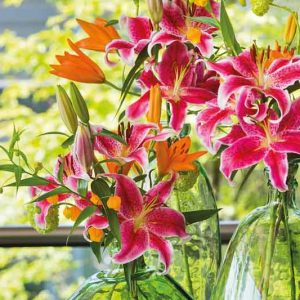
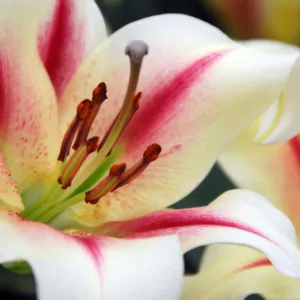
Discover the nine major types of lilies and what makes each group unique. Compare Asiatic, Martagon, Candidum, American, Longiflorum, Trumpet, Oriental, interdivisional, and species lilies, including popular LA and Orienpet hybrids. Learn how their ancestry shapes flower form, fragrance, bloom season, garden performance, and growing preferences.
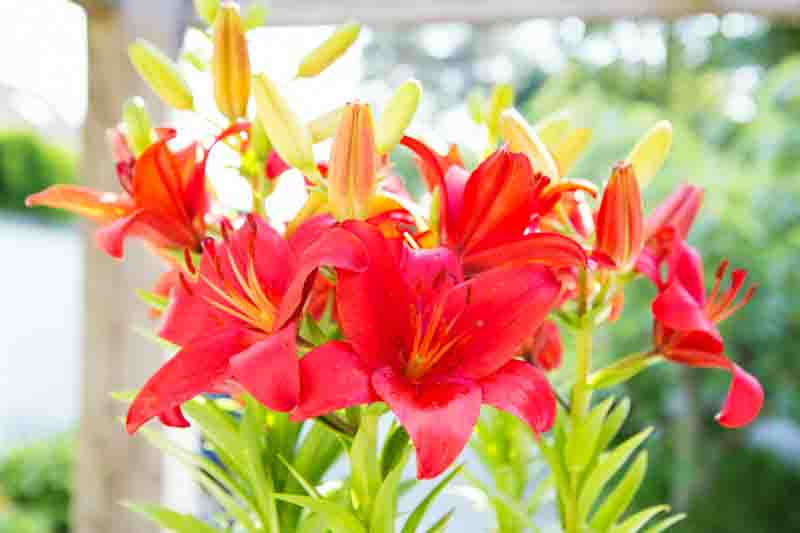


Lilies can look bewilderingly diverse. Some are compact, vividly colored, and almost scentless. Others tower over a border with enormous perfumed trumpets. Some thrive in bright sun, others are at home near a woodland edge, and still others need conditions that closely resemble the habitats of their wild ancestors.
Yet this diversity is not random. Garden lilies belong to the genus Lilium, and the horticultural classification system organizes them into nine major divisions based primarily on parentage. Flower habit and flower form provide additional ways to describe individual lilies within those divisions.
For gardeners, names such as Asiatic, Martagon, Trumpet, Oriental, LA, and Orienpet reveal much more than flower style. They provide clues to a lily’s ancestry and, in turn, to its likely bloom season, fragrance, flower form, vigor, soil preferences, and garden performance.
Why the divisions matter: A lily’s division gives you a useful starting point for understanding its ancestry and predicting traits such as bloom season, fragrance, flower shape, vigor, and cultural preferences. It is much more informative than choosing a lily by flower color alone.
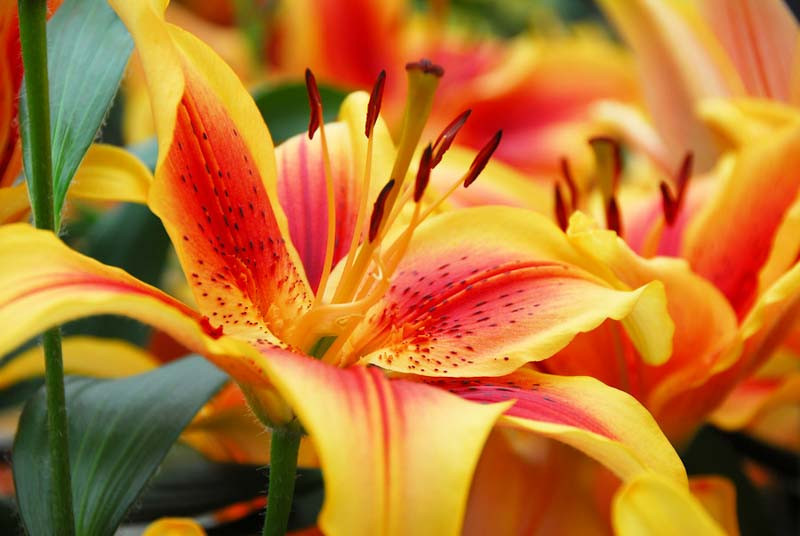
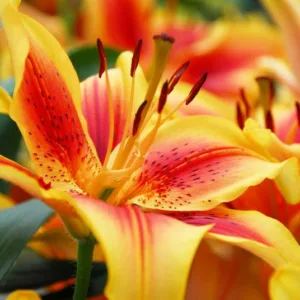
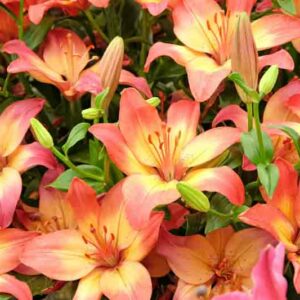
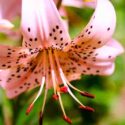
Asiatic lilies are the workhorses of the lily world. They are among the earliest hybrid lilies to flower, offer one of the broadest color ranges of the major divisions, and are generally considered some of the easiest lilies for gardeners to grow.
Division 1 developed from crosses involving Asian species such as Lilium davidii, L. pumilum, L. concolor, L. bulbiferum, and related lilies. Their varied ancestry has produced an enormous range of modern cultivars whose flowers may face upward, outward, or downward.
Because most Asiatic lilies lack the intense perfume associated with Oriental and Trumpet lilies, they are useful where strong fragrance would be unwelcome. Their sturdy stems and broad range of heights also make them versatile garden plants, from compact container lilies to taller border cultivars.
A good choice for beginners: If you are new to lilies and want dependable summer color without demanding specialized conditions, Asiatic hybrids are one of the best places to start.
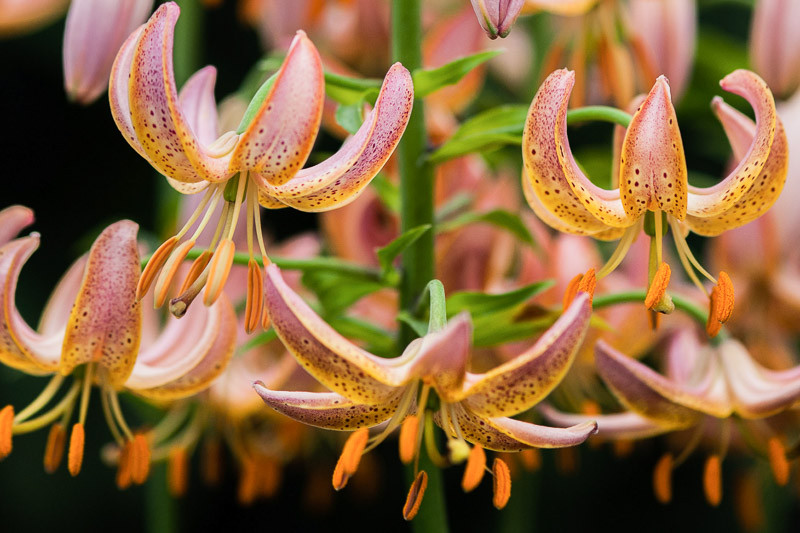
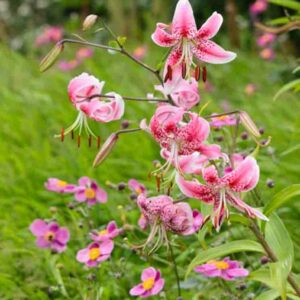
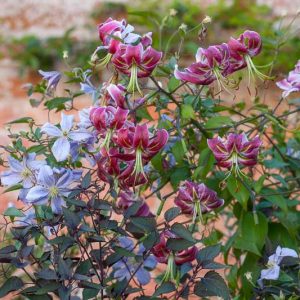
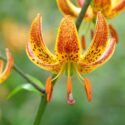
Martagon lilies have an entirely different character. Tall stems carry numerous smaller, usually downward-facing flowers with strongly recurved tepals, producing the familiar Turk’s-cap silhouette. Their leaves are commonly arranged in distinctive whorls around the stem.
Division 2 derives principally from species such as Lilium martagon, L. hansonii, L. medeoloides, and L. tsingtauense. A mature Martagon can carry an impressive number of flowers, but its effect is airy and naturalistic rather than massive and flamboyant.
Martagons are particularly valuable for cooler gardens, lightly shaded borders, and woodland-edge settings. They may take a season or more to settle after planting or transplanting and generally perform best when left undisturbed once established.
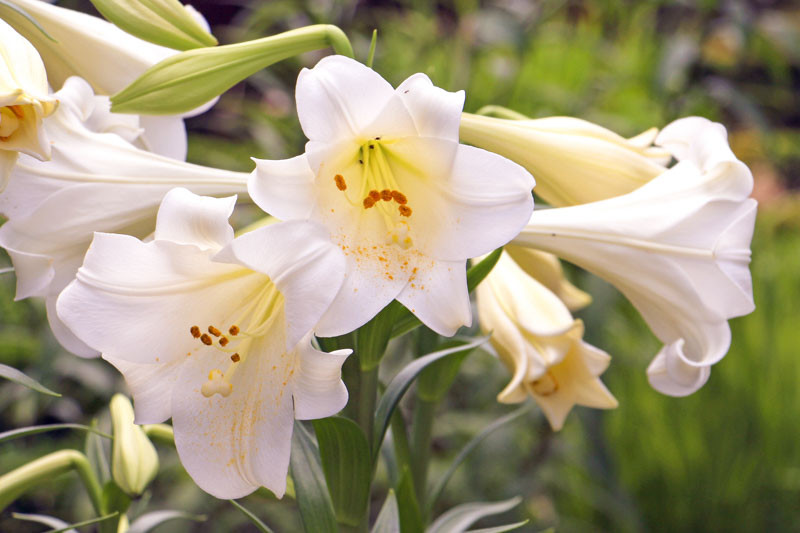
Candidum hybrids are among the least commonly encountered lily divisions in modern commerce. Division 3 contains hybrids derived from Lilium candidum, the Madonna lily, together with L. chalcedonicum, L. monadelphum, and related European species, while excluding the Martagon group.
The parent species Lilium candidum itself belongs to Division 9, the species division. Its importance here is as one of the principal ancestors of Candidum hybrids.
The Madonna lily has been cultivated for centuries and remains instantly recognizable, with elegant white flowers and rich fragrance. It also illustrates an important lesson about lilies: plants that contribute their ancestry to a hybrid division do not necessarily belong to that hybrid division themselves.
Lilium candidum is also notable horticulturally because it is planted unusually shallowly compared with many familiar stem-rooting lilies. It deserves species-specific treatment rather than a generic “plant every lily deeply” approach.
Rare does not mean irrelevant: Candidum hybrids are far less common in catalogs and garden centers than Asiatics or Orientals, but Division 3 remains part of the formal horticultural classification of Lilium.
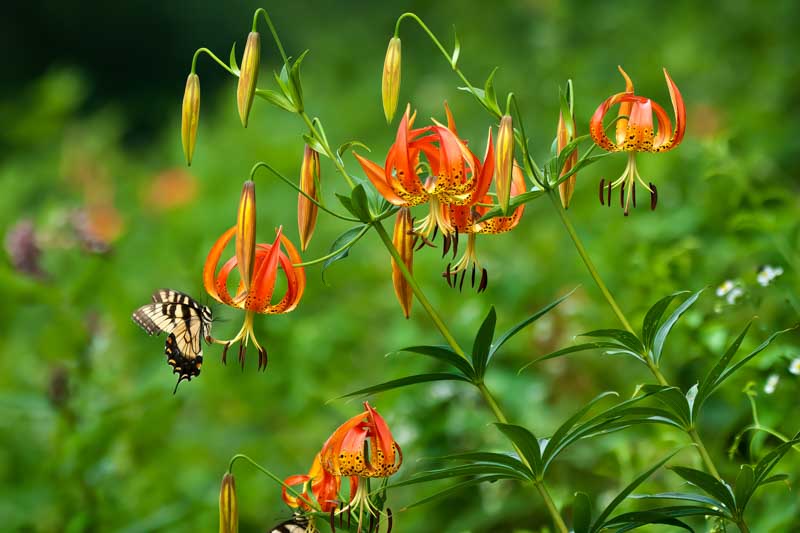
North America has an extraordinary native lily flora, and Division 4 contains hybrids derived from North American Lilium species. Important ancestors include Lilium pardalinum, L. humboldtii, L. kelloggii, L. parryi, and related species.
The continent’s wild lilies are remarkably diverse. Eastern species include Lilium canadense, L. superbum, and L. philadelphicum, while western North America is especially rich in lilies such as L. pardalinum and L. columbianum.
Many American lilies have graceful nodding flowers, often with recurved tepals and conspicuous spotting. Some naturally inhabit woodland openings, moist meadows, stream margins, or mountain slopes, so their preferred growing conditions can differ markedly from those of hybrid lilies bred for ordinary garden borders.
“Native” should not be interpreted as “easy anywhere.” Some American species and their hybrids dislike disturbance and perform best when gardeners closely match the soil, moisture, climate, and light conditions favored by their ancestry.
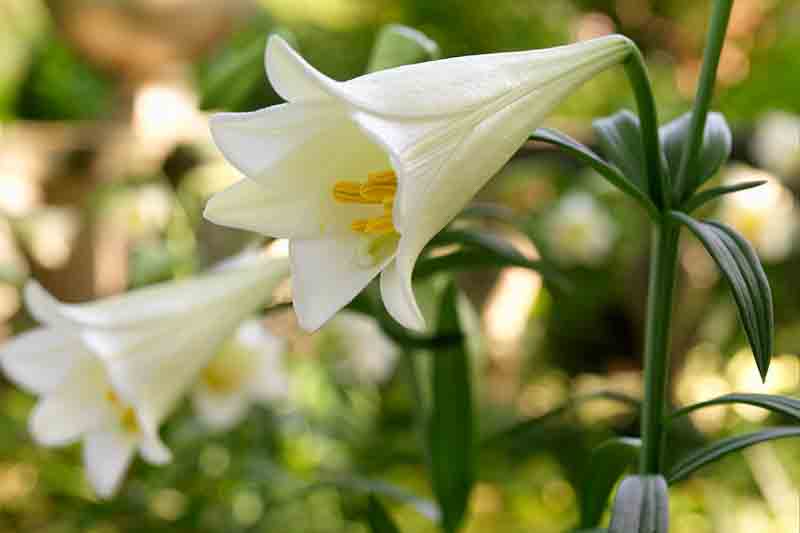
Longiflorum hybrids derive primarily from Lilium longiflorum and L. formosanum. Their characteristic flowers are elegant, elongated trumpets, generally white and often fragrant.
Cultivars such as ‘White Heaven’ display the long, white, fragrant trumpet flowers strongly associated with Longiflorum breeding.
The familiar Easter lily, Lilium longiflorum, is one of the principal parent species behind this division rather than a Division 5 hybrid itself. As a botanical species, L. longiflorum belongs to Division 9. Its distinctive white trumpet flowers illustrate the traits that Longiflorum ancestry has carried into both Division 5 hybrids and modern interdivisional lilies.
Compared with many Asiatic or Trumpet hybrids, traditional Longiflorum hybrids are not among the hardiest lilies for outdoor gardens. This helps explain why Longiflorum-type lilies are so familiar as commercially forced plants, especially around Easter, rather than being universally dependable landscape lilies.
The group is nevertheless enormously important to modern lily breeding. Longiflorum ancestry has been combined with other divisions to create successful interdivisional lilies, particularly LA hybrids with Asiatic ancestry and LO hybrids with Oriental ancestry.
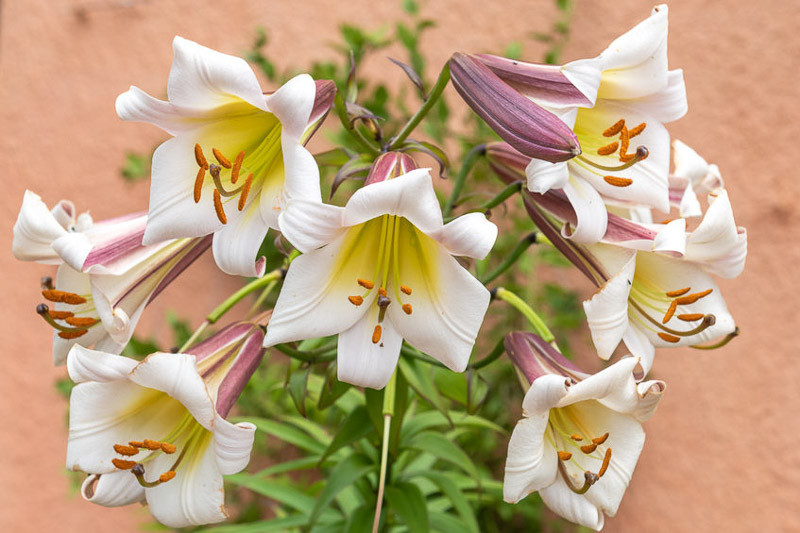
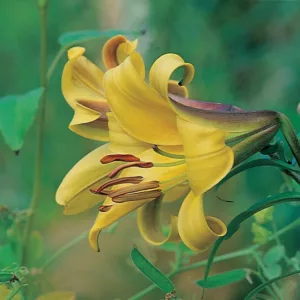
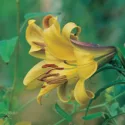
Trumpet lilies are among the most architectural members of the genus. They are often tall, strongly fragrant, and topped with large waxy flowers that may form classic trumpets, broad flares, bowls, or more open shapes.
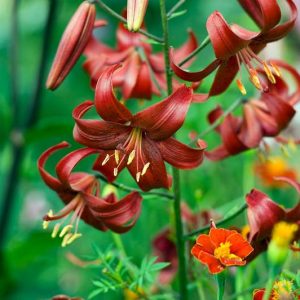
Division 6 includes hybrids derived from trumpet-flowered Asian species such as Lilium regale, L. sargentiae, L. sulphureum, and related lilies. Aurelian hybrids also incorporate the influence of Lilium henryi, whose recurved flowers broaden the range of shapes found within the division.
As a result, Division 6 is considerably more diverse than the simple name “Trumpet lily” suggests. Some blooms are long and tubular, others open widely, and still others may be pendant or recurved. Colors range from white and cream through yellow, gold, apricot, pink, plum, and richly shaded bicolors.
If fragrance is one of your main reasons for growing lilies, Trumpet and Aurelian hybrids deserve serious consideration. On warm summer evenings, even a small group can perfume a surprisingly large part of the garden.
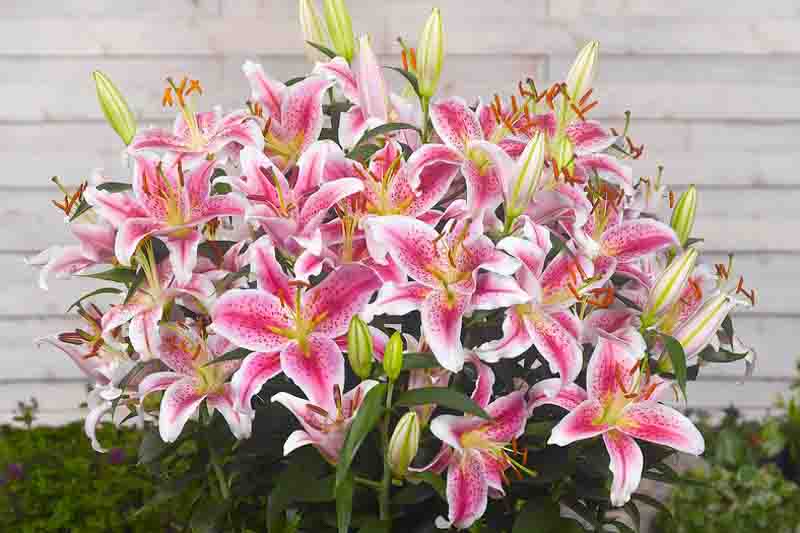
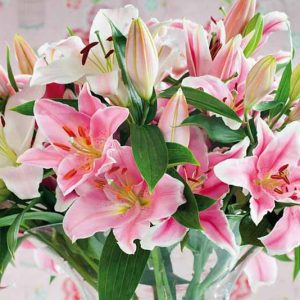
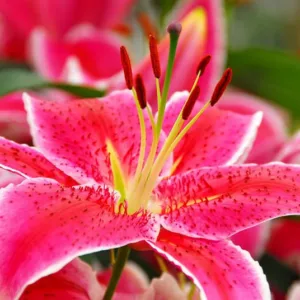
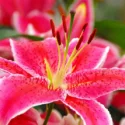
Oriental lilies are among the great late-season stars of the lily garden. Their flowers are often enormous, richly colored, intensely fragrant, and decorated with contrasting throats, spots, brushmarks, bands, or picotee margins.
These hybrids draw heavily on species such as Lilium auratum and L. speciosum, together with related Japanese lilies. Famous cultivars such as ‘Stargazer’ and ‘Casa Blanca’ helped make the Oriental lily look familiar far beyond specialist collections.
Oriental hybrids generally bloom later than Asiatics, making them invaluable for extending the lily season. Their fragrance can be intense, particularly on warm evenings or when cut flowers are brought indoors.
Oriental lilies are more particular about soil than most Asiatic hybrids. They perform best in humus-rich, moisture-retentive but well-drained acidic soil, although some cultivars can succeed in near-neutral conditions. Strongly alkaline or chalky ground is generally unsuitable.
Asiatic or Oriental? Think early, colorful, generally unscented, and adaptable for Asiatic lilies. Think later, larger-flowered, richly fragrant, and more particular about soil for Oriental lilies.
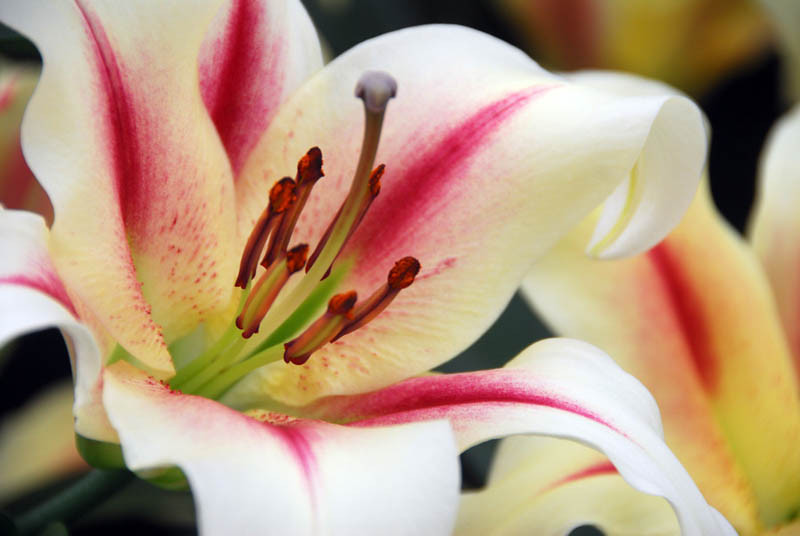
Division 8 is where modern lily breeding becomes particularly interesting. Interdivisional hybrids result from crosses between lilies belonging to different horticultural divisions, allowing breeders to combine traits that traditionally occurred in separate lineages.
Advances in breeding techniques have helped overcome reproductive barriers between groups. The resulting hybrids can combine flower size, fragrance, stem strength, color, vigor, hardiness, and garden performance in combinations that earlier generations of lily breeders could rarely achieve.
How to read interdivisional lily abbreviations:
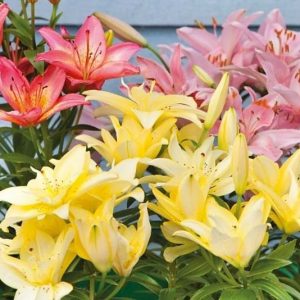
LA lilies combine Longiflorum and Asiatic ancestry. They generally inherit strong garden performance and an extensive color range from the Asiatic side, while Longiflorum parentage contributes substantial flowers and often a heavier, more polished flower texture.
LA hybrids have become important both as garden plants and cut flowers because of their sturdy stems, vigorous growth, and impressive blooms. Fragrance varies, but it is generally much less intense than in Oriental, Trumpet, or many OT lilies.
OT lilies, commonly called Orienpets, combine Oriental and Trumpet/Aurelian ancestry. They are among the most spectacular modern garden lilies, often producing very large flowers on strong, tall stems.
The attraction is easy to understand: breeders sought to combine the flower size and fragrance of Orientals with traits associated with Trumpet and Aurelian lilies, including vigor, stature, and a broader range of garden performance. Mature Orienpets can become imposing plants and are especially valuable toward the later part of the lily season.
OA hybrids combine Oriental and Asiatic ancestry. They allow breeders to blend characteristics associated with richly colored Oriental lilies with traits inherited from vigorous, colorful Asiatic lilies.
They remain less familiar to many home gardeners than LA or OT hybrids, but they demonstrate how far modern lily breeding has moved beyond the older divisions.
LO hybrids combine Longiflorum and Oriental ancestry. They often show the elongated flower influence of Longiflorum lilies together with characteristics inherited from the Oriental group.
Division 8 does not end with these familiar abbreviations. More complex breeding lines can combine ancestry from several divisions, creating hybrids such as OTLA types and other multigenerational crosses.
What does “Orienpet” mean? The name is a convenient shorthand for an OT hybrid: Oriental + Trumpet. It immediately identifies the two major lily groups behind the cross.
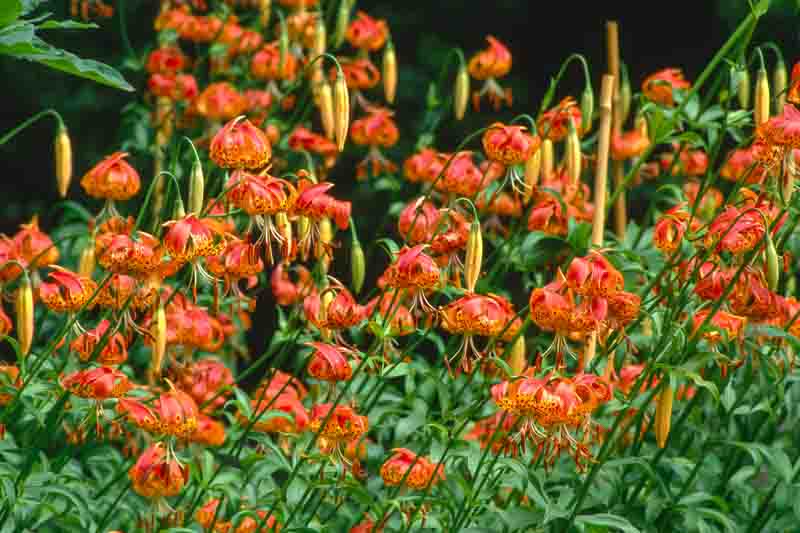
Species lilies are the wild foundation of the entire horticultural lily family. Native Lilium species occur across parts of the temperate Northern Hemisphere, with particularly rich diversity in Asia and important native groups in Europe and North America.
Without species lilies, there would be no Asiatic, Martagon, Trumpet, Oriental, or modern interdivisional hybrids. Generations of breeders have selected and crossed wild species to create the enormous diversity of garden lilies available today.
Species lilies are also worth growing for their own character. They include the fragrant trumpets of Lilium regale, the Turk’s-cap flowers of L. martagon, the enormous patterned blooms of L. auratum, the orange recurved flowers of L. henryi, and North American lilies such as L. canadense and L. pardalinum.
This division also includes species that have given their names to other hybrid groups. Lilium candidum, for example, belongs to Division 9 even though it is a principal ancestor of Division 3 Candidum hybrids. Similarly, Lilium longiflorum is a Division 9 species and an important parent of Division 5 Longiflorum hybrids.
The important difference is that wild species were not bred primarily for broad garden adaptability. Their requirements reflect the environments in which they evolved. One species may favor woodland soil and summer moisture, another may need exceptionally sharp drainage, and another may be strongly associated with acidic conditions.
That makes Division 9 fascinating but variable in difficulty. Before planting a species lily, research that particular species rather than assuming that general advice for hybrid lilies will necessarily apply.
Species are the starting point: Every hybrid division ultimately traces back to wild Lilium. Learning the species behind a hybrid often explains why that hybrid flowers, grows, or responds to soil differently from another lily.
The nine horticultural divisions describe ancestry, but they do not completely describe what a lily flower looks like. The International Lily Register also uses flower habit and flower form to give a more precise visual description of registered lilies.
The Royal Horticultural Society, which is the International Cultivar Registration Authority for lilies, records flower habit as:
Flower form can be recorded as:
This explains why two lilies belonging to the same division can look remarkably different. An Asiatic hybrid might have an up-facing bowl-shaped flower, while another Asiatic has down-facing recurved blooms. Both remain Division 1 because their horticultural division is determined primarily by ancestry rather than flower orientation alone.
Division tells you ancestry. Flower habit and form tell you appearance. Together, those pieces of information create a much more useful description of a lily than its common name alone.
| Division | Group | Known For |
|---|---|---|
| 1 | Asiatic | Early bloom, huge color range, easy culture, little fragrance |
| 2 | Martagon | Nodding Turk’s-cap flowers, whorled leaves, partial shade |
| 3 | Candidum | European ancestry, uncommon in modern commerce |
| 4 | American | North American parentage, naturalistic character |
| 5 | Longiflorum | Elegant white trumpets, Easter-lily ancestry |
| 6 | Trumpet/Aurelian | Height, waxy flowers, strong fragrance |
| 7 | Oriental | Huge flowers, rich fragrance, later bloom |
| 8 | Interdivisional | LA, OT, OA, LO, and other crosses |
| 9 | Species | Wild lilies and the genetic foundation of the hybrid divisions |
There is no single best lily group. The right choice depends on what you want lilies to contribute to the garden and whether your growing conditions suit the group.
| What You Want | Groups to Consider |
|---|---|
| Easy, colorful lilies for beginners | Asiatic |
| Lilies for light woodland or partial shade | Martagon and suitable species lilies |
| Strong fragrance | Oriental, Trumpet/Aurelian, OT/Orienpet |
| Early summer color | Asiatic and Martagon |
| Late-summer impact | Oriental and OT/Orienpet |
| Tall architectural lilies | Trumpet/Aurelian and OT/Orienpet |
| Naturalistic or botanical interest | Species, American, Martagon |
| Large flowers on sturdy stems | LA hybrids |
For a more practical side-by-side selection guide, see Gardenia’s How to Choose Lilies.
Yes, and combining compatible groups is one of the most effective ways to extend the lily season. Asiatic lilies and Martagons can begin the display early, followed by Trumpet and Aurelian lilies, then Orientals and many OT hybrids later in summer. Exact bloom dates vary with cultivar, climate, and weather, but planting several groups creates a much longer succession than relying on one type alone.
The important word is compatible. A sun-loving hybrid that performs well in ordinary garden soil should not automatically be planted beside a specialist woodland or species lily simply because their flower colors look attractive together.
For detailed information on planting depth, soil, watering, feeding, aftercare, containers, winter protection, pests, and diseases, see Gardenia’s complete Lily Growing and Care Guide.
Build a longer lily season: Instead of buying all your bulbs from one division, combine compatible lily groups with different flowering periods. The result can be weeks of successive blooms rather than one spectacular but brief peak.
Horticulturally, lilies are organized into nine main divisions: Asiatic, Martagon, Candidum, American, Longiflorum, Trumpet and Aurelian, Oriental, Interdivisional hybrids, and Species lilies. Within these divisions are numerous species, hybrids, cultivars, flower habits, and flower forms.
Asiatic lilies generally flower earlier, are among the easiest lilies to grow, offer an exceptionally broad range of colors, and are usually unscented. Oriental lilies typically bloom later, produce very large and strongly fragrant flowers, and generally prefer humus-rich, well-drained soil that is acidic or close to neutral.
Orienpet lilies are OT interdivisional hybrids created from Oriental and Trumpet/Aurelian parentage. They often combine large, fragrant flowers associated with Oriental lilies with the vigor, stature, and garden performance of their Trumpet and Aurelian ancestry.
LA lilies are Longiflorum x Asiatic interdivisional hybrids. They are valued for sturdy stems, substantial flowers, vigorous growth, and the broad range of flower colors inherited from Asiatic parentage.
OA means Oriental x Asiatic. These Division 8 hybrids combine ancestry from Oriental and Asiatic lilies and are less commonly encountered than LA or OT hybrids, but they form an important part of modern interdivisional lily breeding.
LO means Longiflorum x Oriental. These hybrids combine Longiflorum and Oriental ancestry and may show the elongated flower influence of Longiflorum lilies together with characteristics inherited from the Oriental group.
Oriental lilies, Trumpet and Aurelian hybrids, and many OT or Orienpet hybrids are among the most strongly fragrant garden lilies. Most Asiatic hybrids have little or no fragrance, while scent varies considerably among species and less commonly grown hybrid groups.
Asiatic hybrids are among the earliest commonly grown hybrid lilies to bloom. Martagons can flower at roughly the same early point in the lily season, depending on climate and cultivar. Trumpet, Oriental, and many OT hybrids generally extend the display later into summer.
Asiatic hybrids are generally considered among the easiest lilies because they are vigorous, adaptable, colorful, and comparatively undemanding. LA hybrids are also valued for strong garden performance. Good drainage and a suitable climate remain important for all lilies.
Some are, but not all. Species lilies retain the ecological preferences of their wild ancestors, so successful cultivation may depend on matching a particular species to its preferred soil, moisture, light, and climate. Modern hybrids are often selected partly for broader garden adaptability.
No. Easter lily usually refers to Lilium longiflorum, a species classified in Division 9 and one of the principal parent species of Division 5 Longiflorum hybrids. Trumpet and Aurelian hybrids belong to Division 6. Both can produce trumpet-shaped flowers, which explains some of the common-name confusion.
The divisions organize the enormous diversity of Lilium primarily according to parentage. Knowing a lily’s division provides useful clues about its ancestry, appearance, flowering season, fragrance, vigor, and likely growing preferences, making the system useful to gardeners, breeders, exhibitors, and plant registrars.
The nine lily divisions turn what can initially look like an overwhelming collection of species and cultivars into a logical family tree. Asiatic lilies provide early color and adaptability. Martagons bring woodland grace. Candidum and American hybrids preserve distinctive lineages. Longiflorum hybrids carry the influence of elegant trumpet-flowered species. Trumpet and Aurelian hybrids offer stature and perfume, while Orientals produce some of the largest and most fragrant flowers of the season.
Division 8 shows what happens when breeders cross those established lineages. LA, OT, OA, LO, and increasingly complex hybrids combine characteristics that once belonged to separate branches of the lily family.
And beneath every hybrid lies Division 9 – the wild species. They are the genetic foundation from which the spectacular diversity of modern garden lilies was created.
Once you understand those relationships, choosing lilies becomes less about memorizing hundreds of cultivar names and more about recognizing what each group can contribute to the garden.
Updated: August 2026 • Reviewed by Gardenia Editors
| Hardiness |
3 - 9 |
|---|---|
| Plant Type | Bulbs, Perennials |
| Genus | Lilium |
| Exposure | Full Sun, Partial Sun |
| Season of Interest | Spring (Late), Summer (Early, Mid, Late), Fall |
| Maintenance | Low |
| Water Needs | Average |
| Soil Drainage | Moist but Well-Drained |
| Characteristics | Cut Flowers, Fragrant, Showy |
| Attracts | Bees, Butterflies, Hummingbirds |
| Landscaping Ideas | Beds And Borders, Patio And Containers |
| Garden Styles | City and Courtyard, Cutting Garden, Informal and Cottage |
| Hardiness |
3 - 9 |
|---|---|
| Plant Type | Bulbs, Perennials |
| Genus | Lilium |
| Exposure | Full Sun, Partial Sun |
| Season of Interest | Spring (Late), Summer (Early, Mid, Late), Fall |
| Maintenance | Low |
| Water Needs | Average |
| Soil Drainage | Moist but Well-Drained |
| Characteristics | Cut Flowers, Fragrant, Showy |
| Attracts | Bees, Butterflies, Hummingbirds |
| Landscaping Ideas | Beds And Borders, Patio And Containers |
| Garden Styles | City and Courtyard, Cutting Garden, Informal and Cottage |
Create a membership account to save your garden designs and to view them on any device.
Becoming a contributing member of Gardenia is easy and can be done in just a few minutes. If you provide us with your name, email address and the payment of a modest $25 annual membership fee, you will become a full member, enabling you to design and save up to 25 of your garden design ideas.
Join now and start creating your dream garden!
Create a membership account to save your garden designs and to view them on any device.
Becoming a contributing member of Gardenia is easy and can be done in just a few minutes. If you provide us with your name, email address and the payment of a modest $25 annual membership fee, you will become a full member, enabling you to design and save up to 25 of your garden design ideas.
Join now and start creating your dream garden!