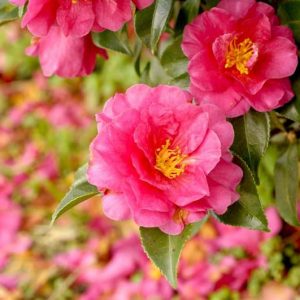
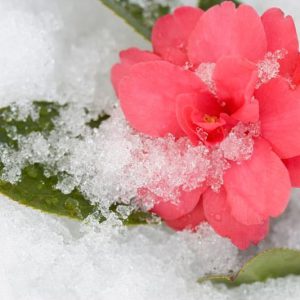
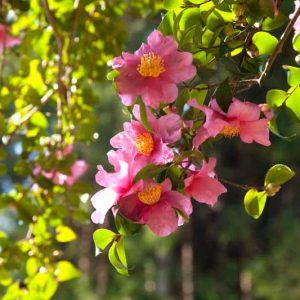
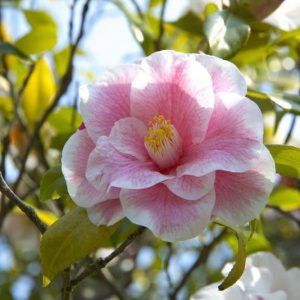
Which camellia truly fits your landscape? Gardenia compares mature height, spread, habit, hardiness, and garden performance to identify the best choices for small gardens, foundations, hedges, privacy screens, espaliers, and large specimens - including varieties that look compact when young but require far more room at maturity.
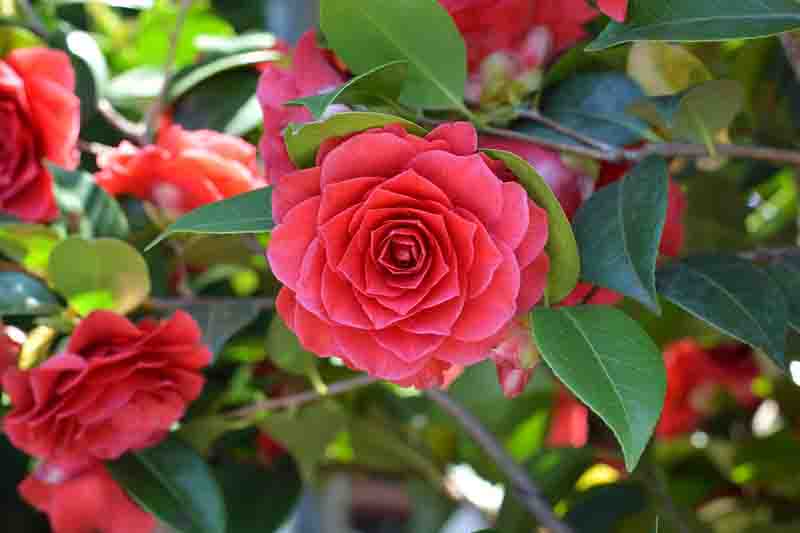


A camellia should be chosen for the space it will occupy at maturity – not for the size of the plant at the nursery or the beauty of a single flower. These evergreen shrubs are exceptionally long-lived, and a variety that appears compact today may eventually cover a window, crowd a path, or consume much of a small border.
The most useful question is therefore not simply, “Which camellia is best?” It is, “Which camellia is best for this particular job?” A low-growing cultivar may be ideal on a bank but much too wide for a foundation bed. An upright camellia may provide an elegant vertical accent without being narrow enough for a side passage. A vigorous sasanqua can make a handsome flowering screen, but it will not provide instant privacy.
For most small gardens, ‘Minato-No-Akebono’ offers the strongest combination of restrained size, graceful habit, fragrance, and long flowering. ‘Chansonette’ is the best genuinely low camellia where ample width is available. For a broad privacy screen, ‘Setsugekka’ is difficult to beat, while ‘Sparkling Burgundy’ is a better choice where somewhat less width is available.
The recommendations below are organized by landscape function, with clear guidance on mature size, advantages, limitations, and situations in which another cultivar would be more suitable. You can investigate additional varieties with Gardenia’s Camellia Comparison Tool or filter plants by height, spread, hardiness, light, soil, and other characteristics in the Plant Finder.
How these camellias were selected: Each cultivar was evaluated according to its documented mature height, spread, growth habit, hardiness, flowering season, and likely performance in the intended landscape role. A plant was excluded from a category when its eventual width, exposure needs, or growth pattern conflicted with that use. Low-growing, compact, upright, and narrow were treated as separate characteristics.
| Landscape need | Best choice | Why it ranks first | Main limitation |
|---|---|---|---|
| Dwarf planting | ‘Chansonette’ | Remains only 2-3 ft. tall | Spreads 7-8 ft. |
| Small garden | ‘Minato-No-Akebono’ | Refined scale, fragrance, long bloom | Not suited to a clipped formal hedge |
| Foundation bed | ‘Winter’s Charm’ | Manageable footprint and improved hardiness | Needs a bed at least several feet deep |
| Upright accent | ‘Hagoromo’ | Slender habit and elegant flowers | Still reaches about 5 ft. wide |
| Medium hedge | ‘Jean May’ | Versatile, vigorous, and sun-tolerant | Can become 10 ft. wide |
| Privacy screen | ‘Setsugekka’ | Tall, vigorous, evergreen, and floriferous | Requires substantial width |
| Espalier | ‘Chansonette’ or ‘Bonanza’ | Spreading branches respond well to training | Requires regular tying and pruning |
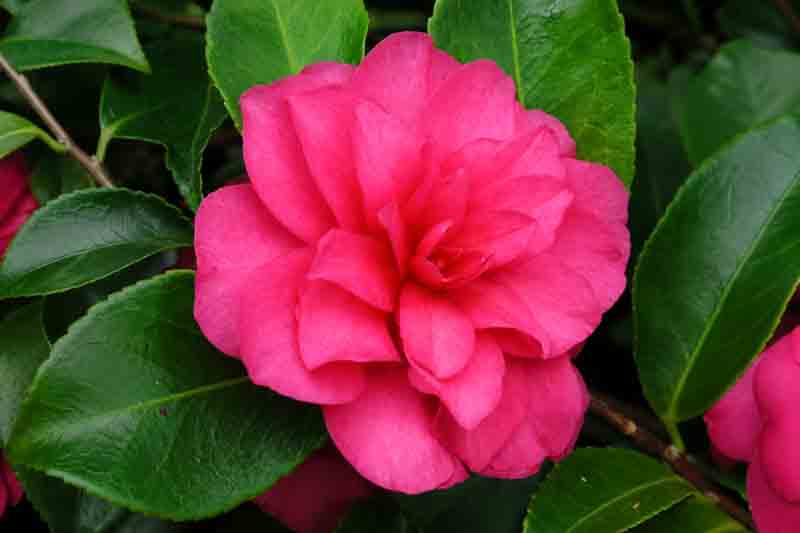
Camellia hiemalis ‘Chansonette’ is the clearest choice when low height is non-negotiable. It generally reaches only 2-3 feet (60-90 cm) tall and produces abundant lavender-pink formal double flowers from fall into winter.
Its mature footprint, however, is not small. The flexible branches can spread 7-8 feet (2.1-2.4 m), making ‘Chansonette’ better suited to a bank, broad foreground planting, raised bed, or low wall than to a confined courtyard.
Why it ranks first: It remains lower than the other camellias in this guide without depending on repeated height-control pruning.
Not recommended for: Narrow borders, small foundation beds, or positions beside frequently used paths. It is dwarf in height, not in width.
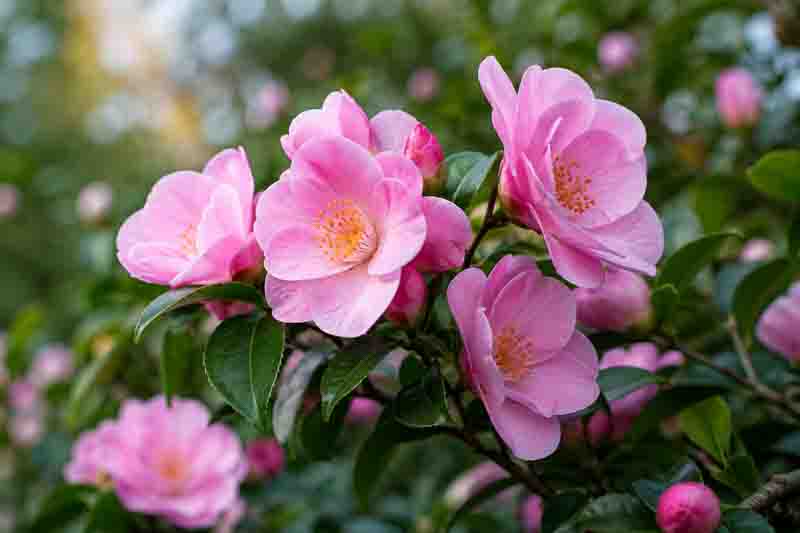
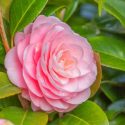
Camellia ‘Minato-No-Akebono’ grows approximately 4-5 feet (1.2-1.5 m) tall and 3-5 feet (90-150 cm) wide. Its miniature shell-pink flowers have prominent golden stamens and a clear fragrance. Bloom can extend from late fall into spring.
It ranks first because its fine branching, arching habit, miniature flowers, and restrained mature footprint remain proportionate to an intimate landscape. This is not merely a large camellia that grows slowly; its entire presentation suits a courtyard, Japanese-inspired garden, woodland edge, or small mixed border.
Choose it over ‘Spring Mist’ when: A graceful habit, miniature flowers, and the longest possible flowering display are the priorities.
Not recommended for: A rigidly clipped hedge or a highly exposed position. Its natural arching form is most effective when allowed to remain informal.
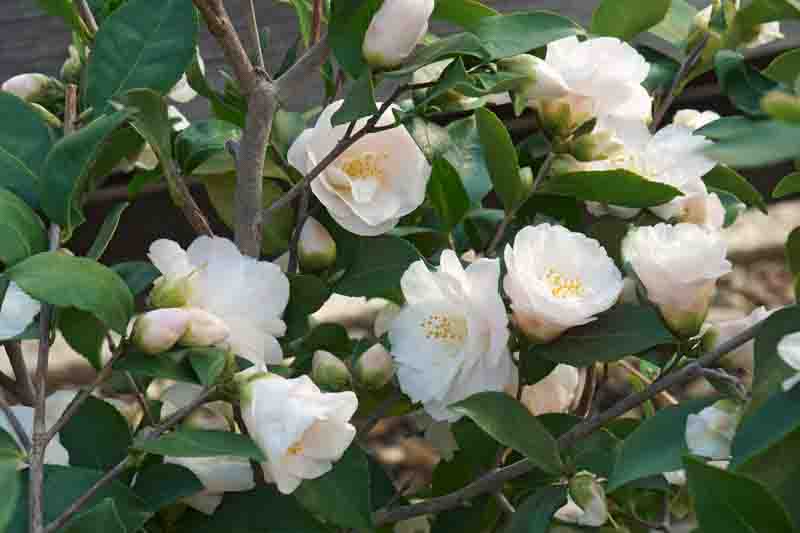
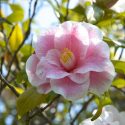
Camellia ‘Spring Mist’ reaches approximately 4-5 feet tall and 3-5 feet wide. Its small semi-double flowers open blush pink and fade toward white at the petal edges, producing a soft luminous effect against the evergreen foliage.
‘Spring Mist’ occupies a similar footprint to ‘Minato-No-Akebono’ and is also fragrant. Its fuller flowers and pale coloring make it a better choice beside a terrace, doorway, or path where flowers will be viewed closely.
Choose it instead when: You prefer semi-double flowers and a delicate blush-and-white color combination.
Small-garden judgment: ‘Minato-No-Akebono’ is the strongest overall specimen. ‘Spring Mist’ is an equally sensible choice when flower form and pale coloring matter more than an especially refined, arching silhouette.
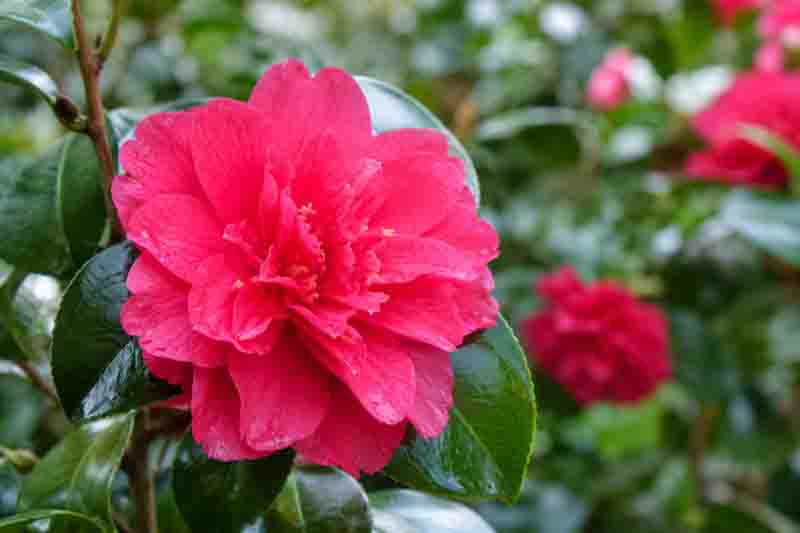
Camellia sasanqua ‘Bonanza’ is frequently described as dwarf, but its documented size of approximately 3-6 feet tall and 4-8 feet wide makes “low-growing” more accurate.
Its brilliant red, semi-double to peony-form flowers produce a strong fall display. The broad, spreading habit is effective on slopes, over retaining walls, and across the front of a generous shrub border.
Why choose it: It provides a brighter red and more forceful mass of color than ‘Chansonette’ while remaining lower than many traditional sasanquas.
Not recommended for: Beds less than about 5 feet deep, narrow spaces beside paving, or gardens where regular width-control pruning would be undesirable.
Truly columnar camellias are rare. The term “upright” describes the direction of the main branches, but it does not mean a plant will remain narrow at maturity.
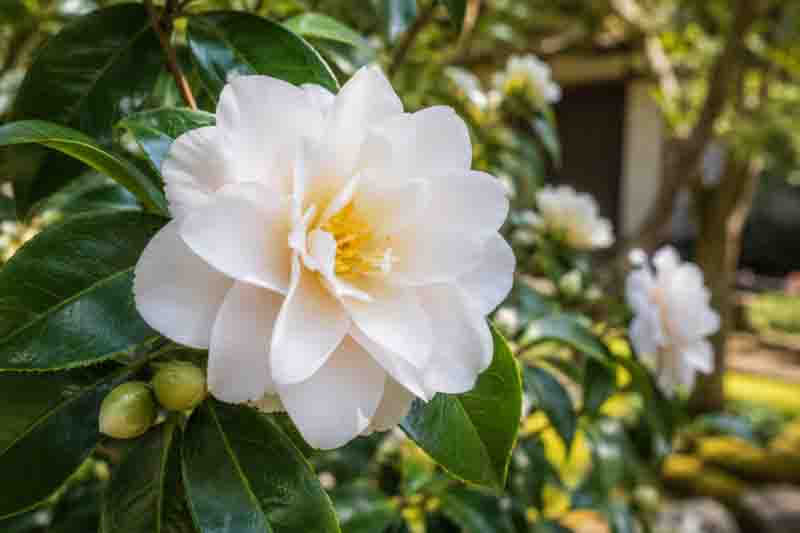
Camellia japonica ‘Hagoromo’ is one of the better choices for vertical structure. It grows approximately 8 feet (2.4 m) tall and 5 feet (1.5 m) wide. Its pale blush-pink semi-double flowers have narrow, recurved petals that complement its relatively slender outline.
Best use: Beside an entrance, between generously spaced windows, or as a vertical accent toward the back of a partially shaded border.
Not recommended for: A 2- or 3-foot-wide side passage. At approximately 5 feet across, ‘Hagoromo’ is slender by camellia standards but not genuinely columnar.
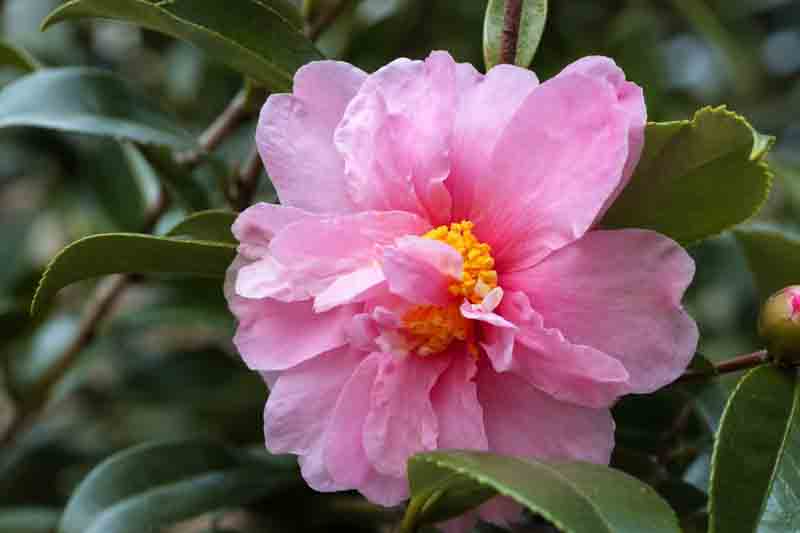
Camellia ‘Winter’s Charm’ grows approximately 4-7 feet tall and 4-5 feet wide. Its manageable footprint and improved cold hardiness make it more adaptable to residential foundation beds than many broad Japanese camellias.
It earns the leading position because its height and width are reasonably balanced. It can provide evergreen structure without automatically spreading across a large section of the house.
Not recommended for: Very shallow beds. Leave enough room between the mature plant and the wall for air circulation, access, and natural branch development.
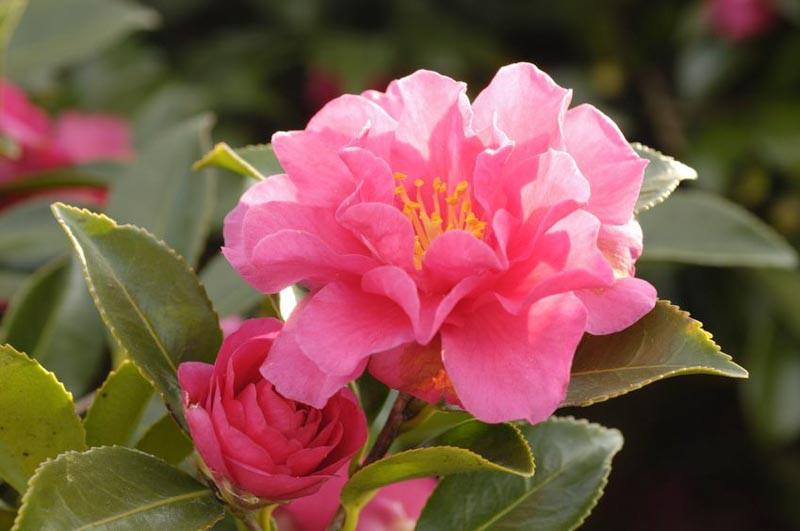
Camellia sasanqua ‘Shishigashira’ remains approximately 4-5 feet tall but spreads 6-8 feet. Its deep rose-pink flowers appear over a long fall-to-winter season.
It is useful beneath high windows or across a deep foundation bed where low height matters more than width. It should not be selected merely because it is described as compact.
Not recommended for: Narrow strips between a house and walkway. Its eventual spread is wider than many homeowners expect.
Foundation warning: Avoid positions beneath downspouts, leaking gutters, and roof valleys. Camellias need consistent moisture, but prolonged saturation around the roots can be damaging.
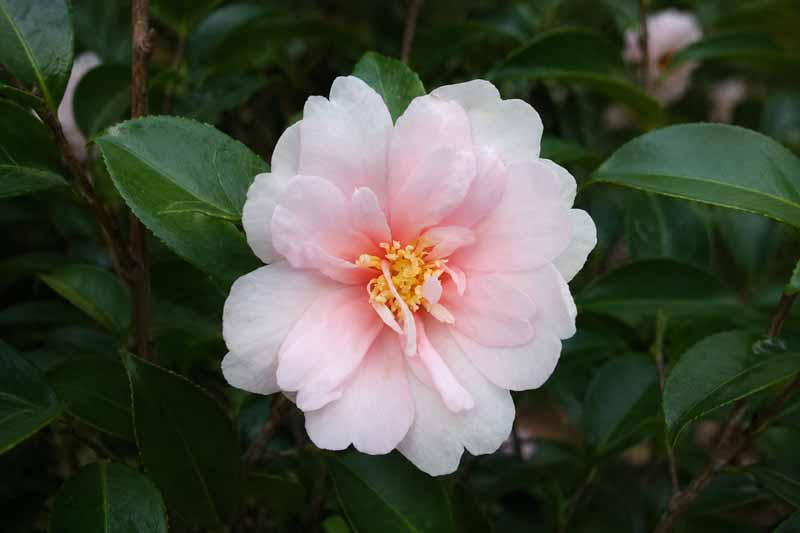
Camellia sasanqua ‘Jean May’ grows approximately 6-10 feet tall and wide. Its shell-pink flowers open in fall and early winter, while its evergreen foliage provides structure throughout the year.
It ranks first for an informal hedge because it combines useful height, relatively vigorous growth, abundant flowering, and greater sun tolerance than most Japanese camellias.
Not recommended for: A narrow property line. A mature width approaching 10 feet requires either adequate space or ongoing selective pruning.
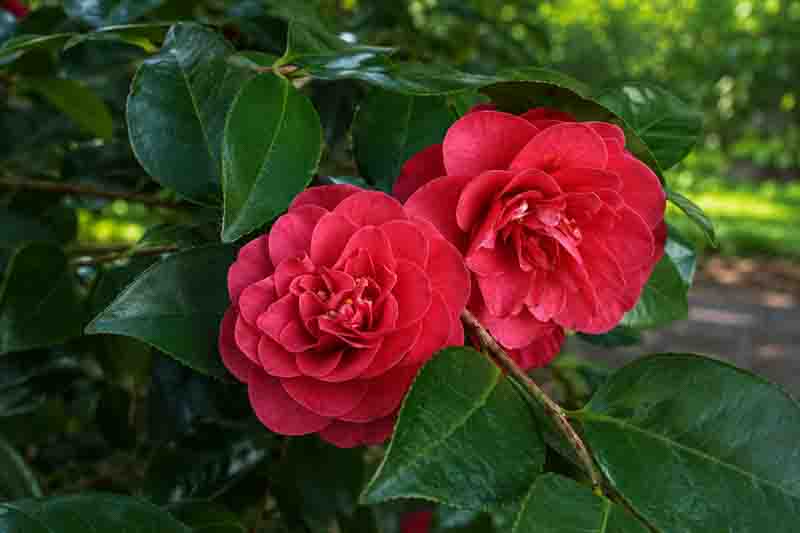
Camellia japonica ‘Lady Campbell’ forms a dense shrub approximately 6-7 feet tall and wide. Its deep red formal double flowers give it a more polished and traditional appearance.
Choose it instead when: The hedge will grow in partial shade and a denser, more formal winter-to-spring display is preferred.
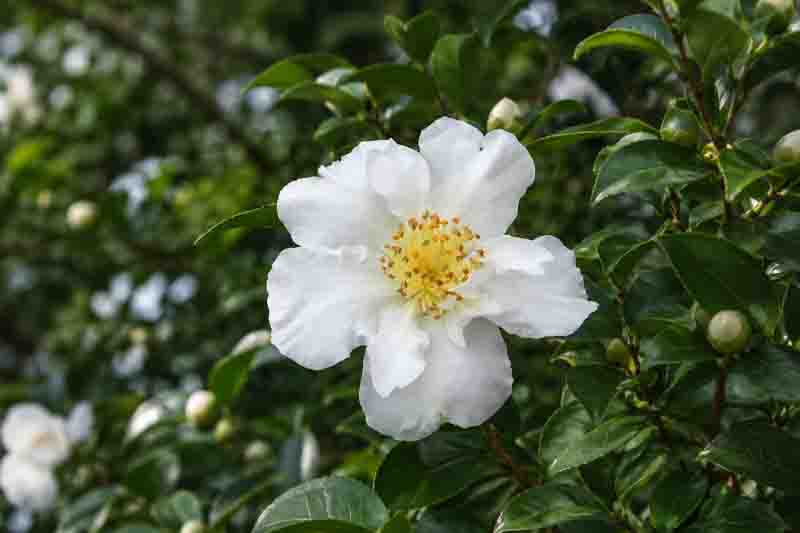
Camellia sasanqua ‘Setsugekka’ reaches approximately 8-10 feet tall and wide. Its vigorous growth, evergreen foliage, and large white semi-double flowers make it the strongest all-around choice for a substantial flowering screen.
Why it ranks first: It combines the scale needed for privacy with the comparatively vigorous growth and greater sun tolerance associated with sasanqua camellias.
Not recommended for: A small property needing a slim hedge. It requires almost as much width as height.
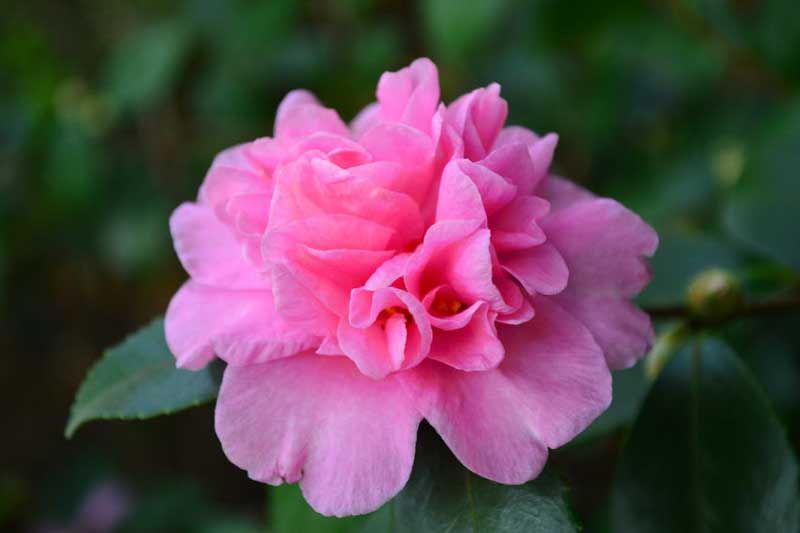
Camellia ‘Sparkling Burgundy’ grows approximately 6-10 feet tall and 4-8 feet wide. Its ruby-red peony-form flowers and potentially narrower footprint make it a better fit where ‘Setsugekka’ would be too broad.
It is still not a columnar screen. Gardeners working with a very narrow property line should not assume that any full-sized camellia can be maintained indefinitely within a slim strip.
Camellias are also not instant screening plants. Choose them when the goal is a durable evergreen boundary with seasonal flowers, not when immediate concealment is essential.
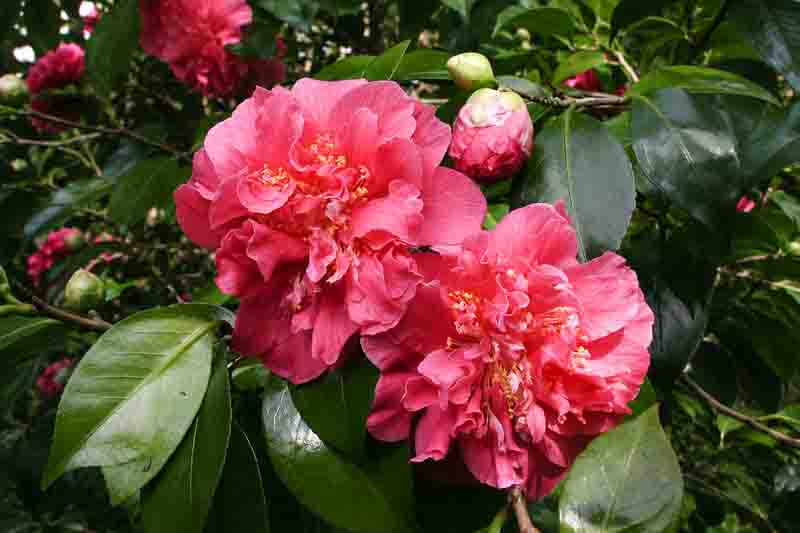
Camellia japonica ‘Scentsation’ grows approximately 8-12 feet tall and 6-10 feet wide. Its substantial size, fragrant silvery-pink flowers, and strong evergreen presence make it a good candidate for gradual training as a multi-trunked specimen.
Best use: As a focal point near a terrace, woodland path, or shaded seating area where the flowers and fragrance can be appreciated.
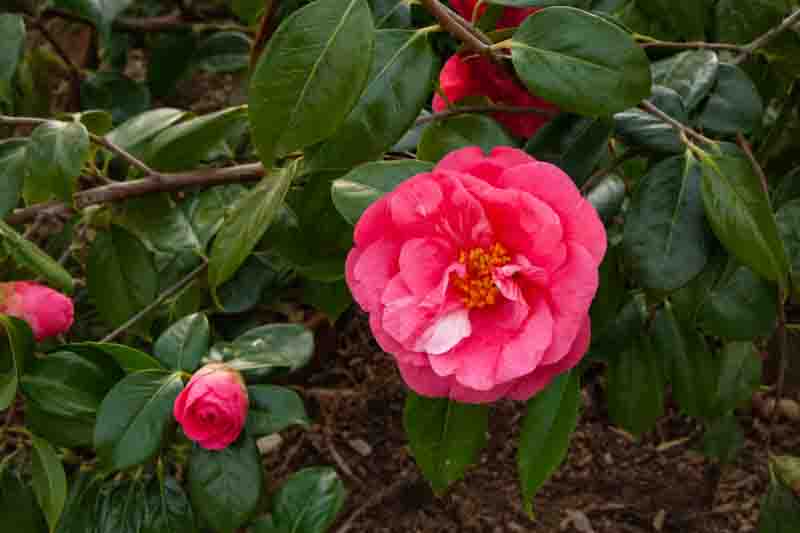
Camellia japonica ‘Drama Girl’ is naturally a broad shrub rather than a true tree-form cultivar. Its enormous salmon-rose flowers nevertheless make it a striking candidate for selective limbing-up in a large border.
Not recommended for: Gardeners seeking a naturally tree-like silhouette. It must be trained gradually, and its broad habit still requires considerable room.
When creating a tree form, select one to three strong trunks and remove lower branches over several years. Do not strip the plant in a single operation, which can unbalance the canopy and expose previously shaded bark abruptly.
Espalier turns width from a liability into an advantage. A spreading cultivar that would overwhelm a narrow bed can be trained flat against a wall, fence, or freestanding framework.
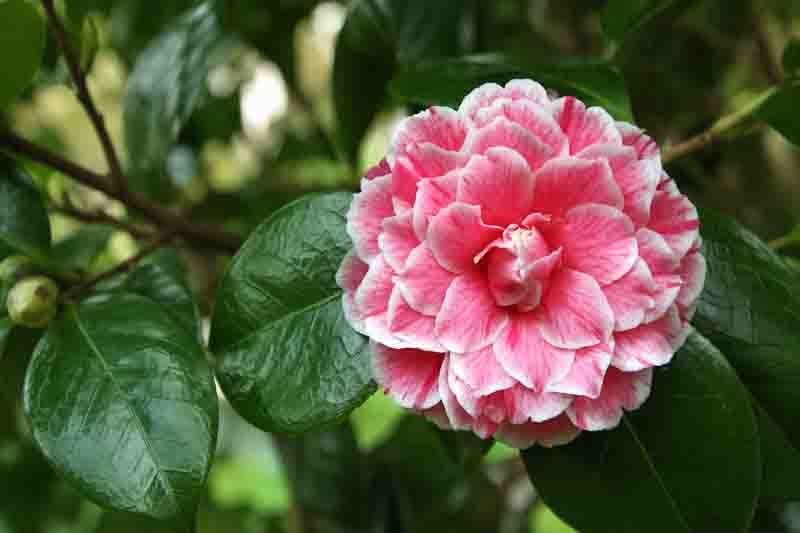
‘Chansonette’ and ‘Bonanza’ are the leading choices because their naturally spreading branches can be redirected along horizontal wires. Camellia japonica ‘Herme’ is a good alternative for a sheltered wall where a Japanese camellia is preferred.
The trade-off: Espalier saves ground space but increases maintenance. Training should begin while stems are young and flexible, ties must be checked regularly, and structural pruning should be completed after flowering.
See How to Espalier a Camellia for support options, training patterns, and pruning instructions.
Begin with the maximum mature height and width the planting site can accommodate. Eliminate cultivars that exceed either measurement. Do not assume pruning will permanently convert a large shrub into a compact one.
Next, match the camellia to the light and landscape role. Sasanquas are generally the stronger candidates for fall flowers, sunnier hedges, screens, and espalier. Japanese camellias often perform best as dense shrubs or specimens in partial shade. Selected hybrids deserve special consideration where cold hardiness or fragrance is important.
Only after these practical requirements have been met should flower color and form determine the final choice. Attractive flowers cannot compensate for a plant that blocks a window, encroaches on a path, or fails to provide the required height.
For additional help, compare cultivars in the Camellia Comparison Tool, explore cold-hardy camellias, or plan a longer flowering display with the month-by-month camellia bloom calendar.
‘Minato-No-Akebono’ is the strongest overall choice in this guide. It grows approximately 4-5 feet tall and 3-5 feet wide and combines fragrant shell-pink flowers, fine branching, and a long flowering season. ‘Spring Mist’ is an excellent alternative for gardeners who prefer fuller blush-pink flowers.
‘Chansonette’ is one of the lowest-growing camellias, usually reaching only 2-3 feet tall. However, it may spread 7-8 feet, so it is better suited to banks, broad borders, low walls, and espalier than to confined beds.
Not necessarily. Compact may describe height, growth rate, or overall scale, while a low camellia may still spread widely. Mature height and mature spread should always be evaluated separately.
‘Setsugekka’ is an excellent choice for a broad flowering screen, reaching approximately 8-10 feet tall and wide. ‘Sparkling Burgundy’ may be more suitable where somewhat less width is available, although it is not a genuinely narrow shrub.
Base spacing primarily on the mature width of the cultivar and the intended finish. Informal screens need room for natural development. Clipped hedges may be planted somewhat closer, but severe crowding reduces air circulation and increases competition for moisture.
Sasanqua camellias are generally more practical for sunny or informal hedges because they tend to grow more vigorously, tolerate more sun, and respond well to pruning. Japanese camellias are effective for dense, more formal hedges in partial shade and usually flower later.
Camellias tolerate selective pruning, but choosing a naturally compatible cultivar is more effective than repeatedly forcing a large plant into a small space. Prune soon after flowering to reduce the risk of removing growth that will carry the next flower buds.
‘Chansonette’ and ‘Bonanza’ are excellent choices because their spreading branches can be trained along wires. ‘Herme’ is a good Japanese camellia for a sheltered wall. Begin training while the stems are young and flexible.
Updated: August 2026 • Reviewed by Gardenia Editors
| Hardiness |
6 - 9 |
|---|---|
| Heat Zones |
7 - 8 |
| Climate Zones | 4, 5, 6, 7, 8, 9, 12, 14, 15, 16, 17, 18, 19, 20, 21, 22, 23, 24 |
| Plant Type | Shrubs |
| Plant Family | Theaceae |
| Genus | Camellia |
| Exposure | Full Sun, Partial Sun, Shade |
| Season of Interest | Spring (Early, Mid), Fall, Winter |
| Maintenance | Low |
| Water Needs | Average |
| Soil Type | Clay, Loam, Sand |
| Soil pH | Acid, Neutral |
| Soil Drainage | Moist but Well-Drained, Well-Drained |
| Characteristics | Cut Flowers, Fragrant, Plant of Merit, Showy |
| Landscaping Ideas | Beds And Borders, Hedges And Screens, Patio And Containers, Wall-Side Borders |
| Garden Styles | City and Courtyard, Informal and Cottage, Japanese Garden, Traditional Garden |
| Hardiness |
6 - 9 |
|---|---|
| Heat Zones |
7 - 8 |
| Climate Zones | 4, 5, 6, 7, 8, 9, 12, 14, 15, 16, 17, 18, 19, 20, 21, 22, 23, 24 |
| Plant Type | Shrubs |
| Plant Family | Theaceae |
| Genus | Camellia |
| Exposure | Full Sun, Partial Sun, Shade |
| Season of Interest | Spring (Early, Mid), Fall, Winter |
| Maintenance | Low |
| Water Needs | Average |
| Soil Type | Clay, Loam, Sand |
| Soil pH | Acid, Neutral |
| Soil Drainage | Moist but Well-Drained, Well-Drained |
| Characteristics | Cut Flowers, Fragrant, Plant of Merit, Showy |
| Landscaping Ideas | Beds And Borders, Hedges And Screens, Patio And Containers, Wall-Side Borders |
| Garden Styles | City and Courtyard, Informal and Cottage, Japanese Garden, Traditional Garden |
Create a membership account to save your garden designs and to view them on any device.
Becoming a contributing member of Gardenia is easy and can be done in just a few minutes. If you provide us with your name, email address and the payment of a modest $25 annual membership fee, you will become a full member, enabling you to design and save up to 25 of your garden design ideas.
Join now and start creating your dream garden!
Create a membership account to save your garden designs and to view them on any device.
Becoming a contributing member of Gardenia is easy and can be done in just a few minutes. If you provide us with your name, email address and the payment of a modest $25 annual membership fee, you will become a full member, enabling you to design and save up to 25 of your garden design ideas.
Join now and start creating your dream garden!