Camellias can thrive in pots for many years, but confined roots make pot size, acidic soil, drainage, watering, and temperature protection critical. Discover the best compact varieties, when to repot or root-prune, how to prevent yellow leaves, and what potted camellias need through summer heat and winter freezes.
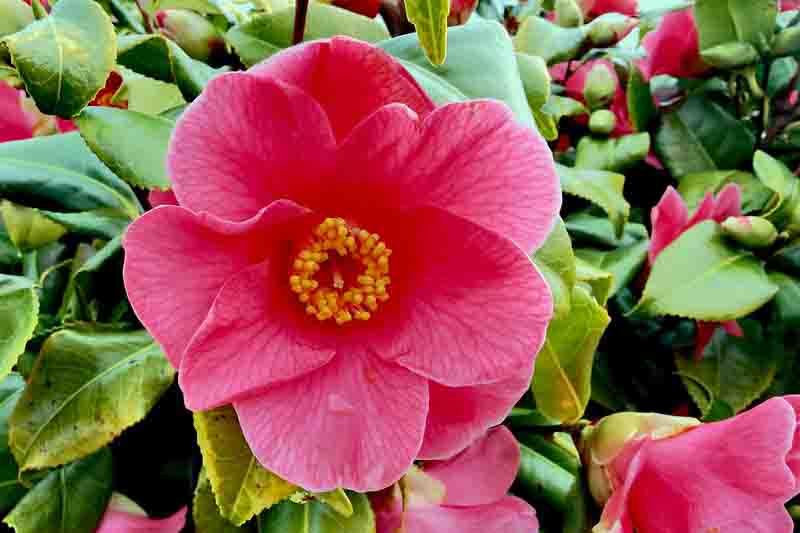


Camellias can remain healthy and flower beautifully in containers for many years, but choosing a plant labeled suitable for patios is only the beginning. Some container-grown camellias remain compact and proportionate. Others eventually become 8, 10, or even 15-foot shrubs that demand substantial tubs, frequent watering, selective pruning, and periodic root management.
Gardenia reviewed all 64 camellias in its database for this guide. Sixty carry the “Patio And Containers” designation, but that classification means they can be grown or displayed in containers – not that they remain compact, require little maintenance, or make practical permanent pot plants.
For the smallest balanced mature footprint, ‘Winter’s Rose’ is the strongest choice. ‘Minato-No-Akebono’ is the best refined flowering specimen, combining fragrance, graceful growth, and an extended bloom period. ‘Scentuous’ is especially useful where width is restricted, while ‘Winter’s Charm’ and ‘Snow Flurry’ offer larger cold-hardy options. Broad or vigorous cultivars can also succeed in tubs, but their eventual size must be considered before they become difficult to move, repot, or protect.
This guide explains how to select the best camellia for a container, choose a suitable pot, use acidic potting mix, maintain drainage and even moisture, manage hard water, fertilize without damaging the roots, repot or root-prune established plants, and protect potted camellias from summer heat and winter freezes.
How the varieties were evaluated: We first screened all 64 Gardenia camellia records by mature height, spread, fragrance, flowering period, and patio-and-container designation. We then reviewed individual plant profiles for growth habit, hardiness, and other characteristics affecting long-term container performance. A patio designation was not treated as evidence that a cultivar would remain compact indefinitely.
| Container need | Best choice | Gardenia recorded landscape size | Main limitation |
|---|---|---|---|
| Most compact long-term container | ‘Winter’s Rose’ | 2-3 ft. tall and wide | Very slow growth |
| Refined flowering specimen | ‘Minato-No-Akebono’ | 4-5 ft. tall, 3-5 ft. wide | Best in a sheltered position |
| Narrow fragrant option | ‘Scentuous’ | 4-6 ft. tall, 3-4 ft. wide | Needs a substantial pot with age |
| Cold-hardy compact choice | ‘Winter’s Rose’ | 2-3 ft. tall and wide | Container roots still need protection |
| White cold-hardy option in this guide | ‘Snow Flurry’ | 5-7 ft. tall, 3-5 ft. wide | Requires a large long-term container |
| Low cascading display | ‘Chansonette’ | 2-3 ft. tall, 7-8 ft. wide | Needs considerable lateral space |
| Tall upright container | ‘April Rose’ | 5-8 ft. tall, 3-5 ft. wide | Eventually tall for a confined patio |
| Large statement tub | ‘Sparkling Burgundy’ | 6-10 ft. tall, 4-8 ft. wide | Long-term pruning and root management |
Sizes shown are Gardenia’s recorded mature landscape ranges, not guaranteed container dimensions. Pot culture, pruning, climate, and root management may alter growth, but a container should not be expected to permanently convert a large cultivar into a dwarf plant.
The strongest long-term container camellias are naturally restrained in both height and width. A low-growing cultivar is not necessarily compact if its branches eventually spread 7 or 8 feet beyond the pot.
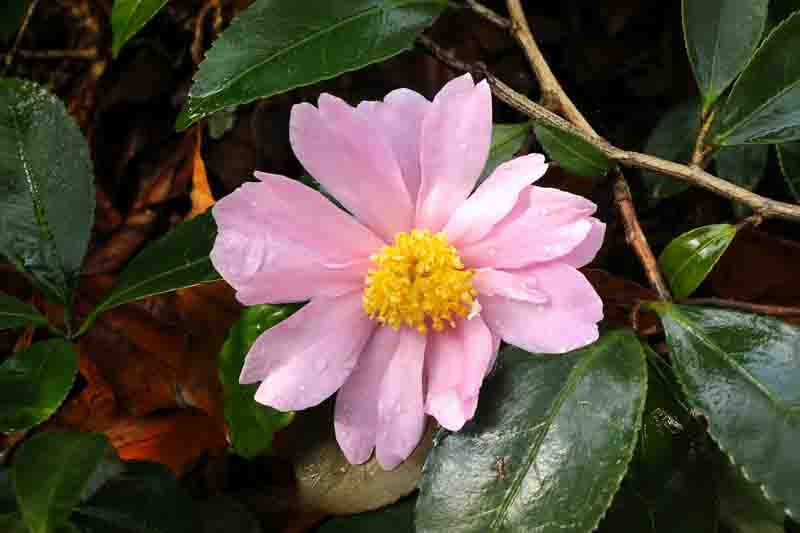
Camellia ‘Winter’s Rose’ is the strongest choice in the Gardenia database when the smallest balanced mature footprint is the priority. It is the only cultivar among the 64 reviewed whose recorded height and spread both remain within 2-3 feet (60-90 cm).
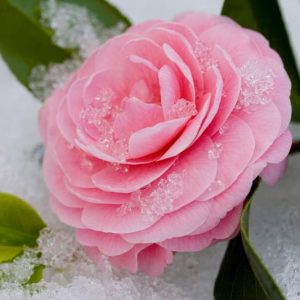
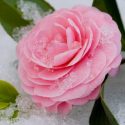
This very slow-growing camellia produces shell-pink rose-form double flowers in fall. Its balanced dimensions make it more practical for a courtyard, balcony, entrance, or compact patio than low cultivars that eventually spread several feet beyond their containers.
Why it ranks first: Its compactness is supported by both height and spread, not merely by a dwarf label.
Not recommended for: Gardeners seeking rapid growth or an immediate large floral display. Its slow development is part of what makes it manageable.
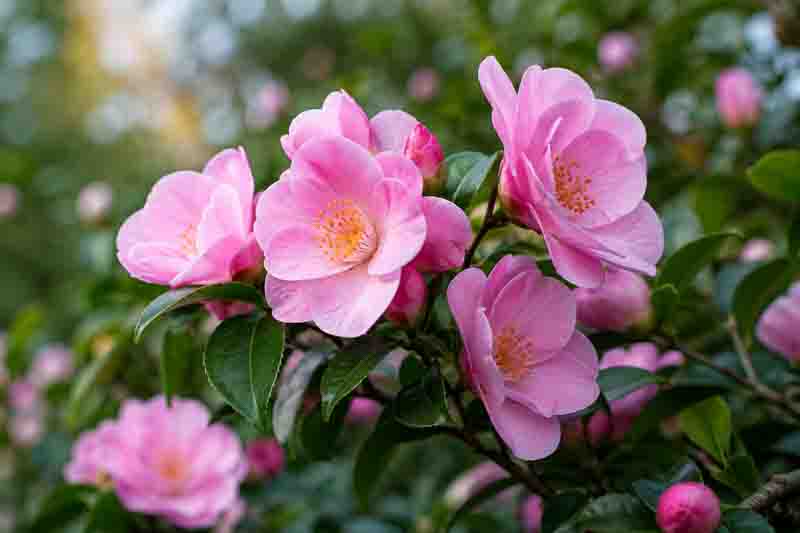
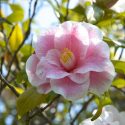
Camellia ‘Minato-No-Akebono’ grows approximately 4-5 feet (1.2-1.5 m) tall and 3-5 feet (90-150 cm) wide. Its fragrant shell-pink flowers are small and may appear over a long period from fall into spring.
Its arching habit, restrained footprint, fragrance, and modestly scaled flowers make it especially effective where the plant will be viewed closely. Position it beside a sheltered doorway, path, or seating area rather than at the back of a large border.
Choose it over ‘Winter’s Rose’ when: Fragrance, a longer flowering season, and a graceful specimen habit matter more than obtaining the smallest possible plant.
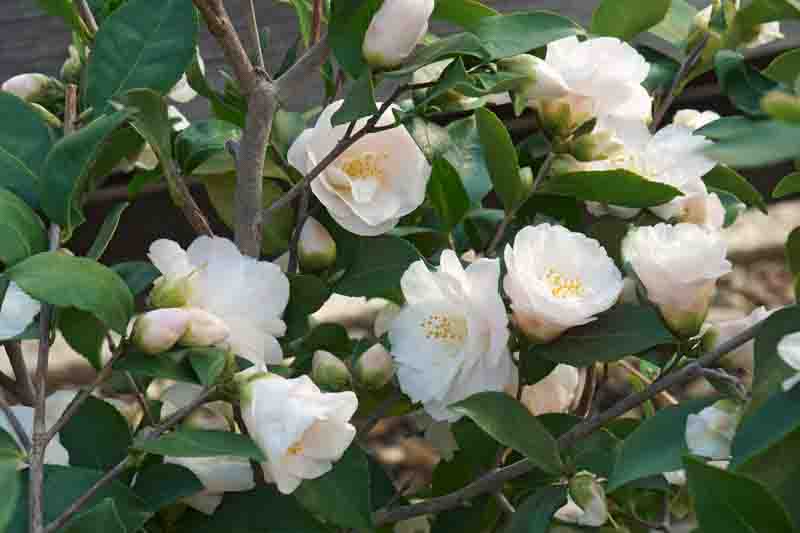
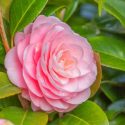
Camellia ‘Spring Mist’ also reaches approximately 4-5 feet tall and 3-5 feet wide. Its fragrant semi-double flowers open blush pink and fade toward white.
Its dimensions are nearly identical to those of ‘Minato-No-Akebono’, so the choice is primarily visual. Select ‘Spring Mist’ for fuller, paler flowers. Select ‘Minato-No-Akebono’ for a more informal silhouette and a longer recorded flowering period.
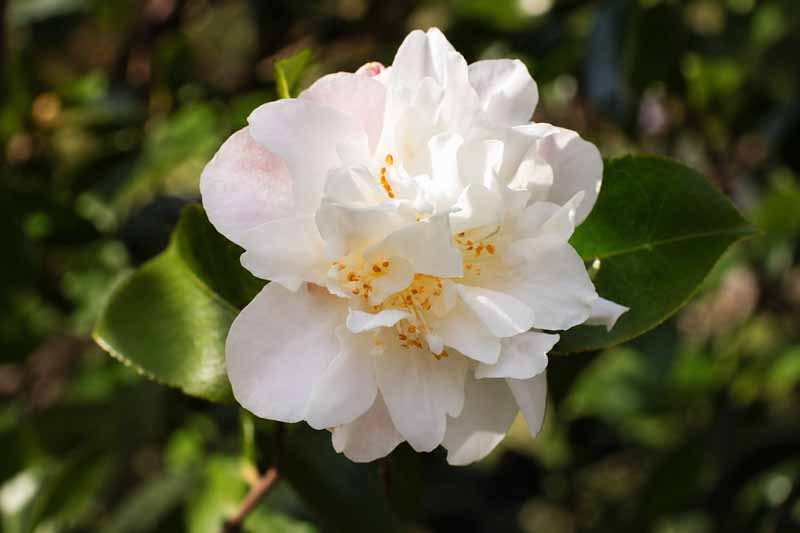
Camellia ‘Scentuous’ reaches 4-6 feet (1.2-1.8 m) tall and only 3-4 feet (90-120 cm) wide. Its small white flowers are flushed pink on the outside and carry a mild fragrance.
This is the narrowest fragrant option among the compact group reviewed. Its upright proportions make it easier to place beside a wall or on a restricted patio than broader cultivars of similar height.
Important limitation: Narrow does not mean miniature. An established 6-foot evergreen shrub still needs a stable floor-standing container, enough root volume, and adequate overhead room.
Compact-container judgment: Choose ‘Winter’s Rose’ for the smallest mature footprint, ‘Minato-No-Akebono’ for the strongest overall flowering specimen, ‘Spring Mist’ for pale fragrant flowers, and ‘Scentuous’ where width is the main constraint.
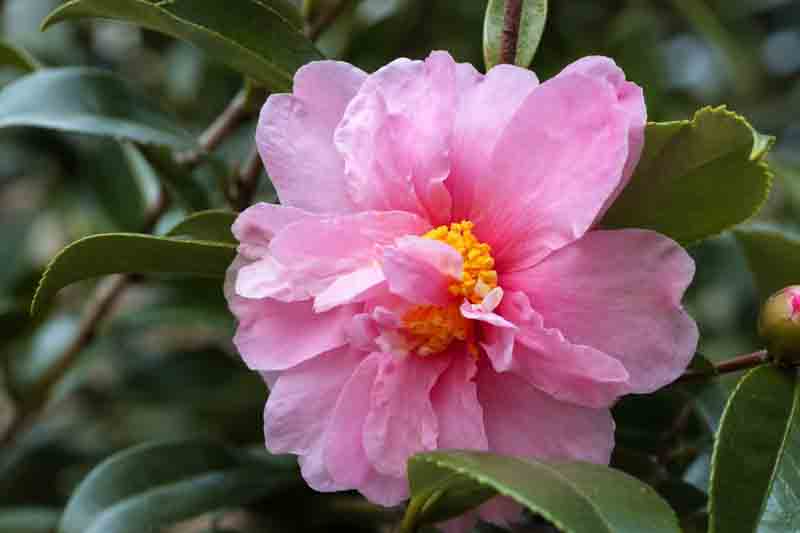
Cold hardiness is valuable in a container, but it does not eliminate the need to protect the roots. A pot freezes from the sides as well as the surface, while garden soil buffers abrupt temperature changes.
| Cultivar | USDA hardiness | Gardenia recorded landscape size | Container judgment |
|---|---|---|---|
| ‘Winter’s Rose’ | Zones 6-9 | 2-3 ft. tall and wide | Best compact cold-hardy choice |
| ‘Winter’s Charm’ | Zones 6-9 | 4-7 ft. tall, 4-5 ft. wide | Larger balanced specimen |
| ‘Snow Flurry’ | Zones 6-9 | 5-7 ft. tall, 3-5 ft. wide | White, relatively narrow option |
| ‘Polar Ice’ | Zones 6-9 | 5-6 ft. tall and wide | Broader specimen |
| ‘Winter’s Star‘ | Zones 6-9 | 4-6 ft. tall, 5-7 ft. wide | Needs significant lateral room |
Selection rule: Use cold hardiness to choose between plants that already fit the available space. Do not use it to justify a cultivar whose mature width or height is unsuitable for the patio.
Upright cultivars can provide height without occupying as much floor space, although few camellias are genuinely columnar.
| Cultivar | Gardenia recorded landscape size | Best use |
|---|---|---|
| ‘April Rose’ | 5-8 ft. tall, 3-5 ft. wide | Tall flowering accent beside an entrance or wall |
| ‘Winter’s Interlude’ | 5-8 ft. tall, 4-5 ft. wide | Cold-hardy upright specimen |
| ‘Hagoromo’ | 6-8 ft. tall, 4-5 ft. wide | Elegant vertical specimen in partial shade |
All three upright choices need broad, stable pots because their evergreen canopies catch the wind. They are unsuitable for lightweight containers, exposed roof terraces, or balconies with strict height restrictions. Drying wind also increases water loss from both foliage and potting mix.
Fragrance is especially valuable in containers because the plant can be positioned within a few feet of a doorway, path, or seating area. Camellia perfume is generally refined rather than powerful, and even documented fragrant varieties are best appreciated at close range.
| Cultivar | Gardenia recorded landscape size | Container judgment |
|---|---|---|
| ‘Minato-No-Akebono’ | 4-5 ft. tall, 3-5 ft. wide | Best refined compact specimen |
| ‘Spring Mist’ | 4-5 ft. tall, 3-5 ft. wide | Best pale-flowered compact option |
| ‘Scentuous’ | 4-6 ft. tall, 3-4 ft. wide | Best where width is restricted |
| ‘Fragrant Pink’ | 6-8 ft. tall, 4-6 ft. wide | More upright than broad, but still a substantial plant |
| ‘Cinnamon Cindy’ | 8-10 ft. tall, 3-6 ft. wide | Long-flowering choice for a very large tub |
‘Sweet Emily Kate‘, ‘Herme‘, ‘Kramer’s Supreme‘, and several fragrant sasanquas can also be grown in containers, but their broader or taller dimensions make them less practical as permanent patio plants.
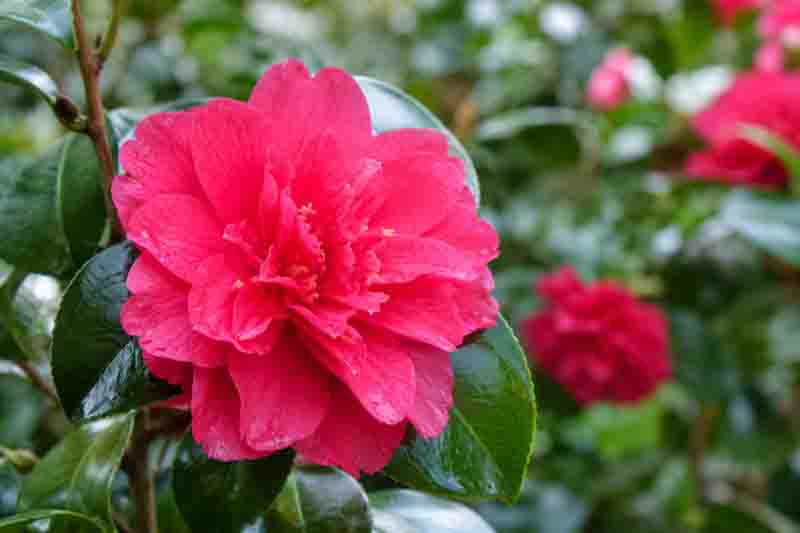
Camellia hiemalis ‘Chansonette’ remains only 2-3 feet tall but spreads 7-8 feet. In a wide, heavy container, its flexible branches can spill attractively over the rim.
Camellia sasanqua ‘Bonanza’ grows approximately 3-6 feet tall and 4-8 feet wide. Its bright red flowers create a stronger mass of fall color, but it needs similar lateral room.
Neither plant is compact in total footprint. Choose them for a broad terrace, raised planter, or generous courtyard where their spreading branches will not obstruct doors, paths, or seating.
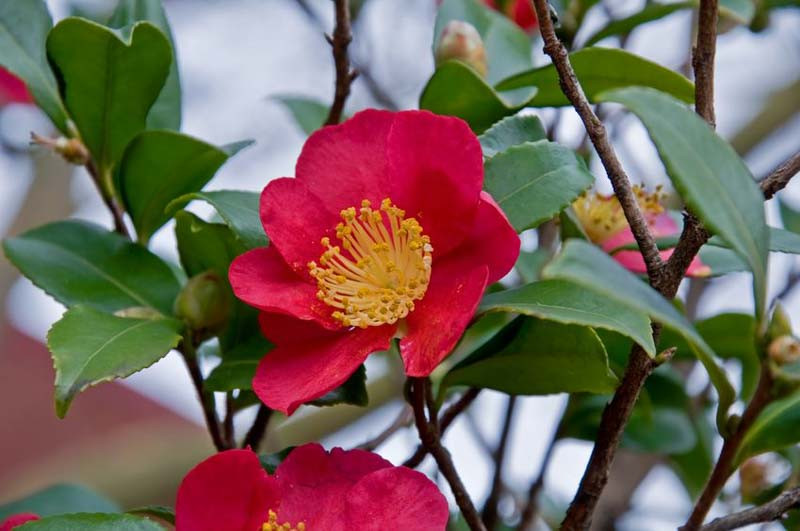
Several Gardenia camellias are designated for patio and container use despite recorded mature dimensions of 6-10 feet or more. These plants can be displayed effectively in large tubs, particularly while young, but their container designation should not be interpreted as a promise that they will remain easy permanent patio plants at full landscape size.
Large-container warning: Once the shrub and saturated potting mix become too heavy to move, winter protection, repotting, and root pruning become significantly more difficult. Confirm that the final container can remain in place safely before selecting a large cultivar.
Some container-tagged cultivars in the Gardenia database reach 10-15 feet or more. They may be displayed in tubs while young, but they are usually better planted in the landscape before their canopies and root systems become difficult to manage.
Examples include ‘Don Mac‘, ‘Korean Fire‘, ‘Anticipation‘, ‘Spring Sonnet‘, ‘Water Lily‘, ‘China Clay‘, and ‘Debbie‘. Their patio designation identifies container capability, not compact long-term growth.
Select according to mature dimensions, not the size of the nursery plant. A young camellia may remain manageable for several seasons while still being fundamentally unsuitable for permanent cultivation on a small balcony or patio.
Choose a container only modestly larger than the existing root ball – often a few inches wider – rather than moving a small plant directly into a much larger volume of potting mix. Excess unused mix may remain wet for too long because few roots are present to absorb the moisture.
Increase the pot size only after roots have substantially occupied the existing mix. The container must be deep enough to accommodate the complete root ball without bending the roots or burying the lower stem.
An established camellia may eventually require a substantial floor-standing container, but there is no single final diameter suitable for every cultivar. Choose the next pot according to the current root ball, plant stability, cultivar vigor, climate, and the amount of future root pruning you are prepared to undertake.
A larger pot is not always safer: A large volume of unused potting mix may remain wet long after the original root ball has absorbed the moisture it needs, reducing aeration and increasing the risk of root decline.
Planting-depth warning: Keep the top of the original root ball level with the finished potting mix. Never bury the lower stem to stabilize the plant. Use a wider or heavier container instead.
Camellias are ericaceous plants and require acidic growing conditions. Use fresh potting mix formulated for camellias, azaleas, rhododendrons, or other acid-loving container plants; these products are designed to maintain an appropriately low pH while providing the drainage and aeration container roots need.
The mix must retain enough moisture to prevent rapid drying while preserving air spaces around the fine roots. Peat-free ericaceous mixes can work well when they maintain acidity and do not collapse into a dense material after repeated watering.
Do not use ordinary garden soil. Even good loam can compact in a container, drain unpredictably, and restrict oxygen around the roots.
Use a container with generous, unobstructed drainage holes. Raise the pot on feet if it stands on flat paving, and empty saucers or decorative outer pots after watering or heavy rain.
Do not rely on a layer of gravel to correct inadequate drainage. Open holes, an aerated potting mix, and a container that does not stand in retained water are far more important.
After thorough watering, excess should begin leaving the base promptly. If water remains on the surface or the mix stays saturated for several days, inspect the drainage holes and root zone before watering again.
Check the moisture within the root ball rather than watering to a fixed calendar. When the upper 1-2 inches (2.5-5 cm) are becoming dry, water thoroughly until excess runs from the drainage holes.
Avoid frequent shallow sips. They may wet only the surface, leave the center of the root ball dry, and encourage dissolved salts to accumulate.
Container camellias may need frequent checks during warm, windy weather. Dense evergreen foliage can shed rainfall, and pots positioned beneath eaves may remain dry even after a storm.
Consistent summer moisture is especially important because the plant is forming the buds responsible for the next flowering season. Severe or repeated drought may result in weak growth, scorched foliage, or bud drop.
Repeated watering with hard, alkaline water can gradually raise the pH of the potting mix. The plant may then struggle to absorb iron and other nutrients even when they are present.
Rainwater is preferable where household water is strongly alkaline. Unsoftened tap water is an acceptable backup when rainwater is unavailable. Do not routinely irrigate with water from a sodium-based household softener because sodium can accumulate in the confined root zone.
White deposits on the pot rim or potting surface may indicate mineral accumulation. Periodically water thoroughly enough for excess to drain away rather than applying only small amounts.
Yellow leaves with green veins? Before adding fertilizer, check the irrigation water and potting-mix pH. Repeated use of hard, alkaline water can make iron unavailable even when nutrients are already present.
Use a fertilizer formulated for acid-loving container plants and follow the product label. Begin feeding after flowering as active growth starts.
Stop well before the end of the growing season so late, soft growth is not encouraged. In temperate Northern Hemisphere gardens, this generally means stopping by midsummer.
Never fertilize a dry, wilted, waterlogged, diseased, or heat-stressed camellia. Moisten a dry root ball first and postpone feeding during extreme heat.
Do not assume yellow leaves indicate hunger. High pH, compacted mix, root damage, waterlogging, drought, and scale insects can produce similar symptoms.
Repot or substantially renew the potting mix approximately every two or three years. Organic ingredients gradually decompose, drainage slows, and air spaces around the roots disappear.
Repot when you notice one or more of the following:
After flowering is generally the most practical time. If the plant still needs a larger container, move up only one sensible size and keep the top of the original root ball level with the new surface.
Once a camellia has reached the largest container you can safely manage, root pruning allows it to return to the same pot with fresh mix.
Remove the plant after flowering and trim approximately 1-2 inches (2.5-5 cm) from the outer and lower root mass with a clean, sharp tool. Remove dead, damaged, or tightly circling roots, but do not cut away an excessive proportion of healthy roots.
Clean the container, reopen the drainage holes, and repot at the original depth with fresh ericaceous mix. Water thoroughly and shelter the plant from intense sun and drying wind while it re-establishes.
Root pruning normally belongs to the two- or three-year repotting cycle, not annual maintenance. Remove less material from a weak plant or one with a sparse root system.
Roots in containers heat more rapidly than roots in the ground. Dark pots positioned on hot paving or against heat-reflecting walls can expose the outer roots to damaging temperatures.
Morning sun, filtered light, or partial shade is generally safer than intense afternoon exposure. Established sasanquas may tolerate more sun, but a sun-tolerant canopy does not mean the container should be allowed to bake.
A light-colored outer pot can reduce heat absorption, while an air gap between the growing container and a decorative cover provides some insulation. Check moisture frequently during heat waves, but confirm that the root zone is actually drying before watering.
A cultivar may be hardy in the landscape yet suffer root injury in an exposed pot. Container roots experience faster temperature changes and less insulation than roots in garden soil.
A cold greenhouse, bright enclosed porch, or similar unheated position can provide short-term protection during extreme weather. A dark garage may be used in an emergency but is not ideal for prolonged overwintering because camellias remain evergreen.
Do not bring a hardy outdoor camellia into a heated room. Plant survival and flower survival are also different: the shrub may remain healthy even when exposed buds or open flowers are damaged by freezing weather.
Yellow leaves are a symptom, not a diagnosis. The pattern of discoloration and the condition of the root zone provide the most useful clues.
| What you see | Possible cause | Check first |
|---|---|---|
| Yellow tissue with green veins | High pH and nutrient chlorosis | Water alkalinity and potting-mix pH |
| Uniformly pale foliage | Depleted mix, nutrient shortage, or damaged roots | Root condition and repotting history |
| Yellowing with wilting | Drought, waterlogging, or root rot | Moisture inside the root ball |
| Yellow patches on upper leaf surfaces | Possible tea scale | Leaf undersides for scale coverings |
| A few older inner leaves | Normal evergreen leaf replacement | Whether new growth remains healthy |
Correct drainage, moisture, root health, and pH before applying fertilizer, iron, or other supplements. See Camellia Leaves Turning Yellow: Causes and Fixes for a fuller diagnostic guide.
A naturally compact camellia can remain container-grown for many years and sometimes for decades when the potting mix is renewed and the roots are managed.
‘Winter’s Rose’, ‘Minato-No-Akebono’, ‘Spring Mist’, and ‘Scentuous’ are the strongest long-term choices among the Gardenia records because their mature dimensions remain comparatively manageable. Medium-sized cultivars can also remain potted, but their watering, stability, pruning, and root-management demands increase with age.
Consider planting the camellia in the ground when:
Use Gardenia’s Camellia Comparison Tool to compare mature height, spread, hardiness, fragrance, and flowering period. For broader planting and maintenance guidance, see Camellia Care: How to Plant, Grow and Prune Camellias.
‘Winter’s Rose’ is the strongest choice when the smallest balanced footprint is the priority, reaching only 2-3 feet tall and wide. ‘Minato-No-Akebono’ is the best refined flowering specimen, while ‘Scentuous’ is especially useful where width is restricted.
Many camellias can grow in containers when young, but mature dimensions determine whether they remain practical. Cultivars reaching 10-15 feet usually require large tubs, regular pruning, and periodic root management and may eventually be better planted in the ground.
Choose a container only modestly larger than the existing root ball and increase its size after roots have substantially occupied the current mix. Avoid placing a small camellia directly into an oversized container that may remain wet for too long.
Use fresh ericaceous potting mix formulated for acid-loving container plants. It should retain moderate moisture while remaining well aerated and free-draining. Ordinary garden soil can become dense and waterlogged in a pot.
Water according to moisture inside the root ball rather than a fixed schedule. When the upper 1-2 inches are becoming dry, water thoroughly until excess drains from the base. Check more frequently during hot, dry, or windy weather.
Rainwater is preferable where tap water is hard or alkaline. Repeated alkaline watering can raise the potting-mix pH and contribute to yellow leaves with green veins. Avoid regular use of sodium-softened household water.
Repot or substantially renew the mix approximately every two or three years, or when roots fill the container and drainage deteriorates. After flowering is generally the most practical time.
Yes. Once a camellia reaches its final manageable pot size, approximately 1-2 inches may be trimmed from the outer and lower root mass during periodic repotting. Return the plant to the cleaned container at its original depth with fresh acidic mix.
Shelter the container from cold wind and insulate the root zone during severe freezes. A cold greenhouse or bright unheated porch can provide temporary protection. Do not overwinter a hardy outdoor camellia in a heated room.
Possible causes include alkaline water, depleted or compacted mix, drought, waterlogging, root rot, scale insects, nutrient problems, or normal leaf aging. Diagnose the yellowing pattern and root-zone condition before fertilizing.
Updated: August 2026 • Reviewed by Gardenia Editors
| Hardiness |
6 - 9 |
|---|---|
| Heat Zones |
7 - 8 |
| Climate Zones | 4, 5, 6, 7, 8, 9, 12, 14, 15, 16, 17, 18, 19, 20, 21, 22, 23, 24 |
| Plant Type | Shrubs |
| Plant Family | Theaceae |
| Genus | Camellia |
| Exposure | Full Sun, Partial Sun, Shade |
| Season of Interest | Spring (Early, Mid), Fall, Winter |
| Maintenance | Low |
| Water Needs | Average |
| Soil Type | Clay, Loam, Sand |
| Soil pH | Acid, Neutral |
| Soil Drainage | Moist but Well-Drained, Well-Drained |
| Characteristics | Cut Flowers, Fragrant, Plant of Merit, Showy |
| Landscaping Ideas | Beds And Borders, Hedges And Screens, Patio And Containers, Wall-Side Borders |
| Garden Styles | City and Courtyard, Informal and Cottage, Japanese Garden, Traditional Garden |
| Hardiness |
6 - 9 |
|---|---|
| Heat Zones |
7 - 8 |
| Climate Zones | 4, 5, 6, 7, 8, 9, 12, 14, 15, 16, 17, 18, 19, 20, 21, 22, 23, 24 |
| Plant Type | Shrubs |
| Plant Family | Theaceae |
| Genus | Camellia |
| Exposure | Full Sun, Partial Sun, Shade |
| Season of Interest | Spring (Early, Mid), Fall, Winter |
| Maintenance | Low |
| Water Needs | Average |
| Soil Type | Clay, Loam, Sand |
| Soil pH | Acid, Neutral |
| Soil Drainage | Moist but Well-Drained, Well-Drained |
| Characteristics | Cut Flowers, Fragrant, Plant of Merit, Showy |
| Landscaping Ideas | Beds And Borders, Hedges And Screens, Patio And Containers, Wall-Side Borders |
| Garden Styles | City and Courtyard, Informal and Cottage, Japanese Garden, Traditional Garden |
Create a membership account to save your garden designs and to view them on any device.
Becoming a contributing member of Gardenia is easy and can be done in just a few minutes. If you provide us with your name, email address and the payment of a modest $25 annual membership fee, you will become a full member, enabling you to design and save up to 25 of your garden design ideas.
Join now and start creating your dream garden!
Create a membership account to save your garden designs and to view them on any device.
Becoming a contributing member of Gardenia is easy and can be done in just a few minutes. If you provide us with your name, email address and the payment of a modest $25 annual membership fee, you will become a full member, enabling you to design and save up to 25 of your garden design ideas.
Join now and start creating your dream garden!