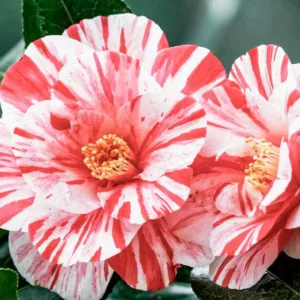
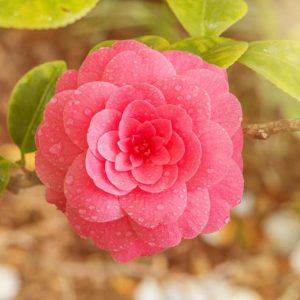
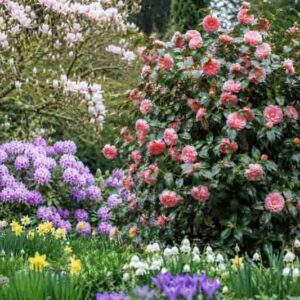
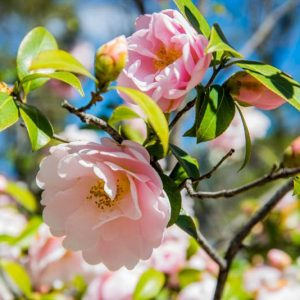
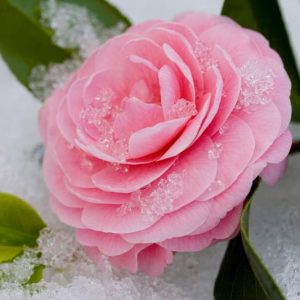
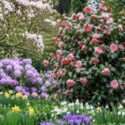
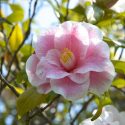
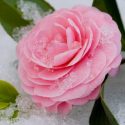
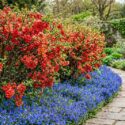
When do camellias bloom? Explore a visual month-by-month calendar from October through May, comparing autumn sasanquas, winter japonicas, spring hybrids, flower colors, mature heights, and hardiness zones. Discover how climate shifts flowering and combine early, midseason, late, and long-blooming cultivars for an exceptionally long season of garden color every year.
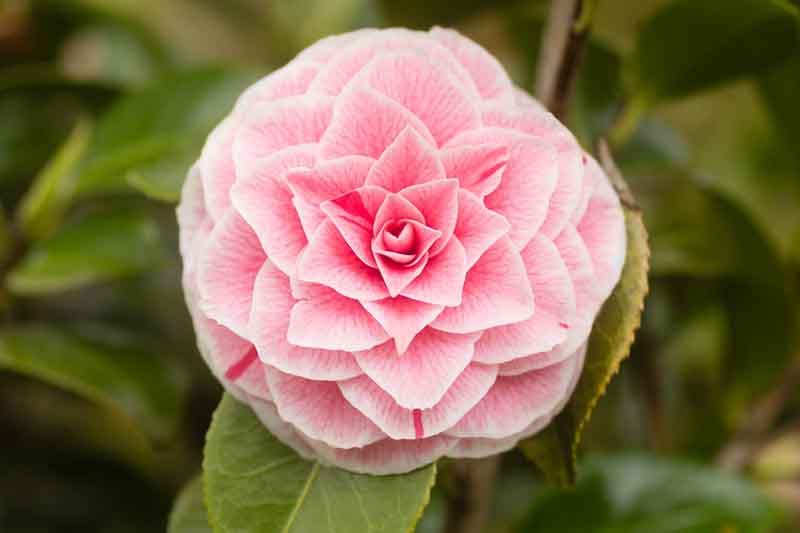


Camellias can provide flowers for far longer than many gardeners realize. A single shrub may bloom for several weeks, while a carefully planned collection can produce color from approximately October through May in a mild Northern Hemisphere climate.
The display usually begins with autumn-flowering Camellia sasanqua cultivars and early hybrids. Winter brings early- and midseason Japanese camellias, cold-hardy hybrids, and long-flowering selections. Late japonicas and Camellia × williamsii hybrids then extend the season through spring.
Bloom dates are approximate rather than fixed. The same cultivar may flower several weeks earlier in a mild coastal garden than in a cool inland site. Temperature, latitude, elevation, wind exposure, sun, plant age, and seasonal weather all influence when the first buds open and how long the flowers last.
This calendar is designed as a visual planning tool rather than another long cultivar list. Use it to identify gaps in your garden’s display, compare complementary bloom windows, and choose camellias with suitable colors, mature sizes, and hardiness.
Calendar orientation: The months in this guide refer to the Northern Hemisphere. In the Southern Hemisphere, the same seasonal sequence occurs approximately six months later.
| Flowering Group | Oct | Nov | Dec | Jan | Feb | Mar | Apr | May |
|---|---|---|---|---|---|---|---|---|
| Autumn and early season Mostly sasanquas and early hybrids |
● | ● | ● | ● | – | – | – | – |
| Winter and midseason Japonicas and many hybrids |
– | ● | ● | ● | ● | ● | ● | – |
| Spring and late season Late japonicas and williamsii hybrids |
– | – | – | ● | ● | ● | ● | ● |
Important: Early, midseason, and late are relative positions within the local camellia season. The month bands above are approximate Northern Hemisphere translations, not universal flowering dates.
October marks the beginning of the camellia season in many mild gardens. Early sasanqua camellias and cold-hardy autumn hybrids begin flowering while most Japanese camellias still carry closed buds.
Compact ‘Winter’s Rose’, white ‘Mine-No-Yuki’, and rosy ‘Shishigashira’ are useful early choices. In a cooler or exposed garden, the same plants may not begin until November.
November is often the strongest month for fall-flowering camellias. Sasanquas produce masses of white, pink, rose, and red flowers on plants ranging from low spreading shrubs to substantial hedges and screens.
Early hybrids also begin bridging the transition into winter, making November one of the easiest months in which to combine several flower colors and plant sizes.
December joins late sasanquas with vernalis hybrids and the first winter-flowering japonicas. Brilliant red ‘Yuletide’ is especially associated with this period, although its flowering window can extend well beyond the holidays.
In cold regions, freezing weather may damage open flowers while unopened buds remain intact and resume flowering during the next mild spell.
January introduces many early and midseason Japanese camellias. Long-flowering hybrids may continue from fall, while cultivars such as ‘Kramer’s Supreme’ begin contributing large, richly colored blooms.
Mild winter gardens may now contain the greatest overlap between autumn, winter, and long-season varieties.
February often offers the widest diversity of camellia flowers. Japonicas contribute formal double, rose-form, peony-form, semi-double, and single blooms, while hybrids add vigor, fragrance, compact growth, or improved cold tolerance.
In colder areas, February may represent the beginning of the main season rather than its peak.
March is the major transition month. Midseason cultivars continue while late japonicas, cold-hardy April Series selections, and spring-flowering hybrids begin opening.
Long-season plants such as ‘Lavinia Maggi’ and ‘Scentuous’ help bridge the calendar, while ‘April Rose’ and ‘Korean Fire’ start the late display.
April belongs to late japonicas, fragrant hybrids, and cold-hardy spring cultivars. It is an important month for gardeners who want camellias to overlap with spring bulbs, azaleas, rhododendrons, and flowering trees.
Early cultivars may already have finished in warm districts, while winter-flowering plants may continue into April in cooler coastal or northern gardens.
May normally marks the end of the Northern Hemisphere camellia season. Late japonicas and hybrids may continue in cool, elevated, coastal, or northern locations.
In warm regions, the season may finish earlier because rising temperatures accelerate bud opening and shorten the life of individual flowers.
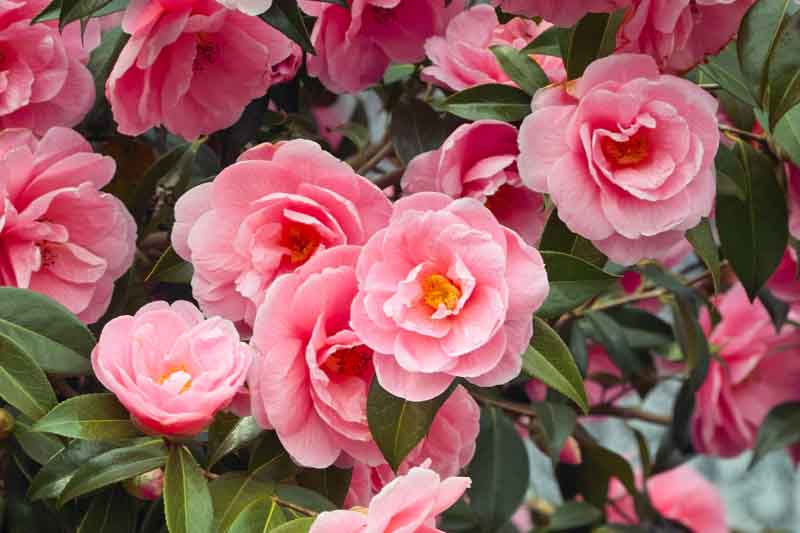
| Climate Pattern | Likely Flowering Effect | Best Planning Strategy |
|---|---|---|
| Mild coastal or warm-winter region | Earlier bud opening and greater overlap, but warm spells may shorten individual flower life | Use autumn sasanquas plus late and long-season cultivars |
| Cool coastal or temperate region | Later opening, often followed by a long and steady spring display | Choose early, midseason, and late plants rather than relying on exact dates |
| Cold inland or exposed region | Autumn flowers face early freezes, and the main season may be delayed | Emphasize cold-hardy late-winter and spring cultivars in sheltered sites |
| Protected courtyard or wall-side position | Stored warmth and wind protection may advance flowering | Expect earlier opening than on the same cultivar in an exposed garden |
A shaded north-facing location may bloom later than a sheltered east-facing wall in the same garden. Elevation, cold-air pockets, wind, and proximity to buildings can shift the calendar even within one USDA hardiness zone.
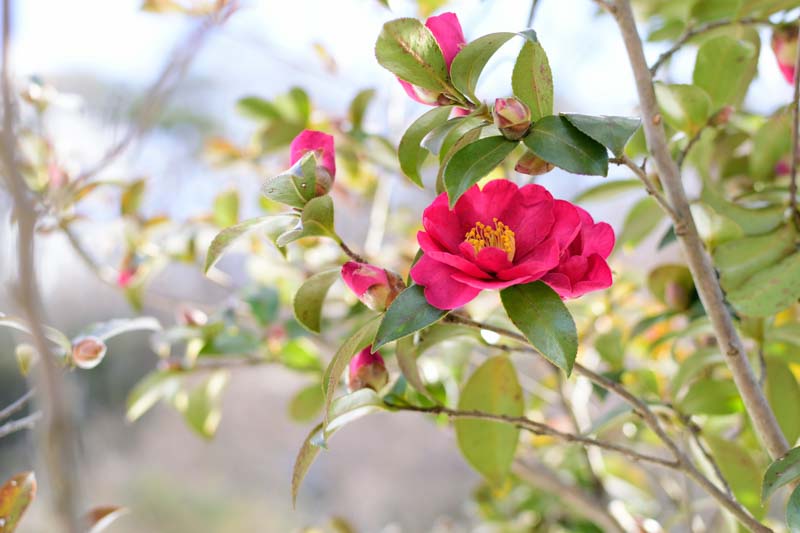
Camellia sasanqua generally opens the season. Most cultivars flower from October or November into December or January, although long-season selections may continue later.
Sasanquas tend to produce many relatively small flowers and often have a lighter, more open habit than japonicas. They are particularly useful for hedges, screens, walls, containers, and gardens where an early display is the priority.
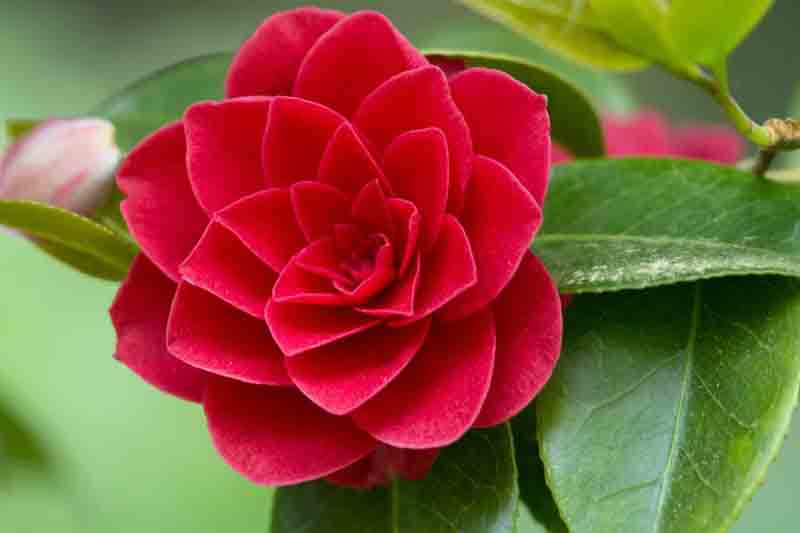
Camellia japonica forms the core of the winter and spring season. Individual cultivars may be classified as early, midseason, late, or early-to-late bloomers.
Japonicas offer the widest range of flower forms and sizes. Depending on cultivar and climate, they may bloom from December or January through April or May.
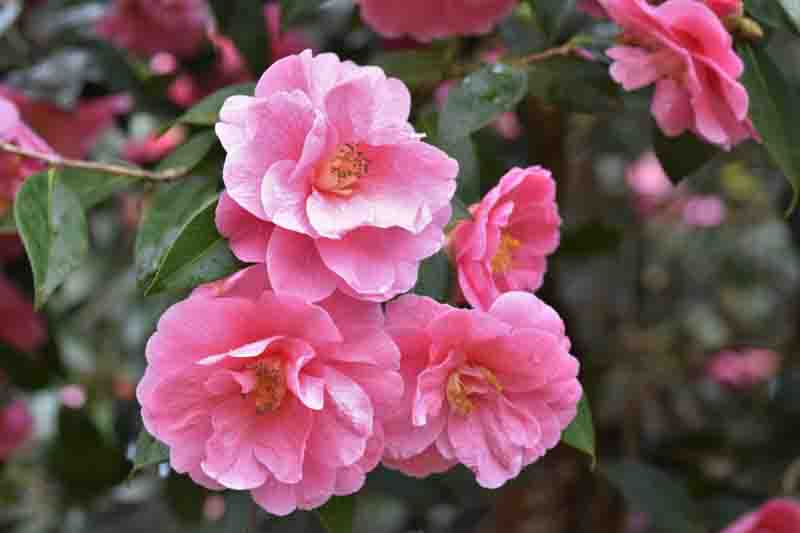
Camellia × williamsii hybrids generally flower from winter into spring. Many are vigorous, floriferous, and capable of shedding spent flowers more cleanly than formal-double japonicas.
They are valuable for filling the central and late sections of the calendar and often perform reliably in cool, temperate climates.
Hybrids involving species such as Camellia oleifera, C. lutchuensis, C. saluenensis, and C. reticulata add cold hardiness, fragrance, compact growth, unusually long bloom periods, or distinctive flower size and form.
These hybrids are especially useful for bridging gaps between the principal sasanqua and japonica seasons.
The following chart combines Gardenia’s cultivar bloom-start and bloom-end fields with the approximate month ranges used on Gardenia plant profiles. The chart is intended for planning, not for predicting an exact opening date.
| Cultivar | Flower Color | Mature Height | USDA Zones | Oct | Nov | Dec | Jan | Feb | Mar | Apr | May |
|---|---|---|---|---|---|---|---|---|---|---|---|
| ‘Winter’s Rose’ | Shell pink | 2-3 ft. | 6-9 | ● | ● | ||||||
| ‘Shishigashira’ | Rosy pink | 4-5 ft. | 7-10 | ● | ● | ● | ● | ● | ● | ||
| ‘Mine-No-Yuki’ | White | 6-8 ft. | 7-9 | ● | ● | ● | ● | ||||
| ‘Yuletide’ | Brilliant red | 8-10 ft. | 7-9 | ● | ● | ● | ● | ● | |||
| ‘Minato-No-Akebono’ | Shell pink | 4-5 ft. | 7-9 | ● | ● | ● | ● | ● | ● | ||
| ‘Cinnamon Cindy’ | White, pink-flushed | 8-10 ft. | 7-9 | ● | ● | ● | ● | ● | ● | ||
| ‘Kramer’s Supreme’ | Brilliant red | 8-10 ft. | 7-9 | ● | ● | ● | |||||
| ‘Lavinia Maggi’ | White, pink-striped | 8-10 ft. | 7-9 | ● | ● | ● | ● | ● | |||
| ‘Scentuous’ | White | 4-6 ft. | 7-9 | ● | ● | ● | ● | ● | |||
| ‘Donation’ | Orchid pink | 8-15 ft. | 7-8 | ● | ● | ● | |||||
| ‘April Rose’ | Deep rose-red | 5-8 ft. | 6-9 | ● | ● | ● | |||||
| ‘Korean Fire’ | Deep red | 10-15 ft. | 6-9 | ● | ● | ● | |||||
How the chart was created: Gardenia’s bloom-start and bloom-end classifications were translated into approximate Northern Hemisphere calendar months and checked against published cultivar profiles. Colored cells indicate possible bloom months, not guaranteed continuous flowering throughout every highlighted month.
In colder regions, a completely uninterrupted October-to-May display is less predictable because early freezes may damage autumn flowers. Concentrating more cultivars in late winter and spring generally produces the most dependable sequence.
Three carefully chosen camellias can provide a long display, but four to six cultivars offer better protection against weather-related gaps.
Adding one long-flowering hybrid across the middle of the calendar reduces the risk of a visible gap between the early and late groups.
Gardenia’s guide to planting and caring for camellias explains the soil, moisture, exposure, and maintenance conditions that support dependable blooms.
This page is designed to show when the main groups and selected cultivars overlap. Use the existing seasonal guides when you need a larger selection for a particular part of the calendar:
Do not choose every camellia because it flowers during the same favorite month. A spectacular February collection may leave the garden without a camellia flower in November or April.
Begin with the calendar. Select at least one early cultivar, one or two winter cultivars, and one late cultivar. Then refine the choices by hardiness, mature size, flower color, fragrance, and intended garden use.
Camellias do not share one universal flowering season. Sasanquas and early hybrids generally begin in fall, japonicas and many hybrids dominate winter, and late japonicas and williamsii hybrids carry the display into spring.
In mild Northern Hemisphere gardens, a thoughtfully chosen collection can provide flowers from approximately October through May. Warm sites generally start earlier, while cool regions flower later and may have a more concentrated season.
Use the horizontal bloom chart to identify complementary flowering windows. A sequence of early-, midseason, late-, and long-flowering plants is more dependable than relying on one cultivar to provide continuous color by itself.
Depending on cultivar and climate, camellias may flower from approximately October through May in the Northern Hemisphere. Autumn sasanquas bloom first, winter japonicas and hybrids follow, and late cultivars continue into spring.
Camellia sasanqua cultivars generally bloom from fall into early winter, commonly beginning in October or November and continuing through December or January. Some long-flowering cultivars persist later in mild climates.
Camellia japonica cultivars bloom mainly from winter through spring. Early cultivars may begin in late fall or early winter, while late cultivars may continue into April or May in cool regions.
Yes. Combine an autumn-flowering sasanqua, a winter japonica or hybrid, and a late spring-flowering cultivar. Adding a long-season hybrid helps bridge gaps, although weather may interrupt the display.
Generally, yes. Mild autumn and winter temperatures often advance bud opening and increase overlap between cultivars. However, warm spells can shorten individual flower life and may compress part of the season.
An early-season camellia flowers near the beginning of the local camellia season, generally during fall or early winter. Early, midseason, and late are relative categories rather than fixed universal months.
Cool weather, shade, elevation, wind exposure, plant age, drought during bud formation, and cultivar genetics can delay flowering. Published bloom periods are approximate ranges rather than guaranteed opening dates.
Three carefully selected cultivars may provide a long display, but four to six usually offer better continuity. Include an autumn camellia, a winter cultivar, a late spring selection, and preferably a long-flowering hybrid.
Updated: July 2026 • Calendar derived from Gardenia cultivar data and published plant profiles • Reviewed by Gardenia Editors
| Hardiness |
6 - 9 |
|---|---|
| Heat Zones |
7 - 8 |
| Climate Zones | 4, 5, 6, 7, 8, 9, 12, 14, 15, 16, 17, 18, 19, 20, 21, 22, 23, 24 |
| Plant Type | Shrubs |
| Plant Family | Theaceae |
| Genus | Camellia |
| Exposure | Full Sun, Partial Sun, Shade |
| Season of Interest | Spring (Early, Mid), Fall, Winter |
| Maintenance | Low |
| Water Needs | Average |
| Soil Type | Clay, Loam, Sand |
| Soil pH | Acid, Neutral |
| Soil Drainage | Moist but Well-Drained, Well-Drained |
| Characteristics | Cut Flowers, Fragrant, Plant of Merit, Showy |
| Landscaping Ideas | Beds And Borders, Hedges And Screens, Patio And Containers, Wall-Side Borders |
| Garden Styles | City and Courtyard, Informal and Cottage, Japanese Garden, Traditional Garden |
| Hardiness |
6 - 9 |
|---|---|
| Heat Zones |
7 - 8 |
| Climate Zones | 4, 5, 6, 7, 8, 9, 12, 14, 15, 16, 17, 18, 19, 20, 21, 22, 23, 24 |
| Plant Type | Shrubs |
| Plant Family | Theaceae |
| Genus | Camellia |
| Exposure | Full Sun, Partial Sun, Shade |
| Season of Interest | Spring (Early, Mid), Fall, Winter |
| Maintenance | Low |
| Water Needs | Average |
| Soil Type | Clay, Loam, Sand |
| Soil pH | Acid, Neutral |
| Soil Drainage | Moist but Well-Drained, Well-Drained |
| Characteristics | Cut Flowers, Fragrant, Plant of Merit, Showy |
| Landscaping Ideas | Beds And Borders, Hedges And Screens, Patio And Containers, Wall-Side Borders |
| Garden Styles | City and Courtyard, Informal and Cottage, Japanese Garden, Traditional Garden |
Create a membership account to save your garden designs and to view them on any device.
Becoming a contributing member of Gardenia is easy and can be done in just a few minutes. If you provide us with your name, email address and the payment of a modest $25 annual membership fee, you will become a full member, enabling you to design and save up to 25 of your garden design ideas.
Join now and start creating your dream garden!
Create a membership account to save your garden designs and to view them on any device.
Becoming a contributing member of Gardenia is easy and can be done in just a few minutes. If you provide us with your name, email address and the payment of a modest $25 annual membership fee, you will become a full member, enabling you to design and save up to 25 of your garden design ideas.
Join now and start creating your dream garden!