Azalea mollis, Soft Rhododendron, Late Midseason Azalea, Deciduous Azalea
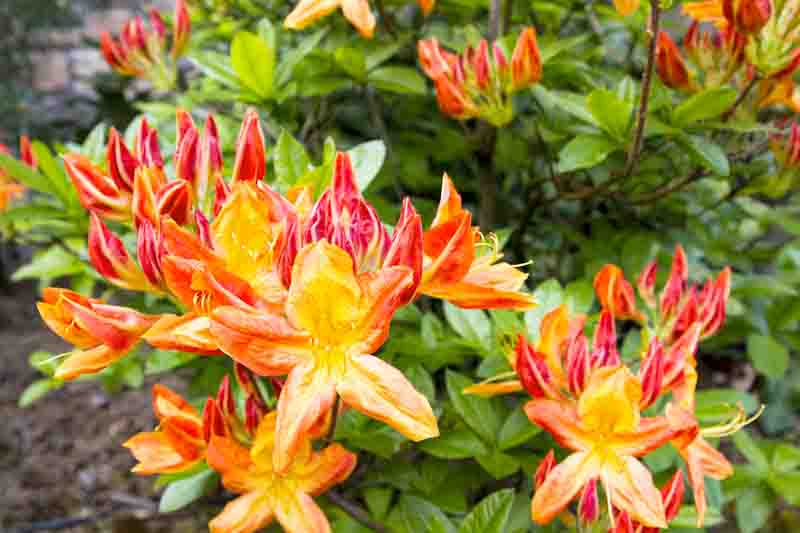


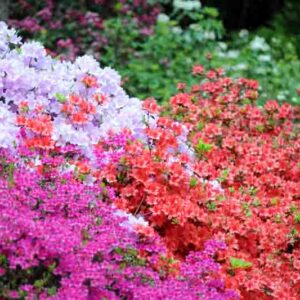
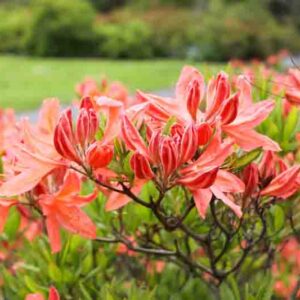
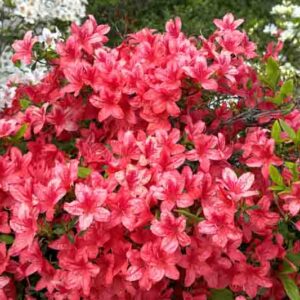
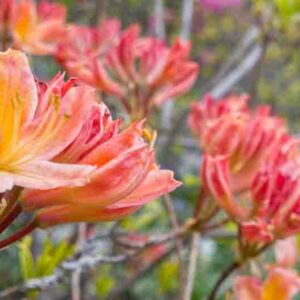
Brilliantly colored and spectacular in spring, Mollis Hybrid Azaleas are deciduous rhododendrons prized for their large, open flowers in glowing shades of yellow, gold, orange, orange-red, and fiery red. Their flowers appear in generous clusters in late spring, often before or just as the new foliage unfolds, creating one of the most vivid displays among deciduous azaleas.
Mollis azaleas originated largely from crosses involving the Chinese Rhododendron molle and the Japanese azalea historically known as Rhododendron japonicum. Developed in Europe during the late 19th and early 20th centuries, they became important ancestors of later large-flowered deciduous azalea groups, including the famous Knap Hill and Exbury hybrids.
Summary: Deciduous hybrid azaleas celebrated for large, brilliantly colored late-spring flowers.
Use: Shrub borders, woodland edges, informal plantings, foundation plantings, and mixed acid-loving borders.
Highlight: Spectacular yellow, gold, orange, orange-red, and red flowers, often opening before or with the new leaves.
Important: Mollis, Knap Hill, and Exbury azaleas are related historically, but they are not interchangeable hybrid-group names.
| Plant Group | Mollis Hybrid Azaleas |
|---|---|
| Parentage | Derived largely from Rhododendron molle and the Japanese azalea historically known as Rhododendron japonicum |
| Plant Type and Habit | Deciduous, upright to rounded shrubs |
| Size | Typically 4-6 ft. tall and wide (120-180 cm), depending on cultivar and conditions |
| Exposure | Full sun to partial shade; shelter from drying winds |
| Soil | Acidic, humus-rich, moist but well-drained soil |
| Flowers | Yellow, gold, orange, orange-red, and red; late spring |
| Foliage | Deciduous green foliage, often developing yellow, orange, bronze, or red fall color |
Large orange or yellow flowers do not automatically make a deciduous azalea a Mollis hybrid. Gardenia recommends checking the cultivar name and breeding group rather than relying on flower appearance alone. Mollis azaleas contributed to later breeding, but Knap Hill and Exbury azaleas have more complex ancestry and should not automatically be labeled Mollis.
Mollis azaleas belong to an important historic group of deciduous rhododendron hybrids developed for large flowers and exceptionally vivid spring color. Their ancestry is associated particularly with the Chinese Rhododendron molle and the Japanese azalea historically known as Rhododendron japonicum.
Important breeding work took place in Belgium in the late 19th century, followed by extensive development in the Netherlands. Dutch nurseries, particularly the Koster nursery, selected plants for larger flowers, stronger colors, and improved garden performance.
Mollis hybrids subsequently became important breeding material for later deciduous azaleas. Their influence can be found in the development of the Knap Hill and Exbury groups, but these later hybrids should not be treated simply as alternative names for Mollis azaleas.
Mollis azaleas are upright to rounded deciduous shrubs, commonly reaching about 4-6 ft. tall and wide (120-180 cm). Mature size varies among cultivars and according to climate, soil, moisture, and growing conditions.
The green foliage provides a relatively quiet background during summer after the brilliant spring flowering display. In fall, the leaves can develop attractive shades of yellow, orange, bronze, or red before dropping, giving these shrubs a valuable second season of color.
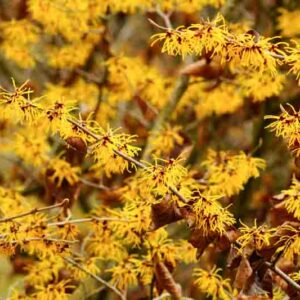
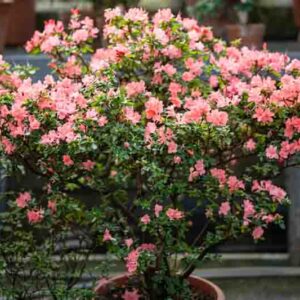
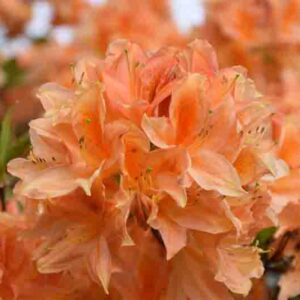
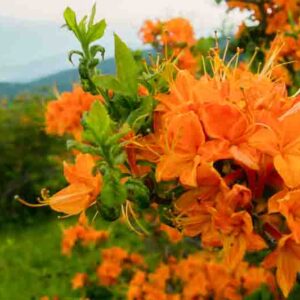
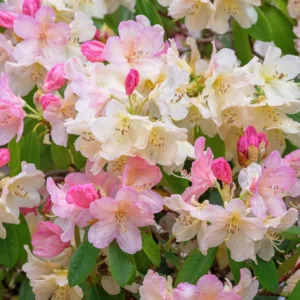
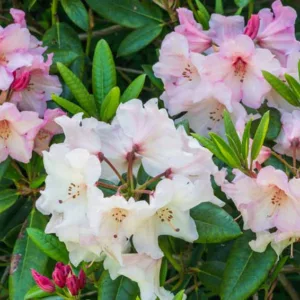
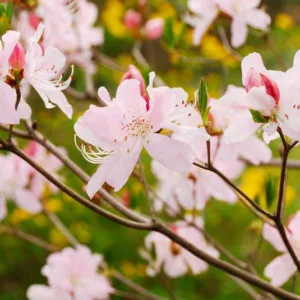
The spectacular flowers are the principal attraction. Large, funnel-shaped blooms appear in generous clusters in late spring, generally before or as the new leaves emerge. With relatively little foliage to compete with them, the flowers can cover the branches in intense color.
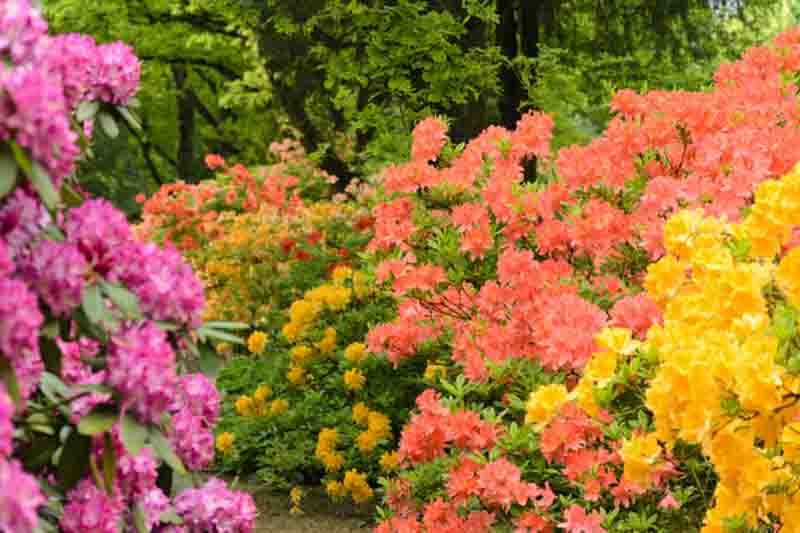
Traditional Mollis colors concentrate heavily on the warm end of the spectrum – clear yellow, gold, orange, orange-red, and red. This comparatively focused palette is one useful distinction from later Knap Hill and Exbury hybrids, which expanded the range of flower colors and forms considerably.
Mollis azaleas are primarily grown for their brilliant color and large flowers rather than fragrance. Gardeners specifically seeking strongly fragrant deciduous azaleas may find better choices among other groups and species.
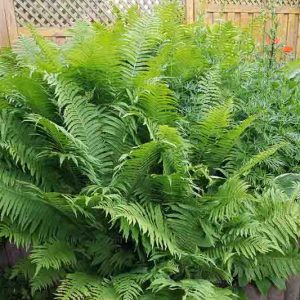
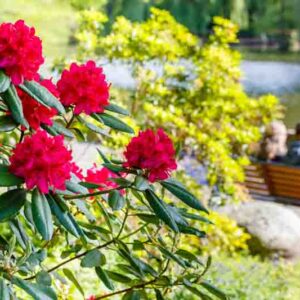
The yellow, orange, and red flowers of Mollis azaleas are exceptionally vivid. Rather than surrounding them with many competing flower colors, Gardenia recommends using evergreen foliage, ferns, Japanese maples, and quieter woodland plants as a backdrop. The contrast allows the azaleas to provide the main burst of spring color.
Historic Mollis selections demonstrate the group’s characteristic warm color range. Cultivar availability varies considerably by region and nursery.
Mollis azaleas helped provide breeding material for later deciduous azalea groups, but the names are not interchangeable. Knap Hill and Exbury hybrids have more complex parentage and generally offer a broader range of flower colors, forms, sizes, and often fragrance. If cultivar identity matters, Gardenia recommends keeping these historic hybrid groups separate rather than labeling every large-flowered deciduous azalea as a Mollis hybrid.
The spring flowers can provide nectar and pollen for bees and other visiting pollinating insects. Their flowering period can therefore contribute to the succession of spring bloom in a wildlife-friendly garden.
Like other rhododendrons and azaleas, Mollis hybrids contain grayanotoxins. All parts are toxic if ingested and should be kept away from children and animals likely to eat them. They are toxic to dogs, cats, and horses.
Grow Mollis azaleas in full sun to partial shade. Good light encourages abundant flowering and compact growth, but afternoon shade can be beneficial where summers are hot. Deep shade should be avoided because it can reduce flowering and encourage loose, less attractive growth.
Plant in acidic, humus-rich, moist but well-drained soil. Mollis azaleas have shallow root systems and dislike both prolonged drought and waterlogged ground. Loam and sandy soils can be excellent when enriched with organic matter, while heavy clay requires particularly careful attention to drainage.
Water regularly during establishment and prolonged dry periods. An annual mulch of leaf mold, pine bark, or another suitable organic material helps retain soil moisture, moderate root-zone temperatures, and protect the shallow roots. Keep mulch away from the main stems.
A Mollis azalea may be perfectly hardy through winter yet still lose part of its floral display to a late spring frost. Because the flowers open relatively early among deciduous azalea hybrids, Gardenia recommends considering frost pockets, cold-air drainage, and flower-bud exposure when choosing the planting site – not simply the USDA hardiness zone.
Plant Mollis azaleas shallowly, setting the top of the root ball at or slightly above the surrounding soil level rather than burying the crown. Water thoroughly after planting and avoid deep cultivation around established shrubs because their roots remain close to the soil surface.
Little pruning is normally required. Remove dead, damaged, crossing, or poorly placed branches after flowering if necessary. Spent flower clusters can be removed for appearance and to prevent seed formation, but routine deadheading is not essential for healthy growth.
Named cultivars may be propagated by semi-ripe cuttings in late summer or by grafting in winter. Vegetative propagation is necessary when the characteristics of a particular named cultivar need to be preserved.
Most problems result from unsuitable growing conditions rather than demanding maintenance requirements. Poorly drained soil can lead to root problems, while alkaline conditions may cause iron chlorosis. Prolonged drought can produce leaf scorch, premature leaf drop, and reduced flowering.
As with other rhododendrons and azaleas, potential problems may include vine weevils, aphids, scale insects, lace bugs, leaf diseases, bud problems, and root rots. Maintaining acidic soil, reliable moisture, good drainage, and suitable light gives plants the strongest foundation for healthy growth.
Check the amount of light, pruning time, and spring frost exposure. Deep shade can suppress flowering, late pruning can remove developing flower buds, and frost can damage buds or opening flowers even when the shrub itself remains healthy.
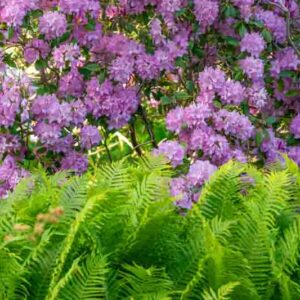
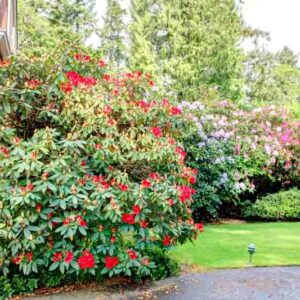
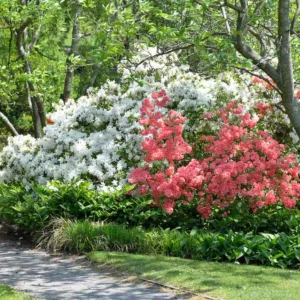
Mollis azaleas bring intense warm color to the spring garden, making them particularly effective against evergreen foliage and beneath the light canopy of woodland-edge plantings. Their yellow and orange flowers also contrast beautifully with burgundy Japanese maple foliage, emerging fern fronds, and the cooler flower colors of compatible spring plants.
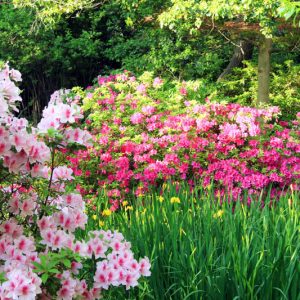
They are excellent choices for shrub borders, woodland-edge gardens, informal groupings, foundation plantings, and mixed acid-loving borders. For additional ideas, see Gardenia’s guide to shade and acid-loving plants for woodland gardens.
Before choosing companions for their flower or foliage colors, Gardenia recommends matching hardiness, light, soil pH, moisture, and drainage. Then compare mature size and seasonal interest. This produces combinations that work horticulturally as well as visually.
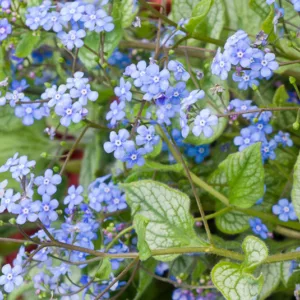
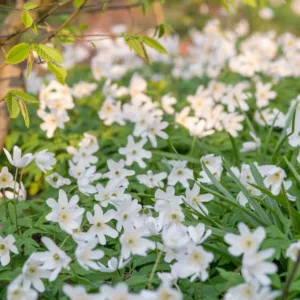
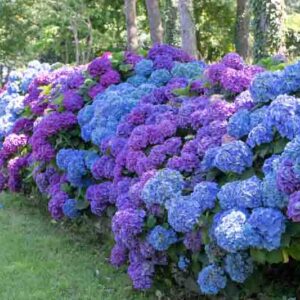
The fiery spring flowers of Mollis azaleas combine beautifully with evergreen rhododendrons, Japanese maples, ferns, and other woodland plants, but successful companions also need compatible soil, moisture, light, and climate.
Choose the Mollis azalea that gives you the spring color you want, find plants that genuinely share its growing conditions, and then check how the entire combination will work as the garden matures.
Mollis azaleas are deciduous rhododendron hybrids developed largely from Rhododendron molle and the Japanese azalea historically known as Rhododendron japonicum. They are prized for large yellow, gold, orange, orange-red, and red flowers in late spring.
Mollis azaleas commonly grow about 4-6 ft. (120-180 cm) tall and wide, although mature size varies among cultivars and according to growing conditions.
Mollis azaleas grow well in full sun to partial shade. Good light encourages abundant flowering, while some afternoon shade can be beneficial in hot climates. Deep shade may reduce flowering.
No. Mollis azaleas contributed to the ancestry of later deciduous azalea groups, but Knap Hill and Exbury hybrids have more complex parentage and should not be treated as interchangeable names for Mollis azaleas.
Yes. Like other rhododendrons and azaleas, Mollis hybrids contain grayanotoxins. All parts are toxic if ingested and are toxic to dogs, cats, and horses.
| Hardiness |
5 - 8 |
|---|---|
| Heat Zones |
5 - 9 |
| Plant Type | Shrubs |
| Plant Family | Ericaceae |
| Genus | Rhododendron |
| Common names | Azalea, Rhododendron |
| Exposure | Full Sun, Partial Sun |
| Season of Interest | Spring (Late), Summer (Early), Fall |
| Height | 4' - 6' (120cm - 180cm) |
| Spread | 3' - 4' (90cm - 120cm) |
| Spacing | 48" (120cm) |
| Maintenance | Low |
| Water Needs | Average |
| Soil Type | Clay, Loam, Sand |
| Soil pH | Acid |
| Soil Drainage | Moist but Well-Drained |
| Characteristics | Showy |
| Tolerances | Rabbit, Clay Soil |
| Attracts | Butterflies, Hummingbirds |
| Garden Uses | Beds And Borders, Hedges And Screens |
| Garden Styles | Butterfly Garden, City and Courtyard, Informal and Cottage, Japanese Garden, Pollinator Garden, Traditional Garden, Woodland Garden |
| Toxic to Humans | Low severity |
| Toxic to Cats | Toxic |
| Toxic to Dogs | Toxic |
| Toxic to Horses | Toxic |


| Hardiness |
5 - 8 |
|---|---|
| Heat Zones |
5 - 9 |
| Plant Type | Shrubs |
| Plant Family | Ericaceae |
| Genus | Rhododendron |
| Common names | Azalea, Rhododendron |
| Exposure | Full Sun, Partial Sun |
| Season of Interest | Spring (Late), Summer (Early), Fall |
| Height | 4' - 6' (120cm - 180cm) |
| Spread | 3' - 4' (90cm - 120cm) |
| Spacing | 48" (120cm) |
| Maintenance | Low |
| Water Needs | Average |
| Soil Type | Clay, Loam, Sand |
| Soil pH | Acid |
| Soil Drainage | Moist but Well-Drained |
| Characteristics | Showy |
| Tolerances | Rabbit, Clay Soil |
| Attracts | Butterflies, Hummingbirds |
| Garden Uses | Beds And Borders, Hedges And Screens |
| Garden Styles | Butterfly Garden, City and Courtyard, Informal and Cottage, Japanese Garden, Pollinator Garden, Traditional Garden, Woodland Garden |
| Toxic to Humans | Low severity |
| Toxic to Cats | Toxic |
| Toxic to Dogs | Toxic |
| Toxic to Horses | Toxic |
How many Rhododendron molle do I need for my garden?
| Plant | Quantity | |
|---|---|---|
| Rhododendron molle | N/A | Buy Plants |
Create a membership account to save your garden designs and to view them on any device.
Becoming a contributing member of Gardenia is easy and can be done in just a few minutes. If you provide us with your name, email address and the payment of a modest $25 annual membership fee, you will become a full member, enabling you to design and save up to 25 of your garden design ideas.
Join now and start creating your dream garden!