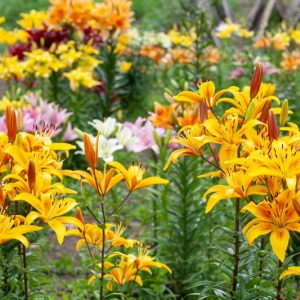
Oriental or Orienpet lilies? Both offer spectacular late-summer flowers and fragrance, but Orienpets add Trumpet ancestry, often bringing greater height, vigor, heat tolerance, and soil flexibility. Compare bloom time, scent, flowers, hardiness, containers, and six popular cultivars to discover which lily is the better fit for your garden.
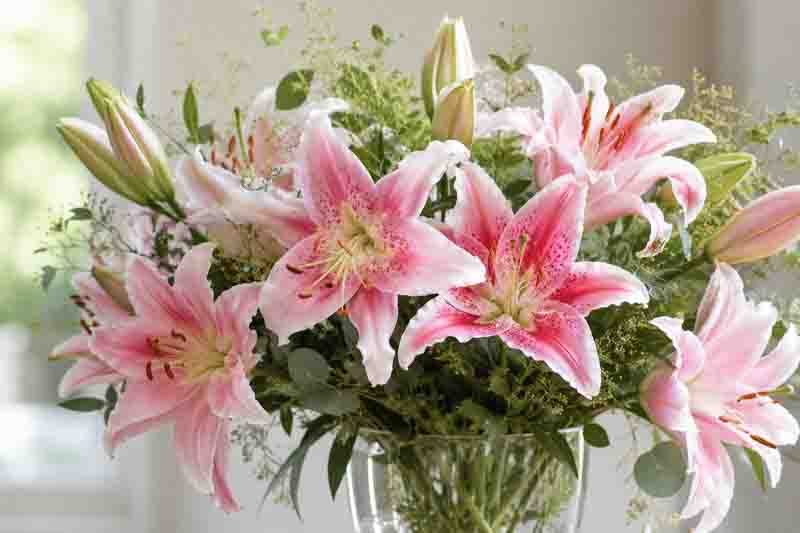


Oriental or Orienpet lily? This is a more nuanced choice than Asiatic versus Oriental because the two groups share many of the qualities gardeners prize most in lilies: large flowers, summer bloom, fragrance, dramatic color, and excellent performance as cut flowers.
The key difference lies in their ancestry. Oriental lilies are a distinct hybrid group renowned for broad, flamboyant, intensely fragrant flowers and a strong preference for acidic soil. Orienpet lilies – also called OT or Oriental-Trumpet hybrids – combine Oriental lilies with Trumpet/Aurelian ancestry, often adding greater height, sturdier stems, broader soil adaptability, and better heat tolerance while retaining spectacular flowers and fragrance.
Neither group is universally better. A compact Oriental may be ideal beside a patio, while a tall Orienpet can become an architectural centerpiece at the back of a perennial border. The best choice depends on your soil, climate, available space, fragrance preference, and the role you want the lily to play in your garden.
Gardenia’s shortcut: choose Oriental lilies for classic fragrance and flamboyant flowers where acidic conditions suit them. Choose Orienpets for Oriental-style drama with greater vigor, scale, and general site flexibility.
| Feature | Oriental Lilies | Orienpet Lilies |
|---|---|---|
| Hybrid group | Oriental Hybrids – Division VII | Oriental-Trumpet interdivisional hybrids – Division VIII |
| Bloom season | Mostly mid to late summer | Mostly mid to late summer, with many strong late-season performers |
| Fragrance | Typically strong, rich, and unmistakable | Usually fragrant, with intensity and character varying by cultivar |
| Flower form | Broad, open, often ruffled or recurved | Highly variable, from broad Oriental-like bowls to trumpet-influenced forms |
| Height | Often about 2-6 ft. (60-180 cm) | Often about 3-8 ft. (90-240 cm), with shorter exceptions |
| Soil pH | Generally favor acidic soil | Generally more flexible, although cultivar requirements still matter |
| Heat adaptability | Varies by cultivar and climate | Many cultivars show greater heat tolerance and vigor than traditional Orientals. |
| Hardiness | Many are very cold-hardy | Many are very cold-hardy; check the cultivar rather than assuming one group is hardier |
| Containers | Excellent, with many manageable cultivars | Excellent when a suitably compact cultivar is chosen |
| Best reason to choose | Classic fragrant Oriental-lily experience | Oriental-style drama with greater scale and adaptability |
Important: these are group-level tendencies, not promises about every plant. Some Orienpets are no taller than medium-sized Orientals, while fragrance, hardiness, flower form, bloom timing, and soil tolerance vary by cultivar. Use the hybrid group to narrow your choice, then compare the actual lily.
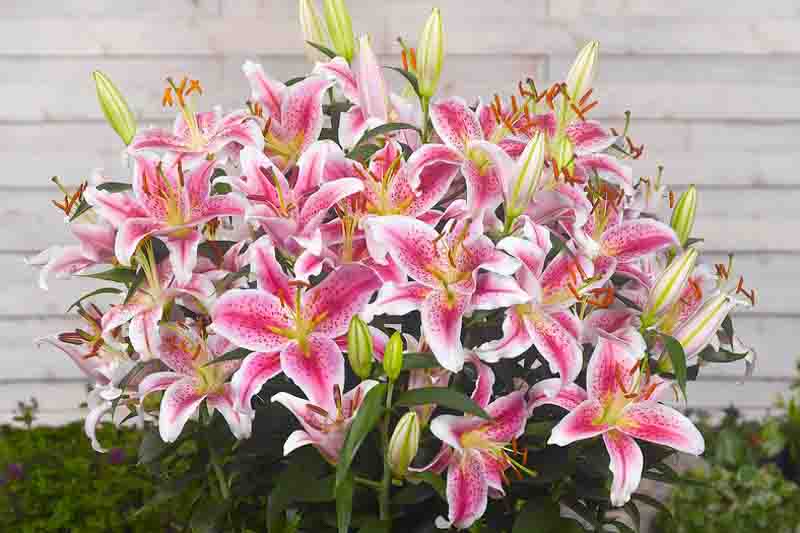
Oriental lilies belong to Lilium Horticultural Division VII. Their ancestry includes East Asian lilies such as Lilium auratum and Lilium speciosum, and they have become some of the most recognizable lilies in gardens and cut-flower arrangements.
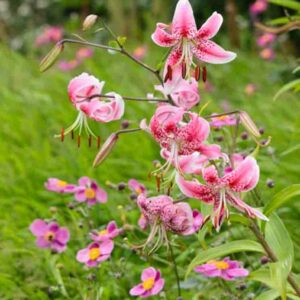
The group is famous for three characteristics: large flowers, intense fragrance, and late-summer drama. Blooms are often broad and open, with substantial tepals, recurved or ruffled edges, spots, contrasting bands, and striking throats.
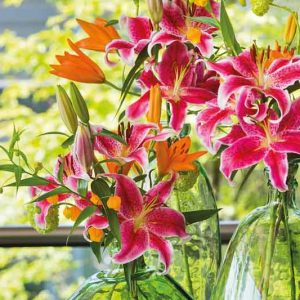
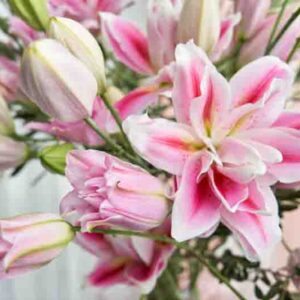
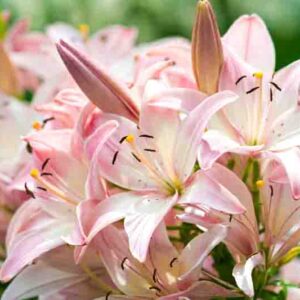
Classic examples include heavily scented Lilium ‘Star Gazer’, white-flowered Lilium ‘Casa Blanca’, and pink-striped Lilium ‘Muscadet’.
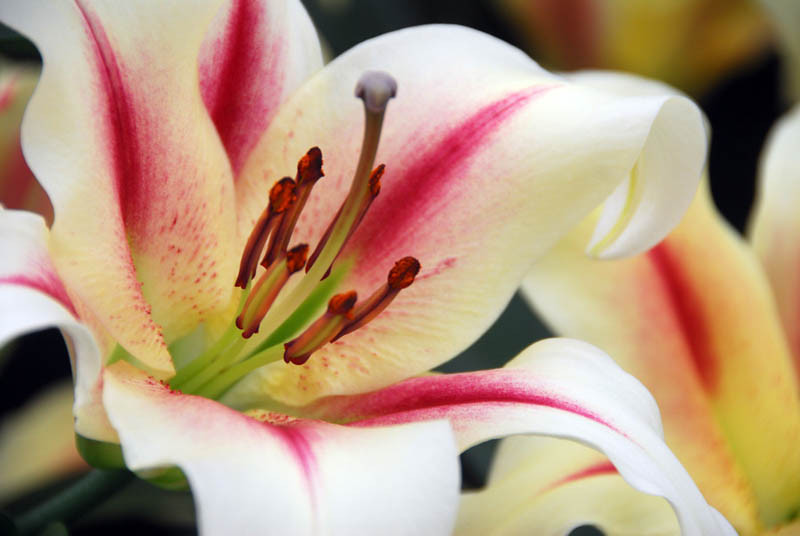
Orienpet lilies, also called OT hybrids or Oriental-Trumpet lilies, are interdivisional hybrids created by crossing Oriental lilies with Trumpet/Aurelian lilies. They belong to Horticultural Division VIII.
That mixed ancestry gives Orienpets a distinctive combination of traits. They retain much of the flower size, fragrance, and glamour associated with Orientals while often gaining the sturdier growth, stature, heat tolerance, and wider site adaptability associated with Trumpet/Aurelian hybrids.
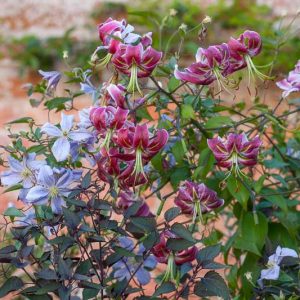
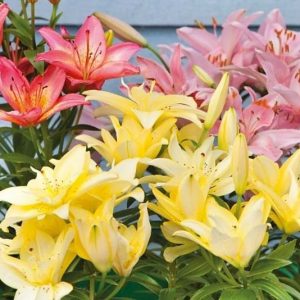
Popular Gardenia examples include yellow-and-white Lilium ‘Conca d’Or’, towering crimson Lilium ‘Black Beauty’, and dusty-pink Lilium ‘Candy Club’.
This is the fundamental difference between the two groups.
Oriental lilies are Division VII hybrids. Orienpets are Division VIII interdivisional hybrids produced by crossing Oriental lilies with Trumpet/Aurelian lilies.
The distinction matters because Orienpets are not simply extra-large Orientals. Their Trumpet ancestry can influence plant height, stem strength, flower form, color range, soil flexibility, and performance in warm summer conditions.
Gardenia interpretation: think of an Orienpet not as a larger Oriental, but as a separate hybrid group combining characteristics from both Oriental and Trumpet lily lineages.
Bloom time is not a dramatic dividing line between Oriental and Orienpet lilies. Both are important during the middle and later part of the lily season.
Oriental lilies generally bloom from midsummer into late summer. Orienpets also flower primarily from midsummer into late summer, with many selections contributing strongly toward the end of the main lily season.
If extending the lily season is your priority, combine earlier Asiatic lilies with Trumpets, Orientals, and Orienpets rather than expecting a large seasonal gap between Orientals and Orienpets alone.
See Gardenia’s Lily Bloom Calendar for a broader view of the flowering sequence.
Unlike an Asiatic-versus-Oriental comparison, fragrance does not produce an easy winner here.
Oriental lilies are famous for their rich, powerful perfume. ‘Star Gazer’, ‘Casa Blanca’, and ‘Muscadet’ are classic examples.
Many Orienpets are fragrant too, but scent character and intensity can vary more noticeably from cultivar to cultivar. That makes individual selection especially important if fragrance is one of your main reasons for growing lilies.
Gardenia’s Most Fragrant Lilies and Most Fragrant LA Hybrids and Orienpet Lilies can help narrow the choices.
Both groups can produce enormous, show-stopping blooms, but their flowers often have a different visual character.
Oriental lilies typically produce broad, open or bowl-shaped flowers with substantial overlapping tepals. Ruffled margins, recurved tips, spots, contrasting bands, and dramatic throats are common.
Orienpets inherit flower traits from both parent groups. Some look strongly Oriental, while others reveal obvious Trumpet influence through longer, more funnel-shaped, outward-facing, or recurved flowers.
One of the most practical reasons to choose an Orienpet is scale.
Many Oriental cultivars make substantial plants, but Orienpets are particularly associated with tall, heavy stems and strong vertical presence. Established bulbs can become commanding features in a perennial border.
For example, ‘Candy Club’ grows about 3-4 ft. (90-120 cm), while ‘Black Beauty’ can reach about 4-7 ft. (120-210 cm).
Gardenia buying tip: “Orienpet” tells you the hybrid group, not the eventual height. Check the cultivar before deciding whether it belongs in a container, the middle of a border, or behind everything else.
Oriental and Orienpet labels are extremely useful starting points, but actual cultivars reveal how much variation exists within both groups. Gardenia’s plant records show why the final decision should be made at cultivar level.
| Cultivar | Group | Height | Hardiness | What It Shows |
|---|---|---|---|---|
| Lilium ‘Star Gazer’ | Oriental | 2-3 ft. (60-90 cm) | USDA 3-9 | A relatively compact but intensely fragrant Oriental that works in borders and larger containers. |
| Lilium ‘Casa Blanca’ | Oriental | 3-4 ft. (90-120 cm) | USDA 4-9 | Large white flowers and powerful perfume exemplify classic Oriental character. |
| Lilium ‘Muscadet’ | Oriental | 3-4 ft. (90-120 cm) | USDA 4-9 | Huge, strongly scented white-and-pink flowers show the luxurious Oriental style. |
| Lilium ‘Candy Club’ | Orienpet | 3-4 ft. (90-120 cm) | USDA 5-9 | Shows that an Orienpet can remain in the same general height class as many popular Orientals. |
| Lilium ‘Conca d’Or’ | Orienpet | 4-5 ft. (120-150 cm) | USDA 4-8 | Large yellow-and-white flowers and substantial stems demonstrate the impressive scale possible in OT hybrids. |
| Lilium ‘Black Beauty’ | Orienpet | 4-7 ft. (120-210 cm) | USDA 4-9 | Its exceptional height and profuse recurved flowers show how far an Orienpet can depart from the classic broad Oriental form. |
Gardenia cultivar insight: Orienpet does not automatically mean giant. In Gardenia’s examples, ‘Candy Club’ remains around 3-4 ft. (90-120 cm), overlapping with Oriental ‘Casa Blanca’ and ‘Muscadet’, while ‘Black Beauty’ can reach 4-7 ft. (120-210 cm). Hybrid group predicts character; cultivar determines scale.
This is one of the most useful practical differences between the two groups.
Oriental lilies generally favor acidic soil. In clearly alkaline conditions, they may be easier to grow in containers filled with an appropriate ericaceous growing medium.
Orienpets are generally more flexible at group level. Their Trumpet ancestry gives gardeners more options, and Oriental-Trumpet hybrids can succeed across a wider range of soil conditions than classic Orientals. Individual cultivar requirements still matter, however.
Gardenia site-fit rule: if you love Oriental-style flowers but your garden is alkaline, investigate Orienpets first – then check the exact cultivar before planting.
Heat adaptability is one of the practical strengths commonly associated with Orienpet lilies. By combining Oriental and Trumpet/Aurelian ancestry, many OT hybrids show greater garden vigor and heat tolerance than traditional Oriental lilies.
That does not make Orienpets drought plants. Both groups perform best with adequate moisture during active growth and well-drained soil, and neither should be expected to thrive in persistently dry or waterlogged conditions.
Heat tolerance is still not a substitute for checking the individual plant. Climate suitability, moisture, soil, exposure, and cultivar all contribute to long-term performance.
Both Oriental and Orienpet lilies contain highly cold-hardy cultivars, so it is misleading to declare one group universally hardier.
Gardenia’s cultivar records illustrate the overlap:
The comparison makes an important point: a specific Oriental can tolerate colder winters than a particular Orienpet. Hybrid-group reputation is useful, but it should never replace the hardiness range of the exact cultivar.
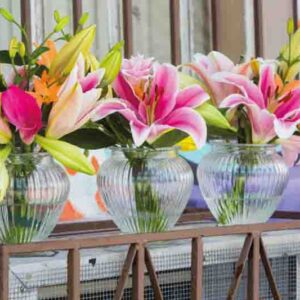
Both groups can grow successfully in containers, but mature height becomes especially important with Orienpets.
If the lily will live on a patio or balcony, mature height and fragrance may matter more than hybrid group. See Gardenia’s Best Lilies for Pots and Containers.
This may ultimately be the most useful design distinction.
Oriental lilies excel at close-range luxury. Their broad flowers and perfume make them natural choices near paths, patios, doors, windows, and seating areas where individual blooms can be appreciated.
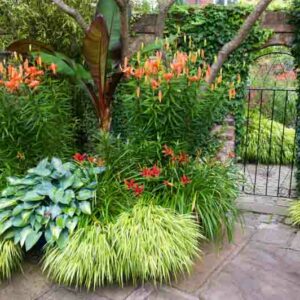
Orienpets often excel as structural garden plants. Taller cultivars can rise through perennial borders and create dramatic vertical accents when many other summer plants are beginning to soften.
For complementary plants around taller OT lilies, see Gardenia’s Great Companion Plants for Orienpet Hybrid Lilies.
Choose Oriental lilies when you want classic intense lily fragrance, broad flamboyant flowers, manageable border or container plants, and you can provide suitable acidic growing conditions.
Choose Orienpet lilies when you want greater stature, sturdy late-summer structure, broader general soil adaptability, greater heat tolerance, and spectacular flowers that retain much of the Oriental character.
Choose both when space allows. Their overlapping bloom seasons but contrasting heights, flower forms, and habits can produce a richer late-summer display than either group alone.
The Oriental-versus-Orienpet distinction is only the first decision. Individual cultivars differ enough in height, fragrance, flower form, hardiness, bloom timing, and soil tolerance that the final choice should be made plant by plant.
Ready to choose the actual lily? Use Gardenia’s Lilium Comparison Tool to compare Oriental and Orienpet cultivars side by side by height, spread, bloom season, hardiness, light, soil, drainage, pH, and other garden characteristics – then narrow the choices to lilies that actually fit your site.
Explore Gardenia’s full Oriental Lily Guide and Orienpet Lily Guide for more cultivar choices.
If you are still deciding among lily groups, see Gardenia’s How to Choose Lilies.
The hybrid group tells you the general personality. Gardenia’s cultivar profiles and comparison tools tell you which actual lily fits your soil, climate, space, and garden design.
Both Oriental and Orienpet lilies are true lilies (Lilium) and are extremely dangerous to cats. Flowers, leaves, stems, pollen, and other plant material can all present a serious risk.
If cats have access to your garden or cut-flower arrangements, keep true lilies completely out of reach and seek urgent veterinary advice if exposure is suspected.
Oriental lilies are Division VII hybrids known for large, intensely fragrant flowers and a preference for acidic soil. Orienpets are Division VIII Oriental-Trumpet hybrids that combine Oriental flower quality with traits inherited from Trumpet lilies, often including greater height, vigor, heat tolerance, and broader general soil adaptability.
No. Orienpets contain Oriental ancestry but are interdivisional hybrids created by crossing Oriental lilies with Trumpet or Aurelian lilies. They form a different horticultural group and can differ significantly from Orientals in height, flower form, soil tolerance, heat adaptability, and garden performance.
Oriental lilies are especially famous for consistently rich, powerful fragrance. Many Orienpets are also fragrant, but scent intensity and character vary more by cultivar. If classic intense lily perfume is your main priority, Oriental lilies are the safer group-level choice.
Orienpet lilies are generally taller. Many reach 3 to 8 feet, while Oriental cultivars commonly range from about 2 to 6 feet. There is considerable overlap, however, and shorter Orienpets exist, so always check the mature height of the individual cultivar.
Generally, Orienpets offer more flexibility in alkaline soils than classic Oriental lilies, but individual cultivar requirements still matter. Oriental lilies generally favor acidic soil, while many Oriental-Trumpet hybrids can grow across a broader range of soil conditions. Both groups require good drainage.
Many Orienpet lilies are valued for greater heat adaptability than traditional Oriental lilies, reflecting their Oriental-Trumpet ancestry. They still need suitable moisture during active growth and well-drained soil and should not be treated as drought-loving plants.
Their bloom seasons overlap substantially. Both commonly flower from midsummer into late summer, and many Orienpets contribute strongly toward the end of the main lily season. Exact timing depends on cultivar, climate, planting time, and seasonal conditions.
Both can grow well in containers. Orientals include many naturally manageable cultivars, while shorter Orienpets can also perform beautifully. Very tall Orienpets need large, heavy containers and may require support. Containers are especially useful for Oriental lilies where garden soil is alkaline.
Yes. Orienpet lilies make excellent cut flowers, combining large showy blooms with sturdy stems and fragrance. Oriental lilies are also outstanding for cutting, especially when strong perfume and broad flamboyant flowers are desired.
Yes. Both are true lilies in the genus Lilium and are extremely dangerous to cats. Flowers, leaves, stems, pollen, and other plant material can pose a serious risk. Seek urgent veterinary advice if exposure is suspected.
Oriental and Orienpet lilies both bring spectacular flowers and fragrance to the later summer garden, but they are not interchangeable. Orientals offer the classic combination of broad flamboyant flowers and powerful perfume, especially where acidic soil suits them. Orienpets add Trumpet ancestry, often bringing taller stems, greater heat tolerance, broader general soil adaptability, and a more architectural presence.
Remember Gardenia’s shortcut: Oriental for classic fragrance and flower drama. Orienpet for Oriental beauty with greater scale and adaptability. The cultivar makes the final decision.
Updated: August 2026 • Reviewed by Gardenia Editors
| Hardiness |
3 - 9 |
|---|---|
| Heat Zones |
1 - 3 |
| Climate Zones | 1, 2, 3, 4, 5, 6, 7, 8, 9, 14, 15, 16, 17, 18, 19, 20, 21, 22, 23 |
| Plant Type | Bulbs, Perennials |
| Genus | Lilium |
| Exposure | Full Sun, Partial Sun |
| Season of Interest | Spring (Late), Summer (Early, Mid, Late) |
| Maintenance | Low |
| Water Needs | Average |
| Soil Type | Chalk, Clay, Loam, Sand |
| Soil pH | Acid, Alkaline, Neutral |
| Soil Drainage | Moist but Well-Drained, Well-Drained |
| Characteristics | Cut Flowers, Fragrant, Showy |
| Landscaping Ideas | Beds And Borders, Patio And Containers |
| Garden Styles | City and Courtyard, Cutting Garden, Informal and Cottage, Traditional Garden |
| Hardiness |
3 - 9 |
|---|---|
| Heat Zones |
1 - 3 |
| Climate Zones | 1, 2, 3, 4, 5, 6, 7, 8, 9, 14, 15, 16, 17, 18, 19, 20, 21, 22, 23 |
| Plant Type | Bulbs, Perennials |
| Genus | Lilium |
| Exposure | Full Sun, Partial Sun |
| Season of Interest | Spring (Late), Summer (Early, Mid, Late) |
| Maintenance | Low |
| Water Needs | Average |
| Soil Type | Chalk, Clay, Loam, Sand |
| Soil pH | Acid, Alkaline, Neutral |
| Soil Drainage | Moist but Well-Drained, Well-Drained |
| Characteristics | Cut Flowers, Fragrant, Showy |
| Landscaping Ideas | Beds And Borders, Patio And Containers |
| Garden Styles | City and Courtyard, Cutting Garden, Informal and Cottage, Traditional Garden |
Create a membership account to save your garden designs and to view them on any device.
Becoming a contributing member of Gardenia is easy and can be done in just a few minutes. If you provide us with your name, email address and the payment of a modest $25 annual membership fee, you will become a full member, enabling you to design and save up to 25 of your garden design ideas.
Join now and start creating your dream garden!
Create a membership account to save your garden designs and to view them on any device.
Becoming a contributing member of Gardenia is easy and can be done in just a few minutes. If you provide us with your name, email address and the payment of a modest $25 annual membership fee, you will become a full member, enabling you to design and save up to 25 of your garden design ideas.
Join now and start creating your dream garden!