What's attacking your lilies? Identify red lily beetles, aphids, slugs, bulb mites, Botrytis, Fusarium basal rot, bulb rots, and lily viruses by their symptoms. Learn which problems damage leaves, roots, bulbs, and flowers, how to prevent outbreaks, and when treatment, sanitation, or plant removal is the best response.
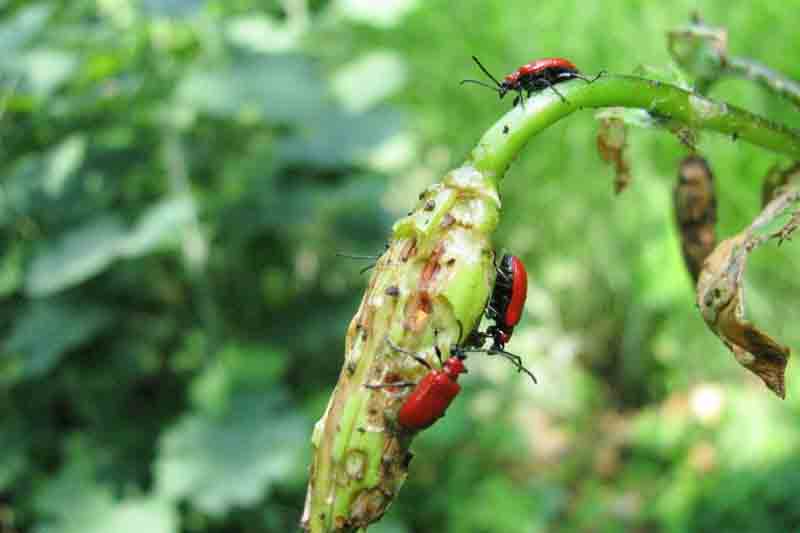


Few things are more frustrating than watching a healthy-looking lily suddenly develop chewed leaves, brown spots, distorted growth, failing buds, or a stem that collapses for no obvious reason. True lilies in the genus Lilium can be affected by a surprisingly varied group of pests and diseases, and many produce symptoms that initially look alike.
The bright red lily beetle can strip foliage. Aphids cluster around tender growth and can transmit viruses. Slugs and snails attack emerging shoots. Bulb mites, vine weevil larvae, and other underground pests can weaken roots and bulbs without being seen. Disease problems range from Botrytis leaf blight to Fusarium basal rot, Rhizoctonia, other root and bulb rots, and systemic viruses.
The most important rule is simple: identify the problem before treating it. A lily covered with chewing holes needs a very different response from one developing oval brown leaf lesions. A bulb rotting from the basal plate cannot be cured by spraying its leaves, while a virus cannot be eliminated with a fungicide.
| What You See | Likely Problem | Key Clue |
|---|---|---|
| Leaves rapidly disappearing | Red lily beetle | Scarlet adults or dark, excrement-covered larvae |
| Curled or distorted young growth | Aphids | Colonies of small sap-feeding insects, often with sticky honeydew |
| Irregular holes in young leaves or shoots | Slugs or snails | Night feeding, ragged holes, and often slime trails |
| Fine stippling or silvery damage | Spider mites or thrips | Tiny pests, discoloration, scarring, or webbing |
| Oval brown leaf spots | Lily disease / Botrytis | Lesions enlarge and merge, especially in wet conditions |
| Yellowing growth and brown bulb base | Fusarium basal rot | Brown decay around the basal plate and lower scales |
| Wilt despite wet soil | Root or bulb damage | Dark roots, rot, root-feeding larvae, or poor drainage |
| Mottled, streaked, twisted, or distorted growth | Virus disease | Persistent systemic symptoms rather than discrete spots or chewing |
Before you spray anything: Decide whether the damage comes from a chewing pest, sap-feeding pest, foliar disease, underground rot, virus, or environmental stress. Treating the wrong problem wastes time and may harm beneficial organisms without helping the lily.
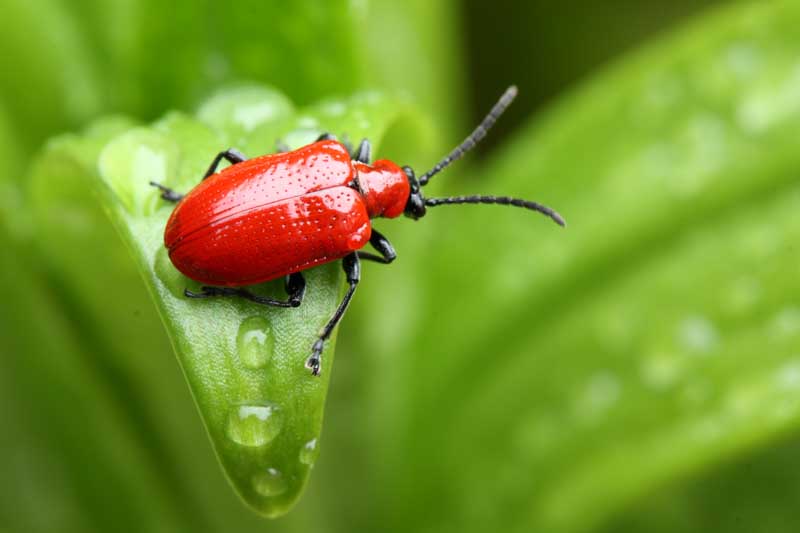
The red lily beetle, Lilioceris lilii, is difficult to mistake once you know what to look for. Adult beetles are bright scarlet-red with black heads and legs. Both adults and larvae feed on true lilies, while fritillaries are also important hosts.
The larvae are much less attractive than the adults. They cover themselves with dark, wet excrement, creating a protective coating that can make them look like small lumps of debris on the underside of a leaf. This unusual disguise is one of the best clues to their identity.
Look for:
Control: Inspect lilies regularly from spring onward. Small infestations can often be managed by handpicking adults, eggs, and larvae. Adults readily drop from plants when disturbed, so placing a hand or container beneath them before touching the plant can make collection easier.
If an insecticide becomes necessary, use only a product labeled for the pest and ornamental plant concerned and follow the label precisely. Avoid routine spraying when beetles are absent, particularly when flowering plants are being visited by pollinators.
Why early control matters: Lilies may still flower after modest leaf damage, but severe early-season defoliation reduces the foliage available to replenish the bulb and can leave bulbs undersized and plants weaker.
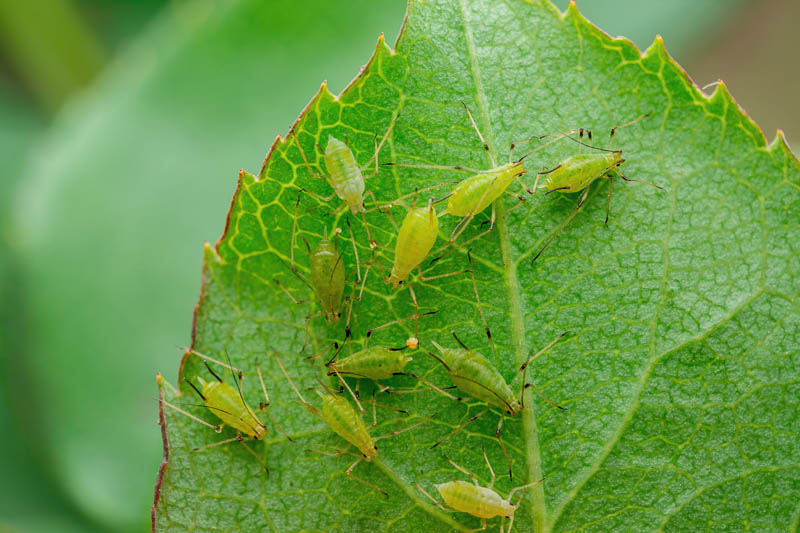
Aphids are small, soft-bodied insects that gather on tender stems, young leaves, and developing flower buds. Their feeding can produce curled leaves, distorted shoots, yellowing, and reduced vigor when colonies become large.
On lilies, their importance extends beyond direct feeding. Aphids can act as vectors for several viruses, carrying virus particles from infected plants to healthy ones as they move and feed.
Typical signs include:
Control: Small colonies may be washed from plants with a strong stream of water. Lady beetles, lacewings, hoverfly larvae, and parasitic wasps naturally suppress aphids. Insecticidal soaps and other appropriately labeled products can be useful when infestations persist, but contact products must reach the insects to work.
Aphid management can reduce opportunities for virus transmission, but it is not a substitute for removing virus-infected lilies. An infected plant remains a source of virus even after its aphids have been controlled.
Aphids plus mottled foliage? Do not assume the insects caused all the visible damage. Persistent streaking, mottling, distortion, or abnormal flowers can indicate virus infection and deserves separate investigation.
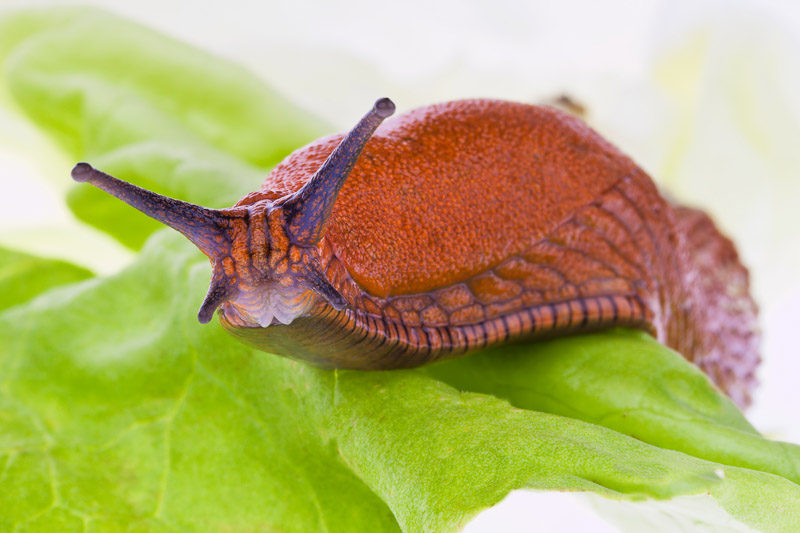
Slugs and snails can damage lilies throughout the growing season, but young emerging shoots are especially vulnerable. A mature plant may tolerate a few holes. A tender shoot eaten close to the ground can lose much of its season’s growth before it has properly begun.
These mollusks rasp plant tissue rather than producing the clean-edged feeding typical of some insects. The resulting holes are irregular, and damage is often most obvious after damp nights.
Look for:
Control: Reduce unnecessary hiding places, inspect vulnerable lilies after dark, and handpick where practical. Protect valuable emerging shoots during periods of high slug activity. Baits and barriers can also be useful, but products and permitted active ingredients differ among countries, so follow current local guidance and label directions.
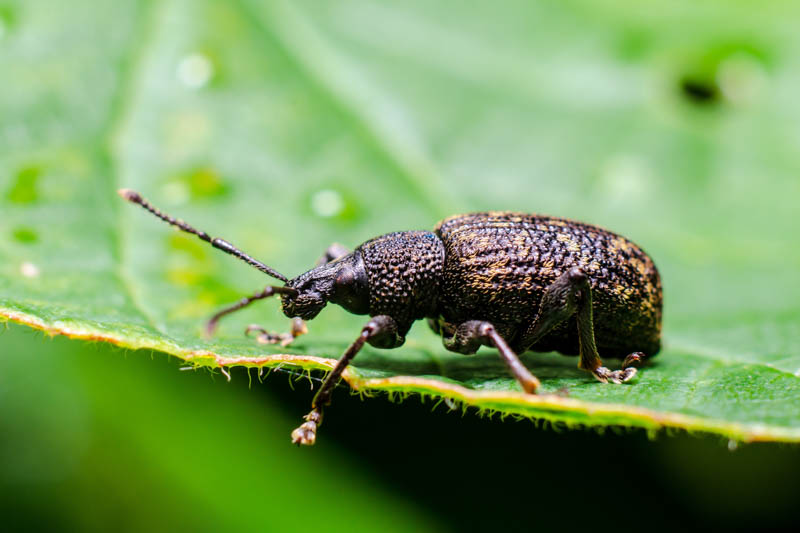
Vine weevil is particularly important when lilies are grown in pots. Adult weevils may leave characteristic notches around leaf margins, but the more damaging stage is underground. Cream-colored, legless larvae with brown heads feed on roots and other underground tissues.
A potted lily with severe root damage may wilt even though the potting mix is moist, grow poorly, become loose in the container, or collapse. This is why repeatedly watering a wilting container lily without checking its roots can make diagnosis more difficult.
Control: Examine root balls when suspicious plants are repotted, remove visible larvae, and discard plants that have lost most of their roots. Biological controls using beneficial nematodes are available in some regions and can be effective when temperatures and growing conditions are suitable. Follow product-specific instructions carefully.
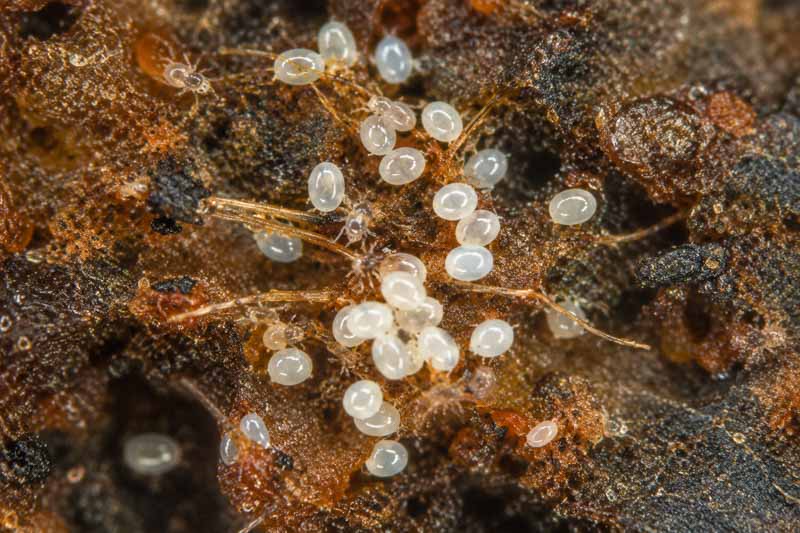
Bulb mites, including species of Rhizoglyphus, are tiny pale mites that live and feed among bulb scales, near the basal plate, and within damaged or decaying underground tissue.
They are frequently associated with bulbs already weakened by injury or decay, but established populations can cause significant additional damage. Their feeding wounds can also provide entry points for soil-borne pathogens, including Fusarium.
Possible signs include:
Control: Prevention is far easier than rescuing a badly infested bulb. Purchase sound planting stock, minimize bulb injuries, reject bulbs showing significant decay, provide excellent drainage, and remove badly rotted bulbs promptly.
Bulb mites and rot often occur together. Finding mites does not necessarily mean they caused the original decay, but their feeding can worsen damaged tissue and create wounds that favor additional infection.
Lily beetles, aphids, slugs, snails, bulb mites, and vine weevil are among the most useful pests for home gardeners to recognize, but they are not the only organisms capable of attacking lilies. Several additional pests become important in particular climates, production systems, or individual gardens.
Other pests recorded on lilies include scales, leafminers, whiteflies, beetles, wireworms, and related soil pests. Their occurrence is far less predictable, so avoid treating for them simply because a lily looks unhealthy. Look for characteristic damage or obtain a diagnosis first.
Common does not mean universal. Red lily beetle can be devastating where it occurs but is not equally important everywhere. Bulb flies, nematodes, thrips, and mites are also strongly influenced by region and growing conditions. Local identification matters.
Disease diagnosis can be more difficult than pest diagnosis because several pathogens produce similar symptoms. Yellow foliage can accompany root rot, Fusarium, poor drainage, or environmental stress. Buds may abort after root damage. Leaf discoloration can come from disease, viruses, nutrient disorders, or weather injury.
Gardenia’s dedicated Lily Disease Guide provides a focused disease reference. The sections below explain the diseases most important to recognize when assessing a struggling lily.
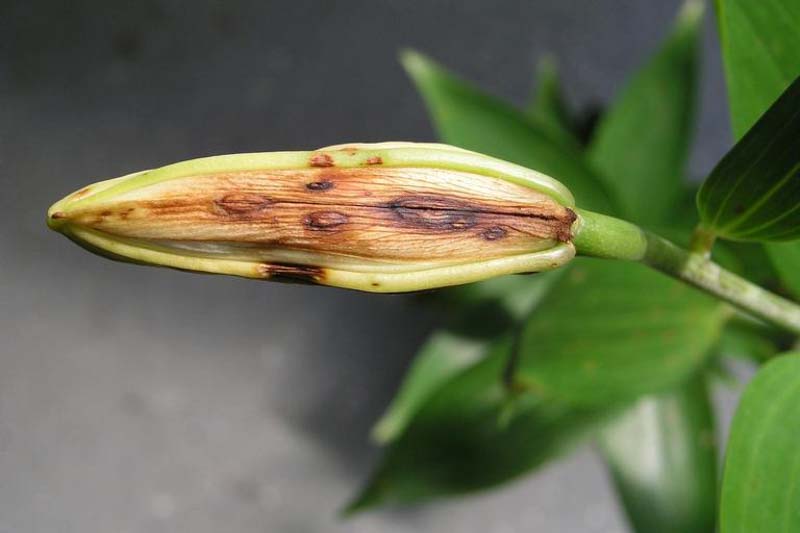
The condition traditionally called lily disease is a fungal leaf disease caused by Botrytis elliptica. It typically begins with oval brown lesions on the foliage. During prolonged wet conditions, spots enlarge and may merge until substantial portions of a leaf are destroyed.
This terminology deserves some precision. Gray mold or Botrytis is a broad category of disease affecting many plants. On lilies, other Botrytis species can also occur, including Botrytis cinerea, but the classic disease referred to specifically as “lily disease” is associated with B. elliptica.
Look for:
Prevention and management: Remove affected foliage and infected debris promptly, reduce prolonged leaf wetness, and provide enough spacing for air to circulate through the planting. Avoid overhead watering late in the day where it leaves foliage wet for extended periods.
For garden lilies, sanitation is particularly important because B. elliptica forms persistent resting structures called sclerotia in infected dead foliage. Removing diseased leaves and debris reduces the amount of infected material left to overwinter and produce spores the following season.
Important distinction: “Lily disease” does not mean every disease affecting lilies. It refers specifically to the Botrytis leaf disease classically caused by Botrytis elliptica.
Fusarium oxysporum f. sp. lilii causes an important soil-borne disease of lilies. Infection affects roots and the basal plate, often entering where bulb tissue has been damaged. As disease progresses, brown decay develops from the bulb base into the scales, roots deteriorate, and scales may eventually detach from the basal plate.
Above ground, affected plants may be stunted, turn yellow prematurely, decline early, or produce buds that fail to develop normally. A severely infected bulb may fall apart when lifted.
Management:
For a broader explanation of underground decay, see Gardenia’s Bulb Rot Guide.
Do not replant too soon. Serious soil-borne Fusarium and Rhizoctonia problems are not solved simply by removing the visibly sick lily. Pathogens can persist in the site after the infected bulb is gone.
Rhizoctonia solani is another soil-borne pathogen capable of attacking lilies. Infection of underground tissues can result in brown rot, yellowing foliage, poor growth, and eventual collapse. The organism can persist in soil, which makes sanitation and site selection important when serious disease has occurred.
Pythium species can cause root rot, particularly in container and production situations. Affected roots become brown and unhealthy rather than firm and pale, while lower leaves may yellow and die. Flower buds can abort when root damage is severe.
Bulb storage rots can involve additional organisms such as Penicillium and Rhizopus. These become particularly important when bulbs are injured, improperly stored, or already deteriorating.
Reduce the risk of root and bulb rots by:
If a lily wilts while its soil is already wet, do not automatically add more water. Check the roots and bulb first. Wilting caused by damaged roots can become worse when already saturated soil receives still more irrigation.
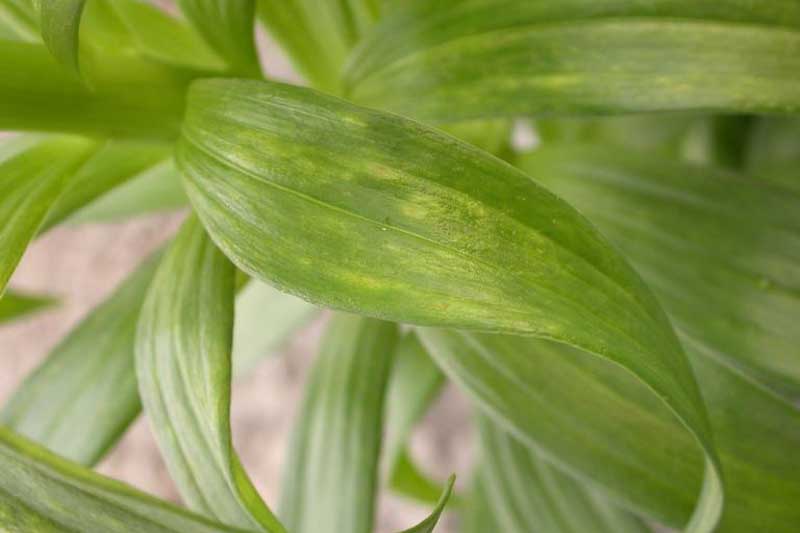
Lilies can host several viruses, and more than one virus may occur in the same plant. Important examples include strains of Tulip breaking virus, Lily symptomless virus, and Cucumber mosaic virus. Mixed infections can make symptoms especially variable.
Possible signs include yellow streaking, mottling, twisted or distorted leaves, reduced vigor, fewer flowers, and blooms that are malformed or fail to open normally. Some viruses can remain comparatively inconspicuous in certain lilies, so visual diagnosis is not always definitive.
Viruses are systemic infections. Once the plant is infected, fungicides and insecticides cannot remove the virus from its tissues.
Management:
Tulip breaking virus can infect both tulips and lilies. Where this virus is a concern, RHS advises against growing the two groups together because infected plants can serve as sources for aphid-mediated transmission.
Virus reality check: Killing aphids does not cure an infected lily. Aphid management helps reduce transmission, while removal of infected source plants addresses the reservoir of virus already present in the garden.
The most effective lily protection strategy is not a calendar of routine pesticide applications. It is integrated prevention: healthy planting stock, suitable growing conditions, regular inspection, sanitation, and targeted intervention when a genuine problem appears.
Your lily protection checklist:
Healthy lily culture is part of pest and disease prevention. Gardenia’s Lily Growing and Care Guide covers planting, drainage, watering, feeding, aftercare, and other practices that support vigorous plants.
A spotted leaf does not automatically justify removing an entire lily. Limited Botrytis damage, a few aphids, or a small lily beetle infestation can often be managed while the plant remains in place. Systemic viruses and serious underground rots require a different approach.
Removing the plant or bulb is usually appropriate when:
Do not automatically compost heavily diseased bulbs or virus-infected plants where the pathogen may survive the process. Disposal recommendations vary by disease and locality, so follow local guidance for seriously infected plant material.
Not every damaged lily is infected or infested. Environmental stress can mimic disease surprisingly well, and distinguishing the categories prevents unnecessary treatment.
| Problem Type | Typical Clues | Examples |
|---|---|---|
| Chewing pest | Missing tissue, holes, ragged leaves, damaged shoots | Lily beetle, slugs, snails |
| Sap-feeding pest | Curling, stippling, honeydew, scarring, visible tiny pests | Aphids, thrips, spider mites |
| Fungal or oomycete disease | Expanding lesions, blight, root decay, bulb rot | Botrytis, Fusarium, Rhizoctonia, Pythium |
| Virus | Persistent mottling, streaking, distortion, stunting, abnormal flowers | Tulip breaking virus, Lily symptomless virus, Cucumber mosaic virus |
| Environmental problem | No pest or pathogen signs; damage follows weather, water, light, or soil problems | Frost injury, waterlogging, drought, scorch, nutrient problems |
When a lily looks healthy but simply fails to produce flowers, investigate light, bulb vigor, drainage, previous foliage loss, and other cultural causes rather than assuming a pest or disease is responsible.
Important lily pests include red lily beetle, aphids, slugs, snails, bulb mites, and vine weevil larvae, especially in containers. Thrips, bulb flies, spider mites, nematodes, and other pests can also occur, with importance varying by region and growing conditions.
Lily disease is the name commonly used for the Botrytis leaf disease caused by Botrytis elliptica. It produces oval brown lesions that can enlarge and merge, particularly in wet conditions. It should not be used as a general name for every disease affecting lilies.
Adult red lily beetles are bright scarlet with black heads and legs. Their orange-red eggs are usually found on leaf undersides, while the larvae are covered with dark excrement. Adults and larvae chew lily foliage and can cause extensive defoliation.
Lily bulb and root rots can involve Fusarium, Rhizoctonia, Pythium, Penicillium, Rhizopus, and other microorganisms. Infected planting stock, bulb injuries, contaminated soil, poor drainage, and unfavorable storage conditions can increase the risk, depending on the pathogen involved.
Fusarium basal rot causes brown decay around the basal plate and lower bulb scales. Roots deteriorate, scales may detach, and affected lilies can become stunted, yellow prematurely, decline, or produce buds that fail to develop normally. Severely infected bulbs should be removed.
No. Plant viruses are systemic and cannot be eliminated from an infected lily with fungicides or insecticides. Confirmed or strongly symptomatic infected plants are generally removed. Aphid control can reduce opportunities for transmission but does not cure an infected plant.
Holes in lily leaves usually indicate a chewing pest. Red lily beetles and their larvae can remove substantial amounts of foliage, while slugs and snails make irregular holes and often feed at night. Inspect both sides of the leaves and look for beetles, larvae, eggs, or slime trails.
Start with healthy bulbs, plant in well-drained soil, avoid damaging bulbs, provide good air circulation, remove seriously infected material promptly, and keep containers clean after disease. Regular inspection and good sanitation are more useful than indiscriminate routine spraying.
Yes. Aphids can transmit important viruses among lilies. Managing aphids can reduce opportunities for transmission, but infected lilies should also be removed because they remain sources of virus. Controlling the vector alone does not eliminate virus already present in a plant.
Not immediately in the affected site. RHS advises that after lilies infected with Fusarium oxysporum f. sp. lilii or Rhizoctonia solani are removed, susceptible plants should be grown elsewhere in the garden for at least five years.
Successful lily pest and disease control starts with the pattern of damage. Missing foliage points toward chewing pests such as lily beetles, slugs, or snails. Curling and honeydew suggest aphids. Fine stippling or silvery scarring may indicate mites or thrips. Oval brown lesions during wet weather point toward Botrytis, while yellowing growth combined with a decaying bulb directs attention below ground.
Persistent mottling, streaking, distortion, and abnormal flowers deserve particular caution because virus infection cannot be cured. Likewise, serious Fusarium or Rhizoctonia infection requires removal of diseased bulbs and careful management of the contaminated site rather than repeated treatment of the foliage.
The best defense is not to spray everything. Start with healthy bulbs, provide good drainage and air circulation, inspect plants regularly, preserve healthy foliage, remove serious sources of infection promptly, and intervene specifically when you know what is causing the damage.
A fungicide cannot cure a virus. An insecticide cannot repair bulb rot. And extra watering can make a root disease worse. Identify first, then treat the problem you actually have.
Updated: August 2026 • Reviewed by Gardenia Editors
| Hardiness |
3 - 9 |
|---|---|
| Plant Type | Bulbs, Perennials |
| Genus | Lilium |
| Exposure | Full Sun, Partial Sun |
| Season of Interest | Spring (Late), Summer (Early, Mid, Late), Fall |
| Maintenance | Low |
| Water Needs | Average |
| Soil Drainage | Moist but Well-Drained |
| Characteristics | Cut Flowers, Fragrant, Showy |
| Attracts | Bees, Butterflies, Hummingbirds |
| Landscaping Ideas | Beds And Borders, Patio And Containers |
| Garden Styles | City and Courtyard, Cutting Garden, Informal and Cottage |
| Hardiness |
3 - 9 |
|---|---|
| Plant Type | Bulbs, Perennials |
| Genus | Lilium |
| Exposure | Full Sun, Partial Sun |
| Season of Interest | Spring (Late), Summer (Early, Mid, Late), Fall |
| Maintenance | Low |
| Water Needs | Average |
| Soil Drainage | Moist but Well-Drained |
| Characteristics | Cut Flowers, Fragrant, Showy |
| Attracts | Bees, Butterflies, Hummingbirds |
| Landscaping Ideas | Beds And Borders, Patio And Containers |
| Garden Styles | City and Courtyard, Cutting Garden, Informal and Cottage |
Create a membership account to save your garden designs and to view them on any device.
Becoming a contributing member of Gardenia is easy and can be done in just a few minutes. If you provide us with your name, email address and the payment of a modest $25 annual membership fee, you will become a full member, enabling you to design and save up to 25 of your garden design ideas.
Join now and start creating your dream garden!
Create a membership account to save your garden designs and to view them on any device.
Becoming a contributing member of Gardenia is easy and can be done in just a few minutes. If you provide us with your name, email address and the payment of a modest $25 annual membership fee, you will become a full member, enabling you to design and save up to 25 of your garden design ideas.
Join now and start creating your dream garden!