Mountain laurel and rhododendron are two of North America's most beautiful woodland shrubs, but they aren't the same plant. Discover how to distinguish their flowers, leaves, and buds, compare their growing needs, and decide which deserves a place in your garden. Learn why choosing the right species matters.
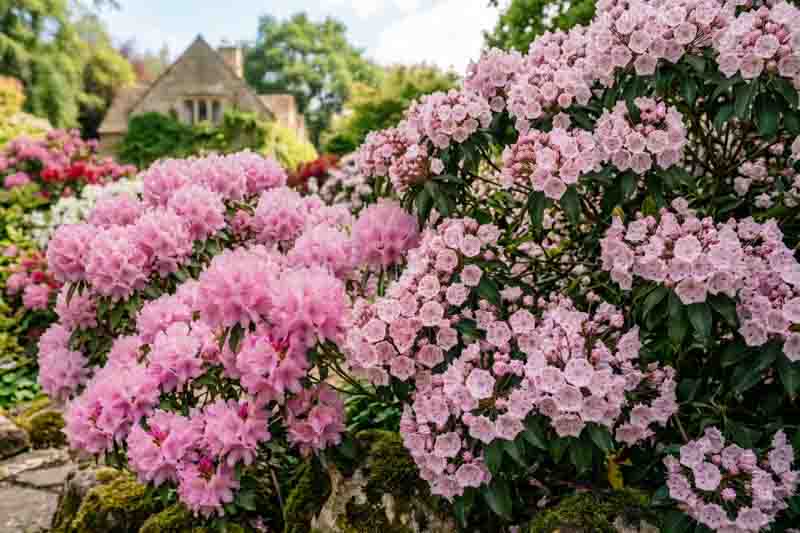


At first glance, mountain laurel and rhododendron could be mistaken for close relatives. Both have handsome evergreen leaves, flourish in acidic woodland soils, and produce beautiful clusters of flowers in spring or early summer.
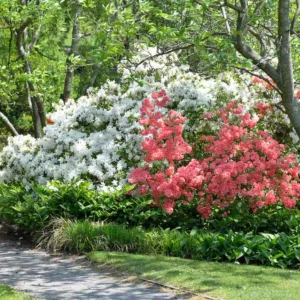
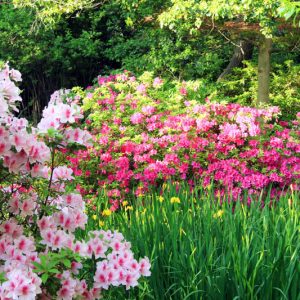
Look more closely, though, and the differences are striking. Mountain laurel has intricately patterned flowers that seem almost sculpted from porcelain. Rhododendrons typically make a bolder display, with large clusters of bell-shaped blossoms rising above their glossy foliage.
Both belong to the heath family, Ericaceae, but mountain laurel (Kalmia latifolia) is not a rhododendron. The confusion isn’t helped by common names: Rosebay Rhododendron (Rhododendron maximum) is also known as Great Laurel or White Laurel.
So how can you tell mountain laurel from rhododendron? Which flowers first, which grows larger, and which is better suited to your garden? Here’s what matters, from botanical identification to planting and long-term care.
Quick answer: Mountain laurel has cup-shaped, often five-sided flowers with distinctive markings and ten stamens held in tiny pockets. Large-leaved evergreen rhododendrons generally have longer leaves and bell- or funnel-shaped flowers in showy clusters. Both favor acidic, well-drained soil and often grow best in partial shade, but mature size, flowering time, and individual growing requirements differ.
Flowers offer the clearest distinction, but leaf size, flowering season, and growth habit are helpful clues, particularly when plants are not in bloom.
| Feature | Mountain Laurel | Large-Leaved Evergreen Rhododendron |
|---|---|---|
| Botanical name | Kalmia latifolia | Rhododendron species and hybrids |
| Flowers | Cup-shaped, often five-sided, usually white to pink with contrasting markings | Usually bell- or funnel-shaped, in prominent clusters |
| Distinctive detail | Ten stamens held in pockets inside each flower | Prominent floral trusses; no spring-loaded anther pockets |
| Leaves | Glossy, leathery, often 2-5 in. long | Frequently longer and broader, depending on species |
| Flowering season | Usually late spring to early summer | Spring to summer, depending on species or cultivar |
| Typical mature height | Often 5-15 ft.; wild specimens may grow much taller | Highly variable; many reach 6-15 ft. or more |
| Preferred light | Often partial shade | Usually bright shade or partial sun |
| Soil | Acidic, humus-rich, well-drained | Acidic, humus-rich, moist but well-drained |
| Toxicity | Poisonous if eaten | Poisonous if eaten |
This comparison concerns mountain laurel and familiar large-leaved evergreen rhododendrons. The genus Rhododendron also includes small-leaved species and deciduous azaleas, which can look quite different.
If you have a flowering branch in front of you, identification is usually straightforward. The blossoms have very different structures.
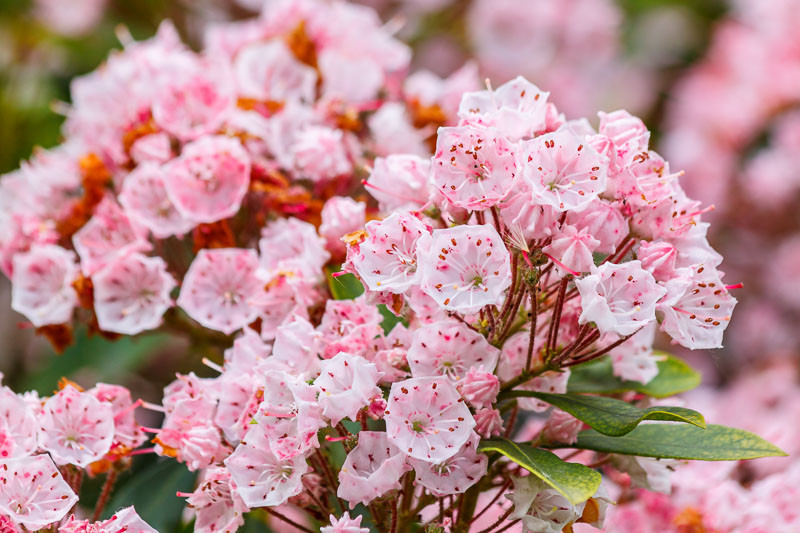
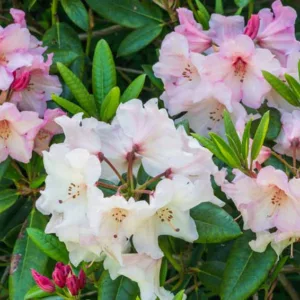
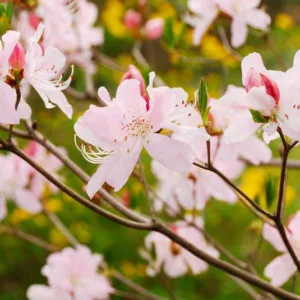
Mountain laurel flowers are among the most intricately shaped blossoms in the spring garden. Each forms a shallow cup with five subtly defined sides. Depending on the plant, the petals may be white, blush pink, or deeper rose, often decorated with burgundy or purple markings.
Look inside a freshly opened flower. Ten stamens are held under tension, with their anthers tucked into small pockets in the corolla. When a visiting insect releases them, the stamens spring free and deposit pollen on the visitor.
This remarkable mechanism is one of the most reliable ways to identify mountain laurel.
The flower buds provide another clue. Before opening, they are often distinctly ribbed, with an angular, almost miniature-pastry appearance. On some cultivars, deep-pink buds create a beautiful contrast with the paler open flowers.
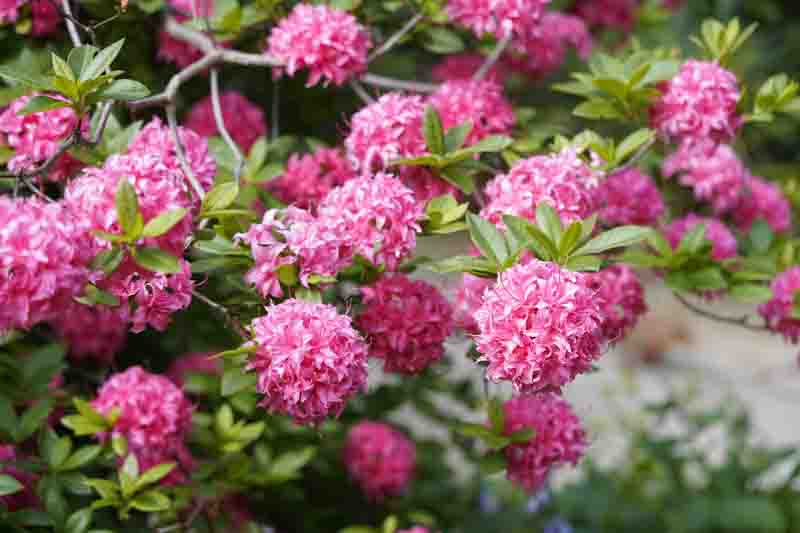
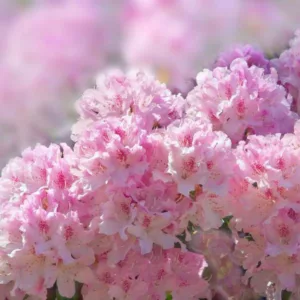
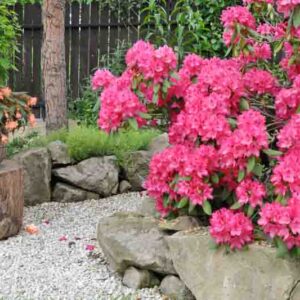
Large-leaved evergreen rhododendrons generally produce bell- or funnel-shaped flowers arranged in dense terminal clusters known as trusses.
Some have spotted throats, contrasting markings, or colorful stamens. But they lack mountain laurel’s characteristic anther pockets and spring-loaded pollen mechanism.
Many rhododendrons also have ten stamens, so counting stamens alone is not enough to distinguish the plants.
When neither shrub is blooming, the leaves, flower buds, and branching habits provide useful clues.
Mountain Laurel (Kalmia latifolia):
Large-Leaved Evergreen Rhododendrons:
Identification tip: Leaf size alone is not conclusive. Some rhododendrons have relatively small leaves, while Mountain Laurel can vary considerably in size and habit. Compare several features together, particularly the leaves, flower buds, and overall branching structure, and confirm the identification when the flowers appear.
Gardenia’s identification tip: Check the flower before the leaves. A five-sided cup with ten anthers seated in tiny pockets strongly points to mountain laurel. Large bell-shaped flowers gathered into substantial trusses suggest a large-leaved rhododendron.
Three familiar species illustrate the difference between mountain laurel and rhododendron particularly well. All are native to eastern North America, but each offers a distinct landscape effect.
| Hardiness |
3 - 9 |
|---|---|
| Plant Type | Shrubs |
| Genus | Rhododendron |
| Exposure | Full Sun, Partial Sun |
| Season of Interest | Spring (Early, Mid, Late), Summer (Early), Fall, Winter |
| Maintenance | Low |
| Water Needs | Average |
| Soil Type | Clay, Loam, Sand |
| Soil pH | Acid |
| Soil Drainage | Moist but Well-Drained |
| Tolerances | Rabbit |
| Attracts | Butterflies, Hummingbirds |
| Landscaping Ideas | Beds And Borders, Patio And Containers, Small Gardens |
| Garden Styles | City and Courtyard, Gravel and Rock Garden, Informal and Cottage, Japanese Garden, Traditional Garden |
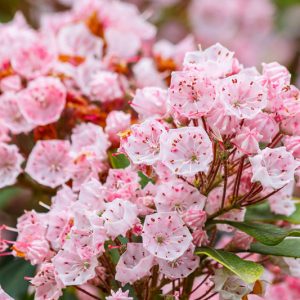


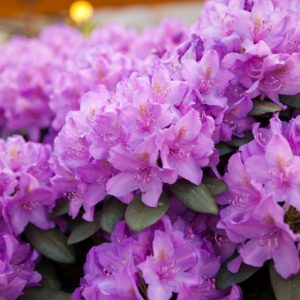
Mountain laurel and rhododendrons can bloom at different times, making them excellent companions for extending the flowering season in a woodland garden.
By combining early-flowering rhododendrons, mountain laurel, and later-blooming Rosebay Rhododendron, you can enjoy successive waves of flowers rather than a single short display. Exact bloom times vary with location and weather.
Which should you choose? For delicate floral detail, mountain laurel is difficult to beat. For dramatic masses of color, large-flowered rhododendrons often make the stronger statement. In a spacious woodland garden, the two complement each other beautifully.
Mountain laurel and large-leaved evergreen rhododendrons share a preference for acidic, well-drained soil and sheltered growing conditions. However, their tolerance of sunlight, moisture, and pruning varies by species and cultivar.
For a detailed comparison of sunlight requirements and suitable varieties, see Gardenia’s Rhododendrons for Sun vs. Shade Guide.
Both shrubs generally prefer acidic, humus-rich soil, commonly around pH 4.5-6.0, with good drainage.
For pruning techniques and timing, see Gardenia’s Rhododendron and Azalea Pruning Guide.
Check your soil before planting: If your garden is strongly alkaline or remains saturated after rain, neither mountain laurel nor a typical rhododendron will be an easy choice. Selecting a shrub naturally adapted to those conditions may be a better long-term solution.
Yes. Mountain Laurel and many rhododendrons make beautiful companions in woodland gardens, provided they share similar requirements for sunlight, acidic soil, moisture, and drainage. Their contrasting flowers and evergreen foliage can create a richly layered display, sometimes extending the blooming season.
However, rhododendrons vary enormously in size, hardiness, and growing preferences. Choose individual species and cultivars carefully, allow sufficient room for their mature spread, and avoid assuming that all rhododendrons will thrive in the same conditions as Mountain Laurel.
Yes. Both contain toxic compounds, including grayanotoxins. Eating leaves, flowers, or other plant parts can cause serious illness in people, pets, and livestock.
Symptoms may include nausea, vomiting, weakness, low blood pressure, and heart rhythm disturbances. If ingestion is suspected, seek prompt advice from a poison center or veterinarian.
Neither shrub is appropriate where grazing animals can reach it. In gardens frequented by pets or young children, consider whether a non-toxic alternative would be more suitable.
Both shrubs provide flowers visited by bees and other pollinators, along with evergreen cover in woodland habitats. Mountain laurel’s spring-loaded stamens are particularly fascinating to observe when insects visit its flowers.
Honey can occasionally contain grayanotoxins if bees collect substantial nectar from certain toxic members of the heath family, including mountain laurel and some rhododendrons. This potential hazard to people consuming such honey is distinct from the flowers’ value to visiting bees.
For ecological planting, choose species native to your particular region and obtain nursery-propagated plants rather than removing shrubs from wild populations.
Mountain laurel has a high flammability rating in NC State Extension’s plant database. It should not be planted within a home’s designated defensible space.
Rhododendrons are not automatically fire-safe alternatives. Their flammability and suitability also depend on species, site conditions, plant maintenance, and local fire guidance.
In wildfire-prone areas, follow local defensible-space recommendations and select appropriate low-flammability plants near buildings.
Safety first: Both shrubs are poisonous if eaten. Mountain laurel also carries an important wildfire-related planting limitation. Check toxicity, animal access, and local fire-safety guidance before selecting either plant.
Mountain laurel and rhododendrons may share similar woodland conditions, but their mature dimensions, flowering seasons, and planting requirements differ enough to influence an entire border.
Gardenia’s Plant Finder helps you explore species and cultivars by sunlight, USDA hardiness zone, soil pH, drainage, water needs, and native-plant preferences.
Once you’ve selected promising plants, save them and use the Garden Design Tool to compare growing-condition compatibility, mature dimensions, seasonal interest, and planting quantities.
For example, the space needed by a mature Rosebay Rhododendron may be very different from that required by a compact mountain laurel. Checking those dimensions now is much easier than moving established shrubs later.
No. Mountain laurel is Kalmia latifolia, while rhododendrons belong to the genus Rhododendron. Both are members of the heath family, Ericaceae, and share several preferences for acidic soil and woodland conditions.
Mountain laurel has cup-shaped, often five-sided flowers with distinctive markings and ten anthers held in tiny pockets. Large-leaved evergreen rhododendrons typically have longer leaves and bell- or funnel-shaped flowers gathered in showy clusters.
Both can become substantial shrubs. Mountain laurel commonly reaches about 5-15 feet tall, while Rosebay Rhododendron may grow 10-20 feet or more in favorable conditions. Many compact cultivars of both are available.
Both often grow best in bright partial shade or filtered sunlight. Mountain laurel can tolerate more sun in suitable conditions, while many large-leaved rhododendrons appreciate protection from hot afternoon exposure. Deep shade may reduce flowering.
Yes. Both contain grayanotoxins and can cause serious poisoning if eaten by dogs, cats, horses, other livestock, or people. Seek veterinary or poison-center advice promptly if ingestion is suspected.
Yes, if their soil acidity, drainage, sunlight, moisture, and mature-space requirements overlap. Both can thrive in suitable woodland gardens, and their different flowering periods may extend the seasonal display.
Mountain laurel generally flowers in late spring or early summer. Some rhododendrons bloom earlier, while Rosebay Rhododendron often flowers later. Timing varies by species, cultivar, climate, and elevation.
Mountain laurel and rhododendrons bring different qualities to the woodland garden. Mountain laurel rewards close inspection with beautifully patterned flowers, while large-leaved rhododendrons offer bold flower clusters and impressive evergreen structure. Choose according to your space, soil, climate, and growing conditions, and you may find that both deserve a place in your garden.
Updated and reviewed by Gardenia: October 2026
| Hardiness |
3 - 9 |
|---|---|
| Plant Type | Shrubs |
| Genus | Rhododendron |
| Exposure | Full Sun, Partial Sun |
| Season of Interest | Spring (Early, Mid, Late), Summer (Early), Fall, Winter |
| Maintenance | Low |
| Water Needs | Average |
| Soil Type | Clay, Loam, Sand |
| Soil pH | Acid |
| Soil Drainage | Moist but Well-Drained |
| Tolerances | Rabbit |
| Attracts | Butterflies, Hummingbirds |
| Landscaping Ideas | Beds And Borders, Patio And Containers, Small Gardens |
| Garden Styles | City and Courtyard, Gravel and Rock Garden, Informal and Cottage, Japanese Garden, Traditional Garden |
Create a membership account to save your garden designs and to view them on any device.
Becoming a contributing member of Gardenia is easy and can be done in just a few minutes. If you provide us with your name, email address and the payment of a modest $25 annual membership fee, you will become a full member, enabling you to design and save up to 25 of your garden design ideas.
Join now and start creating your dream garden!