Should you remove every tomato sucker? No. Those small shoots can become full fruiting stems. Gardenia explains when suckers are useful, when they overcrowd a plant, why determinate and indeterminate tomatoes need different treatment, and how your stake, cage, trellis, climate, and harvest goal change the answer.


Few tomato-growing instructions are repeated as confidently as this one: remove the suckers. But should you?
Not automatically. A tomato sucker is not a parasite, a drain with no purpose, or a piece of wasted growth. It is a new stem. If you leave it on the plant, it can produce leaves, flower clusters, tomatoes, and additional suckers of its own.
That means removing a sucker is a tradeoff. You may gain a narrower plant that is easier to stake, inspect, and harvest, but you are also removing potential fruiting growth. Whether that trade makes sense depends on the tomato’s growth habit, the available support and spacing, where the sucker is growing, and what you want from the harvest.
The short answer: Do not remove every tomato sucker automatically. Determinate tomatoes generally need very little sucker pruning. Indeterminate tomatoes can be selectively suckered when you are intentionally training them to a limited number of stems.
| Situation | Typical Approach | Why? |
|---|---|---|
| Determinate tomato | Prune very lightly, if at all | Upper shoots contribute directly to the concentrated crop |
| Indeterminate on a single stake or string | Remove most unwanted suckers | A narrow support can carry only a limited number of leaders |
| Indeterminate on a wide trellis | Selective pruning | Several fruiting stems can be retained if spacing and support allow |
| Indeterminate in a large cage | Keep more suckers | The cage is designed to support a fuller multi-stem plant |
| Large sucker already carrying flowers | Think before removing | It is already a productive stem with useful leaves and potential fruit |
| Hot, intense-sun conditions | Prune conservatively | Extra foliage can help shade fruit from sunscald |
A tomato sucker is a lateral shoot that develops in the leaf axil, the angle where a leaf joins the main stem.
When it first appears, it may be only a tiny cluster of leaves. Give it time and it becomes another full stem with:
Its own leaves.
New growing points.
Flower clusters.
Potential tomatoes.
Additional suckers of its own.
This matters because the word “sucker” makes the shoot sound harmful. Botanically, however, it is simply normal branching growth.
On an indeterminate tomato, one small sucker can eventually become a substantial fruiting branch. In a roomy cage, that may be useful. On a tomato being trained up one narrow string, it may be exactly the growth you do not want.
Gardenia’s first sucker rule: A sucker is a potential fruiting stem. The question is not whether suckers are “good” or “bad.” The question is whether that additional stem fits your growing system.
Main stem: The primary leader carrying leaves, flower clusters, and new growth.
Leaf: Projects from the main stem and carries multiple leaflets.
Sucker: Emerges between the leaf and the main stem and begins producing leaves of its own.
Flower cluster: Carries flower buds rather than leafy growth.
Do not confuse a sucker with a flower cluster. If the growth carries flower buds rather than small leaves, leave it alone. Removing it means removing potential tomatoes.
Yes. This is the fact that makes the sucker question more complicated than many gardening tips suggest.
On indeterminate tomatoes, an undisturbed sucker develops into another stem and can produce its own flower clusters and fruit. Removing it therefore does not merely redirect wasted energy. You are choosing to remove one potential fruit-bearing branch in order to change the structure of the plant.
That can be a perfectly sensible decision. A single stake cannot comfortably support every branch a vigorous indeterminate tomato wants to produce. But the reason for the cut should be clear.
Removing a sucker may give you:
A narrower, easier-to-train plant.
Fewer stems to tie or support.
Easier access for harvesting and inspection.
A more open trained canopy.
Earlier or larger individual fruit in some tightly managed systems.
Keeping the sucker may give you:
Another productive stem.
More potential flower clusters.
More leaf area for photosynthesis.
More shade for developing fruit.
More total fruit if the plant has enough support, spacing, water, and nutrients.
Usually, only very lightly.
Determinate tomatoes grow differently from indeterminate tomatoes. Their stems eventually terminate in flower clusters, and much of their harvest develops within a relatively concentrated period.
That makes repeated sucker removal risky. Many of the shoots you might be tempted to remove contribute directly to the crop.
If pruning is used on a determinate tomato, it should be conservative and tied to the training system.
Remove growth touching the soil when necessary for access or sanitation.
On some staked determinate tomatoes, the lowest suckers may be removed during early training.
For many cultivars, suckers below the strong shoot immediately beneath the first flower cluster may be removed, while that shoot itself is retained.
Preserve productive growth at and above the first flower cluster.
Avoid repeated heavy suckering through the season.
Do not prune determinate tomatoes like single-stem indeterminate vines. Repeatedly removing upper suckers can remove productive growth and reduce the concentrated harvest.
If you are not sure which type you are growing, start with Gardenia’s Determinate vs. Indeterminate Tomatoes guide.
Sometimes. Indeterminate tomatoes are where sucker pruning becomes genuinely useful.
These plants continue extending their stems, forming new side shoots, flowering, and producing fruit until frost, disease, unfavorable weather, or the gardener stops them. A healthy plant can therefore accumulate many productive stems.
Whether to remove those stems depends heavily on support and spacing.
If you are training an indeterminate tomato vertically on one narrow stake or string, removing most unwanted suckers is usually part of the system.
You may keep:
The original main leader only.
The main leader plus one strong, well-positioned sucker.
Occasionally a third leader if the plant has enough room and support.
Every retained sucker eventually becomes a larger branch that needs physical space and support. A narrow vertical system works because the number of leaders is deliberately limited.
A wide trellis gives you more flexibility. Several suckers can be retained as productive leaders if the spacing between plants and the width of the support allow it.
Instead of asking, “Should I remove this sucker?” ask:
Does this stem have enough room to develop?
Can I support it separately?
Will keeping it crowd another leader?
A large, sturdy cage is designed to support a fuller plant. Heavy sucker removal often defeats the purpose.
Instead, selectively remove:
Growth lying on the soil.
Damaged or badly diseased foliage.
Branches that become impossible to support.
Excessively congested growth that makes the interior difficult to access.
Support changes the answer. A sucker that is excessive on a single-stem tomato may be useful on the same cultivar growing inside a large cage.
Instead of automatically pinching every sucker, Gardenia recommends four quick checks.
Growth habit: Is the tomato determinate, indeterminate, or semi-determinate?
Support and spacing: Does the plant have enough physical room and support capacity for another full fruiting stem?
Stem position: Is the sucker well placed to become a useful leader, or will it crowd the center of the plant?
Canopy needs: Would removing it improve manageability, or would the plant benefit from keeping its leaves and fruit shade?
| If This Is True… | Lean Toward… |
|---|---|
| Determinate plant with productive upper growth | Keep it |
| Indeterminate trained to one narrow stake or string | Pinch unwanted suckers |
| Strong sucker positioned well for a second leader | Keep it if spacing and support allow |
| Large cage with ample room | Keep more suckers |
| Dense plant exceeding its support or allotted space | Remove selected new suckers |
| Fruit already heavily exposed to strong sun | Preserve more foliage |
Gardenia’s sucker rule: Keep a sucker when it can become a useful, supportable fruiting stem with enough room to develop. Pinch it when another full stem would make the plant harder to support, space, manage, or keep within its allotted area.
Not necessarily.
This is one of the most important distinctions in tomato pruning. Sucker removal can alter fruit size, harvest timing, total fruit number, plant density, and ease of management, but these are different outcomes.
Heavily trained tomatoes often produce fewer stems and fewer flower clusters. In return, they may produce earlier or larger individual fruit and are easier to manage vertically.
Fuller, less-pruned plants may carry more fruiting stems and often produce a larger total crop when they have enough room, support, moisture, and nutrients.
In practical terms:
More pruning: Often means fewer stems, easier training, and potentially earlier or larger individual fruit.
Less pruning: Often means more productive stems and potentially more total fruit.
Neither is automatically better: The better system is the one that matches your space and harvest goals.
“Bigger tomatoes” and “more tomatoes” are not the same goal. Before removing suckers to improve yield, decide which kind of yield you actually mean.
No. A sucker is normal tomato growth and does not cause disease simply by being present.
However, a vigorous indeterminate tomato with many stems can develop a dense canopy. In humid or wet conditions, crowded foliage may dry more slowly and become harder to inspect.
Selective pruning can make a trained canopy more open and accessible, but pruning is not a universal disease-prevention treatment.
Disease risk also depends on:
Plant spacing.
Rainfall and humidity.
Irrigation method.
Air movement.
Mulching and soil splash.
Cultivar resistance.
Local pathogen pressure.
If your tomato already has spots, yellow leaves, wilting, or unusual stem symptoms, do not assume the answer is simply more pruning. Use Gardenia’s Tomato Problems: What Is Wrong With My Plant? and Tomato Diseases: Identification, Treatment & Prevention guides to identify the underlying problem first.
If you have decided that a sucker does not belong in your training system, remove it while it is still small.
Small suckers are:
Easy to identify.
Easy to pinch away with your fingers.
Less disruptive to remove than a mature branch.
Less likely to represent a major loss of useful foliage.
Check actively growing indeterminate tomatoes regularly, often about once a week during vigorous growth. Exact timing varies with weather and cultivar vigor.
Whenever possible, remove suckers while foliage is dry, especially where disease is a concern. Avoid unnecessarily handling wet diseased plants, and clean pruning tools when moving between plants if a transmissible disease is suspected.
Do not assume it still needs to come off. Once a sucker has become large, it is effectively another branch.
Before cutting it, ask:
Is it already carrying flowers or fruit?
Does the plant have room for it?
Can the support carry it?
Would removing it suddenly expose fruit to strong sun?
Will the plant still have plenty of healthy leaf area afterward?
If the stem is useful, simply support it and treat it as another leader.
If it needs to be controlled, consider Missouri pruning: remove the growing tip while leaving one or two sets of leaves. This limits additional extension while preserving some photosynthetic foliage.
A large sucker is no longer just a tiny shoot. Before removing it, treat the decision as branch pruning: consider its leaves, flowers, fruit, shade, position, and support.
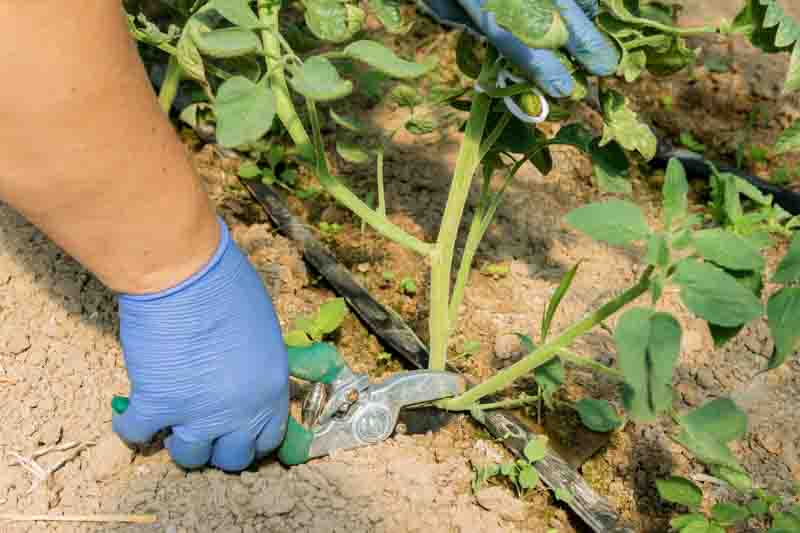
Very small suckers can usually be removed with your fingers.
Find the leaf axil where the sucker joins the main stem.
Confirm that it is a leafy shoot rather than a flower cluster.
Pinch the sucker close to its base.
Bend it gently sideways until it snaps away.
For thicker suckers, use clean pruning shears rather than tearing the stem and damaging surrounding tissue.
Small is easy. If your training system requires sucker removal, deal with unwanted shoots while they are small instead of waiting until they become substantial fruiting branches.
For complete instructions on single- and multi-stem training, lower-leaf removal, Missouri pruning, topping, and avoiding overpruning, see Gardenia’s How and When to Prune Tomatoes.
Yes.
Removing every possible side shoot can leave a tomato with much less leaf area than it needs for its growing environment.
Over-suckering can:
Reduce total crop potential: Productive stems and flower clusters are removed before they can contribute fruit.
Reduce photosynthetic leaf area: Fewer leaves are available to support growth and fruit development.
Expose fruit to sunscald: Previously shaded tomatoes can suddenly receive intense sunlight.
Alter crop load: Fewer remaining fruits receive a larger share of the plant’s resources.
Create unnecessary wounds: Especially when large stems are repeatedly removed.
Do not confuse an open canopy with a stripped plant. Tomatoes need leaves. The goal is to create a structure your support can handle while preserving enough productive foliage to feed and shade the crop.
Growing in a container does not automatically mean every sucker should be removed.
Start with growth habit:
Compact determinate tomato: Usually needs little structural sucker pruning.
Dwarf tomato: Follow its actual growth habit rather than assuming dwarf means determinate.
Indeterminate tomato: Selective sucker removal may be useful if the plant must stay within a limited stake, cage, or trellis.
Container size matters too. Pruning does not make an oversized indeterminate tomato magically suited to a small pot. Root volume, water availability, fertility, spacing, and support still need to match the mature plant.
In hot climates, be particularly careful about removing excessive foliage from container tomatoes because pots already dry rapidly and exposed fruit is more vulnerable to intense sun.
Removing every sucker automatically: Tomato type, spacing, and support should determine how much pruning is useful.
Heavily suckering determinate tomatoes: This can remove productive shoots that contribute to their concentrated harvest.
Confusing flower clusters with suckers: Check for leaves before pinching.
Waiting until unwanted suckers are huge: Large stems represent far more foliage and potential fruit than tiny shoots.
Keeping too many stems for the available space: Every retained sucker eventually needs room and support.
Removing foliage during intense heat without considering sunscald: Developing fruit benefits from protective shade.
Assuming sucker removal always increases yield: Heavy training often favors fewer, earlier, or larger fruit rather than the largest total harvest.
The useful question is not “Should tomatoes have suckers?” They naturally do. Ask instead: “How many productive stems can this tomato, in this space and on this support, carry well?”
If you remember only one thing, remember that tomato suckers are normal fruiting shoots.
Keep more suckers when:
The plant is determinate and the shoot is part of its productive growth.
An indeterminate tomato has a roomy cage or wide trellis.
The sucker is well positioned to become a useful second or third leader.
The plant has enough spacing and support for another full stem.
The plant needs foliage to shade fruit in intense sun.
Your priority is a fuller plant and potentially more total fruit.
Remove selected suckers when:
You are deliberately training an indeterminate tomato to one or a few stems.
The support cannot carry additional branches.
The plant does not have enough physical space for another leader.
The canopy is becoming difficult to manage or inspect.
The sucker is small, unwanted, and clearly outside your training plan.
For complete tomato growing requirements, visit Gardenia’s Tomato (Solanum lycopersicum) profile.
A tomato sucker is a lateral shoot that develops in the leaf axil, the angle where a leaf meets the main stem. If left in place, it can become another stem with leaves, flowers, fruit, and additional suckers of its own.
No. Whether a sucker should be removed depends on the tomato’s growth habit, available spacing, and support system. Determinate tomatoes generally need little sucker pruning, while indeterminate tomatoes may be selectively suckered when trained to a limited number of stems.
Yes. A sucker can develop into a full fruiting stem that produces leaves, flower clusters, and tomatoes. Removing a sucker therefore removes potential fruiting growth as well as reducing the size of the canopy.
Determinate tomatoes generally require very little sucker pruning. If pruning is used, it should usually be limited to low early growth according to the cultivar and support system. Avoid repeatedly removing productive shoots around and above the first flower cluster.
Remove selected suckers if you are training an indeterminate tomato to one or a few stems on a stake, string, or narrow trellis. A large cage or wider trellis can support more productive stems, so less sucker removal may be appropriate.
Not necessarily. Heavily trained tomatoes may produce fewer but earlier or larger individual fruits. Fuller, less-pruned plants often have more fruiting stems and may produce a larger total crop when spacing, support, water, and nutrients are adequate.
If a sucker does not fit your training system, remove it while it is still small. Small suckers are easy to pinch away and their removal causes less disruption than cutting out a mature fruiting stem.
First decide whether the stem can simply be retained and supported. If it needs to be controlled, Missouri pruning removes the growing tip while leaving one or two sets of leaves, limiting further growth without removing all of its foliage.
Yes. Excessive sucker removal reduces leaf area and potential fruiting stems and can expose developing tomatoes to sunscald. Prune only enough to create the structure required by your support, spacing, and growing conditions.
No. Suckers are normal plant growth. A very dense canopy may dry more slowly and be harder to manage in humid conditions, but the suckers themselves do not cause disease. Spacing, weather, irrigation, airflow, and pathogen pressure also affect disease risk.
Updated: September 2026 • Reviewed by Gardenia Editors
| Hardiness |
2 - 11 |
|---|---|
| Climate Zones | 1, 1A, 1B, 2, 2A, 2B, 3, 3A, 3B, 4, 5, 6, 7, 8, 9, 10, 11, 12, 13, 14, 15, 16, 17, 18, 19, 20, 21, 22, 23, 24, A1, A2, A3, H1, H2 |
| Plant Type | Fruits |
| Plant Family | Solanaceae |
| Genus | Solanum, Tomatoes |
| Common names | Love Apple, Tomato |
| Exposure | Full Sun |
| Season of Interest | Spring (Late), Summer (Early, Mid, Late), Fall |
| Height | 3' - 10' (90cm - 3m) |
| Spread | 1' - 4' (30cm - 120cm) |
| Spacing | 24" - 36" (60cm - 90cm) |
| Maintenance | Average, High |
| Water Needs | Average |
| Soil Type | Clay, Loam, Sand |
| Soil pH | Acid, Neutral |
| Soil Drainage | Moist but Well-Drained |
| Tolerance | Rabbit, Clay Soil |
| Attracts | Bees |
| Landscaping Ideas | Patio And Containers |
| Garden Styles | City and Courtyard, Informal and Cottage, Pollinator Garden |
| Hardiness |
2 - 11 |
|---|---|
| Climate Zones | 1, 1A, 1B, 2, 2A, 2B, 3, 3A, 3B, 4, 5, 6, 7, 8, 9, 10, 11, 12, 13, 14, 15, 16, 17, 18, 19, 20, 21, 22, 23, 24, A1, A2, A3, H1, H2 |
| Plant Type | Fruits |
| Plant Family | Solanaceae |
| Genus | Solanum, Tomatoes |
| Common names | Love Apple, Tomato |
| Exposure | Full Sun |
| Season of Interest | Spring (Late), Summer (Early, Mid, Late), Fall |
| Height | 3' - 10' (90cm - 3m) |
| Spread | 1' - 4' (30cm - 120cm) |
| Spacing | 24" - 36" (60cm - 90cm) |
| Maintenance | Average, High |
| Water Needs | Average |
| Soil Type | Clay, Loam, Sand |
| Soil pH | Acid, Neutral |
| Soil Drainage | Moist but Well-Drained |
| Tolerance | Rabbit, Clay Soil |
| Attracts | Bees |
| Landscaping Ideas | Patio And Containers |
| Garden Styles | City and Courtyard, Informal and Cottage, Pollinator Garden |
Create a membership account to save your garden designs and to view them on any device.
Becoming a contributing member of Gardenia is easy and can be done in just a few minutes. If you provide us with your name, email address and the payment of a modest $25 annual membership fee, you will become a full member, enabling you to design and save up to 25 of your garden design ideas.
Join now and start creating your dream garden!
Create a membership account to save your garden designs and to view them on any device.
Becoming a contributing member of Gardenia is easy and can be done in just a few minutes. If you provide us with your name, email address and the payment of a modest $25 annual membership fee, you will become a full member, enabling you to design and save up to 25 of your garden design ideas.
Join now and start creating your dream garden!