Surround tomatoes with the right flowers and your vegetable garden can buzz with life. Discover the best companion flowers for bumblebees, native bees, hoverflies and other beneficial insects, plus where to plant them, how to avoid overcrowding, and how to create continuous blooms from spring through fall.
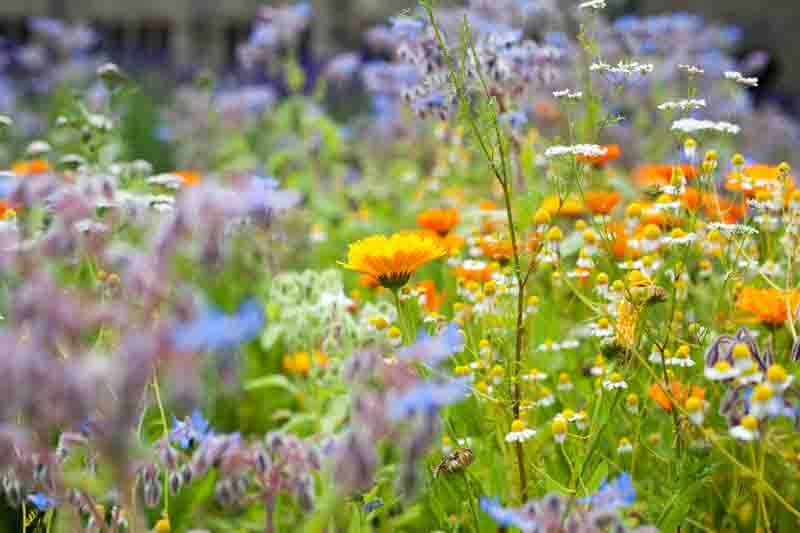


A tomato garden can produce far more than tomatoes. Add the right flowers and it becomes a small working ecosystem – one that feeds bumblebees and native bees, draws hoverflies and other beneficial insects, adds months of color, and makes a vegetable bed feel like an intentional garden rather than a row of crops.
But simply scattering marigolds around tomato plants is not the same as creating useful insect habitat.
The best flowers for tomatoes do different jobs. Some provide pollen or nectar for bees. Some have tiny, accessible flowers that can feed adult hoverflies and parasitoid wasps. Some bloom early, before tomato flowering peaks. Others carry the floral display through the heat of summer and into fall.
The real goal is diversity – not the greatest possible number of plants, but the right combination of flower shapes, bloom times, mature sizes, and ecological functions.
Gardenia tip: Do not ask only, “What flower should I plant with tomatoes?” A better question is, “What job do I need that flower to do?” Pollination, beneficial-insect habitat, early-season bloom, summer nectar, or low-growing bed edging may lead you to very different plants.
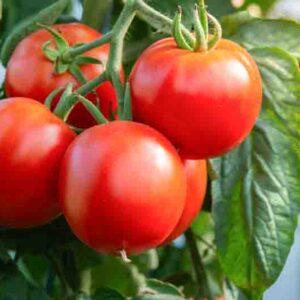
Tomatoes are self-compatible. Each flower contains the structures needed to produce fruit with its own pollen, so a tomato plant does not need pollen carried from another variety or even another plant.
What tomato flowers do need is movement. Their pollen is held inside specialized anthers and must be shaken loose. Outdoors, wind and normal plant movement often provide enough vibration for satisfactory fruit set.
Bumblebees and some other native bees can do something even more specialized: buzz pollination. A bee grips the flower and rapidly vibrates its flight muscles, releasing pollen from the anthers.
This does not mean tomatoes without bees will remain fruitless. Many outdoor plants pollinate perfectly well through wind and movement. But buzz-pollinating bees can contribute to effective pollen release, which is one reason a diverse bee population is welcome around a tomato garden.
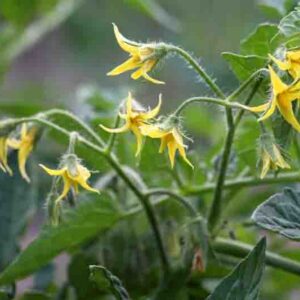
Tomato flowers also differ from many familiar garden flowers because they offer pollen but essentially no nectar. That makes nearby nectar-producing flowers particularly useful: they provide another food source for insects visiting the vegetable garden.
Worth knowing: Honey bees visit many vegetable-garden flowers, but they do not perform true buzz pollination. Bumblebees and certain other bees are especially well suited to vibrating tomato flowers.
“Beneficial insect” is a useful gardening phrase, but it covers insects doing very different jobs.
Pollinators move pollen between or within flowers. Around tomatoes, bumblebees and other buzz-pollinating bees are especially interesting because they can vibrate tomato blossoms. Bees visiting the surrounding flowers also pollinate many herbs, fruits, and ornamentals elsewhere in the garden.
Predators eat other insects. Hoverfly larvae, lacewing larvae, lady beetles, minute pirate bugs, and other predators may feed on aphids, eggs, small larvae, or other arthropods.
Parasitoids are different again. Many tiny parasitoid wasps lay eggs in or on another insect. Their developing young eventually kill the host. Depending on the parasitoid species, hosts may include aphids, caterpillars, whiteflies, or other garden pests.
The important detail is that the diet of a beneficial insect can change with its life stage. A hoverfly larva may be an aphid predator while the adult hoverfly feeds on pollen and nectar. Adult lacewings of some species also use floral resources even though their larvae are voracious predators.
That is why flowers matter even when the flower itself has no direct effect on a tomato pest.
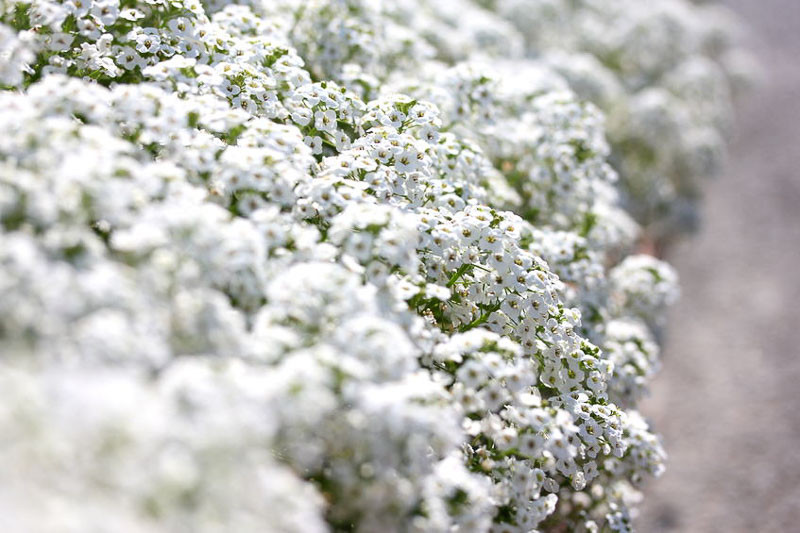
Sweet alyssum (Lobularia maritima) is one of the most useful small flowers for a tomato bed. Its clusters of tiny blooms are accessible to small insects, including hoverflies and small bees, while its low growth makes it easy to fit around larger vegetables.
Use alyssum along the front edge of raised beds, beside paths, or in small pockets rather than creating a dense carpet beneath tomato plants. It is especially attractive where its flowers can spill slightly over a bed edge.
Best role: low insectary edge.
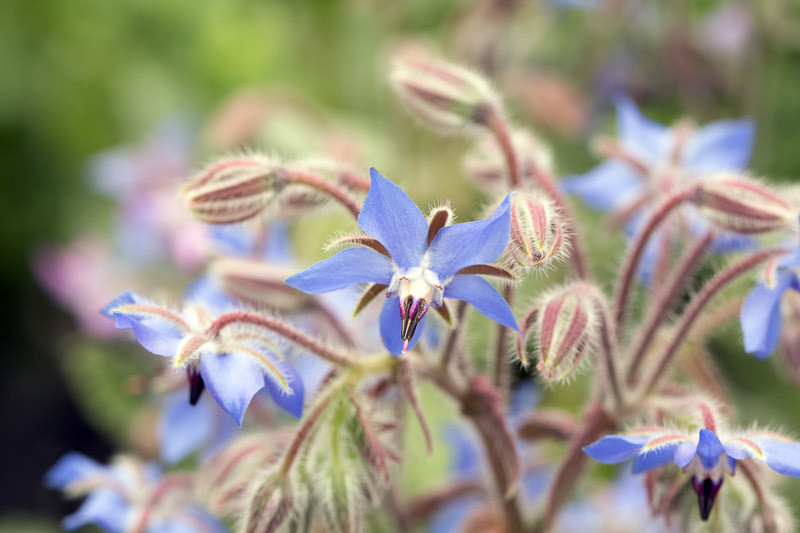
Borage (Borago officinalis) produces distinctive blue, star-shaped flowers that are highly attractive to bees. Its long flowering period can make it a valuable source of floral resources through much of the tomato season.
Do not underestimate its mature size. Borage can reach roughly 1-3 feet (30-90 cm) high and spread widely enough to crowd a small vegetable bed. It is usually better at a bed corner or immediately outside the main tomato planting than directly beneath a tomato cage.
Best role: bee-focused perimeter flower.
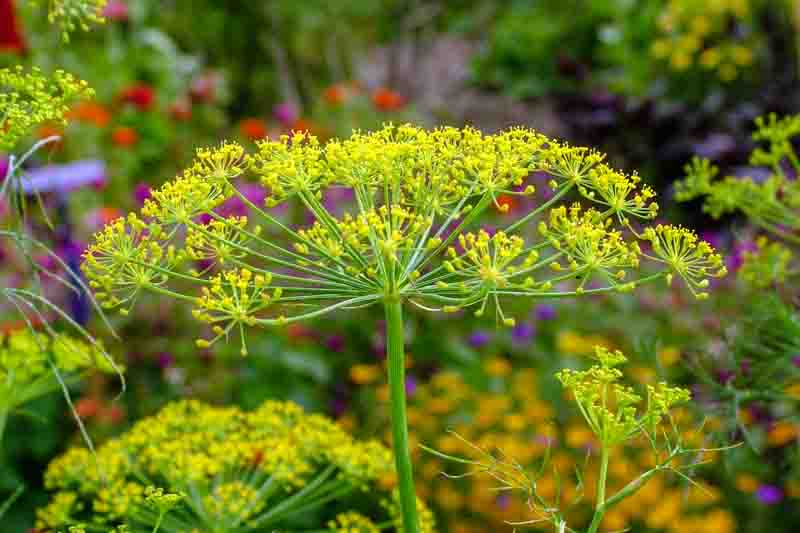
Dill (Anethum graveolens) becomes especially valuable when you allow some plants to flower. Its broad umbels are composed of many tiny flowers with easily accessible floral resources.
That flower structure works particularly well for small insects, including hoverflies and parasitoid wasps. The plant is tall but airy, so it can fit into a productive garden without creating the solid shade cast by a dense ornamental plant.
Place flowering dill toward the back, corner, or end of the bed where it will not lean across tomato foliage.
Best role: small-insect and parasitoid resource.
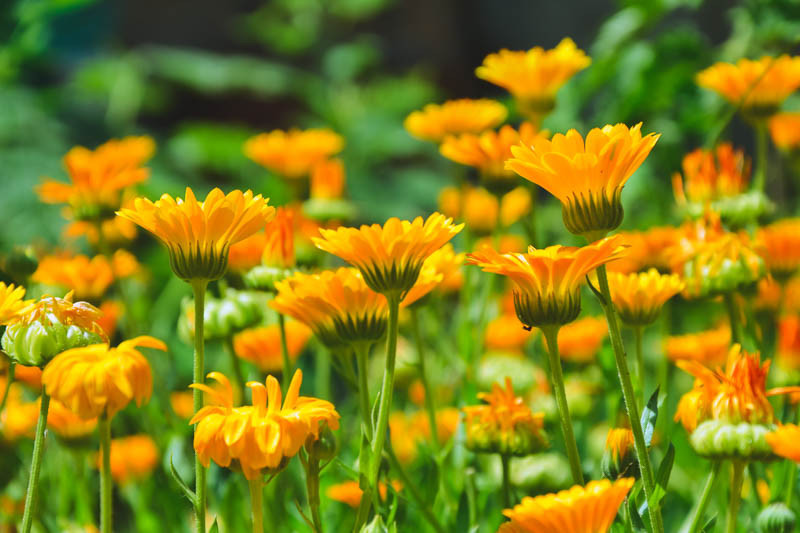
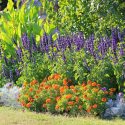
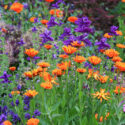
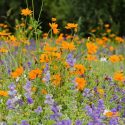
Calendula (Calendula officinalis) brings bright yellow, orange, cream, or apricot flowers into the vegetable garden and is visited by a variety of flower-feeding insects.
Its greatest value in a tomato planting may be timing. Calendula often performs particularly well in the cooler parts of the growing season, allowing it to contribute flowers before heat-loving annuals reach their peak.
In hot climates, flowering may slow once intense summer heat arrives.
Best role: early-season floral bridge.
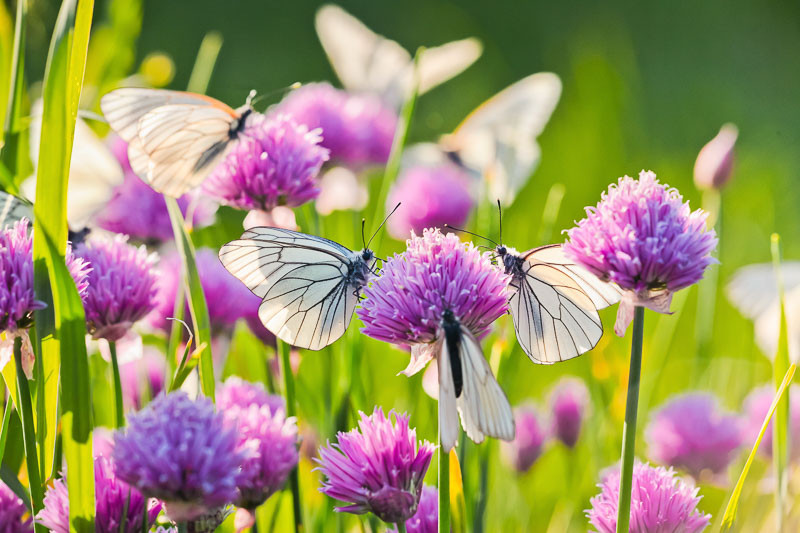
Chives (Allium schoenoprasum) are an excellent fit for tomato gardens because they combine culinary value with attractive spring and early-summer flowers. Their rounded purple flower heads are visited by bees and other pollinators, while the narrow, upright foliage takes up relatively little space.
Unlike basil, which is often pinched to prevent flowering and encourage leaf production, chives can be allowed to bloom without undermining their usefulness as an edible herb. After flowering, the spent heads can be removed if you want to limit self-seeding and keep the clumps tidy.
Chives work especially well near the front or edge of a tomato bed, where they add vertical texture without sprawling into tomato stems or competing heavily for above-ground space.
Best role: compact edible flowering herb for bees and bed edges.
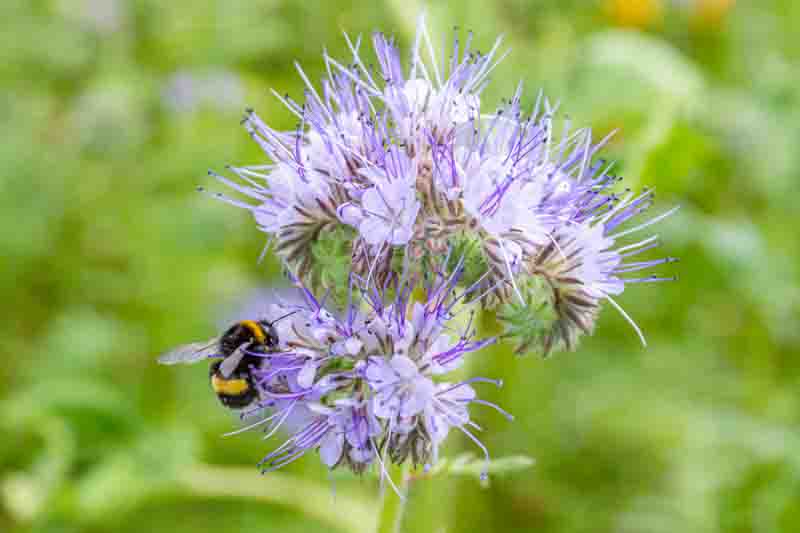
Phacelia tanacetifolia is an outstanding insectary plant where space allows. Its curled clusters of lavender-purple flowers attract bees, hoverflies, and other flower visitors.
It grows too vigorously to tuck casually under mature tomato plants, but it is excellent at the end of a vegetable bed, in an adjacent strip, or along the sunny edge of a kitchen garden.
Best role: high-value nearby insectary planting.
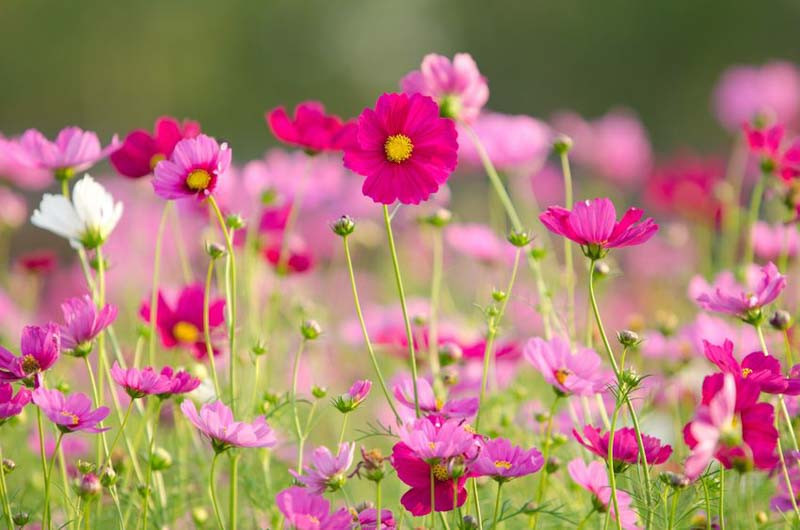
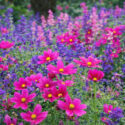
Cosmos produces open flowers that make pollen and nectar easy to reach, and it can continue blooming for a long period in summer.
Choose the cultivar with mature size in mind. Compact cosmos can fit comfortably beside a raised bed, while tall forms belong behind or beyond the tomato row where they will not block sunlight or interfere with harvest.
Best role: long-season perimeter flower.
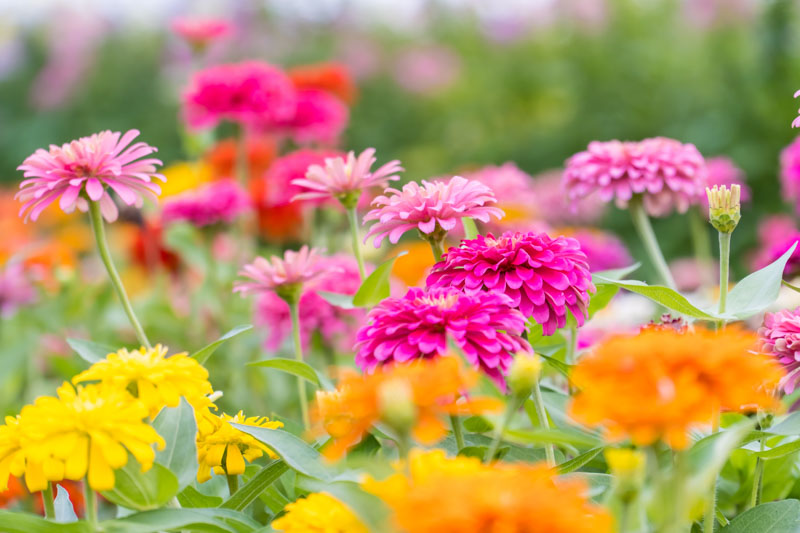
Zinnias (Zinnia elegans) thrive during the warm months when tomatoes are growing rapidly. Their bright flowers are visited by bees and butterflies, making them useful for extending floral resources through summer.
If supporting insects is a priority, favor single or semi-double flowers with accessible central florets rather than using only densely double cultivars.
Dwarf zinnias can work near bed edges; taller cultivars are better used at row ends or nearby.
Best role: midsummer and late-summer nectar display.
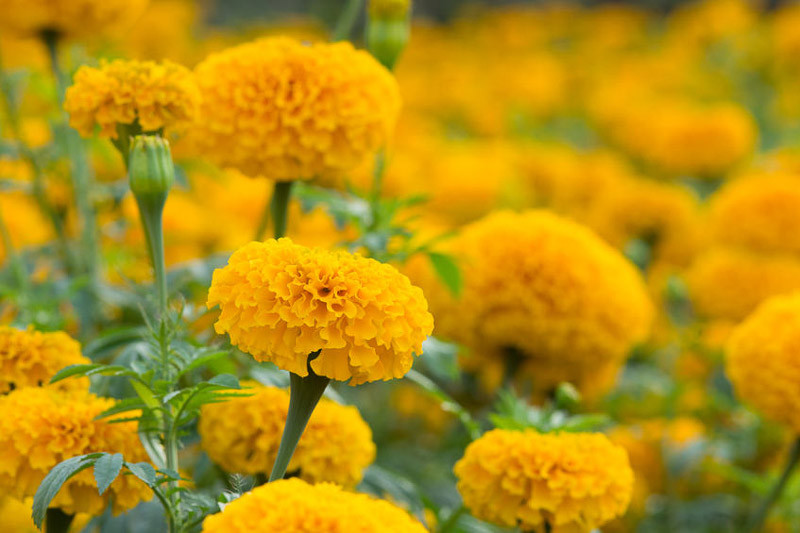
Marigolds (Tagetes) are traditional vegetable-garden companions, but their value is often exaggerated. A marigold planted beside a tomato does not create an invisible barrier against every insect pest.
The more defensible reasons to grow marigolds are their long flowering period, tolerance of summer conditions, compact size in many cultivars, vivid color, and usefulness to visiting insects.
Open or relatively simple flower forms are more accessible than extremely dense doubles.
Best role: durable summer color and floral diversity.
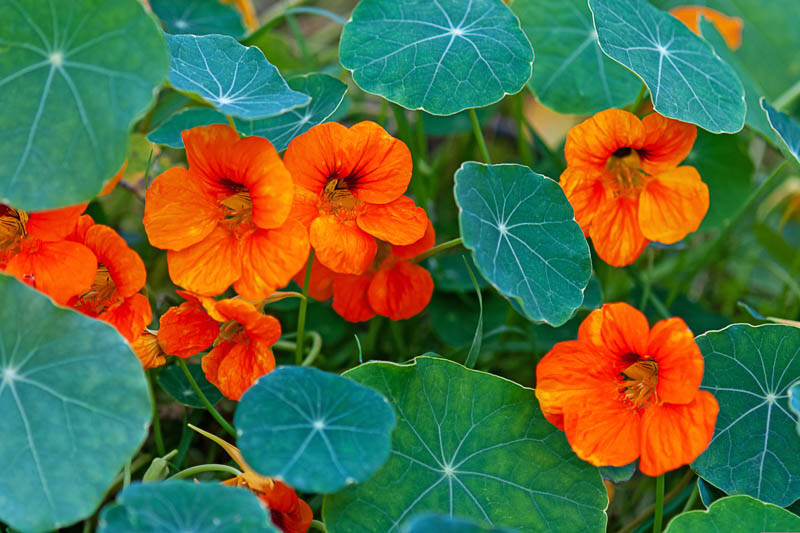
Nasturtiums (Tropaeolum majus) bring rounded leaves and bright trumpet-shaped flowers to a vegetable garden and are attractive to flower-visiting insects.
Their sprawling habit is both an advantage and a warning. A plant trailing over the outside of a raised bed can be beautiful; the same plant growing through tomato stems can become inconvenient.
Best role: trailing edge or container companion.
| Plant | Especially useful for | Flower structure | Best position |
|---|---|---|---|
| Sweet alyssum | Hoverflies, small bees and other small flower visitors | Masses of tiny accessible flowers | Bed edge |
| Borage | Bumblebees and other bees | Open star-shaped flowers | Corner or perimeter |
| Dill | Hoverflies, parasitoid wasps and other small insects | Tiny flowers in open umbels | Back or bed end |
| Phacelia | Bees, hoverflies and other beneficial insects | Dense curling flower clusters | Adjacent insectary strip |
| Calendula | Bees and other general flower visitors | Open composite flowers | Front or middle |
| Cosmos and zinnias | Bees, butterflies and diverse summer visitors | Open-centered flowers | Perimeter or nearby |
The lesson is simple: flower shape matters. A garden containing only one type of flower offers a narrower menu than one containing umbels, tiny clustered blooms, open composites, and bee-friendly flowers.
Flowers do not kill tomato pests. What they can do is help create habitat for insects that prey on or parasitize some of them.
| Tomato pest | Potential natural enemies |
|---|---|
| Aphids | Hoverfly larvae, lacewing larvae, lady beetles, parasitoid wasps and other predators |
| Whiteflies | Certain parasitoid wasps and predatory insects |
| Caterpillars | Various parasitoid wasps and generalist predators |
| Small insect eggs and larvae | Lacewings, minute pirate bugs, lady beetles and other predators, depending on species |
| Thrips and other small arthropods | Various predatory bugs and other natural enemies may contribute to suppression |
This is biological control, not pest eradication. A healthy garden may still contain aphids, caterpillars, whiteflies, and other insects. In fact, natural enemies need prey.
The objective is a more balanced garden in which predators and parasitoids can contribute to keeping pest populations below damaging levels.
Important: Do not wait for companion flowers to solve a severe infestation. Inspect tomato leaves regularly, identify the pest correctly, and use flowers as one part of an integrated pest-management strategy.
You do not need all ten flowers. For a small raised bed, Gardenia’s simplest starting formula is:
1 low insectary plant + 1 bee-focused flower + 1 flowering herb or airy insectary plant.
For example:
Sweet alyssum + borage + dill – a useful mixture of tiny flowers, bee forage, and umbels.
Sweet alyssum + calendula + chives – compact and particularly suitable for a small raised bed.
Alyssum + phacelia + dill – better where the phacelia and dill can sit outside or at the end of the main tomato row.
The formula is not a rigid recipe. Its purpose is to prevent one of the most common companion-planting mistakes: filling the bed with several plants that perform essentially the same role.
Bloom continuity is one of the easiest ways to improve a tomato insectary.
Early in the season: Calendula and sweet alyssum can provide flowers while tomatoes are still establishing.
As tomatoes begin flowering heavily: Borage, dill, basil, phacelia, marigolds, and other warm-season companions can begin contributing.
During midsummer and late summer: Zinnias, cosmos, marigolds, basil, and repeat-flowering plants help keep resources available after early flowers decline.
The exact sequence varies with climate, sowing date, variety, and summer heat. Instead of following a fixed calendar, look at your garden and ask a practical question: If one plant stops flowering next week, what begins next?
The best companion flower does not necessarily belong between two tomato stems.
Keep the immediate tomato root and stem zone relatively open for watering, tying, pruning, inspection, and harvest. Then use the surrounding space more creatively.
Bed edges: sweet alyssum, compact calendula, dwarf marigolds.
Open pockets between well-spaced plants: basil and other compact herbs.
Corners and row ends: borage, flowering dill, compact zinnias.
Behind or outside the bed: taller cosmos, large zinnias, phacelia, and other vigorous insectary plants.
Containers beside tomatoes: flowering basil, alyssum, calendula, compact marigolds, and nasturtiums.
Beneficial insects can fly. A flower does not need to touch the tomato plant to be useful.
Keep tomatoes as the dominant plants. Edge part of the bed with sweet alyssum, add two or three basil plants, tuck calendula or compact marigolds into one or two open corners, and grow dill or borage at the outer edge.
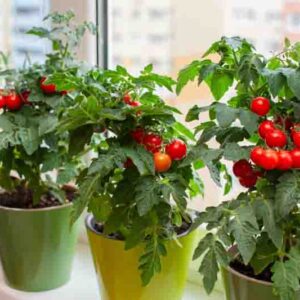
Give each tomato its own appropriately sized container rather than filling the pot with aggressive companions. Place separate pots of alyssum, flowering basil, dwarf zinnias, calendula, or nasturtium nearby. You get floral diversity without forcing several root systems into the tomato container.
Think beyond individual tomato plants. Run a flowering strip along one side of the vegetable garden or use bed ends for phacelia, dill, cosmos, zinnias, and borage. Edge selected beds with lower flowers such as alyssum.
This approach creates more habitat while leaving crop rows practical and easy to maintain.
Annuals such as alyssum, borage, dill, calendula, and zinnias can be useful around vegetables, but they do not need to be the entire pollinator garden.
Native flowering plants adapted to your region can add habitat outside the vegetable bed and may support locally occurring bees, butterflies, and other wildlife. Because native status depends on geography, there is no single list that works everywhere.
A practical approach is to keep manageable annual insectary plants near the tomatoes and create a longer-lived native planting nearby – along a fence, beside a path, around the vegetable garden, or elsewhere in the sunny landscape.
Use Gardenia’s Plant Finder to narrow plants by growing conditions, size, season of interest, and other characteristics rather than choosing a native plant simply because it appears on a generic national list.
A pollinator garden is valuable, but it is not magic.
Marigolds do not repel every tomato pest. Nasturtiums do not guarantee aphid-free tomatoes. Basil does not create an invisible protective zone. And adding flowers does not mean you can stop inspecting your crop.
Flowers work most reliably as habitat. They provide pollen, nectar, structure, and seasonal resources that can make your garden more welcoming to useful insects.
Protect that habitat by avoiding unnecessary broad-spectrum insecticide use, especially when plants are flowering. If intervention is needed, identify the pest first and select the most targeted effective approach.
Even beneficial insects should not be expected to eliminate every pest. A garden that supports predators and parasitoids will usually still contain some prey – and that is part of a functioning food web.
The difference between a good plant list and a garden that actually works is often mature size, bloom timing, and placement.
Gardenia’s Garden Design Tool lets you review plant choices by characteristics including season, mature size, sunlight, water needs, and maintenance, and review a bloom calendar before committing to the final combination.
That matters here. A tomato insectary should not simply contain “good pollinator plants.” The flowers need to fit the available space, tolerate the site, and collectively provide useful bloom over time.
Start with the Gardenia Tomato Insectary Framework:
Function: Which insects or ecological job does the flower support?
Flower architecture: Which insects can readily use the flowers?
Bloom timing: What flowers before and after it?
Spatial fit: Where will the plant fit at mature size?
Then keep the combination simple. A thoughtful mixture of three or four flowers can be more useful – and far easier to manage – than crowding a tomato bed with every companion plant you can find.
The Gardenia takeaway: The best flowers for tomatoes are not simply the ones that attract “the most pollinators.” Build a mix that combines different insects, flower structures, bloom periods, and mature sizes. Give tomatoes the space they need, move vigorous insectary plants to the perimeter, and keep something flowering for as much of the growing season as possible.
Borage, sweet alyssum, calendula, flowering dill, basil, phacelia, cosmos, zinnias, marigolds, and nasturtiums are useful choices. A stronger planting combines flowers with different bloom times, shapes, heights, and ecological roles rather than relying on one species.
No. Tomatoes are self-compatible, and wind or movement can provide enough vibration for outdoor flowers to release pollen and set fruit. However, bumblebees and certain other bees perform buzz pollination, which can improve pollen release from tomato flowers.
Sweet alyssum, flowering dill, phacelia, calendula, and other plants with accessible flowers can attract adult hoverflies. Adults feed on floral resources, while the larvae of many hoverfly species prey on aphids and other soft-bodied insects.
Small, accessible flowers are particularly useful because many parasitoid wasps are tiny. Flowering dill and other plants with small exposed blooms can provide adult parasitoids with floral resources.
Sweet alyssum does not directly fertilize or protect tomatoes, but its masses of tiny flowers provide floral resources for hoverflies, small bees, and other insects. Its low growth also makes it convenient for edging vegetable beds without creating much shade.
Marigolds should not be treated as a universal tomato pest repellent. Their reliable advantages include long-lasting summer flowers, compact growth in many cultivars, and floral resources for visiting insects. Tomatoes still need regular pest inspection.
Usually both approaches can work, but choose by mature size. Compact plants such as basil or alyssum can fit near well-spaced tomatoes, while borage, tall cosmos, phacelia, and flowering dill are often better at bed corners, row ends, or just outside the tomato planting.
Yes. Dense companion planting can make watering, harvesting, inspection, and airflow more difficult and can increase competition for space. A few carefully chosen flowers with different ecological functions are usually more useful than filling every gap around the tomatoes.
Updated: September 2026 • Reviewed by Gardenia Editors
| Hardiness |
2 - 11 |
|---|---|
| Climate Zones | 1, 1A, 1B, 2, 2A, 2B, 3, 3A, 3B, 4, 5, 6, 7, 8, 9, 10, 11, 12, 13, 14, 15, 16, 17, 18, 19, 20, 21, 22, 23, 24, A1, A2, A3, H1, H2 |
| Plant Type | Annuals, Fruits, Perennials |
| Plant Family | Solanaceae |
| Genus | Solanum, Tomatoes |
| Exposure | Full Sun |
| Season of Interest | Spring (Late), Summer (Early, Mid, Late), Fall |
| Maintenance | Average, High |
| Water Needs | Average |
| Soil Type | Clay, Loam, Sand |
| Soil pH | Acid, Neutral |
| Soil Drainage | Moist but Well-Drained |
| Hardiness |
2 - 11 |
|---|---|
| Climate Zones | 1, 1A, 1B, 2, 2A, 2B, 3, 3A, 3B, 4, 5, 6, 7, 8, 9, 10, 11, 12, 13, 14, 15, 16, 17, 18, 19, 20, 21, 22, 23, 24, A1, A2, A3, H1, H2 |
| Plant Type | Annuals, Fruits, Perennials |
| Plant Family | Solanaceae |
| Genus | Solanum, Tomatoes |
| Exposure | Full Sun |
| Season of Interest | Spring (Late), Summer (Early, Mid, Late), Fall |
| Maintenance | Average, High |
| Water Needs | Average |
| Soil Type | Clay, Loam, Sand |
| Soil pH | Acid, Neutral |
| Soil Drainage | Moist but Well-Drained |
Create a membership account to save your garden designs and to view them on any device.
Becoming a contributing member of Gardenia is easy and can be done in just a few minutes. If you provide us with your name, email address and the payment of a modest $25 annual membership fee, you will become a full member, enabling you to design and save up to 25 of your garden design ideas.
Join now and start creating your dream garden!
Create a membership account to save your garden designs and to view them on any device.
Becoming a contributing member of Gardenia is easy and can be done in just a few minutes. If you provide us with your name, email address and the payment of a modest $25 annual membership fee, you will become a full member, enabling you to design and save up to 25 of your garden design ideas.
Join now and start creating your dream garden!