A butterfly flashes past the garden – orange, black, yellow, blue – and is gone before you can decide what you saw. Fortunately, butterfly identification becomes much easier once you stop trying to memorize hundreds of species and start looking for a few reliable clues.
This visual guide focuses on common, widespread, distinctive, and garden-relevant butterflies of North America. It is not a checklist of every species on the continent. Instead, it covers butterflies you are especially likely to notice in gardens, parks, meadows, roadsides, woodland edges, wetlands, and other accessible habitats.
Start with appearance, but do not stop there. Geographic range, habitat, flight style, and nearby caterpillar host plants can help separate butterflies that look remarkably similar.
🦋 Gardenia’s 5-Clue Butterfly ID: Check 1. size and color, 2. wing shape, 3. signature marking, 4. geographic range, and 5. host-plant clue. No single clue is always decisive, but together they can eliminate many look-alikes.
Jump to a color group: Orange & Black | Swallowtails | Dark & Patterned | White & Yellow | Small Blues, Hairstreaks & Skippers
1 Orange and Black Butterflies
Orange and black butterflies are among the most familiar – and among the most frequently confused. Look beyond the overall color. Veins, eyespots, silver markings, wing shape, and the underside of the wings usually provide the answer.

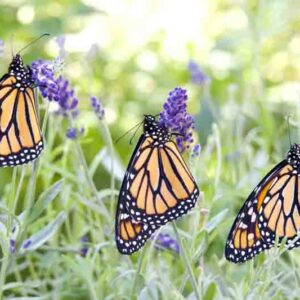
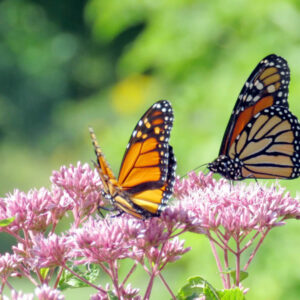
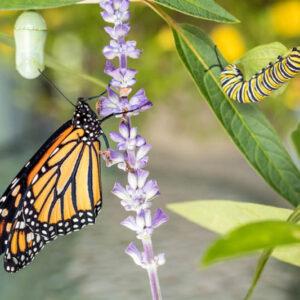
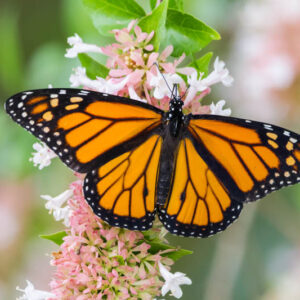
- ID: Bright orange wings crossed by heavy black veins, with broad black borders dotted in white.
- Best clue: Bold black vein network, but no black line crossing the middle of the hindwing.
- Size: Roughly 3.5-4 in. (9-10 cm).
- Range & habitat: Widespread across North America in gardens, meadows, roadsides, open fields, and migration corridors.
- Caterpillar host: Milkweeds (Asclepias and related milkweed hosts).
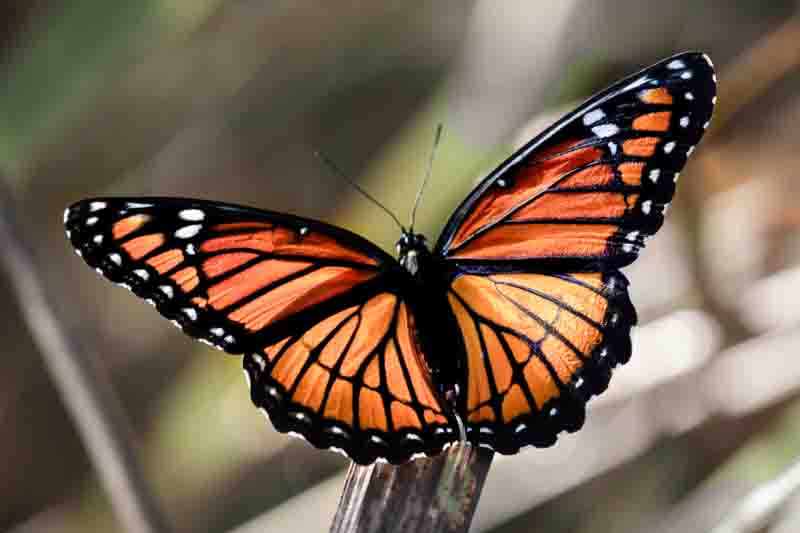
- ID: Orange wings with black veins, dark borders, and white spots – strongly resembling a Monarch.
- Best clue: A black line crosses the veins of each hindwing.
- Size: About 2.5-3.4 in. (6.3-8.6 cm).
- Range & habitat: Much of the United States and southern Canada, especially wetlands, stream edges, and moist open habitats.
- Caterpillar host: Willows, poplars, cottonwoods, aspens, and other documented woody hosts.
🔎 Monarch or Viceroy? Ignore size at first. Look at the hindwing. A dark line crossing the veins points strongly to Viceroy. Their caterpillars offer another clue: Monarchs use milkweed; Viceroys primarily use woody hosts such as willow and poplar.
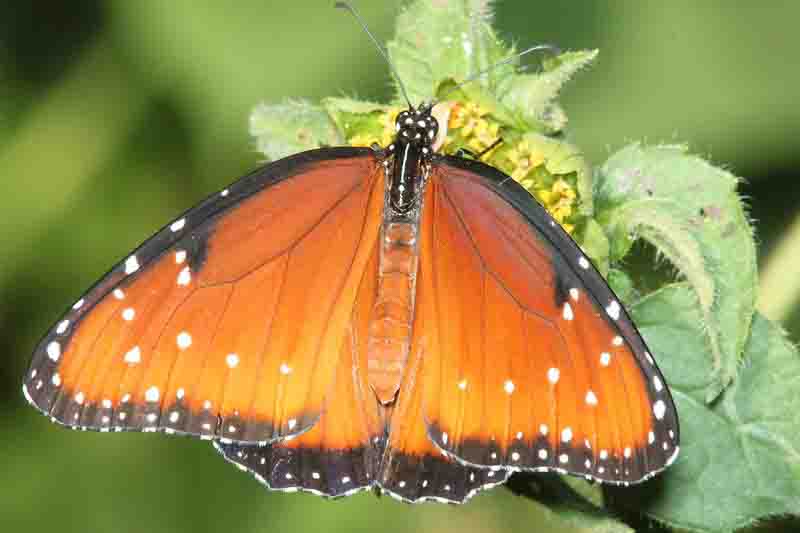
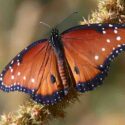
- ID: Rich chestnut or mahogany-brown wings bordered in black and dotted with white.
- Best clue: The upper wings are much less heavily veined than a Monarch’s.
- Size: About 2.6-3.9 in. (6.7-9.8 cm).
- Range & habitat: Most familiar in the southern United States and Southwest, in sunny gardens, fields, desert washes, and open landscapes.
- Caterpillar host: Milkweeds and other suitable plants in the milkweed family.

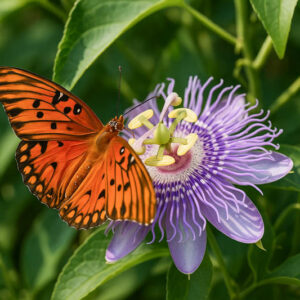
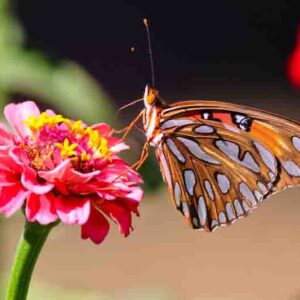
- ID: Brilliant orange above with black markings; much more dramatic beneath.
- Best clue: The underside carries large elongated silver-white spots that seem almost metallic.
- Size: Roughly 2.5-3.7 in. (6.4-9.5 cm).
- Range & habitat: Common in the southern United States and seasonally farther north, especially in sunny gardens and open habitats.
- Caterpillar host: Passionflowers (Passiflora).
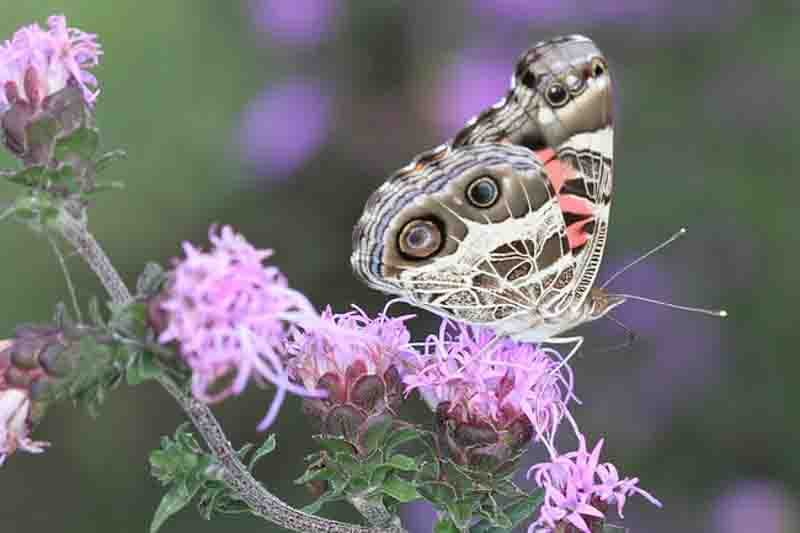
- ID: Orange, black, and brown patterned wings with white marks near the forewing tips.
- Best clue: The underside of each hindwing usually displays two very large eyespots.
- Size: About 1.75-2.6 in. (4.5-6.7 cm).
- Range & habitat: Widespread in open habitats, including meadows, dunes, roadsides, lawns, gardens, and woodland edges.
- Caterpillar host: Pussytoes, pearly Everlasting, and related plants.

- ID: Orange-brown wings patterned with black and white, superficially similar to the American Lady.
- Best clue: The hindwing underside normally has several smaller eyespots, rather than two huge ones.
- Size: Roughly 2-3 in. (5-7.5 cm).
- Range & habitat: Widespread across North America and much of the world, favoring sunny, open habitats.
- Caterpillar host: Thistles, mallows, hollyhocks, and a broad assortment of other plants.
👀 American Lady or Painted Lady? Wait for the butterfly to close its wings. American Lady usually shows two oversized hindwing eyespots; Painted Lady shows several smaller ones. The underside is far more useful than the orange upper wings.
Great Spangled Fritillary (Speyeria cybele)
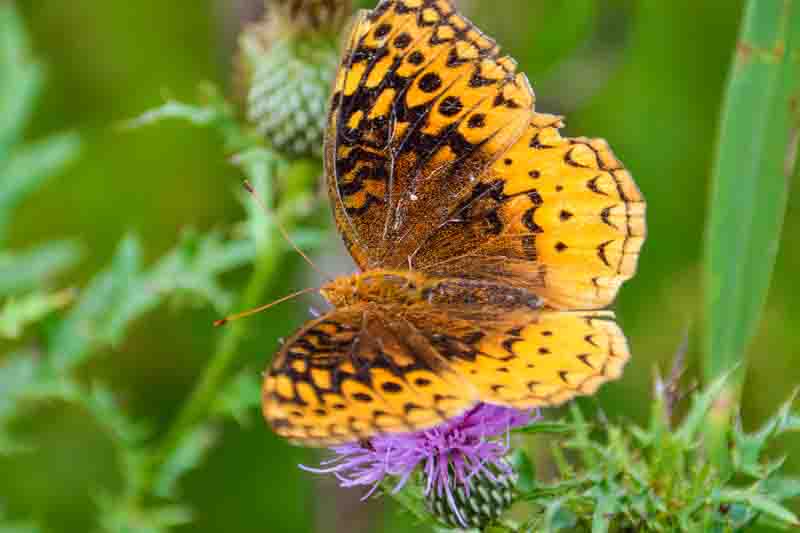
- ID: Large orange fritillary with numerous black spots and lines; females are often darker toward the wing bases.
- Best clue: Look underneath for large silvery spots on the hindwing.
- Size: Roughly 2.5-4 in. (6.3-10 cm).
- Range & habitat: Much of eastern and central North America in meadows, fields, woodland openings, and gardens.
- Caterpillar host: Violets (Viola spp.).
2 Large Swallowtail Butterflies
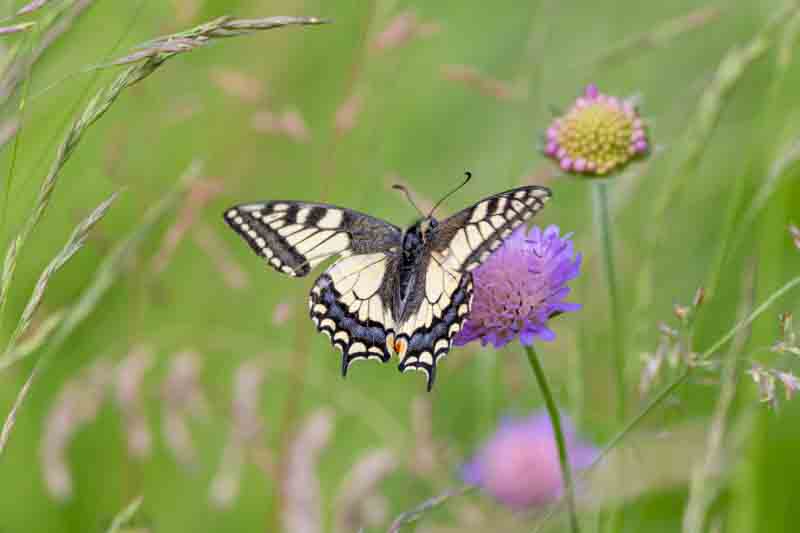
Swallowtails are usually large, powerful butterflies, and many carry the tail-like hindwing extensions that inspired their name. Yellow tiger swallowtails can be separated partly by geography; dark swallowtails demand closer attention to spots, iridescence, and the underside of the hindwings.
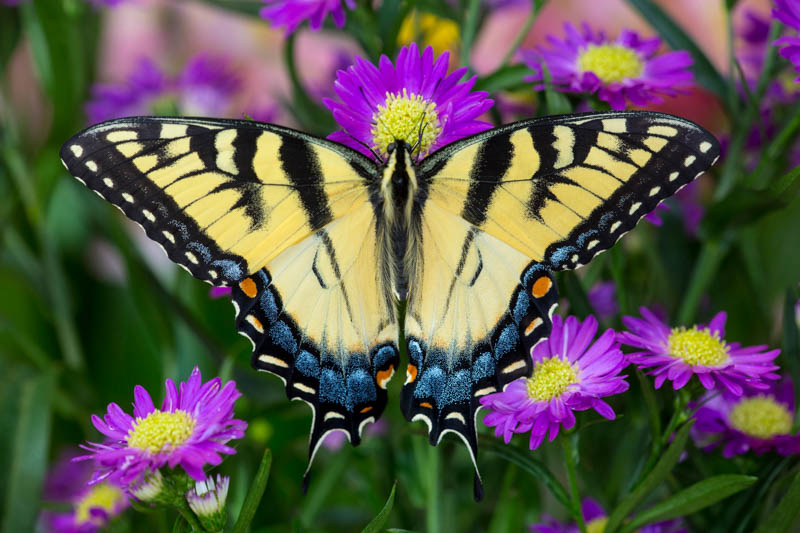
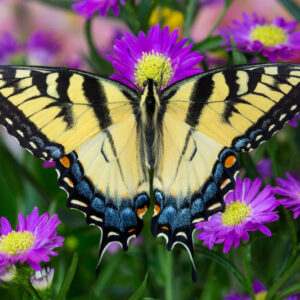
- ID: Large yellow butterfly with four bold black tiger stripes on each forewing. Some females are nearly black.
- Best clue: Yellow + four black tiger stripes + long tails.
- Size: Roughly 3.5-5.5 in. (9-14 cm).
- Range & habitat: Eastern North America in deciduous forests, river corridors, parks, woodland edges, and gardens.
- Caterpillar host: Tulip tree, black cherry, sweetbay magnolia, and several other trees.
Western Tiger Swallowtail (Papilio rutulus)
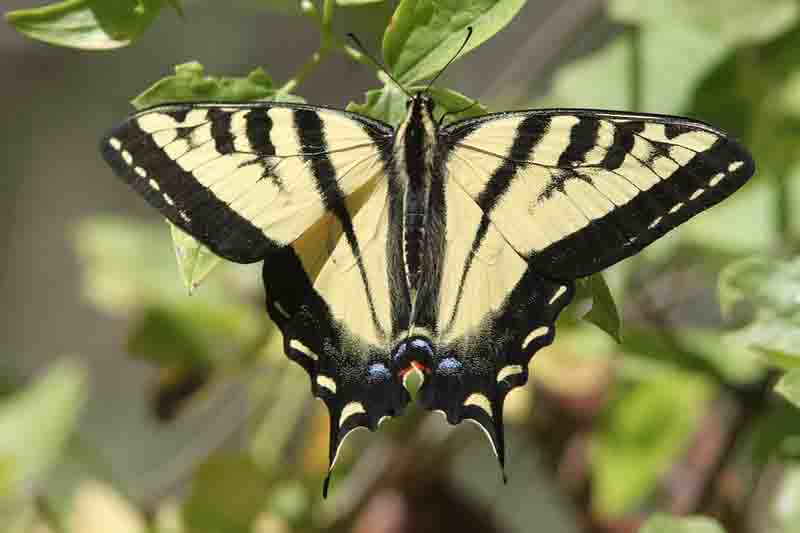
- ID: Large yellow swallowtail patterned with strong black tiger stripes, closely resembling its eastern relative.
- Best clue: Geography is critical – this is a characteristic western tiger swallowtail.
- Size: Roughly 3-4 in. (7.5-10 cm).
- Range & habitat: Western North America, especially wooded suburbs, canyons, rivers, parks, and stream corridors.
- Caterpillar host: Willows, cottonwoods, aspens, wild cherry, and ash (Fraxinus).
📍 Eastern or Western Tiger Swallowtail? Their patterns are similar enough that location may be more useful than color. A tiger swallowtail in Virginia and one in coastal California are unlikely to be the same species.

- ID: Black wings with rows of pale yellow spots; females often have stronger blue on the hindwings.
- Best clue: Look for the orange-red hindwing eyespot with a black center.
- Size: Usually about 2.5-3.5 in. (6.4-8.9 cm).
- Range & habitat: Much of the United States and southern Canada in gardens, fields, farms, and sunny open habitats.
- Caterpillar host: Parsley-family plants, including parsley, dill, fennel, carrots, Golden Alexanders, and native relatives.
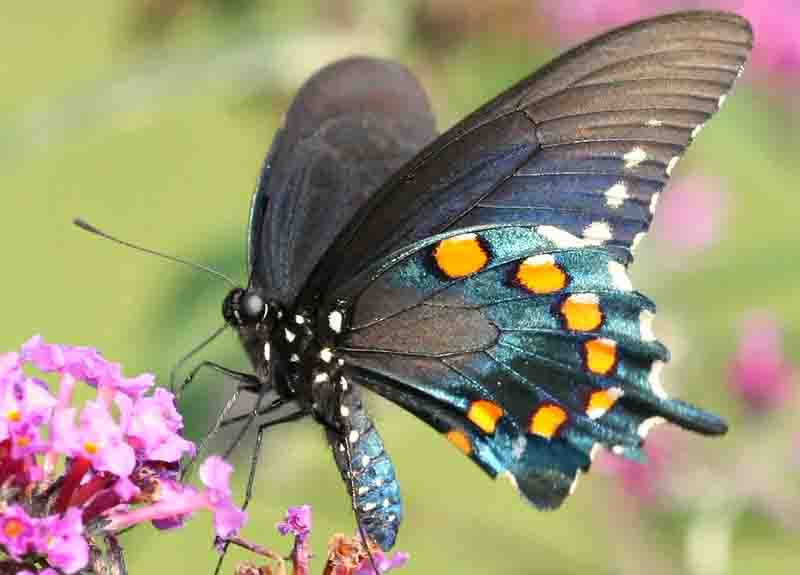
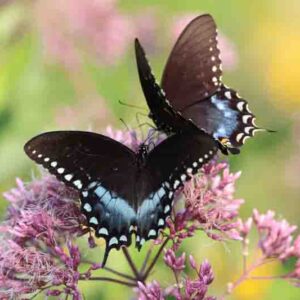
- ID: Black wings with a blue or blue-green iridescent wash across the hindwings.
- Best clue: The underside shows a bold row of large orange spots against metallic blue.
- Size: Roughly 2.75-5 in. (7-13 cm).
- Range & habitat: Much of the United States in woodland edges, stream corridors, gardens, chaparral, and sunny openings.
- Caterpillar host: Suitable pipevines (Aristolochia and related accepted hosts).

- ID: Mostly black with pale marginal spots and an iridescent blue-green wash across the hindwings.
- Best clue: Beneath the hindwing, the orange spots surround a bluish-green central area.
- Size: About 3-4 in. (7-10 cm).
- Range & habitat: Primarily eastern North America in woodlands, stream corridors, shaded edges, and gardens.
- Caterpillar host: Spicebush and sassafras.
🔎 Black, Pipevine, or Spicebush Swallowtail? Do not rely on “black with blue.” Check the hindwing spots and underside. Also look around you: parsley-family plants suggest Black Swallowtail, pipevine suggests Pipevine Swallowtail, and spicebush or Sassafras strengthens the case for Spicebush Swallowtail.
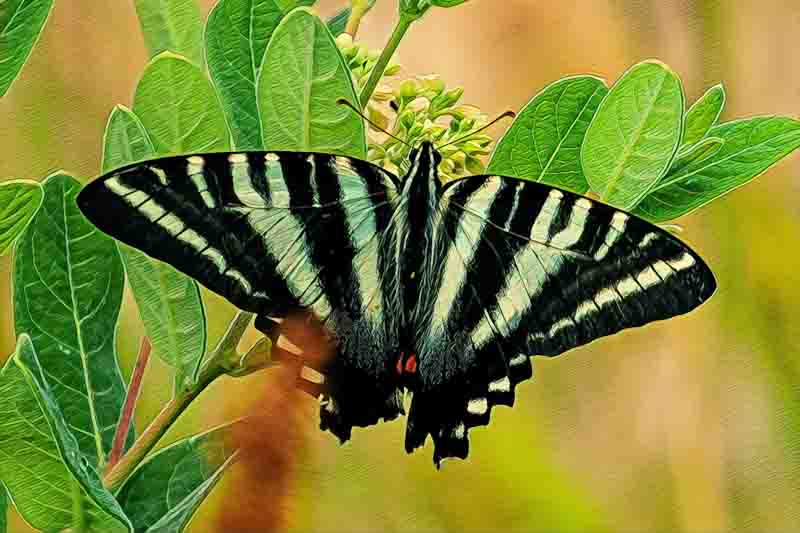
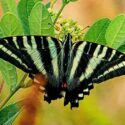
- ID: Pale wings crossed with dramatic black stripes and exceptionally long, narrow hindwing tails.
- Best clue: Zebra striping + unusually long tails is a distinctive combination.
- Size: About 2.5-4 in. (6.4-10.4 cm).
- Range & habitat: Eastern United States, especially river bottoms, woodland edges, and areas where pawpaw grows.
- Caterpillar host: Pawpaws (Asimina).

- ID: Very large dark butterfly with broad yellow bands forming an X-like pattern across the wings.
- Best clue: Huge size + bold yellow diagonal bands.
- Size: Often 4-5.5 in. (10-14 cm).
- Range & habitat: Much of the eastern, central, and southern United States, extending into parts of the West.
- Caterpillar host: Rue-family plants, including Hop tree, prickly ash, and citrus.
3 Dark, Brown, and Boldly Patterned Butterflies
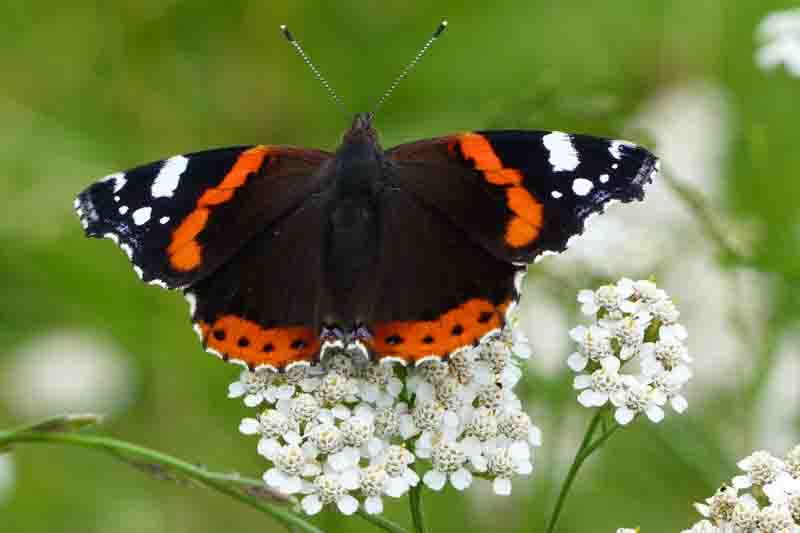
- ID: Velvety black wings crossed by vivid red-orange bands, with white marks near the forewing tips.
- Best clue: The red-orange diagonal forewing band is difficult to miss.
- Size: Roughly 1.75-3 in. (4.5-7.5 cm).
- Range & habitat: Widespread in parks, gardens, trails, woodland edges, clearings, and other semi-open habitats.
- Caterpillar host: Nettles and related plants in the nettle family.
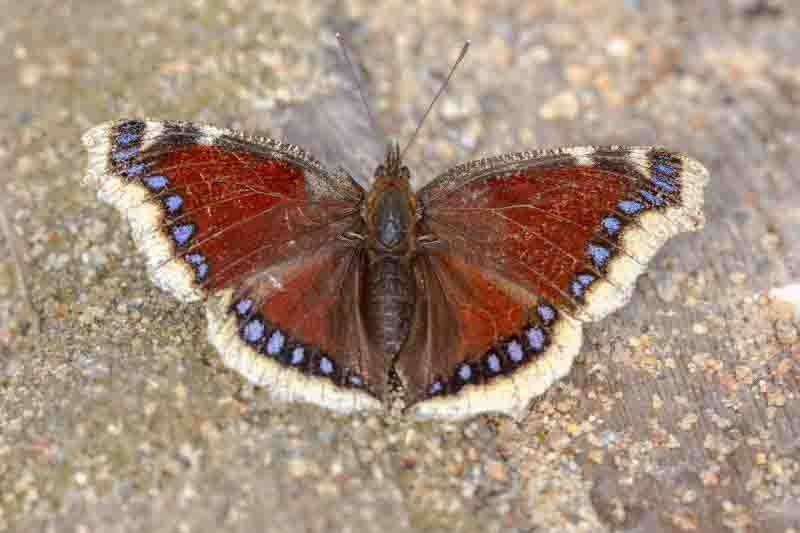
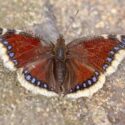
- ID: Deep brown-purple wings edged by a broad cream-yellow border, with bright blue spots just inside it.
- Best clue: Dark center + pale border + blue spots.
- Size: About 2.25-4 in. (5.7-10.1 cm).
- Range & habitat: Widespread across much of North America, especially around woodland edges and tree-lined waterways.
- Caterpillar host: Black willow, weeping willow, American elm, cottonwood, quaking aspen, paper birch, hackberry, and other woody hosts.
Red-Spotted Purple (Limenitis arthemis astyanax)
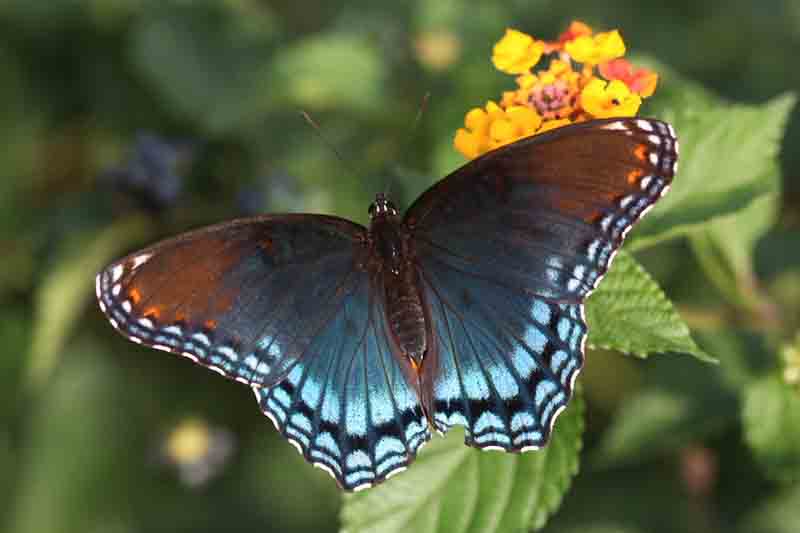
- ID: Blue-black wings with brilliant iridescent blue, especially toward the hindwings; red-orange spots show more clearly beneath.
- Best clue: A large electric-blue dark butterfly with no hindwing tails.
- Size: Roughly 3-4 in. (7.5-10 cm).
- Range & habitat: Eastern and central North America in forests, roads through woodland, stream corridors, and wooded gardens.
- Caterpillar host: Black cherry, willows, poplars, serviceberries, hawthorns, and several other woody plants.
California Sister (Adelpha californica)
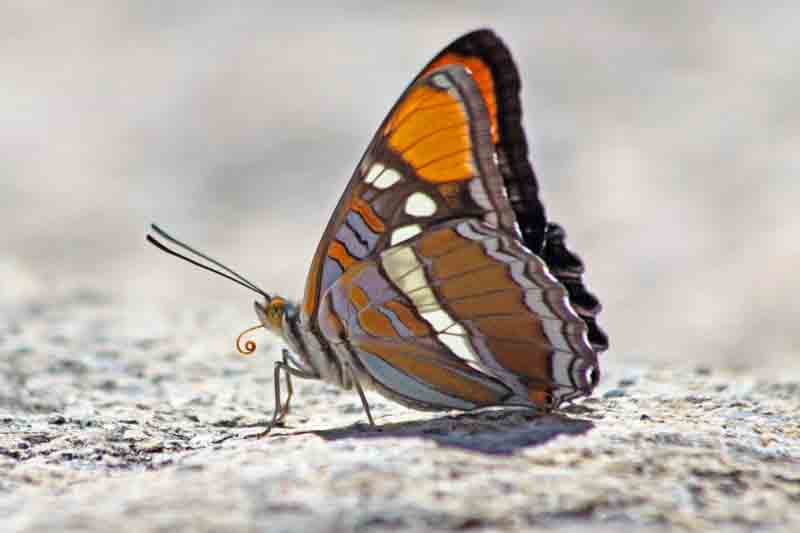
- ID: Dark brown-black wings crossed by crisp white bands, with bright orange patches near the forewing tips.
- Best clue: White wing band + orange forewing tip against a very dark background.
- Size: Roughly 2.5-4 in. (6.4-10 cm).
- Range & habitat: Western North America, particularly oak woodland, canyons, forest openings, and wooded gardens.
- Caterpillar host: Oaks.
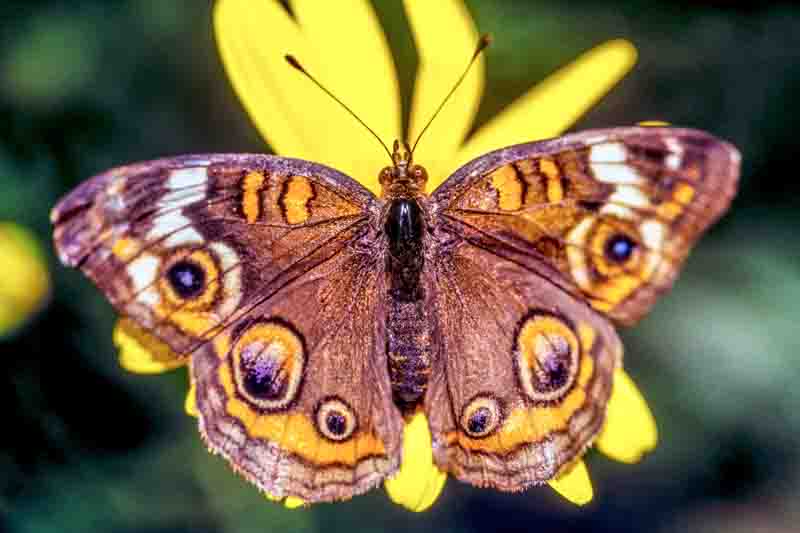
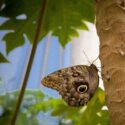
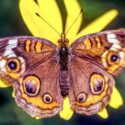
- ID: Warm brown wings decorated with enormous target-like eyespots, orange bars, and cream markings.
- Best clue: The large circular eyespots dominate the pattern.
- Size: About 1.6-2.75 in. (4.2-7 cm).
- Range & habitat: Resident through much of the southern United States and seasonally farther north, often flying low over sunny ground.
- Caterpillar host: Frogfruit, ruellias, plantains, false Foxglove, and other herbaceous hosts.
Common Buckeyes frequently land on paths, gravel, bare soil, or short vegetation. Their habit of flying low and suddenly spreading those striking eyespots can help you recognize them before you ever study a photograph.
4 White and Yellow Butterflies
Cabbage White (Pieris rapae)
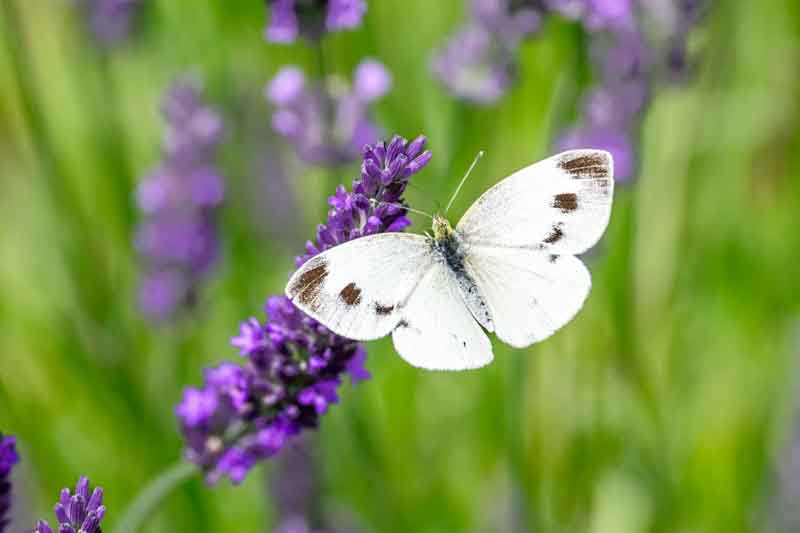
- ID: Small creamy-white butterfly with dark forewing tips and one or two black spots.
- Best clue: A small white butterfly fluttering erratically over lawns or vegetable beds.
- Size: Roughly 1.25-2 in. (3.2-5 cm).
- Range & habitat: Introduced from Eurasia and now widespread across North America in gardens, farms, roadsides, lawns, and disturbed habitats.
- Caterpillar host: Mustard-family plants, including cabbage, broccoli, kale, mustard, and related species.
Cloudless Sulphur (Phoebis sennae)
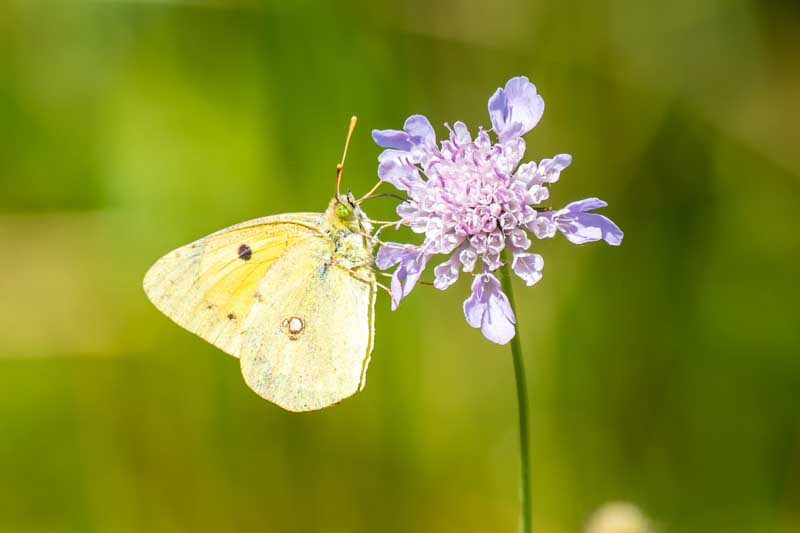
- ID: Large lemon-yellow butterfly with relatively clean, uncluttered wings and a strong, purposeful flight.
- Best clue: Large + almost entirely yellow + fast directional flight.
- Size: Roughly 2.2-3.3 in. (5.5-8.3 cm).
- Range & habitat: Most common in the southern United States but migrates or disperses farther north during warm seasons.
- Caterpillar host: Sennas and related legumes.
Orange Sulphur (Colias eurytheme)
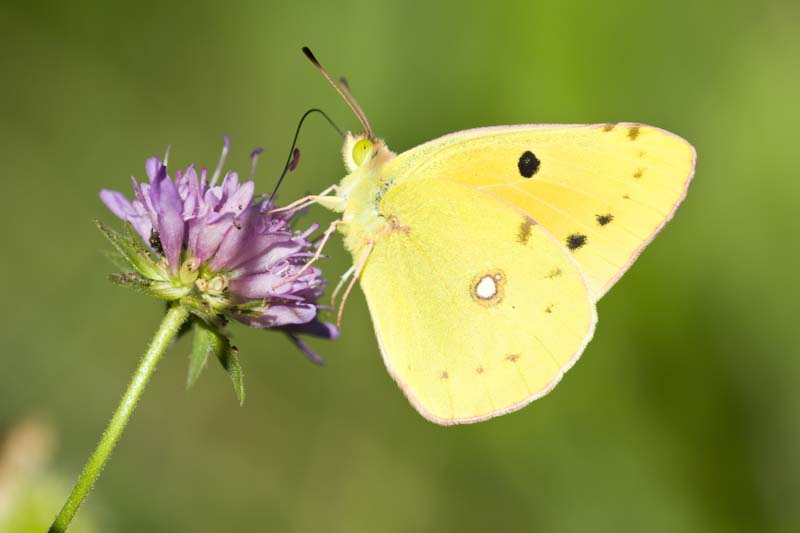
- ID: Yellow to orange butterfly with dark wing margins; females can be paler than males.
- Best clue: Look for an orange wash inside yellow wings, although color varies considerably.
- Size: Roughly 1.4-2.7 in. (3.5-7 cm).
- Range & habitat: Widespread in North American fields, agricultural land, roadsides, meadows, and gardens.
- Caterpillar host: Alfalfa, clovers, and other legumes.
Sara Orangetip (Anthocharis sara)
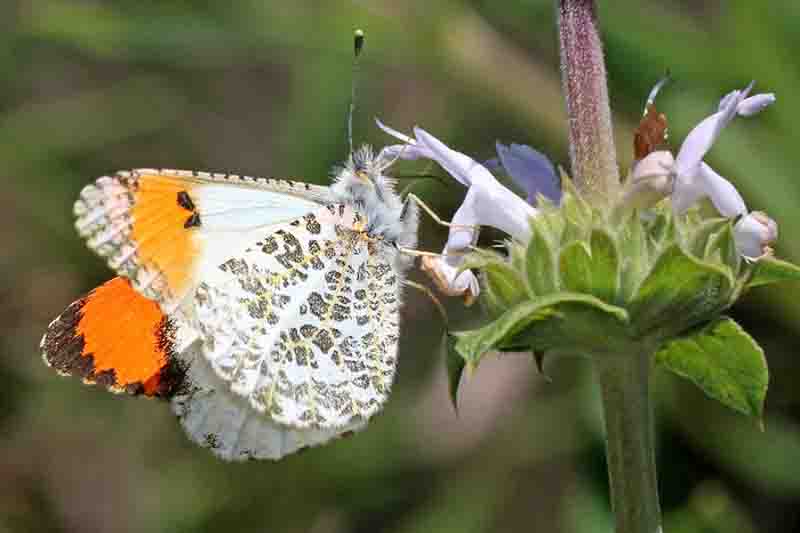
- ID: White butterfly with dark forewing tips dramatically filled with orange.
- Best clue: The bright orange patch at the tip of otherwise white forewings.
- Size: Roughly 1.25-1.75 in. (3.2-4.5 cm).
- Range & habitat: Western North America in foothills, open woodland, canyons, meadows, and spring wildflower habitats.
- Caterpillar host: Mustard-family plants.
5 Small Blues, Hairstreaks, and Skippers
Small butterflies are easily overlooked, but they often become much easier to recognize once they settle. For hairstreaks and blues, inspect the hindwing carefully. For skippers, body shape, antennae, and flight can be more useful than color.
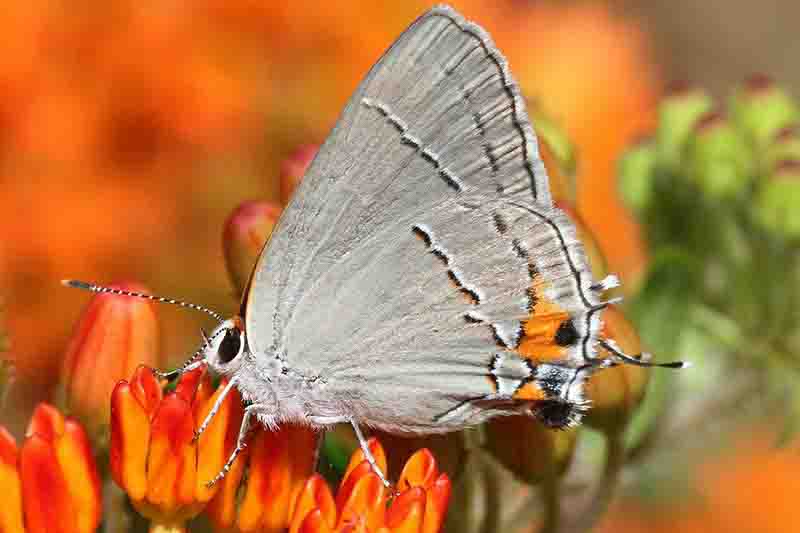
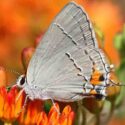
- ID: Silvery-gray butterfly with fine dark lines, delicate tails, and orange-capped black spots near the rear of the hindwing.
- Best clue: Thin tail + orange patch beside a black false eyespot.
- Size: Roughly 1-1.25 in. (2.5-3.2 cm).
- Range & habitat: One of North America’s most widespread hairstreaks, found in gardens, farms, roadsides, grasslands, and disturbed sunny habitats.
- Caterpillar host: Exceptionally broad, including legumes, partridge pea, white clover, mallow, beans and many other plants.
Watch a Gray Hairstreak after it lands. It may rub its hindwings together, moving the tails and eyespots in a way that makes the rear of the butterfly resemble a false head.
Eastern Tailed-Blue (Cupido comyntas)
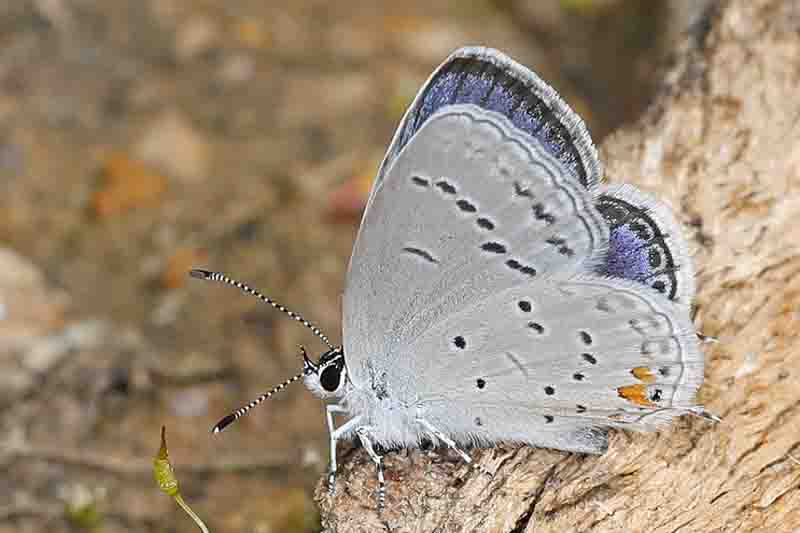
- ID: Tiny butterfly, blue above in many males and browner in females, with small hindwing tails.
- Best clue: Tiny tails + orange spots along the lower hindwing.
- Size: Usually under 1.25 in. (3.2 cm).
- Range & habitat: Common through much of eastern and central North America in lawns, meadows, fields, and low vegetation.
- Caterpillar host: Clovers, ticktrefoils, peas, beans, and other legumes.
Silver-Spotted Skipper (Epargyreus clarus)
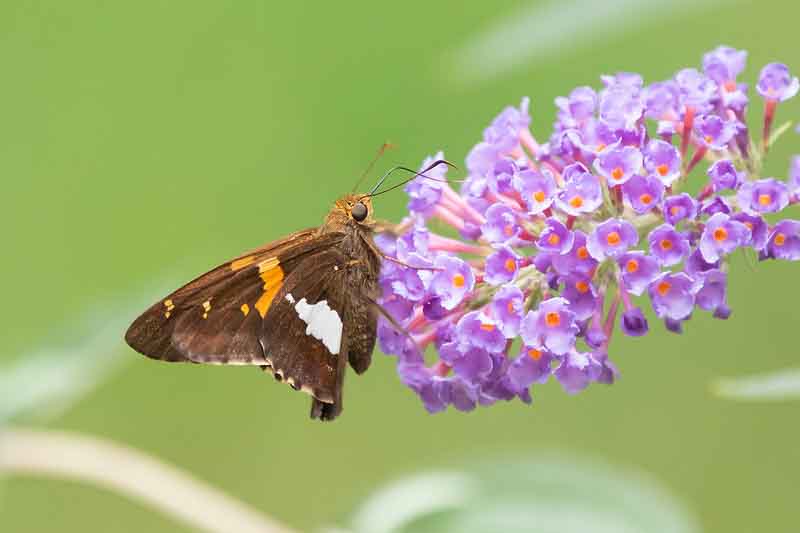
- ID: Large, stocky brown skipper with golden-orange markings on the forewing.
- Best clue: A conspicuous silvery-white patch on the underside of the hindwing.
- Size: Roughly 1.75-2.5 in. (4.5-6.4 cm).
- Range & habitat: Widespread across much of the United States and southern Canada in gardens, fields, and woodland edges.
- Caterpillar host: Black Locust, False Indigo, and other legumes.
Common Checkered-Skipper (Burnsius communis)
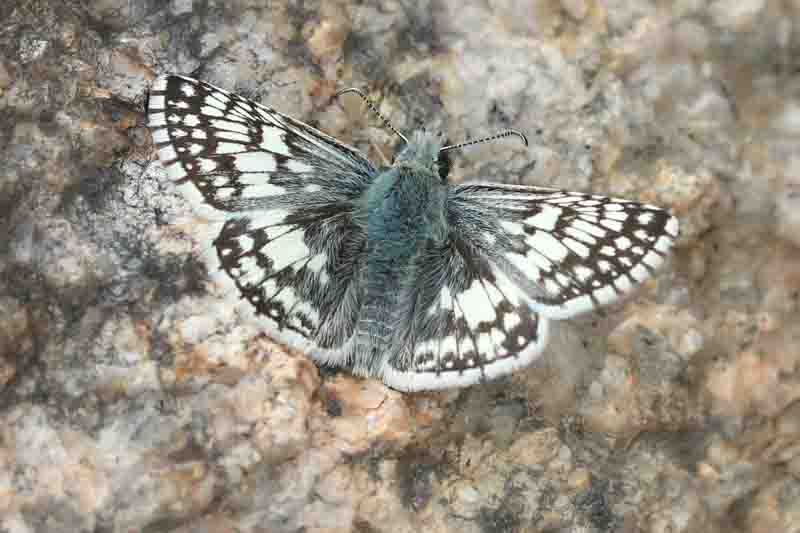
- ID: Small gray-brown skipper patterned with conspicuous white checks and spots.
- Best clue: A checkered gray-and-white pattern and quick, low flight.
- Size: Roughly 1-1.5 in. (2.5-3.8 cm).
- Range & habitat: Widespread in open sunny areas, gardens, roadsides, fields, and disturbed ground.
- Caterpillar host: Mallows and related plants.
🦋 Butterfly or skipper? Skippers tend to have stockier bodies, relatively small wings, large eyes, rapid darting flight, and antennae whose clubs often end in little hooks. Once you notice the body shape, they become much easier to recognize.
6 How to Identify a Butterfly You Don’t Recognize
If your butterfly is not an obvious match, do not start scrolling through hundreds of photographs. Work through the clues in a consistent order.
- Estimate size and dominant color. Is it tiny and blue, medium and orange, or a huge dark swallowtail?
- Study wing shape. Look for tails, elongated wings, scalloped edges, rounded wings, or the compact shape of a skipper.
- Find one signature mark. A cross-line, giant eyespots, a silver patch, red band, white stripe, or row of orange spots may identify the butterfly faster than the overall color.
- Check geography. Similar-looking butterflies often replace one another geographically.
- Look at nearby plants. A butterfly drinking nectar may be far from its caterpillar host, but a female laying eggs or a caterpillar feeding on a plant gives you a much stronger clue.
📸 Take two photos if you can: one with the wings open and one showing the underside. Many decisive field marks – American Lady eyespots, Gulf Fritillary silver spots, and Pipevine Swallowtail orange spots – are easier to see underneath.
7 Use the Plant as an Identification Clue
This is where butterfly identification becomes especially interesting. The plant beside the butterfly may tell you something the wings cannot.
- Milkweed + orange-and-black butterfly: Monarch or Queen deserves a closer look.
- Pawpaw + striped swallowtail: Zebra Swallowtail becomes a strong possibility.
- Passionflower + brilliant orange butterfly: look for Gulf Fritillary.
- Passionflower + long black-and-yellow striped butterfly in Florida: consider Zebra Longwing.
- Parsley, dill, or fennel + striped caterpillar: Black Swallowtail is a likely candidate across much of its range.
- Nettle + black butterfly with a red band: Red Admiral fits both appearance and host relationship.
- Willow + Monarch-like butterfly: check carefully for the Viceroy’s hindwing cross-line.
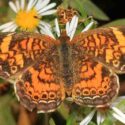
- Asters + small orange checkered butterfly: Pearl Crescent is worth investigating.
A host plant does not prove an identification by itself. Adult butterflies can travel considerable distances from their caterpillar hosts, and many plants support more than one insect. But appearance + range + host relationship is far more informative than color alone.
🌿 The Gardenia ID advantage: Move from what it looks like → where it occurs → what its caterpillar eats → which actual plant supports it. Identification becomes the doorway to understanding the butterfly’s ecology.
8 You Identified the Butterfly – What Comes Next?
A name answers the first question. Gardenia is designed to help with the next ones.
If the butterfly was a Monarch, which milkweed belongs in your region? If it was a Zebra Swallowtail, can pawpaw grow in your garden? If it was a Viceroy, which willow or other host is practical for the space you have? If Gulf Fritillaries are using your passionflower, how much foliage should you expect the caterpillars to eat?
Start with Gardenia’s Butterfly Host Plants guide to match butterflies with the plants their caterpillars require.
For adult food, see Best Plants to Attract Butterflies. If woody plants are part of the picture, explore Best Trees and Shrubs for Butterflies.
Then use the Gardenia Plant Finder to narrow potential host and nectar plants by hardiness, climate, sunlight, soil, drainage, water needs, native status, wildlife value, and other growing conditions.
If you want to combine them into a real planting, the Garden Design Tool helps compare growing conditions, mature size, seasonal interest, compatibility, quantities, and garden space.
Identify the butterfly → discover its caterpillar host → find a host suited to your region and site → add adult food → build habitat around the entire life cycle.
Identified your butterfly? Find the host and nectar plants that can support it, then check how well they fit your garden.
Once you begin looking at butterflies this way, the insect on the flower is no longer simply “an orange butterfly” or “a black swallowtail.” It becomes a clue to a much larger relationship between insects, plants, habitat, geography, and the garden around you.
How can I identify a butterfly?
Start with size and color, then look at wing shape and one distinctive marking such as eyespots, stripes, tails, bands, or veins. Check whether the species occurs in your region and consider nearby caterpillar host plants. Photos showing both the upper and lower wing surfaces are especially useful.
How can I tell a Monarch from a Viceroy?
Look at the hindwing. A Viceroy normally has a black line crossing the veins of each hindwing, while a Monarch does not. Their caterpillar hosts also differ: Monarch caterpillars depend on milkweeds, while Viceroys primarily use willows, poplars, cottonwoods, aspens, and other woody hosts.
How can I tell an American Lady from a Painted Lady?
Look at the underside of the hindwing. An American Lady usually has two very large eyespots, while a Painted Lady normally shows several smaller eyespots. This is often the easiest way to separate these similar orange butterflies.
What is the large yellow butterfly with black stripes?
In eastern North America it may be an Eastern Tiger Swallowtail, while in western regions a Western Tiger Swallowtail may be more likely. Both are large yellow butterflies with strong black tiger stripes, making geographic location an important identification clue.
What is a brown butterfly with large eyespots?
A Common Buckeye is a strong possibility if the butterfly has warm brown wings with several large target-like eyespots, orange bars, cream markings, and a habit of flying low over sunny open ground.
Can the plant beside a butterfly help identify it?
Yes. Host plants can provide valuable clues when combined with appearance and geographic range. Monarch caterpillars use milkweed, Zebra Swallowtails use pawpaw, Gulf Fritillaries use passionflower, Black Swallowtails use parsley-family plants, and Red Admirals primarily use nettle-family plants.
What photos are best for butterfly identification?
If possible, photograph the entire butterfly with its wings open and then capture the underside when the wings close. Important identification marks are often found below the wings. A photograph of the plant where the butterfly was feeding, laying eggs, or where the caterpillar was found can also help.
Why does location matter when identifying butterflies?
Similar-looking butterflies may occupy different geographic ranges. Eastern and Western Tiger Swallowtails are a good example. Checking whether a species normally occurs where the butterfly was seen can eliminate unlikely possibilities and prevent identification based on color alone.
Updated and reviewed by Gardenia: October 2026
While every effort has been made to describe these plants accurately, please keep in mind that height, bloom time, and color may differ in various climates. The description of these plants has been written based on numerous outside resources.