Learn how Illinois USDA hardiness zones, frost-free dates, and microclimates shape your garden year. From windy Chicagoland yards to lush southern beds, we’ll show you when to plant, what thrives in each zone, and easy, climate-smart ideas for vegetables, flowers, fruit trees, natives, shrubs, herbs, vines, grasses, perennials, and evergreens.


Gardening in Illinois can mean anything from prairie wind whipping across a farm field near Rockford to juicy tomatoes on a Chicago balcony and long-season harvests in the state’s far southern tip. Illinois planting zones span a surprisingly warm range of USDA hardiness zones, running roughly from zone 5a in the far northwest to zone 7b in the southern tip of the state.
This guide will help you understand your Illinois growing zone, read the USDA map, time your planting around frost dates, and pick the best plants for your corner of the Prairie State.
Illinois stretches from the cool, lake-influenced north to the warmer Ohio River valley in the south, so its hardiness zones reflect a clear north–south temperature gradient. In general, Illinois hardiness zones range from about zone 5a in the northwest corner to zone 7b in the far south.
The USDA Plant Hardiness Zone Map for Illinois shows how winter lows change as you move from lake-cooled, urbanized Chicagoland to the more subtropical feel of the southern counties along the Ohio River. The map is based on 30-year averages of the coldest winter temperatures (1991–2020) and is the standard tool for choosing trees, shrubs, and perennials that can survive your local winter.
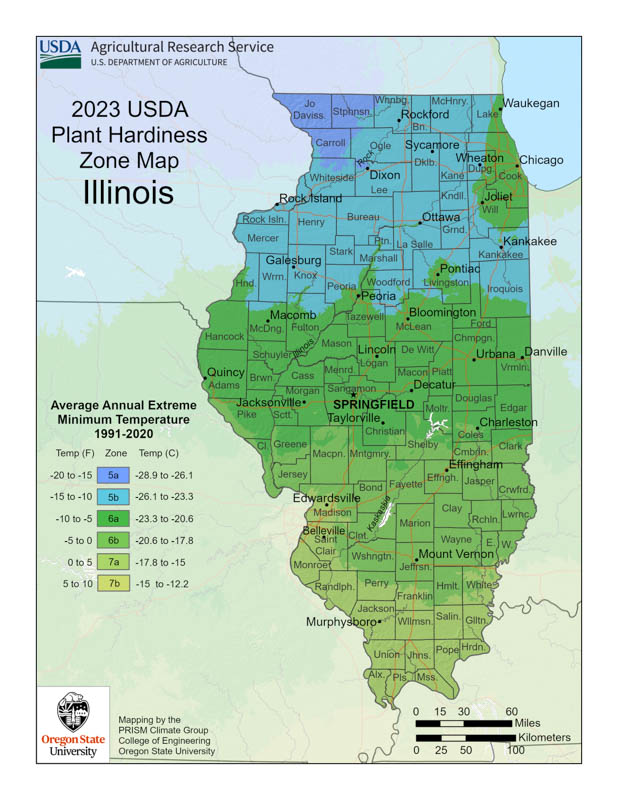
A simplified Illinois planting zone map based on the USDA 2023 Hardiness Zone Map, using 1991–2020 climate data.
Use the map together with your ZIP code to pinpoint your exact Illinois garden zone. Look up your Illinois planting zone by ZIP code using the USDA tool, then come back here or visit our Plant Finder for plants tailored to your zone and site conditions.
Although Illinois planting zones run from 5a to 7b, local conditions such as lake breezes, river bottoms, and city pavement create countless microclimates. Breaking Illinois into regions makes it easier to match plants to your climate—and your garden style.
This region includes Chicago and many surrounding suburbs, stretching along the Lake Michigan shoreline. Winters can be snowy and windy, but the lake and urban heat soften extreme lows a bit. Growing seasons are solidly long enough for warm-season vegetables, herbs, and lush ornamental beds.
From Rockford and Freeport over toward the Mississippi River bluffs near Galena, winters are colder and the growing season a bit shorter. You’ll still enjoy plenty of summer heat, but cool nights and occasional late frosts favor hardy perennials and cool-season crops.
Think Peoria, Bloomington–Normal, Decatur, Champaign–Urbana, and Springfield. This band of the state offers a classic four-season climate: cold winters, hot summers, and a solid mid-length growing season. Fertile soils and relatively reliable rainfall make it prime territory for both vegetables and ornamental landscapes.
As you head south past I-70 toward the St. Louis metro east side and the Kaskaskia River region, winters turn milder and summers long and hot. Here you can experiment with slightly less hardy perennials, enjoy long tomato and pepper seasons, and try warm-loving fruits.
Around Carbondale, Marion, and down to Cairo at the confluence of the Ohio and Mississippi Rivers, Illinois feels almost like a different world. Winters are comparatively mild, springs come early, and the growing season is long—perfect for heat-loving vegetables, fruits, and exuberant flower gardens.
In a state as tall as Illinois, frost dates are your best planning tool. Whether you’re gardening on a windy lakeshore north of Chicago or in a warm valley near Carbondale, your average last and first frosts determine when it’s safe to plant tender crops and when you should be ready with covers in fall.
Across Illinois, last spring frosts typically range from mid-April to early May, and first fall frosts usually arrive from early October to early November, depending on latitude and elevation.
| Region / City | Average Last Spring Frost | Average First Fall Frost | Approx. Frost-Free Days |
|---|---|---|---|
| Chicago (O’Hare, Northeastern IL) | Late April (Apr 21–30) | Mid–Late October (around Oct 15–25) | ~170–180 days |
| Rockford (Northern IL) | Late April–Early May (Apr 25–May 5) | Early–Mid October (Oct 5–15) | ~160–170 days |
| Springfield (Central IL) | Mid–Late April (around Apr 20–25) | Mid October (Oct 10–20) | ~170 days |
| Peoria/Bloomington (Central IL) | Late April–Early May (Apr 25–May 5) | Mid October (Oct 10–20) | ~160–170 days |
| Carbondale (Southern IL) | Early–Mid April (Apr 1–15) | Mid–Late October (Oct 16–31) | ~190–200 days |
Dates summarized from regional climate and frost-date tools; always check a local forecast and ZIP-code–based lookup for the most precise information for your garden.
Use these frost dates as a planning guide—your yard may be warmer or cooler depending on elevation, slope, wind, surrounding pavement, nearby water, and building heat. They’re long-term averages, not guarantees, so keep an eye on the forecast during spring and fall cold snaps.
Once you know your Illinois planting zone, you can lean into your region’s strengths—whether that’s a cooler season up north or the long, warm summers of southern Illinois. Focus on cold-hardy staples in zones 5–6 and heat-loving crops and ornamentals in zones 6–7, while choosing perennials rated for your specific hardiness zone.
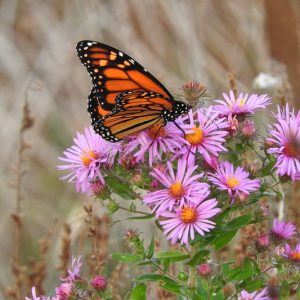
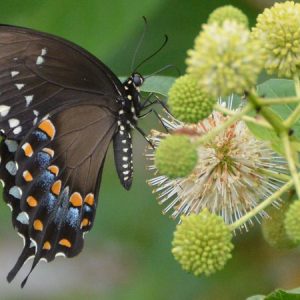
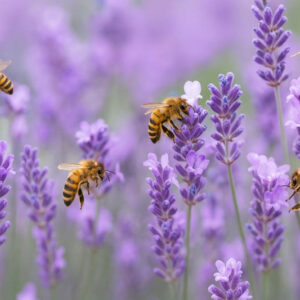
Illinois native plants are perfectly tuned to local soils, moisture, and winter cold. Mix native wildflowers, grasses, shrubs, and trees for a low-maintenance, wildlife-friendly landscape that supports pollinators, songbirds, and beneficial insects.
Browse curated lists like great pollinator plants for Illinois and monarch– and bird-friendly plant collections to build a garden that buzzes and flutters from spring through frost.
Tap a month to see what to plant in Illinois by zone. Use these quick guides as a starting point—then adjust for your exact frost dates and whether you garden on a windy ridge, shaded city courtyard, or sheltered southern slope.
Illinois gardeners juggle lake-effect snow, thunderstorms, strong winds, and the occasional droughty spell. These tips help your plants thrive from zone 5a to 7b:
Now that you understand your Illinois planting zone, frost dates, and regional climate, you’re ready to choose plants that love your conditions and create a thriving Prairie State garden. Mix edible crops, flowering perennials, and native plants for a landscape that feeds both your household and local wildlife. Want to compare Illinois to other states? Visit our national USDA planting zone guide to explore growing zones across the United States.
Illinois spans USDA hardiness zones 5a through 7b. Most of the state, including northern and central Illinois, falls in zones 5b–6b, while the far northwest is mainly 5a and the warmest southern counties reach 7a–7b. These zones are based on long-term average minimum winter temperatures.
Chicago and many of its surrounding suburbs are primarily in USDA zone 6a, with some pockets that behave like slightly warmer microclimates near Lake Michigan and in dense urban neighborhoods. Historically mapped as 5b, updated data shows winter lows that now align more closely with zone 6a conditions.
Southern Illinois, including cities like Carbondale and Marion and the Shawnee Hills region, generally falls in USDA zones 6b–7a, with the very warmest pockets reaching 7b. Winters are milder and the growing season is notably longer than in northern Illinois, allowing for a wider range of heat-loving crops and ornamentals.
Central Illinois—roughly the band that includes Peoria, Bloomington–Normal, Decatur, Champaign–Urbana, and Springfield—is typically classified as USDA zone 6a, with some nearby areas in 5b or 6b. The region has cold winters, hot summers, and a dependable growing season suitable for a wide variety of vegetables, fruits, and perennials.
To find your precise planting zone in Illinois, use the official USDA Plant Hardiness Zone Map or an online tool that lets you enter your ZIP code. The tool will return a zone such as 5a, 5b, 6a, 6b, 7a, or 7b based on the 30-year average of your coldest winter temperature.
Typical frost dates in Illinois vary north to south. Northern areas usually see their last spring frost from late April to early May and their first fall frost in early to mid-October. Central Illinois often has last frost in mid–late April and first frost in mid-October. Southern Illinois can be frost-free from early to mid-April until mid or late October.
Illinois generally has about 150 to 200 frost-free days each year, depending on location. Northern and northwestern areas average closer to 150–170 frost-free days, central Illinois often has around 160–180 days, and southern Illinois can enjoy 180–200 frost-free days thanks to its milder climate and longer growing season.
Yes, frost dates are critical for Illinois gardeners. Warm-season crops such as tomatoes, peppers, squash, beans, and sweet corn are easily damaged or killed by freezing temperatures. Knowing your average last spring frost helps you decide when it is safe to plant them outdoors, while average first fall frost dates guide when to protect or harvest late-season crops.
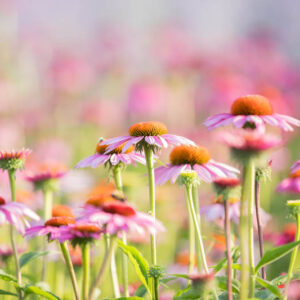
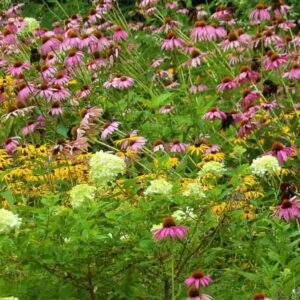
Illinois’s zones 5–7 support a wide range of crops. Cool-season vegetables like lettuce, peas, spinach, broccoli, and radishes thrive in spring and fall, while warm-season crops such as tomatoes, peppers, beans, cucumbers, and sweet corn perform well in summer. Common ornamentals include coneflower, black-eyed Susan, daylilies, hostas, phlox, and many prairie natives.
Yes. Apples, pears, plums, tart cherries, and hardy grapes grow well across most of Illinois when given full sun, well-drained soil, and proper pruning. Warmer central and southern areas (zones 6–7) are also suitable for peaches, some apricots, and sweet cherries, especially on sites with good air drainage that reduce frost damage to blossoms.
Illinois has many microclimates that subtly shift how plants experience temperature. Lake Michigan moderates winter lows along the northeastern shoreline, urban areas such as Chicago retain heat, and low-lying valleys along rivers can trap cold air and frost. Wind exposure, pavement, tree cover, and slope can make a site feel effectively a half-zone warmer or cooler than the map suggests.
Native plants are an excellent choice for Illinois gardens. Species adapted to the state’s prairies, woodlands, and wetlands handle local soils, rainfall patterns, and winter cold with less input. Native grasses, wildflowers, shrubs, and trees provide nectar, pollen, and habitat for pollinators and birds while creating resilient, low-maintenance landscapes.
Use planting zones to decide which perennial plants, shrubs, and trees can survive your typical winter lows, and use frost dates to schedule when to plant or protect annuals and vegetables. Zones tell you about long-term climate suitability, while frost-date and weather data guide week-to-week decisions in your specific garden.
Updated: December 2025 • Reviewed by Gardenia Editors
| Hardiness |
5 - 7 |
|---|---|
| Native Plants | United States, Illinois, Midwest |
| Hardiness |
5 - 7 |
|---|---|
| Native Plants | United States, Illinois, Midwest |
Create a membership account to save your garden designs and to view them on any device.
Becoming a contributing member of Gardenia is easy and can be done in just a few minutes. If you provide us with your name, email address and the payment of a modest $25 annual membership fee, you will become a full member, enabling you to design and save up to 25 of your garden design ideas.
Join now and start creating your dream garden!
Create a membership account to save your garden designs and to view them on any device.
Becoming a contributing member of Gardenia is easy and can be done in just a few minutes. If you provide us with your name, email address and the payment of a modest $25 annual membership fee, you will become a full member, enabling you to design and save up to 25 of your garden design ideas.
Join now and start creating your dream garden!