Discover Ohio’s USDA growing zones and learn how frost dates, regional microclimates, and soil conditions shape what you can grow. This guide covers planting calendars, the best vegetables, fruits, flowers, and native plants, plus expert tips for thriving gardens across the Buckeye State.


Gardening in Ohio can mean anything from breezy Lake Erie cottage borders in Cleveland to patio peppers in Columbus and long-season harvests in the rolling southern hills. According to the 2023 USDA Plant Hardiness Zone Map, Ohio planting zones fall within a moderate band of zones 5b through 7a, with most gardeners in zones 6a–6b and small lakeshore and urban pockets mapped as zone 7a.
This guide will help you understand your Ohio growing zone, read the USDA map, time your planting around frost dates, and choose the best plants for your corner of the Buckeye State.
Ohio stretches from the windy Lake Erie shoreline to the warm, sheltered Ohio River valleys and Appalachian foothills in the south. That north–south shift in winter lows is reflected in the state’s USDA hardiness zones. Based on the 2023 map, Ohio ranges from zone 5b to zone 7a, with most populated areas in 6a–6b and a few small 7a pockets near Lake Erie and in dense urban areas.
The USDA Plant Hardiness Zone Map for Ohio shows how average winter lows change as you move from exposed northwest farmland to the more protected southern and southeastern hills. These zones are based on 30-year averages of annual minimum temperatures (1991–2020) and are the standard reference for choosing trees, shrubs, and perennials that can survive your local winter.
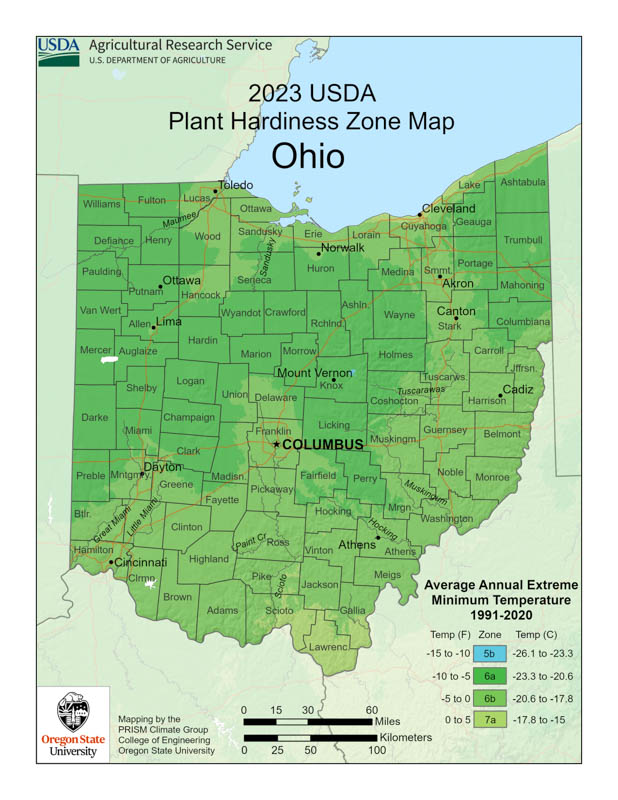
A simplified Ohio planting zone map based on the USDA 2023 Hardiness Zone Map.
Use the map together with your ZIP code to pinpoint your exact Ohio garden zone. Look up your Ohio planting zone by ZIP code using the USDA tool, then come back here or visit our Plant Finder for plants tailored to your zone and site conditions.
Although Ohio planting zones officially span 5b–7a, local factors such as lake breezes, river bottoms, hillsides, and city pavement create countless microclimates. Thinking in terms of regions makes it easier to match plants to your climate—and your gardening style.
This region includes Cleveland, Lorain, Sandusky, and the snowbelt counties east of Cleveland. Lake Erie moderates winter lows, often extending the growing season enough for most warm-season vegetables, roses, hydrangeas, and lush perennial borders. Snowbelt areas may see deep snow cover, which actually insulates plant roots. The warmest lakeshore neighborhoods and some urban cores in this region now appear as zone 7a on the 2023 map.
From Toledo and Bowling Green down through Lima and surrounding farmland, winters are colder and winds stronger across open fields. You’ll still enjoy warm summers, but cool nights and occasional late frosts favor hardy perennials and cool-season crops, especially in low-lying or rural areas.
Think Columbus, Delaware, Newark, and surrounding suburbs. This heart-of-the-state band offers a classic four-season climate: cold winters, hot summers, and a solid growing season. Fertile soils and relatively reliable rainfall make it prime territory for vegetables, small fruits, and ornamental landscapes.
As you head southwest toward Dayton, Cincinnati, and the surrounding Miami Valley and tri-state area, winters grow milder and summers long and humid. Here you can experiment with slightly less hardy perennials, enjoy long tomato and pepper seasons, and grow a wide range of fruit trees and small fruits.
Around Athens, Marietta, Portsmouth, and other towns hugging the Ohio River, the state feels a bit more southern. Winters are comparatively mild, springs come early, and the growing season is long—perfect for heat-loving vegetables, fruits, and exuberant flower gardens, especially on south-facing slopes and in sheltered hollows.
In a state that ranges from lake-effect snow to river valley heat, frost dates are your best planning tool. Whether you’re gardening on a breezy bluff near Toledo or in a protected valley near Portsmouth, your average last and first frosts determine when it’s safe to plant tender crops and when you should be ready with covers in fall.
Across Ohio, last spring frosts typically range from late April to mid-May, and first fall frosts usually arrive from early October in the north to mid–late October in the south, depending on latitude, elevation, and proximity to water.
| Region / City | Average Last Spring Frost | Average First Fall Frost | Approx. Frost-Free Days |
|---|---|---|---|
| Cleveland (Lake Erie Shore, NE OH) | Late April (Apr 21–30) | Mid–Late October (around Oct 15–25) | ~175–185 days |
| Toledo (NW OH) | Early May (May 1–10) | Early–Mid October (Oct 5–15) | ~160–170 days |
| Columbus (Central OH) | Late April (around Apr 21–30) | Mid October (Oct 9–20) | ~170–180 days |
| Dayton (Miami Valley) | Late April–Early May (Apr 21–May 5) | Early–Mid October (Oct 5–15) | ~165–175 days |
| Cincinnati (SW OH / Ohio River) | Late April (Apr 21–30) | Mid–Late October (Oct 15–25) | ~175–190 days |
| Athens / SE Hills | Early–Mid May (May 1–10) | Mid–Late October (Oct 15–25) | ~165–185 days |
Dates summarized from regional climate and frost-date tools; always check a local forecast and ZIP-code–based lookup for the most precise information for your garden.
Use these frost dates as a planning guide—your yard may be warmer or cooler depending on elevation, slope, wind, surrounding pavement, nearby water, and building heat. They’re long-term averages, not guarantees, so keep an eye on the forecast during spring and fall cold snaps.
Once you know your Ohio planting zone, you can lean into your region’s strengths—whether that’s a slightly shorter, cooler season up north or the longer, warmer summers along the Ohio River and Lake Erie shore. Focus on cold-hardy staples in zone 5b and a wide range of heat-loving crops and ornamentals in zones 6a–6b, with the warmest 7a pockets behaving like a mild extension of zone 6b. Always choose perennials rated to your specific hardiness zone.
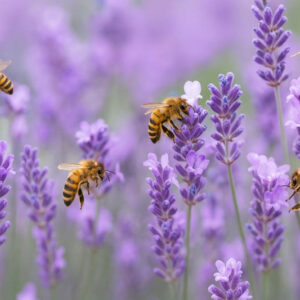
Ohio native plants are perfectly tuned to local soils, moisture, and winter cold. Mix native wildflowers, grasses, shrubs, and trees for a low-maintenance, wildlife-friendly landscape that supports pollinators, songbirds, and beneficial insects.
Browse curated lists like great pollinator plants for Ohio and other pollinator- and bird-friendly plant collections to build a garden that buzzes and flutters from spring through frost.
Tap a month to see what to plant in Ohio by zone. Use these quick guides as a starting point—then adjust for your exact frost dates and whether you garden on a windy ridge, shaded city courtyard, or sheltered southern or lakeshore slope.
Ohio gardeners juggle lake-effect snow, spring thunderstorms, humid summers, and the occasional drought. These tips help your plants thrive from zone 5b to 7a:
Now that you understand your Ohio planting zone, frost dates, and regional climate, you’re ready to choose plants that love your conditions and create a thriving Buckeye State garden. Mix edible crops, flowering perennials, and native plants for a landscape that feeds both your household and local wildlife. Want to compare Ohio to other states? Visit our national USDA planting zone guide to explore growing zones across the United States.
Ohio falls entirely within USDA hardiness zones 5b through 7a according to the 2023 USDA Plant Hardiness Zone Map. The coldest areas in the far northwest and a few higher-elevation spots are zone 5b, while most of the state, including major cities, is zone 6a–6b, with small lakeshore and urban pockets mapped as zone 7a.
The coldest planting zone in Ohio is USDA zone 5b. This zone occurs mainly in rural northwest Ohio and some exposed or higher-elevation areas where average annual minimum temperatures drop to about –15°F to –10°F (–26.1°C to –23.3°C).
Yes. Under the 2023 USDA Plant Hardiness Zone Map, small pockets of Ohio—especially along portions of the Lake Erie shore near Cleveland and in a few warm urban microclimates—are classified as zone 7a. However, the vast majority of the state remains in zones 5b through 6b.
Columbus and most of its metropolitan area are in USDA zones 6a–6b. This gives gardeners a relatively long frost-free season and enough warmth to grow a wide range of vegetables, small fruits, and hardy ornamental plants.
Cleveland and much of the Lake Erie shore in northeast Ohio are generally in USDA zones 6a–6b. Lake Erie moderates winter temperatures slightly, but snowbelt areas can still experience heavy snow and occasional cold snaps, so plants should be rated hardy to at least zone 6.
Cincinnati and much of the surrounding southwest Ohio and tri-state area are classified as USDA zone 6b. This is one of Ohio’s mildest regions, with relatively long growing seasons that support peaches, some figs with protection, and many warm-season vegetable and flower varieties.
Toledo and parts of the western Lake Plain sit near the transition between USDA zones 5b and 6a. Winters here are colder and more exposed than in central and southern Ohio, so gardeners should favor plants reliably hardy to zone 5 or colder.
You can look up your exact planting zone by entering your ZIP code into the USDA’s official Plant Hardiness Zone Map tool. This online map uses 30-year climate averages to assign a zone to your location based on average annual minimum temperature.
Planting zones tell you how cold your garden can get in a typical winter, which is critical for choosing perennials, shrubs, and trees that will survive year after year. In Ohio, knowing whether you are in zone 5b, 6a, 6b or a warm 7a pocket helps you avoid plants that may be damaged or killed by local winter lows.
While zones describe average winter minimum temperatures, frost dates estimate when your location typically has its last spring frost and first fall frost. In Ohio, last spring frosts usually occur between late April and mid-May, and first fall frosts generally arrive between early and late October, depending on whether you are in the north or south of the state.
In northern Ohio (such as Toledo), the last frost often falls in early May and the first frost usually comes in early to mid-October. In central and southern Ohio (such as Columbus and Cincinnati), last frost dates are usually in late April, and first frosts tend to arrive in mid to late October.
Ohio’s zones support a wide range of cool- and warm-season crops. Cool-season vegetables like lettuce, peas, broccoli, cabbage, carrots, beets, and radishes thrive in spring and fall, while warm-season crops such as tomatoes, peppers, beans, cucumbers, summer squash, pumpkins, and sweet corn perform well during the summer, especially in the warmer 6a–7a parts of the state.
Apples, pears, tart cherries, and many plum varieties grow well across most of Ohio in zones 5b–7a, provided the variety is cold-hardy enough for the site. In warmer zone 6a–6b areas—and in the mildest 7a microclimates, especially in central, southwest, and lakeshore Ohio—gardeners can also grow peaches and some sweet cherries if they choose cold-hardy cultivars and plant in sites with good air drainage.
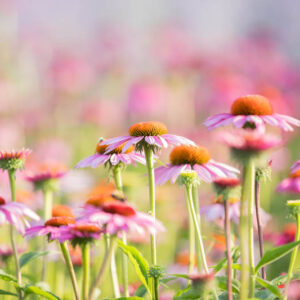
Popular, reliable choices include perennials such as coneflower, black-eyed Susan, daylilies, hostas, phlox, Shasta daisies, and asters. Woody ornamentals like eastern redbud, serviceberry, flowering dogwood, hydrangeas, and many native maples and oaks also perform well when matched to the light and soil conditions of the site across zones 5b–7a.
Yes. Native plants are adapted to Ohio’s soils, climate, and wildlife, making them generally easier to maintain and more resilient. Native wildflowers, grasses, shrubs, and trees support pollinators, birds, and beneficial insects while providing year-round interest that fits naturally into Ohio’s zones 5b–7a.
Recent USDA maps already reflect some warming trends, with more of Ohio shifting into zone 6 and small areas now classified as 7a compared to older maps. Gardeners may find that some traditionally borderline plants overwinter more reliably, but they must also plan for greater weather variability, including sudden cold snaps, heat waves, and heavy rainfall events.
Updated: December 2025 • Reviewed by Gardenia Editors
| Hardiness |
5 - 7 |
|---|---|
| Native Plants | United States, Midwest, Ohio |
Create a membership account to save your garden designs and to view them on any device.
Becoming a contributing member of Gardenia is easy and can be done in just a few minutes. If you provide us with your name, email address and the payment of a modest $25 annual membership fee, you will become a full member, enabling you to design and save up to 25 of your garden design ideas.
Join now and start creating your dream garden!
Create a membership account to save your garden designs and to view them on any device.
Becoming a contributing member of Gardenia is easy and can be done in just a few minutes. If you provide us with your name, email address and the payment of a modest $25 annual membership fee, you will become a full member, enabling you to design and save up to 25 of your garden design ideas.
Join now and start creating your dream garden!