Thunderstruck White Lightning Crape Myrtle, Thunderstruck White Lightning Crepe Myrtle, Thunderstruck White Lightning Crapemyrtle, Thunderstruck White-Lightning Crape Myrtle, Thunderstruck Series White Lightning Crape Myrtle, White Lightning Crape Myrtle, White Crape Myrtle, White Crepe Myrtle, Crape Myrtle, Crepe Myrtle, Crapemyrtle, Lagerstroemia × 'JM4', Lagerstroemia x 'JM4'
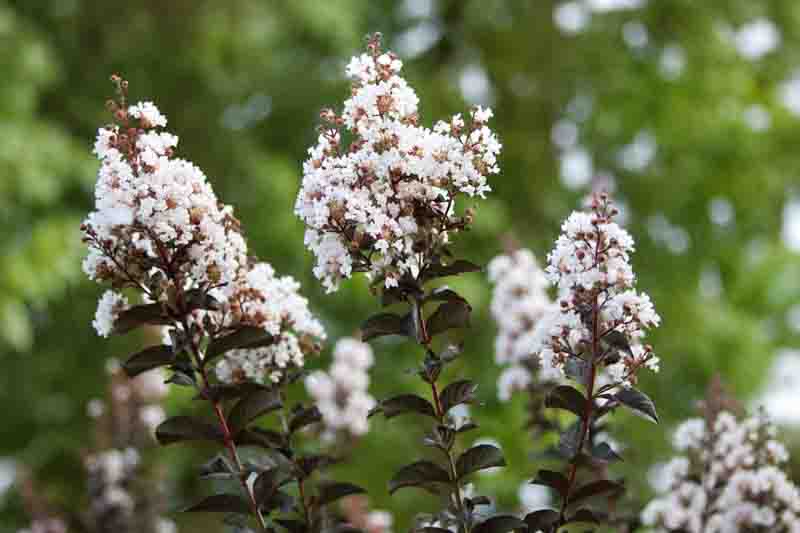


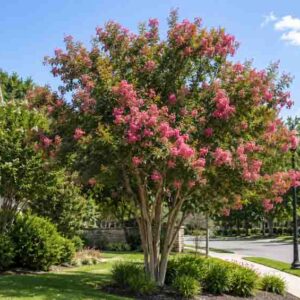
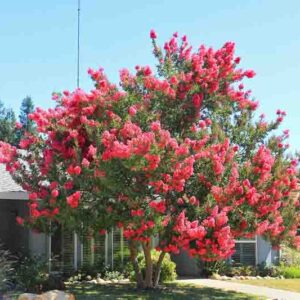
Lagerstroemia Thunderstruck™ White Lightning™, commonly called Thunderstruck White Lightning crape myrtle or White Lightning crepe myrtle, is a tall deciduous flowering tree prized for its dramatic combination of pure white blooms and foliage that deepens from green to dark gray-purple or nearly black. Its bold color contrast, upright habit, and long summer display make it an imposing specimen for sunny landscapes.
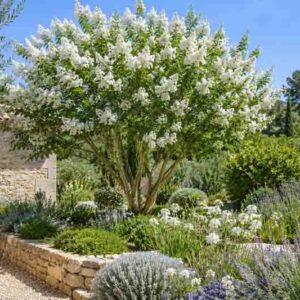
Sold under the Thunderstruck™ collection, this patented cultivar is Lagerstroemia ‘JM4’ PP31534, also identified in the patent as Lagerstroemia indica ‘JM4’. It develops into a tall, freely branching tree commonly reaching about 20 to 30 ft. tall and 10 to 15 ft. wide (6-9 m by 3-4.5 m). Because it is substantially larger than many dark-leaved crape myrtles, it needs ample overhead clearance and should not be treated as a compact foundation shrub.
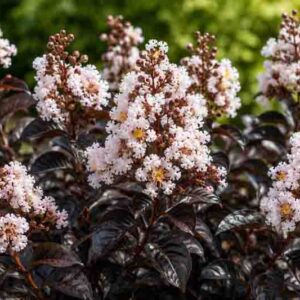
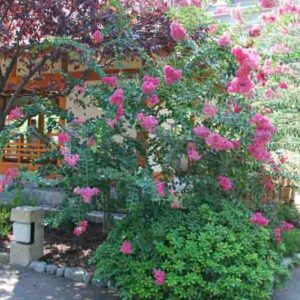
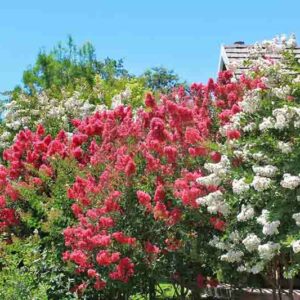
The numerous ruffled flowers are white, creating a crisp contrast against the dark summer canopy. Blooming generally occurs from summer through early fall, with the patent recording late-summer to autumn flowering under Texas trial conditions. The glossy foliage is initially dark green and matures to dark gray-purple, giving the tree ornamental value before and after its main floral display.
Summary: Tall, vigorous dark-foliaged crape myrtle with pure white flowers, upright branching, and exceptional summer contrast.
Use: Best as a large specimen tree, lawn tree, avenue tree, flowering screen, or major landscape focal point.
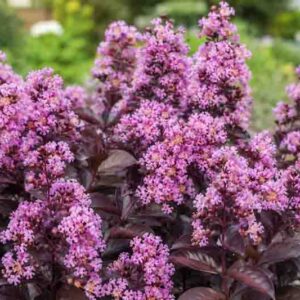
Highlight: Dark green leaves mature to gray-purple or nearly black, providing a dramatic background for masses of white flowers.
Note: This is one of the taller Thunderstruck™ cultivars. Give it generous space rather than attempting to restrain it with severe annual pruning.
| Botanical Name | Lagerstroemia ‘JM4’ PP31534; described in the patent as Lagerstroemia indica ‘JM4’ |
|---|---|
| Trade Name | Thunderstruck™ White Lightning™ |
| Family | Lythraceae |
| Common Names | Thunderstruck White Lightning crape myrtle, White Lightning crepe myrtle, dark-leaved crape myrtle |
| Parentage | ‘Natchez White’ × ‘Ebony Flame’ |
| Plant Type and Habit | Deciduous large shrub or medium-sized tree; tall, upright to slightly spreading, freely branching, sturdy, and commonly multi-stemmed |
| Hardiness (USDA) | Zones 6 to 9; top growth may suffer winter injury in colder Zone 6 locations |
| Size | Commonly 20-30 ft. tall and 10-15 ft. wide (6-9 m by 3-4.5 m) |
| Growth Rate | Moderate to fast; vigorous in warm, favorable conditions |
| Sun and Exposure | Full sun; at least 6 hours of direct sunlight, with 8 or more hours ideal |
| Soil | Average, moderately fertile, well-drained clay, loam, or sandy soil; slightly acidic to neutral conditions are ideal |
| Bloom Time | Summer through early fall; late summer into autumn in patent trials |
| Flower Color | White |
| Foliage Color | Initially dark green, maturing to dark gray-purple or nearly black; slightly glossy |
| Disease Resistance | Observed resistance to powdery mildew and Cercospora leaf spot; full sun and airflow remain beneficial |
| Wildlife Value | Flowers may be visited by bees and other insects; best regarded as a supplemental floral resource |
| Deer Resistance | Not usually preferred by deer, but young growth may be browsed and trunks may be rubbed |
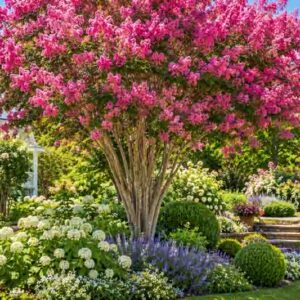
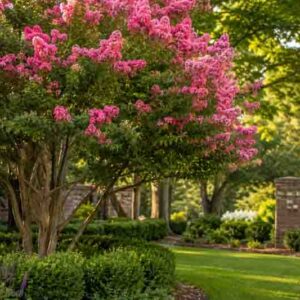
Use White Lightning™ as a high-contrast focal point. Its white flower clusters glow against the dark canopy, while chartreuse foliage, silver grasses, pale paving, or a warm brick backdrop intensify the effect without competing with it.
Thunderstruck™ White Lightning™ is the commercial name for the patented cultivar ‘JM4’ PP31534. The patent identifies the plant botanically as Lagerstroemia indica ‘JM4’, while the brand markets it as Lagerstroemia × ‘JM4’. It was developed in a breeding program aimed at producing vigorous, freely branching crape myrtles with dark foliage and distinctive flower colors.
The cultivar originated from a controlled cross between white-flowered ‘Natchez White’ and dark-foliaged, red-flowered ‘Ebony Flame‘. It combines the white bloom color of the former with the darkening foliage of the latter, while developing a taller and more upright habit than many other Thunderstruck™ selections.
‘JM4’ forms a tall, upright to slightly outward-spreading framework with numerous secondary and tertiary branches. The sturdy stems create a dense canopy, and the plant is commonly grown with several trunks. Young specimens can be trained to fewer stems when a more formal tree silhouette is desired.
A practical mature expectation is 20-30 ft. tall and 10-15 ft. wide. That makes White Lightning™ considerably taller than Thunderstruck™ Lavender Blast™ and other intermediate selections. Allow generous clearance from utility lines, roofs, narrow paths, and neighboring trees. If the available space cannot accommodate its mature height, choose a smaller cultivar rather than planning to reduce it severely each winter.
The numerous terminal panicles carry ruffled white flowers that face upward and outward. The blooms are approximately pure white in the patent description, although the colored stamens and dark stems may add subtle contrast at close range. Against the mature gray-purple foliage, the flower clusters appear especially bright and clean.
The branded plant is promoted as blooming from summer through fall. Patent observations in Fort Worth, Texas, recorded flowering from late summer into autumn, illustrating how timing can vary with climate, heat, latitude, and establishment. Deadheading is unnecessary on a mature tree and becomes impractical once the canopy develops.
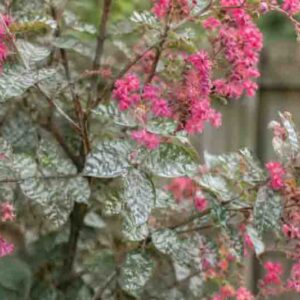
The foliage undergoes a distinctive seasonal change. Developing leaves begin dark green, then mature to deep gray-purple, often reading as nearly black in the landscape. This transition differs from cultivars whose leaves emerge purple immediately. Strong sunlight promotes the darkest mature color, while shade may leave the foliage greener.
The slightly glossy leaves create a bold summer canopy even when the tree is not in flower. Fall color varies by climate and is less predictable than the white-flower and dark-foliage display. After leaf drop, the upright branching structure and smooth woody stems provide modest winter interest.
Do not confuse White Lightning™ (‘JM4’, PP31534) with Thunderstruck™ White Flash™ (‘JM6’, PP31556). White Lightning™ is the taller selection, typically reaching 20-30 ft., while White Flash™ is generally marketed at 12-15 ft.
Thunderstruck™ White Lightning™ is generally marketed for USDA Zones 6 to 9 and thrives where summers are hot and sufficiently long. The patent reports cold hardiness to Zone 6 and tolerance of temperatures down to approximately 14°F (-10°C) in trials. In colder Zone 6 sites, stem injury may reduce mature size or delay bloom. A protected position and a broad organic mulch layer can help safeguard the root zone.
The flowers may be visited by bees and other insects, but crape myrtle is best considered a supplemental floral resource. Combine it with native trees, grasses, and long-blooming perennials that provide more diverse nectar, pollen, seeds, and habitat.
Crape myrtles are not usually the first woody plants selected by deer, but they are not completely deer-proof. Young shoots and low branches may be sampled, and trunks can be damaged by rubbing where deer pressure is high.
Once established, White Lightning™ tolerates heat and moderate drought. Newly planted trees need deep, regular irrigation while roots expand into the surrounding soil. Mature plants retain foliage and flower more reliably when watered during prolonged drought, but constantly wet ground should be avoided.
Crape myrtle is not commonly regarded as toxic to people, cats, dogs, or horses. Nevertheless, ornamental plant material should not be intentionally eaten, and any concerning ingestion should be discussed with an appropriate medical or veterinary professional.
Thunderstruck™ White Lightning™ is not an aggressive spreading tree. Related Lagerstroemia indica plants have naturalized in parts of the southeastern United States, however. Remove unwanted seedlings near sensitive natural areas and follow current regional guidance.
Full sun is strongly recommended. Provide at least six hours of direct sunlight daily; eight or more hours generally produce the darkest mature foliage, heaviest flowering, densest growth, and lowest disease pressure. Shade can result in greener leaves, fewer flowers, and branches that lean toward available light.
The cultivar adapts to clay, loam, and sandy soil provided drainage is adequate. Slightly acidic to neutral conditions are ideal. Avoid low sites where water remains around the root crown after rain, and do not create a narrow pocket of heavily amended soil that discourages roots from expanding outward.
Water deeply after planting and whenever the developing root zone begins to dry. Deep irrigation encourages broad root development, while frequent shallow sprinkling does not. Once established, water during prolonged drought rather than keeping the soil continuously moist.
Excess nitrogen can produce vigorous leafy shoots, delay flowering, and encourage aphid activity. Apply compost or a modest slow-release fertilizer in spring only when soil fertility or plant performance indicates a need. A soil test is preferable to routine heavy feeding.
Plant in spring or fall with the root flare visible at or slightly above grade. Dig a hole wider than the root ball but no deeper, backfill with the existing soil, water thoroughly, and mulch over a broad area. Keep mulch several inches away from the trunks and allow for a mature spread of 10-15 ft.
Crape myrtles flower on new wood, so necessary structural pruning is best completed in late winter or early spring. Remove dead, damaged, rubbing, crossing, or inward-growing branches and unwanted basal shoots. Gradually raise the canopy where clearance is needed while preserving the major framework.
Never top White Lightning™ or cut every branch back to large stubs. Severe annual pruning destroys the tall natural outline, creates clusters of weak shoots, hides developing stems, and commits the owner to repeated corrective work. Proper siting is the most effective way to keep maintenance low.
Select White Lightning™ only where a 20-30 ft. crape myrtle belongs. Preserve its tall, freely branching framework rather than trying to convert it into a compact shrub.
Thunderstruck™ White Lightning™ is protected by U.S. Plant Patent PP31534. Unauthorized asexual propagation is prohibited while patent protection applies. Purchase correctly labeled plants from licensed nurseries rather than attempting to reproduce the cultivar from cuttings.
The patent records resistance to powdery mildew and Cercospora leaf spot, two important fungal diseases of crape myrtle. Resistance reduces the likelihood and severity of infection but does not guarantee completely symptom-free foliage under every combination of shade, crowding, humidity, and plant stress. Aphids, bark scale, Japanese beetles, and other pests may still occur.
These companions tolerate full sun, summer heat, and well-drained soil while providing enough color and texture to display the dark canopy. Plant them beyond the immediate trunk zone and account for increasing shade beneath the tree as it matures.
Thunderstruck White Lightning commonly grows about 20 to 30 feet tall and 10 to 15 feet wide. It is one of the taller Thunderstruck crape myrtles and needs substantially more room than intermediate or dwarf cultivars.
The flowers are white and appear in numerous ruffled terminal clusters. Their crisp color contrasts strongly with foliage that matures from dark green to gray-purple or nearly black.
Thunderstruck White Lightning generally blooms from summer through early fall. Patent trials in Texas recorded flowering from late summer into autumn, so timing varies with climate, heat, latitude, and plant establishment.
Yes. Give it at least six hours of direct sunlight each day, with eight or more hours ideal. Strong sun promotes darker mature foliage, heavier flowering, denser growth, and lower fungal disease pressure.
Yes. Thunderstruck White Lightning was observed in patent trials to be resistant to powdery mildew and Cercospora leaf spot. Resistance is not absolute immunity, so full sun, good airflow, and appropriate spacing remain beneficial.
Established trees tolerate summer heat and moderate drought. Newly planted specimens require regular deep watering, and mature plants retain foliage and bloom better when irrigated during prolonged dry periods.
Prune selectively in late winter or early spring, removing dead, damaged, crossing, crowded, or inward-growing branches and unwanted suckers. Never top the tree or cut all branches back to large stubs.
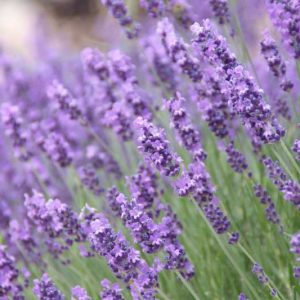
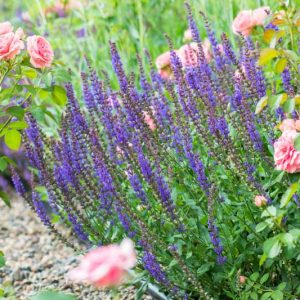
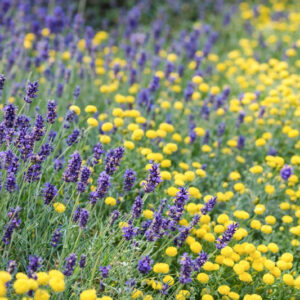
Good companions include switchgrass, Russian sage, black-eyed Susan, pink muhly grass, threadleaf coreopsis, and purple coneflower. Their lighter foliage and blue, yellow, pink, or purple flowers contrast effectively with the near-black canopy.
Google Patents – United States Plant Patent PP31534, Lagerstroemia ‘JM4’: https://patents.google.com/patent/USPP31534P2/en
Justia Patents – United States Plant Patent PP31534, Lagerstroemia ‘JM4’: https://patents.justia.com/patent/PP31534
Garden Debut – Thunderstruck™ White Lightning™ Crapemyrtle: https://www.gardendebut.com/plant/Thunderstruck-White-Lightning-Crapemyrtle
Garden Debut – Thunderstruck™ White Lightning™ Product Sheet: https://www.gardendebut.com/_ccLib/image/plants/PDF-6668.pdf
Clemson Cooperative Extension – Crape Myrtle Diseases and Insect Pests: https://hgic.clemson.edu/factsheet/crape-myrtle-diseases-insect-pests/
University of Florida IFAS Extension – Crapemyrtle Pruning: https://ask.ifas.ufl.edu/publication/EP399
Updated: July 2026 • Reviewed by Gardenia Editors
| Hardiness |
6 - 9 |
|---|---|
| Heat Zones |
7 - 9 |
| Climate Zones | 7, 8, 9, 10, 12, 13, 14, 15, 18, 19, 20, 21, H1, H2 |
| Plant Type | Shrubs, Trees |
| Plant Family | Lythraceae |
| Genus | Lagerstroemia |
| Common names | Crepe Myrtle |
| Exposure | Full Sun |
| Season of Interest | Summer (Mid, Late), Fall |
| Height | 20' - 30' (6.1m - 9.1m) |
| Spread | 10' - 15' (3m - 4.6m) |
| Spacing | 120" - 180" (3m - 4.6m) |
| Maintenance | Low |
| Water Needs | Average |
| Soil Type | Chalk, Loam, Sand |
| Soil pH | Acid, Neutral |
| Soil Drainage | Well-Drained |
| Characteristics | Showy |
| Tolerances | Drought, Deer, Clay Soil, Heat |
| Attracts | Bees, Birds |
| Garden Uses | Beds And Borders |
| Garden Styles | City and Courtyard, Informal and Cottage, Mediterranean Garden, Pollinator Garden |
| Toxic to Humans | No known toxicity |
| Toxic to Cats | Not toxic |
| Toxic to Dogs | Not toxic |
| Toxic to Horses | Not toxic |


| Hardiness |
6 - 9 |
|---|---|
| Heat Zones |
7 - 9 |
| Climate Zones | 7, 8, 9, 10, 12, 13, 14, 15, 18, 19, 20, 21, H1, H2 |
| Plant Type | Shrubs, Trees |
| Plant Family | Lythraceae |
| Genus | Lagerstroemia |
| Common names | Crepe Myrtle |
| Exposure | Full Sun |
| Season of Interest | Summer (Mid, Late), Fall |
| Height | 20' - 30' (6.1m - 9.1m) |
| Spread | 10' - 15' (3m - 4.6m) |
| Spacing | 120" - 180" (3m - 4.6m) |
| Maintenance | Low |
| Water Needs | Average |
| Soil Type | Chalk, Loam, Sand |
| Soil pH | Acid, Neutral |
| Soil Drainage | Well-Drained |
| Characteristics | Showy |
| Tolerances | Drought, Deer, Clay Soil, Heat |
| Attracts | Bees, Birds |
| Garden Uses | Beds And Borders |
| Garden Styles | City and Courtyard, Informal and Cottage, Mediterranean Garden, Pollinator Garden |
| Toxic to Humans | No known toxicity |
| Toxic to Cats | Not toxic |
| Toxic to Dogs | Not toxic |
| Toxic to Horses | Not toxic |
How many Lagerstroemia Thunderstruck™ White Lightning™ (Crape Myrtle) do I need for my garden?
| Plant | Quantity | |
|---|---|---|
| Lagerstroemia Thunderstruck™ White Lightning™ (Crape Myrtle) | N/A | Buy Plants |
Create a membership account to save your garden designs and to view them on any device.
Becoming a contributing member of Gardenia is easy and can be done in just a few minutes. If you provide us with your name, email address and the payment of a modest $25 annual membership fee, you will become a full member, enabling you to design and save up to 25 of your garden design ideas.
Join now and start creating your dream garden!
Create a membership account to save your garden designs and to view them on any device.
Becoming a contributing member of Gardenia is easy and can be done in just a few minutes. If you provide us with your name, email address and the payment of a modest $25 annual membership fee, you will become a full member, enabling you to design and save up to 25 of your garden design ideas.
Join now and start creating your dream garden!