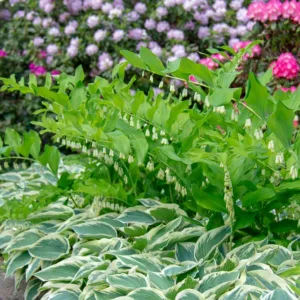
Want a hosta that commands attention? Discover giant varieties that can spread 5-7 feet, from 'Empress Wu' and 'Humpback Whale' to blue, gold, and variegated standouts. Gardenia's Giant Hosta Fit framework helps you compare mature footprint, habit, foliage scale, color, and site needs before giving one permanent garden space.
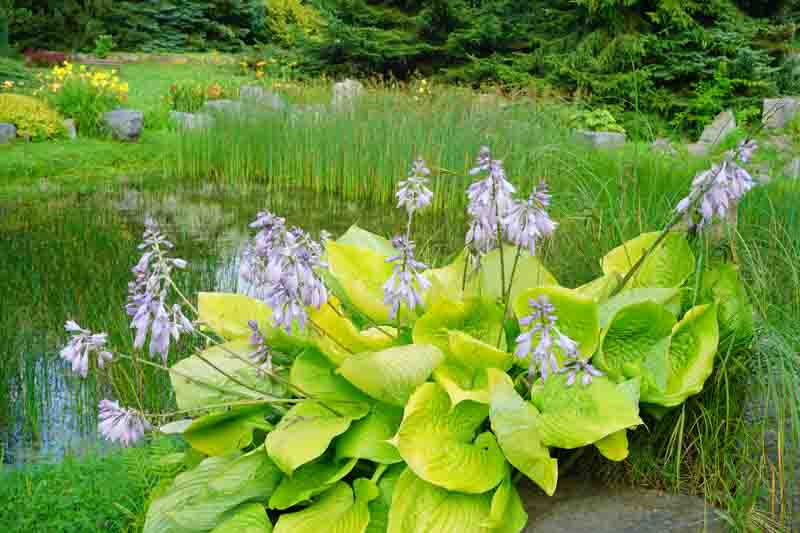


Few shade plants create drama quite like a mature giant hosta. Given enough time and space, the largest hosta varieties form enormous mounds of overlapping leaves that can spread 5, 6, 7, or even 8 feet across. A single specimen can anchor an entire shade border, soften the base of a wall, or create an almost tropical effect beneath trees.
But “giant hosta” is used loosely. Some hostas qualify as giants by mature clump height. Others sit near the boundary between large and giant yet occupy an extraordinary amount of garden space because of their width. Still others have exceptionally large individual leaves without developing the biggest overall clump.
For gardeners, the most useful question is therefore not simply, “Which hosta is technically giant?” It is “Which hosta will give me the scale, shape, color, and mature footprint I want in my shade garden?”
Widest variegated statement: Hosta ‘Drop-Dead Gorgeous’ – a huge green-and-gold hosta growing 2-3 feet tall and spreading an extraordinary 7-8 feet.
Best cascading giant-scale hosta: Hosta ‘Komodo Dragon’ – a broad cascading mound reaching 2-3 feet tall and 6-7 feet wide.
Best massive blue dome: Hosta ‘Humpback Whale’ – thick blue-green foliage on a 2-3-foot-tall mound spreading 6-7 feet.
Best classic blue giant: Hosta ‘Blue Angel’ – a substantial blue-gray hosta reaching about 3 feet tall and 5-6 feet wide.
Best famous giant: Hosta ‘Empress Wu’ – one of the best-known giant hostas, reaching 3-4 feet tall and 5-6 feet wide.
Best variegated true giant: Hosta ‘Wu-La-La’ – a huge 3-4-foot-tall hosta spreading 5-6 feet, with apple-green margins around dark blue-green leaves.
Best architectural giant: Hosta ‘Krossa Regal’ – upright blue foliage on a 3-4-foot-tall plant with a mature spread of 3-6 feet.
Best golden large-to-giant statement: Hosta ‘Sum and Substance’ – enormous chartreuse-to-gold foliage on a plant reaching 2-3 feet tall and 4-5 feet wide.
Best upright variegated statement: Hosta ‘Sagae’ – an architectural 2-3-foot-tall hosta spreading 4-5 feet.
Best exceptionally broad lower hosta: Hosta ‘American Halo’ – only 1-2 feet tall but capable of spreading 5-6 feet.
Best large fragrant statement: Hosta ‘Royal Crest’ – a substantial 2-3-foot-tall hosta spreading 4-5 feet and producing fragrant flowers.
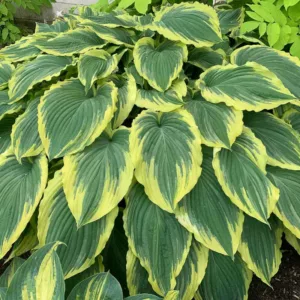
Best classic textured variegation: Hosta ‘Frances Williams’ – heavily puckered blue-green foliage edged in yellow to cream on a 2-3-foot-tall, 3-4-foot-wide plant.
Gardenia’s Giant Hosta Rule: Judge a statement hosta by its mature footprint, not by the size of the plant in the nursery pot. A young division may eventually spread 5-8 feet, so choose the site for the plant it will become, not the plant you are buying today.
“Giant” can mean two different things in the hosta world, and understanding the distinction makes choosing and spacing large hostas much easier.
The American Hosta Society uses a leaf-size classification for hosta shows. Under that system, a giant leaf has an area of at least 120 square inches. This describes the individual leaf blade, not the eventual dimensions of the entire plant.
The American Hosta Growers Association developed a separate mature-clump size standard, also explained by the American Hosta Society. Under that system:
This means that a cultivar recorded as 2-3 feet tall may straddle a formal size boundary depending on the mature specimen and climate, while a hosta only 1-2 feet tall may still occupy 5-6 feet of garden width.
Gardenia’s size distinction: Giant leaf, giant height, and giant garden footprint are not the same thing. For actual landscape planning, mature spread and growth habit can be more useful than a size label alone.
Gardenia evaluates giant and statement hostas using six practical factors. Together, they answer a much more useful question than “Which hosta gets biggest?”
This is why the widest hosta is not automatically the best hosta. ‘Humpback Whale’ produces a broad blue dome. ‘Krossa Regal’ creates vertical architecture. ‘Sum and Substance’ brings huge luminous leaves. ‘Drop-Dead Gorgeous’ combines immense width with bold variegation.
Choose the type of impact you want first, then choose the cultivar.
‘Drop-Dead Gorgeous’ is an extraordinary choice when both width and variegation matter. It forms a huge mound of large green leaves edged in brightly contrasting yellow, with heavily rippled margins giving the foliage additional movement.
At maturity, it grows 2-3 feet tall and 7-8 feet wide, making it the broadest hosta in this selection.
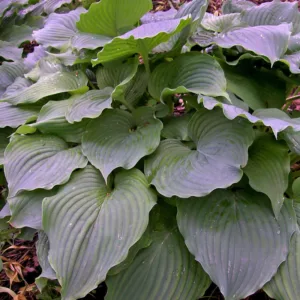
‘Komodo Dragon’ forms a dramatic vase-shaped, cascading mound of dark blue-green leaves with deeply impressed veins and lightly rippled margins.
It grows 2-3 feet tall and 6-7 feet wide. That extreme difference between height and spread is a perfect illustration of why mature width matters so much when planning with giant hostas.
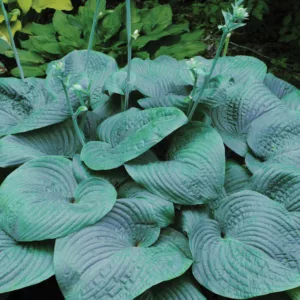
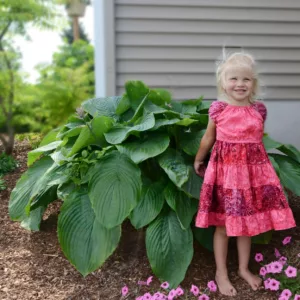
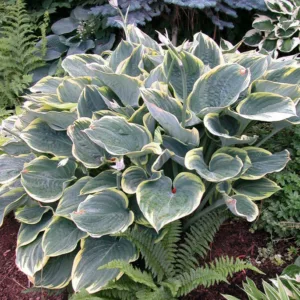
‘Humpback Whale’ develops into a massive dome of thick, corrugated, heart-shaped blue-green leaves.
At maturity, it reaches 2-3 feet tall and 6-7 feet wide, forming a massive blue-green dome.
| Hardiness |
3 - 9 |
|---|---|
| Heat Zones |
1 - 8 |
| Climate Zones | 1, 1A, 1B, 2, 2A, 2B, 3, 3A, 3B, 4, 5, 6, 7, 8, 9, 10, 14, 15, 16, 17, 18, 19, 20, 21 |
| Plant Type | Perennials |
| Plant Family | Asparagaceae |
| Genus | Hosta |
| Exposure | Partial Sun, Shade |
| Season of Interest | Spring (Mid, Late), Summer (Early, Mid, Late), Fall |
| Maintenance | Low |
| Soil Drainage | Moist but Well-Drained |
Gardenia’s spacing lesson: A hosta capable of spreading 7-8 feet should be planned as a 7-8-foot garden feature. Do not fill its future footprint with permanent shrubs or large perennials simply because the young plant leaves temporary gaps.
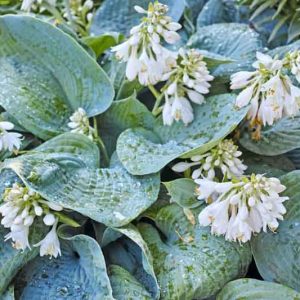
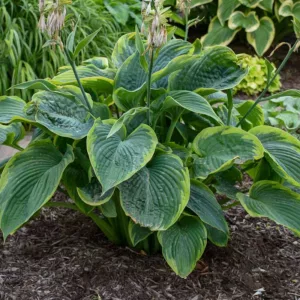
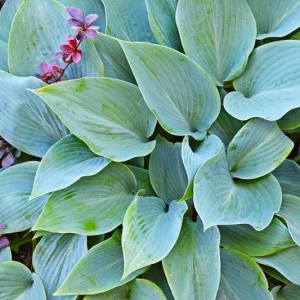
‘Blue Angel’ combines true giant height with the cool coloration that makes blue hostas so useful in shade gardens.
Mature plants reach about 3 feet tall and 5-6 feet wide, forming a broad mound of thick, textured blue-gray to blue-green foliage.
The blue coloration comes from a waxy surface bloom and generally persists best with protection from intense sun.
‘Empress Wu’ is one of the best-known giant hostas and remains an excellent choice where sheer presence is the goal.
Mature plants reach 3-4 feet tall and 5-6 feet wide, creating an imposing mound with the mass of a small shrub during the growing season.
‘Wu-La-La’ delivers genuine giant dimensions with the added distinction of variegated foliage. Thick, deeply veined dark blue-green leaves are bordered in apple green.
It grows 3-4 feet tall and 5-6 feet wide, combining true giant scale with strongly contrasting foliage.
For more blue cultivars of every size, explore Gardenia’s Blue Hostas for Gardens and Containers.
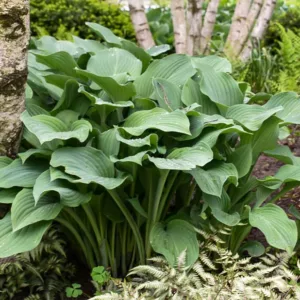
‘Krossa Regal’ is very different from the broad, low giants. Its gray-blue foliage rises in an elegant upright, vase-shaped clump, producing vertical architecture rather than simply horizontal mass.
At maturity, it reaches 3-4 feet tall and 3-6 feet wide, forming an upright, arching, vase-shaped mound that sets it apart from broader, lower giants.
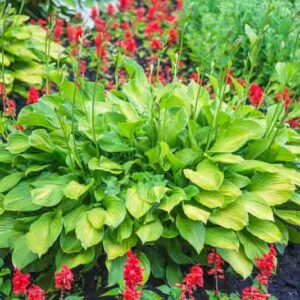
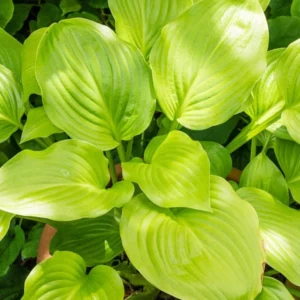
‘Sum and Substance’ is one of the great golden statement hostas. Its enormous heart-shaped foliage changes from light green toward chartreuse or gold according to light levels.
It grows 2-3 feet tall and 4-5 feet wide. Because its height range straddles the northern giant threshold, it is best treated as a large-to-giant statement hosta rather than assuming every specimen will technically qualify as giant.
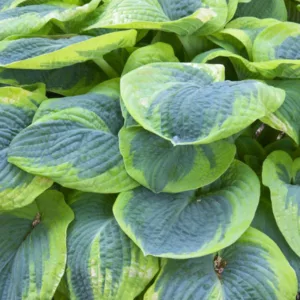
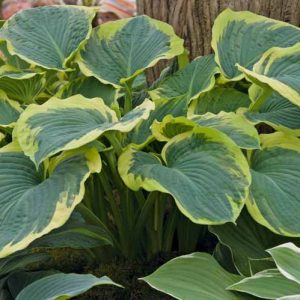
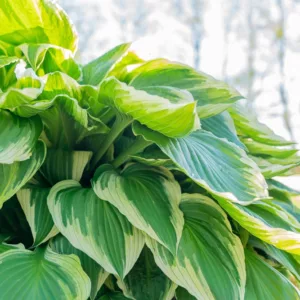
‘Frances Williams’ is a classic large variegated hosta with thick, heavily puckered blue-green leaves broadly margined in greenish yellow that matures to creamy beige.
It grows 2-3 feet tall and 3-4 feet wide, making it a substantial but more manageable statement hosta than the widest giants.
Gardenia design rule: Not all statement hostas should look alike. Combining a broad mound, an upright cultivar, and a contrasting foliage color usually creates more interest than repeating several huge rounded plants with similar leaves.
Not every hosta with major landscape presence sits neatly inside a technical giant category. These three are particularly useful because they demonstrate why mature spread, habit, and foliage impact matter alongside height.
‘Sagae’ is an architectural variegated hosta with frosted blue-green leaves edged in yellow that mature toward cream.
At maturity, ‘Sagae’ reaches 2-3 feet tall and 4-5 feet wide, with an upright habit that gives it more architectural presence than its height alone suggests.
‘American Halo’ is the clearest demonstration that height and footprint are not the same thing.
It grows only 1-2 feet tall but spreads 5-6 feet wide, making it one of the clearest examples of why mature footprint matters more than height alone.
Its broad blue-green leaves with wide, rippled, creamy-white margins create substantial visual impact despite the lower profile.
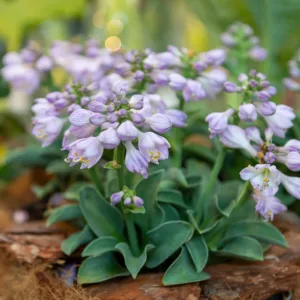
‘Royal Crest’ combines substantial foliage with fragrant flowers, adding another dimension to the statement-hosta category.
Mature plants reach 2-3 feet tall and 4-5 feet wide, creating a substantial mound with the added appeal of fragrant flowers.
Why Gardenia includes large statement hostas here: A formal size category answers one question. Landscape footprint answers another. A lower hosta spreading 5-6 feet may require more planning space than a taller, narrower cultivar.
Before choosing a plant, compare both dimensions. Height describes vertical presence. Spread tells you how much garden space the mature clump may actually occupy.
| Hosta | Height | Garden Effect | |
|---|---|---|---|
| ‘Drop-Dead Gorgeous’ | 2-3 ft | 7-8 ft | Exceptionally broad variegated statement |
| ‘Komodo Dragon’ | 2-3 ft | 6-7 ft | Broad cascading mound |
| ‘Humpback Whale’ | 2-3 ft | 6-7 ft | Massive blue-green dome |
| ‘Blue Angel’ | 3 ft | 5-6 ft | Classic blue giant |
| ‘Empress Wu’ | 3-4 ft | 5-6 ft | Tall commanding giant |
| ‘Wu-La-La’ | 3-4 ft | 5-6 ft | Variegated true giant |
| ‘Krossa Regal’ | 3-4 ft | 3-6 ft | Upright architectural giant |
| ‘Sum and Substance’ | 2-3 ft | 4-5 ft | Golden large-to-giant statement |
| ‘Sagae’ | 2-3 ft | 4-5 ft | Upright variegated statement |
| ‘American Halo’ | 1-2 ft | 5-6 ft | Low but exceptionally broad |
| ‘Royal Crest’ | 2-3 ft | 4-5 ft | Large fragrant statement |
| ‘Frances Williams’ | 2-3 ft | 3-4 ft | Classic textured variegated specimen |
These are approximate mature size ranges. Final dimensions can vary with climate, soil, moisture, age, and root competition.
Gardenia’s Footprint Rule: Treat mature spread as reserved garden space. If a cultivar is listed at 5-6 feet wide, plan for roughly that mature foliage zone rather than assuming permanent neighboring plants will continue to occupy the same ground.
Buying a cultivar capable of giant dimensions does not guarantee that it will reach the upper end of its size range. Genetics set the potential, but growing conditions determine how fully that potential is expressed.
For strong growth:
For planting depth, watering, feeding, division, seasonal care, and troubleshooting, see Gardenia’s complete guide to growing and caring for hostas.
Most giant hostas perform best with protection from intense afternoon sun, but tolerance varies considerably with cultivar, climate, and moisture availability.
Heat, wind, and inadequate moisture all increase the risk of scorched leaf margins, so “sun tolerant” should never be interpreted separately from water availability.
For cultivar-specific guidance, see Gardenia’s Hostas Tolerant of Sun.
Some can, but technically possible and practical are very different things.
A hosta growing 2-3 feet tall and 4-5 feet wide may already require a very substantial planter. A cultivar capable of spreading 6, 7, or 8 feet demands considerably more root volume, moisture, and physical space.
For most gardeners, the largest hostas are more practical in the ground.
If you want statement foliage in a container:
See Gardenia’s Best Hostas for Containers for more practical choices by mature size.
The strongest companion plants usually contrast with giant hostas rather than imitate them.
Huge hosta leaves create broad, visually heavy masses. Pair them with plants that contribute finer foliage, vertical flowers, airy texture, or a different season of interest.
Do not crowd the hosta simply to disguise empty ground while the plant is young. Place permanent companions beyond the expected mature foliage zone, or use plants that can easily be relocated as the hosta expands.
For more ideas, see Gardenia’s Hosta Companion Plants guide.
Gardenia’s Giant Hosta Design Formula: one giant foliage anchor + one fine-textured companion + one vertical flowering plant + one low edging layer. Let the hosta provide the mass instead of surrounding it with several plants competing for the same visual role.
Instead of beginning with a cultivar name, start with the effect you want the mature plant to create.
| Your Goal | Gardenia Pick | Gardenia Mature Size | Why |
|---|---|---|---|
| Maximum width + variegation | ‘Drop-Dead Gorgeous’ | 2-3 ft × 7-8 ft | Exceptional green-and-gold spread |
| Huge cascading form | ‘Komodo Dragon’ | 2-3 ft × 6-7 ft | Extraordinary horizontal presence |
| Massive blue dome | ‘Humpback Whale’ | 2-3 ft × 6-7 ft | Broad blue-green foliage mass |
| Classic blue giant | ‘Blue Angel’ | 3 ft × 5-6 ft | Cool cascading blue-gray foliage |
| Iconic giant presence | ‘Empress Wu’ | 3-4 ft × 5-6 ft | Commanding height and leaf scale |
| Variegated true giant | ‘Wu-La-La’ | 3-4 ft × 5-6 ft | Giant dimensions plus bright margins |
| Strong upright architecture | ‘Krossa Regal’ | 3-4 ft × 3-6 ft | Elegant vase-shaped habit |
| Golden foliage | ‘Sum and Substance’ | 2-3 ft × 4-5 ft | Huge luminous foliage |
| Upright variegated statement | ‘Sagae’ | 2-3 ft × 4-5 ft | Architectural form plus bright margins |
| Maximum width at lower height | ‘American Halo’ | 1-2 ft × 5-6 ft | Extraordinary spread without great height |
| Large foliage plus fragrance | ‘Royal Crest’ | 2-3 ft × 4-5 ft | Substantial mound plus fragrant flowers |
| Classic textured variegation | ‘Frances Williams’ | 2-3 ft × 3-4 ft | Bold puckering and creamy margins |
Gardenia’s final giant-hosta rule: Choose the shape and footprint of the mature plant before the cultivar name. Width creates mass, height creates presence, upright habit creates architecture, and foliage color determines whether the specimen feels cool, luminous, bold, or variegated.
Want to Find More Large and Giant Hostas?
These are only a selection of Gardenia’s statement hostas. Use Gardenia’s Plant Finder to explore additional Hosta varieties and narrow your choices by mature height, spread, foliage color, sun exposure, growing conditions, and other features that matter in your garden.
Compare Your Finalists Before You Plant
Once you have narrowed the field, use Gardenia’s Hosta comparison tool to compare mature size and growing requirements side by side, or browse the complete Hosta collection for more choices.
Among the hostas featured here, Gardenia lists ‘Drop-Dead Gorgeous’ at 2-3 feet tall and 7-8 feet wide, while ‘Komodo Dragon’ and ‘Humpback Whale’ reach 2-3 feet tall and 6-7 feet wide. ‘Empress Wu’ is taller, reaching 3-4 feet tall and 5-6 feet wide.
The largest hostas in Gardenia’s selection range from about 2-4 feet tall and can spread 5-8 feet depending on the cultivar. Mature dimensions are influenced by climate, soil, moisture, age, and root competition.
Hosta size can refer to individual leaf area or mature clump size. The American Hosta Growers Association clump-size standard places the giant threshold at about 30 inches in northern climates and 25 inches in southern climates, but mature spread is also important when planning how much garden space a cultivar needs.
Of the cultivars featured in this guide, Gardenia lists ‘Drop-Dead Gorgeous’ at 7-8 feet wide. ‘Komodo Dragon’ and ‘Humpback Whale’ follow at 6-7 feet wide.
‘Blue Angel’ is an excellent classic blue giant at about 3 feet tall and 5-6 feet wide. ‘Humpback Whale’ creates a broader blue-green dome at 2-3 feet tall and 6-7 feet wide, while ‘Krossa Regal’ is better for an upright architectural effect.
Many large and giant hostas tolerate full shade, but very dark sites can reduce vigor. Bright shade or partial shade with consistent moisture often encourages stronger growth. Blue cultivars generally retain their coloration best with protection from intense sun.
They can, but the widest cultivars require enormous root volume, regular watering, and considerable surrounding space. For most gardeners, hostas capable of spreading 6-8 feet are more practical in the ground, while smaller statement varieties make easier container plants.
Giant hostas take several years to develop their mature specimen form. Growth varies with cultivar and site, and mature size is influenced by moisture, soil fertility, climate, root competition, and whether the plant is left undisturbed.
Updated: September 2026 – Reviewed by Gardenia Editors
| Hardiness |
3 - 9 |
|---|---|
| Heat Zones |
1 - 8 |
| Climate Zones | 1, 1A, 1B, 2, 2A, 2B, 3, 3A, 3B, 4, 5, 6, 7, 8, 9, 10, 14, 15, 16, 17, 18, 19, 20, 21 |
| Plant Type | Perennials |
| Plant Family | Asparagaceae |
| Genus | Hosta |
| Exposure | Partial Sun, Shade |
| Season of Interest | Spring (Mid, Late), Summer (Early, Mid, Late), Fall |
| Maintenance | Low |
| Soil Drainage | Moist but Well-Drained |
Create a membership account to save your garden designs and to view them on any device.
Becoming a contributing member of Gardenia is easy and can be done in just a few minutes. If you provide us with your name, email address and the payment of a modest $25 annual membership fee, you will become a full member, enabling you to design and save up to 25 of your garden design ideas.
Join now and start creating your dream garden!
Create a membership account to save your garden designs and to view them on any device.
Becoming a contributing member of Gardenia is easy and can be done in just a few minutes. If you provide us with your name, email address and the payment of a modest $25 annual membership fee, you will become a full member, enabling you to design and save up to 25 of your garden design ideas.
Join now and start creating your dream garden!