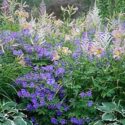
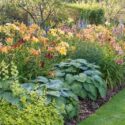
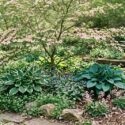
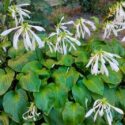
Brighten shade with the best variegated Hostas, from crisp white-edged 'Francee' and 'Patriot' to luminous 'Stained Glass' and architectural 'Sagae'. Gardenia's Variegated Hosta Fit Framework helps you compare pattern, contrast, seasonal color change, light sensitivity, mature scale, and garden role before choosing the right foliage statement.
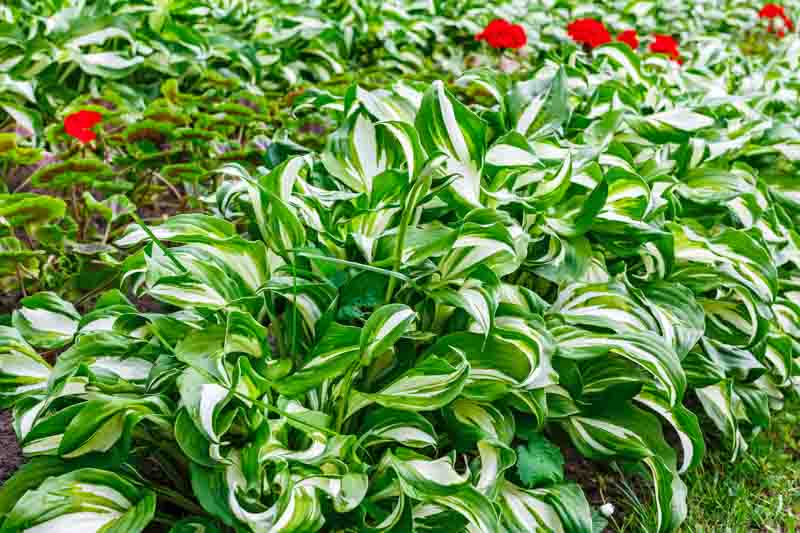


Variegated Hostas can transform a shady border before a single flower opens. Their leaves may be edged in ivory, cream, yellow, or gold; centered in white or chartreuse; streaked with several colors; or change noticeably as the season progresses. In shade, those pale and golden areas catch the eye in a way that solid green foliage often cannot.
But “variegated Hosta” covers many very different plants. A narrow white edge creates a crisp outline. A broad cream margin can turn an entire clump into a focal point. A gold center surrounded by green can glow in brighter shade, while a predominantly white center may need more protection from intense sun and heat.
The best variegated Hosta is therefore not simply the one with the brightest leaves. Pattern, color contrast, seasonal change, mature size, leaf substance, light exposure, and the role the plant will play in the garden all matter.
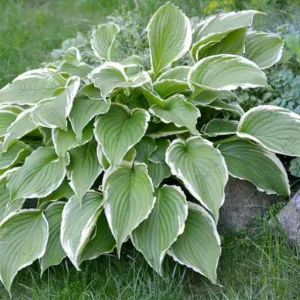
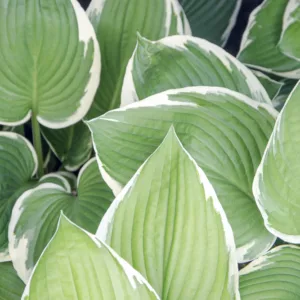
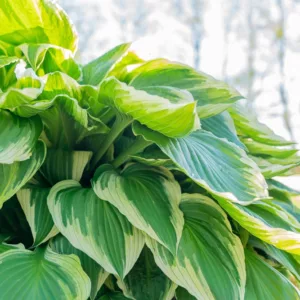
Best classic white margin: Hosta ‘Francee’ – rich dark green leaves outlined by crisp narrow white margins.
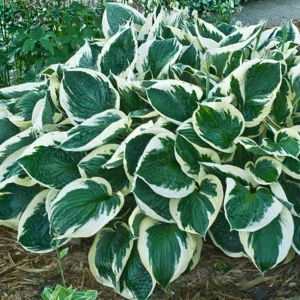
Best bold white margin: Hosta ‘Patriot’ – dark green foliage surrounded by broad irregular ivory margins.
Best pure white contrast: Hosta ‘Minuteman’ – satiny dark green leaves with wide pure white margins.
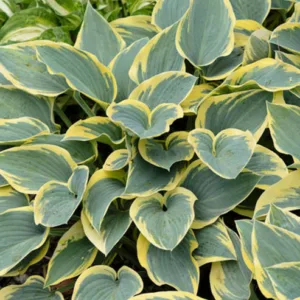
Best blue-green with changing margins: Hosta ‘First Frost’ – blue-green leaves edged in gold in spring, fading toward cream.
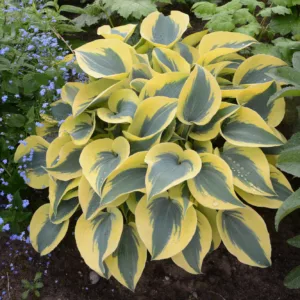
Best extra-wide margin: Hosta ‘Autumn Frost’ – frosty blue foliage with broad yellow margins maturing to cream-white.
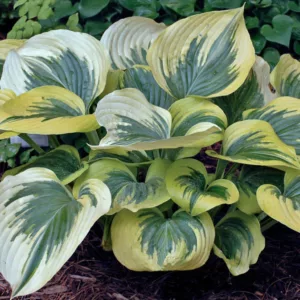
Best large architectural variegation: Hosta ‘Liberty’ – thick blue-green leaves with very broad yellow margins aging to ivory.
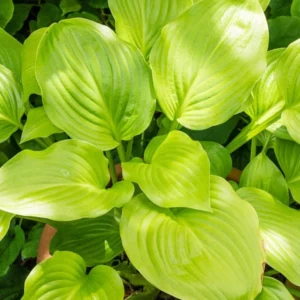
Best gold-centered classic: Hosta ‘Paul’s Glory’ – chartreuse centers becoming bright gold, framed by green margins.
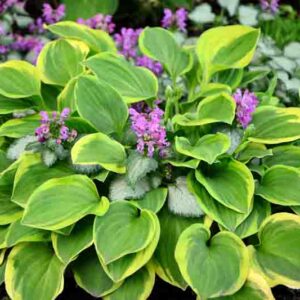
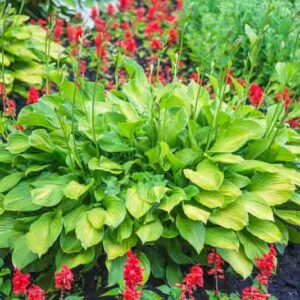
Best luminous gold center: Hosta ‘Stained Glass’ – brilliant golden-yellow centers surrounded by dark green margins.
Best changing pale center: Hosta ‘Great Expectations’ – blue-green leaves with gold centers that mature toward creamy white.
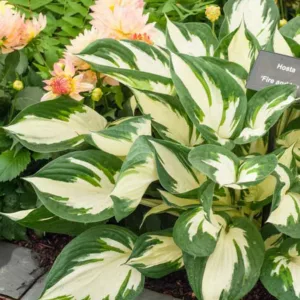
Best compact white-centered Hosta: Hosta ‘Fire and Ice’ – creamy ivory to pure white centers with dark green margins.
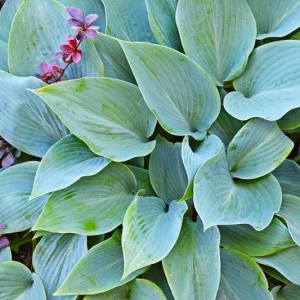
Best large blue-and-cream statement: Hosta ‘Sagae’ – blue-green leaves with broad yellow margins maturing to cream.
Best exceptionally broad white-margined Hosta: Hosta ‘American Halo’ – intensely blue-green foliage with wide rippled creamy-yellow margins.
Gardenia’s Variegated Hosta Rule: Choose the pattern before the cultivar. A white margin, gold center, pale center, or color-changing edge creates a different visual effect and may respond differently to light. Decide what kind of contrast you need, then choose the Hosta that delivers it at the right mature size.
The American Hosta Society defines a variegated leaf as one with more than one color because of differences in pigment. Within that broad category, the pattern can take several forms.
The terminology matters because these patterns create very different effects in a garden. A narrow white margin outlines each individual leaf. A broad ivory edge brightens the entire mound. A large gold or cream center makes the plant read from a distance as a luminous patch rather than as predominantly green foliage.
Gardenia’s pattern distinction: Variegation is not one design trait. Margin color defines the outline of the leaf, while center variegation determines how much brightness the whole clump appears to carry.
Gardenia evaluates variegated Hostas across six practical factors. Together, they help turn a visual preference into a plant that actually fits the garden.
This is more useful than simply ranking the “prettiest” cultivars. ‘Francee’ and ‘Patriot’ are both green-and-white Hostas, but their visual impact is very different. ‘Paul’s Glory’ and ‘Stained Glass’ are both gold-centered, yet one changes strongly through the season while the other is valued for a particularly luminous center.
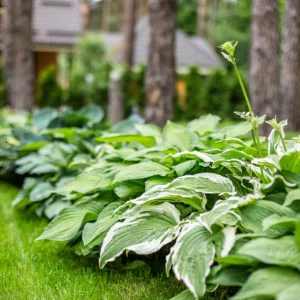
‘Francee’ remains one of the classic white-margined Hostas. Rich dark green, broadly heart-shaped leaves are edged by narrow white margins, producing a clean, understated outline rather than an overwhelmingly bright effect.
Its relatively restrained variegation makes it easy to combine with ferns, Astilbe, Heuchera, Carex, and other shade plants without creating visual competition.
‘Patriot’ takes the green-and-white pattern much further. Its large satiny dark green leaves have broad, irregular ivory margins that make the plant significantly brighter from a distance.
It is a sport of ‘Francee’, but the broader pale edge produces a much stronger visual statement. Use it where you want a white-edged Hosta to function as a focal point rather than merely provide a quiet outline.
‘Minuteman’ is another excellent choice for gardeners who want a crisp white margin. Its large satiny dark green leaves are surrounded by wide pure white margins, while good leaf substance helps give the clump a substantial appearance.
The combination is bold but clean, making ‘Minuteman’ especially effective against deep green ferns or other dark backgrounds.
| Hardiness |
3 - 9 |
|---|---|
| Heat Zones |
1 - 8 |
| Climate Zones | 1, 1A, 1B, 2, 2A, 2B, 3, 3A, 3B, 4, 5, 6, 7, 8, 9, 10, 14, 15, 16, 17, 18, 19, 20, 21 |
| Plant Type | Perennials |
| Plant Family | Asparagaceae |
| Genus | Hosta |
| Exposure | Partial Sun, Shade |
| Season of Interest | Spring (Mid, Late), Summer (Early, Mid, Late), Fall |
| Maintenance | Low |
| Soil Drainage | Moist but Well-Drained |
Gardenia’s white-margin shortcut: Choose ‘Francee’ for refinement, ‘Patriot’ for a broader and brighter ivory edge, and ‘Minuteman’ for a particularly crisp dark-green-and-white effect.
‘First Frost’ is prized for blue-green leaves edged in broad gold margins in spring. As the season advances, those margins gradually mature toward creamy white.
The result is a Hosta that changes character rather than presenting exactly the same foliage from spring through fall.
‘Autumn Frost’ is a sport of ‘First Frost’ with an even broader margin. Frosty blue leaves are edged in bright yellow early in the season, with the border maturing toward cream-white.
Because the pale edge is so wide, it creates a brighter overall effect than ‘First Frost’ while remaining relatively compact.
‘Liberty’ brings the same blue-green-and-yellow palette to a much larger architectural plant. Its thick, broadly heart-shaped leaves carry exceptionally broad irregular golden-yellow margins that mature toward ivory.
This is a statement Hosta rather than an edging plant. The broad margin and substantial leaf size give it enough visual weight to anchor a large shaded border.
Gardenia design insight: A changing margin adds another layer of seasonal interest. ‘First Frost’, ‘Autumn Frost’, and ‘Liberty’ shift from warmer yellow or gold toward cream, so the same planting can look noticeably different later in the season.
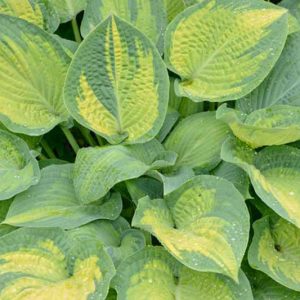
‘Paul’s Glory’ is one of the most interesting color-changing variegated Hostas. In spring, its leaves open with a broad chartreuse center surrounded by blue-green margins. As the season advances, the center becomes bright golden yellow while the margins deepen toward green.
This seasonal transformation makes it much more dynamic than a cultivar whose colors remain relatively stable.
‘Stained Glass’ creates one of the brightest gold-and-green combinations. Broad golden-yellow leaf centers are surrounded by irregular dark green margins, while prominent veins strengthen the stained-glass effect that inspired its name.
This is a strong choice when the goal is to illuminate a shaded planting rather than merely outline foliage. It can also perform with somewhat brighter light when moisture is dependable and intense afternoon heat is avoided.
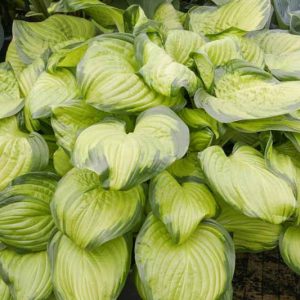
‘Great Expectations’ pairs broad blue-green margins with a lighter center that begins gold and matures toward creamy white. Its leaves are also strongly puckered, giving the plant as much textural interest as color contrast.
Because the pale center occupies a large proportion of the leaf surface, the whole clump reads as considerably brighter than a margin-variegated Hosta.
‘Great Expectations’ can be slower to establish than many vigorous Hostas, so it rewards patience and a well-prepared site with consistent moisture and good drainage.
Gardenia’s Center-Variegation Rule: The larger the pale or golden center, the more the entire clump reads as a bright plant rather than a green plant with an accent. Use these Hostas as focal points rather than scattering too many competing patterns through one small bed.
‘Fire and Ice’ reverses the familiar ‘Patriot’ pattern. The leaf center is creamy ivory to pure white, while irregular dark green margins frame the outside.
Its compact upright mound makes it especially effective where a dramatic white-centered Hosta is wanted without requiring the footprint of a large specimen.
‘Sagae’ is a very different proposition: a large architectural Hosta with frosted blue-green leaves edged in broad irregular margins.
The margins emerge bright yellow and mature toward creamy white, with greenish transitional tones between center and edge. The upright habit gives a mature plant considerably more architectural presence than a broad, low mound.
‘American Halo’ forms an exceptionally broad mound of large, intensely blue-green leaves surrounded by wide, rippled, creamy-yellow margins.
The pale margins emphasize every leaf edge, while the blue-green center provides a cool, substantial background. Because the plant can spread 5-6 feet, it needs to be treated as a major landscape feature rather than a small accent.
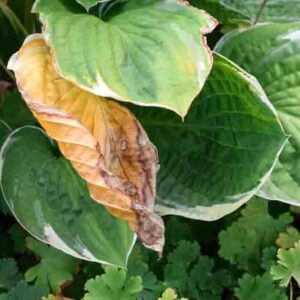
Often, yes – especially when a large proportion of the leaf is white or cream. Pale areas contain less chlorophyll than green tissue and can be more vulnerable to bleaching, browning, or scorch in intense exposure. However, cultivar genetics, leaf substance, climate, soil moisture, and the timing of direct sun also strongly influence how well a variegated Hosta performs.
Gardenia’s Pale-Tissue Rule: The more white or cream tissue a Hosta carries, the more carefully you should evaluate intense sun and heat. Pale variegation is a useful warning sign, not a complete sun-tolerance rating – cultivar, climate, moisture, and time of day still matter.
For cultivar-specific guidance, see Gardenia’s Hostas Tolerant of Sun.
Some Hostas are prized precisely because their colors do not remain static.
The American Hosta Society uses terms such as lutescent for foliage that becomes lighter or yellower as the season progresses and viridescent for foliage that becomes greener. These changes are normal cultivar traits rather than automatic signs of nutrient deficiency, disease, or sun damage.
Examples in this guide include:
That seasonal progression is a design asset. A border that appears warmer and more golden in spring may become cooler and creamier later in summer without changing a single plant.
Yes. Variegated Hostas can occasionally produce shoots that differ from the rest of the clump. A sport may develop a different color pattern, while a reverted shoot can become predominantly or entirely green.
This matters because a vigorous solid-green division may eventually compete with the more lightly pigmented variegated portion of the clump.
If a clearly different shoot appears:
Many famous Hostas themselves originated as sports. ‘Patriot’ is a sport of ‘Francee’, ‘Autumn Frost’ is a sport of ‘First Frost’, and ‘Fire and Ice’ is a reverse sport of ‘Patriot’.
Gardenia’s Reversion Check: Ask whether the pattern changed on one shoot or across the whole plant. A single persistently different division suggests a sport or reversion. A whole clump changing gradually may simply be expressing its normal seasonal color progression.
If unusual mottling, ink-bleed markings, distortion, or abnormal color breaks appear rather than a clean change in variegation pattern, consider disease rather than assuming reversion. Gardenia’s Hosta Virus X guide explains the warning signs and what to do next.
Strong variegation is visually powerful, which means it often works best when given enough quiet space around it.
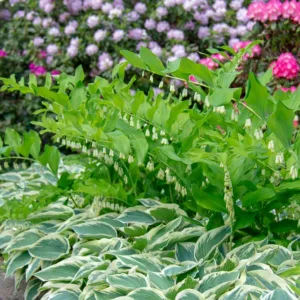
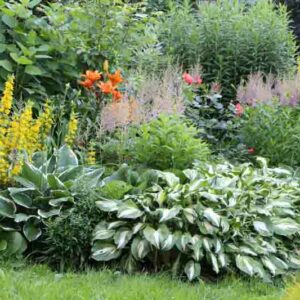
A heavily patterned Hosta can be paired with calmer foliage such as green ferns, sedges, Solomon’s seal, Hakonechloa, or solid-colored Heuchera rather than surrounding it with several equally strong variegated plants.
Gardenia’s Variegation Design Formula: one patterned Hosta + one fine-textured green companion + one solid contrasting foliage color + one seasonal flowering accent. Let the Hosta provide the pattern instead of asking every neighboring plant to compete for attention.
For more combinations and planting ideas, see Gardenia’s Hosta Companion Plants guide and browse Hosta plant combinations.
Start with the foliage effect you want rather than choosing by cultivar name alone.
| Your Goal | Gardenia Pick | Variegation Pattern | Why |
|---|---|---|---|
| Classic narrow white edge | ‘Francee’ | Dark green + narrow white margin | Refined and easy to combine |
| Bold ivory margin | ‘Patriot’ | Dark green + broad ivory margin | Bright and highly visible |
| Crisp pure-white border | ‘Minuteman’ | Dark green + wide pure-white margin | Sharp high contrast |
| Blue foliage + changing margin | ‘First Frost’ | Blue-green + gold-to-cream margin | Seasonal color change |
| Extra-wide margin on compact plant | ‘Autumn Frost’ | Frosty blue + yellow-to-cream margin | Luminous compact mound |
| Large architectural margin | ‘Liberty’ | Blue-green + gold-to-ivory margin | Statement scale |
| Season-changing gold center | ‘Paul’s Glory’ | Chartreuse-to-gold center + green margin | Dynamic seasonal color |
| Luminous gold-centered effect | ‘Stained Glass’ | Golden-yellow center + dark green margin | Bright focal point |
| Pale center + blue-green edge | ‘Great Expectations’ | Gold-to-cream center + blue-green margin | Bright center with strong texture |
| Compact white-centered plant | ‘Fire and Ice’ | White center + dark green margin | Extreme contrast in little space |
| Large blue-and-cream specimen | ‘Sagae’ | Blue-green + yellow-to-cream margin | Architectural focal point |
| Exceptionally broad creamy margin | ‘American Halo’ | Blue-green + wide creamy-yellow margin | Huge high-contrast mound |
Gardenia’s final variegated-hosta rule: Match the amount of contrast to the job the plant must do. Narrow margins refine a planting. Broad white margins brighten it. Gold centers illuminate shade. Large pale centers create focal points. The strongest design begins by choosing the visual role first.
These twelve cultivars show how diverse variegated Hostas can be, but they are only a starting point. The right selection depends on mature size, light exposure, color pattern, seasonal change, container or garden use, and how strongly you want the plant to stand out.
Find More Hostas for Your Garden
Use Gardenia’s Plant Finder to explore additional Hostas and narrow your choices by mature size, foliage color, sun exposure, growing conditions, garden use, and other features that matter in your planting.
Compare Your Finalists Side by Side
Use Gardenia’s Hosta comparison tool to compare mature size and growing requirements, or browse the complete Hosta collection before deciding which foliage pattern belongs in your shade garden.
There is no single best variegated Hosta. ‘Francee’ is excellent for narrow white margins, ‘Patriot’ and ‘Minuteman’ provide bold white edging, ‘Stained Glass’ offers a luminous gold center, ‘Sagae’ creates a large architectural statement, and ‘Fire and Ice’ is a compact high-contrast white-centered choice.
It depends on the cultivar and pattern. Hostas with extensive white or cream tissue can be more vulnerable to bleaching or scorch and often benefit from protection from intense afternoon sun. Gold and chartreuse cultivars may develop stronger color with somewhat brighter light when moisture is dependable.
Some cultivars naturally change color through the season. For example, ‘Paul’s Glory’ develops a brighter golden center, while ‘First Frost’, ‘Autumn Frost’, ‘Liberty’, and ‘Sagae’ have margins that move from yellow or gold toward cream. Normal seasonal change should not be confused with scorch, disease, or nutrient problems.
Yes. A variegated Hosta may occasionally produce a green reversion or another differently colored sport. If a persistent green shoot arises from one division and begins competing with the original variegated plant, that division can be removed at its point of origin with clean, sanitized tools.
‘Francee’, ‘Patriot’, ‘Minuteman’, and ‘American Halo’ are excellent white- or cream-margined Hostas. If you also like margins that begin yellow or gold and mature toward cream, consider ‘First Frost’, ‘Autumn Frost’, ‘Liberty’, and ‘Sagae’.
‘Paul’s Glory’ and ‘Stained Glass’ are two outstanding gold-centered Hostas. ‘Paul’s Glory’ changes from chartreuse toward bright gold as the season progresses, while ‘Stained Glass’ develops a particularly luminous golden-yellow center surrounded by dark green.
Yes. Many variegated Hostas grow beautifully in containers, especially compact and medium cultivars such as ‘Fire and Ice’, ‘Autumn Frost’, and ‘Stained Glass’. Match the pot to the mature plant, provide good drainage, and monitor moisture carefully during summer.
Variegated Hostas usually look strongest beside calmer foliage. Green ferns, sedges, Solomon’s seal, Hakonechloa, and solid-colored Heuchera provide contrast without competing with the Hosta’s pattern. Avoid crowding a small space with too many strongly variegated plants.
Updated: September 2026 – Reviewed by Gardenia Editors
| Hardiness |
3 - 9 |
|---|---|
| Heat Zones |
1 - 8 |
| Climate Zones | 1, 1A, 1B, 2, 2A, 2B, 3, 3A, 3B, 4, 5, 6, 7, 8, 9, 10, 14, 15, 16, 17, 18, 19, 20, 21 |
| Plant Type | Perennials |
| Plant Family | Asparagaceae |
| Genus | Hosta |
| Exposure | Partial Sun, Shade |
| Season of Interest | Spring (Mid, Late), Summer (Early, Mid, Late), Fall |
| Maintenance | Low |
| Soil Drainage | Moist but Well-Drained |
Create a membership account to save your garden designs and to view them on any device.
Becoming a contributing member of Gardenia is easy and can be done in just a few minutes. If you provide us with your name, email address and the payment of a modest $25 annual membership fee, you will become a full member, enabling you to design and save up to 25 of your garden design ideas.
Join now and start creating your dream garden!
Create a membership account to save your garden designs and to view them on any device.
Becoming a contributing member of Gardenia is easy and can be done in just a few minutes. If you provide us with your name, email address and the payment of a modest $25 annual membership fee, you will become a full member, enabling you to design and save up to 25 of your garden design ideas.
Join now and start creating your dream garden!