Hostas can lose much of their foliage when deer or rabbits discover them. Learn how to distinguish deer browsing from rabbit damage, whether a damaged Hosta can recover, and which protections work best. Gardenia's Browse Signature Check and Browse-Pressure Protection Ladder help match the animal and damage level to the right response.



If your Hosta looked full and healthy yesterday and is suddenly reduced to chewed leaves, ragged petioles, or disappearing spring shoots, deer or rabbits may be responsible. Hostas are commonly browsed by both animals, especially when tender new growth is emerging and when other food is limited.
The good news is that a damaged Hosta is not necessarily lost. An established plant can often recover if its crown and roots remain healthy. The bigger concern is repeated browsing. A single feeding event damages the display; repeated defoliation can gradually weaken the plant because it keeps losing the leaves needed to rebuild energy reserves.
Successful protection begins with two questions: what is eating the Hosta, and how often is it happening? Deer and rabbits leave different clues, and occasional sampling calls for a different response from a garden that is being stripped week after week.
Leaves torn off with ragged petioles: suspect deer, especially when damage occurs at several heights.
Young shoots or petioles clipped cleanly at an angle: suspect rabbits, particularly when damage is concentrated close to the ground.
Large portions of a Hosta disappear overnight: deer can remove a substantial amount of foliage in one visit.
New spring shoots vanish repeatedly: rabbits are a strong possibility, although deer may browse emerging Hostas too.
For occasional deer browsing: a labeled repellent may help when started early and reapplied according to the product label.
For repeated or heavy deer browsing: physical exclusion is more dependable. Conventional deer fencing is about 8 feet high.
For rabbits: use fine-mesh fencing about 2 feet high, with openings no larger than 1 inch and the bottom secured tightly to the ground or buried several inches.
Do not rely on a supposedly deer-resistant Hosta: no Hosta cultivar should be considered reliably deer-proof or rabbit-proof under significant browsing pressure.
Gardenia’s Hosta Browse Rule: Identify the browsing signature before choosing the protection. Deer usually tear; rabbits usually clip. Once you know which animal is feeding, match the response to that animal and to the frequency of the damage.
Yes. Hostas are commonly browsed by deer, and a single visit can remove large leaves, flower scapes, or entire sections of a clump.
Deer damage can be surprisingly dramatic because they may feed at night or during quiet periods and return to the same garden once they discover a dependable food source. A Hosta that looked untouched the previous evening may be left with little more than damaged petioles by morning.
Typical signs of deer browsing include:
Deer lack upper incisors and tend to pull or tear vegetation rather than slice it cleanly. That rough browsing surface is one of the most useful clues when deciding whether deer are responsible.
Yes. Rabbits commonly feed on tender Hosta shoots, young leaves, petioles, and flowers, especially when fresh growth is close to the ground.
Rabbit damage usually differs from deer browsing because rabbits have sharp incisors. They can leave shoots and petioles clipped cleanly, often at an angle. Damage is generally concentrated lower on the plant.
Look for:
Young Hostas and newly divided plants can be especially vulnerable because even modest browsing may remove much of the available foliage.
Not every damaged Hosta has been browsed by deer or rabbits. The pattern of injury usually tells you more than the amount of missing foliage.
| Clue | Likely Cause | What to Look For |
|---|---|---|
| Large leaves or whole sections missing | Deer | Ragged, torn petioles and damage at more than one height |
| Shoots clipped close to the ground | Rabbit | Clean angled cuts and small round droppings |
| Irregular holes within intact leaves | Slugs or snails | Chewed holes rather than missing petioles; slime may be visible |
| Plant declines without obvious leaf browsing | Voles or root/crown trouble | Inspect crown and roots for underground damage or decay |
Gardenia’s Browse Signature Check: Look at three things – cut quality, damage height, and what is missing. Ragged + higher browsing + whole leaves missing points toward deer. Clean cuts + low browsing + tender shoots disappearing points toward rabbits. Holes through otherwise intact leaves point elsewhere.
If your Hosta damage does not fit deer or rabbit browsing, use the Hosta Problems guide to compare browsing with slugs, scorch, disease, crown problems, nematodes, and other causes.
Often, yes, if the crown and roots remain healthy. Hostas are herbaceous perennials with stored energy below ground, so the loss of foliage does not automatically kill an established plant.
If browsing occurs early enough in the growing season, a healthy established Hosta may produce some replacement foliage. The amount of regrowth varies with the plant’s vigor, the severity and timing of damage, and whether new leaves are protected from further browsing.
The greater concern is repeated defoliation. Leaves manufacture the carbohydrates the crown relies on for continued growth and future seasons. If deer or rabbits repeatedly remove each new flush before the plant can maintain a functioning canopy, vigor may decline over time.
After browsing:
Gardenia’s Hosta Recovery Rule: One browsing event is a damage problem; repeated browsing becomes a plant-vigor problem. Protect the next flush of foliage rather than focusing only on the leaves that have already been lost.
Where deer pressure is persistent, physical exclusion is more dependable than hoping deer will lose interest or relying on a supposedly less-palatable Hosta.
A conventional deer-exclusion fence is approximately 8 feet high. The barrier also needs to be securely installed so deer cannot simply move beneath, through, or around it.
Protection can operate at several scales:
Check local regulations, homeowners’ association rules, visibility requirements, and safety guidance before installing tall or electrified fencing.
Exclusion becomes especially valuable once deer have incorporated a garden into a regular feeding route. Under high browsing pressure, even plants considered less palatable may be sampled.
Rabbit exclusion is generally easier because the barrier can be much lower than deer fencing.
A practical rabbit fence is about 2 feet high and made from wire mesh with openings 1 inch or smaller. Keep the lower edge tight against the soil or bury it several inches so rabbits cannot push beneath it.
For a small Hosta planting, you do not necessarily need to fence the entire garden.
Useful approaches include:
Pay particular attention to the base of the barrier. A low fence with a gap underneath may look protective while remaining easy for a rabbit to enter.
Gardenia’s Rabbit Barrier Rule: Think low, fine, and tight. Rabbits do not require an imposing fence – they require a barrier with small enough openings and no easy route underneath.
Repellents can reduce browsing, particularly when deer pressure is moderate, but they are less dependable than physical exclusion when animals feed repeatedly in the garden.
Commercial repellents may discourage feeding through unpleasant odors, tastes, or both. Their effectiveness depends on browsing pressure, weather, application timing, new plant growth, and how long the product remains effective on the foliage.
For the best chance of success:
A repellent should be viewed as a management tool, not an invisible fence. Under heavy feeding pressure, hungry deer may browse despite an unpleasant smell or taste.
If rabbits are the problem, check the label specifically. A repellent labeled for deer should not automatically be assumed effective or approved for rabbits.
Scare tactics can sometimes provide temporary help, particularly before deer become comfortable entering a garden. Motion-activated sprinklers may interrupt an animal as it approaches a protected area.
However, deer can become accustomed to repeated sights, sounds, or odors that never develop into a meaningful threat. Lights, radios, hanging objects, bars of soap, hair, and similar home remedies are therefore far less dependable than properly installed exclusion.
Think of scare devices as a supplement rather than the foundation of a serious wildlife-management plan.
No Hosta should be considered reliably deer resistant or rabbit resistant. Browsing behavior varies by local animal populations, season, weather, alternative food, and previous feeding habits.
Claims that thick-leaved, blue, fragrant, or particular named Hostas are “deer proof” should be treated cautiously. Deer may eat plants they usually ignore when browsing pressure is high.
The same principle applies to rabbits. A cultivar left untouched in one garden may be repeatedly clipped in another.
Gardenia’s Cultivar Rule: Do not solve a wildlife-access problem by searching for a supposedly resistant Hosta. If deer or rabbits repeatedly browse the site, change the level of protection rather than relying on cultivar preference.
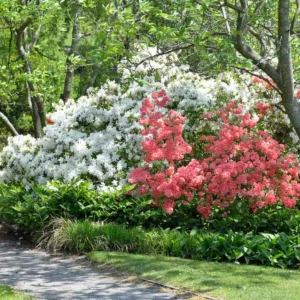
Surrounding Hostas with less-preferred plants may make the overall planting less attractive to browsing animals, but companion planting should not be treated as a dependable physical barrier.
Deer can step around or reach through neighboring plants if they want the Hosta behind them. The value of less-preferred companions is therefore primarily in creating a more resilient garden rather than making individual Hostas inaccessible.
One useful shade companion is Brunnera ‘Jack Frost’, which is resistant to both deer and rabbits and which can share similar shade-garden conditions with Hostas.
But companion planting is not exclusion. In a garden where deer or rabbits repeatedly enter and consume Hostas, protect the Hostas themselves.
For combinations based on light, moisture, mature size, texture, and garden role, see Hosta Companion Plants guide.
The best protection depends on how often browsing occurs.
| Browsing Pressure | What It Looks Like | Gardenia Response |
|---|---|---|
| Occasional | One isolated visit or minor sampling | Confirm the animal, protect vulnerable new growth, and consider a labeled repellent |
| Recurring | The same Hostas are browsed repeatedly | Add cages, netting, or protected beds rather than relying on repellent alone |
| Heavy | Large losses or several Hostas damaged repeatedly | Move toward dependable physical exclusion |
| Chronic | Hostas cannot maintain foliage season after season | Fence the planting area or redesign exposed areas around less-preferred plants |
Gardenia’s Browse-Pressure Rule: Escalate the protection when the damage repeats. A repellent may be reasonable for occasional visits. A Hosta being stripped again and again needs a barrier, not a stronger adjective on the spray bottle.
Protection works best when it begins before browsing becomes routine.
Pay particular attention during:
If deer routinely follow the same route through the property, think about intercepting that movement before the animals reach the Hosta bed rather than treating damaged foliage after each visit.
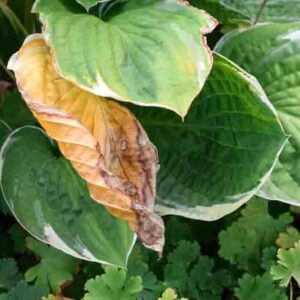
A browsed Hosta often looks worse than it actually is. Before removing the plant, inspect the crown and remaining petioles.
If the crown is firm and healthy:
Do not assume a Hosta that fails to rebound simply needs more fertilizer. Chronic browsing can occur alongside drought, root competition, excessive shade, poor drainage, or disease.
If a Hosta becomes smaller each season despite protection, use complete Hosta growing and care guide to review the entire site.
If deer or rabbits make unprotected Hostas impractical in part of your garden, it may be more effective to reserve Hostas for protected spaces and use less-preferred plants where wildlife access is difficult to control.
Build a More Wildlife-Resilient Planting
Use Gardenia’s Plant Finder to explore plants by light, soil, moisture, mature size, and tolerance characteristics. Keep Hostas in protected locations and use less-preferred plants where fencing or cages are impractical.
Still Not Sure What Is Eating Your Hosta?
Use this Hosta Problems guide to compare deer and rabbit browsing with slug holes, vole damage, crown problems, scorch, disease, nematodes, and other causes of damaged foliage.
Yes. Hostas are commonly browsed by deer. Deer may remove large leaves, flowers, or much of a clump in one visit and often leave ragged or torn petioles because they pull vegetation rather than clipping it neatly.
Yes. Rabbits commonly feed on tender Hosta shoots, young leaves, petioles, and flowers. Their sharp incisors often leave cleaner angled cuts than deer browsing, and small round droppings nearby can help confirm rabbit activity.
Often, yes, if the crown and roots remain healthy. A healthy established Hosta may produce some replacement foliage after early-season damage, but the amount varies with plant vigor, timing, severity, and whether the new leaves are protected from further browsing.
Physical exclusion is the most dependable solution where deer pressure is high. Conventional deer fencing is about 8 feet high. For occasional browsing, labeled repellents may help when applied early and reapplied according to the product label.
Use fine-mesh fencing about 2 feet high with openings 1 inch or smaller. Keep the bottom tight to the soil or bury it several inches so rabbits cannot push underneath. Individual wire cages can also protect vulnerable Hostas.
No Hosta should be considered reliably deer resistant. Deer preferences change with food availability, season, local population pressure, and feeding habits. Where deer repeatedly eat Hostas, physical protection is more dependable than choosing a supposedly resistant cultivar.
Deer typically leave rough, torn, or ragged petioles and can browse foliage at several heights. Rabbits usually feed closer to the ground and often leave cleaner angled cuts made by their incisors. Small round droppings nearby also point toward rabbits.
They can reduce browsing, particularly when pressure is moderate and treatment begins before deer establish a regular feeding habit. Repellents are less dependable than exclusion under heavy pressure and should be reapplied according to the product label.
Updated: September 2026 – Reviewed by Gardenia Editors
| Hardiness |
3 - 9 |
|---|---|
| Heat Zones |
1 - 8 |
| Climate Zones | 1, 1A, 1B, 2, 2A, 2B, 3, 3A, 3B, 4, 5, 6, 7, 8, 9, 10, 14, 15, 16, 17, 18, 19, 20, 21 |
| Plant Type | Perennials |
| Plant Family | Asparagaceae |
| Genus | Hosta |
| Exposure | Partial Sun, Shade |
| Season of Interest | Spring (Mid, Late), Summer (Early, Mid, Late), Fall |
| Maintenance | Low |
| Water Needs | Average |
| Soil Drainage | Moist but Well-Drained |
| Attracts | Bees, Butterflies, Hummingbirds |
| Landscaping Ideas | Patio And Containers, Small Gardens |
| Garden Styles | City and Courtyard, Gravel and Rock Garden, Informal and Cottage, Pollinator Garden, Woodland Garden |
| Hardiness |
3 - 9 |
|---|---|
| Heat Zones |
1 - 8 |
| Climate Zones | 1, 1A, 1B, 2, 2A, 2B, 3, 3A, 3B, 4, 5, 6, 7, 8, 9, 10, 14, 15, 16, 17, 18, 19, 20, 21 |
| Plant Type | Perennials |
| Plant Family | Asparagaceae |
| Genus | Hosta |
| Exposure | Partial Sun, Shade |
| Season of Interest | Spring (Mid, Late), Summer (Early, Mid, Late), Fall |
| Maintenance | Low |
| Water Needs | Average |
| Soil Drainage | Moist but Well-Drained |
| Attracts | Bees, Butterflies, Hummingbirds |
| Landscaping Ideas | Patio And Containers, Small Gardens |
| Garden Styles | City and Courtyard, Gravel and Rock Garden, Informal and Cottage, Pollinator Garden, Woodland Garden |
Create a membership account to save your garden designs and to view them on any device.
Becoming a contributing member of Gardenia is easy and can be done in just a few minutes. If you provide us with your name, email address and the payment of a modest $25 annual membership fee, you will become a full member, enabling you to design and save up to 25 of your garden design ideas.
Join now and start creating your dream garden!
Create a membership account to save your garden designs and to view them on any device.
Becoming a contributing member of Gardenia is easy and can be done in just a few minutes. If you provide us with your name, email address and the payment of a modest $25 annual membership fee, you will become a full member, enabling you to design and save up to 25 of your garden design ideas.
Join now and start creating your dream garden!