Bring spectacular spring color to your patio with rhododendrons grown in pots. Discover compact varieties and flowering azaleas, choose containers and acidic compost, and learn how to manage watering, feeding, pruning, and winter protection. Find the right plants for your climate and enjoy beautiful, healthy shrubs for years to come.
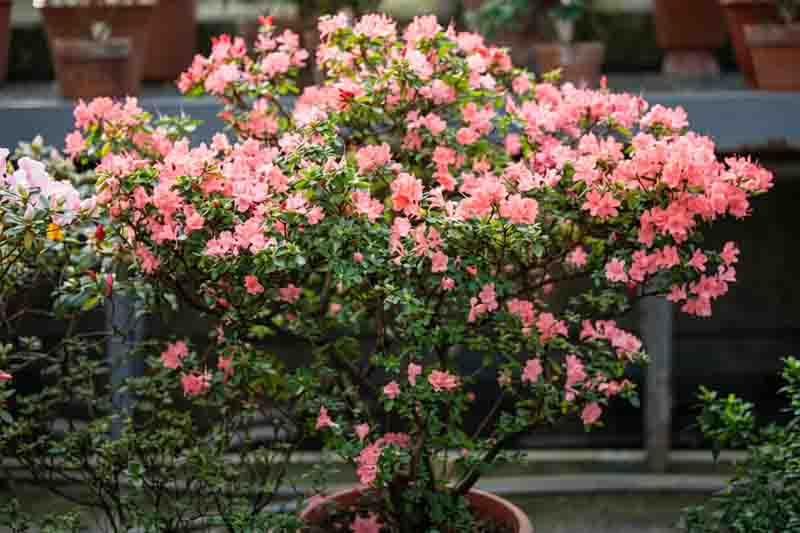


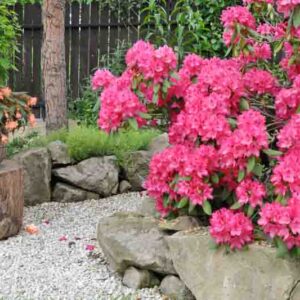
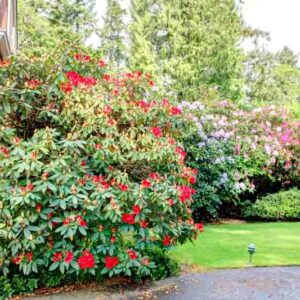
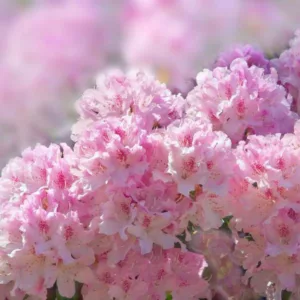
A rhododendron in full flower can transform even a small patio. For a few glorious weeks in spring, its branches disappear beneath clusters of pink, purple, white, red, or yellow blooms. The rest of the year, its evergreen foliage provides structure and greenery.
Better still, you don’t need a large garden to grow one. Compact rhododendrons and evergreen azaleas are excellent candidates for containers, particularly where garden soil is alkaline or planting space is limited.
Can rhododendrons grow in pots? Yes. Many compact varieties thrive in containers for years when given acidic, well-drained potting mix, consistent moisture, suitable light, and protection from extreme temperatures. The most important decision is choosing a cultivar that won’t quickly outgrow its container.
Whether you’re planting a single flowering specimen or creating a collection of patio pots, here’s how to choose the right rhododendron and keep it healthy.
Containers offer a simple solution when your garden soil is unsuitable for acid-loving plants. Instead of trying to change an entire planting bed, you can provide the growing conditions rhododendrons need in a single pot.
They are also ideal for patios, balconies, courtyards, and entrances, where their flowers can be enjoyed at close range. A compact evergreen variety provides year-round interest without occupying valuable garden space.
There is one trade-off: potted rhododendrons need more attention than established shrubs growing in the ground. Their roots have limited space, containers dry out more quickly, and winter cold or summer heat can affect the entire root ball.
Gardenia’s first rule: Choose the rhododendron before choosing the container. A naturally compact shrub will be easier to grow, water, repot, and protect than a vigorous variety that eventually reaches 8 ft. tall.
For a small patio or your first container-grown rhododendron, start with one of these naturally compact varieties. They offer abundant flowers without requiring an enormous planter.
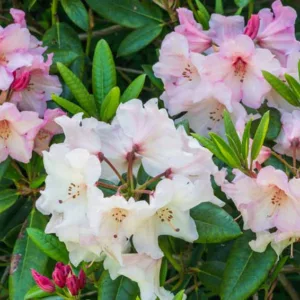
‘Ginny Gee’ is a delightful little evergreen rhododendron with masses of white flowers delicately touched with pink. Bright rose-pink buds add to its spring display, while its tiny dark green leaves provide year-round texture.
Growing just 12-18 in. tall (30-45 cm) and 18-24 in. wide (45-60 cm), it is one of the most manageable choices for small containers. Its dense, spreading habit is especially attractive in a wide, low-profile planter.
Best for: Small patios, compact containers, and white-and-pink spring displays.
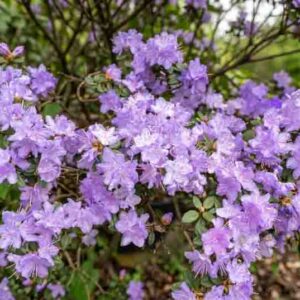
‘Ramapo’ produces clusters of light violet-purple flowers in early to mid-spring. Its aromatic, blue-green leaves develop attractive bronze tones in colder weather.
Reaching approximately 2 ft. tall (60 cm) and 2-3 ft. wide (60-90 cm), it has a naturally spreading habit. Choose a broad, stable container rather than a narrow, upright pot.
It is particularly appealing in cooler climates, where its exceptional cold hardiness is an advantage, although the roots still need protection when grown in a container.
Best for: Cool-climate patios and low, spreading container displays.
‘Mary Fleming’ produces delicate creamy flowers flushed with pink and soft yellow. Its attractive small leaves and broad, rounded growth make it a lovely companion to other compact evergreen shrubs.
At approximately 18-30 in. tall and wide (45-75 cm), it remains manageable in a medium-sized container. Give it partial shade and protect its fine roots from drying out.
Best for: Small patios, soft pastel combinations, and medium-sized pots.
| Plant Type | Shrubs |
|---|---|
| Genus | Rhododendron |
| Exposure | Partial Sun |
| Season of Interest | Spring (Early, Mid, Late), Summer (Early), Fall, Winter |
| Maintenance | Low |
| Water Needs | Average |
| Soil Type | Clay, Loam, Sand |
| Soil pH | Acid |
| Soil Drainage | Moist but Well-Drained |
| Characteristics | Showy |
| Tolerances | Rabbit |
| Attracts | Butterflies, Hummingbirds |
| Landscaping Ideas | Patio And Containers |
| Garden Styles | City and Courtyard, Informal and Cottage, Japanese Garden, Traditional Garden |
For a more substantial display, these selections produce striking spring flowers while remaining more manageable than large woodland rhododendrons. Their eventual size should guide your choice of planter.
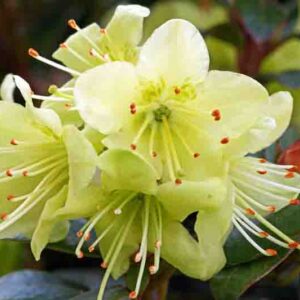
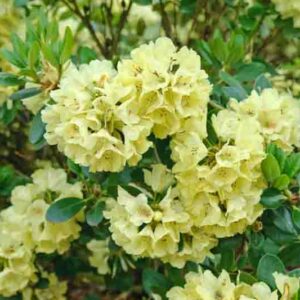
‘Princess Anne’ is a compact evergreen shrub bearing soft greenish-yellow flowers in mid to late spring. Its neat, dark green foliage develops bronze tones during colder weather.
At approximately 2-3 ft. tall and wide (60-90 cm), it is particularly suitable for a medium-sized patio container. Its tidy habit also makes it an attractive choice for an entrance or sheltered courtyard.
‘Goldkrone’ produces clusters of golden-yellow flowers delicately spotted with reddish brown. Blooming in late spring to early summer, it brings welcome brightness to partially shaded patios.
Its bushy, rounded habit can eventually reach 3-5 ft. tall and wide (90-150 cm). It is best reserved for a substantial planter, with enough room to accommodate future root growth.
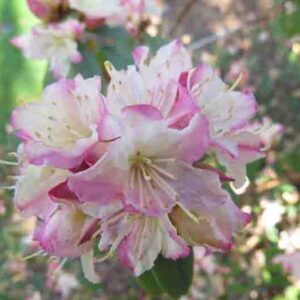
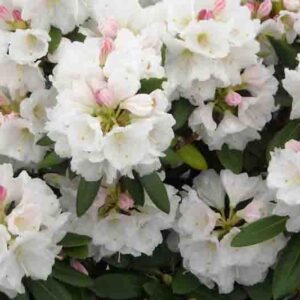
‘Nestucca’ makes a spectacular container specimen. Raspberry-pink buds open into large, frilled white flowers, which stand out against glossy evergreen foliage in mid to late spring.
Growing approximately 3-4 ft. tall and wide (90-120 cm), it suits a generous patio planter. Although valued for its cold hardiness and tolerance of sun and heat in suitable conditions, its roots still need protection from drying out or overheating in a container.
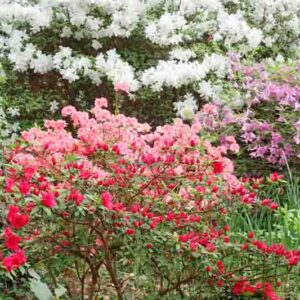
Azaleas belong to the genus Rhododendron, and many compact evergreen or semi-evergreen varieties make excellent container plants. Their smaller foliage and abundant flowers are particularly effective in courtyard gardens.
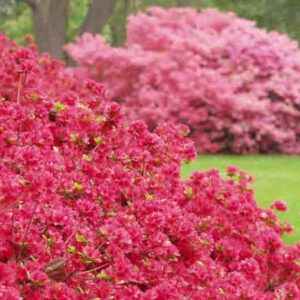
‘Hino Crimson’ is a compact evergreen Kurume azalea covered in brilliant scarlet-red flowers in early to mid-spring. Its dark green foliage develops bronze-red tones in cold weather.
Although only 2-3 ft. tall (60-90 cm), it can spread 3-5 ft. (90-150 cm). Its broad habit makes it better suited to a wide planter than a narrow decorative urn.
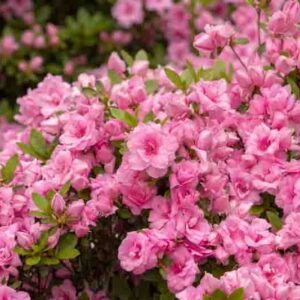
‘Rosebud’ is an evergreen azalea with fully double, rosy-pink flowers that resemble miniature roses. Its spring display is especially charming when the pot stands close to a seating area or garden path.
Reaching approximately 2-3 ft. tall (60-90 cm) and 3-4 ft. wide (90-120 cm), it has a dense, spreading habit that suits a generous container.
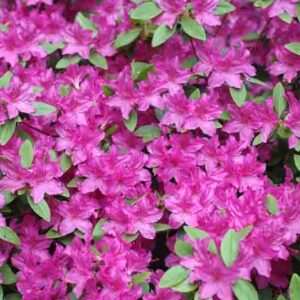
‘Karens’ is a compact, semi-evergreen azalea producing rich reddish-purple flowers in mid to late spring. Its foliage takes on attractive wine-red and coppery tones during colder weather.
Growing approximately 3-5 ft. tall and wide (90-150 cm), it is a good candidate for a large patio container in a suitable climate. In colder or exposed conditions, it may shed some leaves rather than remain fully evergreen.
Choosing the right rhododendron is easier when you compare its mature dimensions with the space available. A compact plant is generally more practical in a pot than a vigorous shrub that requires frequent pruning or repotting.
| Rhododendron | Mature Height × Width | Container Choice |
|---|---|---|
| ‘Ginny Gee’ | 12-18 × 18-24 in. | Small patio containers |
| ‘Ramapo’ | 2 × 2-3 ft. | Medium, broad containers |
| ‘Mary Fleming’ | 18-30 × 18-30 in. | Medium containers |
| ‘Princess Anne’ | 2-3 × 2-3 ft. | Medium patio planters |
| ‘Goldkrone’ | 3-5 × 3-5 ft. | Large, substantial planters |
| ‘Nestucca’ | 3-4 × 3-4 ft. | Large specimen containers |
How to use this guide: Start with the available space, then consider the plant’s mature size, growth habit, and climate requirements. These container categories are Gardenia’s practical planning assessments, not fixed pot-volume recommendations or RHS ratings.
Remember that mature shrub width refers to the canopy, not the diameter of the root ball. It does not mean that a rhododendron growing 4 ft. wide automatically requires a 4 ft.-wide pot.
Choose a pot modestly larger than the existing root ball, with adequate depth, stability, and drainage holes. A small plant shouldn’t be placed directly into an enormous container, where excess potting mix may stay wet for too long.
Increase the container size gradually as the roots develop. If the plant has reached a manageable size, it may be possible to refresh the growing medium without moving into a much larger pot.
Terracotta looks attractive but dries out faster. Plastic and resin retain moisture longer and are easier to move, while glazed ceramic provides stability but can become very heavy. Dark-colored pots may overheat in intense summer sunshine.
Use a high-quality ericaceous potting mix formulated for acid-loving plants. Rhododendrons generally prefer a pH around 4.5-6.0, with approximately 5.0-6.0 suitable for many cultivated varieties.
A peat-free, loam-based ericaceous compost can be an excellent choice because it combines useful moisture retention with good root aeration. Avoid heavy garden soil, alkaline mixes, and containers without drainage holes.
For more information on soil acidity and plant nutrition, see Rhododendron Soil and Fertilizer: Complete Growing Guide.
One common mistake: Don’t place gravel beneath the compost hoping to improve drainage. Use a pot with proper drainage holes and a suitable potting medium instead. Never leave the container permanently standing in water.
Spring or early fall is usually a good time to pot rhododendrons, when temperatures are moderate and the roots can establish without intense heat or severe cold.
Place the newly potted shrub in a sheltered position with suitable light. Avoid unnecessary fertilizer immediately after planting, particularly if the compost already contains nutrients.
There is no fixed watering schedule. A small terracotta pot in hot, windy weather may need water daily, while a large container in cool shade remains moist much longer.
Check the compost just below the surface and water thoroughly when the root zone begins to dry. Avoid allowing the entire root ball to become parched, but never keep the roots continuously saturated.
Pay particular attention during summer, when many rhododendrons are developing flower buds for the following spring. Severe drought at this stage can reduce the next year’s display.
Rainwater is particularly useful in areas with highly alkaline tap water, although the priority is always to provide adequate moisture.
Most potted rhododendrons prefer morning sunlight with protection from intense afternoon heat. Some compact cultivars tolerate more sun in cool climates, but even sun-tolerant varieties can suffer when the container itself becomes extremely hot.
For cultivar-specific guidance, read How Much Sun Do Rhododendrons Need?.
Use a suitable ericaceous fertilizer during active growth when feeding is needed, following the product’s recommended dosage. Slow-release formulations or correctly diluted liquid fertilizers are convenient for containers.
Do not overfeed. Excess fertilizer can injure the roots, and yellowing foliage is not always a sign of nutrient deficiency. Check the compost, pH, and drainage first. For more information, see Best Soil and Fertilizer for Rhododendrons.
Most compact rhododendrons need little pruning. Remove damaged branches and shorten occasional overlong shoots immediately after flowering, before next year’s flower buds develop.
Spent flower trusses can be removed carefully, taking care not to damage new shoots just beneath them. Deadheading is optional, especially on plants that shed their spent flowers naturally, but it can keep container specimens looking tidy.
For detailed pruning advice, visit How and When to Prune Rhododendrons and Azaleas.
Inspect the roots and compost each spring. Tightly circling roots, rapid drying after watering, poor drainage, or deteriorating compost may indicate that repotting is needed.
RHS recommends renewing some soil-less container-growing media approximately every two years, since they can lose structure and become poorly aerated. In the intervening year, replace the top 2 in. (5 cm) of compost with fresh ericaceous mix.
Repotting does not always mean choosing a larger container. A healthy plant may be returned to the same pot with refreshed compost and, where appropriate, careful root pruning. Avoid excessive disturbance of its fine roots.
Many can, but their roots are more exposed to freezing than those of plants growing in the ground. Even a cold-hardy rhododendron may need extra protection when its root ball is surrounded by freezing air.
In colder climates, group pots in a sheltered position, insulate exposed containers, or move them to an unheated protected location during severe cold. Avoid bringing hardy rhododendrons into a warm living room for the winter.
Check moisture during mild spells. Evergreen leaves continue losing some water even when growth has slowed.
Winter warning: A USDA hardiness rating does not guarantee that a rhododendron’s roots will survive unprotected in a container. Consider your local winter temperatures, pot size, exposure, and the cultivar’s cold tolerance.
Many container problems begin with the roots. Poor drainage, incorrect pH, crowded roots, and irregular watering can all cause similar symptoms, so check the growing medium before reaching for fertilizer.
| What You See | Possible Cause | What to Check First |
|---|---|---|
| Yellow leaves | High pH, nutrient availability, or root stress | Compost pH and drainage |
| Wilting in wet compost | Poor aeration or root disease | Drainage holes and root condition |
| Brown leaf edges | Drought, excessive heat, wind, or fertilizer salts | Moisture, exposure, and recent feeding |
| Few flowers | Shade, summer drought, or incorrect pruning | Light and previous season’s care |
| Weak growth | Crowded roots or deteriorating compost | Root ball and growing-medium structure |
A root-bound plant and one growing in decomposed, waterlogged compost may both grow poorly, but they need different solutions. Inspect the roots and medium before increasing fertilizer or watering.
The best container rhododendron is not necessarily the smallest or most colorful. It is the one that suits your climate, available space, sunlight, and long-term maintenance expectations.
Use Gardenia’s Plant Finder to explore rhododendrons by hardiness zone, sunlight, growing conditions, and other plant characteristics. Then open their individual profiles to compare mature sizes, flowering periods, and garden uses.
With Gardenia’s Garden Design Tool, you can save your favorites and compare their growing requirements, mature dimensions, and seasonal interest before planning a collection of patio plants.
Yes. Many compact rhododendrons and azaleas can remain in containers for years with acidic, well-drained compost, regular watering, appropriate feeding, periodic repotting, and winter protection where needed.
‘Ginny Gee’, ‘Ramapo’, and ‘Mary Fleming’ are compact choices. ‘Princess Anne’ is also suitable for medium-sized patio containers. Choose according to the cultivar’s mature dimensions and your local growing conditions.
Use a well-drained ericaceous potting mix formulated for acid-loving plants. A peat-free, loam-based ericaceous compost can provide useful moisture retention and root aeration. Avoid alkaline garden soil and poorly drained containers.
Check the compost regularly and water thoroughly when the root zone begins to dry. Frequency varies with pot size, weather, growing medium, and exposure. Never allow the entire root ball to become parched or waterlogged.
Early spring is usually a good time to repot. Check root crowding and compost condition annually. Some soil-less media benefit from renewal every two years, with the top 2 inches of compost replaced in the intervening year.
Often yes, but exposed containers provide less insulation than garden soil. Protect the root ball during severe freezing weather, shelter the plant from drying winds, and monitor moisture during mild periods.
Updated and reviewed by Gardenia: October 2026
| Plant Type | Shrubs |
|---|---|
| Genus | Rhododendron |
| Exposure | Partial Sun |
| Season of Interest | Spring (Early, Mid, Late), Summer (Early), Fall, Winter |
| Maintenance | Low |
| Water Needs | Average |
| Soil Type | Clay, Loam, Sand |
| Soil pH | Acid |
| Soil Drainage | Moist but Well-Drained |
| Characteristics | Showy |
| Tolerances | Rabbit |
| Attracts | Butterflies, Hummingbirds |
| Landscaping Ideas | Patio And Containers |
| Garden Styles | City and Courtyard, Informal and Cottage, Japanese Garden, Traditional Garden |
Create a membership account to save your garden designs and to view them on any device.
Becoming a contributing member of Gardenia is easy and can be done in just a few minutes. If you provide us with your name, email address and the payment of a modest $25 annual membership fee, you will become a full member, enabling you to design and save up to 25 of your garden design ideas.
Join now and start creating your dream garden!