Not all rhododendrons are alike. Some are tiny evergreen shrubs, others grow into flowering trees, and many familiar azaleas belong to the same genus. Discover the main rhododendron groups, identify their differences, compare outstanding varieties, and find the right plant for your garden's climate, sunlight, soil, and space.
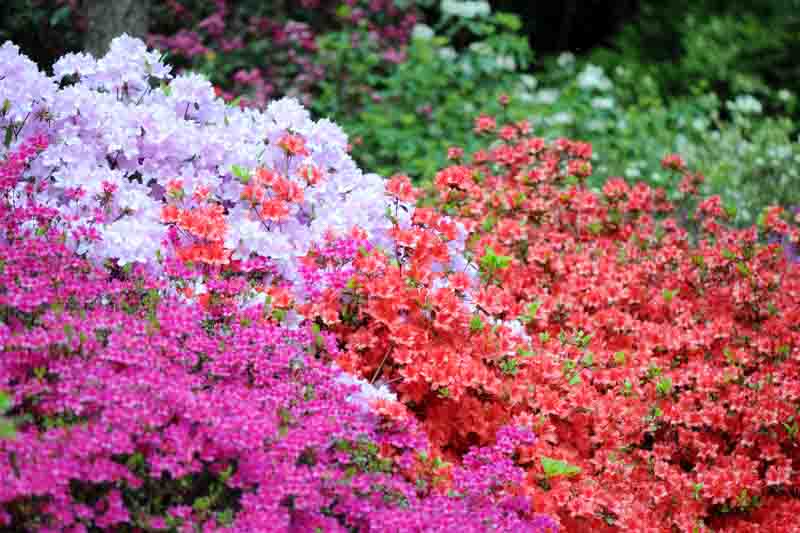


Rhododendrons range from miniature evergreen shrubs to towering flowering trees, with flowers in shades of white, pink, red, purple, blue, orange, and yellow. Some survive exceptionally cold winters. Others belong in sheltered gardens with mild summers. And many plants we call azaleas are rhododendrons too.
That diversity can make choosing one surprisingly difficult. A dwarf rhododendron for a rock garden has little in common with a ten-foot evergreen rosebay, while a fragrant deciduous azalea offers a completely different seasonal display.
So where should you begin? Learn to recognize the main types, then choose a species or variety that suits your climate, available space, soil, and the effect you want.
This illustrated Gardenia guide explains the differences between rhododendron groups, introduces outstanding species and hybrids, and helps you move from admiring a plant to choosing one that will actually thrive in your garden.
Quick answer: Gardeners commonly recognize four broad horticultural groups: large-leaved evergreen rhododendrons, small-leaved lepidote rhododendrons, evergreen azaleas, and deciduous azaleas. Species, hybrids, and cultivars occur across these groups. The best choice depends on hardiness, mature size, sunlight, soil drainage, and the seasonal features you value most.
The easiest starting point is the foliage. Leaf retention, size, texture, and the presence of tiny scales often tell you more about a rhododendron than its flower color.
| Type | Identifying features | Typical garden use |
|---|---|---|
| Large-leaved evergreen | Broad, often leathery leaves; showy flower trusses; generally without leaf scales | Specimens, woodland borders, screening |
| Small-leaved lepidote | Minute scales on leaves; often smaller, aromatic foliage | Rock gardens, compact borders, cold-climate planting |
| Evergreen azalea | Usually small, often hairy leaves; abundant flowers; sometimes semi-evergreen | Borders, foundation planting, containers |
| Deciduous azalea | Leaves fall in autumn; flowers often brightly colored or fragrant | Native gardens, woodland edges, seasonal color |

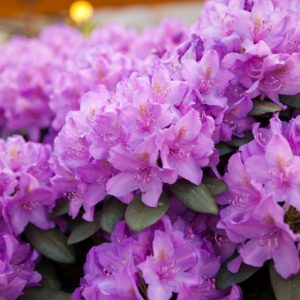
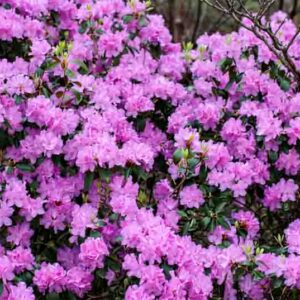
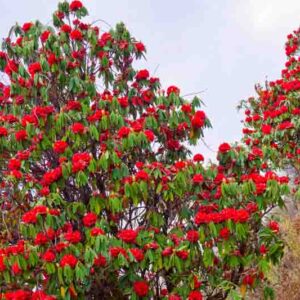
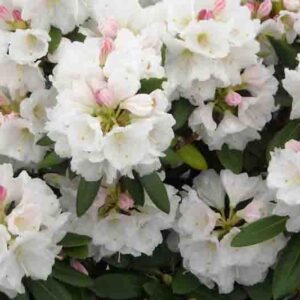
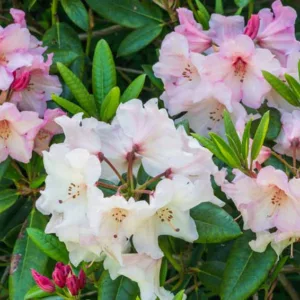
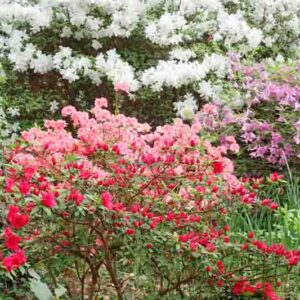
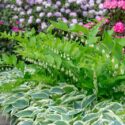
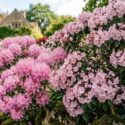
Large-leaved evergreen
Rhododendron catawbiense – broad foliage, substantial flower trusses.

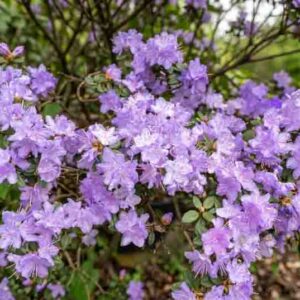
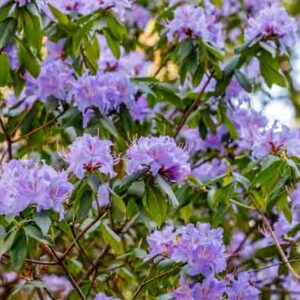
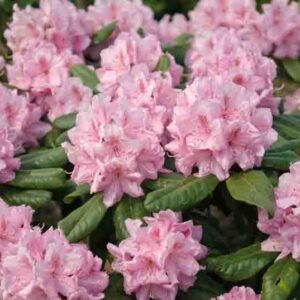
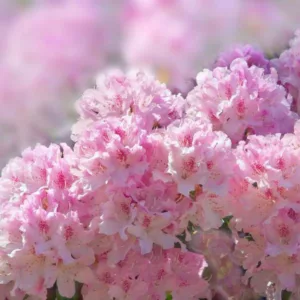
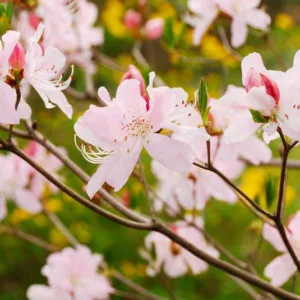
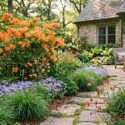
Small-leaved lepidote
Rhododendron ‘Ramapo’ – compact habit, fine foliage, violet flowers.
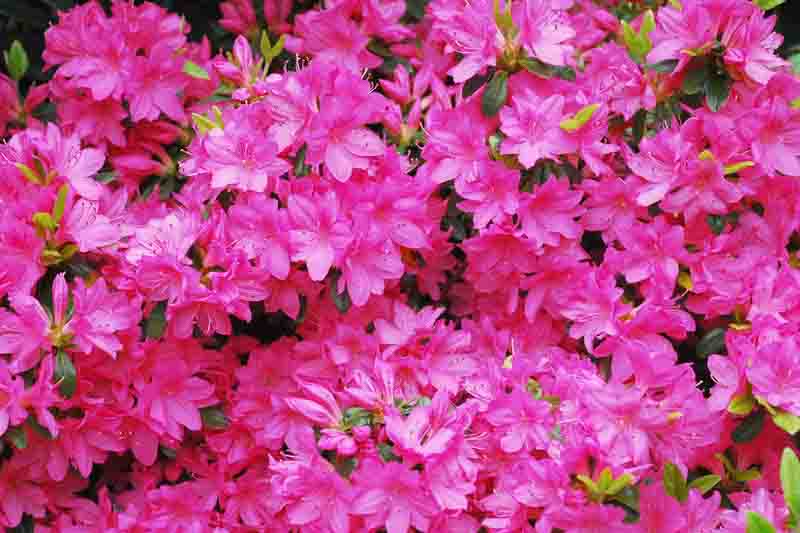
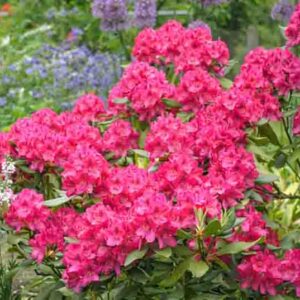
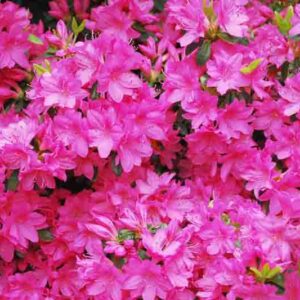
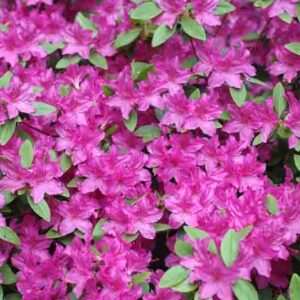
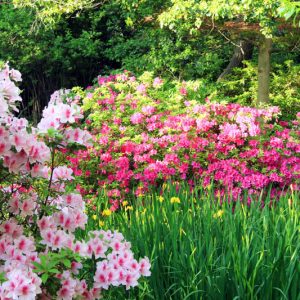
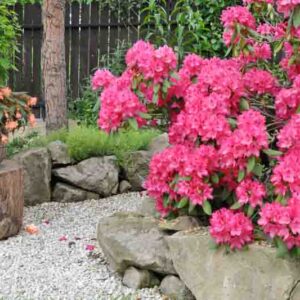
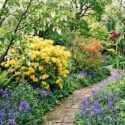
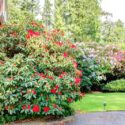
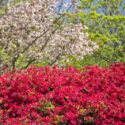
Evergreen azalea
Rhododendron ‘Girard’s Fuchsia’ – dense flowering and smaller leaves.
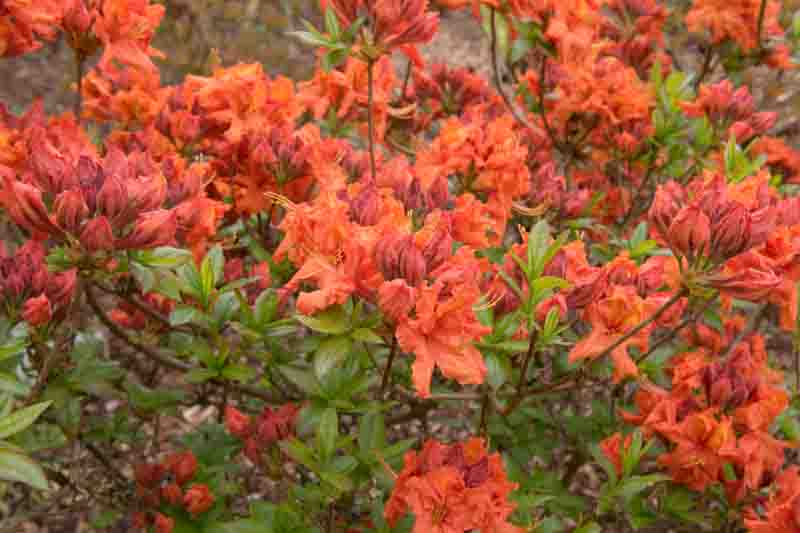
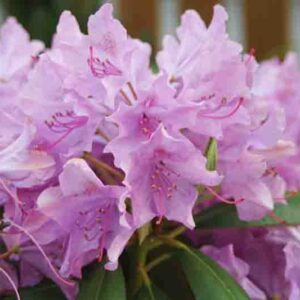
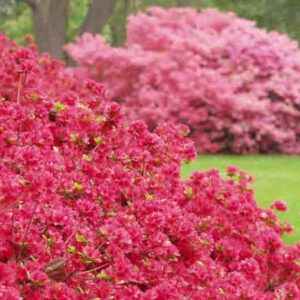
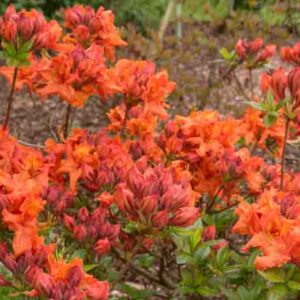
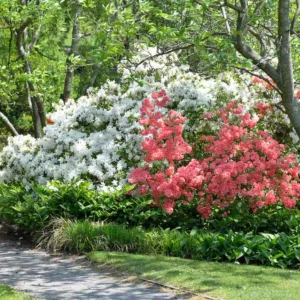
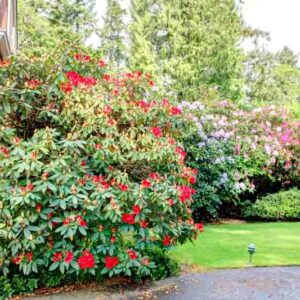
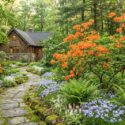
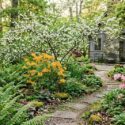
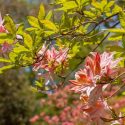
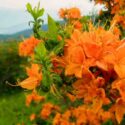
Deciduous azalea
Rhododendron ‘Gibraltar’ – fiery orange flowers and leaves that fall in autumn.
Important: These are useful horticultural groups, not four equivalent branches of a formal botanical classification. Wild species, named cultivars, and hybrids can belong to different groups. Lepidote rhododendrons are defined by leaf scales, not by small size alone.
These are the classic rhododendrons of woodland gardens: handsome evergreen shrubs carrying broad, often leathery leaves and magnificent clusters of flowers called trusses.
Most familiar large-leaved evergreens are elepidote rhododendrons. Their leaves lack the minute scales characteristic of lepidotes, although some have a woolly or felt-like covering of hairs, called indumentum, beneath the foliage.
Size is their biggest variable. Some selections remain relatively compact, while others become substantial shrubs that eventually resemble small trees.
| Hardiness |
4 - 9 |
|---|---|
| Plant Type | Shrubs |
| Genus | Rhododendron |
| Exposure | Full Sun, Partial Sun |
| Season of Interest | Spring (Early, Mid, Late), Summer (Early), Fall, Winter |
| Maintenance | Low |
| Water Needs | Average |
| Soil Type | Clay, Loam, Sand |
| Soil pH | Acid |
| Soil Drainage | Moist but Well-Drained |
| Tolerances | Rabbit |
| Attracts | Butterflies, Hummingbirds |
| Landscaping Ideas | Beds And Borders, Patio And Containers, Small Gardens |
| Garden Styles | City and Courtyard, Gravel and Rock Garden, Informal and Cottage, Japanese Garden, Traditional Garden |
Best for: Substantial evergreen structure, woodland planting, informal hedges, and screening.
Check before planting: Mature spread and root-zone drainage. A shrub that looks manageable in a container may eventually be wider than the planting bed.
Many lepidote rhododendrons have smaller, finer-textured leaves than the familiar broad-leaved evergreens. Some are miniature alpine shrubs, while others can reach several feet in height.
The defining feature is microscopic or minute scales on the leaves, particularly underneath. Several species have aromatic foliage, and flower colors range from purple and blue-violet to pink, yellow, and white.
‘Ramapo’ forms a dense, low evergreen shrub with violet-purple flowers and blue-green foliage that develops bronze tones in colder weather. It typically reaches about 2 ft. (60 cm) tall and 2-3 ft. (60-90 cm) wide, making it a useful alternative to much larger rhododendrons.
The PJM Group includes remarkably cold-hardy hybrids developed by the Mezitt family in Massachusetts. Many have lavender to reddish-purple flowers, small aromatic evergreen leaves, and mahogany-purple winter foliage. ‘PJM Elite’ may grow 5-6 ft. (1.5-1.8 m) tall and wide, illustrating why small-leaved does not necessarily mean dwarf.
Native to China, Rhododendron augustinii is prized for its unusually blue-toned flowers, ranging from pale lavender to violet-blue, often with greenish or brown spotting in the throat. Its narrow evergreen leaves have fine hairs above and scales beneath. This large, bushy shrub generally reaches 5-8 ft. (1.5-2.5 m) tall and wide in cultivation.
All azaleas belong to the genus Rhododendron, but gardeners continue to use the name azalea for their distinctive flowers, foliage, and growth habits.
Evergreen azaleas usually have relatively small, often hairy leaves and produce masses of flowers in spring. Their dense branching makes them useful in foundation plantings, borders, and containers.
Some are effectively semi-evergreen in colder regions. Certain types produce larger spring leaves and smaller summer leaves, with different amounts of foliage retained during winter.
Azalea or rhododendron? Leaf size, hairiness, flower form, and stamen number provide clues, but there are exceptions. See Gardenia’s Azalea vs. Rhododendron guide for a closer identification comparison.
Deciduous azaleas offer a different seasonal experience. They lose their leaves in autumn, but many compensate with intensely colored spring flowers, memorable fragrance, and attractive fall foliage.
They are especially effective at woodland edges, in naturalistic borders, and where a flowering shrub can contribute interest beyond its bloom period.
Other popular choices include the Northern Lights hybrids, bred for exceptional winter hardiness. They are particularly useful in regions where less hardy azaleas experience bud or stem damage.
Remember that plants native to North America are not necessarily native to every part of the continent. Choose species appropriate to your own region when ecological restoration or local native planting is the goal.
Rhododendron labels sometimes combine botanical names, group names, and cultivar names, which can make classification confusing.
A wild species may appeal to gardeners interested in botanical diversity or native planting. A hybrid may provide a particular combination of hardiness, flower color, or compactness.
Neither is automatically easier to grow. The correct choice depends on its documented requirements and performance in your climate.
Some rhododendrons truly develop into trees. Others are large shrubs that gradually become tree-like, while nursery-grown standards are shrubs trained into a single-stem form.
Rhododendron arboreum, commonly called Tree Rhododendron, is native to parts of the Himalayas and surrounding Asian regions. Its large, leathery evergreen leaves often have a silvery, cinnamon-brown, or fawn-colored felted underside. Rounded clusters of red, pink, or white flowers appear in early spring. The species can grow into a substantial tree, reaching a cultivated height of approximately 25-40 ft. (8-12 m), although wild specimens can exceed this in favorable habitats. Unlike the cold-hardy PJM Group, R. arboreum generally needs a sheltered, relatively mild site with acidic, moisture-retentive but well-drained soil. It is not a reliable tree choice for severe continental winters.
Some North American rhododendrons can develop impressive, tree-like forms with age. Rhododendron maximum(Rosebay Rhododendron), native to eastern North America, forms substantial woody stems and may reach 15-20 ft. (4.5-6 m) or more. On the Pacific Coast, Rhododendron macrophyllum (Pacific Rhododendron) is a large evergreen shrub that can occasionally grow into a small tree, reaching 25-30 ft. (7.6-9 m) in favorable conditions. Both are generally shrubby or multi-stemmed, unlike the more naturally tree-forming Rhododendron arboreum.
A rhododendron sold as a standard has been trained to grow with a clear stem and a rounded head. This describes how the plant was grown, not necessarily a naturally tree-forming species.
Before buying a rhododendron tree: Check its exact botanical identity, mature height, winter hardiness, and whether it is naturally tree-forming or a trained standard. A genuine tree species and a standard azalea are not interchangeable.
Botanical classification is helpful, but gardeners usually have a more immediate question: Which rhododendron should I actually plant?
Use the following comparison as a starting point, then verify each selection’s mature dimensions and local climate suitability.
| Garden need | Good starting choices | Check carefully |
|---|---|---|
| Very cold winters | PJM selections, Northern Lights azaleas, hardy Catawba hybrids | Flower-bud hardiness and frost exposure |
| Small garden | ‘Ramapo’, dwarf lepidotes, compact evergreen azaleas | Ultimate spread, not just ten-year size |
| Fragrance | Alabama Azalea, Swamp Azalea, fragrant hybrids | Flowering season and individual fragrance |
| More sunlight | ‘English Roseum’, selected PJMs, suitable deciduous azaleas | Summer heat and reliable moisture |
| Hot, humid summers | Heat-bred Southgate hybrids, locally adapted azaleas | Local hardiness, drainage, afternoon shade |
| Native garden | Regionally native rosebays and deciduous azaleas | Actual native range |
| Containers | ‘Ramapo’, dwarf evergreen azaleas | Root space, potting mix, winter root protection |
| Autumn leaf color | Deciduous azaleas, including ‘Gibraltar’ | Cultivar’s actual fall performance |
| Evergreen screening | Catawba Rosebay, ‘English Roseum’, larger evergreens | Full height, width and spacing |
Summer heat can be challenging for rhododendrons, particularly in the southeastern United States. Fortunately, some evergreen hybrids and native azaleas are better adapted to warmer conditions. Among large-leaved evergreens, ‘Scintillation’ is valued for its soft pink flowers and tolerance of heat and humidity. ‘Nestucca’ is a more compact, white-flowered selection with good reported sun and heat tolerance. For a native alternative, Florida Flame Azalea (Rhododendron austrinum) is adapted to warm southeastern climates and produces fragrant golden-yellow to orange flowers in spring.
Heat tolerance is not the same as drought tolerance or full-sun tolerance. Even heat-adapted rhododendrons require suitable soil, dependable moisture, and drainage. Many appreciate afternoon shade.
For narrower recommendations by climate, see Gardenia’s Choosing Azaleas and Rhododendrons guide and the regional rhododendron plant lists.
Two purple-flowering rhododendrons can look almost identical when photographed in bloom. To identify the plant more reliably, examine several features together.
These clues can often identify the horticultural group, but exact species or cultivar identification may require specialist keys or provenance records.
Identification shortcut: Start by establishing whether the shrub is evergreen or deciduous. Then examine leaf scales, hairs, flower clusters, and growth habit. Don’t identify a cultivar from flower color alone.
Now comes the decision that matters most. A rhododendron can have beautiful flowers, a prestigious award, and excellent cold hardiness, yet still be wrong for your garden.
For example: A gardener seeking a compact purple rhododendron may discover that ‘PJM Elite’ grows much too large, while ‘Ramapo’ fits the available space.
Another gardener looking for blue flowers might admire R. augustinii, only to find that its winter hardiness is unsuitable for their location.
These are the choices Gardenia’s Plant Finder can help narrow by growing conditions. Once you have selected plants, the Garden Design Tool can help assess compatibility, seasonal interest, mature size, and quantities within a planned garden.
Gardeners commonly distinguish large-leaved evergreen rhododendrons, small-leaved lepidote rhododendrons, evergreen azaleas, and deciduous azaleas. Species, hybrids, and named cultivars occur across these groups rather than forming separate equivalent categories.
Yes. All azaleas belong to the genus Rhododendron. Gardeners distinguish evergreen and deciduous azaleas because of their familiar growth habits and flowers, although their detailed botanical relationships are more complex.
Examine leaf retention, leaf size, scales or hairs, flower structure, growth habit, and flowering season. These clues help identify the group. Exact species or cultivar identification may require botanical keys or a reliable nursery label.
Dwarf lepidotes such as ‘Ramapo’, certain alpine species, and compact evergreen azaleas are useful starting points. Check both mature height and width; not all small-leaved rhododendrons are dwarf.
Rhododendron arboreum is a genuine tree-forming species that may reach 26-39 ft. (8-12 m) in suitable cultivation. Some other species become tree-like shrubs, while nursery standards are trained forms rather than necessarily true tree species.
PJM rhododendrons, selected hardy Catawba hybrids, and Northern Lights deciduous azaleas are good starting points. Confirm the specific cultivar’s hardiness and remember that early flowers may still be damaged by spring frost.
Start with winter hardiness, summer heat tolerance, mature size, sunlight, acidic soil, and drainage. Then compare flower color, fragrance, blooming season, foliage, and intended garden use. Gardenia’s Plant Finder and Design Tool can help narrow the choices.
There is no single best rhododendron for every garden. A dwarf lepidote, a fragrant native azalea, a large evergreen rosebay, and a tree rhododendron offer entirely different possibilities.
The most rewarding choice starts with knowing which type you are looking at, then finding a species or cultivar suited to your conditions. That way, the shrub you admire in spring can remain an asset to your garden for many years.
Updated by Gardenia: October 2026
| Hardiness |
4 - 9 |
|---|---|
| Plant Type | Shrubs |
| Genus | Rhododendron |
| Exposure | Full Sun, Partial Sun |
| Season of Interest | Spring (Early, Mid, Late), Summer (Early), Fall, Winter |
| Maintenance | Low |
| Water Needs | Average |
| Soil Type | Clay, Loam, Sand |
| Soil pH | Acid |
| Soil Drainage | Moist but Well-Drained |
| Tolerances | Rabbit |
| Attracts | Butterflies, Hummingbirds |
| Landscaping Ideas | Beds And Borders, Patio And Containers, Small Gardens |
| Garden Styles | City and Courtyard, Gravel and Rock Garden, Informal and Cottage, Japanese Garden, Traditional Garden |
Create a membership account to save your garden designs and to view them on any device.
Becoming a contributing member of Gardenia is easy and can be done in just a few minutes. If you provide us with your name, email address and the payment of a modest $25 annual membership fee, you will become a full member, enabling you to design and save up to 25 of your garden design ideas.
Join now and start creating your dream garden!