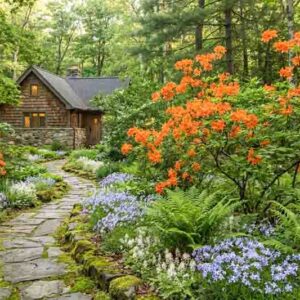
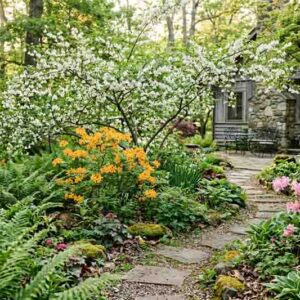
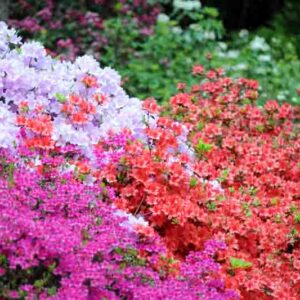
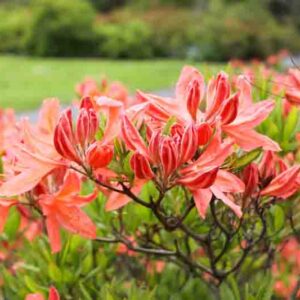
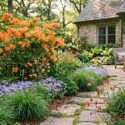
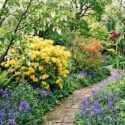
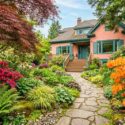
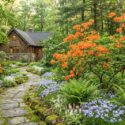
Create a beautiful, flowering privacy screen with evergreen rhododendrons. Discover the best varieties for tall woodland boundaries, dense garden hedges, and smaller spaces. Learn how to choose the right plants, calculate spacing, encourage fuller growth, and design a lush screen that looks attractive throughout the year.
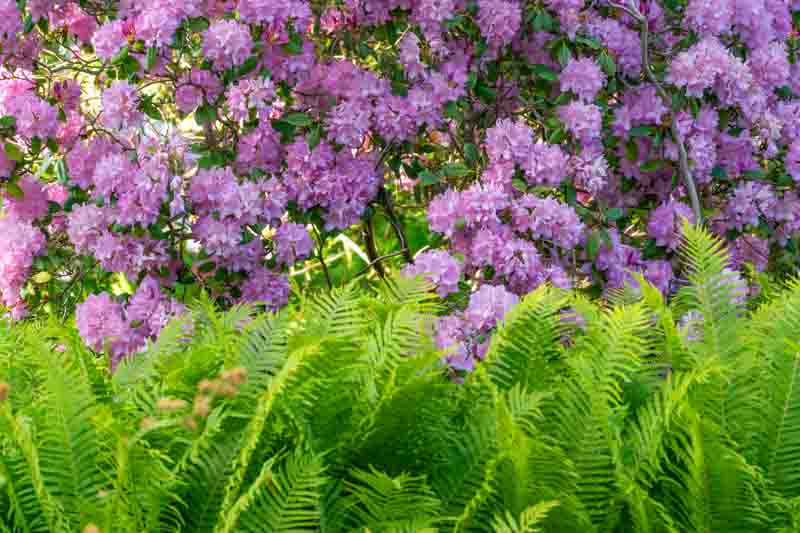


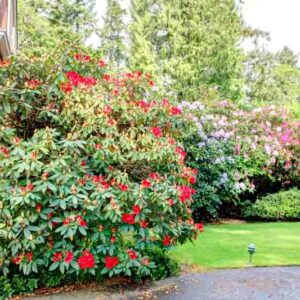
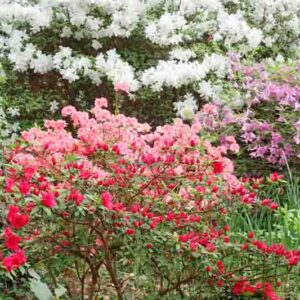
A rhododendron hedge offers something a fence never can: a magnificent display of spring flowers. For the rest of the year, its evergreen foliage provides privacy, shelter, and a beautiful backdrop for the garden.
But not every rhododendron makes a good hedge. Some form dense, leafy shrubs ideal for screening, while others develop into large woodland specimens with open lower branches. The difference matters when you’re trying to hide a neighboring window or create a private patio.
Which rhododendrons are best for privacy? For a flowering evergreen hedge around 6-8 ft. (1.8-2.4 m) tall, consider ‘English Roseum’, ‘Roseum Elegans’, and ‘Nova Zembla’. For larger woodland screens, Rhododendron maximum and R. catawbiense are worth considering. Smaller varieties such as ‘PJM Elite’ and ‘Nestucca’ create attractive lower boundaries.
The best choice depends on how much privacy you need, the space available, and whether your garden has the right growing conditions.
Yes, especially if you prefer a broad, informal evergreen hedge to a tightly clipped wall. Their substantial leaves provide year-round structure, while their flowers transform an ordinary boundary into a spring highlight.
Rhododendrons work particularly well in three situations:
They are not usually the quickest way to establish privacy. Most grow at a moderate or relatively slow rate, require acidic soil, and become considerably wider than gardeners expect.
Gardenia’s privacy rule: Height alone doesn’t guarantee screening. A tall rhododendron with bare lower branches may block fewer views than a shorter, densely branched shrub. Look at mature width and foliage density, not just maximum height.
For most residential gardens with enough planting space, these three substantial evergreen hybrids make attractive flowering screens.
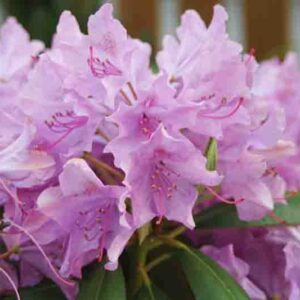
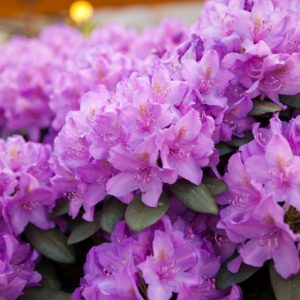
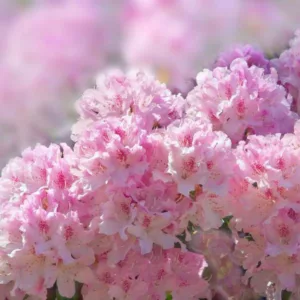
Rhododendron ‘English Roseum’ combines a dense, rounded habit with generous clusters of lilac-rose flowers in late spring to early summer. Growing approximately 6-8 ft. tall and wide (1.8-2.4 m), it provides good evergreen coverage and is valued for its tolerance of cold, humidity, and some sun exposure.
Best for: Broad flowering hedges and medium-height privacy screens.
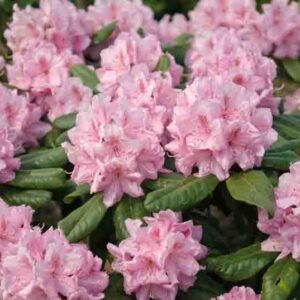
Rhododendron ‘Roseum Elegans’ produces large clusters of rosy lavender flowers above glossy evergreen leaves. Its rounded, spreading growth, typically 6-8 ft. tall and wide (1.8-2.4 m), creates a substantial presence in sheltered woodland gardens.
Best for: Informal flowering hedges and generous evergreen borders.
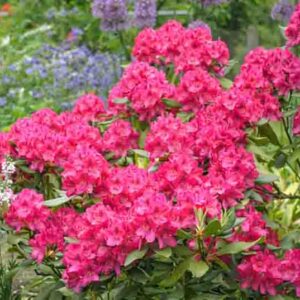
Rhododendron ‘Nova Zembla’ brings vivid red flowers with darker markings and handsome evergreen foliage. Its vigorous, relatively upright habit makes it appealing for colorful screens. Allow approximately 6-8 ft. in height (1.8-2.4 m) and 5-7 ft. in width (1.5-2.1 m).
Best for: Flowering privacy screens and mixed evergreen boundaries.
| Plant Type | Shrubs |
|---|---|
| Genus | Rhododendron |
| Exposure | Partial Sun |
| Season of Interest | Spring (Early, Mid, Late), Summer (Early), Fall, Winter |
| Maintenance | Low |
| Water Needs | Average |
| Soil Type | Clay, Loam, Sand |
| Soil pH | Acid |
| Soil Drainage | Moist but Well-Drained |
| Characteristics | Showy |
| Tolerances | Rabbit |
| Attracts | Butterflies, Hummingbirds |
| Landscaping Ideas | Hedges And Screens |
| Garden Styles | City and Courtyard, Informal and Cottage, Japanese Garden, Traditional Garden |
On larger properties, evergreen species can create impressive natural boundaries. These are better suited to informal woodland screening than narrow, clipped hedges.
Great Laurel is an eastern North American native with long, dark green leaves and white to pale pink flowers in early to midsummer. Reaching approximately 5-15 ft. tall (1.5-4.5 m), it tolerates considerable shade and creates an imposing woodland presence.
Its lower branches may become open with age, so shorter evergreen companions can help fill gaps near the ground.
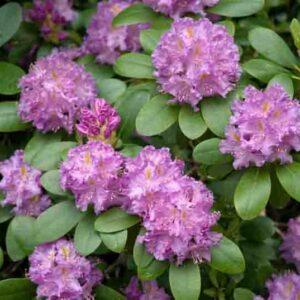
Catawba Rosebay produces striking lilac-purple flowers above broad evergreen foliage. Growing approximately 6-10 ft. tall (1.8-3 m) and potentially 8-12 ft. wide (2.4-3.7 m), this eastern native needs generous space but makes a beautiful woodland boundary.
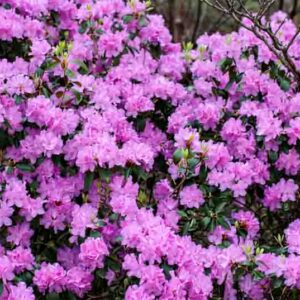
Pacific Rhododendron brings pink to purple spring flowers to suitable West Coast gardens. It can reach approximately 4-15 ft. tall (1.2-4.5 m), developing a broad, sometimes open framework.
It is better suited to a naturalistic screen than a uniform hedge, particularly in the moist woodland and maritime climates of its native range.
Sometimes all you need is a flowering boundary around a patio, terrace, or garden room. These three selections offer attractive evergreen foliage without the scale of the larger hybrids.
‘PJM Elite’ develops a dense, rounded habit approximately 5-6 ft. tall and wide (1.5-1.8 m). Its reddish-purple spring flowers and bronze-tinted winter foliage make it particularly appealing for lower evergreen screens.
‘Scintillation’ bears magnificent pale pink flower clusters above large evergreen leaves. Growing approximately 4-6 ft. tall and wide (1.2-1.8 m), it makes an elegant ornamental screen, although its somewhat open habit is less suited to a dense, formal hedge.
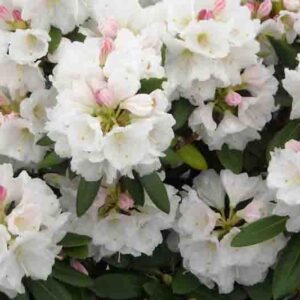
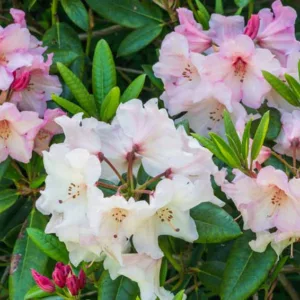
‘Nestucca’ produces large white flowers opening from raspberry-pink buds in mid to late spring. Its compact, spreading growth, approximately 3-4 ft. tall and wide (90-120 cm), makes it an excellent choice for low flowering hedges and smaller gardens.
Plant too far apart and gaps may remain visible for years. Plant too closely and the shrubs may eventually compete for water, nutrients, and space.
For an informal screen with some eventual overlap, a preliminary planning estimate is to space plants at approximately 70-85% of their expected mature width, measured from center to center. This is a design guideline, not a universal planting rule.
For a 30 ft. (9.1 m) boundary, six shrubs planted approximately 5 ft. (1.5 m) apart may be a reasonable starting point if their expected mature spread is around 6 ft. (1.8 m).
Adjust the final number for end setbacks, branch density, and growing conditions. Naturally open species may need a second layer of shrubs rather than closer spacing.
Before buying your plants: Use Gardenia’s Garden Design Tool to compare mature sizes, growing conditions, and planting quantities. It helps you prepare a planting plan, although it does not calculate sightlines or guarantee visual privacy.
Rhododendrons prefer acidic soil, generally around pH 4.5-6.0, that stays moist but drains freely. Most large-leaved varieties appreciate partial sun or dappled shade, particularly where summers are hot.
For more detailed advice, explore rhododendron sun requirements and soil and fertilizer recommendations.
Newly planted shrubs need consistent attention until their roots establish. Avoid both prolonged drought and waterlogged soil.
Rhododendrons generally look better with selective pruning than frequent close clipping. Shorten overly long branches and remove damaged or crowded growth, preferably immediately after flowering.
Late pruning may remove flower buds for the following spring, while severe cuts into old wood can produce unpredictable regrowth.
For detailed techniques, read How and When to Prune Rhododendrons.
How quickly will your hedge grow? Growth depends on cultivar, starting size, and site conditions. Choose healthy, well-branched nursery plants, and remember that good foliage coverage is just as important as height.
Two important cautions: Rhododendrons are poisonous if ingested by people and animals. Also avoid planting Rhododendron ponticum where it is invasive, including Great Britain and other affected regions.
Woodland boundary: Plant taller species such as R. maximum or R. catawbiense behind lower evergreen shrubs. The layered foliage creates a softer screen and helps conceal open lower branches.
Flowering patio screen: Use ‘English Roseum’ or ‘Roseum Elegans’ in a generous planting bed, where their flowers can be enjoyed from a nearby seating area.
Mixed evergreen border: Combine rhododendrons with shrubs that share their soil, light, and moisture requirements. Explore Best Companion Plants for Rhododendrons and Azaleas for planting inspiration.
Before purchasing your plants, consider the height and width of the screen you want, the growing conditions, and the space each shrub will eventually occupy.
Gardenia helps you move from inspiration to a practical plan. Use the Plant Finder to choose suitable shrubs, then the Design Tool to compare their mature sizes, compatibility, seasonal interest, and planting quantities.
‘English Roseum’, ‘Roseum Elegans’, and ‘Nova Zembla’ are good choices for broad flowering evergreen hedges. For taller woodland screens, consider Rhododendron maximum and R. catawbiense.
Spacing depends on mature width and growth habit. Approximately 70-85% of expected mature spread can be used as a preliminary estimate for an informal overlapping screen, but this is not a universal planting standard.
Evergreen rhododendrons retain foliage through winter and can provide year-round screening. Deciduous azaleas lose their leaves in fall.
Growth depends on the cultivar, nursery plant size, and site conditions. Rhododendrons generally provide privacy gradually, and dense side branching is as important as height.
Light shaping is possible, but most large-leaved rhododendrons are better suited to informal hedges. Selective pruning soon after flowering helps preserve their natural shape and next year’s flower buds.
Updated by Gardenia: October 2026.
| Plant Type | Shrubs |
|---|---|
| Genus | Rhododendron |
| Exposure | Partial Sun |
| Season of Interest | Spring (Early, Mid, Late), Summer (Early), Fall, Winter |
| Maintenance | Low |
| Water Needs | Average |
| Soil Type | Clay, Loam, Sand |
| Soil pH | Acid |
| Soil Drainage | Moist but Well-Drained |
| Characteristics | Showy |
| Tolerances | Rabbit |
| Attracts | Butterflies, Hummingbirds |
| Landscaping Ideas | Hedges And Screens |
| Garden Styles | City and Courtyard, Informal and Cottage, Japanese Garden, Traditional Garden |
Create a membership account to save your garden designs and to view them on any device.
Becoming a contributing member of Gardenia is easy and can be done in just a few minutes. If you provide us with your name, email address and the payment of a modest $25 annual membership fee, you will become a full member, enabling you to design and save up to 25 of your garden design ideas.
Join now and start creating your dream garden!