How far apart should tomato plants be? The answer depends on much more than variety. Compare spacing for determinate and indeterminate tomatoes, stakes, cages, trellises, Florida weave, raised beds and sprawling plants. Gardenia's four-factor approach matches spacing to growth habit, stem count, support system and airflow needs.


How far apart should you plant tomatoes? There is no single spacing that works for every tomato plant.
A compact determinate tomato grown in a cage, an indeterminate tomato trained to one stem, and an unpruned tomato allowed to sprawl can all need very different amounts of room. Plant them all 18 inches apart and one planting may work beautifully while another turns into a dense wall of stems and leaves.
For most home gardens, tomato plants are commonly spaced somewhere between 18 and 36 inches (45-90 cm) apart, but the right distance depends on mature plant size, growth habit, support, pruning or training method, and local growing conditions. Vigorous unsupported plants may need 3-4 feet (90-120 cm) or more.
Gardenia Tomato Spacing Principle: Do not choose spacing from fruit size or from one universal number on a chart. Match growth habit + stem count + support system + airflow needs. The mature canopy you intend to maintain determines how much horizontal space each tomato requires.
Use this table as a practical starting point, then adjust for cultivar vigor, pruning, climate, and support.
| Tomato / Growing System | Practical Plant Spacing | Why |
|---|---|---|
| Dwarf / very compact tomato | About 12-18 in. (30-45 cm), cultivar dependent | Compact architecture occupies less horizontal space. |
| Determinate, supported | About 18-30 in. (45-75 cm) | Final plant width varies substantially among cultivars. |
| Determinate, bushy / unsupported | About 24-36 in. (60-90 cm) | More lateral growth needs more room. |
| Indeterminate, staked / narrow leaders | About 18-24 in. (45-60 cm) | Pruning keeps the canopy narrow and vertical. |
| Florida weave / basket weave | About 18-24 in. (45-60 cm) | Plants are contained upright along a supported row. |
| Indeterminate, large cage | About 30-36 in. (75-90 cm) | Multiple stems create a broader canopy. |
| Indeterminate, sprawling | About 36-48 in. (90-120 cm) or more | Unsupported vines occupy substantial ground area. |
These are practical ranges, not biological absolutes. A tomato grown as a single leader occupies far less horizontal space than the same cultivar grown with several stems or allowed to sprawl.
Spacing is not simply about whether plants fit on planting day. A six-inch transplant can become several feet wide and, in the case of an indeterminate tomato, six feet tall or considerably more.
Proper spacing improves:
Air circulation: foliage dries more quickly after dew, rain, or irrigation.
Light penetration: neighboring plants are less likely to shade one another heavily.
Disease management: open plants are easier to inspect and diseased leaves easier to remove.
Harvest access: you can reach fruit without breaking stems or crawling through foliage.
Pruning and tying: there is room to maintain supports throughout the season.
Root access to water and nutrients: closely planted tomatoes share the same soil resources.
Support performance: cages, stakes, trellises, and weave systems need space to function properly.
Spacing is really canopy management. You are not spacing the small transplant you see in spring. You are allocating room for the mature canopy you intend to create by midsummer.
Determinate tomatoes grow to a genetically limited size and tend to ripen much of their crop during a relatively concentrated period. They are often called bush tomatoes, but “determinate” does not mean every cultivar has the same mature width.
A useful starting range is:
Compact determinate cultivars: about 18-24 inches (45-60 cm) apart when mature size allows.
Full-sized supported determinates: about 24-30 inches (60-75 cm) apart.
Bushy unsupported determinates: about 24-36 inches (60-90 cm) apart.
Some dwarf or exceptionally compact tomatoes can fit more closely, but always check cultivar-specific mature dimensions when those are available.
Growth habit tells you how the plant grows. It does not give you one universal plant diameter.
Indeterminate tomatoes continue producing stems, leaves, flowers, and fruit while conditions remain favorable. Because their potential size is much greater, spacing depends heavily on how you intend to manage that growth.
The same cultivar might reasonably be planted:
18-24 inches apart when trained vertically to one or two narrow leaders.
30-36 inches apart when grown in a generous cage with several stems.
36-48 inches or more when minimally pruned and allowed to spread.
This is why one spacing number for every indeterminate tomato is misleading.
For more on how pruning changes tomato architecture, see Gardenia’s How and When to Prune Tomatoes and Tomato Suckers: Should You Remove Them?.
Gardenia spacing rule: The more stems you keep, the wider the canopy becomes. A single-leader tomato and an unpruned tomato may have identical genetics but should not automatically receive identical spacing.
Staking allows tomatoes to use vertical rather than horizontal space. For indeterminate tomatoes trained fairly narrowly, 18-24 inches (45-60 cm) between plants is a reliable home-garden range.
Intensively managed single-leader systems can sometimes use closer spacing, but tighter planting increases the need for disciplined pruning, irrigation, feeding, support, and disease monitoring.
For most home gardeners, planting full-sized indeterminate tomatoes much closer than 18 inches provides little advantage unless the entire system has been designed around high-density vertical training.
With staked tomatoes:
Install supports early: ideally at planting or soon afterward.
Choose the stem count: decide whether each plant will carry one, two, or several leaders.
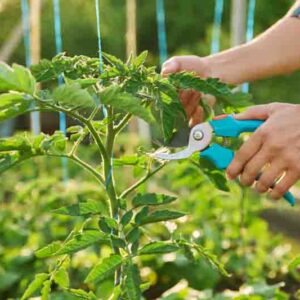
Remove or redirect suckers: maintain the architecture that justified the spacing.
Preserve useful foliage: avoid stripping plants so severely that fruit becomes exposed to sunscald.
Leave working room: you still need access for tying, pruning, inspection, and harvest.
A stake by itself does not make a tomato narrow. The training system does.
Caged tomatoes normally retain more stems and foliage than tightly staked plants, so they need more horizontal room.
For full-sized indeterminate tomatoes in substantial cages, about 30-36 inches (75-90 cm) between plants is an excellent practical starting point.
Determinate tomatoes in smaller cages may be planted closer if their mature width allows.
When planning the layout, consider the cage diameter too. Two cages that are 24 inches across cannot be placed 18 inches center-to-center without physically overlapping.
Also remember that foliage extends beyond the cage itself as the season progresses.
Vertical trellises and string systems can create a narrow tomato canopy when indeterminate plants are regularly trained to one or two leaders.
For most home gardens, 18-24 inches (45-60 cm) is a comfortable range.
Experienced growers using strict single-leader production may go tighter, but closer spacing makes pruning and canopy maintenance essential rather than optional.
Closer spacing is a management system, not a free-space trick. If tomatoes are planted closely because they will be trained to single leaders, they must actually remain single leaders. Stop maintaining the system and the planned spacing quickly disappears into foliage.
The Florida weave, also called basket weave, supports tomatoes in a row by running twine between regularly spaced stakes. Successive layers of twine hold stems upright as the plants grow.
Space tomatoes about 18-24 inches (45-60 cm) apart within the row as a practical home-garden starting point.
The system works particularly well for determinate and moderately vigorous tomatoes because many plants can share a continuous support structure.
For good results:
Drive sturdy stakes deeply enough to resist the weight of mature plants.
Add new layers of twine as the plants grow rather than waiting until stems flop outward.
Keep the row reasonably open rather than allowing every sucker to create a dense thicket.
Leave generous path space on both sides for tying, harvesting, and disease inspection.
The weave contains the row, but it does not eliminate the need for airflow or access.
Tomatoes allowed to grow without cages, stakes, trellises, or weave systems need substantially more horizontal room.
Allow approximately:
Determinate plants: about 24-36 inches (60-90 cm), depending on cultivar.
Indeterminate plants: about 36-48 inches (90-120 cm) or more.
Sprawling has disadvantages. Foliage and fruit remain closer to the soil, harvesting becomes more difficult, plants occupy more bed area, and dense stems can limit air movement.
Support is therefore usually worthwhile even when garden space is not severely limited.
Plant-to-plant spacing is only half the layout. You also need enough space between rows for light, air circulation, harvesting, watering, tying, and walking.
For outdoor home gardens, use these practical starting points:
Compact or well-trained tomatoes: about 4 feet (120 cm) between rows.
Large caged or bushy tomatoes: about 4-5 feet (120-150 cm).
Unsupported sprawling tomatoes: about 5 feet (150 cm) or more.
Raised beds and highly managed vertical systems can be arranged differently because access may come from dedicated paths on both sides rather than from space between conventional rows.
Think less about the empty soil between plants in spring and more about whether you will still be able to move through the garden in August.
Raised beds do not suspend the normal rules of plant architecture. Rich soil can produce vigorous plants, but it does not make foliage occupy less physical space.
For a typical 4-foot-wide raised bed:
Single row of large caged indeterminates: about 30-36 inches apart down the bed.
Single row of vertically trained indeterminates: about 18-24 inches apart.
Compact determinate tomatoes: approximately 18-30 inches apart depending on mature cultivar size.
A double row can work with compact tomatoes or carefully trained vertical systems, but avoid creating two dense walls of foliage that shade one another and cannot be reached from the bed edges.
Before planting, imagine the midsummer canopy and ask whether you will still be able to:
Reach the center of the bed for harvest.
Tie or prune every plant.
Inspect the undersides of leaves.
Remove diseased lower foliage.
Water the root zone without stepping into the bed.
Gardenia Raised-Bed Test: A spacing plan works only if mature plants still leave enough physical access to manage them. Maximum plant count is not the same as maximum productive use of the bed.
Often, yes.
Dense tomato canopies remain humid and dry slowly after rain, dew, or overhead irrigation. That matters because many foliar tomato diseases develop or spread more readily when foliage remains wet for prolonged periods.
If you garden in a humid climate or have a history of foliar disease:
Use the wider end of the recommended range.
Support plants rather than allowing them to sprawl.
Avoid unnecessarily dense multi-stem growth.
Water at soil level where practical.
Remove badly diseased lower foliage promptly.
Spacing alone cannot prevent early blight, Septoria leaf spot, bacterial spot, or late blight, but an open canopy is easier to inspect and dries more readily.
See Gardenia’s Tomato Diseases: Identification, Treatment & Prevention for diagnosis and management.
Heat changes the spacing equation in a different way.
Good airflow still matters, but very aggressive pruning combined with wide spacing can expose tomatoes directly to intense sun and increase sunscald risk.
In hot, bright climates:
Give plants enough room without stripping away excessive foliage.
Preserve healthy leaves that shade developing fruit.
Use mulch to moderate soil temperature and moisture loss.
Consider intense afternoon sun when positioning rows and supports.
The objective is not the sparsest possible canopy. It is a manageable canopy with reasonable airflow and sufficient foliage to protect fruit.
Do not determine spacing from fruit category alone.
A cherry tomato can grow on an enormous indeterminate vine, while a plant producing much larger fruit may have a compact determinate habit.
Cherry tomatoes: may be compact patio plants or extremely vigorous indeterminate vines.
Roma and paste tomatoes: include both determinate and indeterminate cultivars.
Beefsteak tomatoes: are often vigorous indeterminates, but growth habit still varies by cultivar.
Heirloom tomatoes: “heirloom” describes history or seed lineage, not mature plant size.
Fruit size does not predict plant size. Space tomatoes according to mature growth habit and training system, not according to whether the fruit is cherry, plum, slicing, or beefsteak sized.
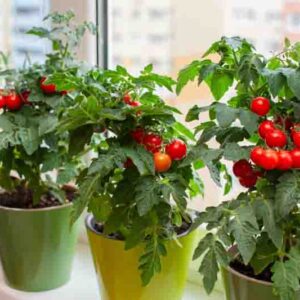
Container spacing is different because root systems may be physically separated, but mature canopies can still crowd one another.
For most home container gardens:
Grow one full-sized tomato per ordinary container.
Provide enough root volume for the mature cultivar.
Position pots so mature foliage is not permanently compressed together.
Leave access for watering, harvesting, pruning, and support maintenance.
Increase separation in humid or poorly ventilated locations.
Moving two pots closer together does not create root competition between the containers, but overlapping foliage still reduces access and air movement.
See Gardenia’s Growing Tomatoes in Containers: Complete Guide for cultivar selection, pot size, watering, support, feeding, and pruning.
Crowded tomatoes may still grow and produce fruit, but management becomes progressively harder.
Common consequences include:
Heavy shading: lower leaves receive less light.
Reduced airflow: humid foliage dries more slowly.
More difficult disease management: intertwined plants are harder to inspect and treat appropriately.
Harder harvesting: fruit becomes buried inside dense foliage.
More pruning pressure: gardeners may remove foliage simply to regain access.
Greater competition: closely spaced roots draw from the same soil moisture and nutrient supply.
Support conflicts: neighboring plants become tangled across cages, stakes, or strings.
Close spacing does not automatically cause disease, but it can create conditions that favor disease development and make problems harder to manage.
Yes, but excessive spacing is usually less troublesome than severe crowding.
Planting much farther apart than necessary mainly wastes productive garden space. The goal is not maximum distance – it is enough room for each mature canopy to function without unnecessary competition or crowding.
More space is not automatically better. Once a tomato has enough room for its intended mature canopy and for comfortable garden access, extra distance provides diminishing benefits.
If you are unsure how far apart to place a particular tomato, answer four questions before planting:
What is its growth habit? Dwarf, determinate, semi-determinate, or indeterminate?
How many stems will you keep? One trained leader occupies far less horizontal space than a multi-stem or unpruned plant.
What support will contain the canopy? Stake, string, trellis, cage, Florida weave, or none?
How much airflow does your climate demand? Humid, disease-prone gardens generally benefit from the wider end of the appropriate range.
Gardenia Four-Factor Tomato Spacing Test: Habit → Stem count → Support → Airflow. Change any one of those factors and the ideal spacing may change with it.
This is why useful spacing advice should describe the growing system, not just the cultivar name.
Use this sequence when planning your garden:
Dwarf or very compact cultivar? Start with the stated mature width; some can fit at roughly 12-18 inches apart.
Supported determinate? Start around 18-30 inches apart.
Unsupported bushy determinate? Move toward 24-36 inches.
Indeterminate trained to one or two leaders? About 18-24 inches is a useful home-garden range.
Florida weave? About 18-24 inches within the row is a practical starting point.
Large caged indeterminate? About 30-36 inches gives the multi-stem canopy more room.
Sprawling indeterminate? Allow roughly 36-48 inches or more.
Humid, disease-prone garden? Favor the wider end of the appropriate range.
Unsure how aggressively you will prune? Give the plant more room rather than relying on a narrow training system you may not maintain.
When in doubt, plan for the plant you are likely to grow, not the plant you imagine you will prune. An 18-inch spacing works only if the canopy is actually kept narrow enough to justify it.
For complete tomato planting, soil, watering, feeding, and seasonal care, continue with Gardenia’s How to Grow Tomatoes: Complete Planting & Care Guide. For cultivar selection and growth habits, explore Gardenia’s Tomato Varieties.
Most tomatoes are planted about 18-36 inches (45-90 cm) apart, but the correct distance depends on growth habit, mature size, pruning, and support. Narrowly trained indeterminate tomatoes may fit at 18-24 inches, while large caged or sprawling plants need substantially more room.
Determinate tomatoes are commonly spaced about 18-30 inches apart when supported, while large, bushy, unsupported cultivars may need 24-36 inches. Check the mature size of the specific cultivar because determinate tomatoes vary considerably in width.
Indeterminate tomatoes trained vertically to one or two leaders can often be spaced about 18-24 inches apart. Plants grown in large cages usually need around 30-36 inches, while sprawling indeterminate tomatoes may require 36-48 inches or more.
Twelve-inch spacing may work for some dwarf cultivars or specialized high-density single-leader systems, but it is too close for most full-sized home-garden tomatoes. Wider spacing is generally easier to manage.
Yes, particularly when indeterminate tomatoes are staked or trellised and regularly trained to a narrow canopy, or when compact cultivars are used. Eighteen inches is generally too tight for large multi-stem caged plants or tomatoes allowed to sprawl.
Yes. Two feet is a versatile spacing for many supported determinate tomatoes and vertically trained indeterminate tomatoes. Very vigorous, minimally pruned, or heavily caged plants may need more room.
Large caged indeterminate tomatoes generally benefit from about 30-36 inches between plants because cages retain multiple stems and create a broader canopy. Compact determinate cultivars may be spaced closer according to mature size.
Staked indeterminate tomatoes are commonly planted about 18-24 inches apart when kept to one or a few trained stems. More stems require more horizontal room, so spacing and pruning should be planned together.
About 18-24 inches between plants in the row is a practical starting point for a Florida weave or basket-weave system. Leave adequate row and path spacing for tying, harvesting, airflow, and plant inspection.
Vertically trained tomatoes can often be planted about 18-24 inches apart in raised beds, while large caged indeterminate plants usually need around 30-36 inches. Always preserve enough access for pruning, tying, watering, and harvest.
About 4 feet between rows is a useful starting point for compact or well-trained tomatoes, while large caged or bushy plants are easier to manage with 4-5 feet. Sprawling tomatoes may require 5 feet or more.
Not necessarily. Fruit size does not determine mature plant size. Some cherry tomatoes are extremely vigorous indeterminate vines and need as much or more room than large-fruited tomatoes.
Crowded tomatoes have poorer airflow, are harder to harvest and inspect, may shade one another heavily, and compete more intensely for water and nutrients. Dense foliage can also remain wet longer, making disease management more difficult.
Yes. Training an indeterminate tomato to one or two vertical leaders produces a much narrower canopy than allowing several stems to develop. Close spacing only works if the planned pruning and training are maintained throughout the season.
Using the wider end of the recommended range is often sensible in humid or disease-prone climates because a more open canopy improves air movement and helps foliage dry more quickly after rain, irrigation, or dew.
Spacing recommendations normally refer to the distance between plant centers or stems at planting. Mature foliage will extend beyond that distance, which is why expected canopy size and the training system must be considered before planting.
Updated: September 2026 • Reviewed by Gardenia Editors
| Hardiness |
2 - 11 |
|---|---|
| Climate Zones | 1, 1A, 1B, 2, 2A, 2B, 3, 3A, 3B, 4, 5, 6, 7, 8, 9, 10, 11, 12, 13, 14, 15, 16, 17, 18, 19, 20, 21, 22, 23, 24, A1, A2, A3, H1, H2 |
| Plant Type | Fruits |
| Plant Family | Solanaceae |
| Genus | Solanum, Tomatoes |
| Common names | Love Apple, Tomato |
| Exposure | Full Sun |
| Season of Interest | Spring (Late), Summer (Early, Mid, Late), Fall |
| Height | 3' - 10' (90cm - 3m) |
| Spread | 1' - 4' (30cm - 120cm) |
| Spacing | 24" - 36" (60cm - 90cm) |
| Maintenance | Average, High |
| Water Needs | Average |
| Soil Type | Clay, Loam, Sand |
| Soil pH | Acid, Neutral |
| Soil Drainage | Moist but Well-Drained |
| Tolerance | Rabbit, Clay Soil |
| Attracts | Bees |
| Landscaping Ideas | Patio And Containers |
| Garden Styles | City and Courtyard, Informal and Cottage, Pollinator Garden |
| Hardiness |
2 - 11 |
|---|---|
| Climate Zones | 1, 1A, 1B, 2, 2A, 2B, 3, 3A, 3B, 4, 5, 6, 7, 8, 9, 10, 11, 12, 13, 14, 15, 16, 17, 18, 19, 20, 21, 22, 23, 24, A1, A2, A3, H1, H2 |
| Plant Type | Fruits |
| Plant Family | Solanaceae |
| Genus | Solanum, Tomatoes |
| Common names | Love Apple, Tomato |
| Exposure | Full Sun |
| Season of Interest | Spring (Late), Summer (Early, Mid, Late), Fall |
| Height | 3' - 10' (90cm - 3m) |
| Spread | 1' - 4' (30cm - 120cm) |
| Spacing | 24" - 36" (60cm - 90cm) |
| Maintenance | Average, High |
| Water Needs | Average |
| Soil Type | Clay, Loam, Sand |
| Soil pH | Acid, Neutral |
| Soil Drainage | Moist but Well-Drained |
| Tolerance | Rabbit, Clay Soil |
| Attracts | Bees |
| Landscaping Ideas | Patio And Containers |
| Garden Styles | City and Courtyard, Informal and Cottage, Pollinator Garden |
Create a membership account to save your garden designs and to view them on any device.
Becoming a contributing member of Gardenia is easy and can be done in just a few minutes. If you provide us with your name, email address and the payment of a modest $25 annual membership fee, you will become a full member, enabling you to design and save up to 25 of your garden design ideas.
Join now and start creating your dream garden!
Create a membership account to save your garden designs and to view them on any device.
Becoming a contributing member of Gardenia is easy and can be done in just a few minutes. If you provide us with your name, email address and the payment of a modest $25 annual membership fee, you will become a full member, enabling you to design and save up to 25 of your garden design ideas.
Join now and start creating your dream garden!