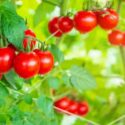
Growing tomatoes in containers is easy when the plant, pot, support, and watering routine work together. Learn how large a tomato pot should be, which varieties perform best, how often to water and feed, when to prune, and how to prevent blossom-end rot, cracking, root stress, and other common problems.
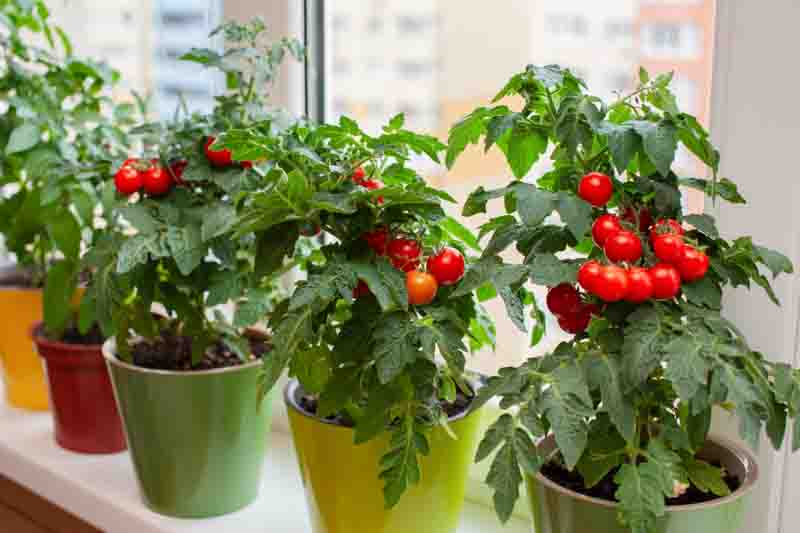


Growing tomatoes in containers can produce an impressive harvest from a balcony, patio, deck, rooftop, driveway, or small garden. But a productive potted tomato needs more than a sunny spot and a large bucket. Container-grown tomatoes live in a smaller, faster-changing root environment than plants in the ground. Their roots have less access to stored moisture and nutrients, pots heat up quickly, and tall vines can become surprisingly difficult to support.
The key is to treat the tomato, container, root system, support, watering routine, and pruning strategy as one connected system. A compact determinate tomato can be relatively easy to manage in a modest container, while a vigorous indeterminate cherry tomato may need considerably more root volume despite producing tiny fruit.
Gardenia Container Tomato Rule: Do not choose the pot according to fruit size. Match the container to the mature plant habit, root demand, support system, water demand, and management style. A one-ounce cherry tomato can grow on a much larger vine than a five-ounce tomato bred for compact patio production.
Almost any tomato can grow in a sufficiently large container, but some cultivars are much easier to manage than others.
Determinate tomatoes reach a genetically limited size and ripen much of their crop over a relatively concentrated period. Many work well in pots because their final structure is easier to accommodate.
Indeterminate tomatoes continue growing, flowering, and producing fruit until frost, disease, or unfavorable weather stops them. They can be excellent container plants, particularly when vertical growing space is available, but they generally demand more support, root volume, water, and training.
Dwarf tomatoes deserve separate consideration. Dwarf refers to stature and architecture, not necessarily to determinate growth. Some dwarf tomatoes remain compact while producing over a long season.
Before choosing a cultivar, consider five factors together:
Growth habit: determinate, indeterminate, semi-determinate, or dwarf.
Mature plant size: the size of the vine matters more than the size of the fruit.
Root volume: vigorous plants need a larger reservoir of water and nutrients.
Support: tall indeterminate plants need a container and support system that remain stable together.
Water demand: large fruiting plants in small pots can become difficult to keep evenly moist.
Gardenia Five-Factor Container Fit: A tomato is truly container-friendly when its growth habit + mature size + root volume + support requirement + water demand fit the space and care you can realistically provide. A “patio” label is useful, but this five-part fit is more informative.
For help choosing between growth habits, see Gardenia’s Determinate vs. Indeterminate Tomatoes.
The best tomato for a container depends on how much space, root volume, and support you can provide. Compact determinate and dwarf tomatoes are usually the easiest choices, but vigorous indeterminate cherry, cocktail, and slicing tomatoes can also be highly productive in large pots.
Do not assume that small fruit means a small plant. Some of the most vigorous tomatoes in the garden produce cherry-sized fruit, while certain compact plants produce much larger tomatoes.
Gardenia variety rule: Choose a container tomato by matching the mature plant habit to the pot, not by matching fruit size to the pot. A vigorous cherry tomato may need more root volume and support than a compact plant producing much larger fruit.
| Variety | Growth Habit | Why It Works in Containers | Gardenia Practical Pot Target |
|---|---|---|---|
| Patio Choice Yellow | Compact determinate | Very compact habit with abundant yellow cherry tomatoes; particularly useful where growing space is limited. | Follow cultivar-specific guidance; smaller pots may be sufficient |
| Celebrity | Determinate | Manageable growth, good-sized slicing fruit, and useful disease resistance make it a practical all-purpose choice. | About 7-10+ gallons |
| Roma | Determinate | A relatively manageable paste tomato producing a concentrated crop useful for sauces, roasting, and preserving. | About 7-10+ gallons |
| Mountain Magic | Compact indeterminate | Productive 2-ounce cocktail tomatoes, strong crack resistance, and excellent late-blight resistance in a relatively manageable indeterminate plant. | About 10+ gallons |
| Juliet | Indeterminate | A vigorous, productive grape tomato that responds well to vertical training and produces fruit over a long season. | About 10+ gallons |
| Sun Gold | Indeterminate | Exceptionally sweet orange cherry tomatoes and heavy production make it rewarding in pots, but the vine is vigorous and needs strong support. | About 10+ gallons |
| Black Cherry | Indeterminate | Richly flavored dark cherry tomatoes on productive vines. Excellent for a large container where vertical support is available. | About 10+ gallons |
| Super Sweet 100 | Indeterminate | Produces long clusters of sweet red cherry tomatoes, but its vigorous vines need generous root volume and tall support. | About 10+ gallons |
| Early Girl | Indeterminate | Useful when an earlier crop of medium-sized slicing tomatoes is a priority. Performs best in a substantial container with vertical support. | About 10-15+ gallons |
| Big Beef | Indeterminate | A larger-fruited choice for gardeners who want substantial slicing tomatoes and can provide a large pot, strong support, and consistent irrigation. | About 15-20+ gallons |
Small space? Start with a compact determinate or dwarf cultivar. Plenty of vertical space? A vigorous indeterminate cherry or cocktail tomato can be extremely productive in a 10-gallon or larger container. Want large slicers? Increase both root volume and support rather than trying to squeeze a beefsteak plant into a small pot.
Large heirloom tomatoes such as ‘Brandywine‘, ‘Mortgage Lifter‘, or ‘Cherokee Purple‘ can also be grown in containers, but they are not the easiest choices for beginners. Their vigorous vines, large fruit loads, and substantial water demand make them better suited to generous containers, often 15-20 gallons or more, with strong support and attentive watering.
Whatever cultivar you choose, remember that container size is only one part of the system. A large pot cannot compensate for poor sunlight, weak support, saturated soil, or inconsistent watering, while a carefully managed container can make even a vigorous indeterminate tomato surprisingly productive.
This is the question that causes the most confusion because minimum container size and ideal container size are not the same thing.
Some extension recommendations allow quite small volumes for compact cherry tomatoes, while standard tomatoes are commonly given a minimum around 5 gallons. Those numbers describe what can work under good management. They do not necessarily describe the easiest size for keeping a mature tomato watered, fed, upright, and productive through summer.
Minimum is not optimum: A tomato may survive and fruit in a relatively small pot, but additional root volume provides a larger reserve of water, nutrients, and physical stability. Gardenia therefore sizes containers for reliable management, not simply for the smallest volume in which a tomato might survive.
As a practical starting point, Gardenia recommends:
| Tomato Type | Gardenia Practical Target |
|---|---|
| Micro / very compact patio tomato | Follow cultivar-specific guidance; smaller pots may be sufficient |
| Compact determinate tomato | 5 gallons can work; 7-10 gallons usually gives a better moisture reserve |
| Full-sized determinate tomato | About 7-10+ gallons |
| Indeterminate cherry / cocktail tomato | About 10+ gallons for easier watering and support |
| Large indeterminate slicer / beefsteak | About 10 gallons is a useful practical starting target; 15-20+ gallons is often much easier to manage |
These are practical Gardenia targets, not universal biological minimums. A skilled gardener with automatic irrigation may successfully grow a vigorous tomato in less soil, while a gardener in a hot, windy climate may benefit enormously from using more.
The container should also be wide enough to remain stable. A narrow pot supporting a six-foot tomato can tip even if its nominal volume seems adequate.
Tomatoes are not concerned with whether their container is decorative or inexpensive, but container material changes how quickly the root zone heats and dries.
Plastic: Lightweight and relatively moisture-retentive. Often useful in hot, dry climates.
Fabric grow bags: Excellent aeration and drainage, but they can dry rapidly in heat and wind.
Glazed ceramic: Attractive and relatively moisture-retentive, but heavy once filled.
Unglazed terra-cotta: Porous and attractive, but moisture evaporates through the walls, increasing watering demand.
Self-watering containers: Useful where frequent irrigation is difficult, provided the reservoir is large enough for a mature tomato.
Food-safe buckets and recycled containers: Perfectly functional when clean, large enough, and provided with generous drainage.
On balconies and rooftops, consider weight as well as volume. A large container filled with wet potting mix can weigh many tens of pounds, and very large pots may approach or exceed 100 pounds. Make sure balconies, decks, wheeled stands, and benches can safely carry the load.
Every tomato container needs adequate drainage holes. Roots need both moisture and oxygen, and potting mix that remains permanently saturated can cause root stress, yellow foliage, poor nutrient uptake, wilting, and root disease.
Do not put gravel, rocks, or broken pot shards in the bottom as a “drainage layer.” They reduce usable root volume and do not solve poor drainage. The important combination is open drainage holes + a free-draining potting mix.
If you use saucers beneath containers, avoid leaving tomato roots standing continuously in stagnant water.
Do not diagnose wilt by appearance alone: A tomato can wilt because the pot is dry, but damaged roots in saturated soil can also leave the foliage limp. Check root-zone moisture before automatically adding more water.
Use a high-quality growing medium formulated for containers. Good potting mix combines moisture retention with drainage and aeration.
Garden soil by itself is generally too dense for pots. It can compact, drain poorly, restrict oxygen around roots, and become extremely heavy.
Container mixes commonly contain ingredients such as peat or coconut coir for water retention, bark or composted materials for structure, and perlite or similar materials for aeration.
Leave a little space below the rim so you can water deeply without washing soil over the sides.
Tomatoes need full sun. Aim for at least 6 hours of direct sunlight, with 8 hours or more generally supporting stronger growth and fruiting.
Containers, however, create a second temperature problem that in-ground tomatoes experience less severely: the roots themselves can overheat.
Dark containers on concrete, rooftops, balconies, or against west-facing walls can become far hotter than garden soil. A tomato may receive ideal sunlight while its root zone experiences unnecessary heat stress.
Hot-pot warning: Keep the foliage in good light while reducing unnecessary heating of the container. Larger pots, pale-colored containers, mulch, grouping pots together, or shading the pot itself can help moderate root-zone temperatures without shading the tomato canopy.
Container gardening also offers one useful advantage: smaller pots can sometimes be repositioned as seasonal light patterns change.
Water management is usually the hardest part of growing tomatoes in pots. A mature fruiting plant can use water remarkably quickly during hot, dry, or windy weather.
There is no reliable rule such as “one cup every morning” or “water every two days.” Demand changes with plant size, pot volume, container material, sunlight, temperature, wind, humidity, and fruit load.
Instead, check the root zone. Water thoroughly when the upper layer begins to dry, applying enough water to moisten the full root ball and produce some drainage from the bottom.
During cool weather, that may not be necessary every day. During hot summer weather, a large plant may need daily watering and exposed containers may need another moisture check later in the day.
Water the potting mix rather than routinely wetting foliage.
Wet the entire root zone rather than giving repeated shallow sips.
Check small pots and fabric bags more frequently.
Mulch the surface to slow evaporation.
Consider drip irrigation for multiple containers or when daily hand watering is difficult.
Gardenia Watering Rule: Water according to root-zone moisture, not the calendar. A fixed schedule ignores the two factors that change continuously through the season: plant demand and weather.
Container tomatoes depend on a limited volume of growing medium, and frequent watering gradually leaches soluble nutrients through the drainage holes. Regular feeding is therefore usually more important than it is in fertile garden soil.
A controlled-release fertilizer incorporated at planting, or regular applications of a complete soluble fertilizer labeled for vegetables or tomatoes, can both work well when used according to the product directions.
Avoid the assumption that more fertilizer means more fruit. Excessive nitrogen can produce lush green vines with disappointing flowering and fruiting.
Do not automatically add Epsom salts, extra calcium, or heavy potassium doses. Unnecessary fertilizer can raise soluble-salt levels and create nutrient imbalances.
Gardenia Feeding Rule: Aim for steady, balanced nutrition, not maximum fertilizer. If a healthy plant is growing, flowering, and setting fruit normally, adding extra nutrients simply because it is in a container may create more problems than it solves.
Install support at planting time or soon afterward. Pushing stakes or cages through a pot packed with mature roots can damage the root system.
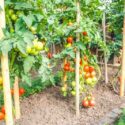
Determinate tomatoes often perform well with sturdy cages. Indeterminate plants may be trained on tall cages, stakes, trellises, or vertical strings.
The important point is that the support, plant, and container operate as one structure. A strong six-foot stake provides little security if a narrow lightweight pot can tip over in wind.
For exposed balconies and rooftops, choose broad containers and secure tall support systems where necessary.
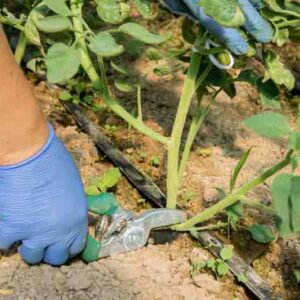
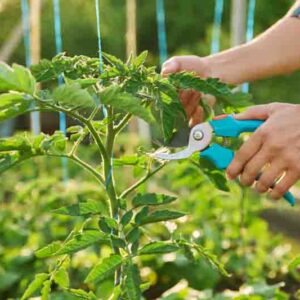
Do not prune a tomato merely because it is growing in a pot. Pruning should match the plant’s growth habit, available root volume, support system, and space.
For determinate tomatoes, routinely removing healthy suckers can reduce productive stems and potentially reduce the crop.
For indeterminate tomatoes, selective pruning can help fit a vigorous plant onto a vertical support. A one- or two-stem system may make sense on a narrow balcony, while a large cage and large container may support several stems.
A sucker is not useless growth. It is a lateral shoot capable of becoming another flowering and fruiting stem.
Gardenia Container Pruning Rule: Every retained stem adds production potential and resource demand. Keep extra stems only when the container has enough root volume, light, water, nutrients, and support to carry them. Pruning is therefore part of container sizing, not a separate decision.
For more detail, see Gardenia’s How and When to Prune Tomatoes and Tomato Suckers: Should You Remove Them?.
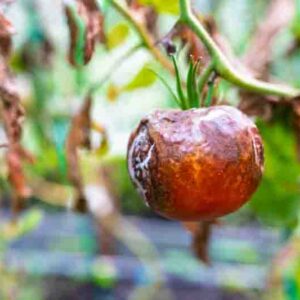
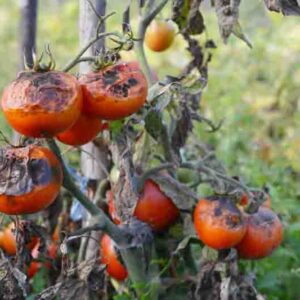
A dark, sunken patch at the blossom end of a tomato usually indicates that calcium is not reaching developing fruit adequately. It does not automatically prove that the potting mix lacks calcium.
In containers, irregular moisture, root stress, root damage, or excessive soluble salts can interfere with calcium delivery. Check moisture consistency and root health before automatically adding calcium.
See Gardenia’s Blossom-End Rot.
Cracking often follows rapid fruit expansion after a dry root zone suddenly receives abundant water. Maintain more even moisture and harvest ripe or nearly ripe fruit when severe rain is expected.
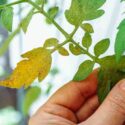
Yellow foliage can result from normal aging, drought, excessive water, restricted roots, nutrient imbalance, or disease. Look for the pattern before reaching for fertilizer.
Do not assume every wilted tomato needs irrigation. Saturated or damaged roots may be unable to supply the foliage even when the pot is wet.
Heavy pruning can suddenly expose developing tomatoes to intense sunlight. Maintain enough healthy foliage to shade fruit naturally.
Repeated fertilizer applications and mineral-rich irrigation water can leave salts behind. A pale crust on the soil surface or pot rim may be a clue. Periodic deep irrigation that allows water to drain freely can help flush accumulated salts when drainage is good.
For symptom-based diagnosis, use Gardenia’s Tomato Problems: What Is Wrong With My Plant?. For infectious diseases, see Tomato Diseases: Identification, Treatment & Prevention.
For most home containers, one tomato plant per pot is the simplest and most reliable approach.
Two tomatoes in one ordinary container do not simply produce twice as much. They compete for the same reservoir of root space, water, nutrients, oxygen, and physical support.
Very large planters can support multiple tomatoes when the total soil volume and spacing are adequate, but two vigorous plants crowded into a typical 5- or 10-gallon pot usually make watering and feeding harder.
The same logic applies to companion plants. Basil, marigolds, or herbs can share a very large planter, but every additional plant also draws from the root zone. In smaller containers, separate pots are often the better design.
If you want a dependable starting system rather than the absolute smallest setup that might succeed:
Choose a cultivar whose mature habit fits your available space.
Use roughly 5 gallons only as a practical starting minimum for many standard tomatoes, not as a universal ideal.
Move toward 10 gallons or more for vigorous indeterminate plants.
Use 15-20 gallons or more when growing large indeterminate slicers and easy watering matters.
Use fresh, high-quality potting mix with excellent drainage.
Install support at planting time.
Give the plant full sun while protecting the container from excessive heat where necessary.
Water according to root-zone moisture rather than a rigid schedule.
Feed steadily but avoid excessive fertilizer.
Prune according to growth habit, pot volume, and the number of stems your system can actually support.
Gardenia Container Success Equation: Right cultivar + enough root volume + stable support + steady moisture + balanced nutrition + manageable stem count = a productive container tomato. When a plant struggles, identify which part of that system is limiting it before automatically adding fertilizer, calcium, water, or pesticide.
For complete tomato care from planting through harvest, see Gardenia’s How to Grow Tomatoes: Complete Planting & Care Guide and the Tomato (Solanum lycopersicum) profile.
There is no single ideal size for every tomato. About 5 gallons is a practical minimum for many standard tomatoes, but 7-10 gallons is easier for many determinate plants, about 10 gallons or more is more forgiving for vigorous indeterminate tomatoes, and large slicers may benefit from 15-20 gallons or more.
Yes. Many tomatoes can grow and fruit in a 5-gallon bucket with drainage holes, good potting mix, full sun, regular feeding, support, and careful watering. Larger vigorous cultivars are usually easier to manage in larger containers.
Some compact cherry cultivars can grow in relatively small containers, but fruit size does not determine plant size. Vigorous indeterminate cherry tomatoes may require as much root volume and support as large-fruited cultivars.
Usually one. A single tomato already uses substantial root space, water, and nutrients. Crowding two plants into a 5-gallon container generally increases competition and watering stress.
Compact determinate, dwarf, patio, and smaller-statured cultivars are easiest to manage, but indeterminate tomatoes can also thrive in large containers. Choose according to mature habit, root demand, support, maturity, disease resistance, and fruit use.
Yes. Indeterminate tomatoes can be highly productive in pots when given enough root volume, sturdy vertical support, full sun, consistent moisture, and a stem-training system appropriate to the available space.
Do not rely on a fixed schedule. Check the root zone and water thoroughly when the upper potting mix begins to dry. Large fruiting plants may need daily watering in hot weather, while cooler conditions reduce demand.
Yes. Permanently saturated potting mix deprives roots of oxygen and can cause yellowing, wilting, root damage, nutrient problems, and disease. Containers need adequate drainage holes and a free-draining growing medium.
No. A gravel or rock layer does not replace drainage holes and can reduce usable root space. Use a well-drained potting mix in a container with adequate drainage openings.
Garden soil by itself is generally too dense and heavy for containers. Use a quality potting mix designed to provide both water retention and root aeration.
Usually yes. Container roots depend on a limited volume of growing medium, and frequent watering leaches soluble nutrients. Use a balanced fertilizer according to label directions and avoid excessive nitrogen.
Pruning depends on growth habit and the container system. Determinate tomatoes generally need little sucker pruning. Indeterminate tomatoes may be selectively pruned to control stem number when root volume, support, or available space is limited.
Blossom-end rot occurs when calcium does not reach developing fruit adequately. In containers, irregular moisture, root stress, root damage, or excessive salts can interfere with calcium delivery even when calcium is present in the potting mix.
Yes. Dark containers on concrete, balconies, rooftops, or against hot walls can become much warmer than garden soil. Larger or lighter-colored pots, mulch, and shading the container while keeping foliage in sun can help reduce root-zone heat stress.
Yes, provided the balcony receives enough direct sun and can safely support the weight of the containers. Use stable pots, secure tall plants against wind, and monitor moisture closely because balconies can be hot and exposed.
Updated: September 2026 • Reviewed by Gardenia Editors
| Hardiness |
2 - 11 |
|---|---|
| Climate Zones | 1, 1A, 1B, 2, 2A, 2B, 3, 3A, 3B, 4, 5, 6, 7, 8, 9, 10, 11, 12, 13, 14, 15, 16, 17, 18, 19, 20, 21, 22, 23, 24, A1, A2, A3, H1, H2 |
| Plant Type | Fruits |
| Plant Family | Solanaceae |
| Genus | Solanum, Tomatoes |
| Common names | Love Apple, Tomato |
| Exposure | Full Sun |
| Season of Interest | Spring (Late), Summer (Early, Mid, Late), Fall |
| Height | 3' - 10' (90cm - 3m) |
| Spread | 1' - 4' (30cm - 120cm) |
| Spacing | 24" - 36" (60cm - 90cm) |
| Maintenance | Average, High |
| Water Needs | Average |
| Soil Type | Clay, Loam, Sand |
| Soil pH | Acid, Neutral |
| Soil Drainage | Moist but Well-Drained |
| Tolerance | Rabbit, Clay Soil |
| Attracts | Bees |
| Landscaping Ideas | Patio And Containers |
| Garden Styles | City and Courtyard, Informal and Cottage, Pollinator Garden |
| Hardiness |
2 - 11 |
|---|---|
| Climate Zones | 1, 1A, 1B, 2, 2A, 2B, 3, 3A, 3B, 4, 5, 6, 7, 8, 9, 10, 11, 12, 13, 14, 15, 16, 17, 18, 19, 20, 21, 22, 23, 24, A1, A2, A3, H1, H2 |
| Plant Type | Fruits |
| Plant Family | Solanaceae |
| Genus | Solanum, Tomatoes |
| Common names | Love Apple, Tomato |
| Exposure | Full Sun |
| Season of Interest | Spring (Late), Summer (Early, Mid, Late), Fall |
| Height | 3' - 10' (90cm - 3m) |
| Spread | 1' - 4' (30cm - 120cm) |
| Spacing | 24" - 36" (60cm - 90cm) |
| Maintenance | Average, High |
| Water Needs | Average |
| Soil Type | Clay, Loam, Sand |
| Soil pH | Acid, Neutral |
| Soil Drainage | Moist but Well-Drained |
| Tolerance | Rabbit, Clay Soil |
| Attracts | Bees |
| Landscaping Ideas | Patio And Containers |
| Garden Styles | City and Courtyard, Informal and Cottage, Pollinator Garden |
Create a membership account to save your garden designs and to view them on any device.
Becoming a contributing member of Gardenia is easy and can be done in just a few minutes. If you provide us with your name, email address and the payment of a modest $25 annual membership fee, you will become a full member, enabling you to design and save up to 25 of your garden design ideas.
Join now and start creating your dream garden!
Create a membership account to save your garden designs and to view them on any device.
Becoming a contributing member of Gardenia is easy and can be done in just a few minutes. If you provide us with your name, email address and the payment of a modest $25 annual membership fee, you will become a full member, enabling you to design and save up to 25 of your garden design ideas.
Join now and start creating your dream garden!