When should tomato plants go outside? Frost date alone does not tell the whole story. Learn how soil temperature, nighttime weather, hardening off, planting depth, spacing, watering, and support affect transplant success, including how to plant leggy tomatoes, handle grafted plants correctly, and protect young plants from a late cold snap.


Knowing when to plant tomatoes outdoors can make the difference between seedlings that establish quickly and plants that sit stalled in cold soil for weeks. Tomatoes are warm-season plants. They are easily damaged by frost, establish slowly in chilly soil, and respond poorly when tender indoor-grown leaves are suddenly exposed to intense sun, wind, and fluctuating spring temperatures.
The best tomato planting date is therefore not simply “two weeks after the last frost” or whatever date appears on a regional calendar. Successful transplanting depends on several conditions lining up at once: frost risk, soil warmth, the short-term forecast, seedling hardening, and the readiness of the planting site.
Gardenia planting principle: Plant tomatoes when the soil and weather are ready for active growth, not simply when the calendar says you can. A tomato planted slightly later into warm soil often establishes faster than one planted early into cold ground.
Plant tomato transplants outdoors after the danger of frost has passed and the soil has warmed. For reliable establishment, soil temperatures around 60°F (16°C) or warmer are an excellent practical target.
Tomato growth slows substantially in cold conditions. Putting plants outside too early does not necessarily give you an earlier harvest because chilled roots absorb water and nutrients less efficiently and top growth may stall.
Nighttime temperatures also matter, but they should not be turned into a rigid planting rule. Tomatoes can survive cool nights above freezing, especially once hardened, but prolonged temperatures below about 50°F (10°C) slow growth. Once plants are flowering, repeated nights in the low-to-mid 50s°F (about 10-13°C) can also reduce pollen performance and fruit set.
These temperature measurements answer different questions:
| Question | What to Watch | Why It Matters |
|---|---|---|
| Could frost kill the plant? | Local frost risk and short-term forecast | Tomatoes are frost-tender. |
| Will roots establish actively? | Soil temperature around 60°F (16°C) or warmer | Cold soil slows root activity and establishment. |
| Will flowering and fruit set proceed normally? | Repeated cool nights, especially in the low-to-mid 50s°F | Cool conditions can reduce pollination efficiency and fruit set. |
Gardenia temperature rule: Do not collapse frost risk, soil temperature, and nighttime temperature into one magic planting number. They describe different biological risks. Use them together.
Instead of relying on a single date, use five checks before transplanting tomatoes into the garden.
Check your local average last frost date, but remember that an average is not a guarantee. It describes probability, not a promise that no later frost will occur.
A soil temperature around 60°F (16°C) is a useful target for transplanting tomatoes. Measure several inches below the surface in the planting area rather than judging by one warm afternoon.
Look beyond today’s temperature. Several cold, wet, windy nights immediately after planting can stress a transplant even if no frost occurs.
Indoor-grown or greenhouse tomatoes need gradual exposure to outdoor sun, wind, and temperature changes before permanent planting.
The soil should be workable rather than saturated, the support system should be available, and irrigation should be ready so the plant is not left drying while you finish preparing the bed.
Gardenia Five-Check Outdoor Planting Test: Plant when frost risk is acceptably low + soil is warm + the short-term forecast is mild + seedlings are hardened + the planting site is ready. Passing all five tests is more useful than chasing one perfect date.
An average last spring frost date is useful, but it should not be treated as an exact switch from “too early” to “safe.”
A late cold event can still occur after the average date, and local elevation, slope, cold-air drainage, nearby buildings, urban heat, and proximity to large bodies of water can make two gardens in the same region behave differently.
Use the frost date to tell you when to begin watching conditions closely. Then use soil temperature and the actual forecast to make the final decision.
Calendar trap: A warm afternoon after your average last frost date does not necessarily mean the garden is tomato-ready. Look at the coming week, not just the day you want to plant.
A good tomato transplant is compact, sturdy, healthy, and actively growing. Bigger is not automatically better.
Look for plants with:
A sturdy stem rather than a thin, stretched one.
Healthy green foliage without widespread yellowing, spotting, or distortion.
No visible aphids, whiteflies, mites, or other pests.
A well-developed root system that holds the growing mix together without being severely root-bound.
A clear cultivar label so you know its growth habit, maturity time, and expected size.
Avoid assuming that the largest plant at the nursery is automatically the best buy. Oversized plants that have remained too long in a small pot can be stressed and root-bound.
Plants already carrying large fruit may look appealing, but a compact vegetative transplant usually establishes more smoothly than one already investing heavily in fruit while confined to a nursery pot.
For help matching tomato growth habit to your garden, see Gardenia’s Determinate vs. Indeterminate Tomatoes.
Tomato seedlings grown indoors have lived in unusually gentle conditions: limited wind, relatively stable temperatures, and light levels far below direct outdoor sun. Moving them directly into the garden can cause leaf scorch, wilting, stem damage, and stalled growth.
Begin hardening tomatoes approximately 7-14 days before transplanting.
First days: Place plants outdoors for a few hours in a sheltered, shaded location.
Next: Gradually increase outdoor time and introduce gentle morning sun.
Then: Increase exposure to direct sunlight and normal air movement.
Final stage: Allow plants to spend most of the day outdoors when conditions are mild.
Bring tender seedlings back under protection when unusually cold or severe weather is forecast. Continue watering as needed because small nursery containers can dry rapidly outdoors.
Hardening-off rule: Harden seedlings to sun, wind, and temperature, not just to time outdoors. Six hours outside in dense shade does not prepare a tomato for six hours of direct sun.
Tomatoes perform best in full sun, with at least 6 hours of direct sunlight and preferably 8 or more for vigorous growth and good fruit production.
Choose soil that is fertile, moisture-retentive but well drained, and rich in organic matter. A pH around 6.0-6.8 suits tomatoes well.
Before planting:
Remove weeds that will compete for light, water, and nutrients.
Incorporate mature compost if organic matter or soil structure needs improvement.
Use a soil test where possible rather than adding lime, calcium, phosphorus, or fertilizer blindly.
Avoid working heavy soil while it is saturated.
Plan irrigation and support before the plants go into the ground.
Do not automatically add bone meal, Epsom salts, eggshells, or large amounts of fertilizer to every tomato planting hole. Amendments should solve an identified need rather than follow a ritual.
Gardenia soil rule: Prepare the root zone, not a highly enriched pocket. Tomato roots eventually spread well beyond the original planting hole, so good bed-wide soil structure matters more than creating a concentrated fertilizer zone around the transplant.
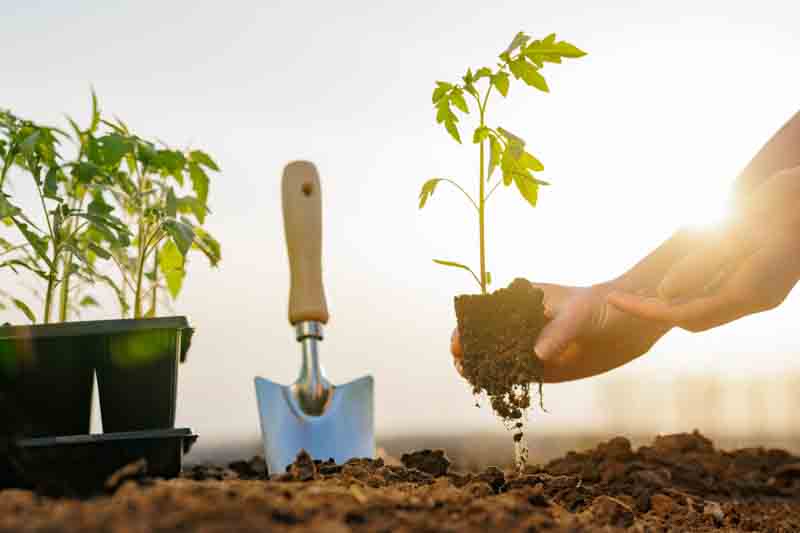
Most ungrafted tomatoes can be planted deeper than they grew in their nursery pots because buried stem tissue can produce additional roots.
For a normal ungrafted transplant:
Remove the lowest leaves that would otherwise be buried.
Dig a hole deeper than the original root ball.
Set the plant so part of the bare lower stem is below soil level.
Leave several healthy sets of leaves above ground.
Backfill gently and firm the soil enough to remove large air pockets without compacting it heavily.
Deep planting is particularly useful for slightly tall transplants because it places more stem in contact with moist soil while leaving a stockier plant above ground.
For an extremely tall, stretched seedling, use the trench method. Remove leaves from the lower portion of the stem, dig a shallow horizontal trench, lay the root ball and bare stem sideways, and cover them with soil while leaving the leafy growing tip above ground.
This can be preferable to digging a very deep vertical hole, especially where deeper soil remains cold or poorly drained.
Important exception – grafted tomatoes: Do not bury a grafted tomato above the graft union. Plant it approximately at the depth it grew in its container and keep the graft union at least about 1 inch (2.5 cm) above the soil. If the upper scion produces its own roots, it can bypass the rootstock and reduce the disease-resistance or vigor benefits for which the plant was grafted.
Gardenia planting-depth rule: Deep planting is useful for ordinary ungrafted tomatoes, but grafted tomatoes are the exception. Identify which type of transplant you have before burying the stem.
Tomato spacing should be based on the cultivar, support system, and amount of pruning rather than one universal number. For a detailed comparison of spacing by growth habit and training method, see Gardenia’s Tomato Plant Spacing: How Far Apart to Plant.
A useful general starting range for many home-garden tomatoes is about 24-36 inches (60-90 cm) between plants. Supported and intensively trained tomatoes may be spaced more closely, while broad caged or sprawling plants need considerably more room.
| Growing Style | Spacing Approach |
|---|---|
| Compact determinate tomatoes | Often fit toward the closer end of the range. |
| Staked or single-leader indeterminate tomatoes | Can often be grown closer together when actively trained. |
| Caged, multi-stem indeterminate tomatoes | Need more horizontal room for a broad canopy. |
| Unpruned or sprawling tomatoes | Need substantially more horizontal space. |
In humid or disease-prone gardens, generous spacing can help foliage dry more quickly and make inspection and harvesting easier.
Gardenia spacing rule: Spacing and pruning are linked. The more stems and foliage you intend to keep, the more horizontal room the plant generally needs. Do not copy a close spacing recommendation from a single-stem system and apply it to an unpruned tomato growing in a large cage.
When possible, transplant tomatoes on a cloudy, calm day or later in the afternoon rather than during intense midday sun and drying wind.
This gives the plant several cooler hours to begin settling into the soil before facing full daytime stress.
If you must plant during hot, bright weather, water carefully and consider temporary light shading for newly transplanted seedlings while they establish.
Avoid transplanting immediately before severe wind, torrential rain, hail, or a sharp temperature drop simply because the calendar says planting day has arrived.
Once conditions are suitable and the seedlings are hardened, transplanting is straightforward.
Water the seedling before planting. A moist root ball is less vulnerable to drying during transplanting.
Prepare the planting hole. Make it deep enough to bury part of the stem if the plant is ungrafted.
Remove lower leaves if necessary. Take off only those that would be buried.
Remove the plant carefully from its pot. Support the root ball and avoid unnecessary root tearing.
Set an ungrafted tomato deeper if useful. Use the trench method for a very leggy transplant. Keep a grafted tomato’s graft union above the soil.
Backfill with garden soil. Firm gently around the root ball and buried stem.
Water thoroughly. Wet the surrounding root zone to settle the soil around the roots.
Install support. Cage, stake, or trellis the plant before roots and stems make installation difficult.
Label the cultivar. This becomes surprisingly important once several similar tomato plants mature.
If plants were grown in peat or fiber pots, make sure no absorbent rim remains exposed above the soil, where it can wick moisture away from the root ball.
Water newly transplanted tomatoes thoroughly after planting and keep the root zone reasonably moist while new roots move into the surrounding soil.
Do not keep the soil saturated. Tomato roots need oxygen as well as water.
Once the soil is warm, apply an organic mulch such as clean straw or shredded leaves around the plants. Mulch can reduce evaporation, suppress weeds, moderate soil-moisture fluctuations, and limit soil splash onto lower foliage.
Keep thick mulch from being packed tightly against the stem.
For complete watering, feeding, support, pruning, and harvest guidance, see Gardenia’s How to Grow Tomatoes: Complete Planting & Care Guide.
Install tomato support at planting time or shortly afterward, while plants are still easy to handle and roots have not filled the surrounding soil.
Cages work well for plants grown with a relatively natural multi-stem canopy.
Stakes suit narrower plants that will be tied and selectively trained.
Trellises or strings work well for vertically trained indeterminate tomatoes.
Determinate tomatoes often benefit from support even though their stems stop extending sooner. A compact plant carrying a heavy concentrated fruit load can still lean or break.
For detailed pruning choices, see Gardenia’s How and When to Prune Tomatoes.
Even carefully timed tomato planting can be followed by an unexpected cold night.
If frost or unusually low temperatures are forecast shortly after planting:
Cover young plants with frost cloth, row cover, or another suitable protective material.
Support covers so heavy material does not crush tender seedlings.
Secure the edges to help trap warmer air near the soil.
Remove or ventilate coverings when temperatures rise, especially under strong sun.
Move container tomatoes temporarily to a protected location when practical.
Do not rely on a thin sheet of plastic touching foliage during freezing conditions. Plastic itself provides limited insulation, and leaves touching cold plastic can still be injured.
Do not confuse survival with good growing weather: A protected tomato may survive a cold night, but repeated chilling can still slow establishment. Protection is useful for an unexpected event, not a substitute for planting into suitably warm conditions.
Cold soil and repeated chilly nights can stall tomatoes. Earlier planting does not automatically mean earlier tomatoes.
Tender indoor foliage can scorch rapidly in outdoor sunlight, while unconditioned stems and leaves may be damaged by wind.
Working or planting into soggy ground can damage soil structure and leave roots with poor aeration.
Concentrated fertilizer around young roots can cause injury, while excessive nitrogen may later encourage foliage at the expense of balanced fruit production.
Spacing that looks enormous around six-inch seedlings can become crowded once mature plants fill their supports.
If the graft union is buried, the upper scion can form its own roots and bypass the rootstock. Keep the graft union safely above soil level.
Installing cages or stakes after plants become large risks broken stems and damaged roots.
An average frost date is useful, but current soil and weather conditions determine how well a transplant will establish.
A newly transplanted tomato may show little visible top growth for several days while roots begin extending into the surrounding soil. That is not necessarily a problem.
During establishment:
Keep the root zone evenly moist but not saturated.
Watch for wilt that persists into cooler evening conditions.
Check foliage for sunscald if hardening was incomplete.
Inspect young leaves and stems for pests.
Secure stems loosely to supports where needed.
Avoid repeatedly adding fertilizer because the plant has not grown visibly for a few days.
Healthy plants should resume active growth as roots establish and temperatures remain favorable.
If plants develop yellow leaves, severe wilt, spotting, distortion, or unusual stem symptoms, use Gardenia’s Tomato Problems: What Is Wrong With My Plant? to diagnose the pattern before treating.
There is no universal last planting date because the answer depends on your remaining warm season and the cultivar’s maturity time.
Check the variety’s days to maturity, then allow additional time for transplant establishment and slower ripening as autumn temperatures decline.
An early 55-day tomato has a much better chance of producing a useful late-season crop than a 90-day beefsteak planted at the same time.
Gardenia late-planting rule: Do not ask only, “Is it too late to plant tomatoes?” Ask, “Does this cultivar have enough warm growing time left to establish, flower, set fruit, and ripen before my season ends?”
This is one reason cultivar choice matters as much as planting technique. Early cultivars can succeed in situations where a long-season heirloom may run out of time.
Before putting a tomato transplant into the ground, check:
Frost danger has passed or reliable temporary protection is available.
Soil temperature is around 60°F (16°C) or warmer.
The short-term forecast does not show damaging cold or severe weather.
The seedling has been hardened gradually.
The planting site receives at least 6 hours of direct sun, preferably more.
The soil drains well and is workable rather than saturated.
The cultivar is spaced according to its mature habit and training system.
If the plant is ungrafted, lower leaves are removed before burying part of the stem.
If the plant is grafted, the graft union will remain above soil level.
The root ball is moist before planting.
The plant will be watered thoroughly after transplanting.
A suitable cage, stake, or trellis is ready to install.
The goal is fast establishment, not the earliest possible planting date. A hardened seedling planted into warm soil under settled weather can begin growing promptly. A chilled plant put outside prematurely may spend the same period simply recovering.
For all-season care after planting, continue with Gardenia’s Tomato (Solanum lycopersicum) profile and complete tomato growing guide. If problems develop later, Gardenia’s Tomato Diseases and Blossom-End Rot guides provide more focused diagnosis and management.
Plant tomatoes after frost danger has passed and the soil has warmed. Soil around 60°F (16°C) or warmer is a useful target for active establishment. Also check the short-term forecast rather than relying on the calendar alone.
Tomatoes are frost-tender and grow poorly during prolonged cold. Nights consistently in the 50s°F or warmer are preferable for establishment. Once plants are flowering, repeated nights in the low-to-mid 50s°F can also reduce pollination and fruit set.
About 60°F (16°C) or warmer is a useful practical target. Tomatoes planted into colder soil may survive, but root growth and overall establishment are slower.
Yes. Gradually expose indoor-grown or greenhouse seedlings to outdoor sun, wind, and temperature changes over about 7-14 days before transplanting. This reduces sunscald and transplant stress.
Ungrafted tomatoes can be planted deeper than they grew in their nursery pots because buried stems can produce additional roots. Remove lower leaves and bury part of the bare stem while leaving a healthy leafy canopy above ground.
No. Keep the graft union above the soil, ideally at least about 1 inch (2.5 cm) above ground level. If the scion roots above the graft, it can bypass the rootstock and reduce the benefits of grafting.
Yes, if it is ungrafted. Very leggy tomatoes can be planted in a shallow trench with much of the bare stem laid horizontally and covered. Leave the leafy growing tip above the soil.
About 24-36 inches (60-90 cm) is a useful starting range for many home-garden tomatoes, but closer spacing may suit supported single-stem plants while broad caged or sprawling plants need more room.
A cloudy, calm day or late afternoon is ideal because seedlings face less immediate heat, sun, and wind stress. If planting during bright weather, water thoroughly and protect newly transplanted seedlings from severe stress while they establish.
Tomatoes need adequate fertility, but avoid placing concentrated fertilizer against young roots or automatically adding amendments without knowing the soil’s needs. A soil test and balanced fertility plan are more reliable than adding extra fertilizer to every planting hole.
Yes. Water thoroughly after transplanting to settle soil around the roots and moisten the surrounding root zone. Keep newly planted tomatoes reasonably moist while they establish, but do not keep the soil permanently saturated.
Cover young plants with frost cloth, row cover, or another suitable protective material and secure the edges. Remove or ventilate coverings when conditions warm. Container tomatoes can often be moved temporarily to a protected location.
Waiting for reliably warm soil and weather is usually better than planting simply to gain a few calendar days. A tomato transplanted into warm soil can establish quickly, while one planted prematurely may stall in cold conditions.
It is possible with effective frost protection, but the gain may be small if soil and air remain cold. For most home gardeners, waiting until frost risk is low and soil conditions are warm enough for active growth is more reliable.
It depends on your remaining warm season and the cultivar’s maturity time. Compare days to maturity with the time remaining before cool autumn weather, allowing extra time for transplant establishment and ripening.
Updated: September 2026 • Reviewed by Gardenia Editors
| Hardiness |
2 - 11 |
|---|---|
| Climate Zones | 1, 1A, 1B, 2, 2A, 2B, 3, 3A, 3B, 4, 5, 6, 7, 8, 9, 10, 11, 12, 13, 14, 15, 16, 17, 18, 19, 20, 21, 22, 23, 24, A1, A2, A3, H1, H2 |
| Plant Type | Fruits |
| Plant Family | Solanaceae |
| Genus | Solanum, Tomatoes |
| Common names | Love Apple, Tomato |
| Exposure | Full Sun |
| Season of Interest | Spring (Late), Summer (Early, Mid, Late), Fall |
| Height | 3' - 10' (90cm - 3m) |
| Spread | 1' - 4' (30cm - 120cm) |
| Spacing | 24" - 36" (60cm - 90cm) |
| Maintenance | Average, High |
| Water Needs | Average |
| Soil Type | Clay, Loam, Sand |
| Soil pH | Acid, Neutral |
| Soil Drainage | Moist but Well-Drained |
| Tolerance | Rabbit, Clay Soil |
| Attracts | Bees |
| Landscaping Ideas | Patio And Containers |
| Garden Styles | City and Courtyard, Informal and Cottage, Pollinator Garden |
| Hardiness |
2 - 11 |
|---|---|
| Climate Zones | 1, 1A, 1B, 2, 2A, 2B, 3, 3A, 3B, 4, 5, 6, 7, 8, 9, 10, 11, 12, 13, 14, 15, 16, 17, 18, 19, 20, 21, 22, 23, 24, A1, A2, A3, H1, H2 |
| Plant Type | Fruits |
| Plant Family | Solanaceae |
| Genus | Solanum, Tomatoes |
| Common names | Love Apple, Tomato |
| Exposure | Full Sun |
| Season of Interest | Spring (Late), Summer (Early, Mid, Late), Fall |
| Height | 3' - 10' (90cm - 3m) |
| Spread | 1' - 4' (30cm - 120cm) |
| Spacing | 24" - 36" (60cm - 90cm) |
| Maintenance | Average, High |
| Water Needs | Average |
| Soil Type | Clay, Loam, Sand |
| Soil pH | Acid, Neutral |
| Soil Drainage | Moist but Well-Drained |
| Tolerance | Rabbit, Clay Soil |
| Attracts | Bees |
| Landscaping Ideas | Patio And Containers |
| Garden Styles | City and Courtyard, Informal and Cottage, Pollinator Garden |
Create a membership account to save your garden designs and to view them on any device.
Becoming a contributing member of Gardenia is easy and can be done in just a few minutes. If you provide us with your name, email address and the payment of a modest $25 annual membership fee, you will become a full member, enabling you to design and save up to 25 of your garden design ideas.
Join now and start creating your dream garden!
Create a membership account to save your garden designs and to view them on any device.
Becoming a contributing member of Gardenia is easy and can be done in just a few minutes. If you provide us with your name, email address and the payment of a modest $25 annual membership fee, you will become a full member, enabling you to design and save up to 25 of your garden design ideas.
Join now and start creating your dream garden!