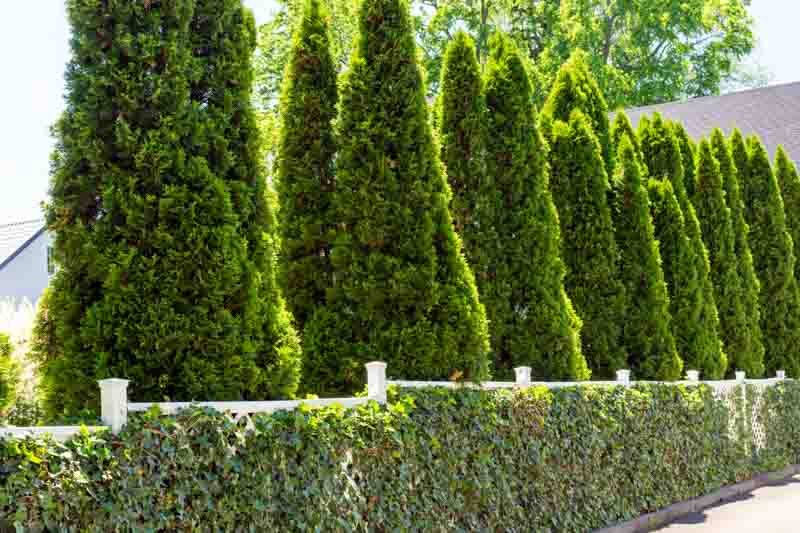
Evergreen Privacy Screen Guides
A beautiful evergreen privacy screen can transform an overlooked garden into a peaceful retreat, but planting a row of shrubs is only the beginning. How close should they be spaced? What makes a hedge thick from the ground up? And how do you prevent arborvitae from turning brown or a fast-growing screen from becoming unmanageable? Creating reliable year-round privacy starts with choosing plants that fit the space, preparing the soil properly, and giving young evergreens the right care. Discover how to plant, train, prune, and maintain healthy evergreen privacy screens that look beautiful through every season.
Learn How to Plan and Plant an Evergreen Privacy Screen with the Right Height and Spacing
The best evergreen privacy screens begin with a practical plan. Before selecting plants, identify the views you want to conceal, measure your available space, and consider how much room the planting will occupy once mature.
Seven essential steps for planting an evergreen screen:
- Identify the sightline: Decide whether you need to hide a fence, neighboring patio, upstairs window, or road.
- Measure the available space: Record the planting length, usable width, and required screen height.
- Choose suitable plants: Check mature dimensions, USDA hardiness, sunlight, drainage, water needs, and tolerance of local conditions.
- Plan the spacing: Use cultivar-specific mature widths to determine center-to-center planting distances.
- Prepare the soil: Remove weeds, assess compaction and drainage, and prepare sufficient space for healthy root establishment.
- Plant at the right depth: Keep the root flare or top of the root ball at the appropriate soil level and avoid burying stems.
- Water and mulch: Water thoroughly after planting and apply suitable mulch without piling it against trunks or crowns.
How tall should an evergreen privacy screen be? The correct height depends on the view you want to block. A screen around 6-8 feet tall may provide useful eye-level privacy in some gardens, while an upper-story sightline may require a taller arrangement. Check local rules and consider the effect on neighboring light and views.
How far apart should arborvitae be planted? Spacing depends on the cultivar and desired coverage. Emerald Green Arborvitae needs a different planting distance from the much larger Green Giant. Avoid following a universal spacing formula without considering mature width and room for maintenance.
Should privacy shrubs be planted in one row or two? A single row is often appropriate for narrow, upright conifers. Staggered double rows can create deeper coverage but require substantially more planting width. Use the arrangement that fits the mature plants and available space.
How close can a hedge be planted to a fence? Leave enough room for mature branches, root development, pruning, and access to the fence. Planting directly against a boundary can distort growth and make future maintenance difficult.
How should soil be prepared for evergreen screening plants? Test drainage and assess soil structure before planting. Most evergreen shrubs benefit from adequate aeration, but their moisture and pH needs differ. Rhododendrons, for example, generally require acidic, moisture-retentive yet well-drained soil, while yews should not be planted where roots remain waterlogged.
When is the best time to plant evergreen screens? Spring and fall are often favorable in temperate climates. In cold regions, spring planting gives less hardy evergreens more time to establish before winter. Avoid planting during severe heat, frozen ground, or prolonged waterlogging.
How long does it take a privacy screen to fill in? The answer depends on plant size, growth rate, spacing, climate, and establishment care. Some vigorous plants can provide overlapping coverage within a few seasons, while slower-growing hedges may take much longer.
Should you buy large or small screening plants? Larger plants offer more immediate coverage but cost more and may need careful establishment. Smaller plants can establish successfully and may catch up over time. Healthy root systems and appropriate growing conditions are more important than initial height alone.
Gardenia’s planting advice: Design the screen around the mature plants, not their appearance on planting day. Correct spacing and adequate root space are essential for an attractive, long-lasting hedge.
Explore Gardenia’s Choosing Your Ideal Hedge, Best Plants for Privacy, and Arborvitae Growing Guides.
Discover How to Water, Feed, Train, and Prune Evergreen Hedges for Dense Coverage
A healthy privacy screen should develop balanced growth from near the ground upward. Proper watering during establishment, appropriate pruning, and early attention to gaps are more effective than trying to repair a neglected hedge years later.
How often should newly planted evergreens be watered? Water thoroughly after planting and monitor root-zone moisture regularly during establishment. Frequency depends on rainfall, soil type, temperature, and plant size. Evergreen foliage continues losing water even during cool weather, so drought stress can occur outside summer.
How do you encourage thick growth at the base? Give the hedge adequate light and enough room for branches to develop. For clipped hedges, maintaining a slightly wider base than top helps sunlight reach lower foliage. Some species respond well to formative pruning, but conifers differ in their capacity to regenerate from old wood.
When should arborvitae be pruned? Light shaping is generally preferable to severe cutting. Remove damaged branches when appropriate and trim excessive new growth at a suitable seasonal time. Emerald Green Arborvitae often needs little formal shaping because of its natural upright habit.
Can you cut arborvitae back into bare brown wood? Generally, no. Many arborvitae do not reliably produce new foliage from old, leafless interior stems. A hedge that has grown too wide may not recover its green surface after severe pruning.
How do you prune a yew privacy hedge? Yews generally tolerate pruning better than many conifers and can be maintained as formal hedges. However, timing, plant health, and the extent of cutting still matter. Avoid severe pruning during periods of environmental stress.
How do you maintain a cherry laurel screen? Cherry laurel can be shaped through regular pruning, although individual selective cuts may leave its large leaves looking more attractive than repeated rough shearing. Monitor growth near paths and buildings and avoid allowing a vigorous hedge to become excessively wide.
When should evergreen rhododendrons be pruned? Rhododendrons are often best shaped shortly after flowering if pruning is necessary. Heavy pruning at the wrong time can remove developing flower buds. Choose a cultivar that reaches the required height naturally to reduce maintenance.
Should evergreen privacy plants be fertilized annually? Not automatically. Healthy shrubs in suitable soil may need little supplemental nutrition. Test or assess soil conditions before feeding, since excessive fertilizer can encourage weak growth or damage roots.
How do you mulch evergreen hedges? Apply an appropriate organic mulch around the root zone to conserve moisture, moderate soil temperature, and reduce weed competition. Keep mulch away from direct contact with trunks and crowns.
How often should a privacy hedge be trimmed? It depends on growth rate, desired form, and species. A naturally columnar arborvitae may require little trimming, while a formal yew or broadleaf hedge may need periodic shaping. Choose the maintenance approach appropriate to the plant.
How do you keep a hedge from becoming too wide? Start with a suitable cultivar, plan for mature spread, and maintain the desired outline while plants are young. Regular light shaping is often safer and more attractive than severe reductions after the hedge has outgrown its space.
Can an old evergreen hedge be rejuvenated? Sometimes. Yews and certain broadleaf evergreens may tolerate renovation, but many conifers cannot regenerate effectively from bare wood. Identify the species and assess its condition before attempting major corrective pruning.
Gardenia’s maintenance advice: A well-selected evergreen screen should not require constant cutting to survive in its allotted space. Aim for healthy, dense growth and gradual maintenance rather than forcing naturally large plants into narrow dimensions.
Read Gardenia’s Thuja Planting and Care Guides, Rhododendron Planting and Care, and Low-Maintenance Shrub Selection.
Solve Evergreen Screen Problems: Brown Foliage, Gaps, Winter Damage, Deer, and Poor Growth
Even a well-planted evergreen screen can develop problems. Brown foliage, bare patches, slow growth, and winter damage are often related to soil conditions, environmental stress, or unsuitable plant selection rather than one easily identified disease.
Why are my arborvitae turning brown? Drought, waterlogged soil, winter desiccation, root damage, pests, and disease can all cause browning. Some interior foliage naturally browns and sheds as it ages. Check whether damage affects only older internal growth or the entire plant before deciding on treatment.
Why does my evergreen hedge have gaps? Gaps may result from uneven growth, plant loss, excessive shade, browsing, poor spacing, or damage from pruning. Diagnose the underlying cause before installing replacement plants, or the problem may recur.
Why is my privacy hedge bare at the bottom? Insufficient light reaching lower branches, overcrowding, or unsuitable pruning may contribute. Some conifers cannot regenerate from bare interior wood, which makes prevention through plant selection and appropriate shaping especially important.
How do you repair a damaged evergreen screen? First determine whether the affected branches are alive and capable of regrowth. Selective pruning may improve the appearance of some shrubs, but severely damaged arborvitae or other conifers may require replacement if they cannot produce foliage from bare wood.
What causes winter burn on evergreens? Winter burn often occurs when leaves lose water during cold, sunny, or windy conditions while frozen roots cannot replace it. Choose properly hardy plants, provide suitable exposure, and maintain adequate moisture before freezing periods.
Can evergreen privacy hedges tolerate heavy snow? Many can, but upright branches may bend or split under snow and ice. Plant structure, species, and exposure influence susceptibility. Avoid damaging branches while removing accumulated snow.
Why are deer eating my privacy screen? Deer browse various evergreens, including arborvitae and yews, particularly when other food is scarce. Choose less-preferred regional species, consider protective fencing during establishment, and remember that deer resistance is never guaranteed.
How do you prevent root rot? Avoid planting shrubs in persistently waterlogged soil unless they are adapted to those conditions. Improve drainage where feasible, water according to actual root-zone moisture, and avoid burying root flares.
Why is my evergreen hedge growing slowly? Slow growth may be natural to the species or caused by poor root establishment, inadequate light, moisture stress, compacted soil, or unsuitable pH. Excess fertilizer is rarely a substitute for correcting the growing conditions.
Can an evergreen screen develop pest problems? Yes. Arborvitae, yew, holly, and other shrubs are affected by different insects and diseases. Inspect foliage and stems regularly and identify the cause before applying treatments.
What if my privacy screen has grown too tall? Assess the species before cutting. Certain yews and broadleaf shrubs can tolerate reduction, but large conifers may not recover after severe topping or pruning into bare wood. Professional advice may be appropriate for tall, mature trees.
How do you keep a screen healthy in a windy location? Choose species adapted to exposure, provide appropriate watering during establishment, and avoid excessively narrow planting strips with poor soil. Exposed coastal sites may need different plants from sheltered inland gardens.
Gardenia’s final care advice: Healthy year-round privacy depends on the right plant, suitable soil, adequate water during establishment, and realistic maintenance. Early attention to problems is much more effective than trying to correct years of inappropriate growth.
Explore Gardenia’s Deer-Resistant Evergreen Privacy Plants, Plants for Windy Coastal Gardens, and Shrub Growing and Care Guides.