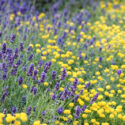
Lavender and Russian sage both thrive in sunny, dry gardens, but they shine in different ways. Lavender offers fragrance, compact structure, evergreen presence, and container appeal. Russian sage delivers airy blue flowers, long late-season bloom, low maintenance, and rugged drought tolerance. Compare both before choosing the best fit.
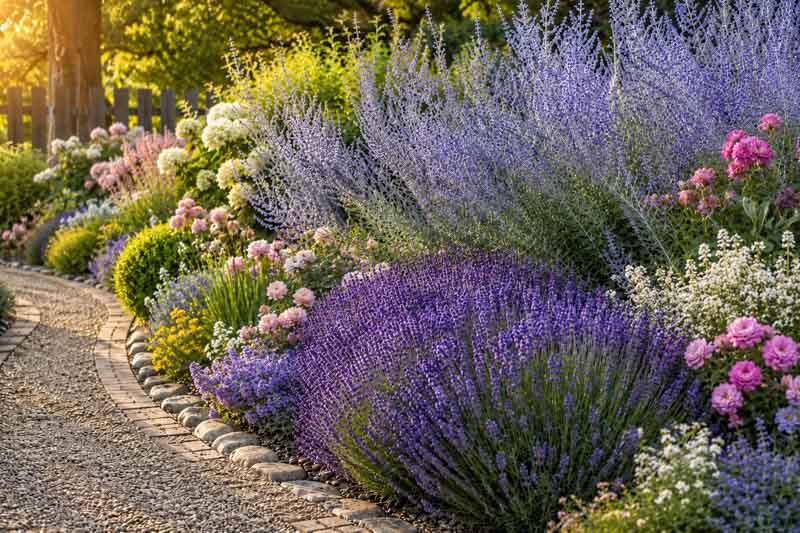


Lavender and Russian sage are two of the most loved plants for sunny, dry gardens. Both offer silvery foliage, clouds of blue to purple flowers, strong drought tolerance, deer resistance, and a relaxed Mediterranean look. They are often used in gravel gardens, cottage borders, pollinator plantings, coastal gardens, and low-water landscapes. So it is no surprise that many gardeners ask the same question: lavender vs Russian sage – which one should I plant?
The short answer is simple: choose lavender if fragrance, evergreen structure, compact edging, containers, and harvestable flowers matter most. Choose Russian sage if you want a taller, airier, lower-maintenance plant with a long late-summer to fall display and excellent resilience in hot, dry conditions.
That quick verdict helps, but it does not settle every garden. Lavender and Russian sage may look similar from a distance, yet they behave very differently in the landscape. Lavender is more compact, aromatic, evergreen to semi-evergreen in many climates, and strongly associated with edging, containers, herb gardens, formal lines, and Mediterranean planting. Russian sage is looser, taller, deciduous, more cloud-like, and often better for naturalistic borders, large drifts, and late-season color.
Quick verdict: Lavender is the better choice for fragrance, compact form, containers, edging, and evergreen presence. Russian sage is the better choice for long late-season bloom, lower maintenance, hummingbird appeal, clay and salt tolerance, and a taller, airy border effect.
This guide compares lavender and Russian sage in depth: hardiness, bloom time, fragrance, size, soil, water needs, maintenance, wildlife value, deer resistance, pet safety, design uses, and the best situations for each plant. Use it as a practical decision guide, then refine your choice with the Gardenia Plant Finder and test the planting in the Gardenia Design Tool.
The table below summarizes the practical differences between lavender and Russian sage using Gardenia plant data and standard garden performance characteristics. Always check individual species and cultivars, because English lavender, lavandin, Spanish lavender, and compact Russian sage cultivars can vary in size, cold hardiness, and bloom timing.
| Feature | Lavender | Russian Sage | Best Choice |
|---|---|---|---|
| Botanical group | Lavandula species and cultivars | Salvia yangii, formerly Perovskia atriplicifolia | Tie |
| Typical hardiness | Often Zones 5-9 for English lavender, with variation by type | Often Zones 4-9 for many cultivars | Russian sage in colder regions |
| Sun | Full sun | Full sun | Tie |
| Soil drainage | Needs excellent drainage; dislikes wet winter soil | Needs well-drained soil but tolerates tougher sites once established | Russian sage for difficult sites |
| Water needs | Low once established | Low once established | Tie |
| Bloom season | Late spring to summer, with some types blooming into late summer or fall | Mid-summer to fall | Lavender early, Russian sage late |
| Flower color | Lavender, purple, blue, pink, white | Blue, lavender, purple | Lavender for color range |
| Fragrance | Strongly fragrant flowers and foliage | Mildly aromatic foliage; flowers are not strongly fragrant | Lavender |
| Typical size | Usually compact, often 1-3 ft. tall and wide, depending on type | Often 2-4 ft. tall and wide, with compact cultivars available | Lavender for small spaces, Russian sage for volume |
| Habit | Bushy, mounding, rounded, sometimes upright | Bushy, upright, airy, open-textured | Depends on design style |
| Leaf retention | Often evergreen or semi-evergreen in suitable climates | Deciduous | Lavender |
| Wildlife value | Attracts bees and butterflies | Attracts bees, butterflies, and hummingbirds | Russian sage for hummingbirds, tie for pollinators |
| Deer and rabbit resistance | Generally deer and rabbit resistant | Generally deer and rabbit resistant | Tie |
| Salt tolerance | Light coastal tolerance in sharply drained soil; not recommended for saline soils or salty runoff. | Moderate salt tolerance; better supported for coastal salt spray | Russian sage |
| Maintenance | Average; needs regular pruning to stay compact | Low; usually cut back in late winter or early spring | Russian sage |
| Best uses | Edging, containers, herb gardens, paths, low hedges, Mediterranean borders | Sunny borders, gravel gardens, pollinator gardens, large drifts, late-season structure | Depends on garden role |
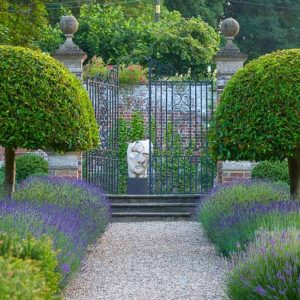
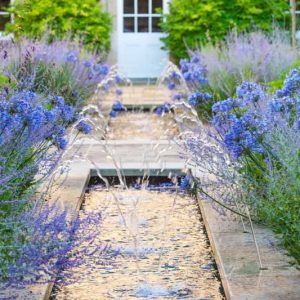
The easiest way to understand the difference between lavender and Russian sage is to think about their role in the garden. Lavender is a fragrant, sculptural plant. It forms mounds, lines, cushions, or low hedges, and it rewards close contact. Plant lavender along a path, beside a terrace, near a gate, or in a container, and brushing the foliage releases its signature scent.
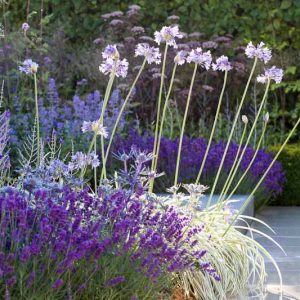
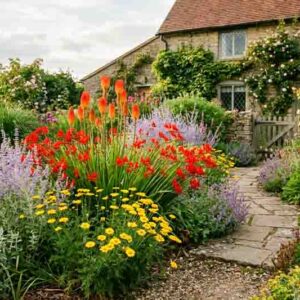
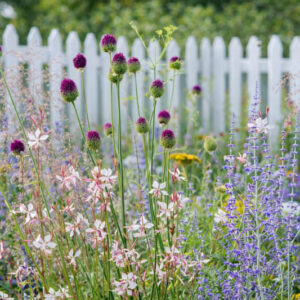
Russian sage is more atmospheric. It creates a haze of lavender-blue flowers above silvery stems and gray-green foliage. It is less about close-up fragrance and more about movement, lightness, and mass effect. In late summer, when many gardens begin to tire, Russian sage can make a border feel luminous again.
Design insight: Lavender is a foreground plant that invites touch. Russian sage is a mid-border or background plant that creates atmosphere. Use lavender where people pass close by. Use Russian sage where you want a soft, glowing cloud of color.
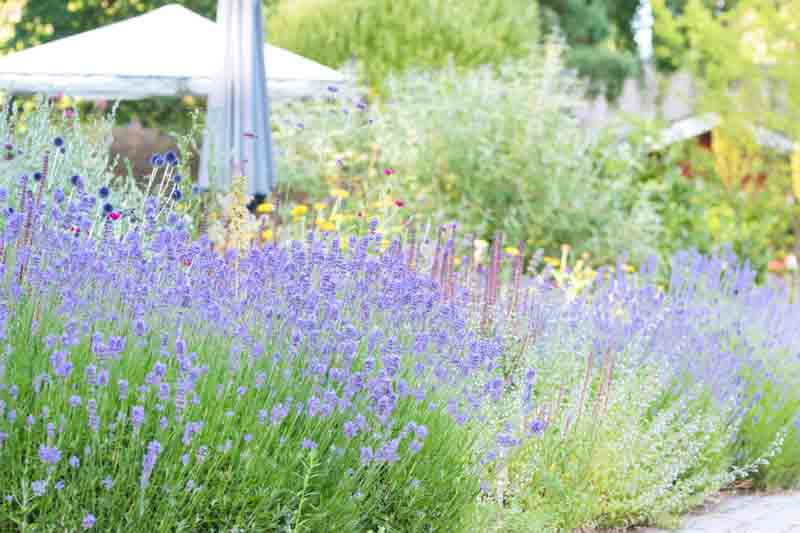
Lavender is hard to beat for fragrance, compact structure, and close-up appeal. Its aromatic flowers and foliage make it ideal for paths, patios, raised beds, herb gardens, courtyard gardens, seating areas, and sunny containers.
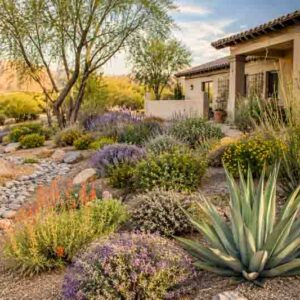
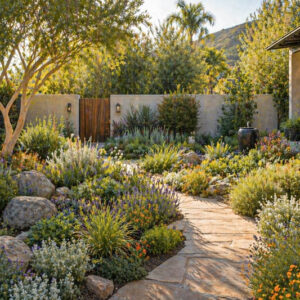
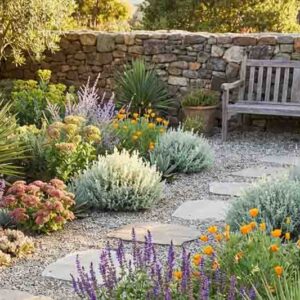
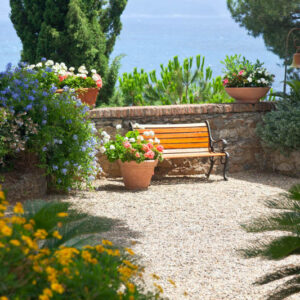
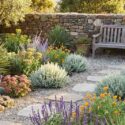
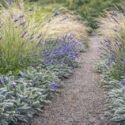
In the landscape, lavender works beautifully as edging, a low hedge, a repeated mound in a dry border, or a Mediterranean accent in gravel gardens and coastal-style plantings. It thrives in full sun and sharply drained soils such as chalk, loam, or sand.
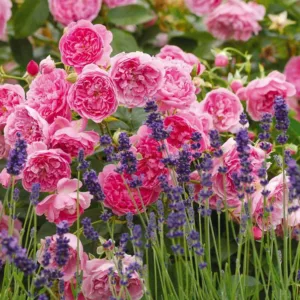
For companions, mix lavender with roses, catmint, salvia, yarrow, santolina, ornamental grasses, and Mediterranean herbs.
Plant lavender along sunny paths, around patios, in herb gardens, in containers, as low edging, or in a dry, fragrant border where its scent can be enjoyed up close.
Lavender dislikes wet feet, heavy winter moisture, and rich, soggy soil. In humid or poorly drained gardens, raised beds and gravelly soil preparation are often the difference between success and decline.
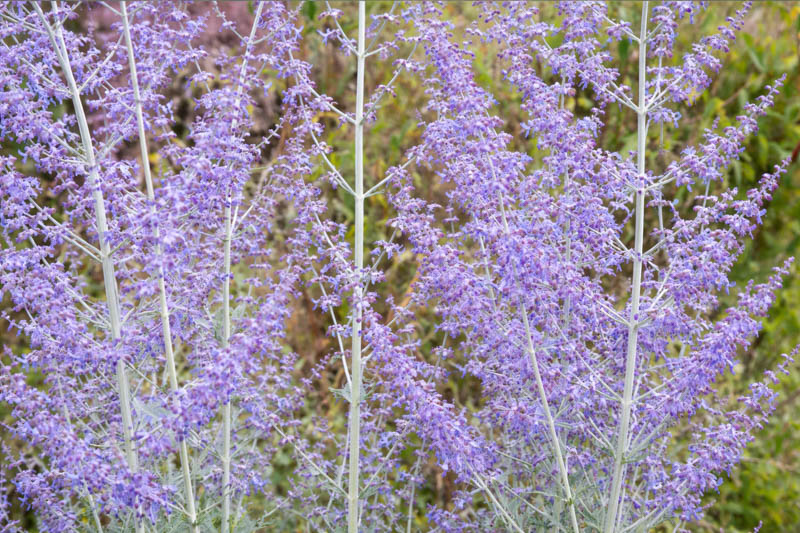
Russian sage is one of the best plants for late-season color in dry, sunny borders. From mid-summer into fall, its lavender-blue flowers create a soft haze above silvery stems, adding height, lightness, and movement when many earlier perennials are fading.
Once established, Russian sage tolerates drought, heat, lean soil, and moderate salt exposure better than many perennials, provided drainage is good. It is a strong choice for hot borders, gravel gardens, parking-strip plantings, exposed sites, and pollinator-friendly designs.
Use it with ornamental grasses, echinacea, rudbeckia, sedum, yarrow, hyssop, catmint, and goldenrod to soften stronger colors and extend the garden’s blue-purple season.
Use Russian sage in sunny borders, gravel gardens, pollinator beds, dry slopes, mass plantings, and late-season combinations where you want height, haze, and movement.
Russian sage can look too loose in very formal designs unless you choose compact cultivars, plant it in repeated drifts, or pair it with more structured plants.
Cold hardiness depends strongly on the exact lavender species or cultivar. English lavender or lavandin is generally the best choice for colder gardens (Zone 5), while Spanish lavender and some tender lavenders are better suited to mild climates (Zone 8 and above). In many gardens, lavender is more vulnerable to winter wet than to cold alone. A cold winter with dry, sharply drained soil may be easier on lavender than a milder winter with soggy roots.
Russian sage is often the safer choice for cold-winter regions, especially when using hardy cultivars (Zone 4). Because Russian sage is deciduous and cut back in late winter or early spring, it does not maintain an evergreen framework through winter like lavender does.
Cold-climate rule: In Zone 4 or exposed Zone 5 gardens, Russian sage is usually the safer bet. If you want lavender, choose a cold-hardy English lavender and give it excellent drainage, full sun, and protection from winter wet.
Lavender is typically strongest from late spring through summer, depending on type. English lavender often flowers in late spring to early summer. Lavandin types are famous for summer bloom and fragrant stems. Some lavenders, especially in warm climates or with careful pruning, can continue or rebloom later in the season.
Russian sage usually shines later. Its mid-summer to fall bloom makes it incredibly valuable in the garden calendar. If your sunny border looks strong in May and June but fades by August, Russian sage may solve a more important seasonal problem than lavender.
The best strategy is often not lavender or Russian sage. It is lavender and Russian sage. Lavender can bring early fragrance and structure, while Russian sage carries the same cool color palette into late summer and fall.
Both lavender and Russian sage need full sun and well-drained soil. This is non-negotiable. Neither plant is at its best in shade, wet clay, or heavily irrigated beds. In too much shade, flowering drops and growth becomes loose. In wet soil, roots can decline or rot.
Lavender is the more drainage-sensitive of the two. It thrives in lean, sandy, gravelly, or chalky soil and often struggles in rich, damp, heavily mulched borders. If your garden has clay soil, lavender may still work in raised beds, on slopes, in containers, or where grit and drainage have been improved. However, it is rarely happy in soil that stays wet in winter.
Russian sage also needs drainage, but it is generally more forgiving of tough conditions. It can handle clay-based soils better than lavender where drainage is adequate, and it tolerates dry soil, drought, and moderate salt exposure once established. That does not mean it should be planted in waterlogged ground, but it can be a better choice for challenging sunny sites.
Soil decision: If your soil is sandy, gravelly, chalky, or sharply drained, lavender can be superb. If your soil is heavier, drier in summer, or exposed to salt, Russian sage may be easier and more reliable.
Once established, both lavender and Russian sage are excellent choices for low-water gardens. Water them regularly during the first growing season to help roots establish, then shift to deeper, less frequent watering.
Lavender performs best in dry, sharply drained soil and can decline if kept too wet, especially in humid climates or during winter. Russian sage is equally drought-tolerant and often remains attractive in late summer, when many thirstier perennials begin to fade.
For xeriscaping, gravel gardens, Mediterranean gardens, and hot sunny borders, both plants are strong options. The real choice is not drought tolerance – it is role: choose lavender for fragrance and compact structure, or Russian sage for height, movement, and late-season color.
Lavender is easy to grow when pruned correctly. Light pruning after flowering keeps plants compact and helps prevent woody, open growth. Avoid cutting hard into old, leafless wood, as neglected lavender may not recover well from severe renovation.
Russian sage is simpler. In most climates, cut it back close to the base in late winter or early spring as new growth begins. It will send up fresh stems for the season’s flowers. Taller varieties may flop in rich soil or partial shade, so full sun, lean soil, and compact cultivars are best for a neater habit.
Maintenance verdict: Lavender rewards careful shaping. Russian sage rewards a simple annual cutback. For gardeners who want the lowest-maintenance option, Russian sage usually wins.
Lavender is a classic bee and butterfly plant. Its fragrant flower spikes attract pollinators and fit beautifully into pollinator gardens, herb gardens, and sunny borders. Because lavender is compact, it is especially useful near paths and seating areas where pollinator activity can be enjoyed up close.
Russian sage attracts bees, butterflies, and hummingbirds. Its long bloom season gives it special value in late summer and fall, a period when pollinator resources can become thin in many gardens.
If your goal is a high-performing pollinator garden, the strongest answer is to plant both, then add companion plants that cover other seasonal windows. Use lavender for earlier fragrance and bee activity, Russian sage for late-season nectar and hummingbird appeal, and then connect them with salvia, catmint, yarrow, agastache, echinacea, rudbeckia, sedum, and asters.
Both lavender and Russian sage are good choices for gardens with browsing pressure. Their aromatic foliage helps make them less appealing to deer and rabbits than many softer, lusher perennials. No plant is completely deer-proof, especially when animals are hungry, but both are commonly used in deer-resistant planting schemes.
Lavender works well at the front of a deer-resistant border, where its compact form and scent can define the edge. Russian sage works well behind it or through the middle of the bed, where its taller stems add a loose, silvery haze.
Lavender is widely grown, but it can be a concern for pets if ingested. The ASPCA lists lavender as toxic to dogs, cats, and horses because of compounds such as linalool and linalyl acetate.
Russian sage is generally considered a lower-concern ornamental for pets, and ASPCA includes it among fall plants described as relatively harmless. Even so, any plant can cause mild digestive upset if eaten, so gardeners should discourage chewing and consult a veterinarian if a pet eats a significant amount of any ornamental plant.
Pet-friendly planting tip: If dogs or cats regularly chew plants, Russian sage may be the safer choice. If you grow lavender, place it where pets are less likely to browse and avoid using concentrated lavender oils around animals without veterinary guidance.
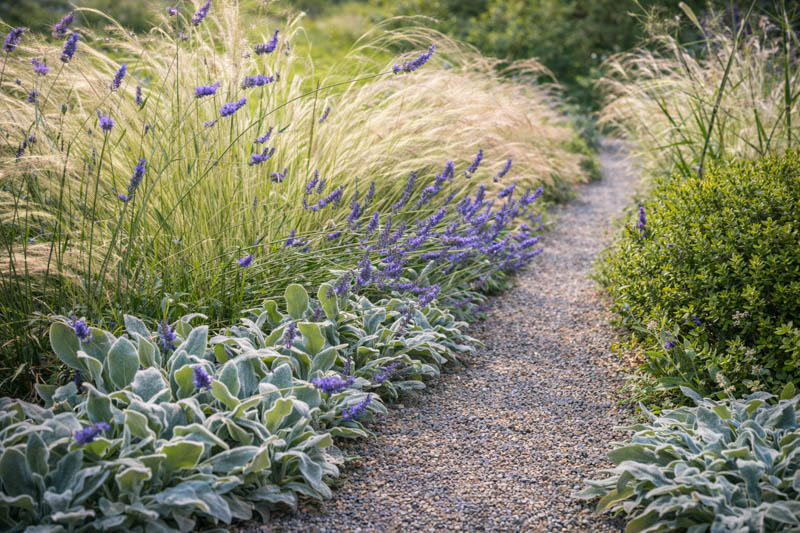
Lavender is most effective when you use its fragrance, shape, and texture deliberately. It works as a low line along a path, a rounded cushion in a sunny border, a scented plant near seating areas, or a compact evergreen presence in suitable climates.
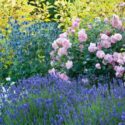
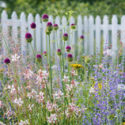
For a Mediterranean look, pair lavender with rosemary, santolina, thyme, sage, olive trees, cistus, nepeta, yarrow, and ornamental grasses. In cottage gardens, combine it with roses, catmint, hardy geraniums, alliums, salvia, and foxgloves. For modern gravel gardens, repeat lavender in simple blocks with agave, yucca, grasses, allium seedheads, and silver foliage plants.
Lavender also excels in containers. Use a pot with drainage holes, a gritty free-draining mix, and full sun. Terracotta is especially useful because it dries quickly. In cold climates, containers may need winter protection because roots in pots are more exposed than roots in the ground.
Browse Garden Design Ideas with Lavender
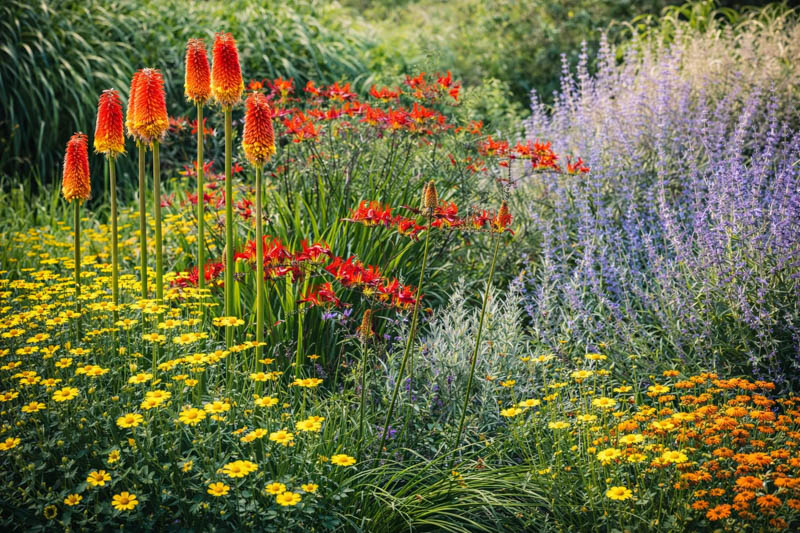
Russian sage brings airiness, movement, and a soft lavender-blue haze to sunny plantings. It is especially useful for loosening formal borders, softening strong shapes, and creating a luminous transition between bolder perennials.
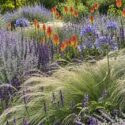
For naturalistic plantings, combine Russian sage with ornamental grasses, echinacea, rudbeckia, agastache, salvia, alliums, sedum, asters, and goldenrod. In dry Mediterranean-style borders, pair it with lavender, santolina, yarrow, catmint, rosemary, and gravel mulch. In pollinator beds, use it as a late-season anchor surrounded by earlier-blooming companions.
Compact cultivars suit smaller gardens, while taller types create a more dramatic drift. Give Russian sage enough room to breathe, because crowding can turn its graceful, airy habit into a tangled mass.
Browse Garden Design Ideas with Russian Sage
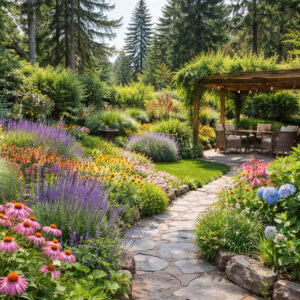
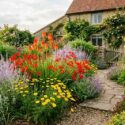
Design upgrade: Try using lavender at the front of a sunny border and Russian sage behind it. The colors harmonize, but the forms contrast beautifully: lavender gives structure and scent, while Russian sage adds height and late-season movement.
Because lavender and Russian sage share similar preferences, many companion plants work with both. The best companions like full sun, well-drained soil, and moderate to low water once established.
For ready-made design inspiration, explore Gardenia Plant Combinations. You can use companion ideas to build a border that carries color from late spring through fall instead of relying on a single peak moment.
Lavender is usually the easier choice for small gardens because it stays compact, can be clipped lightly, and works well in containers. It can define a path, edge a small bed, or add fragrance to a patio without overwhelming the space.
Russian sage can also work in small gardens if you choose compact cultivars such as shorter selections. The trick is to avoid planting a large, open variety where a tight mound is needed. In a small garden, Russian sage looks best when it is allowed to be slightly loose and natural rather than forced into a formal shape.
Lavender is the better container plant in most situations. Its compact form, fragrance, evergreen presence, and preference for sharp drainage make it a natural fit for pots. Containers also allow gardeners with heavy soil to grow lavender successfully by controlling the planting mix.
Russian sage can be grown in large containers, especially compact cultivars, but it generally looks more at home in the ground where its roots can establish and its stems can create a fuller drift. If grown in a pot, use a large container, full sun, and a free-draining mix.
Both plants are excellent for pollinator gardens, but they serve different timing and design roles. Lavender is excellent for bees and butterflies and is especially valuable where fragrance and close-up pollinator activity are part of the experience. Russian sage extends the season and adds hummingbird value, making it especially useful in late summer and fall.
Both plants can work in city and courtyard gardens. Lavender brings fragrance, compactness, and a refined look. Russian sage brings toughness, low maintenance, and excellent performance in hot, open spaces. For coastal gardens or areas affected by salt, Russian sage has a stronger tolerance profile in Gardenia records, although some lavenders can perform well near the coast if drainage is excellent and exposure is not too extreme.
Spring is often the best planting time in colder climates because it gives both plants a full growing season to establish before winter. In mild climates, fall can also work well, especially where summers are hot and dry. Avoid planting lavender into cold, wet soil, and avoid planting either plant too late for roots to establish before severe weather.
After planting, water regularly until the plant is established. Once established, gradually reduce irrigation. Both plants generally prefer deep, occasional watering over frequent shallow watering.
The best plant is not the one that wins every category. It is the one that fits your garden’s conditions and purpose. Before deciding, use the Gardenia Plant Finder to filter lavender, Russian sage, and similar plants by hardiness zone, sun exposure, soil type, water needs, bloom season, height, spread, deer resistance, drought tolerance, and garden style.
Once you have a shortlist, use the Gardenia Design Tool to test spacing, repetition, seasonal color, and placement. This is especially useful if you are deciding whether lavender belongs along the front edge, Russian sage belongs in the middle of the border, or both should be used together for a longer blue-purple season.
Gardenia workflow: Use Plant Finder to choose the right plant for your zone and conditions. Use the Design Tool to see where it belongs in the border. Then explore Plant Combinations to build a planting that looks good from spring through fall.
Choose lavender for fragrance, compact structure, edging, containers, pathways, herb gardens, and close-up sensory appeal.
Choose Russian sage for lower maintenance, airy height, long mid-summer to fall bloom, hummingbird appeal, and tough sunny sites.
In many dry, sunny gardens, the best answer is both: lavender for a polished, fragrant foreground and Russian sage for late-season movement and color.
Both are excellent for sunny dry gardens. Choose lavender for fragrance, edging, containers, and compact structure. Choose Russian sage for long late-season bloom, lower maintenance, and airy height in borders.
Yes. Lavender and Russian sage grow well together because both prefer full sun, well-drained soil, and low water once established. Lavender works well toward the front of the border, while Russian sage adds height and movement behind it.
Russian sage usually provides the longer late-season display, blooming from mid-summer into fall. Lavender typically blooms from late spring into summer, although some types and climates may extend the season or rebloom.
Lavender is much more fragrant. Its flowers and foliage are strongly aromatic. Russian sage has mildly aromatic foliage, but it is not grown primarily for fragrance.
No. Russian sage and lavender are different plants. Lavender belongs to the genus Lavandula, while Russian sage is Salvia yangii, formerly known as Perovskia atriplicifolia. They share a similar color palette and drought tolerance but differ in fragrance, habit, bloom season, and garden use.
Both lavender and Russian sage attract bees and butterflies. Lavender is excellent for close-up pollinator activity near paths and patios, while Russian sage is especially valuable for late-summer and fall pollinator support.
Russian sage is generally the better choice for hummingbirds. Gardenia Russian sage records consistently list hummingbirds among the wildlife attracted to the plant.
Both lavender and Russian sage are generally deer resistant because of their aromatic foliage. No plant is completely deer-proof, but both are good choices for deer-resistant sunny borders.
Russian sage is more forgiving of clay-based soils than lavender, but only where drainage is adequate. It should not be planted in heavy soil that stays wet. Lavender is more sensitive to heavy, wet soil and often performs better in raised beds, containers, sandy soil, gravelly soil, or sharply drained sites.
Lavender requires more caution because ASPCA lists it as toxic to dogs, cats, and horses. Russian sage is generally considered a lower-concern garden plant, but pets should still be discouraged from chewing ornamental plants.
Lavender is usually better for containers because of its compact habit, fragrance, and strong preference for free-draining soil. Russian sage can be grown in large containers, especially compact cultivars, but it is most often used in borders and mass plantings.
Use the Gardenia Plant Finder to compare plants by zone, sun, soil, water needs, bloom time, height, spread, deer resistance, and garden style. Then use the Gardenia Design Tool to test placement, spacing, and companion plants before planting.
Updated: June 2026 – Reviewed by Gardenia Editors
| Plant Type | Shrubs |
|---|---|
| Plant Family | Lamiaceae |
| Genus | Lavandula, Perovskia |
| Exposure | Full Sun |
| Maintenance | Low, Average |
| Water Needs | Low |
| Soil Type | Chalk, Loam, Sand |
| Soil pH | Acid, Alkaline, Neutral |
| Soil Drainage | Well-Drained |
| Tolerances | Drought, Dry Soil, Rabbit |
| Attracts | Bees, Butterflies |
| Plant Type | Shrubs |
|---|---|
| Plant Family | Lamiaceae |
| Genus | Lavandula, Perovskia |
| Exposure | Full Sun |
| Maintenance | Low, Average |
| Water Needs | Low |
| Soil Type | Chalk, Loam, Sand |
| Soil pH | Acid, Alkaline, Neutral |
| Soil Drainage | Well-Drained |
| Tolerances | Drought, Dry Soil, Rabbit |
| Attracts | Bees, Butterflies |
Create a membership account to save your garden designs and to view them on any device.
Becoming a contributing member of Gardenia is easy and can be done in just a few minutes. If you provide us with your name, email address and the payment of a modest $25 annual membership fee, you will become a full member, enabling you to design and save up to 25 of your garden design ideas.
Join now and start creating your dream garden!
Create a membership account to save your garden designs and to view them on any device.
Becoming a contributing member of Gardenia is easy and can be done in just a few minutes. If you provide us with your name, email address and the payment of a modest $25 annual membership fee, you will become a full member, enabling you to design and save up to 25 of your garden design ideas.
Join now and start creating your dream garden!