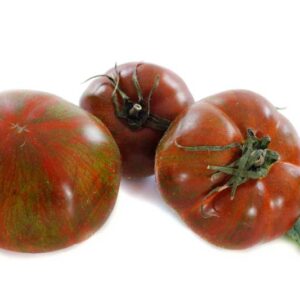
Tomato 'Mortgage Lifter'
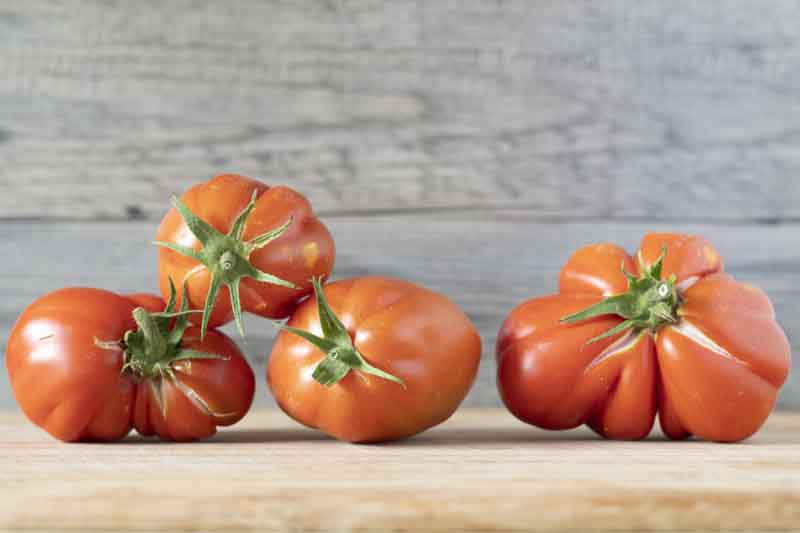



Solanum lycopersicum ‘Mortgage Lifter’ is a celebrated American heirloom tomato known for very large pink to pinkish-red beefsteak fruits, meaty flesh, relatively few seeds, and rich old-fashioned tomato flavor. Traditional strains are vigorous and indeterminate, producing substantial slicing tomatoes over an extended season rather than ripening one concentrated crop.
The name also carries one of vegetable gardening’s best-known origin stories. The classic strain known as Radiator Charlie’s Mortgage Lifter was developed in West Virginia by M.C. Byles, a radiator repairman and self-taught tomato breeder. Today, however, several distinct Mortgage Lifter strains circulate, so fruit size, color, plant height, maturity, and disease resistance should always be tied to the exact maintained strain rather than assumed to be identical across every tomato carrying the Mortgage Lifter name.
Gardenia cultivar insight: “Mortgage Lifter” is best treated as a cultivar name represented by multiple maintained strains, not as one completely uniform modern seed line. Radiator Charlie’s original, Halladay’s Mortgage Lifter, Mortgage Lifter VFN, Pesta strain, and other selections can differ significantly. Identify the strain before assigning exact height, fruit size, color, maturity, or resistance codes.
| Botanical Name | Solanum lycopersicum ‘Mortgage Lifter’ |
|---|---|
| Family | Solanaceae |
| Common Name | Mortgage Lifter tomato |
| Historic Strain | Radiator Charlie’s Mortgage Lifter, developed by M.C. Byles in Logan, West Virginia, beginning in the 1930s |
| Plant Type and Habit | Warm-season fruiting annual; vigorous, indeterminate vine requiring strong support |
| Seed Type | Open-pollinated heirloom; several maintained strains exist |
| Size | Height varies by maintained strain and seed source. Burpee currently lists its Mortgage Lifter at about 36-40 in. (90-100 cm). Because Mortgage Lifter strains are indeterminate, actual vine length may differ with genetics, support, pruning, climate, fertility, and season length. |
| Growth Habit | Indeterminate; continues flowering and producing fruit through the growing season |
| Tomato Type | Large pink to pinkish-red heirloom beefsteak / slicing tomato |
| Fruit | Very large pink to pinkish-red beefsteak tomatoes. Fruit size is strongly strain-dependent: Halladay’s is documented around 1-2 lb. (450-900 g), while Cornell and some commercial descriptions report Mortgage Lifter fruit reaching 2½ lb. or more. |
| Fruit Characteristics | Meaty flesh, relatively few seeds, broad slices, and classic beefsteak form |
| Flavor | Rich, balanced, old-fashioned tomato flavor, especially prized for fresh eating |
| Days to Maturity | Approximately 79-90 days from transplanting, depending on maintained strain |
| Sun and Exposure | Full sun; at least 6 hours of direct sunlight, preferably 8 or more |
| Soil | Fertile, organically rich, moist but well-drained clay, loam, or sandy soil; ideally around pH 6.0-6.8 |
| Spacing | 24-36 in. (60-90 cm); allow additional room for large cages or multi-stem plants |
| Harvest | Main-season and extended; harvest according to the mature color of the specific strain |
| Best Uses | Fresh slicing, sandwiches, burgers, tomato plates, salads, salsa, and fresh summer cooking |
| Disease Resistance | Varies by strain. Do not transfer resistance claims from Mortgage Lifter VFN or another selected strain to every Mortgage Lifter seed line |
| Container Suitability | Possible in a very large container with sturdy support, but vigorous indeterminate growth and exceptionally heavy fruit make garden beds easier |
Mortgage Lifter combines enormous beefsteak fruit with the rich flavor and meaty texture that make heirloom tomatoes so appealing. Cornell describes Mortgage Lifter as an indeterminate, main-season cultivar with pinkish-red, meaty fruits that can reach 2½ lb. or more.
That figure should not be treated as universal for every Mortgage Lifter strain. Halladay’s Mortgage Lifter, for example, is documented at roughly 1-2 lb., while other maintained strains and commercial lines use different fruit-size descriptions.
The tomatoes are best known as slicers. Their broad, fleshy interiors make them particularly good for sandwiches, burgers, tomato plates, and salads where one large fruit can provide several substantial servings.
Best reason to grow Mortgage Lifter: Choose it when you want heirloom flavor, very large beefsteak tomatoes, and one of the most memorable stories in American vegetable gardening. If uniform fruit, compact growth, or a standardized disease-resistance package matters more, a modern hybrid may be easier.
The famous Mortgage Lifter story is unusually well documented for an heirloom tomato. Southern Exposure Seed Exchange has preserved portions of a 1985 taped interview with M.C. Byles, the West Virginia gardener who developed the best-known strain.
Byles lived in Logan, West Virginia, and operated a radiator repair business near a steep hill where trucks frequently overheated. His repair work earned him the nickname “Radiator Charlie.”
According to Byles’s own account, he began developing the tomato in the early 1930s despite having no formal plant-breeding education. He selected four of the largest-fruited tomatoes available to him and repeatedly crossed and selected the offspring over several growing seasons.
The interview-based account identifies the source material as German Johnson, Beefsteak, an Italian variety, and an English variety. Byles continued selecting the best plants until he obtained a stable, exceptionally large-fruited tomato.
Gardenia history rule: The Radiator Charlie story is more than anonymous gardening folklore because important details can be traced to a recorded interview with M.C. Byles himself. Gardenia treats the four-parent account as Byles’s recorded breeding history, however, not as a modern genetic pedigree verified by DNA analysis.
The name is tied directly to Byles’s success selling plants of his new tomato.
According to the account preserved from his interview, Byles sold Mortgage Lifter plants for $1 each during the 1940s. Gardeners reportedly traveled considerable distances to purchase the seedlings.
Byles said those sales allowed him to pay off the approximately $6,000 mortgage on his home in about six years. The tomato consequently became known as ‘Mortgage Lifter’.
Gardenia source note: The familiar mortgage story should be presented as Byles’s recorded recollection. That gives the story a clear historical source without pretending that every dollar, date, and sale has been independently reconstructed from financial records.
Several maintained Mortgage Lifter strains now circulate, and their traits should not be automatically combined into one cultivar description.
Radiator Charlie’s Mortgage Lifter refers to the famous pink to pinkish-red heirloom associated with M.C. Byles.
Mortgage Lifter (Halladay’s) is a Kentucky family strain preserved for generations by the Halladay family. Seed Savers Exchange has described Halladay’s as indeterminate, approximately 80-90 days, with pink beefsteak fruits weighing around 1-2 lb.
Mortgage Lifter VFN, also marketed as Red Mortgage Lifter by some seed sources, is an improved selection rather than the original Radiator Charlie strain. It produces smaller, more uniform red fruit and was selected for increased disease resistance.
Other named strains and seedkeeper selections, including Pesta strain, also circulate.
Gardenia identity rule: Never copy fruit weight, color, maturity, height, or resistance codes from one Mortgage Lifter strain to another simply because both share the Mortgage Lifter name. Mortgage Lifter VFN, Halladay’s Mortgage Lifter, and Radiator Charlie’s Mortgage Lifter are not interchangeable database records.
Traditional Mortgage Lifter strains are indeterminate. Their vines continue growing, flowering, and producing fruit through the season rather than terminating after a concentrated harvest.
Exact mature height is less consistent. Burpee currently lists its Mortgage Lifter at approximately 36-40 in. (90-100 cm), but that measurement belongs to its maintained seed line and should not be treated as a universal height for every Mortgage Lifter strain.
Because Mortgage Lifter strains are indeterminate, actual vine length can also change with genetics, support, pruning, fertility, climate, and season length. Height data from Mortgage Lifter VFN or another named strain should remain attached to that strain rather than being used to redefine Radiator Charlie’s Mortgage Lifter or the cultivar as a whole.
Whatever the final vine length, the support structure needs to be substantial because individual fruits may become exceptionally heavy.
Support rule: With Mortgage Lifter, support the fruit load, not just the stem length. A relatively manageable vine can still carry exceptionally heavy tomatoes capable of bending branches or collapsing a lightweight cage.
For more on tomato growth habit, see Gardenia’s Determinate vs. Indeterminate Tomatoes. For pruning guidance, see How and When to Prune Tomatoes.
Grow Mortgage Lifter in full sun, with at least 6 hours of direct sunlight and preferably 8 or more for strong flowering and development of its large fruit.
Plant in fertile, organically rich, moist but well-drained soil. Clay, loam, or sandy soil can work when fertility and drainage are suitable. Aim for a slightly acidic to neutral pH around 6.0-6.8.
Allow about 24-36 inches (60-90 cm) between supported plants. Give large cages or multi-stem plants additional room where possible.
Maintain reasonably even moisture throughout fruit development. Large beefsteak tomatoes can crack when plants move abruptly from dry soil to abundant moisture following heavy rain or irrigation.
Use balanced fertility and avoid excessive nitrogen. Large fruit requires strong roots and healthy foliage, but excessive nitrogen can encourage leafy growth at the expense of balanced flowering and fruiting.
For the best crop: Give Mortgage Lifter deep fertile soil, full sun, steady moisture, strong support, and enough healthy foliage to fuel its large fruit. Do not assume that aggressive pruning or excessive fertilizer will produce bigger tomatoes.
For complete tomato care, see Gardenia’s Tomato (Solanum lycopersicum) profile.
Disease resistance is one of the clearest reasons to keep Mortgage Lifter strains separate.
Southern Exposure’s maintained Radiator Charlie material has been associated with resistance to Verticillium wilt and Fusarium wilt race 1. Cornell’s general Mortgage Lifter cultivar record, however, does not provide a standardized resistance package.
Mortgage Lifter VFN is explicitly an improved selection developed for greater disease resistance and more uniform red fruit. Published resistance or tolerance for that selected line can include Verticillium wilt, Fusarium wilt race 1, root-knot nematodes, and additional disease traits depending on the source.
Gardenia resistance rule: Do not assign the VFN package to ordinary Mortgage Lifter simply because a cultivar called Mortgage Lifter VFN exists. Resistance belongs to the documented strain or seed source. This is exactly the kind of cultivar-name shortcut that creates inaccurate plant databases.
Mortgage Lifter can still encounter early blight, late blight, Septoria leaf spot, blossom-end rot, fruit cracking, and pests such as tomato hornworms.
If symptoms are unclear, use Gardenia’s Tomato Problems: What Is Wrong With My Plant?. For infectious diseases, see Tomato Diseases: Identification, Treatment & Prevention.
Mortgage Lifter’s large beefsteak fruits can show some of the physiological irregularities common in very large-fruited heirloom tomatoes.
Cracking may develop when rapidly expanding fruit receives a sudden increase in water after a dry period. Keeping root-zone moisture more consistent can reduce the risk.
Catfacing produces puckered, scarred, or malformed tissue, usually near the blossom end. Cool conditions during flower development can increase the risk, particularly in large-fruited tomatoes.
Some ribbing, flattening, or asymmetry is simply part of the appearance of a giant heirloom beefsteak and does not necessarily indicate disease.
Appearance reality: Do not expect every large Mortgage Lifter to look like a uniform supermarket tomato. Heirloom beefsteaks can be ribbed or irregular and still have excellent eating quality. Distinguish normal shape variation from deep cracking, rot, or disease.
Mortgage Lifter is generally a main-season tomato, but maturity varies by maintained strain. Southern Exposure has listed Radiator Charlie’s strain at about 79 days, Cornell lists approximately 80-85 days for Mortgage Lifter, and Halladay’s has been described at roughly 80-90 days.
Harvest according to the mature color of the specific strain. Radiator Charlie-type Mortgage Lifters are generally pink to pinkish-red when ripe, while Mortgage Lifter VFN / Red Mortgage Lifter selections mature red.
Because individual fruits can become exceptionally heavy, inspect them frequently as ripening progresses. A large ripe tomato can place considerable stress on the fruit stem and supporting branch.
Gardenia harvest cue: Use the mature color of the specific Mortgage Lifter strain, not the cultivar name alone. A pink-fruited strain should not be left on the vine indefinitely while you wait for it to become the deep red of a different selection.
Mortgage Lifter can grow in a container, but it is not naturally suited to small pots. An indeterminate plant producing exceptionally heavy tomatoes needs substantial root volume, reliable moisture, and support capable of carrying the fruit.
Use at least about a 10-gallon container, with 15-20 gallons providing a much more forgiving root zone for a vigorous plant. Install sturdy support when planting rather than trying to add it after large fruit begins developing.
Container-grown plants require close attention to watering during hot or windy weather because limited soil volume can dry quickly.
Container reality: Mortgage Lifter can be grown in a pot, but its fruit load makes generous root space and sturdy support more important than a catalog height alone might suggest.
Choose companions that share full sun and compatible soil conditions without competing heavily with Mortgage Lifter’s canopy and root system.
Basil (Ocimum basilicum) shares similar sun and moisture requirements and fits naturally into an edible tomato bed.
French Marigold (Tagetes patula) thrives in full sun and can flower around the edge of a tomato bed.
Nasturtium (Tropaeolum majus) can trail around bed edges rather than competing for vertical canopy space.
Garlic (Allium sativum) can occupy garden space before the tomato reaches full summer size.
For more ideas based on compatible growing conditions and practical garden functions rather than folklore, see Gardenia’s Companion Plants for Tomatoes.
Traditional Mortgage Lifter strains are indeterminate. Their vines continue flowering and producing fruit through the season and need sturdy support.
Fruit size varies significantly by maintained strain. Halladay’s Mortgage Lifter is documented around 1-2 pounds, while Cornell and some commercial descriptions report Mortgage Lifter fruits reaching 2½ pounds or more.
Height varies by maintained strain and seed source. Burpee currently lists its Mortgage Lifter at about 36-40 inches. Because Mortgage Lifter strains are indeterminate, actual vine length may differ with genetics, support, pruning, fertility, climate, and season length.
Most traditional Mortgage Lifter strains mature in roughly 79-90 days after transplanting. Radiator Charlie, Cornell’s Mortgage Lifter record, and Halladay’s strain each have slightly different published maturity ranges.
M.C. “Radiator Charlie” Byles said he sold plants for $1 each and used the proceeds to pay off the roughly $6,000 mortgage on his West Virginia home in about six years. The familiar story can be traced to a recorded interview with Byles.
The famous Radiator Charlie strain was developed by M.C. Byles of Logan, West Virginia, beginning in the 1930s. According to Byles’s recorded account, he crossed and selected large-fruited tomatoes over several years.
No. Several maintained strains exist, including Radiator Charlie’s Mortgage Lifter, Halladay’s Mortgage Lifter, Mortgage Lifter VFN / Red Mortgage Lifter, Pesta strain, and others. Fruit size, color, maturity, vine size, and resistance may differ.
No. Mortgage Lifter VFN is an improved selection associated with greater disease resistance, more uniform red fruit, and generally smaller fruit than the classic pink to pinkish-red Radiator Charlie strain.
Yes, but use generous root space and very strong support. A 15-20 gallon container is more forgiving than a small pot for an indeterminate plant carrying exceptionally heavy fruit.
Yes. Traditional Mortgage Lifter strains are open-pollinated. Save seed from healthy, true-to-type plants and label the strain carefully because several different Mortgage Lifter selections circulate.
| Hardiness |
2 - 11 |
|---|---|
| Climate Zones | 1, 1A, 1B, 2, 2A, 2B, 3, 3A, 3B, 4, 5, 6, 7, 8, 9, 10, 11, 12, 13, 14, 15, 16, 17, 18, 19, 20, 21, 22, 23, 24, A1, A2, A3, H1, H2 |
| Plant Type | Annuals, Fruits, Perennials |
| Plant Family | Solanaceae |
| Genus | Solanum, Tomatoes |
| Common names | Tomato |
| Exposure | Full Sun |
| Season of Interest | Summer (Early, Mid, Late), Fall |
| Height | 3' - 4' (90cm - 120cm) |
| Spread | 2' - 3' (60cm - 90cm) |
| Spacing | 24" - 36" (60cm - 90cm) |
| Maintenance | High |
| Water Needs | Average |
| Soil Type | Clay, Loam, Sand |
| Soil pH | Acid, Neutral |
| Soil Drainage | Moist but Well-Drained |
| Tolerance | Rabbit, Clay Soil |
| Attracts | Bees |
| Garden Uses | Beds And Borders, Patio And Containers, Wall-Side Borders |
| Garden Styles | City and Courtyard, Informal and Cottage, Pollinator Garden |


| Hardiness |
2 - 11 |
|---|---|
| Climate Zones | 1, 1A, 1B, 2, 2A, 2B, 3, 3A, 3B, 4, 5, 6, 7, 8, 9, 10, 11, 12, 13, 14, 15, 16, 17, 18, 19, 20, 21, 22, 23, 24, A1, A2, A3, H1, H2 |
| Plant Type | Annuals, Fruits, Perennials |
| Plant Family | Solanaceae |
| Genus | Solanum, Tomatoes |
| Common names | Tomato |
| Exposure | Full Sun |
| Season of Interest | Summer (Early, Mid, Late), Fall |
| Height | 3' - 4' (90cm - 120cm) |
| Spread | 2' - 3' (60cm - 90cm) |
| Spacing | 24" - 36" (60cm - 90cm) |
| Maintenance | High |
| Water Needs | Average |
| Soil Type | Clay, Loam, Sand |
| Soil pH | Acid, Neutral |
| Soil Drainage | Moist but Well-Drained |
| Tolerance | Rabbit, Clay Soil |
| Attracts | Bees |
| Garden Uses | Beds And Borders, Patio And Containers, Wall-Side Borders |
| Garden Styles | City and Courtyard, Informal and Cottage, Pollinator Garden |
How many Solanum lycopersicum ‘Mortgage Lifter’ (Tomato) do I need for my garden?
| Plant | Quantity | |
|---|---|---|
| Solanum lycopersicum ‘Mortgage Lifter’ (Tomato) | N/A | Buy Plants |
Create a membership account to save your garden designs and to view them on any device.
Becoming a contributing member of Gardenia is easy and can be done in just a few minutes. If you provide us with your name, email address and the payment of a modest $25 annual membership fee, you will become a full member, enabling you to design and save up to 25 of your garden design ideas.
Join now and start creating your dream garden!
Create a membership account to save your garden designs and to view them on any device.
Becoming a contributing member of Gardenia is easy and can be done in just a few minutes. If you provide us with your name, email address and the payment of a modest $25 annual membership fee, you will become a full member, enabling you to design and save up to 25 of your garden design ideas.
Join now and start creating your dream garden!