Tomato 'Black Cherry'
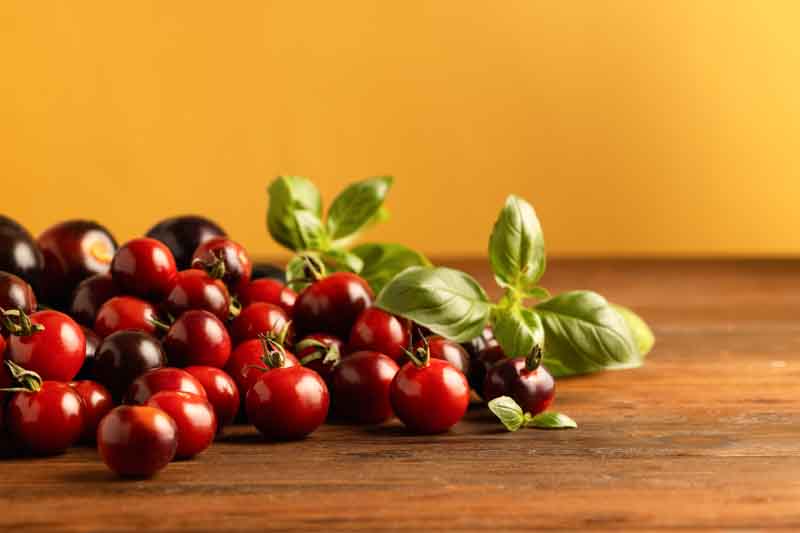


Solanum lycopersicum ‘Black Cherry’ is a vigorous, highly productive cherry tomato known for clusters of round, dusky purple-brown fruits with unusually rich, sweet, complex flavor. The indeterminate vines continue flowering and ripening fruit over a long season, producing bite-sized tomatoes that combine the convenience of a cherry tomato with some of the deeper flavor characteristics associated with dark-fruited slicing tomatoes.
Despite being frequently grouped with heirloom tomatoes, Black Cherry is a relatively modern cultivar. It was developed by the late Vincent “Vince” Sapp of Tomato Growers Supply Company in Florida and introduced in 2003. Current seed-preservation, commercial, and university sources widely maintain it as open-pollinated, so properly saved seed can reproduce the cultivar, although its exact parentage has not been publicly established.
Gardenia cultivar insight: Black Cherry is best classified as a modern open-pollinated cultivar, not a traditional heirloom and not a current F1 hybrid. Vince Sapp’s 2003 introduction is well documented, but the exact genetic event and parentage behind the cultivar are not. Gardenia preserves the documented history rather than inventing a pedigree.
| Botanical Name | Solanum lycopersicum ‘Black Cherry’ |
|---|---|
| Family | Solanaceae |
| Common Name | Black Cherry tomato |
| Breeder / Introducer | Vincent “Vince” Sapp, Tomato Growers Supply Company, Florida, USA |
| Introduced | 2003 |
| Seed Type | Open-pollinated modern cultivar; exact parentage has not been publicly established |
| Plant Type and Habit | Warm-season fruiting annual; vigorous, productive, indeterminate vine requiring support |
| Size | Vigorous indeterminate vine. Mature vine length varies substantially with support, pruning, fertility, climate, and season length; plan for a full-sized tomato plant rather than a compact cherry variety. |
| Growth Habit | Indeterminate; continues flowering and producing fruit until frost or growing conditions end the season |
| Tomato Type | Dark-fruited cherry tomato |
| Fruit | Round cherry tomatoes about 1 in. (2.5 cm) across. Johnny’s lists approximately 20 g (0.7 oz.), while UC Master Gardeners list about 1-2 oz., indicating some variation among seed lines and growing conditions. |
| Fruit Color | Dusky purple-brown to dark red-purple; ripe fruit is not literally jet black |
| Flavor | Rich, sweet, robust, and complex, with more depth than many conventional cherry tomatoes |
| Days to Maturity | About 64-75 days from transplanting, depending on seed source and growing conditions |
| Sun and Exposure | Full sun; at least 6 hours of direct sunlight, preferably 8 or more |
| Soil | Fertile, organically rich, moist but well-drained clay, loam, or sandy soil; ideally around pH 6.0-6.8 |
| Spacing | 24-36 in. (60-90 cm) between supported plants |
| Harvest | Harvest when fruit develops its mature dark red-purple to purple-brown color and yields slightly under gentle pressure |
| Best Uses | Fresh snacking, salads, tomato platters, bruschetta, salsa, roasting, and colorful mixed-cherry combinations |
| Cracking | Improved crack tolerance has been reported, but reputable sources also document splitting in rainy weather; treat cracking as a cultivar-plus-weather interaction rather than a fixed yes/no trait |
| Disease Resistance | No standardized modern V/F/N or late-blight resistance package is established; general field tolerance should not be converted into specific resistance codes |
| Container Suitability | Suitable for a large container with strong support; small fruit does not mean a compact plant |
Black Cherry offers something relatively unusual among small-fruited tomatoes: a flavor profile more often associated with dark slicing tomatoes packed into a bite-sized fruit. The tomatoes are sweet and juicy, but their appeal comes from the additional richness and complexity behind the sweetness.
Johnny’s describes Black Cherry as sweet and robust and lists fruit around 20 g. Other current sources describe one-inch, dark purple-brown cherry tomatoes that may reach closer to an ounce or more depending on the maintained line and growing conditions.
The plants are also productive. Vigorous indeterminate vines produce repeated clusters rather than one concentrated crop, making Black Cherry useful for gardeners who want a steady supply of dark cherry tomatoes through summer.
Best reason to grow Black Cherry: Choose it when you want the convenience and productivity of a cherry tomato but prefer a deeper, richer flavor than sweetness alone. It is especially effective in mixed cherry harvests alongside bright red, yellow, or orange cultivars.
Black Cherry was developed by the late Vincent “Vince” Sapp, associated with Tomato Growers Supply Company in Florida, and introduced in 2003.
What happened before that introduction is less precisely documented. Some sources describe Black Cherry as arising from a “natural occurrence.” The exact genetic event that produced the original material and the precise parents involved have not been publicly established.
That distinction matters because online descriptions sometimes assign specific parents or origin stories without reliable documentation.
Gardenia history rule: It is well supported that Vince Sapp developed and introduced Black Cherry in 2003. It is not equally well established exactly how the originating plant arose or which named cultivars were its parents. Gardenia preserves the documented history without converting speculation into pedigree.
This is one of the most confusing aspects of Black Cherry’s online identity.
Multiple current seed-preservation, commercial, and university sources classify Black Cherry as open-pollinated. Gardeners can therefore save seed from true-to-type plants and expect the cultivar to reproduce reasonably consistently when unwanted cross-pollination is minimized.
Cornell’s cultivar database, however, currently describes Black Cherry as a “Hybrid.” That designation conflicts with its widespread present-day treatment as an open-pollinated cultivar.
Because Black Cherry was introduced in 2003, Gardenia also does not classify it as a traditional heirloom under the historical-lineage definition, even though seed sellers may place it in heirloom tomato collections.
Gardenia identity rule: Gardenia classifies Black Cherry as a modern open-pollinated cultivar. “Open-pollinated” does not mean ancient, and the possibility that crossing occurred somewhere in the cultivar’s origin does not make the stabilized seed sold today an F1 hybrid.
Black Cherry belongs to the group gardeners commonly call black tomatoes, but the ripe fruit is not literally jet black.
Current descriptions place the mature fruit in a range from dusky purple-brown to dark red-purple. Depending on light, ripeness, and growing conditions, individual tomatoes may also appear mahogany or deep brown-red.
The term “black tomato” is therefore a horticultural color category rather than a literal color measurement.
Gardenia color rule: Describe Black Cherry as dusky purple-brown to dark red-purple rather than assigning a literal black color. The horticultural term “black tomato” covers a range of dark red, brown, and purple pigmentation.
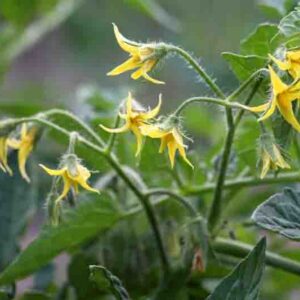
Black Cherry is indeterminate. Its vines continue extending, flowering, and ripening fruit throughout the growing season rather than terminating after one concentrated crop.
Reliable sources consistently describe the plants as vigorous or large-vined, but exact mature-height figures vary substantially. That is normal for an indeterminate tomato, whose final vine length is strongly affected by support, pruning, fertility, climate, and season length.
For practical garden planning, treat Black Cherry as a full-sized tomato vine rather than a compact cherry tomato plant.
Support rule: Do not size the support according to the one-inch fruit. Black Cherry produces small tomatoes on a large indeterminate plant. Install a tall cage, strong stake, trellis, or string system early.
For more on growth habit, see Gardenia’s Determinate vs. Indeterminate Tomatoes. For pruning guidance, see How and When to Prune Tomatoes.
Grow Black Cherry in full sun, with at least 6 hours of direct sunlight and preferably 8 or more for vigorous flowering, fruit production, ripening, and strong flavor.
Plant in fertile, organically rich, moist but well-drained soil. Clay, loam, or sandy soil can work when drainage and fertility are suitable. Aim for a slightly acidic to neutral pH around 6.0-6.8.
Allow approximately 24-36 inches (60-90 cm) between supported plants. Give sprawling or multi-stem plants additional room where possible.
Maintain reasonably even root-zone moisture. Consistent watering supports continuous fruiting and can reduce the rapid moisture swings associated with fruit splitting.
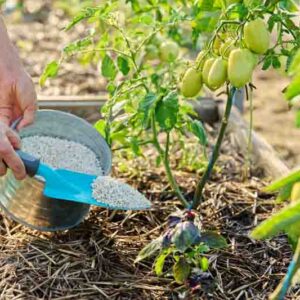
Use balanced fertility rather than excessive nitrogen. Black Cherry is naturally vigorous, so overly nitrogen-rich feeding may create excessive foliage without proportionally improving the crop.
For the best crop: Black Cherry already has vigorous genetics. Give it full sun, fertile soil, steady moisture, healthy foliage, and reliable support rather than trying to force additional growth with excessive fertilizer.
For complete tomato care, see Gardenia’s Tomato (Solanum lycopersicum) profile.
Black Cherry should be allowed to develop its characteristic dark color before harvest. Picking too early can sacrifice some of the richness for which the cultivar is valued.
Look for several ripeness cues together:
The fruit has changed from immature green to a deep red-purple, mahogany, or purple-brown.
The mature color has developed across most of the fruit rather than remaining pale or green.
The tomato gives slightly under gentle finger pressure.
The fruit detaches readily when picked without feeling soft or overripe.
Gardenia harvest cue: Do not wait for Black Cherry to become literally black. A ripe fruit is typically dark red-purple to purple-brown and slightly yielding. Allowing fruit to develop its mature dark color generally gives a better representation of the cultivar’s characteristic flavor.
Black Cherry’s cracking behavior is a good example of why one-word cultivar labels can be misleading.
Some current sources describe Black Cherry as having useful or improved crack tolerance. At the same time, Fedco specifically warns that ripe fruits can crack readily in rainy weather, and gardener reports also document splitting under wet conditions.
These observations are not necessarily mutually exclusive. A cultivar can have better crack tolerance than another tomato and still split when fully ripe fruit experiences rapid water uptake after heavy rain or irrigation.
Gardenia cracking rule: Black Cherry appears to have useful crack tolerance, but that does not make it crack-proof. Reputable sources conflict: some describe good resistance, while others document substantial splitting in rainy weather. Treat cracking as a cultivar-plus-weather interaction, maintain reasonably even soil moisture, and harvest ripe fruit promptly around heavy rain.
Black Cherry has a reputation for vigor and may perform well under ordinary tomato disease pressure, but that should not be confused with a documented modern resistance package.
Some seed sources describe useful general tolerance to common tomato diseases. Cornell’s current disease-resistance database, however, lists Black Cherry only as “resistant to disorders” rather than assigning named Fusarium, Verticillium, late-blight, nematode, or virus resistance.
That evidence is not sufficient to create standardized V, F, N, Ph, or other resistance codes for the cultivar.
Gardenia resistance rule: General vigor or field tolerance is not the same as genetically documented disease resistance. Black Cherry has no broadly established modern V/F/N or late-blight resistance package, so Gardenia does not manufacture resistance codes from anecdotal or nonspecific performance claims.
Plants may still encounter early blight, late blight, Septoria leaf spot, Fusarium wilt, fruit cracking, and pests such as tomato hornworms.
If symptoms are unclear, use Gardenia’s Tomato Problems: What Is Wrong With My Plant?. For infectious diseases, see Tomato Diseases: Identification, Treatment & Prevention.
Black Cherry is relatively early for a dark-fruited tomato. Current sources place maturity at roughly 64-75 days from transplanting.
Because the plant is indeterminate, fruit ripens over a long harvest window. Pick regularly once clusters begin coloring, especially during wet weather when fully ripe fruit may be more vulnerable to splitting.
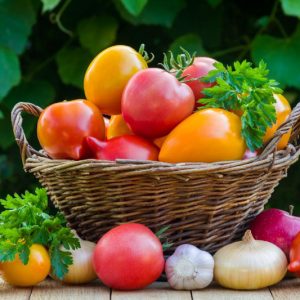
Black Cherry is particularly good for fresh eating. Its rich flavor works well straight from the vine, in salads, on tomato platters, in bruschetta, and mixed with contrasting cherry tomatoes.
The fruits can also be roasted, where their small size allows them to soften quickly while the sweetness and savory tomato character become concentrated.
Kitchen cue: Use Black Cherry where both its flavor and dark color remain visible. Pair it with orange, yellow, and bright red cherry tomatoes to create a mixed harvest with genuine flavor contrast as well as visual variety.
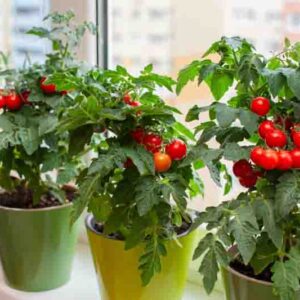
Black Cherry can grow well in a container, but it is not a naturally compact cherry tomato plant.
Use a large container, preferably around 10 gallons or more, with a fertile, well-drained potting mix and sturdy vertical support. Larger containers are easier to keep evenly moist during hot weather and provide a more forgiving root zone for a vigorous plant.
Trying to confine Black Cherry to a small pot can make watering, support, and nutrient management unnecessarily difficult.
Container reality: Black Cherry produces one-inch fruit on a full-sized vine. Choose the container according to the root system and growth habit, not the size of an individual tomato.
Choose companions that share full sun and compatible moisture and soil conditions without crowding Black Cherry’s vigorous indeterminate canopy.
Basil (Ocimum basilicum) shares similar sun and moisture requirements and fits naturally into an edible tomato bed.
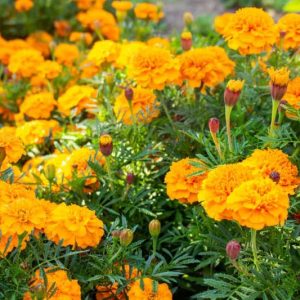
French Marigold (Tagetes patula) thrives in full sun and can flower around bed edges.
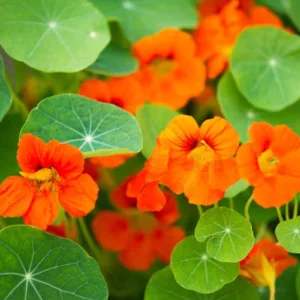
Nasturtium (Tropaeolum majus) can trail around bed margins without occupying the tomato’s vertical canopy space.
Garlic (Allium sativum) can occupy garden space before the tomato reaches full summer size.
For more companion ideas based on practical compatibility rather than folklore, see Gardenia’s Companion Plants for Tomatoes.
Black Cherry is indeterminate. Its vines continue growing, flowering, and producing fruit through the season and need sturdy support.
Gardenia classifies Black Cherry as a modern open-pollinated cultivar rather than a traditional heirloom. Vince Sapp introduced it in 2003, so it does not have the long historical lineage normally associated with traditional heirloom tomatoes.
Multiple current seed and university sources classify Black Cherry as open-pollinated, although Cornell’s cultivar database currently labels it a hybrid. Gardenia follows the broader current evidence and treats the stabilized cultivar sold today as open-pollinated.
Black Cherry was developed by the late Vincent “Vince” Sapp of Tomato Growers Supply Company in Florida and introduced in 2003. Its exact parentage and the precise genetic event that produced the original material have not been reliably published.
Black Cherry produces round fruits about 1 inch (2.5 cm) across. Johnny’s lists approximately 20 grams, while UC Master Gardeners list about 1-2 ounces, so some variation occurs among sources and growing conditions.
Current sources place Black Cherry at roughly 64-75 days from transplanting.
Harvest when the fruit develops its mature dark red-purple, mahogany, or purple-brown color and yields slightly under gentle pressure. It does not need to become literally black.
They can. Black Cherry appears to have useful crack tolerance, but reputable sources differ: some describe good resistance, while others report substantial splitting in rainy weather. Even moisture and prompt harvesting around heavy rain can reduce losses.
No standardized modern V/F/N or late-blight resistance package is broadly established for Black Cherry. Some sources report useful general disease tolerance, but Gardenia does not convert those observations into specific genetic resistance codes.
Yes. Use a large container, preferably around 10 gallons or more, with full sun, consistent moisture, fertile potting mix, and sturdy support for the vigorous indeterminate vine.
Yes. Black Cherry is widely maintained as an open-pollinated cultivar, so seed saved from healthy, true-to-type plants can reproduce the variety when unwanted cross-pollination is minimized.
| Hardiness |
2 - 11 |
|---|---|
| Climate Zones | 1, 1A, 1B, 2, 2A, 2B, 3, 3A, 3B, 4, 5, 6, 7, 8, 9, 10, 11, 12, 13, 14, 15, 16, 17, 18, 19, 20, 21, 22, 23, 24, A1, A2, A3, H1, H2 |
| Plant Type | Annuals, Fruits, Perennials |
| Plant Family | Solanaceae |
| Genus | Solanum, Tomatoes |
| Common names | Tomato |
| Exposure | Full Sun |
| Season of Interest | Summer (Early, Mid, Late), Fall |
| Height | 4' - 5' (120cm - 150cm) |
| Spread | 2' - 3' (60cm - 90cm) |
| Spacing | 24" - 36" (60cm - 90cm) |
| Maintenance | High |
| Water Needs | Average |
| Soil Type | Clay, Loam, Sand |
| Soil pH | Acid, Neutral |
| Soil Drainage | Moist but Well-Drained |
| Tolerance | Rabbit, Clay Soil |
| Attracts | Bees |
| Garden Uses | Beds And Borders, Patio And Containers, Wall-Side Borders |
| Garden Styles | City and Courtyard, Informal and Cottage, Pollinator Garden |


| Hardiness |
2 - 11 |
|---|---|
| Climate Zones | 1, 1A, 1B, 2, 2A, 2B, 3, 3A, 3B, 4, 5, 6, 7, 8, 9, 10, 11, 12, 13, 14, 15, 16, 17, 18, 19, 20, 21, 22, 23, 24, A1, A2, A3, H1, H2 |
| Plant Type | Annuals, Fruits, Perennials |
| Plant Family | Solanaceae |
| Genus | Solanum, Tomatoes |
| Common names | Tomato |
| Exposure | Full Sun |
| Season of Interest | Summer (Early, Mid, Late), Fall |
| Height | 4' - 5' (120cm - 150cm) |
| Spread | 2' - 3' (60cm - 90cm) |
| Spacing | 24" - 36" (60cm - 90cm) |
| Maintenance | High |
| Water Needs | Average |
| Soil Type | Clay, Loam, Sand |
| Soil pH | Acid, Neutral |
| Soil Drainage | Moist but Well-Drained |
| Tolerance | Rabbit, Clay Soil |
| Attracts | Bees |
| Garden Uses | Beds And Borders, Patio And Containers, Wall-Side Borders |
| Garden Styles | City and Courtyard, Informal and Cottage, Pollinator Garden |
How many Solanum lycopersicum ‘Black Cherry’ (Tomato) do I need for my garden?
| Plant | Quantity | |
|---|---|---|
| Solanum lycopersicum ‘Black Cherry’ (Tomato) | N/A | Buy Plants |
Create a membership account to save your garden designs and to view them on any device.
Becoming a contributing member of Gardenia is easy and can be done in just a few minutes. If you provide us with your name, email address and the payment of a modest $25 annual membership fee, you will become a full member, enabling you to design and save up to 25 of your garden design ideas.
Join now and start creating your dream garden!
Create a membership account to save your garden designs and to view them on any device.
Becoming a contributing member of Gardenia is easy and can be done in just a few minutes. If you provide us with your name, email address and the payment of a modest $25 annual membership fee, you will become a full member, enabling you to design and save up to 25 of your garden design ideas.
Join now and start creating your dream garden!