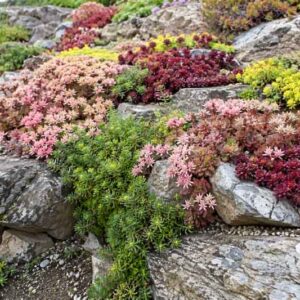
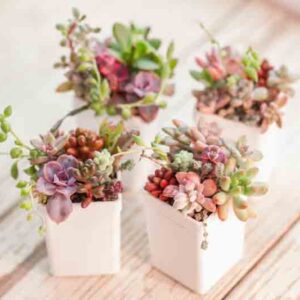
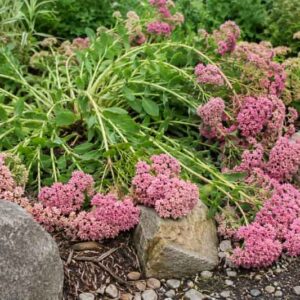
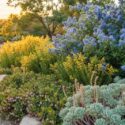
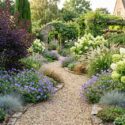
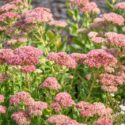
Sedum is more than a late-season flower. The best varieties deliver months of foliage color before bloom, from steel blue and powdery silver to lime, burgundy, coral, and cream variegation. Choose the right sedum, and your dry garden, rock garden, border, or container looks finished long before flowers appear.
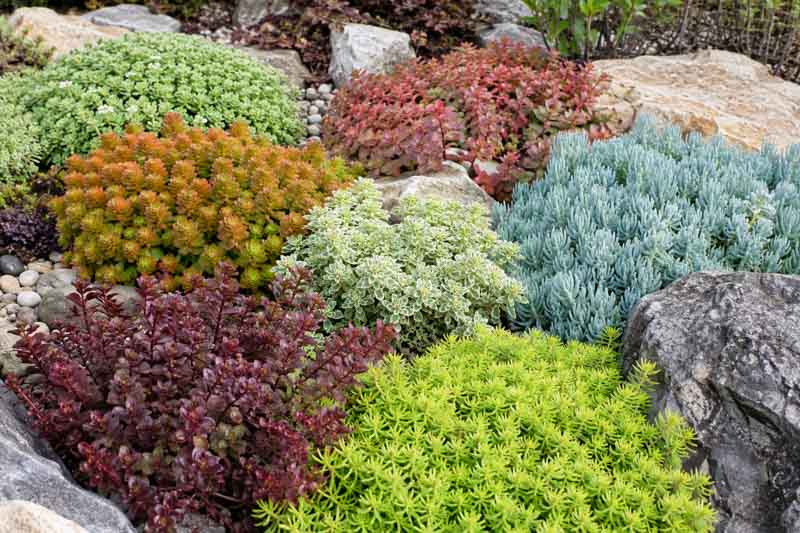


Many gardeners buy sedum for the flowers. That makes sense – the late-season pink, yellow, white, and raspberry blooms can be wonderful for pollinators and garden color. But the real magic of sedum often starts much earlier. Long before the first flower cluster opens, sedum foliage is already doing the design work: cooling a hot border with blue-gray leaves, lighting up a rock garden with lime and gold, adding burgundy drama to a dry edge, or turning coral, copper, and red when the weather cools.
That is why the best sedums are not just “plants that bloom.” They are foliage plants, ground covers, container spillers, winter accents, texture makers, and low-water color tools. If you choose sedum only by flower color, you may miss the most valuable part of the plant. Choose by foliage first, and the flowers become the bonus.
Quick answer
For sedum that looks good before it blooms, focus on foliage color. Try Sedum rupestre ‘Angelina’ for golden-lime leaves, Sedum ‘Blue Elf’ for steel-blue foliage, Sedum ‘Dazzleberry’ for blue-gray mats, Sedum ‘Firecracker’ for burgundy-red color, Sedum ‘Cherry Tart’ for cherry-red leaves, Sedum spathulifolium ‘Cape Blanco’ for powdery silver rosettes, and Sedum takesimense ATLANTIS for variegated foliage.
Sedum flowers may last a few weeks, but foliage can carry a planting from spring into winter. The fleshy leaves store moisture, resist drought, and create strong visual texture even in lean soil. Some sedums form carpets. Some make tight rosettes. Some mound neatly at the front of a border. Others spill over walls and containers. In all of these roles, foliage is what you see first and longest.
The best foliage sedums also solve design problems. A silver sedum can cool down hot paving. A burgundy sedum can echo dark-leaved shrubs or ornamental grasses. A lime sedum can brighten gravel, stone, and dry corners. A blue sedum can make pink flowers look richer. A variegated sedum can turn a small container into a finished composition before bloom season even begins.
Design rule
Buy sedum for the leaves, not just the flowers. If the foliage looks good in May, June, and July, the plant earns its place before bloom season begins.
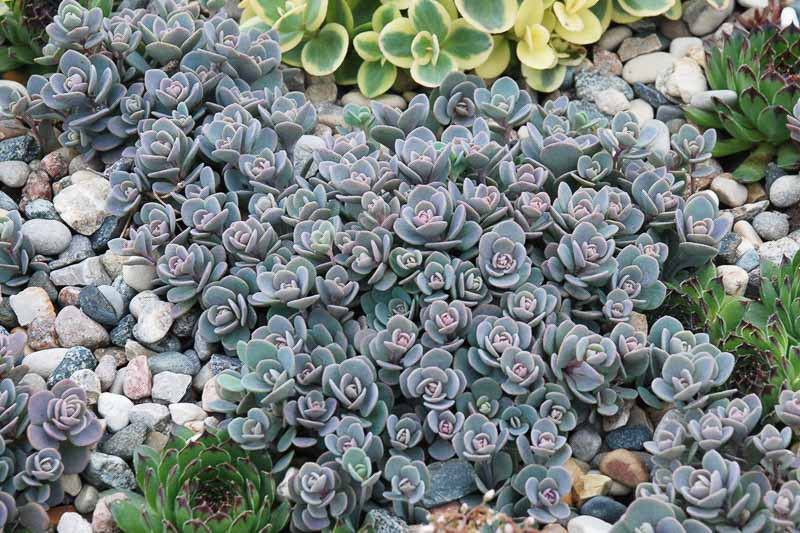
Blue, gray, and silver sedums are among the most useful foliage plants for dry gardens. Their cool tones soften gravel, stone, concrete, terracotta, and hot-colored flowers. They also make excellent companions for lavender, blue fescue, thyme, dianthus, sempervivum, and ornamental grasses.
Sedum reflexum, often called Blue Spruce Stonecrop, is one of the most valuable blue-green foliage sedums for sunny, dry gardens. Its needle-like leaves resemble tiny spruce needles, creating a fine-textured, evergreen mat before the yellow summer flowers appear. Use it as a drought-tolerant ground cover, a spiller over rock walls, or a cascading accent in containers. It is more vigorous than many compact sedums, so give it room where quick coverage is welcome.
Sedum ‘Marina’ is a strong choice for blue-gray foliage. It forms a low, clump-forming plant with thick, fleshy blue-gray leaves that can take on purple tones in summer. The rose-pink flowers arrive later, but the cool, sculptural foliage provides the pre-bloom interest. It is especially useful near silver grasses, burgundy sedums, gravel paths, and dry border edges where the blue-gray color can be seen up close.
Sedum ‘Blue Elf’ is one of the best choices for gardeners who want foliage color before flowers. It forms a very low, dense mat of rounded steel-blue leaves and works beautifully as edging, ground cover, or a container plant. Its dark pink flowers are attractive later, but the blue foliage is the reason to plant it.
Sedum ‘Dazzleberry’ brings a broader, smoky blue-gray look. It is compact, mat-forming, and colorful enough to read clearly from a distance. The raspberry-pink flowers are spectacular in late summer, but the blue-gray leaves keep the plant interesting long before that show begins.
Sedum spathulifolium ‘Cape Blanco’ is the refined choice for rock gardens, troughs, wall pockets, and dry containers. Its powdery gray-green to silvery rosettes look almost sculptural. Use it where you can appreciate the close-up texture: beside gravel, dark stone, dwarf conifers, or burgundy-leaved companions.
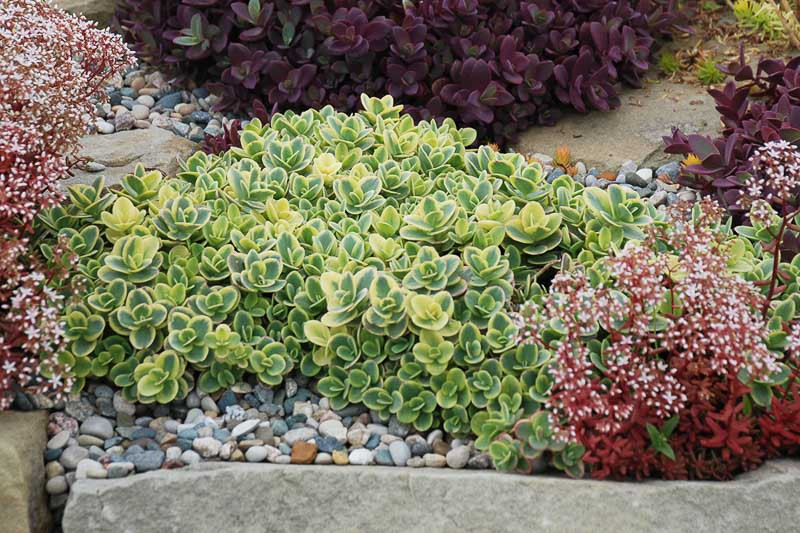
If your dry garden feels dull before flowers arrive, add a lime or gold sedum. These are the sedums that brighten path edges, spill from pots, and create glowing ribbons through gravel gardens. They are especially effective near purple foliage, blue-gray succulents, dark mulch, or weathered stone.
Sedum rupestre ‘Angelina’ is the classic golden foliage sedum. Its needle-like leaves are bright golden-yellow to lime, then often shift toward copper-orange in winter. It is vigorous, mat-forming, drought tolerant once established, and excellent for containers, rock walls, ground cover, and bold color rivers in sunny beds.
Sedum acre ‘Aureum’ is smaller and more delicate, with bright yellow-green foliage that works well in crevices, troughs, and small pockets. It is useful when you want sparkle rather than a large, sweeping mat.
Sedum ‘Lime Zinger’ is a modern foliage-forward sedum with lime-green leaves edged in red. It is compact enough for edging and containers, but showy enough to function as a color plant before flowers appear.
Color tip
Gold and lime sedums look brightest in sun. In too much shade, many yellow sedums become greener, looser, and less dramatic.
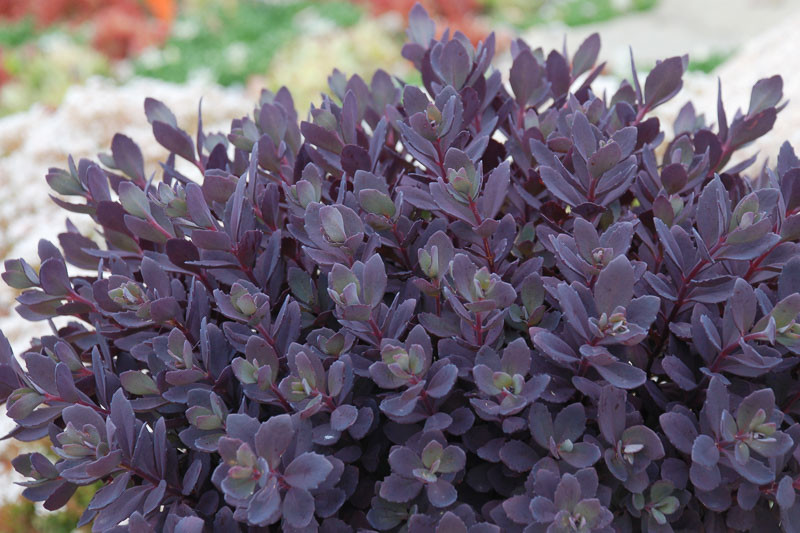
Red, burgundy, bronze, plum, and purple sedums are perfect when you want drama without high water needs. They bring the richness of foliage plants such as heuchera, dark coleus, or purple basil, but with far better drought tolerance in sunny, well-drained sites. Some are low mats for edging and rock gardens. Others are upright border sedums that add dark foliage structure long before their flowers open.
Sedum ‘Firecracker’ is a standout for rich burgundy-red foliage. It forms a dense, well-branched mat and is especially effective in mass plantings, containers, sunny edging, and rock gardens. Its pink flowers are attractive, but the deep foliage color is the main event.
Sedum ‘Cherry Tart’ offers rounded cherry-red leaves that hold their color well through the growing season. It stays compact, making it useful near paths, in containers, or at the front of dry borders where its foliage can be seen clearly.
Sedum ‘Plum Dazzled’ is one of the strongest low-growing purple foliage sedums. It is a dense, mat-forming SunSparkler sedum with dark purple leaves and a compact habit, making it valuable as a colorful ground cover, edging plant, rock garden sedum, or container accent. Its cherry flowers are beautiful later, but the dark plum foliage gives it strong pre-bloom value.
Sedum spurium ‘Dragon’s Blood’ and Sedum spurium ‘Red Carpet’ are reliable low-growing options for red-toned foliage, seasonal color shifts, and practical ground cover. They are especially good for sunny edges, rock gardens, dry slopes, and places where a spreading mat is welcome.
Sedum telephium ‘Purple Emperor’ is one of the classic dark-leaved upright sedums. Its dusky purple foliage forms a semi-upright clump that looks handsome for months before bloom. Use it in sunny borders where you want dark foliage contrast with silver grasses, blue-green sedums, lavender, coneflowers, or golden ornamental grasses.
Sedum ‘Jose Aubergine’ is another excellent pre-bloom foliage sedum, with deep aubergine leaves and dark purple stems. It grows upright without the floppy habit that can affect some taller sedums, making it especially useful in designed borders where structure matters as much as color.
Sedum ‘Cherry Truffle’ adds a different kind of dark foliage effect. Its spring foliage emerges bicolor purple-black and gray-green, then deepens to purple-black later in the season. Because it is compact and upright, it works well near the front or middle of a sunny border where the changing foliage can be appreciated before the warm pink flowers appear.
Sedum telephium ‘Karfunkelstein’ is worth mentioning as a more subtle dark-stemmed, gray-green foliage option rather than a true burgundy-leaved sedum. Its thick fleshy foliage and strong clumping habit provide pre-bloom structure, while the flowers age toward chestnut-bronze in fall. Use it when you want a softer, smoky effect rather than deep purple foliage.
Placement tip
Use low burgundy sedums such as ‘Firecracker’, ‘Cherry Tart’, ‘Plum Dazzled’, and ‘Dragon’s Blood’ at the front of borders, in rock gardens, containers, and edging. Use upright dark-leaved sedums such as ‘Purple Emperor’, ‘Jose Aubergine’, ‘Cherry Truffle’, and ‘Karfunkelstein’ as foliage structure in the middle of sunny borders.
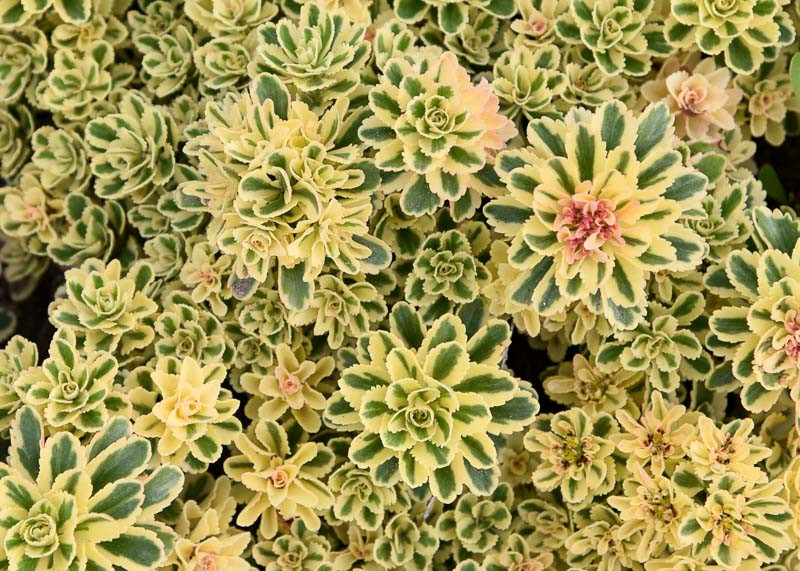
Variegated sedums are small plants with big design value. Their cream, yellow, white, pink, and lime markings catch light, define edges, brighten containers, and make dry gardens look intentional before flowers appear. Some are low, mat-forming sedums for rock gardens and edging. Others are upright or clump-forming border sedums that bring months of foliage interest before their late-season flowers open.
Sedum takesimense ATLANTIS is one of the most distinctive variegated stonecrops. It forms tidy rosettes of dark green leaves with wide creamy-yellow margins, often picking up pinkish tones in fall. It is a strong choice for containers, rock gardens, waterwise landscapes, and small ground cover areas.
Sedum ‘Lime Twister’ is an excellent low-growing variegated sedum. It is a mat-forming sedum with lime-green succulent foliage edged in creamy yellow, giving it strong pre-bloom color even before the soft pink flowers appear. Use it as a bright edging plant, a colorful ground cover, or a container accent where its variegation can be seen up close.
Sedum kamtschaticum var. kamtschaticum ‘Variegatum’ is one of the best variegated sedums for practical garden use. It is low-growing, mat-forming, and semi-evergreen, with fleshy spoon-shaped leaves delicately edged in creamy white and often tinged pink. It works beautifully as a dry-site ground cover, rock garden plant, edging sedum, or container filler.
Sedum spurium ‘Tricolor’ offers green leaves edged with cream and pink. It is useful for softening hard edges, brightening dry borders, and adding variegated color without needing constant watering. Its spreading habit makes it especially useful near paths, gravel edges, and sunny rock garden pockets.
Sedum sieboldii ‘Mediovariegatum’ is more of a trailing container or wall-edge plant than a classic carpet. Its rounded variegated leaves and graceful stems make it valuable before bloom, especially in raised pots, troughs, and low walls where the foliage can spill naturally.
Sedum ‘Autumn Charm’ is a variegated sport of the classic ‘Autumn Joy’. Its gray-green leaves have soft yellow serrated edges that fade to creamy white, giving the plant a bright, clean look long before the late-season flowers open. It is best used as an upright border sedum, not a ground cover.
Sedum erythrostictum ‘Frosty Morn’ is a striking variegated sedum with blue-green leaves broadly margined in creamy white. Its compact, clump-forming habit makes it especially useful in sunny borders, rock gardens, and containers where you want pale foliage contrast before bloom. It is one of the best choices for a softer, cooler variegated effect.
Design tip
Use low variegated sedums such as ATLANTIS, ‘Lime Twister’, ‘Tricolor’, and Sedum kamtschaticum ‘Variegatum’ at the front of borders, in containers, rock gardens, and dry edges. Use upright variegated sedums such as ‘Autumn Charm’ and ‘Frosty Morn’ as bright foliage anchors in sunny perennial borders.
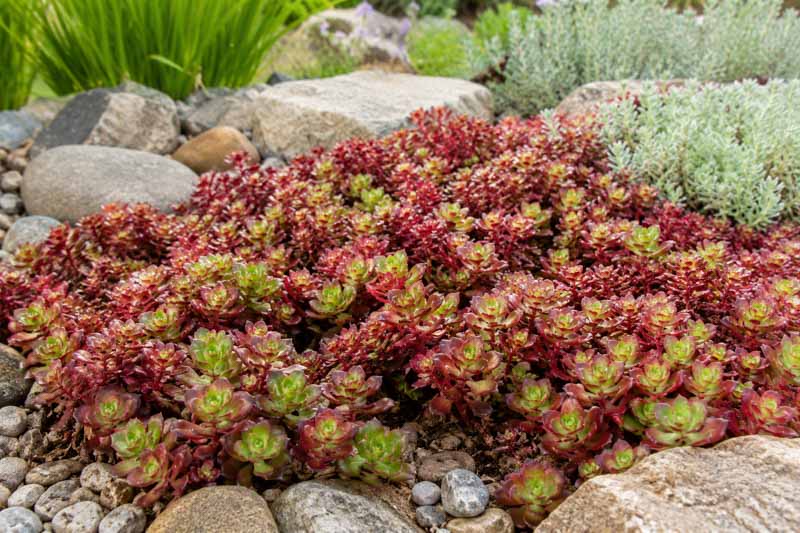
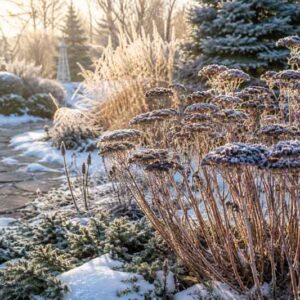
One of the most overlooked sedum traits is winter color. Cold, sun, drought stress, and excellent drainage can intensify red, coral, copper, bronze, orange, pink, and purple tones. In mild climates, many low-growing sedums remain evergreen or semi-evergreen, giving the garden color when many perennials have disappeared. In colder climates, their visible winter performance depends on the species, drainage, snow cover, and local exposure.
Sedum rupestre ‘Angelina’ is the classic choice for winter color. Its golden-yellow, needle-like foliage often shifts to copper, orange, and amber tones in cold weather, making it one of the brightest sedums for winter containers, rock gardens, wall edges, and sunny ground cover.
Sedum album ‘Coral Carpet’ is one of the best winter-tinted sedums for small-scale color. Its tiny rounded leaves emerge coral, mature to green, then turn red in winter, giving it a long season of foliage interest before and after bloom.
Sedum album and Sedum album ‘Murale’ are excellent practical choices for red winter flushing. Their small green leaves can take on red tones in fall and winter, especially in dry, sunny conditions. Use them as low ground covers, green roof plants, rock garden fillers, or drought-tolerant edging sedums.
Sedum tetractinum ‘Coral Reef’ is another useful choice for warm seasonal color. It forms a tight, low carpet of shiny green leaves that take on coral highlights in full sun, with the whole plant turning coral in fall.
Sedum spurium ‘Dragon’s Blood’ earns a place for its strong red seasonal progression. Its bright green leaves are edged burgundy, deepen to bronze-red in summer, and change to brilliant red in fall, making it one of the most dramatic low-growing sedums for late-season foliage color.
Sedum spathulifolium is valuable for cooler, subtler winter tones. Its chalky white, silvery-gray, or blue-green rosettes can pick up reddish or purple tints in winter. It is especially good in rock gardens, containers, coastal gardens, and dry edges where the rosette texture can be appreciated up close.
Sedum dasyphyllum is a small-scale gem for troughs, crevices, and containers. Its tiny silver-gray leaves can take on pink or purple tinges during drought or cool weather, making it a refined winter-interest sedum for close viewing.
Sedum sieboldii is not evergreen in cold climates, but it deserves mention for fall-to-early-winter display. Its blue-green leaves develop pink edges in summer, then turn bright orange-red in fall, especially when grown in containers, raised beds, or rock garden edges where its trailing habit can be seen.
Winter success note
Cold hardiness is not enough. Sedums also need excellent drainage, especially in wet winter climates. Raised beds, gravelly soil, slopes, and containers with drainage holes help prevent rot. In winter, dry cold is usually easier for sedums than cold, wet soil.
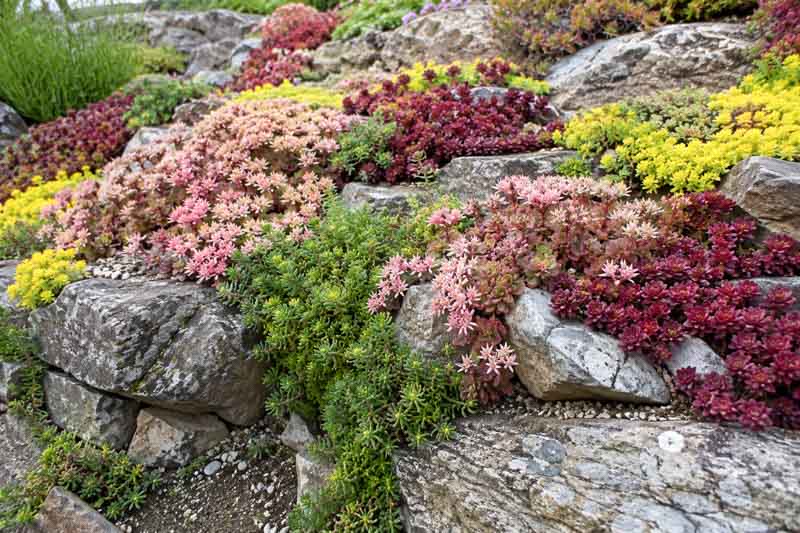
Use sedum like a living paint chip. Blue sedums cool a planting. Gold sedums brighten it. Burgundy sedums add depth. Variegated sedums add detail. Coral and red winter-tinted sedums extend the season. The best combinations often rely on contrast: blue sedum with golden grasses, burgundy sedum with silver artemisia, lime sedum with purple heuchera, or variegated sedum with dark gravel.
For containers, combine one trailing sedum, one rosette sedum, and one upright or mounding succulent. For rock gardens, repeat the same sedum in several pockets instead of using one of everything. For dry borders, plant sedums in groups large enough to read as color blocks. For slopes and banks, choose mat-forming sedums that can knit together and reduce bare soil.
Good companions include Sempervivum, Delosperma, creeping thyme, dianthus, lavender, agastache, and compact ornamental grasses such as blue fescue.
Browse Garden Design Ideas with Sedum
Give most sedums full sun. Strong light improves compact growth and intensifies foliage color. Too much shade can make sedums stretch, green out, or lose their sharp color contrast. Plant them in well-drained soil and avoid heavy feeding. Rich soil may produce lush growth, but it often reduces color and makes plants softer.
Water regularly during establishment, then reduce irrigation once plants are rooted. Most sedums are drought tolerant, but they are not plastic plants. They still need moisture while settling in. After bloom, trim lightly if mats look untidy or if you want to keep creeping stems within bounds.
Use the Gardenia Sedum Plant Finder, Sedum Comparison Tool, Sedum Guides, and Sedum Plant Combinations to compare height, spread, color, hardiness, exposure, water needs, and planting uses before choosing varieties.
Sedum flowers are lovely, but foliage is the feature that makes sedums indispensable. Blue, bronze, lime, burgundy, silver, coral, variegated, and winter-tinted sedums bring months of color to sunny, dry, low-maintenance gardens. They work in containers, rock gardens, gravel gardens, walls, slopes, edging, and waterwise borders.
The smartest way to choose sedum is simple: ask what the plant contributes before it blooms. If the leaves are beautiful, the habit suits the space, and the drainage is right, you will have a sedum that earns its place all season long.
Some of the best foliage sedums before bloom include Sedum rupestre ‘Angelina’ for golden-lime foliage, Sedum reflexum for blue-green needle-like leaves, Sedum ‘Blue Elf’ for steel-blue foliage, Sedum ‘Dazzleberry’ for blue-gray mats, Sedum ‘Firecracker’ and Sedum ‘Plum Dazzled’ for burgundy-purple color, Sedum ‘Cherry Tart’ for cherry-red leaves, Sedum spathulifolium ‘Cape Blanco’ for silver rosettes, and Sedum takesimense ATLANTIS for variegation.
Many sedums hold attractive foliage color for a long season, but intensity depends on variety, sun exposure, temperature, soil, and moisture. Full sun and lean, well-drained soil usually produce the strongest blue, silver, lime, gold, red, burgundy, purple, or variegated foliage. Too much shade or rich soil can make colorful sedums greener and softer.
Good blue, blue-gray, and silver sedums include Sedum reflexum, Sedum ‘Marina’, Sedum ‘Blue Elf’, Sedum ‘Dazzleberry’, and Sedum spathulifolium ‘Cape Blanco’. Sedum reflexum has blue-green needle-like foliage, ‘Marina’ has thick blue-gray leaves that can tint purple, ‘Blue Elf’ forms a steel-blue mat, ‘Dazzleberry’ offers smoky blue-gray foliage, and ‘Cape Blanco’ is valued for powdery silver rosettes.
Sedum rupestre ‘Angelina’ is one of the best sedums for golden-yellow to lime foliage and is especially useful as ground cover, edging, a container spiller, or a bright accent in rock gardens. Sedum acre ‘Aureum’ is a smaller yellow-green sedum for crevices and troughs, while Sedum ‘Lime Zinger’ offers lime-green foliage edged in red.
Low-growing red and burgundy sedums include Sedum ‘Firecracker’, Sedum ‘Cherry Tart’, Sedum ‘Plum Dazzled’, Sedum spurium ‘Dragon’s Blood’, and Sedum spurium ‘Red Carpet’. Upright dark-leaved sedums include Sedum telephium ‘Purple Emperor’, Sedum ‘Jose Aubergine’, Sedum ‘Cherry Truffle’, and Sedum telephium ‘Karfunkelstein’. Use the low types for edging and ground cover, and the upright types for border structure.
Excellent variegated sedums include Sedum takesimense ATLANTIS, Sedum ‘Lime Twister’, Sedum kamtschaticum var. kamtschaticum ‘Variegatum’, Sedum spurium ‘Tricolor’, Sedum sieboldii ‘Mediovariegatum’, Sedum ‘Autumn Charm’, and Sedum erythrostictum ‘Frosty Morn’. Low variegated types work well in edging, rock gardens, containers, and dry ground cover, while upright types such as ‘Autumn Charm’ and ‘Frosty Morn’ are best for sunny borders.
Sedum rupestre ‘Angelina’ is excellent for copper-orange winter tones, while Sedum album ‘Coral Carpet’ is valued for coral-to-red winter color. Sedum tetractinum ‘Coral Reef’, Sedum album, Sedum album ‘Murale’, Sedum spurium ‘Dragon’s Blood’, Sedum spathulifolium, and Sedum dasyphyllum can also develop attractive red, coral, bronze, pink, purple, or reddish winter tints depending on climate, sun, drought stress, and drainage.
Colorful sedum foliage often turns greener when plants receive too much shade, too much water, or overly rich soil. For stronger color, grow sun-loving sedums in bright light, plant them in sharply drained soil, avoid heavy fertilizer, and do not overwater once they are established.
They can be either. Low-growing sedums such as ‘Angelina’, ‘Blue Elf’, ‘Dazzleberry’, ‘Firecracker’, ‘Cherry Tart’, ‘Plum Dazzled’, ‘Dragon’s Blood’, ‘Tricolor’, and ‘Coral Carpet’ work as edging plants, rock garden plants, containers, or ground covers. Upright sedums such as ‘Purple Emperor’, ‘Jose Aubergine’, ‘Cherry Truffle’, ‘Autumn Charm’, and ‘Frosty Morn’ are better used as foliage-rich border perennials.
Most colorful sedums develop their strongest foliage color in full sun. Blue, silver, lime, burgundy, red, and variegated sedums may become greener, looser, or less vivid in too much shade. Good drainage is just as important as sun, especially in winter, because sedums dislike wet, heavy soil.
Updated: June 2026 • Reviewed by Gardenia Editors
| Hardiness |
3 - 9 |
|---|---|
| Plant Type | Cactus & Succulents, Perennials |
| Genus | Sedum |
| Exposure | Full Sun, Partial Sun |
| Season of Interest | Spring (Mid, Late), Summer (Early, Mid, Late), Fall |
| Maintenance | Low |
| Soil Drainage | Well-Drained |
| Attracts | Bees, Butterflies, Birds |
| Hardiness |
3 - 9 |
|---|---|
| Plant Type | Cactus & Succulents, Perennials |
| Genus | Sedum |
| Exposure | Full Sun, Partial Sun |
| Season of Interest | Spring (Mid, Late), Summer (Early, Mid, Late), Fall |
| Maintenance | Low |
| Soil Drainage | Well-Drained |
| Attracts | Bees, Butterflies, Birds |
Create a membership account to save your garden designs and to view them on any device.
Becoming a contributing member of Gardenia is easy and can be done in just a few minutes. If you provide us with your name, email address and the payment of a modest $25 annual membership fee, you will become a full member, enabling you to design and save up to 25 of your garden design ideas.
Join now and start creating your dream garden!
Create a membership account to save your garden designs and to view them on any device.
Becoming a contributing member of Gardenia is easy and can be done in just a few minutes. If you provide us with your name, email address and the payment of a modest $25 annual membership fee, you will become a full member, enabling you to design and save up to 25 of your garden design ideas.
Join now and start creating your dream garden!