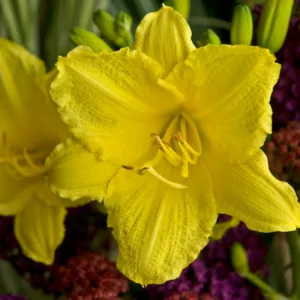
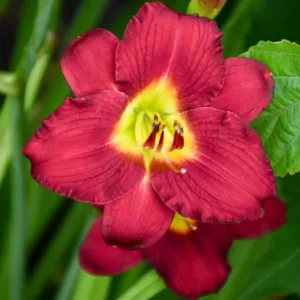
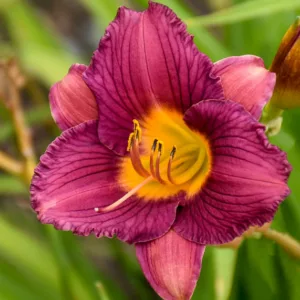
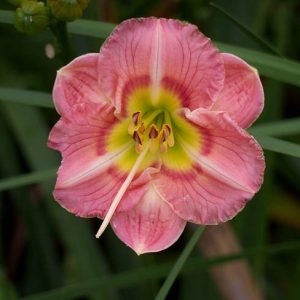
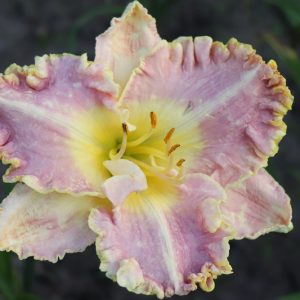
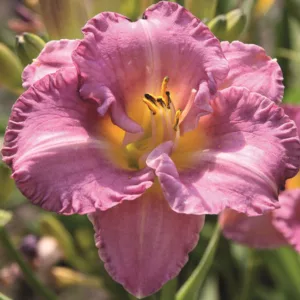
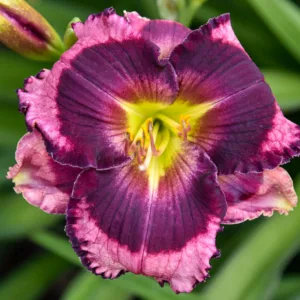
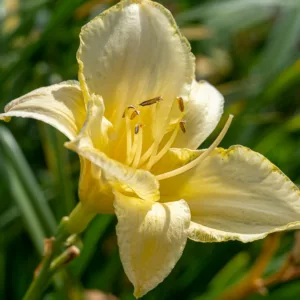
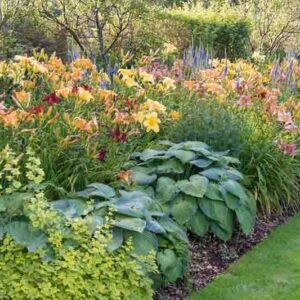
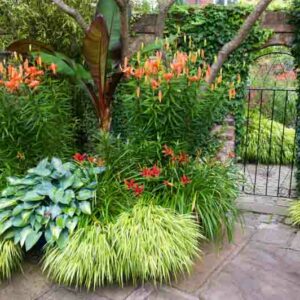
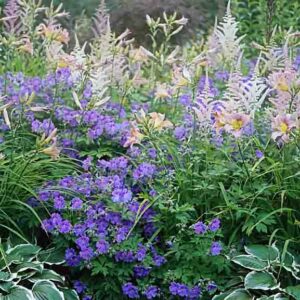
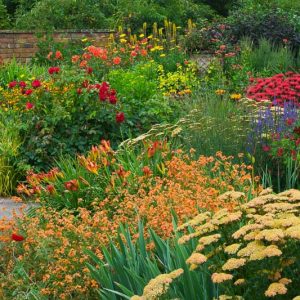
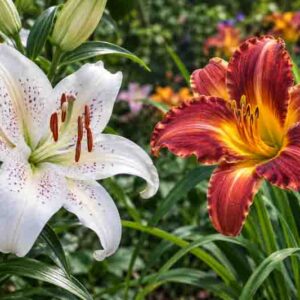
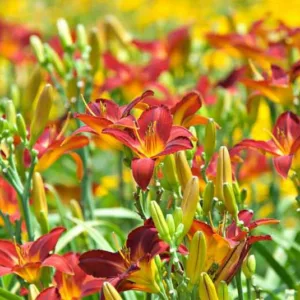
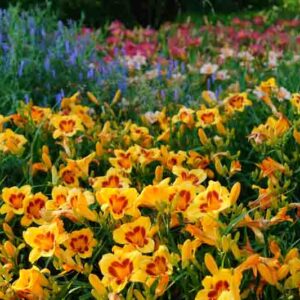
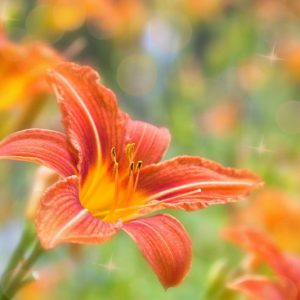
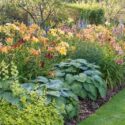
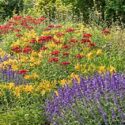
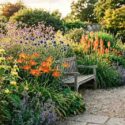
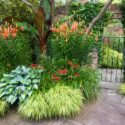
Daylilies can make outstanding container plants when cultivar and pot are properly matched. Discover the best compact and reblooming varieties, how to choose the right container without overpotting, manage watering and feeding, divide crowded clumps, protect roots in winter, and keep potted daylilies flowering beautifully for years.
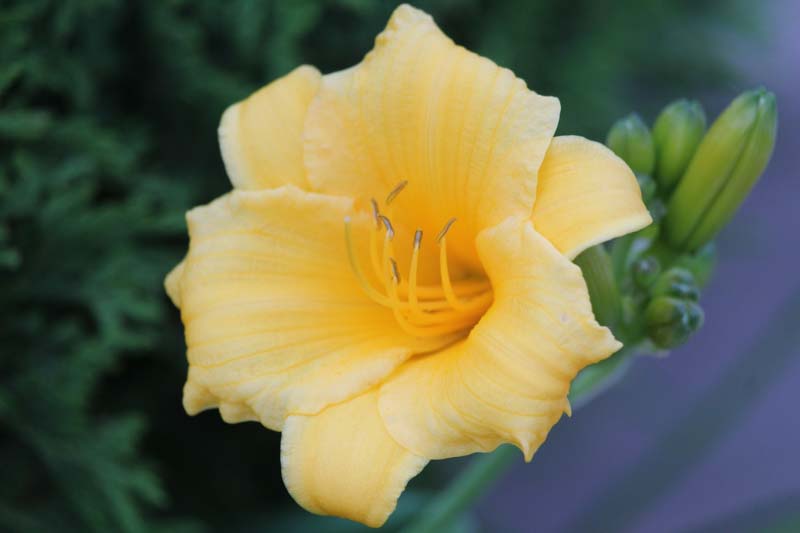


Daylilies are usually associated with generous perennial borders, but they can be surprisingly effective in containers. Their arching foliage softens the edge of a pot, their flower scapes add height without creating a bulky woody framework, and compact cultivars can bring weeks of summer color to patios, balconies, courtyards, decks, and small gardens.
The Royal Horticultural Society specifically recommends smaller and dwarf Hemerocallis for large containers, where their leaves can cascade attractively over the sides. But successful container growing depends on more than finding the shortest cultivar.
A potted daylily has access to less soil, less stored moisture, and fewer nutrients than the same plant growing in the ground. Its roots are also more exposed to heat, cold, and rapid changes in moisture. That means cultivar choice, pot size, drainage, watering, feeding, and winter care all matter more.
The best daylilies for pots combine manageable clump size, attractive foliage, balanced proportions, and enough flowering power to justify valuable container space. Reblooming cultivars can be especially useful, but a tidy habit and good overall scale matter just as much.
Gardenia’s Container Fit Rule: Choose a daylily for the whole plant, not simply the flower. Compare mature height and spread, foliage habit, bloom season, rebloom, flower scale, and the role you want the container to play.
Yes. Daylilies can be grown successfully as long-term container perennials when their roots have enough room, drainage is excellent, and watering and feeding are adjusted for container culture.
RHS describes Hemerocallis as suitable for both borders and containers and specifically recommends smaller and dwarf cultivars for large pots in sunny positions.
A container does not change the plant’s basic light requirements. Most daylilies still flower most generously with substantial direct sunlight. Partial sun can work, but too little light often means fewer flower scapes and buds.
If your patio or balcony is partly shaded, see Gardenia’s guide to growing daylilies in partial shade.
Containers allow daylilies to be used where a conventional perennial bed is impossible or inconvenient. A compact cultivar can bring perennial color to a balcony, paved courtyard, terrace, or small patio without requiring permanent garden soil.
Pots also let you bring flowers closer to outdoor living areas. Because each daylily bloom lasts only about a day, there is something particularly enjoyable about watching new flowers open beside a chair, doorway, or dining area.
Containers can also be rearranged as the season changes. A pot can be moved into a more prominent position while in peak bloom, shifted away from excessive reflected heat, or grouped with other containers to create a temporary summer display.
For collectors, an individual pot can also showcase a favorite cultivar where flower form, color, fragrance, and scape structure are easier to appreciate.
Not every daylily that physically fits into a pot is equally useful there. Gardenia gives particular weight to four characteristics.
Compact scale. A smaller clump is easier to balance visually in a container and generally requires less frequent repotting or division.
Long display. Rebloom or an extended flowering season gives better value from limited container space.
Good foliage. Daylilies spend far more time in leaf than in flower, so a neat mound of arching foliage is especially important in a prominently displayed pot.
Balanced proportions. Flower size and scape height should suit the size and stability of the container. A taller or larger-flowered cultivar can work beautifully, but it needs a correspondingly substantial pot.
Compact does not always mean dwarf. Dwarf and miniature daylilies are obvious candidates, but moderately sized cultivars can also make excellent container plants when the clump stays manageable and the pot is large enough to balance the flowers.
The selections below combine traits that make them especially useful candidates for container growing, including compact scale, repeat flowering, attractive foliage, fragrance, or strong visual impact. The list is not based on height alone.
Gardenia’s container shortlist is not simply a ranking of the shortest cultivars. It favors plants whose mature scale, foliage, flower proportion, rebloom, fragrance, and season of interest make them practical choices for life in a pot.
| Hardiness |
3 - 9 |
|---|---|
| Heat Zones |
2 - 11 |
| Climate Zones | 2, 3, 4, 5, 6, 7, 8, 9, 10, 11, 12, 13, 14, 15, 16, 17, 18, 19, 20, 21, 22, 23, 24, H1, H2 |
| Plant Type | Perennials |
| Genus | Hemerocallis |
| Exposure | Full Sun, Partial Sun |
| Season of Interest | Summer (Early, Mid, Late), Fall |
| Maintenance | Low |
| Water Needs | Average |
| Soil Type | Chalk, Clay, Loam, Sand |
| Soil pH | Acid, Alkaline, Neutral |
| Soil Drainage | Moist but Well-Drained, Well-Drained |
| Characteristics | Showy |
| Tolerances | Drought, Rabbit, Dry Soil, Salt |
| Attracts | Butterflies, Hummingbirds |
| Landscaping Ideas | Banks And Slopes, Beds And Borders, Patio And Containers |
| Garden Styles | City and Courtyard, Coastal Garden, Informal and Cottage, Traditional Garden |
Find the right daylily for your container: Use Gardenia’s Plant Finder to explore daylilies by size, flower color, bloom season, fragrance, exposure, and other characteristics. Use the Daylily Comparison Tool to compare cultivars side by side, or the Garden Design Tool to compare mature sizes and bloom seasons and build a planting palette for your patio or garden.
There is no single correct pot diameter for every daylily. A newly divided miniature cultivar and a mature 24-inch clump do not need the same container.
The best approach is to consider both the current rootball and the cultivar’s eventual clump size.
Daylilies develop fleshy roots and gradually expanding crowns. The container should provide enough room for healthy root growth without being so large that a small plant sits for long periods in a large volume of wet compost.
RHS advises moving container plants into pots only slightly larger than the existing rootball when repotting. Planting a small root system into an excessively large container can lead to overpotting, where unused compost stays wet for too long and root aeration suffers.
As the daylily grows, move it into progressively larger containers or divide the clump and refresh the compost.
Mature spread is often more useful than flower-stalk height when judging eventual container needs. A plant only 18 inches tall may still develop a broad crown and substantial root system.
Gardenia’s Pot-Sizing Rule: Match the pot to both the current rootball and the cultivar’s future clump. Do not judge container size by flower-stalk height alone, and avoid jumping a small plant directly into an excessively large volume of compost.
Good drainage is essential for container-grown daylilies.
RHS recommends fertile, moisture-retentive but well-drained conditions for Hemerocallis, and the same balance matters in pots. Daylilies appreciate reliable moisture during active growth, but their roots should not remain waterlogged.
Use a container with generous drainage holes. If a decorative outer pot has no drainage, keep the daylily in a separate inner pot that can drain freely and never allow it to stand permanently in water.
A wider, stable container is generally easier to manage than a tall, narrow one. Larger containers dry more slowly, offer better temperature buffering, and are less likely to topple when tall flower scapes catch the wind.
Do not add gravel simply to “improve drainage” in an otherwise poorly designed pot. What matters is that water can move freely through the growing medium and escape through open drainage holes.
A container needs a growing medium that holds moisture without becoming dense and airless.
Garden soil by itself is usually unsuitable because it can compact, drain poorly, and become unnecessarily heavy. Use a high-quality potting mix formulated for container plants.
RHS recommends peat-free multipurpose compost for potting bare-root Hemerocallis. For longer-term container culture, choose a mix that remains reasonably moisture-retentive while allowing excess water to drain freely.
Avoid both extremes: a very coarse medium that dries almost immediately and a heavy mix that remains saturated for long periods.
Container-grown daylilies should be replanted at approximately the same depth at which they were growing previously. Keep the crown near the surface rather than burying it deeply.
Set the plant in the pot, arrange the roots naturally where possible, fill around them with fresh potting mix, and firm gently.
Water thoroughly after planting so the growing medium settles around the roots.
Bare-root daylilies can also be started in containers. RHS recommends potting them into peat-free multipurpose compost, watering well, and keeping the medium moist as fresh foliage develops.
Most daylilies flower best in a sunny position. RHS specifically recommends placing smaller and dwarf Hemerocallis grown in containers in a sunny spot.
In very hot climates, some afternoon protection may be helpful, particularly for richly colored red or purple flowers. A pot beside a dark wall, stone patio, or south- or west-facing surface can become considerably hotter than the same plant growing in open ground.
One of the advantages of container growing is flexibility. If flowers are scorching or the pot dries excessively fast, you can often improve conditions simply by moving it away from reflected afternoon heat.
Container-grown daylilies require more attention to watering than established plants in garden soil.
RHS specifically advises watering Hemerocallis in containers regularly during the growing season because their roots have access to a much smaller reservoir of moisture.
There is no useful universal schedule. A daylily may need water much more frequently during hot, windy weather than during a cool spell. Pot size, pot material, exposure, plant size, and growing medium all influence drying time.
Check the compost rather than watering automatically. When water is needed, irrigate thoroughly so the root zone is moistened and excess water drains freely from the base.
Small pots, terracotta containers, balconies, and plants standing on heat-reflecting paving can dry particularly quickly.
Container-grown is different from garden-grown. Established daylilies in open soil can tolerate dry periods because their roots explore a much larger volume of soil. A plant confined to a pot has far less stored moisture available.
Yes, if they remain in containers permanently.
RHS notes that daylilies planted in garden soil generally need little additional feeding, but permanently container-grown plants require regular feeding during the growing season because nutrients in the compost are gradually depleted.
Use a balanced fertilizer according to its label rather than feeding heavily in an attempt to force more flowers.
If a daylily produces abundant foliage but few blooms, first check sunlight, root crowding, water, and the age of the clump. Extra nitrogen will not correct insufficient light and may encourage even more foliage.
Spent flowers are much more noticeable in a pot beside a patio than in a large perennial border.
Remove faded blooms when convenient to keep the plant tidy. Once every flower on a scape has finished, the flower stalk can be cut back near the base.
Deadheading improves appearance and prevents unwanted seed formation, but it does not create rebloom in a cultivar that lacks the genetic ability to rebloom.
For more detailed seasonal grooming, see Gardenia’s guide to when to cut back daylilies and how to deadhead them.
Daylilies gradually produce additional fans and form larger clumps. In a container, that expansion eventually uses most of the available root space.
Signs that a plant needs attention include roots circling densely inside the pot, roots emerging from drainage holes, declining growth or flowering, a crown that has filled the container, or compost that no longer drains and holds water properly.
RHS notes that established Hemerocallis benefit from division every few years. Container-grown plants may need attention sooner because the available root volume is limited.
Spring is an excellent time to repot as active growth begins. You can move the plant into a slightly larger container, or divide an established clump and replant healthy sections into refreshed compost.
For step-by-step guidance, use Gardenia’s guide to dividing daylilies.
Often, but winter treatment depends on climate and exposure.
Container plants are more vulnerable to cold than the same perennials growing in the ground because their roots are exposed on all sides rather than insulated by surrounding soil. RHS also warns that pots are more prone to winter waterlogging.
In mild climates, a hardy daylily in a substantial frost-resistant pot with excellent drainage may overwinter outdoors without difficulty.
In colder regions, move pots to a sheltered position or protect the container so the root zone is less exposed to severe freezes and repeated freeze-thaw cycles. Do not allow dormant roots to become completely dry, but avoid keeping cold compost saturated.
The important point is simple: do not assume that a daylily’s in-ground hardiness automatically guarantees identical performance in an exposed container.
Many daylily cultivars are dormant or deciduous. Their leaves naturally yellow and collapse as temperatures fall, then fresh growth emerges again when conditions improve.
This is normal dormancy, not plant death.
Dead foliage can be removed once it has collapsed, or left temporarily if you prefer to provide winter habitat for insects before cleaning the pot ahead of spring growth.
Evergreen and semi-evergreen cultivars may retain more foliage in mild climates but can look untidy after frost.
You can, but one cultivar per pot is usually simpler for long-term growing.
Several young divisions can create an impressive display in a very large planter, but each crown expands. What looks comfortably full in the first season can become crowded surprisingly quickly.
Separate pots also give you more flexibility. You can combine different heights and bloom seasons, rearrange containers as each cultivar comes into flower, and divide an individual plant without disturbing its neighbors.
Yes, provided the container is large enough and all the plants share similar requirements for light, moisture, and drainage.
Trailing annuals or compact seasonal plants can soften the rim of a large container without overwhelming the daylily crown.
Avoid vigorous perennials or aggressive root systems that rapidly compete for the limited soil volume.
It is often easiest to treat the daylily as the permanent structural plant and use smaller seasonal companions that can be changed without disturbing the crown.
For planting inspiration, see Gardenia’s guide to great companion plants for daylilies.
Lots of foliage but few flowers: check light levels, root crowding, and fertilizer use before assuming the plant needs more feeding.
Brown leaf tips: inconsistent watering, excessive heat, salt accumulation, or root congestion may be involved.
Wilting even after watering: a severely congested rootball may prevent water from penetrating evenly, while water may escape around the outer edge of the pot.
Yellow leaves: some yellowing is normal as foliage ages, but prolonged symptoms can also reflect excess water, drought, nutrient problems, pests, disease, or root stress.
Soggy compost and weak growth: check drainage and consider whether the plant has been overpotted into too much wet compost.
No rebloom: rebloom depends on cultivar genetics as well as climate, moisture, growing-season length, and plant vigor. A reblooming cultivar will not necessarily repeat equally strongly every year or in every region.
For troubleshooting, see Gardenia’s guide to daylily problems, yellow leaves, spots, and poor bloom.
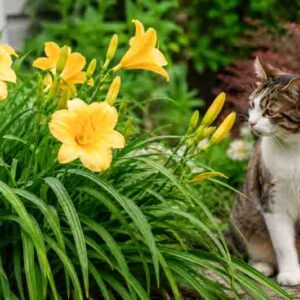
Special caution is needed around cats.
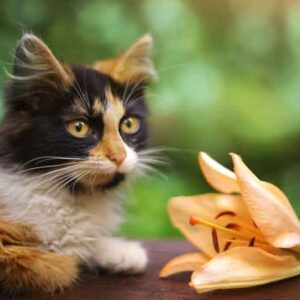
Hemerocallis are toxic to cats, and ingestion of plant material can cause serious poisoning. Container plants may actually place flowers and leaves closer to a curious cat than the same plants growing in a distant border.
If cats regularly have access to your patio, balcony, or terrace, place the container where they cannot chew the plant or choose another perennial.
For more information, see Gardenia’s guide to daylily toxicity in cats.
Daylilies can make excellent container perennials, particularly when you begin with compact or moderately sized cultivars and give their roots enough room to grow without overpotting.
The strongest choices combine manageable scale with attractive foliage and a worthwhile flowering season. Reblooming cultivars can be especially useful where every square foot of patio or balcony space matters.
Use a stable container with excellent drainage, a suitable potting mix, ample sunlight, regular watering, and seasonal feeding. Repot or divide the plant as the crown becomes congested, and remember that exposed container roots may need extra winter protection in cold climates.
Most importantly, select the cultivar as a complete plant. Mature spread, foliage, scape height, flower size, bloom season, fragrance, and rebloom all influence how successful a daylily will look in a pot.
A beautiful container daylily is not simply a flower in a planter. It is a balanced composition of plant, pot, proportion, and season-long performance.
Yes. Daylilies can be grown successfully as long-term container perennials when they receive enough sunlight, regular water, good drainage, and adequate root space. Smaller and dwarf cultivars are particularly useful in large pots.
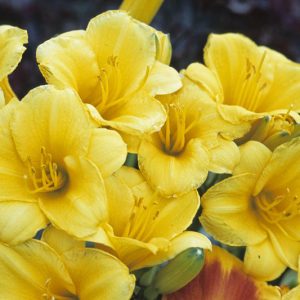
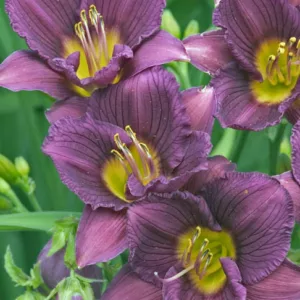
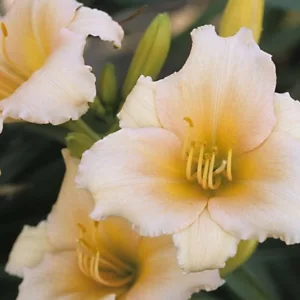
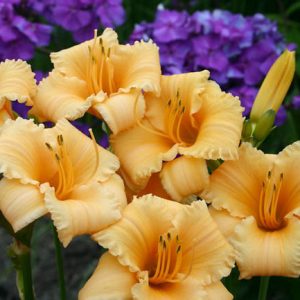
Compact cultivars with attractive foliage and a long flowering season are especially useful. Gardenia suggests considering plants such as ‘Stella de Oro’, ‘Little Grapette’, ‘Mini Pearl’, ‘Apricot Sparkles’, ‘Happy Returns’, ‘Pardon Me’, and ‘Purple de Oro’, along with other compact or reblooming cultivars.
Choose a pot that is slightly larger than the current rootball and move up gradually as the plant develops. Mature clump size is more useful than flower-stalk height when judging how much container space a daylily will eventually need.
Yes. An excessively large pot can leave a small root system surrounded by too much wet compost, increasing the risk of poor aeration and root problems. Move plants into progressively larger containers as they grow.
Check container daylilies regularly and water according to the moisture level rather than a fixed schedule. Water thoroughly when needed and allow excess water to drain freely from the pot.
Yes. Daylilies growing permanently in containers need regular feeding during the growing season because nutrients in the potting mix are gradually depleted. Use fertilizer according to label directions and avoid excessive nitrogen.
Often, but winter survival depends on climate and exposure. Roots in above-ground containers are more exposed to freezing temperatures than roots in garden soil, so potted daylilies may need additional protection in cold climates.
Royal Horticultural Society – How to Grow Hemerocallis – guidance on container growing, smaller and dwarf cultivars, watering, feeding, planting, and division.
Royal Horticultural Society – Growing Plants in Containers – guidance on container size, drainage, watering, winter exposure, and avoiding overpotting.
Royal Horticultural Society – Overpotting – guidance on moving plants gradually into larger pots and avoiding excess wet compost around small root systems.
American Daylily Society – Daylily FAQ – authoritative guidance on daylily culture, sunlight, water, and general performance.
Gardenia – Hemerocallis Daylilies – cultivar dimensions, flower characteristics, bloom seasons, rebloom, fragrance, garden use, photographs, and plant comparisons.
| Hardiness |
3 - 9 |
|---|---|
| Heat Zones |
2 - 11 |
| Climate Zones | 2, 3, 4, 5, 6, 7, 8, 9, 10, 11, 12, 13, 14, 15, 16, 17, 18, 19, 20, 21, 22, 23, 24, H1, H2 |
| Plant Type | Perennials |
| Genus | Hemerocallis |
| Exposure | Full Sun, Partial Sun |
| Season of Interest | Summer (Early, Mid, Late), Fall |
| Maintenance | Low |
| Water Needs | Average |
| Soil Type | Chalk, Clay, Loam, Sand |
| Soil pH | Acid, Alkaline, Neutral |
| Soil Drainage | Moist but Well-Drained, Well-Drained |
| Characteristics | Showy |
| Tolerances | Drought, Rabbit, Dry Soil, Salt |
| Attracts | Butterflies, Hummingbirds |
| Landscaping Ideas | Banks And Slopes, Beds And Borders, Patio And Containers |
| Garden Styles | City and Courtyard, Coastal Garden, Informal and Cottage, Traditional Garden |
Create a membership account to save your garden designs and to view them on any device.
Becoming a contributing member of Gardenia is easy and can be done in just a few minutes. If you provide us with your name, email address and the payment of a modest $25 annual membership fee, you will become a full member, enabling you to design and save up to 25 of your garden design ideas.
Join now and start creating your dream garden!
Create a membership account to save your garden designs and to view them on any device.
Becoming a contributing member of Gardenia is easy and can be done in just a few minutes. If you provide us with your name, email address and the payment of a modest $25 annual membership fee, you will become a full member, enabling you to design and save up to 25 of your garden design ideas.
Join now and start creating your dream garden!