Asiatic Jasmine, Dwarf Confederate Jasmine, Japanese Star Jasmine, Trachelospermum asiaticum majus, Trachelospermum majus Nakai, Trachelospermum crocostemon, Trachelospermum divaricatum

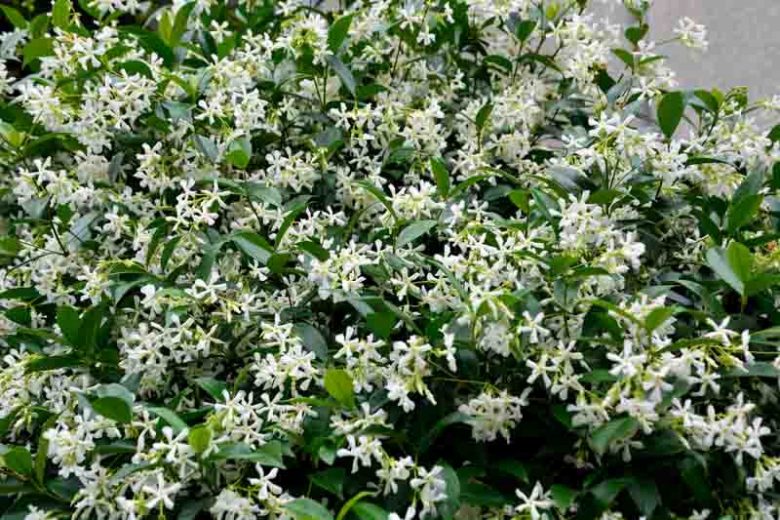


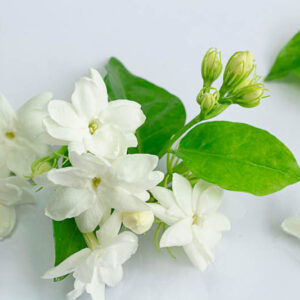
Trachelospermum asiaticum, commonly called Asiatic Jasmine, Asian Star Jasmine, or Yellow Star Jasmine, is an evergreen twining vine and ground cover grown for its glossy foliage, dense spreading habit, and sweetly fragrant creamy flowers. Although it is not a true jasmine, it is one of the most useful evergreen plants for slopes, borders, walls, containers, and large-scale low-maintenance plantings.
Trachelospermum asiaticum is an evergreen vine or ground cover grown for glossy dark green leaves, dense low growth, and clusters of fragrant creamy flowers in summer. Plant it in full sun to part shade in fertile, well-drained soil, water regularly until established, then deeply as needed. Use it as a ground cover, train it onto support, prune in early spring or after bloom, and protect it from cold winds and waterlogged soil.
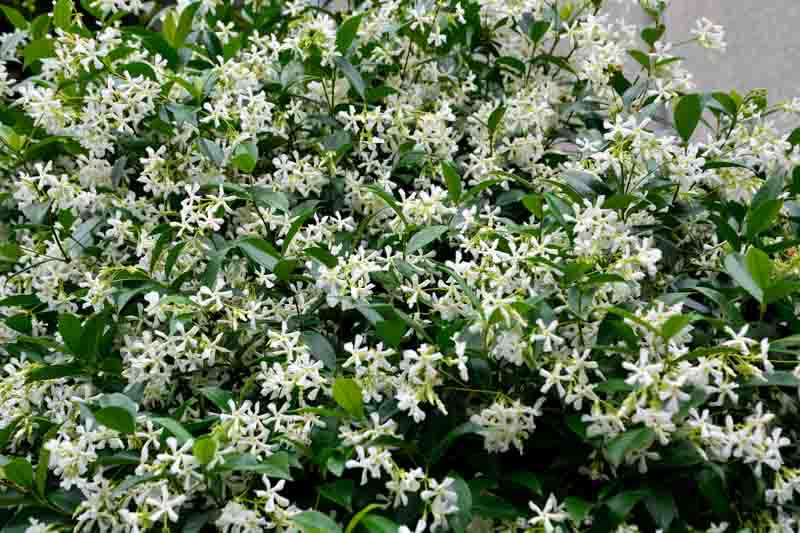
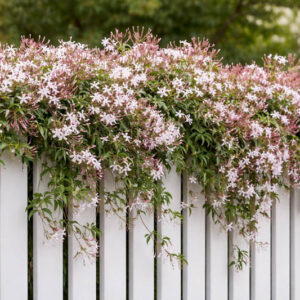
Use: Excellent for ground cover, slopes, borders, fences, trellises, hanging baskets, and containers.
Highlight: Dense evergreen foliage with fragrant creamy flowers in summer.
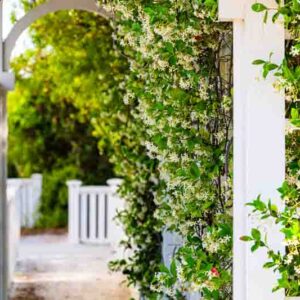
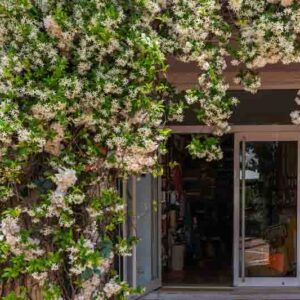
Design note: Let it spread into a polished carpet, or guide it upward to soften a fence, arbor, or wall with glossy evergreen structure.
| Botanical Name | Trachelospermum asiaticum |
|---|---|
| Family | Dogbane family (Apocynaceae) |
| Common Names | Asiatic Jasmine, Asian Star Jasmine, Yellow Star Jasmine |
| Native Range | China, India, Japan and Korea |
| Plant Type | Evergreen woody vine; widely used as a ground cover, trailing container plant, or support-trained climber |
| Hardiness (approx. USDA) | Best in USDA Zones 7-11; often evergreen in mild winters and among the hardier Trachelospermum species |
| Height | 1-2 ft. (30-60 cm) as ground cover; higher when climbing |
| Spread | 10-12 ft. (3-3.6 m) or more, depending on spacing and use |
| Sun Exposure | Full sun to part shade |
| Soil | Average to fertile, well-drained soil |
| Bloom Time | Summer, sometimes extending into early autumn in mild climates |
| Flower Color | Creamy white to pale yellow, often with a buff or yellow-toned center |
| Foliage | Glossy dark green; may bronze or redden in cooler weather |
| Drought Tolerant | Yes, once established |
| Attracts | Pollinators; dense growth also offers cover in the landscape |
| Pet Safety | Pet safety is not as consistently documented as T. jasminoides; avoid ingestion and wear gloves when handling milky sap |
Asiatic Jasmine is a woody evergreen vine most often grown as a ground cover, though it can also climb when given support. It is valued less for dramatic flower power and more for its dense, glossy, polished foliage, its adaptability, and its ability to create a lush, finished look in the landscape. In the right site, it forms a weed-smothering evergreen carpet that looks refined rather than coarse.
Trachelospermum asiaticum has wiry, twining stems and leathery, narrow-oval leaves that stay attractive through all four seasons in mild climates. Left unsupported, it creeps and roots along the ground, building a dense mat. Given a trellis, fence, or arbor, it can climb and soften vertical structures with a more restrained, smaller-leaved look than Star Jasmine.
Native to China, India, Japan and Korea, Asiatic Jasmine is well adapted to warm growing seasons and fertile, free-draining soil. It also handles humidity, summer heat, and light shade better than many evergreen flowering vines, which helps explain why it is widely used in southern and warm-temperate landscapes.
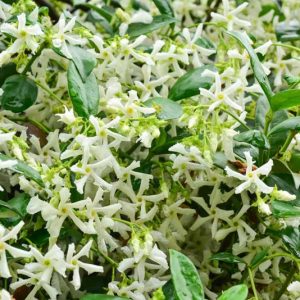
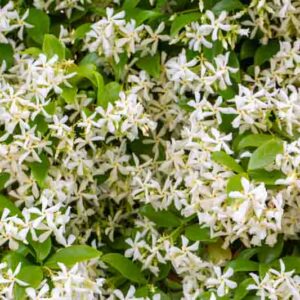
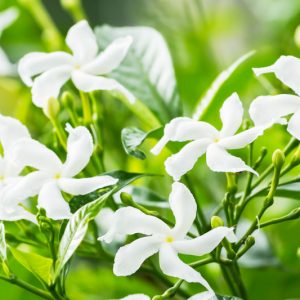
Asiatic Jasmine blooms in summer, sometimes stretching into early autumn in mild regions. The flowers are smaller and less showy than those of Trachelospermum jasminoides (Star Jasmine), but they are still pleasantly fragrant and charming up close. In many landscapes, flowering is a bonus rather than the main reason the plant is chosen.
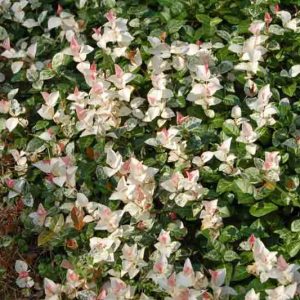
The foliage is where Asiatic Jasmine really earns its place. Leaves are glossy, dark green, and neatly arranged, giving the plant a tidy, evergreen presence. In cool weather, foliage may take on bronze, copper, or reddish tones, adding subtle winter color. That seasonal bronzing is one of the reasons this plant feels dynamic even when not in bloom.
As a ground cover, Asiatic Jasmine usually stays 12-24 inches tall and spreads steadily outward. As a climber, it can reach 10-12 feet or more over time with support, although it is more commonly maintained much lower. Growth rate is moderate to fairly fast once established, especially in warm climates with consistent summer moisture.
Asiatic Jasmine is generally best in USDA Zones 7-11. It is often considered one of the hardier species in the genus, making it a better pick than Star Jasmine in gardens where winter cold is a limiting factor. In Texas, it is widely used for ground cover, foundation plantings, and slope stabilization. In Florida, it performs especially well in large mass plantings and in places where gardeners want a durable alternative to turf. In colder edge-of-range gardens, shelter from drying wind improves winter appearance.
Trachelospermum asiaticum has received the Royal Horticultural Society’s Award of Garden Merit, an indicator of reliable garden performance, ornamental value, and overall durability.
Asiatic Jasmine contributes more than neat evergreen cover. Its summer flowers can attract bees and other pollinators, while the dense foliage creates low shelter and visual cover in mixed plantings. It is also useful in reducing bare-soil exposure on slopes and in difficult transition areas where mulch alone would wash away or thin out.
Asiatic Jasmine is often regarded as deer-resistant, especially once plants have matured and toughened. It is not completely immune, but it is usually less appealing than softer, more tender ground covers. Rabbits may sample young growth, though serious long-term damage is uncommon in established plantings.
Once rooted in, Asiatic Jasmine is considered moderately drought-tolerant. It handles short dry periods better than many lush-looking evergreen covers, but prolonged drought can thin the planting, reduce flowering, and cause leaf scorch. A deep, occasional soaking is far better than constant shallow sprinkling.
Asiatic Jasmine belongs to the dogbane family and, like many members of this group, produces a milky sap. Because pet-safety listings for Trachelospermum asiaticum are not as consistently documented as those for Trachelospermum jasminoides, it is sensible to treat the plant with caution: discourage chewing, avoid ingestion, and wear gloves if you are sensitive to sap or pruning residue.
Asiatic Jasmine is not typically treated as a classic invasive species in most ornamental settings, but it is unquestionably a vigorous spreading plant. That matters. In warm climates, it can move beyond its original footprint if edges are not defined and trimmed. Think of it as aggressive in coverage, not reckless in behavior. Used deliberately and maintained well, that vigor is a strength.
Although both belong to the genus Trachelospermum and are often grouped together, Star Jasmine (Trachelospermum jasminoides) and Asiatic Jasmine (Trachelospermum asiaticum) are used a little differently in the landscape.
In simple terms, Star Jasmine is usually grown for showier flowers and climbing beauty, while Asiatic Jasmine is often chosen for durable, polished ground coverage.
Feed lightly in spring with compost or a balanced slow-release fertilizer. This is not a plant that rewards overfeeding. Too much fertilizer can create soft, overly vigorous top growth that looks lush briefly but becomes harder to manage and not necessarily more attractive.
Apply a 2-3 in. layer of mulch around new plantings to reduce weeds, conserve moisture, and protect the root zone during establishment. Keep mulch slightly away from the crown and main stems to reduce excess moisture around the base.
Container tip:
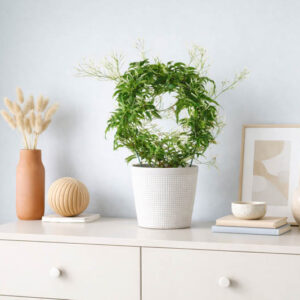
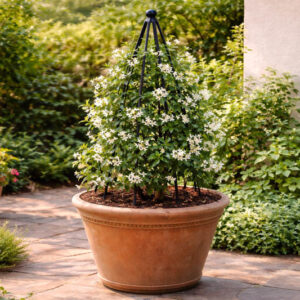
Grow Asiatic Jasmine in a broad pot or hanging basket with excellent drainage and a loose potting mix. In containers, it often shines as a trailing evergreen spiller, but it can also be trained onto a small trellis for a compact, glossy climber.
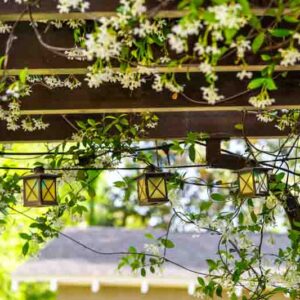
If you want Asiatic Jasmine to climb, start early. Young shoots are flexible and easy to direct. Tie them loosely to wires, lattice, or trellis panels and guide them before the stems tangle. If you are growing it as a ground cover, the opposite strategy works better: pinch or trim spreading shoots to encourage branching and a denser, flatter carpet.
Prune in early spring to clean up winter damage, contain spread, and refresh the planting. A lighter trim after flowering can also help keep edges crisp and growth even.
Training tip:
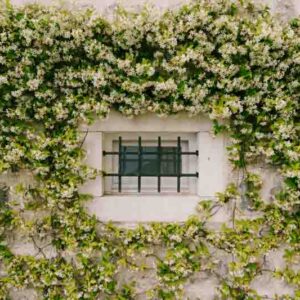
To train Asiatic Jasmine flat against a wall or fence, install horizontal wires and select a few flexible stems as the main framework. Tie in young growth before it stiffens, then trim side shoots to build a tight, evergreen pattern.
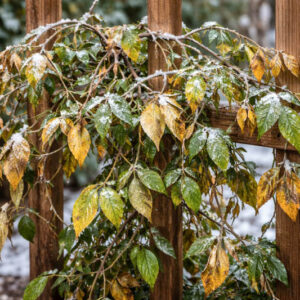
In mild climates, Asiatic Jasmine stays evergreen and attractive all winter. In colder or more exposed gardens, foliage may bronze, redden, or show some wind burn. That color shift is often normal. True winter damage is more likely where roots stay wet or cold wind dehydrates the leaves.
Asiatic Jasmine grows well in containers, especially where its dense foliage can spill over the rim or climb a small support.
Container-grown Asiatic Jasmine is especially useful for patios, balconies, and sheltered courtyards where an evergreen, glossy texture is needed all year.
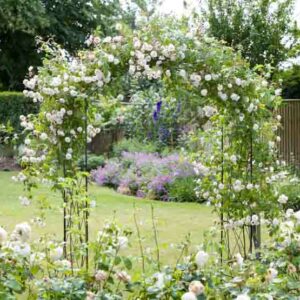
Although more often used as a ground cover, Asiatic Jasmine can make an elegant small-scale espalier. Its finer leaves and controlled twining habit create a neat, evergreen surface that looks sophisticated even when not in bloom.
Espaliered Asiatic Jasmine is particularly effective on intimate walls, courtyard screens, and smaller supports where Star Jasmine might feel too vigorous or too large-leaved.
Asiatic Jasmine is straightforward to maintain, but timing still matters. Feed at the right moment, trim at the right moment, and coverage will be denser, cleaner, and easier to manage.
| Task | Best Time |
|---|---|
| Planting | Plant in spring or fall, when roots can establish without peak summer stress or severe cold. |
| Feeding | Feed lightly in spring as new growth begins. |
| Pruning | Prune in early spring, with optional light shaping after the main bloom. |
| Propagation | Take semi-hardwood cuttings in summer or use layering during active growth. |
| Mulching | Refresh mulch in spring before summer heat and weed pressure build. |
| Winter protection | Protect exposed young plants in late fall to early winter where cold winds are a concern. |
In warm climates, growth may continue for much of the year. In cooler climates, winter slows expansion, making spring the best season for cleanup, feeding, and retraining.
The easiest ways to propagate Asiatic Jasmine are layering and semi-hardwood cuttings.
This is especially easy because low stems often want to root naturally. Pin a flexible shoot to the soil, keep the area lightly moist, and sever the new plant once roots are established.
Take semi-hardwood cuttings during the warmer growing season, remove the lower leaves, and root them in a moist, free-draining medium. This is the preferred method when you want multiple new plants quickly and uniformly.
Asiatic Jasmine may occasionally form paired, narrow seed pods. Seed propagation is rarely used in home gardening because it is slower and less predictable than vegetative methods.
Most problems come down to drainage, watering, light, competition, or maintenance. When Asiatic Jasmine fails, it is usually because the site was never truly right, not because the plant is delicate.
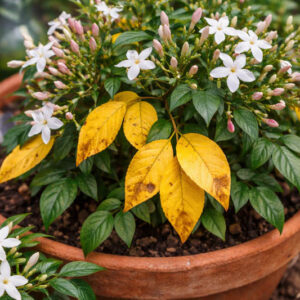
Yellow leaves almost always point to root-zone stress.
If the planting never knit together well, the issue is often spacing, soil preparation, or irregular watering early on.
Asiatic Jasmine is grown mainly for foliage, but if flowering is disappointing, light is the first thing to review.
Blackened foliage often signals sooty mold, which grows on sticky honeydew from sap-sucking insects.
Bronze or red winter foliage is commonly part of the plant’s seasonal color response.
Leaf scorch usually points to environmental stress.
Asiatic Jasmine tolerates many things. Permanently wet soil is not one of them.
The main botanical distinction remains important: Asiatic Jasmine is not a true jasmine. True jasmines belong to Jasminum, while Asiatic Jasmine belongs to Trachelospermum. It has a woody twining habit, evergreen leaves, and small creamy fragrant flowers.
Compared with Star Jasmine (Trachelospermum jasminoides), Asiatic Jasmine usually has smaller leaves, smaller cream-toned flowers, a denser ground-covering habit, and often better tolerance for being used as a low evergreen carpet. Star Jasmine is usually the showier climber. Asiatic Jasmine is usually the tougher ground cover.
Asiatic Jasmine shines in warm-climate, contemporary, Mediterranean, coastal, and low-maintenance landscapes. It is particularly effective when you want the ground plane to look calm, lush, and unified.
Choose companions that enjoy similar drainage and light conditions and that will contrast with its glossy, dark, low foliage. Asiatic Jasmine looks especially good with plants that bring upright form, silver leaves, bold blades, or seasonal color above its evergreen carpet.
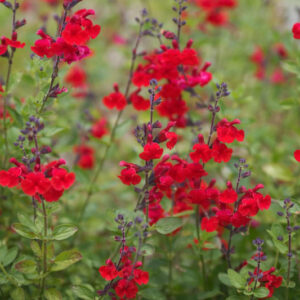
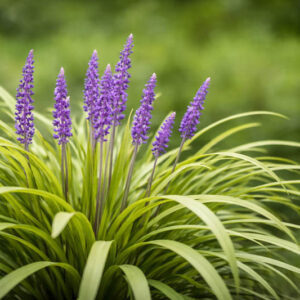
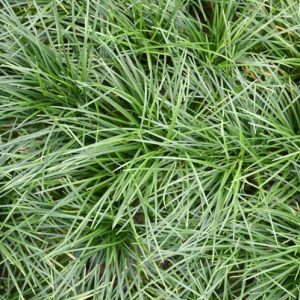
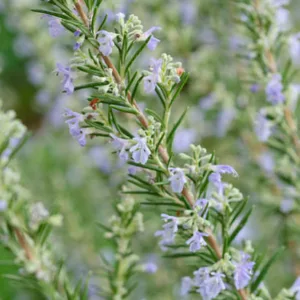
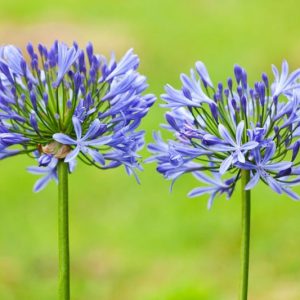
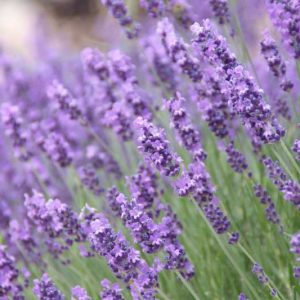
Good companions include: liriope, dwarf mondo grass, society garlic, agapanthus, dianthus, lavender, rosemary, salvia greggii, catmint, teucrium, loropetalum, nandina, boxwood, phormium, hibiscus moscheutos, lantana, creeping thyme, and clumping ornamental grasses such as Pennisetum alopecuroides.
Trachelospermum asiaticum, commonly called Asiatic Jasmine, is an evergreen ground cover or climbing vine grown for its glossy leaves and small, fragrant, star-shaped flowers. It forms a dense carpet of foliage, spreads steadily, and is widely used in warm-climate landscapes for slopes, borders, and low-maintenance ground cover.
No. Asiatic Jasmine is not a true jasmine. True jasmines belong to the genus Jasminum, while Asiatic Jasmine belongs to the genus Trachelospermum. Although the flowers resemble jasmine, the plant is botanically different.
Asiatic Jasmine grows at a moderate rate once established. It spreads by creeping stems that root where they touch the soil, gradually forming a dense ground cover that suppresses weeds and stabilizes soil.
Asiatic Jasmine naturally grows as a ground cover, usually reaching about 12-24 inches tall. However, if given support such as a fence, trellis, or wall, the stems can climb and may reach 10–12 feet or more over time.
Asiatic Jasmine typically blooms in late spring to early summer. The small white flowers are fragrant and appear in clusters, although flowering is often lighter than in Star Jasmine.
Yes. The flowers of Asiatic Jasmine are sweetly fragrant, though the scent is usually lighter and more subtle than the fragrance of Star Jasmine (Trachelospermum jasminoides).
Once established, Asiatic Jasmine is moderately drought tolerant. Mature plants can withstand periods of dry weather, but they grow best with occasional deep watering during extended heat or drought.
Asiatic Jasmine is not generally considered invasive, but it spreads vigorously in warm climates. Its creeping stems root easily, allowing it to form a dense mat of foliage. Regular trimming keeps it contained.
Yes. Asiatic Jasmine tolerates partial shade very well and can even grow in fairly shady locations. However, plants grown in brighter light usually develop denser growth and produce more flowers.
Yes. Asiatic Jasmine is one of the most widely used evergreen ground covers in warm climates. It forms a thick, weed-suppressing carpet of foliage that works well on slopes, along borders, and beneath trees.
Asiatic Jasmine is most easily propagated by stem cuttings or layering. Stems that touch the soil often root naturally, allowing gardeners to divide or transplant new plants easily.
Yellow leaves on Asiatic Jasmine are usually caused by overwatering, poor drainage, or nutrient imbalance. Improving soil drainage and watering deeply but less frequently often resolves the issue.
Yes. Asiatic Jasmine grows well in containers, especially when allowed to cascade from hanging baskets or spill over the edges of large pots. Use a well-drained potting mix and water regularly during establishment.
Updated: March 2026 – Reviewed by Gardenia Editors
| Hardiness |
7 - 11 |
|---|---|
| Heat Zones |
7 - 12 |
| Climate Zones | 6, 7, 8, 9, 10, 11, 12, 13, 14, 15, 16, 17, 18, 19, 20, 21, 22, 23, 24 |
| Plant Type | Climbers, Shrubs |
| Plant Family | Apocynaceae |
| Genus | Trachelospermum |
| Common names | Asiatic Jasmine |
| Exposure | Full Sun, Partial Sun |
| Season of Interest | Spring (Early, Mid, Late), Summer (Early, Mid, Late), Fall, Winter |
| Height | 1' - 2' (30cm - 60cm) |
| Spread | 10' - 12' (3m - 3.7m) |
| Spacing | 120" - 144" (3m - 3.7m) |
| Maintenance | Average |
| Water Needs | Average |
| Soil Type | Chalk, Loam, Sand |
| Soil pH | Acid, Alkaline, Neutral |
| Soil Drainage | Well-Drained |
| Characteristics | Fragrant, Plant of Merit, Showy, Evergreen |
| Tolerance | Drought, Deer, Salt, Full Shade |
| Attracts | Bees, Birds |
| Garden Uses | Ground Covers, Hedges And Screens, Patio And Containers, Wall-Side Borders, Walls And Fences |
| Garden Styles | City and Courtyard, Coastal Garden, Informal and Cottage, Woodland Garden |


| Hardiness |
7 - 11 |
|---|---|
| Heat Zones |
7 - 12 |
| Climate Zones | 6, 7, 8, 9, 10, 11, 12, 13, 14, 15, 16, 17, 18, 19, 20, 21, 22, 23, 24 |
| Plant Type | Climbers, Shrubs |
| Plant Family | Apocynaceae |
| Genus | Trachelospermum |
| Common names | Asiatic Jasmine |
| Exposure | Full Sun, Partial Sun |
| Season of Interest | Spring (Early, Mid, Late), Summer (Early, Mid, Late), Fall, Winter |
| Height | 1' - 2' (30cm - 60cm) |
| Spread | 10' - 12' (3m - 3.7m) |
| Spacing | 120" - 144" (3m - 3.7m) |
| Maintenance | Average |
| Water Needs | Average |
| Soil Type | Chalk, Loam, Sand |
| Soil pH | Acid, Alkaline, Neutral |
| Soil Drainage | Well-Drained |
| Characteristics | Fragrant, Plant of Merit, Showy, Evergreen |
| Tolerance | Drought, Deer, Salt, Full Shade |
| Attracts | Bees, Birds |
| Garden Uses | Ground Covers, Hedges And Screens, Patio And Containers, Wall-Side Borders, Walls And Fences |
| Garden Styles | City and Courtyard, Coastal Garden, Informal and Cottage, Woodland Garden |
How many Trachelospermum asiaticum (Asiatic Jasmine) do I need for my garden?
| Plant | Quantity | |
|---|---|---|
| Trachelospermum asiaticum (Asiatic Jasmine) | N/A | Buy Plants |
Create a membership account to save your garden designs and to view them on any device.
Becoming a contributing member of Gardenia is easy and can be done in just a few minutes. If you provide us with your name, email address and the payment of a modest $25 annual membership fee, you will become a full member, enabling you to design and save up to 25 of your garden design ideas.
Join now and start creating your dream garden!
Create a membership account to save your garden designs and to view them on any device.
Becoming a contributing member of Gardenia is easy and can be done in just a few minutes. If you provide us with your name, email address and the payment of a modest $25 annual membership fee, you will become a full member, enabling you to design and save up to 25 of your garden design ideas.
Join now and start creating your dream garden!