Yellow Jasmine, Italian Jasmine, Nepal Jasmine, Chrysojasminum Humile
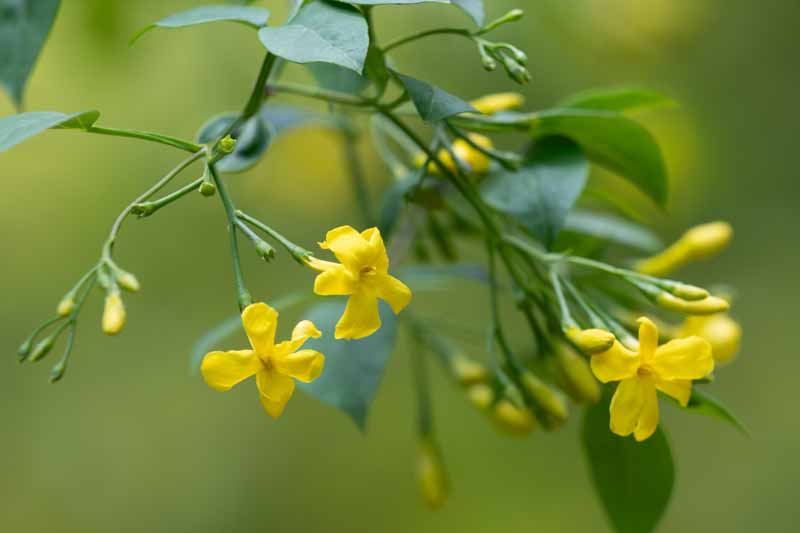


Jasminum humile, commonly called Italian Yellow Jasmine, Italian Jasmine, or Yellow Jasmine, is one of the most useful warm-climate jasmines for gardeners who want vivid color, a long graceful habit, and dependable summer performance. Unlike the better-known white-flowered perfume jasmines, this species brings clusters of bright yellow blooms, fine-textured pinnate foliage, and a flexible growth habit that can behave as a shrub, a scrambling climber, or a wall-trained specimen depending on how you grow it.
Jasminum humile is a semi-evergreen to evergreen jasmine grown for clusters of yellow flowers from late spring or summer into early fall, depending on climate and form. Plant it in full sun to part shade in fertile, well-drained soil, water regularly while establishing, feed moderately in spring, and prune after flowering to keep it dense, balanced, and bloom-ready.
Use: Excellent for sunny borders, shrub borders, warm walls, banks, informal hedges, containers, and light trellis training.
Highlight: Clusters of clear yellow flowers and elegant arching or scrambling growth over a long warm-season window.
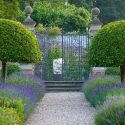
Design note: Use it where its fountain-like form can soften masonry, mingle through shrubs, or brighten a sunny border without looking stiff.
| Botanical Name | Jasminum humile |
|---|---|
| Family | Olive family (Oleaceae) |
| Common Names | Italian Jasmine, Yellow Jasmine, Italian Yellow Jasmine, Himalayan Jasmine |
| Native Range | Native from southern Iran through the Himalaya to central China and northern Myanmar; long cultivated beyond its native range |
| Plant Type | Semi-evergreen shrub, evergreen shrub in mild climates, scrambling shrub, wall shrub |
| Hardiness (approx. USDA) | Best in USDA Zones 7-9, especially in warm sheltered sites with good drainage |
| Height | 8-20 ft. (2.5-6 m), depending on form, support, and climate |
| Spread | 6-12 ft. (2-4 m), often broad and arching with age |
| Sun Exposure | Full sun to part shade, with best flowering in strong light |
| Soil | Well-drained, fertile to average garden soil; loam is ideal |
| Bloom Time | Late spring or summer into early fall, depending on climate and selection |
| Flower Color | Bright yellow flowers in terminal clusters |
| Fragrance | Often lightly fragrant to slightly fragrant, though less powerfully scented than classic white jasmines |
| Foliage | Bright green pinnate leaves with 3-9 or more leaflets depending on form |
Italian Jasmine is a true jasmine valued less for heavy perfume and more for its unusually graceful garden habit, cheerful yellow flowers, and broad design flexibility. It belongs to the genus Jasminum, though some modern taxonomic treatments place it in Chrysojasminum. In horticulture, however, Jasminum humile remains the familiar garden name. That matters because gardeners still search for it, buy it, and design with it under that name.
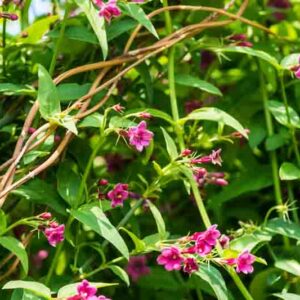
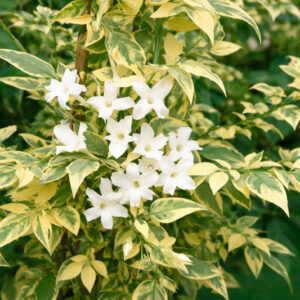
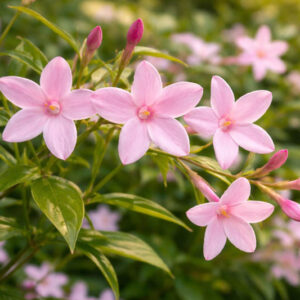
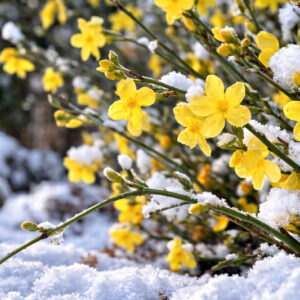
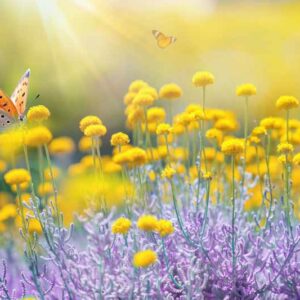
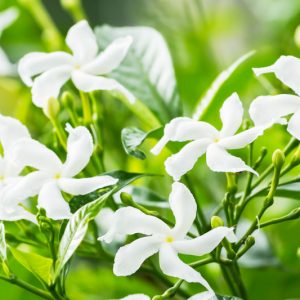
This is not the stiff, upright shrub that many people expect from the word “jasmine.” Italian Jasmine is looser, more fluid, and far more design-friendly. The stems arch, wander, and can scramble through nearby shrubs or over a support. Leaves are pinnate and bright green, giving the plant a lighter texture than broadleaf evergreens. The flowers are small but vivid – clear yellow, tubular at first, then opening into starry faces in clusters near the ends of the shoots. Fragrance is variable and generally light rather than intense.
Jasminum humile is native from southern Iran across the Himalayan regions to central China and northern Myanmar. That wide range helps explain its variability in habit and hardiness, as well as the existence of well-known garden selections such as ‘Revolutum’.
Italian Jasmine generally flowers from late spring into summer, and in warm climates or with certain forms, it can continue into early fall. That extended yellow display is one of its biggest landscape strengths, especially in gardens that need a bridge between spring shrubs and peak summer perennials. Flowers are followed by glossy black berries in the fall.
This species is usually semi-evergreen, though it can be evergreen in mild climates and more deciduous where winters are colder. Its habit is best described as arching, sprawling, scrambling, or loosely climbing. It does not behave like a self-clinging wall vine. Instead, it needs either room to expand outward or gentle training to support.
A typical mature plant reaches around 8-20 ft. (2.5-6 m) depending on climate, variety, pruning, and whether it is allowed to scramble or is kept tighter as a shrub. In many gardens it settles closer to the middle of that range, but it should never be sited as a tiny filler shrub.
Italian Jasmine is generally best in USDA Zones 7-9. It appreciates shelter in colder parts of its range, especially from drying winter wind and badly drained cold soil. That combination – not cold alone – is often what ruins it. It is heat tolerant.
Indoor tip: Italian Jasmine is less often grown indoors than white-flowered jasmines, but container plants can be overwintered in bright, cool-to-mild, frost-free conditions. Indoors, the biggest risks are weak light, stagnant air, and overwatering in winter.
Takeaway: Italian Jasmine is one of the best yellow-flowered true jasmines for gardeners who want an adaptable shrub or scrambler, bright summer color, and a refined, airy look rather than heavy vine growth.
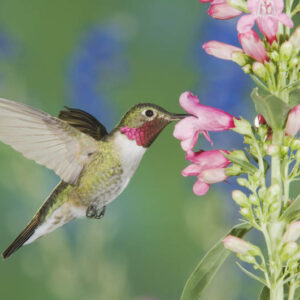
The flowers can attract pollinating insects, and the plant’s dense framework can offer shelter once mature. It also earns a place in broader jasmine care guidance for gardeners building a long-season, pollinator-aware planting scheme with a lighter, less formal character.
Italian Jasmine may show moderate deer resistance, but it is not deer-proof. Browsing pressure, plant stress, and local deer behavior matter more than any universal label.
Once established, Italian Jasmine tolerates some drought and often performs better with occasional dry intervals than with permanently wet soil. That said, flowering and foliage quality are better when moisture is steady during the growing season. It is drought-tolerant, not drought-dependent.
Italian Jasmine handles short dry spells once established, but it looks fuller, flowers longer, and stays healthier with deep occasional watering and excellent drainage.
True jasmines in the genus Jasminum are generally listed as non-toxic to dogs, cats, and horses. Even so, chewing ornamental plants can still cause mild digestive upset, so non-toxic does not mean edible at will.
Italian Jasmine is vigorous, and some forms may sucker or spread locally, but it is not broadly treated as a major invasive jasmine in mainstream garden guidance. The right conclusion is practical rather than dramatic: grow it responsibly, give it room, and check local advice if planting near natural areas in mild climates.
Italian Jasmine is best described as vigorous and occasionally spreading, not universally invasive. Smart siting and region-specific judgment are the right approach.
Feed in spring with compost or a balanced fertilizer. Italian Jasmine does not need aggressive feeding. Overfeeding, especially with nitrogen, gives you lush extension growth and fewer flowers – exactly the wrong trade-off for a display plant.
Apply a 2-3 in. mulch layer in spring to reduce moisture swings, suppress weeds, and protect roots from heat. Keep mulch clear of the crown.
Design tip: Italian Jasmine looks best when allowed to read as a fountain of green and yellow, not when clipped into a boxy shrub. Think movement, not stiffness.
Young stems can be tied to wires, a fence, or a trellis, but the plant is often just as attractive without formal support. The goal is not to force verticality. It is to spread the plant so flowers are displayed across a broad surface and the habit stays elegant.
Prune after flowering. Remove dead, weak, tangled, and oldest stems first, then shorten overly long growth to maintain proportion.
Pruning tip: The best way to prune Italian Jasmine is right after flowering, removing a portion of older stems and shortening long whips so the plant stays open, layered, and flower-productive.
In mild gardens, winter care mostly means protecting drainage and avoiding late soft growth from excessive feeding. In colder places, site it against a warm wall, mulch the root zone, and protect young plants from severe frost until established.
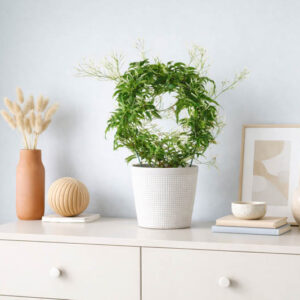
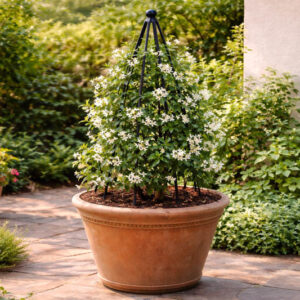
Italian Jasmine can be grown in a large container, especially compact selections.
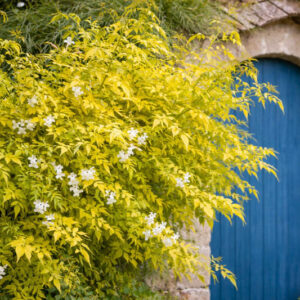
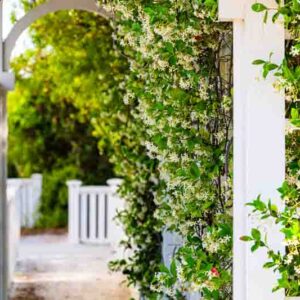
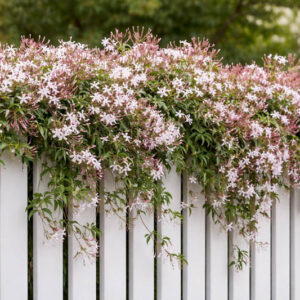
This plant is especially effective on a warm wall where the stems can be lightly fanned.
Bloom trigger: For stronger flowering, give Italian Jasmine bright light, moderate feeding, and enough space to mature without constant shearing. Chronic shade and repeated hard clipping reduce bloom dramatically.
| Task | Best Time |
|---|---|
| Planting | Plant in spring or early fall in mild climates. |
| Feeding | Feed lightly in spring. |
| Pruning | Prune after flowering. |
| Propagation | Take semi-ripe cuttings in summer or layer flexible stems. |
| Mulching | Refresh mulch in spring. |
| Main display | Expect peak bloom from late spring or summer into early fall. |
Italian Jasmine is usually propagated by semi-ripe cuttings or layering.
Take partially matured stems in summer, remove lower leaves, and insert into a sharply draining propagation mix. Keep humid but not wet.
Peg a flexible shoot into soil while attached to the parent plant. Once rooted, detach and replant.
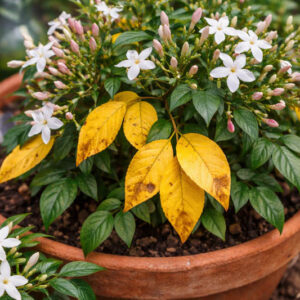
Usually because the plant is shaded, overfed, or never properly thinned. Italian Jasmine needs selective pruning, not random clipping.
Jasminum humile stands out for its yellow flowers, shrubby-scrambling habit, and lighter fragrance profile. Compared with Common Jasmine, it is less of a classic twining white climber and more of an arching shrub. Compared with Pink Jasmine, it is less showy in bud but often easier in the landscape. Compared with Star Jasmine, it is a true jasmine with a softer framework and brighter yellow bloom.
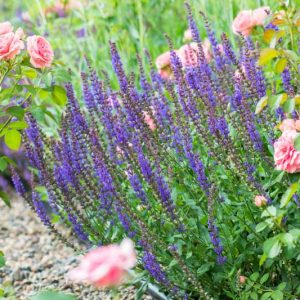
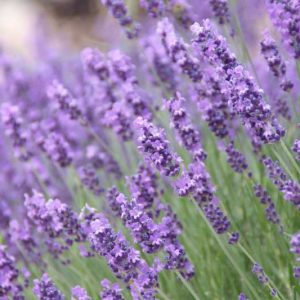
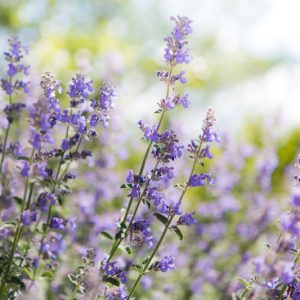
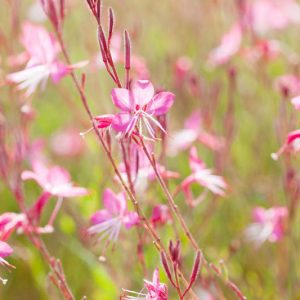
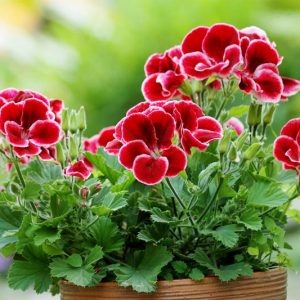
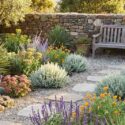
Choose companions that enjoy sun, warmth, and well-drained soil while complementing the plant’s airy habit and yellow flowers. Excellent partners include lavender, rosemary, salvia, cistus, nepeta, teucrium, gaura, santolina, phlomis, penstemon, helianthemum, pelargoniums, and structural evergreens such as pittosporum or myrtle. The best combinations feel relaxed, luminous, and climate-appropriate rather than lush and heavy.
What is Italian Jasmine?
Italian Jasmine, or Jasminum humile, is a true jasmine grown for its bright yellow flowers, graceful arching habit, and long warm-season bloom. It may be grown as a shrub, a scrambling wall plant, or a lightly trained climber.
Is Italian Jasmine a true jasmine?
Yes. Italian Jasmine belongs to the genus Jasminum, so it is a true jasmine.
Is Italian Jasmine fragrant?
Italian Jasmine is often lightly fragrant, but it is generally less intensely scented than white-flowered jasmine species grown for perfume.
When does Italian Jasmine bloom?
Italian Jasmine usually blooms from late spring or summer into early fall, depending on climate and cultivar.
How big does Italian Jasmine get?
Italian Jasmine commonly grows about 8 to 20 feet tall, with a broad arching or scrambling spread depending on climate, pruning, and support.
Is Italian Jasmine a climber or a shrub?
Italian Jasmine can be either. Unsupported, it behaves like an arching shrub or scrambling wall shrub. With support, it can be lightly trained as a climber.
Does Italian Jasmine need full sun?
Italian Jasmine grows best in full sun to part shade. Bright light promotes denser growth and more abundant flowering.
Can Italian Jasmine grow in shade?
It tolerates light shade, but too much shade reduces flowering and often leads to weaker, leggier growth.
What is the best place to plant Italian Jasmine?
The best place to plant Italian Jasmine is in a warm, bright, sheltered spot along a wall, in a sunny border, or on a slope where its graceful arching growth can be appreciated.
Can Italian Jasmine grow in a pot?
Yes. Italian Jasmine can grow well in a container with excellent drainage, especially compact forms or young plants, making it useful for patios and sheltered garden spaces.
Is Italian Jasmine evergreen?
Italian Jasmine is usually semi-evergreen, but it may remain evergreen in mild climates and become more deciduous in colder conditions.
How do you prune Italian Jasmine?
Prune Italian Jasmine after flowering by thinning older stems, shortening long shoots, and shaping the plant to maintain an open, graceful framework.
Why is my Italian Jasmine not flowering?
The most common causes are too little light, excessive nitrogen fertilizer, hard clipping, cold damage, or poor drainage.
How often should I water Italian Jasmine?
Water Italian Jasmine regularly while it establishes, then deeply during dry spells. Container plants usually need more frequent watering than plants growing in the ground.
Is Italian Jasmine good for walls and sunny borders?
Yes. Italian Jasmine is excellent for warm walls, informal training, sunny borders, and Mediterranean-style planting because of its airy habit and long season of yellow flowers.
Can Italian Jasmine be grown indoors?
Italian Jasmine is not the usual indoor jasmine, but container plants can be overwintered in bright, frost-free conditions with good airflow and careful watering.
Updated: March 2026 – Reviewed by Gardenia Editors
| Hardiness |
7 - 9 |
|---|---|
| Heat Zones |
7 - 9 |
| Climate Zones | 5, 6, 7, 8, 9, 10, 12, 13, 14, 15, 16, 17, 18, 19, 20, 21, 22, 23, 24, H1, H2 |
| Plant Type | Shrubs, Trees |
| Plant Family | Oleaceae |
| Genus | Jasminum |
| Common names | Jasmine |
| Exposure | Full Sun, Partial Sun |
| Season of Interest | Spring (Late), Summer (Early, Mid, Late), Fall |
| Height | 8' - 20' (240cm - 6.1m) |
| Spread | 6' - 12' (180cm - 3.7m) |
| Spacing | 72" - 144" (180cm - 3.7m) |
| Maintenance | Low |
| Water Needs | Average |
| Soil Type | Chalk, Loam, Sand |
| Soil pH | Acid, Neutral, Alkaline |
| Soil Drainage | Well-Drained |
| Characteristics | Showy, Semi-Evergreen, Evergreen |
| Tolerances | Drought, Heat |
| Garden Uses | Beds And Borders, Hedges And Screens, Wall-Side Borders |
| Garden Styles | City and Courtyard, Coastal Garden, Informal and Cottage |
| Toxic to Humans | No known toxicity |
| Toxic to Cats | Not toxic |
| Toxic to Dogs | Not toxic |
| Toxic to Horses | Not toxic |


| Hardiness |
7 - 9 |
|---|---|
| Heat Zones |
7 - 9 |
| Climate Zones | 5, 6, 7, 8, 9, 10, 12, 13, 14, 15, 16, 17, 18, 19, 20, 21, 22, 23, 24, H1, H2 |
| Plant Type | Shrubs, Trees |
| Plant Family | Oleaceae |
| Genus | Jasminum |
| Common names | Jasmine |
| Exposure | Full Sun, Partial Sun |
| Season of Interest | Spring (Late), Summer (Early, Mid, Late), Fall |
| Height | 8' - 20' (240cm - 6.1m) |
| Spread | 6' - 12' (180cm - 3.7m) |
| Spacing | 72" - 144" (180cm - 3.7m) |
| Maintenance | Low |
| Water Needs | Average |
| Soil Type | Chalk, Loam, Sand |
| Soil pH | Acid, Neutral, Alkaline |
| Soil Drainage | Well-Drained |
| Characteristics | Showy, Semi-Evergreen, Evergreen |
| Tolerances | Drought, Heat |
| Garden Uses | Beds And Borders, Hedges And Screens, Wall-Side Borders |
| Garden Styles | City and Courtyard, Coastal Garden, Informal and Cottage |
| Toxic to Humans | No known toxicity |
| Toxic to Cats | Not toxic |
| Toxic to Dogs | Not toxic |
| Toxic to Horses | Not toxic |
How many Jasminum humile (Italian Yellow Jasmine) do I need for my garden?
| Plant | Quantity | |
|---|---|---|
| Jasminum humile (Italian Yellow Jasmine) | N/A | Buy Plants |
Create a membership account to save your garden designs and to view them on any device.
Becoming a contributing member of Gardenia is easy and can be done in just a few minutes. If you provide us with your name, email address and the payment of a modest $25 annual membership fee, you will become a full member, enabling you to design and save up to 25 of your garden design ideas.
Join now and start creating your dream garden!
Create a membership account to save your garden designs and to view them on any device.
Becoming a contributing member of Gardenia is easy and can be done in just a few minutes. If you provide us with your name, email address and the payment of a modest $25 annual membership fee, you will become a full member, enabling you to design and save up to 25 of your garden design ideas.
Join now and start creating your dream garden!