Star Jasmine, Downy Jasmine, Indian Jasmine, Jasminum pubescens, Jasminum congestum, Jasminum gracillimum, Jasminum bifarium, Mogorium multiflorum, Mogorium pubescens, Nyctanthes multiflora, Nyctanthes pubescens
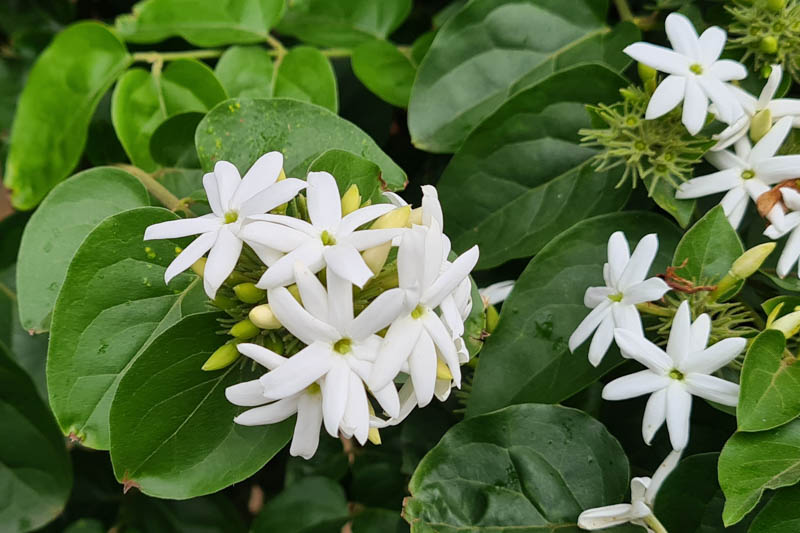
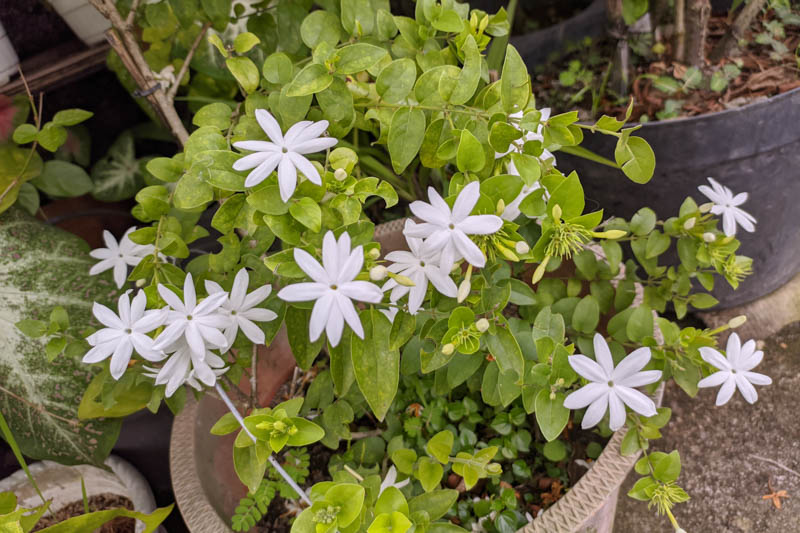


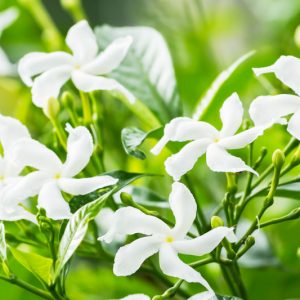
Jasminum multiflorum, commonly called Downy Jasmine, Many-Flowered Jasmine, or sometimes Star Jasmine, is one of the smartest evergreen jasmines for warm climates when the goal is nonstop texture, bright white bloom, and a refined shrub-to-scrambler habit. Unlike the intensely perfumed jasmines grown mainly for scent, this species is prized for its masses of crisp white starry flowers, soft gray-green foliage, and its ability to function as a loose hedge, fountain-shaped shrub, or lightly trained climber.
Jasminum multiflorum is an evergreen jasmine grown for clusters of white star-shaped flowers over a very long season in warm climates. Plant it in full sun to part shade in well-drained soil, water regularly while establishing, feed modestly, and prune after a flush of bloom to keep it dense, healthy, and flower-rich.
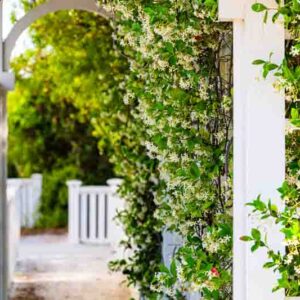
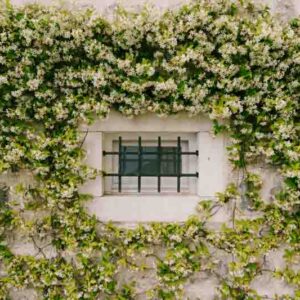
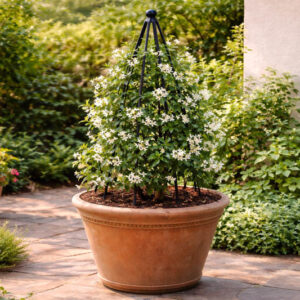
Use: Excellent for warm walls, informal hedges, shrub borders, large containers, trellises, and tropical or subtropical gardens.
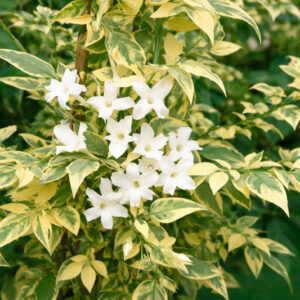
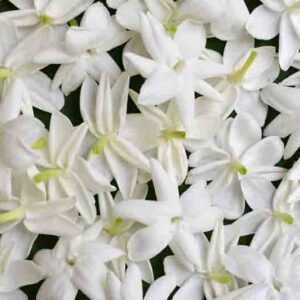
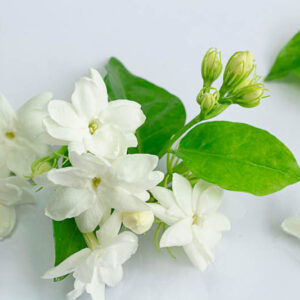
Highlight: Dense clusters of bright white flowers against softly pubescent gray-green foliage.
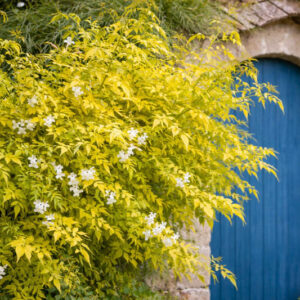
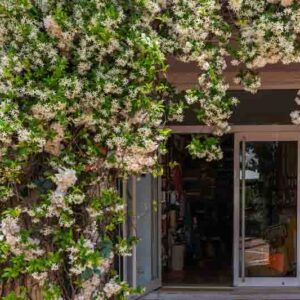
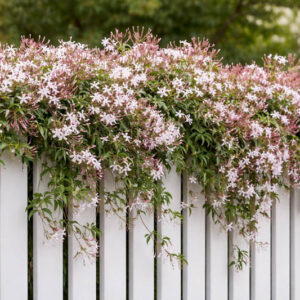
Design note: Use it where its arching habit can spill, mound, or be lightly trained – it looks more elegant when allowed to move naturally.
| Botanical Name | Jasminum multiflorum |
|---|---|
| Family | Olive family (Oleaceae) |
| Common Names | Downy Jasmine, Many-Flowered Jasmine, Star Jasmine |
| Native Range | Native from the Indian Subcontinent to Indo-China; widely cultivated in tropical and subtropical regions |
| Plant Type | Evergreen shrub, scrambling shrub, shrub-vine, hedge plant |
| Hardiness (approx. USDA) | Best in USDA Zones 9-11; can be risky in colder sites and may die back in freeze events |
| Height | 5-10 ft. (1.5-3 m), sometimes more with support |
| Spread | 5-10 ft. (1.5-3 m), broad, arching, and mounded with age |
| Sun Exposure | Full sun to part shade |
| Soil | Well-drained soil, from sandy loam to average garden soil |
| Bloom Time | Longest bloom in warm seasons, often spring through fall and sometimes nearly year-round in frost-free climates |
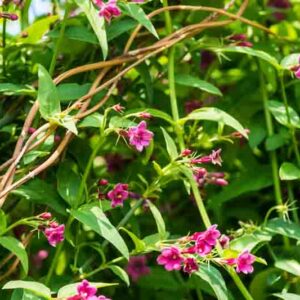
| Flower Color | Pure white star-shaped flowers in clustered sprays |
| Fragrance | Usually lightly fragrant to mildly fragrant, not powerfully scented |
| Foliage | Soft gray-green to green foliage with fine downy hairs that give the plant a velvety cast |
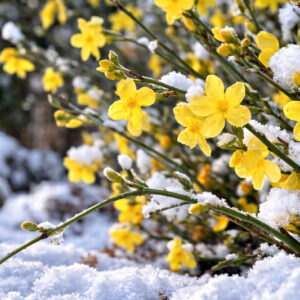
Downy Jasmine is a true jasmine valued for flower quantity, evergreen structure, and a softer visual character than many heavier climbers. It belongs to the genus Jasminum, and its accepted botanical name is Jasminum multiflorum. This plant is often confused with Trachelospermum jasminoides, which is also commonly called star jasmine but is not a true jasmine.
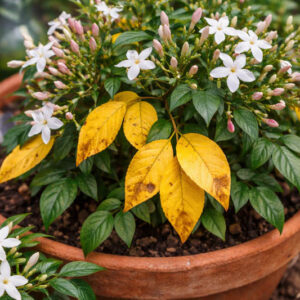
The first thing people notice is abundance. This jasmine blooms in clusters, and when it is happy, it looks dusted with white stars for months. The second thing they notice is texture. Leaves and young stems are covered in soft hairs, which create the gray-green, slightly silvery cast behind the flowers. The result is more sophisticated than flashy. Instead of shouting for attention, Downy Jasmine builds visual brightness and cool contrast.
Jasminum multiflorum is native from the Indian Subcontinent to Indo-China. It is now widely grown across tropical and subtropical regions because it handles heat, sun, and regular pruning well.
In warm climates, bloom can be remarkably extended. Expect the strongest flowering from spring into fall, with intermittent flowering beyond that in frost-free areas. In the warmest landscapes, it may flower on and off through much of the year.
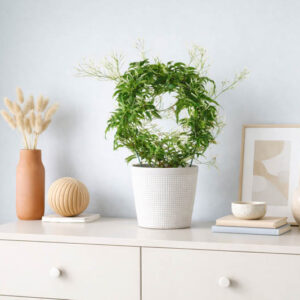
This species is evergreen in warm regions and may become semi-evergreen in cooler-winter regions. Its habit is best described as mounding, arching, scrambling, or shrub-vining. Unsupported, it forms a fountain-like shrub. Given support, it can be tied and spread along a trellis or wall, though it is not self-clinging.
A mature plant commonly reaches 5-10 ft. (1.5-3 m) tall and wide, though long stems can extend beyond that if supported or left unchecked. That means it performs better as a medium-to-large landscape plant than as a tiny accent.
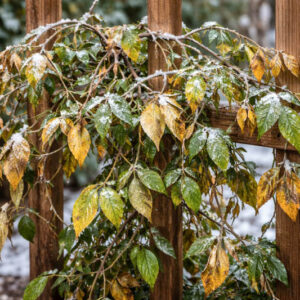
Downy Jasmine is best in USDA Zones 9-11. It can survive in some sheltered 8b locations, especially in warm coastal or urban conditions, but freeze damage is a real risk. In climates with repeated frost, it is better treated as a protected patio specimen or conservatory-style plant.
Indoor tip: Downy Jasmine can be overwintered indoors in bright, frost-free conditions, but it performs best where light is strong, air movement is good, and watering is restrained in cool weather.
Takeaway: Downy Jasmine is a high-performance evergreen jasmine for warm climates, valued more for flower volume, texture, and garden form than for intense perfume.
The flowers can attract pollinating insects, and the plant’s branching structure offers cover in mixed plantings. It also belongs in broader jasmine care guidance for gardeners building fragrance-adjacent, long-season landscapes with evergreen structure.
Downy Jasmine may be moderately deer resistant in some gardens, but it is not deer-proof. Local browsing pressure always matters more than blanket labels.
Once established, Downy Jasmine tolerates short dry spells, but it looks fuller and flowers better with consistent moisture during active growth. Good drainage matters more than constant watering.
Downy Jasmine is moderately drought tolerant once established, but reliable flowering and dense growth come from deep watering during dry periods, not neglect.
True jasmines in the genus Jasminum are generally listed as non-toxic to dogs, cats, and horses. As always, non-toxic does not mean pets should routinely chew ornamental plants.
Downy Jasmine is vigorous and can persist or spread locally in very warm regions, but Florida’s current IFAS assessment rates it low risk for invasion. That is the right practical message: useful, vigorous, and generally manageable when maintained responsibly.
Downy Jasmine is better described as vigorous than invasive in most garden settings. Give it space, prune it intelligently, and check regional guidance in frost-free areas.
Feed in spring with compost or a balanced fertilizer. Too much nitrogen pushes leafy growth at the expense of flowers, so moderate feeding wins.
Apply a 2-3 in. mulch layer to cool roots, reduce evaporation, and steady soil moisture. Keep mulch away from the base of the stems.
Design tip: Downy Jasmine is at its best when it reads as a flowering cloud – not when it is clipped into a hard geometric mass.
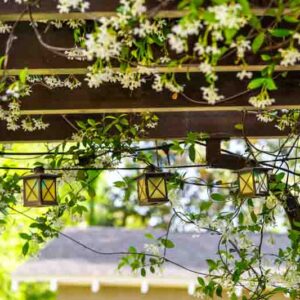
Young stems respond well to loose tying on wires, fences, and trellises. Spread shoots outward so flowers show across the surface rather than piling into a dense knot.
Prune after a major flush of bloom. Remove dead, weak, tangled, and oldest stems first, then shorten long growth to keep the plant layered and dense.
Pruning tip: The best way to prune Downy Jasmine is to thin and shape after flowering, preserving the plant’s fountain-like structure rather than shearing it into stiffness.
In zone-edge gardens, grow it in a protected site, mulch the roots, and shield young plants from hard frost. Container plants should be moved before damaging cold arrives.
Bloom trigger: For stronger flowering, give Downy Jasmine bright light, moderate feeding, and enough room to mature without constant hard clipping.
| Task | Best Time |
|---|---|
| Planting | Plant in spring or early fall in warm climates. |
| Feeding | Feed lightly in spring. |
| Pruning | Prune after a strong bloom flush. |
| Propagation | Take cuttings in warm weather. |
| Mulching | Refresh mulch in spring. |
| Main display | Expect peak flowering from spring through fall, with longer bloom in frost-free climates. |
Downy Jasmine is usually propagated by cuttings.
Take semi-ripe to firm cuttings in warm weather, remove lower leaves, and place them in a sharply draining propagation mix. Keep evenly moist, humid, and warm until rooted.
Usually because of shade, weak pruning strategy, or overfeeding. This plant wants selective thinning and enough sun to stay dense.
Jasminum multiflorum stands out for its white flower clusters, soft downy foliage, and shrubby-scrambling habit. Compared with Common Jasmine, it is less twining and usually less fragrant. Compared with Pink Jasmine, it is less theatrical in bud but more useful as a warm-climate evergreen landscape shrub. Compared with Star Jasmine, it is a true jasmine, while Trachelospermum is not.
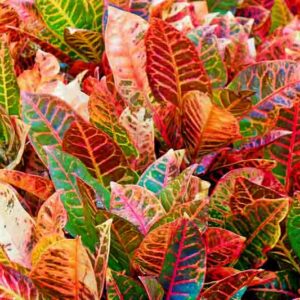
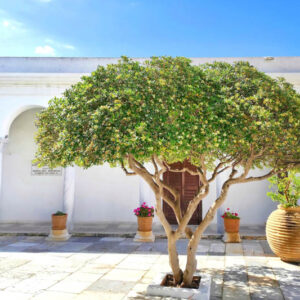
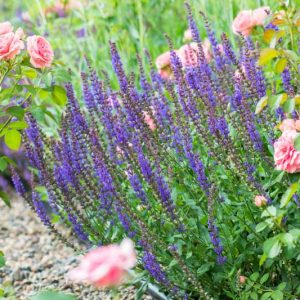
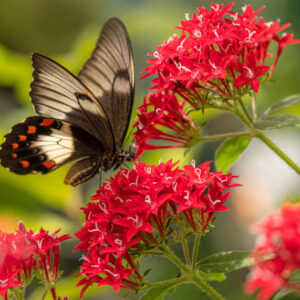
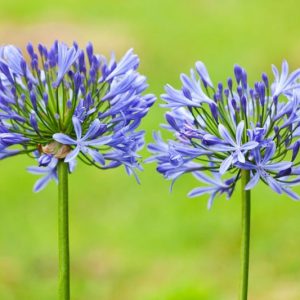
Choose companions that enjoy warmth, sun to part shade, and well-drained soil while contrasting with the plant’s white flowers and gray-green cast. Excellent partners include plumbago, gardenia, ixora, pittosporum, croton, dwarf yaupon holly, ligustrum, pentas, blue salvia, ruellia, agapanthus, liriope, and variegated ginger. The strongest combinations pair clean foliage shapes with long-season bloom.
Downy Jasmine, or Jasminum multiflorum, is a true jasmine grown for its long season of white star-shaped flowers, soft gray-green foliage, and shrub-to-scrambler habit.
Yes. It belongs to the genus Jasminum, so it is a true jasmine.
It is usually lightly fragrant, but far less intensely scented than perfume jasmines such as Jasminum officinale or Jasminum sambac.
It typically blooms from spring through fall, and in frost-free climates it may flower on and off for much of the year.
It commonly grows 5 to 10 feet tall and wide, sometimes larger if supported or left to scramble.
It can be both. Unsupported it forms a mounded shrub, but with support it can be trained as a light climber.
It performs best in full sun to part shade. More sun usually means denser growth and heavier flowering.
Yes. It grows well in a large, well-drained container and is especially useful where winter protection is needed.
Yes, in warm climates it is evergreen, though colder conditions can cause partial leaf drop or dieback.
Prune after flowering by thinning older stems, shortening long shoots, and preserving a layered, fountain-like form.
The usual causes are too little light, excess fertilizer, hard clipping, or cold stress.
Not always. Jasminum multiflorum is sometimes called star jasmine, but the more famous Star Jasmine is Trachelospermum jasminoides, which is not a true jasmine.
Updated: March 2026 – Reviewed by Gardenia Editors
| Hardiness |
9 - 11 |
|---|---|
| Climate Zones | 21, 22, 23, 24, H1, H2 |
| Plant Type | Climbers, Shrubs |
| Plant Family | Oleaceae |
| Genus | Jasminum |
| Common names | Jasmine |
| Exposure | Full Sun, Partial Sun |
| Season of Interest | Spring (Early, Mid, Late), Summer (Early, Mid, Late), Fall |
| Height | 5' - 10' (150cm - 3m) |
| Spread | 5' - 10' (150cm - 3m) |
| Spacing | 120" (3m) |
| Maintenance | Low |
| Water Needs | Average |
| Soil Type | Chalk, Loam, Sand |
| Soil pH | Acid, Neutral, Alkaline |
| Soil Drainage | Moist but Well-Drained, Well-Drained |
| Characteristics | Showy, Evergreen |
| Tolerances | Drought, Heat |
| Garden Uses | Beds And Borders, Wall-Side Borders |
| Garden Styles | City and Courtyard, Coastal Garden, Informal and Cottage |
| Toxic to Humans | No known toxicity |
| Toxic to Cats | Not toxic |
| Toxic to Dogs | Not toxic |
| Toxic to Horses | Not toxic |


| Hardiness |
9 - 11 |
|---|---|
| Climate Zones | 21, 22, 23, 24, H1, H2 |
| Plant Type | Climbers, Shrubs |
| Plant Family | Oleaceae |
| Genus | Jasminum |
| Common names | Jasmine |
| Exposure | Full Sun, Partial Sun |
| Season of Interest | Spring (Early, Mid, Late), Summer (Early, Mid, Late), Fall |
| Height | 5' - 10' (150cm - 3m) |
| Spread | 5' - 10' (150cm - 3m) |
| Spacing | 120" (3m) |
| Maintenance | Low |
| Water Needs | Average |
| Soil Type | Chalk, Loam, Sand |
| Soil pH | Acid, Neutral, Alkaline |
| Soil Drainage | Moist but Well-Drained, Well-Drained |
| Characteristics | Showy, Evergreen |
| Tolerances | Drought, Heat |
| Garden Uses | Beds And Borders, Wall-Side Borders |
| Garden Styles | City and Courtyard, Coastal Garden, Informal and Cottage |
| Toxic to Humans | No known toxicity |
| Toxic to Cats | Not toxic |
| Toxic to Dogs | Not toxic |
| Toxic to Horses | Not toxic |
How many Jasminum multiflorum (Downy Jasmine) do I need for my garden?
| Plant | Quantity | |
|---|---|---|
| Jasminum multiflorum (Downy Jasmine) | N/A | Buy Plants |
Create a membership account to save your garden designs and to view them on any device.
Becoming a contributing member of Gardenia is easy and can be done in just a few minutes. If you provide us with your name, email address and the payment of a modest $25 annual membership fee, you will become a full member, enabling you to design and save up to 25 of your garden design ideas.
Join now and start creating your dream garden!
Create a membership account to save your garden designs and to view them on any device.
Becoming a contributing member of Gardenia is easy and can be done in just a few minutes. If you provide us with your name, email address and the payment of a modest $25 annual membership fee, you will become a full member, enabling you to design and save up to 25 of your garden design ideas.
Join now and start creating your dream garden!