Red Jasmine, Beesianum Jasmine, Jasmin Rose, Rosenjasmin
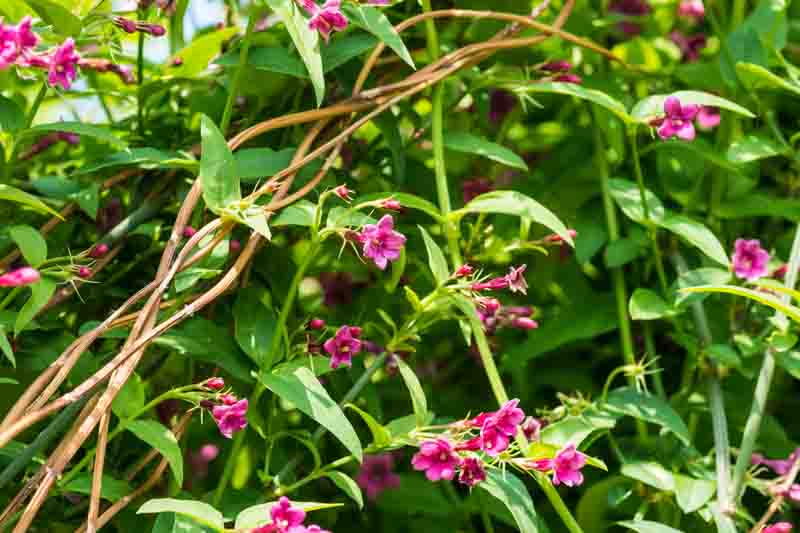


Jasminum beesianum, commonly called Red Jasmine, is a graceful true jasmine grown for fragrant rosy-red flowers, elegant twining stems, and a refined climbing habit. For gardeners searching for Red Jasmine care, how to grow Jasminum beesianum, a fragrant red jasmine vine, or a hardy jasmine with red flowers, this species stands out as one of the most distinctive choices. While many jasmines are known for white blooms and tropical exuberance, Red Jasmine offers something more nuanced – pink-red to red flowers, a lighter structure, and a romantic presence that suits trellises, pergolas, arches, warm walls, and sheltered fences beautifully. It is a true Jasminum, not a jasmine lookalike, and it deserves much wider use in gardens where fragrance, color, and elegant form matter.
Jasminum beesianum is a woody, twining true jasmine grown for fragrant pink-red to red flowers from late spring or early summer into summer. Plant it in full sun to part shade in fertile, well-drained soil, water regularly while it establishes, train it onto a support, and prune after flowering to keep it healthy, balanced, and flower-rich.
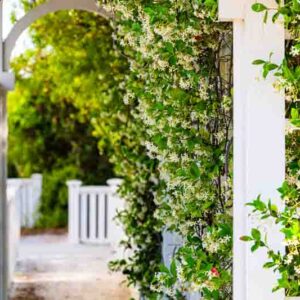
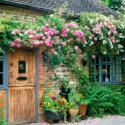
Use: Excellent for trellises, pergolas, arches, obelisks, warm walls, cottage gardens, and large containers.
Highlight: Elegant clusters of fragrant rosy-red flowers on a slender twining framework.
Design note: This jasmine looks best when it is allowed to climb with a little freedom – it becomes far more graceful when loosely trained than when clipped into rigid form.
| Botanical Name | Jasminum beesianum |
|---|---|
| Family | Olive family (Oleaceae) |
| Common Names | Red Jasmine, Beesianum Jasmine |
| Native Range | Southeastern Tibet to south-central China |
| Plant Type | Woody twining climber, climbing shrub, semi-evergreen to deciduous climber |
| Hardiness (approx. USDA) | Best in sheltered temperate gardens, often grown in USDA Zones 7-9; more deciduous and more vulnerable in colder winter gardens |
| Height | 8-15 ft. (2.5-4.5 m), sometimes larger with age and support |
| Spread | 4-8 ft. (1.2-2.5 m), depending on training and support |
| Sun Exposure | Full sun to part shade |
| Soil | Fertile, humus-rich, well-drained soil; adaptable if drainage is good |
| Bloom Time | Late spring or early summer into summer |
| Flower Color | Pink-red to red, sometimes rosy crimson |
| Fragrance | Fragrant |
| Foliage | Dark green leaves, often paler beneath; semi-evergreen to deciduous depending on climate |
Red Jasmine is a true jasmine species valued for fragrance, flower color, and a more delicate climbing habit than many larger jasmines. Its accepted botanical name is Jasminum beesianum, and it belongs to the same genus as some of the world’s best-loved fragrant climbers. What makes this species memorable is not excess or flamboyance, but balance – elegant stems, softly colored flowers, and a long, graceful line that works naturally in both romantic and structured garden settings.
Good to know: Jasminum beesianum is a true jasmine grown for fragrant red to pink-red flowers, graceful twining growth, and reliable garden beauty in sheltered temperate climates.
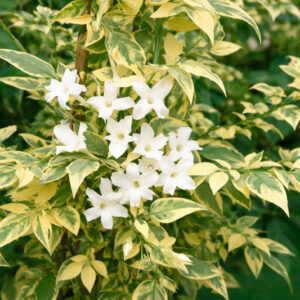
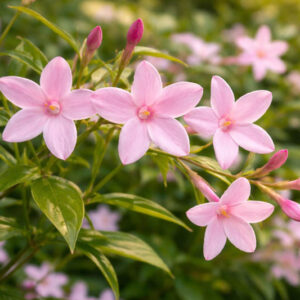
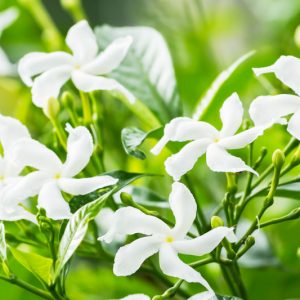
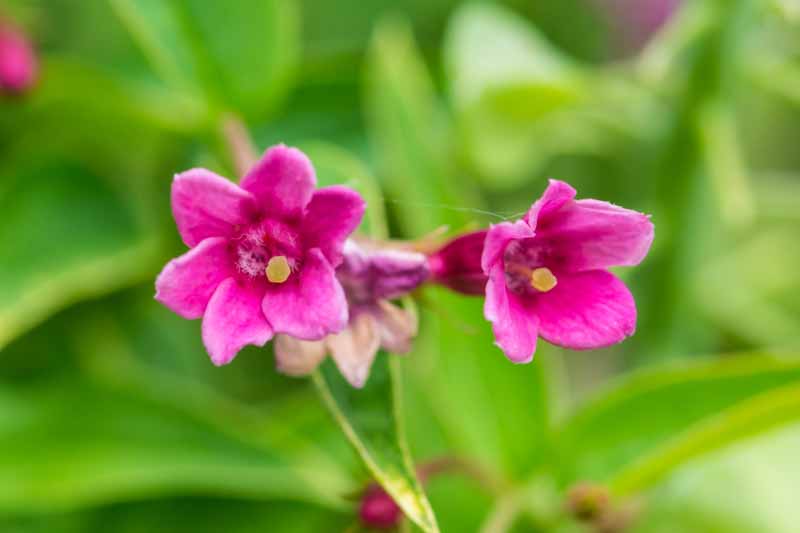
This jasmine is finer textured than many gardeners expect. Its stems are slender and twining, its leaves are opposite and dark green, and its flowers are produced in small clusters that feel delicate rather than heavy. The blossoms are narrow-tubed with a flared face, creating a light, airy effect on the plant. Instead of shouting for attention, Red Jasmine builds charm through refinement. It is exactly the kind of climber that rewards a close look.
Jasminum beesianum is native to southeastern Tibet and south-central China. That origin gives it an identity distinct from strongly tropical jasmines and helps explain why it often performs well in sheltered temperate gardens where some warmer-climate species struggle.
Expect the main flowering season from late spring or early summer into summer. In favorable conditions, a mature plant can produce a generous flush that makes the slender framework look dusted with rosy color. The exact season varies slightly with climate, exposure, and pruning habits. Flowers are followed by shiny, black berries.
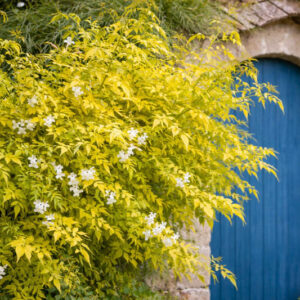
The foliage is simple, opposite, and dark green, often somewhat paler beneath. In mild climates, the plant can remain semi-evergreen, while in colder regions it is more likely to behave as deciduous. Its habit is best described as twining, climbing, or laxly shrubby. Give it support and it will climb with elegance. Leave it unsupported and it may sprawl, mound, or appear more shrub-like.
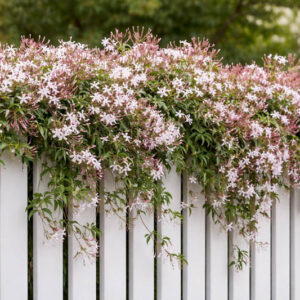
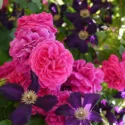
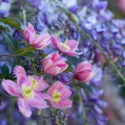
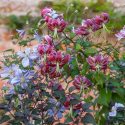
The flowers are among the plant’s biggest attractions: rosy pink-red to deeper red, lightly flared, and carried in small clusters that read beautifully against the foliage. Leaves are neat, opposite, and usually dark green, helping the flowers stand out clearly. The stems are slender and flexible when young, which makes early training easy and allows the plant to be shaped into a graceful, layered climber.
A mature plant commonly reaches about 8-15 ft. (2.5-4.5 m) with support, though older specimens can grow larger in ideal conditions. Spread depends on how the stems are trained, but 4-8 ft. (1.2-2.5 m) is a practical range for most garden situations. This is a medium-to-large climber, not a tiny accent vine.
Red Jasmine is best in sheltered temperate gardens and is often grown in USDA Zones 7-9. In milder areas it may remain semi-evergreen, while colder winters can bring leaf drop or stem dieback. The practical message is simple: give it warmth, drainage, and some winter protection, and it performs far better.
Indoor tip: Red Jasmine can be overwintered in a bright, frost-free place, but it performs best where light is strong, air movement is good, and the plant can enjoy a natural outdoor growing season.
Takeaway: Jasminum beesianum is one of the most appealing true jasmines for gardeners who want fragrance, unusual flower color, and a climber with a lighter, more elegant look.
The flowers can attract pollinating insects, and the plant’s twining structure adds vertical layering in mixed plantings. It also belongs naturally in broader jasmine care guidance for gardeners designing fragrant climber combinations.
Red Jasmine may be moderately deer-resistant in some gardens, but it is not deer-proof. Local browsing pressure always matters more than general labels.
Once established, Red Jasmine can handle short dry spells, but it flowers and looks better with regular moisture during active growth. Deep watering during dry periods is far better than repeated drought stress. Good drainage remains essential.
Red Jasmine is moderately drought-tolerant once established, but consistent moisture and free drainage produce denser growth and better flowering.
True jasmines in the genus Jasminum are generally regarded as non-toxic to dogs, cats, and horses. As always, ornamental plants should not be treated as edible simply because they are considered non-toxic.
Feed lightly in spring with compost or a balanced fertilizer. Too much nitrogen encourages soft leafy growth and can reduce flowering. Moderate feeding gives the best balance of growth and bloom.
Apply a 2-3 in. mulch layer around the root zone to conserve moisture, moderate soil temperature, and reduce competition from weeds. Keep the mulch away from the main stems.
Design tip: Red Jasmine is at its best when its flowering stems can weave and drape naturally across support instead of being forced into a flat, hard-clipped outline.
Young stems should be tied loosely to wires, lattice, or a trellis. Spread them early so flowers are displayed across the framework rather than hidden in a congested center. Good training also improves airflow and makes pruning easier later.
Prune after the main flowering flush. Remove dead, weak, tangled, or overcrowded stems first, then shorten overly long shoots to keep the plant balanced and airy. Avoid constant hard clipping, which reduces elegance and can interfere with flowering.
Pruning tip: The best way to prune Red Jasmine is after flowering, thinning and guiding stems rather than cutting the whole plant back hard.
In colder gardens, place Red Jasmine against a sunny sheltered wall, mulch the roots, and protect young plants from severe frost. Container plants should be moved before hard freezing weather arrives. The colder and wetter the winter site, the more important shelter and drainage become.
Bloom trigger: For the best flowering, give Red Jasmine strong light, modest feeding, room to mature on support, and pruning only after bloom.
| Task | Best Time |
|---|---|
| Planting | Spring or early fall. |
| Feeding | Light feeding in spring. |
| Pruning | Immediately after flowering. |
| Propagation | Cuttings or layering in warm weather. |
| Mulching | Refresh in spring. |
| Main display | Late spring or early summer into summer. |
Red Jasmine is usually propagated by cuttings or layering. Because its stems are flexible and naturally twining, layering can be especially dependable where a low shoot can be pinned to the soil.
Take semi-ripe cuttings in warm weather, remove the lower leaves, and insert them into a sharply draining propagation mix. Keep the cuttings warm, humid, and evenly moist until they root.
Layering works well because the stem stays attached to the parent plant while it forms roots. Peg a flexible shoot to the soil, lightly cover one section, and keep it moist until it roots well enough to separate.
Usually because the plant is too shaded, not well trained, or too soft from rich feeding. More sun and better post-bloom shaping usually correct the problem.
Fast diagnostic: Poor flowering usually means shade, wrong pruning timing, or too much nitrogen. Yellow leaves usually point to water stress, cold injury, or exhausted container soil.
Jasminum beesianum stands out for its pink-red flowers, slender twining growth, and elegant garden character. Compared with Common Jasmine, it is more unusual in color and often a little more restrained in habit. Compared with Pink Jasmine, it is often better suited to sheltered outdoor temperate gardens. Compared with Star Jasmine, it is a true jasmine, while Trachelospermum is not.
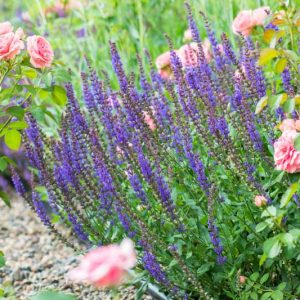
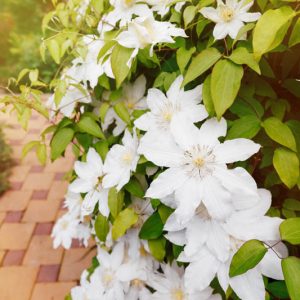
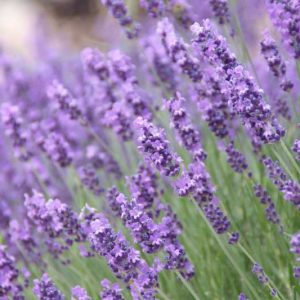
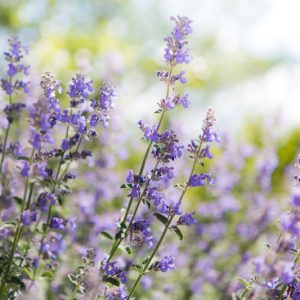
Choose companions that enjoy sun to part shade and well-drained soil, and that either echo Red Jasmine’s romantic character or provide cool contrast to its flower color. Excellent partners include climbing roses, clematis, lavender, salvia, nepeta, penstemon, foxglove, catmint, heuchera, pittosporum, boxwood, and fine-textured ornamental grasses. The strongest combinations either cool the palette around the rosy flowers or provide dark green structure behind them.
What is Red Jasmine?
Red Jasmine, or Jasminum beesianum, is a true jasmine grown for fragrant pink-red to red flowers, twining stems, and an elegant summer display.
Is Jasminum beesianum a true jasmine?
Yes. It belongs to the genus Jasminum, so it is a true jasmine.
Is Red Jasmine fragrant?
Yes. It is valued for its sweetly fragrant flowers.
When does Red Jasmine bloom?
It typically blooms from late spring or early summer into summer.
How big does Red Jasmine get?
It commonly reaches about 8 to 15 feet with support, though mature plants can grow larger in ideal conditions.
Is Red Jasmine a climber or a shrub?
It is mainly a twining climber, though it can look shrubby or lax if left unsupported.
Does Red Jasmine need full sun?
It performs best in full sun to part shade. More sun usually means better flowering and denser growth.
Can Red Jasmine grow in a pot?
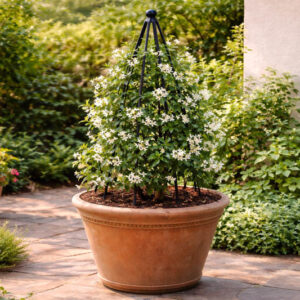
Yes. It grows well in a large container with excellent drainage and sturdy support.
Is Red Jasmine evergreen?
It is semi-evergreen in mild climates and more deciduous in colder regions.
How do you prune Red Jasmine?
Prune after flowering by thinning, guiding, and shortening long stems without harsh shearing.
Why is my Red Jasmine not flowering?
The most common causes are too little sun, too much nitrogen, poor pruning timing, or cold damage.
Is Red Jasmine the same as star jasmine?
No. Jasminum beesianum is a true jasmine, while the commonly sold Star Jasmine is usually Trachelospermum jasminoides.
Updated: March 2026 • Reviewed by Gardenia Editors
| Hardiness |
7 - 9 |
|---|---|
| Heat Zones |
1 - 11 |
| Plant Type | Climbers |
| Plant Family | Oleaceae |
| Genus | Jasminum |
| Common names | Jasmine |
| Exposure | Full Sun, Partial Sun |
| Season of Interest | Spring (Late), Summer (Early, Mid) |
| Height | 8' - 15' (240cm - 4.6m) |
| Spread | 4' - 8' (120cm - 240cm) |
| Spacing | 96" (240cm) |
| Maintenance | Average |
| Water Needs | Average |
| Soil Type | Chalk, Clay, Loam, Sand |
| Soil pH | Acid, Neutral, Alkaline |
| Soil Drainage | Moist but Well-Drained, Well-Drained |
| Characteristics | Showy, Semi-Evergreen, Fragrant |
| Tolerance | Drought, Clay Soil |
| Garden Uses | Hedges And Screens, Wall-Side Borders |
| Garden Styles | Informal and Cottage |


| Hardiness |
7 - 9 |
|---|---|
| Heat Zones |
1 - 11 |
| Plant Type | Climbers |
| Plant Family | Oleaceae |
| Genus | Jasminum |
| Common names | Jasmine |
| Exposure | Full Sun, Partial Sun |
| Season of Interest | Spring (Late), Summer (Early, Mid) |
| Height | 8' - 15' (240cm - 4.6m) |
| Spread | 4' - 8' (120cm - 240cm) |
| Spacing | 96" (240cm) |
| Maintenance | Average |
| Water Needs | Average |
| Soil Type | Chalk, Clay, Loam, Sand |
| Soil pH | Acid, Neutral, Alkaline |
| Soil Drainage | Moist but Well-Drained, Well-Drained |
| Characteristics | Showy, Semi-Evergreen, Fragrant |
| Tolerance | Drought, Clay Soil |
| Garden Uses | Hedges And Screens, Wall-Side Borders |
| Garden Styles | Informal and Cottage |
How many Jasminum beesianum (Red Jasmine) do I need for my garden?
| Plant | Quantity | |
|---|---|---|
| Jasminum beesianum (Red Jasmine) | N/A | Buy Plants |
Create a membership account to save your garden designs and to view them on any device.
Becoming a contributing member of Gardenia is easy and can be done in just a few minutes. If you provide us with your name, email address and the payment of a modest $25 annual membership fee, you will become a full member, enabling you to design and save up to 25 of your garden design ideas.
Join now and start creating your dream garden!
Create a membership account to save your garden designs and to view them on any device.
Becoming a contributing member of Gardenia is easy and can be done in just a few minutes. If you provide us with your name, email address and the payment of a modest $25 annual membership fee, you will become a full member, enabling you to design and save up to 25 of your garden design ideas.
Join now and start creating your dream garden!