Tomato 'Green Zebra', Lycopersicon esculentum 'Green Zebra'
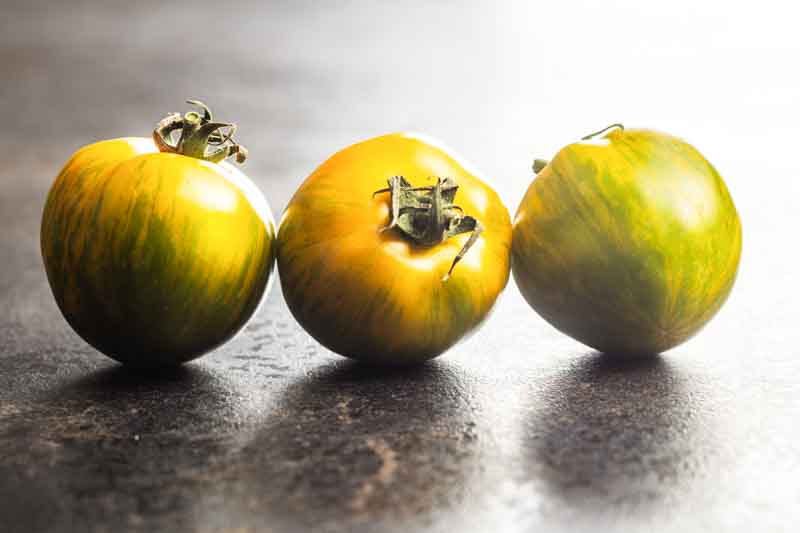
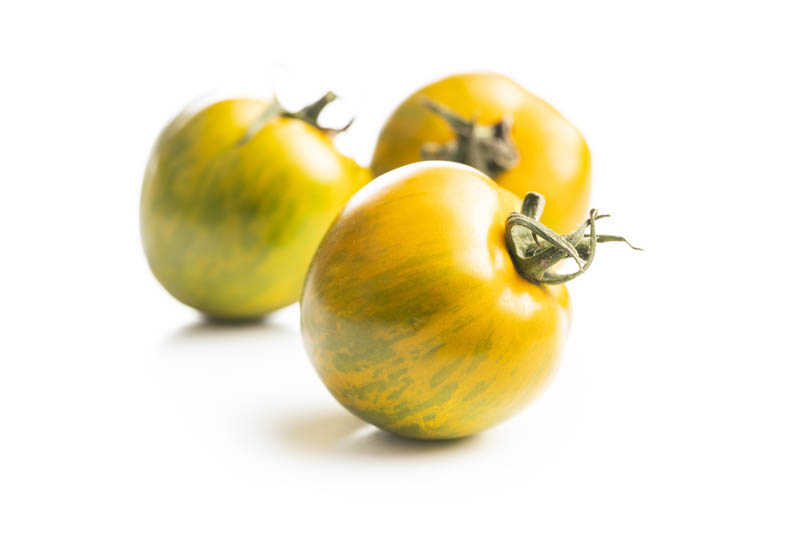


Solanum lycopersicum ‘Green Zebra’ is a distinctive open-pollinated tomato bred for something that once seemed almost contradictory: fruit that remains predominantly green when ripe. Its productive indeterminate vines bear small to medium round fruits that mature from green to olive-yellow or chartreuse while retaining dramatic dark green stripes. Inside, the flesh remains bright green, with a sweet, tangy flavor that makes Green Zebra especially useful for salads, slicing, salsa, and colorful tomato plates.
Green Zebra is also frequently described as an heirloom, but that label needs context. It was deliberately bred by American tomato breeder Tom Wagner during the second half of the 20th century, and Wagner says he released the first Green Zebra seed through his Tater-Mater Seed catalog in 1983. Its pedigree includes older tomato lines, but under the historical-lineage definition, Green Zebra is better described as a modern open-pollinated cultivar than a traditional heirloom passed down unchanged for generations.
Gardenia cultivar insight: Green Zebra is unquestionably open-pollinated, but “open-pollinated” and “heirloom” are not synonyms. Gardenia classifies it as a modern open-pollinated cultivar while recognizing that some seed companies use the term “heirloom” more broadly.
| Botanical Name | Solanum lycopersicum ‘Green Zebra’ |
|---|---|
| Family | Solanaceae |
| Common Name | Green Zebra tomato |
| Breeder | Tom Wagner of Tater-Mater Seed, Washington, USA |
| Introduced | 1983, based on Wagner’s own account of releasing the first Green Zebra seed; some secondary databases list 1985 |
| Plant Type and Habit | Warm-season fruiting annual; productive, indeterminate vine requiring support |
| Seed Type | Open-pollinated modern cultivar; sometimes marketed as an heirloom |
| Size | Indeterminate vine; mature length varies with support, pruning, climate, fertility, seed line, and season length. Provide tall, sturdy support rather than relying on one fixed catalog height. |
| Growth Habit | Indeterminate; continues flowering and producing fruit over an extended season |
| Tomato Type | Main-season, green-when-ripe salad / slicing tomato |
| Fruit | Round, generally about 4-5 oz. (115-140 g); Seed Savers describes fruits roughly 1½-2½ in. across |
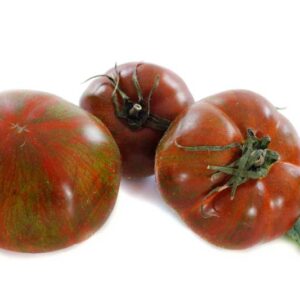
| Fruit Color | Green ripening toward olive-yellow, yellow-green, or chartreuse with dark green to olive stripes; flesh remains green |
| Flavor | Bright, sweet-tart, tangy, and zesty, with more noticeable acidity than many conventional red slicers |
| Days to Maturity | About 75-80 days from transplanting |
| Sun and Exposure | Full sun; at least 6 hours of direct sunlight, preferably 8 or more |
| Soil | Fertile, organically rich, moist but well-drained clay, loam, or sandy soil; ideally around pH 6.0-6.8 |
| Spacing | 24-36 in. (60-90 cm) between supported plants |
| Harvest | Harvest when the green background develops warmer yellow-green or olive tones, the stripes remain distinct, and the fruit begins to soften slightly |
| Best Uses | Fresh slicing, salads, salsa, tomato plates, bruschetta, roasting, canning, and colorful mixed-tomato dishes |
| Disease Resistance | No standardized modern V/F/N or late-blight resistance package should be assumed unless the exact seed source documents one |
| Container Suitability | Suitable for a large container with sturdy support; approximately 10 gallons or more is more forgiving for an indeterminate plant |
Green Zebra combines an unusual ripe-green appearance with a flavor that is notably brighter and tangier than many standard red tomatoes. The fruit matures toward olive-yellow or yellow-green while retaining darker zebra striping, and the flesh remains green.
Its relatively modest fruit size makes it versatile in the kitchen. Green Zebra can be sliced into salads and tomato plates, diced into salsa, layered into sandwiches, or combined with red, orange, purple, and yellow cultivars for dramatic color contrast.
What makes the cultivar enduringly popular, however, is not color alone. The fruit has a lively sweet-tart flavor that provides more acidity and brightness than many sweeter slicing tomatoes.
Best reason to grow Green Zebra: Choose it when you want a tomato that offers more than novelty. Its striped green-and-gold appearance is striking, but the real attraction is its bright flavor, productive indeterminate habit, and usefulness as a contrast to sweeter tomatoes.
Green Zebra was created by American tomato and potato breeder Tom Wagner. Wagner began working toward a green-ripe striped tomato decades before the cultivar reached gardeners.
His own breeding account describes several older tomato lines in Green Zebra’s ancestry. One line involved ‘Evergreen’ crossed with a crack-resistant red tomato. Another came from a green-striped red mutant of an older market tomato crossed with another old variety that Wagner had found in a 1950s seed catalog.
Over successive generations, Wagner selected for green flesh, attractive striping, flavor, and improved resistance to cracking. He eventually stabilized several levels of striping and gave the approximately 60% striped selection the name ‘Green Zebra’.
Gardenia breeding note: Green Zebra has older tomatoes in its pedigree, but the finished cultivar was deliberately created through modern breeding and selection. An old ancestor does not automatically make a newer cultivar a traditional heirloom.
Both dates appear in reputable horticultural references. Cornell gives 1985 in its Green Zebra cultivar record.
Tom Wagner’s own account, however, states that he released the first Green Zebra seed in 1983 through his Tater-Mater Seed catalog. Seed Savers Exchange also identifies 1983 as the cultivar’s introduction year.
Because Wagner was the breeder and his account directly addresses when he released the seed, Gardenia uses 1983 as the best-supported introduction date while preserving the fact that 1985 appears in some secondary references.
Gardenia source rule: When a secondary cultivar database and the breeder’s firsthand release account disagree, preserve the discrepancy rather than silently choosing whichever date appears most often. For Green Zebra, Wagner’s own wording supports 1983.
Green Zebra is frequently sold or described as an heirloom, but the answer depends on how the term “heirloom” is being used.
The cultivar was deliberately bred by Tom Wagner and released in 1983. It is open-pollinated, meaning seed saved from properly isolated, true-to-type plants can reproduce the cultivar with reasonable consistency.
Under the traditional historical-lineage definition, however, Green Zebra is not an old family heirloom passed from generation to generation. Gardenia therefore classifies it as a modern open-pollinated cultivar, while recognizing that some seed companies and gardeners use “heirloom” more broadly for distinctive open-pollinated tomatoes.
Gardenia identity rule: “Open-pollinated” describes how a cultivar reproduces. “Heirloom” describes its historical status, and definitions vary. Green Zebra is unquestionably open-pollinated, but Gardenia does not classify it as a traditional heirloom under the historical-lineage definition.
Ripeness is the question that confuses Green Zebra growers most. Unlike a red tomato, the fruit does not advertise maturity by changing from green to red.
Instead, watch for several changes together:
The pale green background begins shifting toward yellow-green, chartreuse, or olive-yellow.
The darker zebra stripes remain visible and stand out more clearly against the warmer background.
The fruit has reached its expected mature size.
The tomato loses the hard feel of an immature fruit and gives slightly under gentle pressure.
A fully ripe Green Zebra therefore remains recognizably green. The important change is not from green to red, but from a cool, hard immature green to a warmer yellow-green or olive tone combined with slight softening.
Gardenia harvest cue: Green Zebra is not ready simply because it is green. An unripe fruit is harder and more uniformly green. A ripe fruit usually develops a warmer yellow-green or olive cast between the stripes and begins to soften slightly.
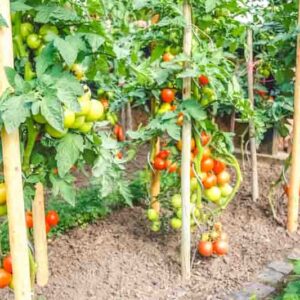
Green Zebra is indeterminate. Its stems continue growing, flowering, and setting fruit through the season rather than terminating after one concentrated harvest.
Published vine heights vary among seed sources, which is normal for an indeterminate tomato. Final vine length is influenced by support, pruning, fertility, climate, and the length of the growing season.
Rather than relying on one fixed mature height, plan for a vigorous supported vine and install a tall cage, stake, trellis, or string system early.
Support rule: Do not size the support according to Green Zebra’s relatively small fruit. The fruit may weigh only a few ounces, but the plant itself remains an indeterminate tomato capable of developing a substantial vine.
For more on tomato growth habit, see Gardenia’s Determinate vs. Indeterminate Tomatoes. For pruning guidance, see How and When to Prune Tomatoes.
Grow Green Zebra in full sun, with at least 6 hours of direct sunlight and preferably 8 or more for vigorous growth, flowering, fruit development, and good flavor.
Plant in fertile, organically rich, moist but well-drained soil. Clay, loam, or sandy soil can work when drainage and fertility are suitable. Aim for a slightly acidic to neutral pH around 6.0-6.8.
Allow about 24-36 inches (60-90 cm) between supported plants. Use wider spacing for large cages, multi-stem plants, or humid conditions where increased airflow is useful.
Maintain reasonably even root-zone moisture. Avoid repeated cycles of severe drying followed by heavy irrigation, which can stress plants and increase the risk of fruit cracking.
Use balanced fertility and avoid excessive nitrogen. Too much nitrogen encourages lush vegetative growth at the expense of balanced flowering and fruiting.
For the best crop: Green Zebra is productive when given full sun, fertile soil, steady moisture, and reliable support. Its relatively small fruit does not require unusually heavy feeding, and excessive fertilizer can create more vine than tomatoes.
For complete tomato care, see Gardenia’s Tomato (Solanum lycopersicum) profile.
Improved crack resistance was one of the traits Tom Wagner selected for while developing Green Zebra. His breeding account describes continued selection for attractive striping, flavor, and better resistance to cracking.
That does not mean Green Zebra is incapable of splitting. Any tomato may crack when expanding fruit experiences abrupt changes in water availability, particularly when dry soil is followed by heavy rainfall or irrigation.
Gardenia cracking note: It is accurate to say that improved crack resistance was part of Green Zebra’s breeding selection. It is not accurate to promise that the cultivar is crack-proof. Genetics can reduce risk; weather and water management still matter.
Green Zebra should not be assigned a standardized modern disease-resistance package unless the exact seed source documents one.
Major cultivar references identify Green Zebra as open-pollinated and indeterminate but do not establish a broadly accepted V/F/N or late-blight resistance package for the cultivar.
Gardenia resistance rule: Do not mistake general vigor, crack resistance, or a gardener’s favorable disease experience for genetically documented disease resistance. Green Zebra has no broadly established modern V/F/N or late-blight resistance package.
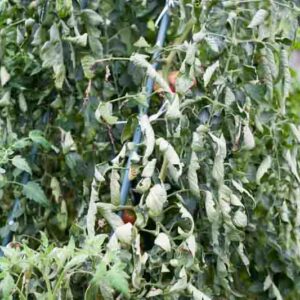
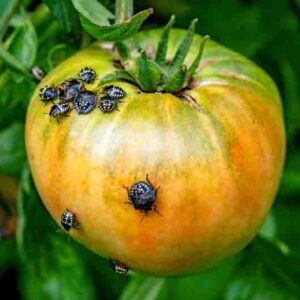
Plants may still encounter early blight, late blight, Septoria leaf spot, blossom-end rot, fruit cracking, and pests such as tomato hornworms.
If symptoms are unclear, use Gardenia’s Tomato Problems: What Is Wrong With My Plant?. For infectious diseases, see Tomato Diseases: Identification, Treatment & Prevention.
Green Zebra generally reaches maturity in about 75-80 days from transplanting.
Harvest when the fruit has shifted from hard green toward yellow-green or olive-yellow, the darker stripes stand out clearly, and the tomato yields slightly under gentle pressure.
The bright sweet-tart flavor makes Green Zebra particularly useful where acidity and visual contrast are desirable. Slice it into salads and tomato platters, dice it into salsa, layer it into sandwiches, or combine it with red, orange, yellow, and purple cultivars for striking fresh dishes.
Green Zebra can also be roasted or preserved, but its most distinctive qualities are easiest to appreciate when the fruit is eaten fresh.
Kitchen cue: Green Zebra’s bright acidity makes it especially useful alongside sweeter tomatoes. Instead of treating the green color as a novelty, use the cultivar as a deliberate flavor contrast in mixed tomato dishes.
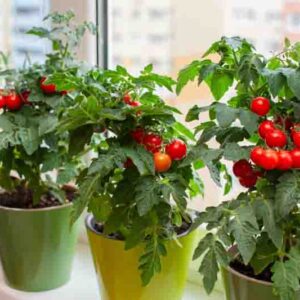
Green Zebra can be grown successfully in a container, but its indeterminate growth means it should not be treated as a compact patio tomato.
Use a large container, preferably about 10 gallons or more, with a fertile, well-drained potting mix and sturdy vertical support. Larger containers provide a more forgiving moisture reserve and help prevent rapid drying during hot weather.
Container reality: Green Zebra’s fruit may be relatively small, but the plant is still indeterminate. Choose container size according to the vine and root system, not the size of an individual tomato.
Choose companions that share full sun and compatible moisture and soil conditions without crowding Green Zebra’s indeterminate canopy.
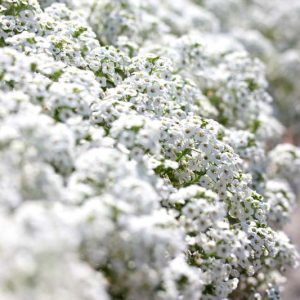
Basil (Ocimum basilicum) shares similar sun and moisture requirements and fits naturally into an edible tomato bed.
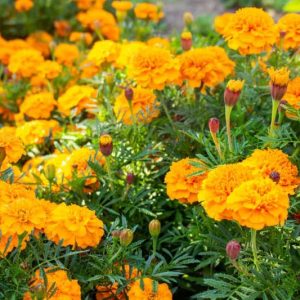
French Marigold (Tagetes patula) thrives in full sun and can flower around bed edges.
Nasturtium (Tropaeolum majus) can trail around the margins without occupying the tomato’s vertical canopy space.
Garlic (Allium sativum) can occupy garden space before the tomato reaches full summer size.
For more companion ideas based on practical compatibility rather than folklore, see Gardenia’s Companion Plants for Tomatoes.
Green Zebra is indeterminate. Its vines continue growing, flowering, and producing fruit through the season and should be supported with a cage, stake, trellis, or string system.
That depends on how “heirloom” is defined. Green Zebra is a modern open-pollinated cultivar deliberately bred by Tom Wagner and released in 1983. Gardenia does not classify it as a traditional heirloom under the historical-lineage definition, although some seed companies use the term more broadly.
Tom Wagner’s own account says he released the first Green Zebra seed through his Tater-Mater Seed catalog in 1983. Seed Savers Exchange also gives 1983, although Cornell lists 1985.
Green Zebra fruits are generally about 4-5 ounces (115-140 g), with a round shape and distinctive dark striping over a green-to-yellow background.
Green Zebra generally matures in about 75-80 days from transplanting.
Look for the pale green background to develop a warmer yellow-green, chartreuse, or olive cast while the darker stripes remain visible. A ripe fruit should also yield slightly under gentle pressure rather than feeling hard.
Yes, but its color changes subtly. Ripe fruit remains predominantly green while developing olive-yellow or yellow-green tones between its darker stripes. The flesh remains green.
Improved crack resistance was one of the traits Tom Wagner selected while breeding Green Zebra, but the cultivar can still crack when moisture changes abruptly. It should not be described as crack-proof.
No standardized modern disease-resistance package is broadly established for Green Zebra. Do not assign V, F, N, or late-blight resistance codes unless the specific seed source provides reliable documentation.
Yes. Use a large container, preferably around 10 gallons or more, with full sun, consistent moisture, fertile potting mix, and sturdy support for the indeterminate vine.
Yes. Green Zebra is open-pollinated, so seed saved from healthy, true-to-type plants can reproduce the cultivar when unwanted cross-pollination is minimized.
| Hardiness |
2 - 11 |
|---|---|
| Climate Zones | 1, 1A, 1B, 2, 2A, 2B, 3, 3A, 3B, 4, 5, 6, 7, 8, 9, 10, 11, 12, 13, 14, 15, 16, 17, 18, 19, 20, 21, 22, 23, 24, A1, A2, A3, H1, H2 |
| Plant Type | Annuals, Fruits, Perennials |
| Plant Family | Solanaceae |
| Genus | Solanum, Tomatoes |
| Common names | Tomato |
| Exposure | Full Sun |
| Season of Interest | Summer (Early, Mid, Late), Fall |
| Height | 3' - 4' (90cm - 120cm) |
| Spread | 2' - 3' (60cm - 90cm) |
| Spacing | 24" - 36" (60cm - 90cm) |
| Maintenance | High |
| Water Needs | Average |
| Soil Type | Clay, Loam, Sand |
| Soil pH | Acid, Neutral |
| Soil Drainage | Moist but Well-Drained |
| Tolerance | Rabbit, Clay Soil |
| Attracts | Bees |
| Garden Uses | Beds And Borders, Patio And Containers, Wall-Side Borders |
| Garden Styles | City and Courtyard, Informal and Cottage, Pollinator Garden |


| Hardiness |
2 - 11 |
|---|---|
| Climate Zones | 1, 1A, 1B, 2, 2A, 2B, 3, 3A, 3B, 4, 5, 6, 7, 8, 9, 10, 11, 12, 13, 14, 15, 16, 17, 18, 19, 20, 21, 22, 23, 24, A1, A2, A3, H1, H2 |
| Plant Type | Annuals, Fruits, Perennials |
| Plant Family | Solanaceae |
| Genus | Solanum, Tomatoes |
| Common names | Tomato |
| Exposure | Full Sun |
| Season of Interest | Summer (Early, Mid, Late), Fall |
| Height | 3' - 4' (90cm - 120cm) |
| Spread | 2' - 3' (60cm - 90cm) |
| Spacing | 24" - 36" (60cm - 90cm) |
| Maintenance | High |
| Water Needs | Average |
| Soil Type | Clay, Loam, Sand |
| Soil pH | Acid, Neutral |
| Soil Drainage | Moist but Well-Drained |
| Tolerance | Rabbit, Clay Soil |
| Attracts | Bees |
| Garden Uses | Beds And Borders, Patio And Containers, Wall-Side Borders |
| Garden Styles | City and Courtyard, Informal and Cottage, Pollinator Garden |
How many Solanum lycopersicum ‘Green Zebra’ (Tomato) do I need for my garden?
| Plant | Quantity | |
|---|---|---|
| Solanum lycopersicum ‘Green Zebra’ (Tomato) | N/A | Buy Plants |
Create a membership account to save your garden designs and to view them on any device.
Becoming a contributing member of Gardenia is easy and can be done in just a few minutes. If you provide us with your name, email address and the payment of a modest $25 annual membership fee, you will become a full member, enabling you to design and save up to 25 of your garden design ideas.
Join now and start creating your dream garden!
Create a membership account to save your garden designs and to view them on any device.
Becoming a contributing member of Gardenia is easy and can be done in just a few minutes. If you provide us with your name, email address and the payment of a modest $25 annual membership fee, you will become a full member, enabling you to design and save up to 25 of your garden design ideas.
Join now and start creating your dream garden!