Tomato 'Yellow Pear'
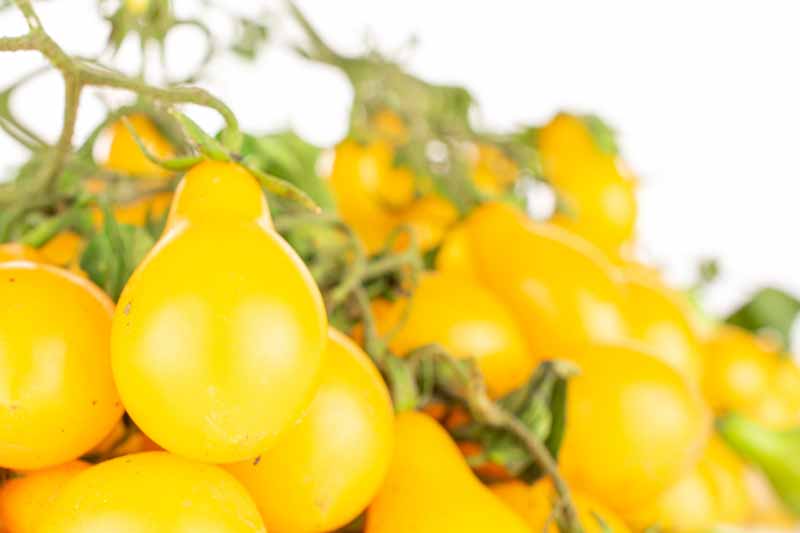
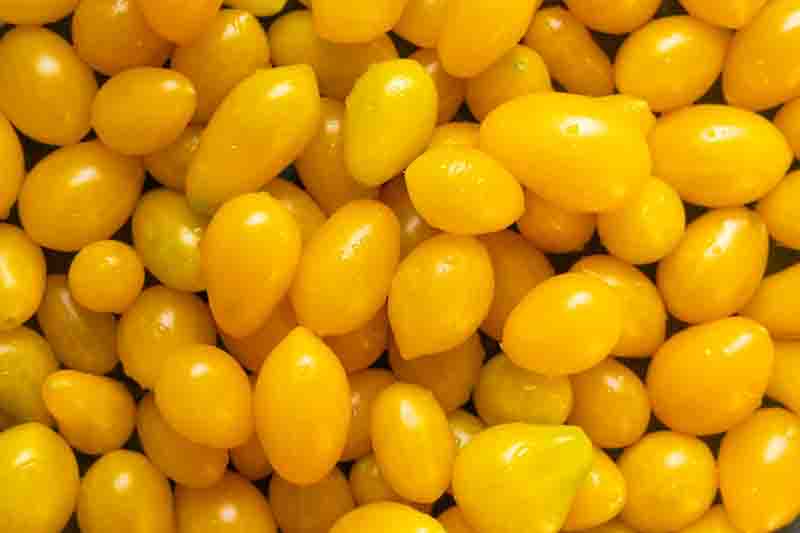
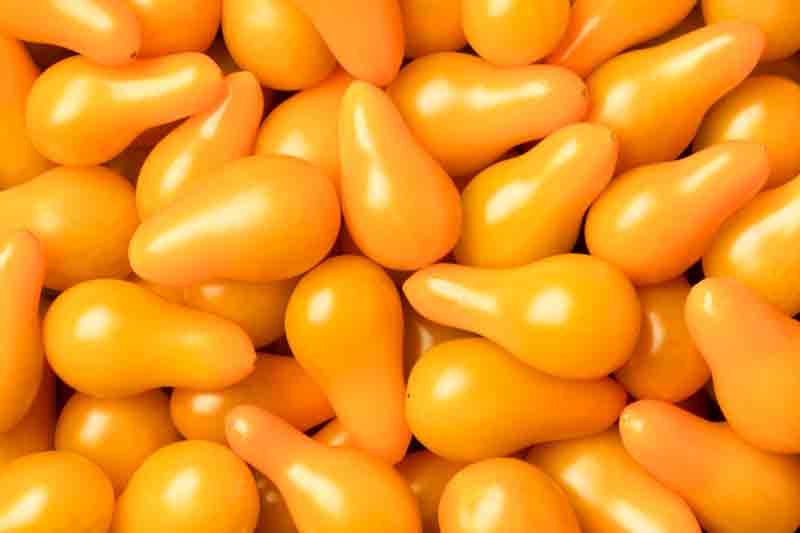
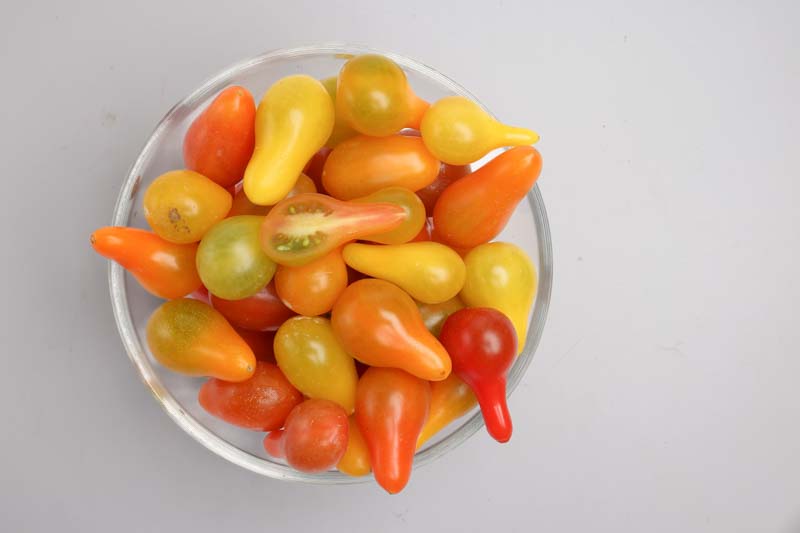


Solanum lycopersicum ‘Yellow Pear’ is a vigorous open-pollinated heirloom tomato famous for abundant clusters of small, bright yellow, pear-shaped fruits. The indeterminate vines continue flowering and producing through the season, often carrying dozens of bite-sized tomatoes at once. Their cheerful color, unusual shape, and mild, pleasantly tangy flavor make them especially useful for salads, snacking, garnishes, tomato platters, and colorful summer dishes.
The name needs some care, however. ‘Yellow Pear’ is a documented cultivar, but “yellow pear tomato” can also be used descriptively for other yellow, pear-shaped cultivars. Distinct named tomatoes such as Beam’s Yellow Pear and Austin’s Yellow Pear should not automatically inherit the fruit size, history, maturity, disease behavior, or other traits of the cultivar ‘Yellow Pear’.
Gardenia cultivar insight: ‘Yellow Pear’ is a named open-pollinated cultivar, while “yellow pear tomato” can also describe a fruit shape and color shared by several cultivars. Gardenia keeps ‘Yellow Pear’, Beam’s Yellow Pear, Austin’s Yellow Pear, and other named pear selections separate unless reliable evidence establishes synonymy.
| Botanical Name | Solanum lycopersicum ‘Yellow Pear’ |
|---|---|
| Family | Solanaceae |
| Common Name | Yellow Pear tomato |
| Historical Status | Old open-pollinated heirloom; yellow pear-shaped tomatoes are documented from the early 19th century, while some modern seed histories describe Yellow Pear as pre-1800 |
| Plant Type and Habit | Warm-season fruiting annual; vigorous, branching, indeterminate vine requiring support |
| Seed Type | Open-pollinated |
| Size | Listed at about 60 in. (1.5 m). As an indeterminate tomato, actual vine length may be considerably greater depending on support, pruning, fertility, climate, and season length. |
| Growth Habit | Indeterminate; continues growing, flowering, and producing fruit over an extended season |
| Tomato Type | Main-season pear-shaped small-fruited tomato; often grouped with cherry tomatoes |
| Fruit | Small, bright yellow, pear-shaped fruit; Cornell documents about ¾-1 oz. (21-28 g) and approximately 1½ in. (4 cm) long |
| Fruit Color | Bright yellow to golden yellow when fully ripe |
| Flavor | Mild, juicy, and pleasantly tangy; sweetness and flavor intensity vary with growing conditions and harvest stage |
| Days to Maturity | About 70-80 days from transplanting, with many current listings around 75-78 days |
| Sun and Exposure | Full sun; at least 6 hours of direct sunlight, preferably 8 or more |
| Soil | Fertile, organically rich, moist but well-drained clay, loam, or sandy soil; ideally around pH 6.0-6.8 |
| Spacing | 24-36 in. (60-90 cm) between supported plants |
| Harvest | Harvest when fruit becomes uniformly bright yellow to golden yellow and yields slightly under gentle pressure |
| Best Uses | Fresh snacking, salads, garnishes, tomato platters, hors d’oeuvres, salsa, roasting, and colorful mixed-tomato dishes |
| Disease Resistance | No standardized V/F/N package is established. Cornell sources have reported promising late-blight performance, but Cornell’s cultivar database says additional evaluation is needed before the trait is considered confirmed. |
| Container Suitability | Possible in a large container with sturdy support; the small fruit should not be mistaken for a compact plant habit |
Yellow Pear is instantly recognizable by its small pear-shaped fruit, narrow neck, rounded base, and bright yellow color. Cornell describes the cultivar as an indeterminate, main-season pear tomato producing fruits approximately ¾-1 oz. and about 1½ inches long.
The vines can be exceptionally productive, producing clusters of bite-sized fruit over a long season. This makes Yellow Pear useful not only as an ornamental addition to the edible garden but as a practical tomato for frequent harvesting.
The fruit requires little preparation. It can be eaten whole, halved into salads, used on appetizer platters, added to salsa, or mixed with round cherry tomatoes for contrast in both shape and color.
Best reason to grow Yellow Pear: Choose it when you want an unusually productive small tomato that contributes shape as well as color. Its pear form makes it stand out among round cherry tomatoes, while the indeterminate vines can keep producing over much of the summer.
‘Yellow Pear’ is a documented open-pollinated cultivar, but the words “yellow pear tomato” also describe a fruit form. This creates an identity problem because several distinct cultivars produce yellow pear-shaped fruit.
Beam’s Yellow Pear, for example, is maintained separately by seed-preservation sources. Austin’s Yellow Pear also appears as a separate named cultivar. A similar appearance does not prove that these tomatoes are genetically identical to ‘Yellow Pear’.
The same principle applies in reverse: a seed packet labeled simply “Yellow Pear” should not automatically inherit the documented history or disease claims of Beam’s Yellow Pear or another named selection.
Gardenia identity rule: Pear shape is not cultivar identity. Gardenia keeps ‘Yellow Pear’, Beam’s Yellow Pear, Austin’s Yellow Pear, and other named pear tomatoes separate unless reliable evidence establishes that two names refer to the same maintained seed line.
Yellow Pear is unquestionably an old heirloom, but its exact historical starting point is less certain than some seed descriptions suggest.
Historical summaries place yellow pear-shaped tomatoes in cultivation by the early 19th century, with 1805 frequently cited for Yellow Pear. Some modern seed companies go further and describe the cultivar as pre-1800.
The difficulty is that early records do not always provide enough detail to prove that every historic yellow pear-shaped tomato was genetically identical to the modern seed line sold today as ‘Yellow Pear’.
Gardenia history note: Gardenia treats the early-1800s record as strong evidence that Yellow Pear belongs to a very old tomato tradition. Claims of a specifically pre-1800 modern cultivar lineage are presented as source-specific rather than as proven uninterrupted genetic continuity.
This does not diminish Yellow Pear’s heirloom status. It simply separates two different claims: that yellow pear tomatoes have a long documented history, and that today’s exact seed line can be genetically traced unchanged to every early reference.
Cornell provides a useful cultivar-specific baseline: Yellow Pear produces yellow fruit weighing approximately ¾-1 oz. (21-28 g) and measuring about 1½ in. (4 cm) long.
The fruits have the characteristic narrow neck and rounded lower half that give the cultivar its pear-like form. They ripen from green to bright yellow, sometimes becoming deeper golden yellow at full maturity.
Flavor descriptions vary more than fruit dimensions. Yellow Pear is often described as mild, juicy, and pleasantly tangy rather than intensely sugary.
Growing conditions matter. Strong sunlight, balanced nutrition, reasonable moisture control, and harvest stage can all influence perceived sweetness, acidity, and flavor intensity.
Gardenia flavor note: Yellow Pear’s main strengths are productivity, shape, color, and versatility. Gardeners seeking an exceptionally sweet cherry tomato may prefer a cultivar specifically selected for high sweetness, while Yellow Pear excels as a prolific and visually distinctive all-purpose small tomato.
Yellow Pear is indeterminate. Its vines continue growing, flowering, and producing fruit throughout the season rather than stopping after one concentrated crop.
Burpee currently lists its Yellow Pear at about 60 in. (1.5 m) tall. That should be treated as a source-specific mature-height figure rather than an absolute maximum for every Yellow Pear plant.
Like other indeterminate tomatoes, actual vine length can change substantially with support, pruning, fertility, climate, and season length. The small fruit does not mean the plant itself will remain small.
Support rule: Do not choose support according to fruit size. Yellow Pear produces tiny tomatoes on a vigorous indeterminate vine, so provide a substantial cage, trellis, stake, or string system just as you would for other full-sized indeterminate tomato plants.
For more on tomato growth habit, see Gardenia’s Determinate vs. Indeterminate Tomatoes. For pruning guidance, see How and When to Prune Tomatoes.
Grow Yellow Pear in full sun, with at least 6 hours of direct sunlight and preferably 8 or more for vigorous growth, flowering, fruit set, ripening, and good flavor.
Plant in fertile, organically rich, moist but well-drained soil. Clay, loam, or sandy soil can work when drainage and fertility are suitable. Aim for a slightly acidic to neutral pH around 6.0-6.8.
Allow about 24-36 inches (60-90 cm) between supported plants. Yellow Pear can form a large, branching vine, so generous spacing improves access, harvesting, and airflow.
Maintain reasonably even root-zone moisture. Repeated cycles of severe drying followed by heavy watering can stress the plant and may contribute to fruit-quality problems.
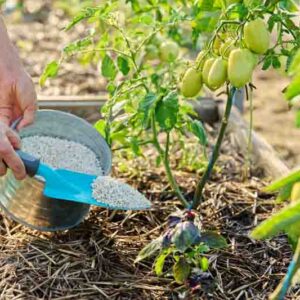
Use balanced fertility rather than excessive nitrogen. Too much nitrogen can produce lush vegetative growth while reducing the balance between foliage, flowering, and fruiting.
For the best crop: Yellow Pear does not need unusually heavy feeding simply because it can produce large numbers of fruit. Full sun, fertile soil, steady moisture, healthy foliage, and reliable support are more useful than pushing the plant with extra fertilizer.
For complete tomato care, see Gardenia’s Tomato (Solanum lycopersicum) profile.
Yellow Pear is easier to judge than a green-when-ripe cultivar, but pale fruit can still be harvested too early.
Look for several ripeness cues together:
The fruit has changed fully from green to a clear bright yellow or golden yellow.
The narrow neck and rounded base have filled out to the cultivar’s mature pear shape.
Green coloration has largely disappeared from the shoulders.
The fruit yields slightly under gentle pressure without becoming soft or wrinkled.
Gardenia harvest cue: Do not judge Yellow Pear only by size. The fruit can reach nearly full size while still green. Wait for its characteristic bright yellow color and slight softening for better flavor.
Yellow Pear should not be assigned a standardized modern disease-resistance package.
Cornell sources are not completely consistent about late blight. Cornell has reported strong or promising late-blight performance for Yellow Pear in some guidance, including references describing excellent resistance. Its cultivar database, however, says that more evaluation is needed before late-blight resistance can be confirmed.
Those statements are not necessarily contradictory in the strictest sense: a cultivar may perform well in particular trials or against particular pathogen populations without having universally reliable resistance across all environments or strains of the disease.
Gardenia resistance rule: Yellow Pear has shown promising late-blight performance in some Cornell reporting, but Gardenia does not convert that into a universal late-blight guarantee or a standardized V/F/N-style resistance code. Resistance can depend on pathogen strain, growing conditions, and the evidence used to define the trait.
Plants may still encounter early blight, late blight, Septoria leaf spot, blossom-end rot, fruit cracking, and pests such as tomato hornworms.
If symptoms are unclear, use Gardenia’s Tomato Problems: What Is Wrong With My Plant?. For infectious diseases, see Tomato Diseases: Identification, Treatment & Prevention.
Yellow Pear generally matures in about 70-80 days from transplanting, with many modern seed listings falling around 75-78 days.
Because the cultivar is indeterminate, harvest continues over an extended period rather than arriving as one concentrated crop. Frequent picking helps keep ripe fruit at its best texture and makes it easier to keep up with productive plants.
Yellow Pear is particularly useful raw. Its fruits are naturally portion-sized for salads, snack plates, lunch boxes, appetizers, and garnishes. The pear shape also provides visual contrast beside round cherry tomatoes.
The fruit can also be roasted, added to salsa, or cooked into sauces. Its greatest culinary advantage, however, is usually its combination of convenient size, distinctive shape, and golden color rather than the dense flesh of a true paste tomato.
Kitchen cue: Use Yellow Pear where both shape and color can be appreciated. Combine it with red, purple, orange, and green tomatoes rather than hiding its distinctive pear form in a heavily cooked dish.
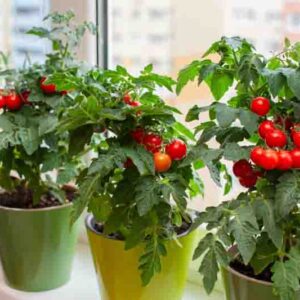
Yellow Pear can grow successfully in a container, but the tiny fruit should not create the impression that it is a miniature plant.
The cultivar is indeterminate and can produce a substantial vine. Use a large container, preferably around 10 gallons or more, filled with a fertile, well-drained potting mix, and install sturdy support at planting.
Larger containers also provide a more stable moisture reserve during summer heat, which is especially useful for a plant that may be continually flowering and ripening clusters of fruit.
Container reality: Choose the pot according to the size of the vine and root system, not the one-ounce tomatoes. Yellow Pear is a small-fruited tomato, not a dwarf tomato plant.
Choose companions that share full sun and compatible growing conditions without crowding Yellow Pear’s vigorous indeterminate canopy.
Basil (Ocimum basilicum) shares similar sun and moisture requirements and fits naturally into an edible tomato bed.
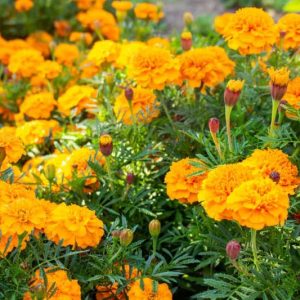
French Marigold (Tagetes patula) thrives in full sun and can flower around bed edges.
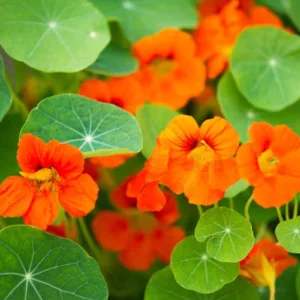
Nasturtium (Tropaeolum majus) can trail around bed margins without occupying the tomato’s vertical canopy space.
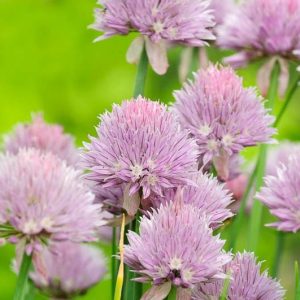
Garlic (Allium sativum) can occupy garden space before the tomato reaches full summer size.
For more companion ideas based on practical compatibility rather than folklore, see Gardenia’s Companion Plants for Tomatoes.
Yellow Pear is indeterminate. Its vines continue growing, flowering, and producing fruit through the season and need sturdy support.
Cornell describes Yellow Pear fruits as approximately ¾-1 ounce (21-28 g) and about 1½ inches (4 cm) long.
Burpee currently lists its Yellow Pear at about 60 inches (1.5 m). Because the cultivar is indeterminate, actual vine length may be considerably greater depending on support, pruning, fertility, climate, and season length.
Yellow Pear generally matures in about 70-80 days from transplanting, with many modern listings around 75-78 days.
Harvest when the fruit has changed completely from green to bright yellow or golden yellow, reached its full pear shape, and begins to yield slightly under gentle pressure.
Yes. Yellow Pear is an old open-pollinated heirloom. Yellow pear-shaped tomatoes are documented from the early 19th century, while some modern seed histories describe the cultivar as pre-1800. Gardenia treats the stronger pre-1800 continuity claim cautiously.
Not necessarily. Beam’s Yellow Pear is maintained as a separate named cultivar. Gardenia therefore keeps Beam’s Yellow Pear and ‘Yellow Pear’ separate unless reliable evidence establishes that a particular seed source treats them as the same maintained line.
It is commonly grouped with cherry or small-fruited tomatoes because its fruits are bite-sized, but its defining horticultural form is pear-shaped. Different seed sources may classify it as either a pear tomato or a cherry-type tomato.
Cornell sources have reported promising or strong late-blight performance for Yellow Pear, but Cornell’s cultivar database also says more evaluation is needed before resistance can be confirmed. Gardenia therefore does not treat late-blight resistance as a universal cultivar guarantee.
Yes, but it is an indeterminate vine rather than a dwarf tomato. Use a large container, preferably around 10 gallons or more, with full sun, consistent moisture, and sturdy support.
Yes. Yellow Pear is open-pollinated, so seed saved from healthy, true-to-type plants can reproduce the cultivar when unwanted cross-pollination is minimized.
| Hardiness |
2 - 11 |
|---|---|
| Climate Zones | 1, 1A, 1B, 2, 2A, 2B, 3, 3A, 3B, 4, 5, 6, 7, 8, 9, 10, 11, 12, 13, 14, 15, 16, 17, 18, 19, 20, 21, 22, 23, 24, A1, A2, A3, H1, H2 |
| Plant Type | Annuals, Fruits, Perennials |
| Plant Family | Solanaceae |
| Genus | Solanum, Tomatoes |
| Common names | Tomato |
| Exposure | Full Sun |
| Season of Interest | Summer (Early, Mid, Late), Fall |
| Height | 4' - 5' (120cm - 150cm) |
| Spread | 2' - 3' (60cm - 90cm) |
| Spacing | 24" - 36" (60cm - 90cm) |
| Maintenance | High |
| Water Needs | Average |
| Soil Type | Clay, Loam, Sand |
| Soil pH | Acid, Neutral |
| Soil Drainage | Moist but Well-Drained |
| Tolerance | Rabbit, Clay Soil |
| Attracts | Bees |
| Garden Uses | Beds And Borders, Patio And Containers, Wall-Side Borders |
| Garden Styles | City and Courtyard, Informal and Cottage, Pollinator Garden |


| Hardiness |
2 - 11 |
|---|---|
| Climate Zones | 1, 1A, 1B, 2, 2A, 2B, 3, 3A, 3B, 4, 5, 6, 7, 8, 9, 10, 11, 12, 13, 14, 15, 16, 17, 18, 19, 20, 21, 22, 23, 24, A1, A2, A3, H1, H2 |
| Plant Type | Annuals, Fruits, Perennials |
| Plant Family | Solanaceae |
| Genus | Solanum, Tomatoes |
| Common names | Tomato |
| Exposure | Full Sun |
| Season of Interest | Summer (Early, Mid, Late), Fall |
| Height | 4' - 5' (120cm - 150cm) |
| Spread | 2' - 3' (60cm - 90cm) |
| Spacing | 24" - 36" (60cm - 90cm) |
| Maintenance | High |
| Water Needs | Average |
| Soil Type | Clay, Loam, Sand |
| Soil pH | Acid, Neutral |
| Soil Drainage | Moist but Well-Drained |
| Tolerance | Rabbit, Clay Soil |
| Attracts | Bees |
| Garden Uses | Beds And Borders, Patio And Containers, Wall-Side Borders |
| Garden Styles | City and Courtyard, Informal and Cottage, Pollinator Garden |
How many Solanum lycopersicum ‘Yellow Pear’ (Tomato) do I need for my garden?
| Plant | Quantity | |
|---|---|---|
| Solanum lycopersicum ‘Yellow Pear’ (Tomato) | N/A | Buy Plants |
Create a membership account to save your garden designs and to view them on any device.
Becoming a contributing member of Gardenia is easy and can be done in just a few minutes. If you provide us with your name, email address and the payment of a modest $25 annual membership fee, you will become a full member, enabling you to design and save up to 25 of your garden design ideas.
Join now and start creating your dream garden!
Create a membership account to save your garden designs and to view them on any device.
Becoming a contributing member of Gardenia is easy and can be done in just a few minutes. If you provide us with your name, email address and the payment of a modest $25 annual membership fee, you will become a full member, enabling you to design and save up to 25 of your garden design ideas.
Join now and start creating your dream garden!