Tomato 'Black Krim'
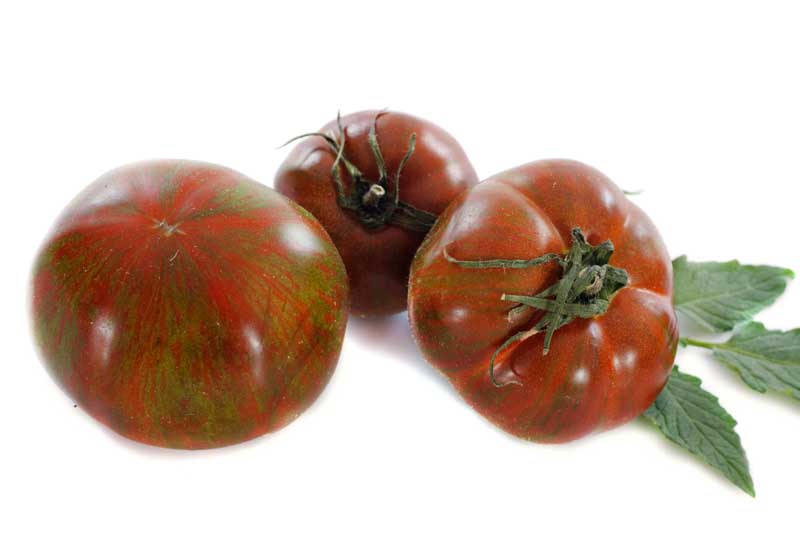
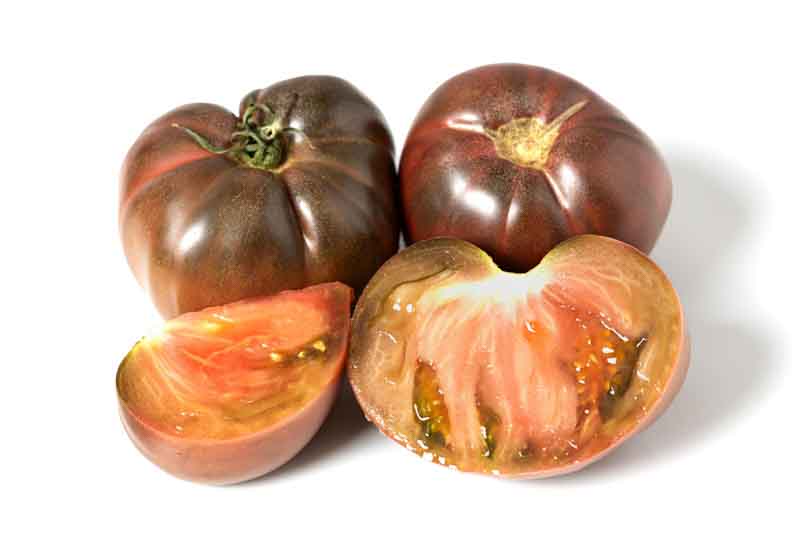


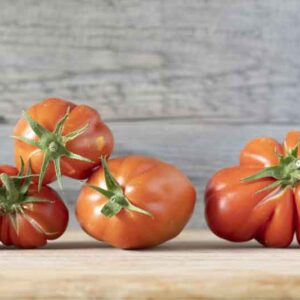
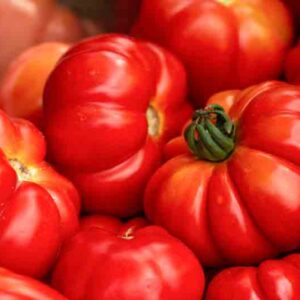
Solanum lycopersicum ‘Black Krim’ is a famous open-pollinated heirloom tomato from the Crimean Peninsula, prized for its unusual dark coloring, rich flavor, and substantial beefsteak fruit. The indeterminate plants produce flattened to slightly lobed tomatoes with deep brown-red, purple-red, and violet tones, often retaining green or green-black shoulders when ripe.
Despite the name, a ripe Black Krim tomato is not literally jet black. Fruit color changes with growing conditions: stronger sunlight and heat can deepen the shoulders and skin until parts of the fruit appear almost black, while fruit grown under cooler or less intense conditions may remain more brown-purple or maroon. This makes Black Krim one of the clearest examples of why tomato color should be described as a range rather than a single fixed shade.
Gardenia cultivar insight: “Black” in Black Krim describes a dark-fruited tomato class, not truly black skin or flesh. Mature fruit is usually a mixture of brown-red, purple-red, violet-brown, and green-black tones, with deeper pigmentation under stronger heat and sunlight. Judge ripeness by mature color and slight softening, not by waiting for the whole fruit to become black.
| Botanical Name | Solanum lycopersicum ‘Black Krim’ |
|---|---|
| Family | Solanaceae |
| Common Names | Black Krim tomato, Black Crimea, Black Crimean, Noire de Crimée |
| Origin | Crimean Peninsula, on the Black Sea; introduced to the Seed Savers Exchange network by Lars Olov Rosenstrom of Sweden and first listed in the U.S. SSE Yearbook in 1990 |
| Plant Type and Habit | Warm-season fruiting annual; vigorous, indeterminate vine requiring support |
| Seed Type | Open-pollinated heirloom |
| Size | Listed at about 42 in. (107 cm). As an indeterminate tomato, vines may grow considerably farther depending on seed line, support, pruning, climate, fertility, and season length. |
| Growth Habit | Indeterminate; continues flowering and producing fruit over an extended season |
| Tomato Type | Main-season, dark-fruited heirloom beefsteak / slicing tomato |
| Fruit | Flattened to slightly lobed beefsteak fruit, commonly about 8-16 oz. (225-450 g) |
| Fruit Color | Deep brown-red to purple-red or violet-brown, often with green to green-black shoulders; color may become nearly black in strong heat and sunlight |
| Flavor | Rich, full, complex flavor balancing sweetness and acidity, often described as smoky and sometimes slightly salty |
| Days to Maturity | About 80 days from transplanting |
| Sun and Exposure | Full sun; at least 6 hours of direct sunlight, preferably 8 or more |
| Soil | Fertile, organically rich, moist but well-drained clay, loam, or sandy soil; ideally around pH 6.0-6.8 |
| Spacing | 24-36 in. (60-90 cm); use wider spacing for large cages or multi-stem plants |
| Harvest | Main-season and extended; harvest when fruit reaches mature dark brown-red / purple-red color and begins to soften slightly, even if the shoulders remain green |
| Best Uses | Fresh slicing, sandwiches, salads, tomato plates, bruschetta, salsa, and fresh summer cooking |
| Disease Resistance | No standardized disease-resistance package is established. Cornell has historically described Black Krim as disease resistant, but specific modern resistance codes, including confirmed late-blight resistance, are not established. |
| Container Suitability | Possible in a large container with sturdy support; about 10 gallons is a practical minimum, with more root volume easier to manage |
Black Krim stands out because of the combination of its dark coloring, complex flavor, and substantial beefsteak fruit. Johnny’s describes the fruit as deep brown-red with brown-green shoulders and generally 8-16 oz., while Seed Savers Exchange describes violet-brown and purple-red fruit that can darken almost to black under sufficient heat and sunlight.
Its flavor is one of the cultivar’s biggest attractions. Black Krim is known for a rich, full taste balancing sweetness and acidity, with smoky notes and, to some palates, a slightly salty quality.
Unlike modern red slicing hybrids bred heavily for uniform appearance, Black Krim may retain dark green shoulders and show substantial variation in tone across a ripe fruit. That is part of the cultivar’s normal appearance.
Best reason to grow Black Krim: Choose it when flavor and character matter more than uniform supermarket appearance. The combination of dark coloring, rich taste, juicy texture, and heirloom history makes Black Krim one of the most distinctive slicing tomatoes.
Black Krim is associated with the Crimean Peninsula on the Black Sea. The name “Krim” is a form of Crimea, and the cultivar is also known as Black Crimea or Black Crimean.
The modern North American seed history is much better documented than its earlier local history. Seed Savers Exchange records that Black Krim was introduced to its network by Lars Olov Rosenstrom of Sweden and first appeared in the 1990 Seed Savers Exchange Yearbook.
Rosenstrom noted that fruit grown in his heated greenhouse became exceptionally dark, while fruit grown outdoors appeared more brownish-purple. That observation is particularly useful because it helps explain why photographs of supposedly identical Black Krim tomatoes can look surprisingly different.
Gardenia history note: The cultivar’s Crimean origin and its 1990 introduction into the U.S. Seed Savers Exchange network are well documented. More elaborate stories about exactly who first bred or selected Black Krim in Crimea should not be presented as fact unless supported by historical records.
No tomato cultivar produces uniformly jet-black fruit in the everyday sense of the word. Black Krim belongs to the horticultural group commonly called black tomatoes, whose ripe fruits combine dark red, brown, purple, and dusky pigments rather than a single true-black color.
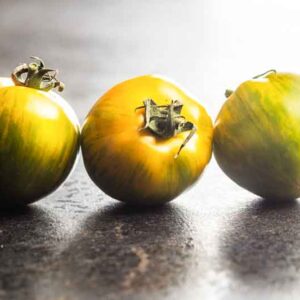
Black Krim typically ripens to a mixture of brown-red, purple-red, violet-brown, and green-black tones. The shoulders often remain green or olive-green even when the rest of the fruit is ripe.
Heat and sunlight can intensify the darker pigmentation. Seed Savers specifically notes that fruit can turn almost black under sufficient sun and heat.
Gardenia color rule: Do not assign Black Krim a single fixed color such as “black,” “purple,” or “red.” The most accurate description is a dark brown-red to purple-red fruit with green to green-black shoulders whose color deepens with heat and sunlight.
Black Krim is an indeterminate tomato. Its vines continue extending, flowering, and producing fruit through the season rather than ending growth after one concentrated crop.
Published mature-height information varies by seed source. Burpee currently lists its Black Krim at about 42 in. (107 cm). Because Black Krim is indeterminate, however, vines may grow substantially farther depending on genetics, support, pruning, fertility, climate, and season length.
For practical garden planning, the indeterminate habit is more useful than treating one catalog height as an absolute maximum. Install a sturdy support system early and allow the plant enough space to develop a productive canopy.
Support rule: Install a strong cage, stake, trellis, or string system early. Black Krim fruit is considerably heavier than cherry tomatoes, and an indeterminate vine becomes much harder to train once it has begun sprawling.
For more on growth habit, see Gardenia’s Determinate vs. Indeterminate Tomatoes. For pruning guidance, see How and When to Prune Tomatoes.
Grow Black Krim in full sun, with at least 6 hours of direct sunlight and preferably 8 or more. Strong light supports flowering, fruit development, ripening, and the cultivar’s characteristic dark pigmentation.
Plant in fertile, organically rich, moist but well-drained soil. Clay, loam, or sandy soil can work when drainage and fertility are suitable. Aim for a slightly acidic to neutral pH around 6.0-6.8.
Allow about 24-36 inches (60-90 cm) between supported plants. Use wider spacing for large cages, multi-stem plants, or humid gardens where greater airflow is useful.
Maintain reasonably even root-zone moisture. Black Krim is a juicy beefsteak tomato, and rapid changes from dry soil to abundant moisture can increase the risk of cracking.
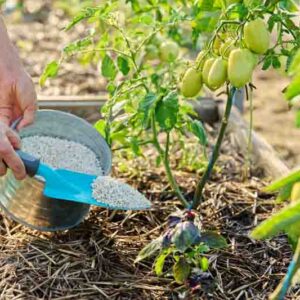
Use balanced fertility and avoid excessive nitrogen. Too much nitrogen can produce vigorous leafy growth while delaying flowering or ripening.
For the best fruit: Give Black Krim full sun, fertile soil, steady moisture, and good airflow. Strong light helps deepen its dark coloration, but color alone should never be used as the only test of ripeness.
For complete tomato care, see Gardenia’s Tomato (Solanum lycopersicum) profile.
Black Krim can confuse gardeners because ripe fruit often retains green shoulders. Waiting for the entire tomato to turn red or uniformly dark can result in fruit becoming overripe.
Instead, use several ripeness cues together:
The lower and middle portions of the fruit have changed from green to brown-red, purple-red, or dark maroon.
The shoulders have darkened but may still retain green or olive-green tones.
The fruit gives slightly under gentle finger pressure.
The skin has developed the cultivar’s characteristic dusky, dark appearance.
Gardenia harvest cue: Green shoulders are not automatically a sign that Black Krim is unripe. If the lower fruit has developed its mature brown-red or purple-red color and the tomato has begun to soften slightly, it may be ready to harvest even while the shoulders remain green.
Black Krim’s juicy, relatively large fruit can crack when water availability changes abruptly, particularly when dry soil is followed by heavy rain or irrigation.
Keeping root-zone moisture reasonably even is one of the most useful preventive strategies. Mulch can help slow evaporation and reduce rapid soil-moisture swings.
Cracking is not inevitable, and published claims about crack resistance are inconsistent across commercial seed sources. Gardenia therefore does not classify Black Krim as universally crack-resistant or universally crack-prone.
Gardenia cracking rule: Treat cracking as a management and weather risk rather than a fixed cultivar guarantee. Avoid transferring one seller’s “crack resistant” claim to every Black Krim plant when broader documentation does not establish that trait consistently.
Black Krim should not be assigned a broad modern disease-resistance package without qualification.
Cornell has historically described Black Krim as a disease-resistant variety, but its resistance information does not establish a standardized modern V/F/N or other coded package for the cultivar. Cornell has also specifically stated that more evaluation is needed before late-blight resistance can be confirmed.
Commercial seed descriptions may make broader disease claims, but those should remain attached to the specific source rather than being converted into universal Black Krim resistance traits.
Gardenia resistance rule: Do not translate a general “disease resistant” description into specific resistance codes. Black Krim has no well-established modern V/F/N package, and confirmed cultivar-wide late-blight resistance should not be claimed on the available evidence.
Plants may still encounter early blight, late blight, Septoria leaf spot, blossom-end rot, fruit cracking, and pests such as tomato hornworms.
If symptoms are unclear, use Gardenia’s Tomato Problems: What Is Wrong With My Plant?. For infectious diseases, see Tomato Diseases: Identification, Treatment & Prevention.
Black Krim is a main-season tomato that typically matures in about 80 days from transplanting.
Harvest when the fruit has developed its mature dark brown-red to purple-red color and has begun to soften slightly. Do not wait for the green shoulders to disappear completely.
The juicy, richly flavored fruit is especially good for fresh eating. Thick slices work well in sandwiches and tomato plates, while chopped Black Krim adds deep color and complex flavor to salads, bruschetta, and fresh salsa.
Flavor tip: Allow freshly harvested fruit to finish ripening at room temperature rather than refrigerating it immediately. Black Krim’s chief attraction is its complex fresh flavor, so handle ripe fruit gently and use it while its texture is at its best.
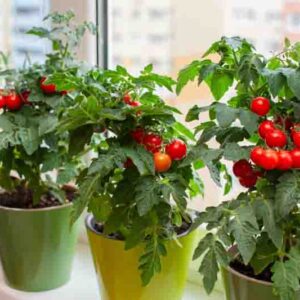
Black Krim can be grown in a container, but its indeterminate habit means it needs more root space and support than a compact patio tomato.
Use at least about a 10-gallon container, with additional soil volume providing a more forgiving moisture reserve. Install a strong cage, stake, or trellis when planting.
Container plants need especially consistent watering because restricted root volume can dry quickly during summer heat, increasing plant stress and the risk of cracking.
Container reality: Black Krim is container-compatible, but it is not naturally compact. A large pot, good support, full sun, and consistent moisture are more useful than trying to restrict the vine through excessive pruning.
Choose companions that share full sun and compatible soil conditions without crowding Black Krim’s indeterminate canopy.
Basil (Ocimum basilicum) shares similar sun and moisture requirements and fits naturally into an edible tomato bed.
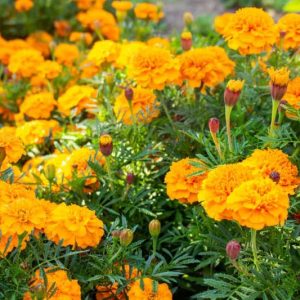
French Marigold (Tagetes patula) thrives in full sun and can flower around the edges of tomato beds.
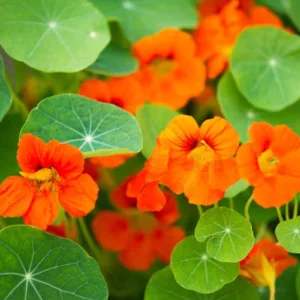
Nasturtium (Tropaeolum majus) can trail around bed edges without occupying the tomato’s vertical canopy space.
Garlic (Allium sativum) can occupy garden space before the tomato reaches full summer size.
For more ideas based on compatible growing conditions and practical garden functions rather than folklore, see Gardenia’s Companion Plants for Tomatoes.
Black Krim is indeterminate. Its vines continue growing, flowering, and producing fruit through the season and need sturdy support.
Black Krim fruit commonly weighs about 8-16 ounces (225-450 g). Individual fruits can vary, and some may exceed one pound.
Burpee currently lists its Black Krim at about 42 inches (107 cm). Because the cultivar is indeterminate, vines may grow considerably farther depending on genetics, support, pruning, fertility, climate, and season length.
Black Krim typically matures in about 80 days from transplanting.
No. Black Krim is a dark-fruited tomato whose ripe skin is usually brown-red, purple-red, or violet-brown with green to green-black shoulders. Strong heat and sunlight can deepen the color until parts of the fruit appear almost black.
Black Krim originated on the Crimean Peninsula near the Black Sea. Lars Olov Rosenstrom of Sweden introduced it to the Seed Savers Exchange network, and it first appeared in the U.S. SSE Yearbook in 1990.
Look for mature brown-red to purple-red color on most of the fruit and slight softening under gentle pressure. The shoulders may remain green or dark green even when the tomato is ripe.
Confirmed cultivar-wide late-blight resistance is not established. Cornell has historically described Black Krim as disease resistant but has specifically stated that more evaluation is needed before late-blight resistance can be confirmed.
Yes. Use a large container, preferably around 10 gallons or more, with full sun, consistent moisture, and sturdy support for the indeterminate vines.
Yes. Black Krim is open-pollinated, so seed saved from healthy, true-to-type plants can reproduce the cultivar when unwanted cross-pollination is minimized.
| Hardiness |
2 - 11 |
|---|---|
| Climate Zones | 1, 1A, 1B, 2, 2A, 2B, 3, 3A, 3B, 4, 5, 6, 7, 8, 9, 10, 11, 12, 13, 14, 15, 16, 17, 18, 19, 20, 21, 22, 23, 24, A1, A2, A3, H1, H2 |
| Plant Type | Annuals, Fruits, Perennials |
| Plant Family | Solanaceae |
| Genus | Solanum, Tomatoes |
| Common names | Tomato |
| Exposure | Full Sun |
| Season of Interest | Summer (Early, Mid, Late), Fall |
| Height | 3' - 4' (90cm - 120cm) |
| Spread | 2' - 3' (60cm - 90cm) |
| Spacing | 24" - 36" (60cm - 90cm) |
| Maintenance | High |
| Water Needs | Average |
| Soil Type | Clay, Loam, Sand |
| Soil pH | Acid, Neutral |
| Soil Drainage | Moist but Well-Drained |
| Tolerance | Rabbit, Clay Soil |
| Attracts | Bees |
| Garden Uses | Beds And Borders, Patio And Containers, Wall-Side Borders |
| Garden Styles | City and Courtyard, Informal and Cottage, Pollinator Garden |


| Hardiness |
2 - 11 |
|---|---|
| Climate Zones | 1, 1A, 1B, 2, 2A, 2B, 3, 3A, 3B, 4, 5, 6, 7, 8, 9, 10, 11, 12, 13, 14, 15, 16, 17, 18, 19, 20, 21, 22, 23, 24, A1, A2, A3, H1, H2 |
| Plant Type | Annuals, Fruits, Perennials |
| Plant Family | Solanaceae |
| Genus | Solanum, Tomatoes |
| Common names | Tomato |
| Exposure | Full Sun |
| Season of Interest | Summer (Early, Mid, Late), Fall |
| Height | 3' - 4' (90cm - 120cm) |
| Spread | 2' - 3' (60cm - 90cm) |
| Spacing | 24" - 36" (60cm - 90cm) |
| Maintenance | High |
| Water Needs | Average |
| Soil Type | Clay, Loam, Sand |
| Soil pH | Acid, Neutral |
| Soil Drainage | Moist but Well-Drained |
| Tolerance | Rabbit, Clay Soil |
| Attracts | Bees |
| Garden Uses | Beds And Borders, Patio And Containers, Wall-Side Borders |
| Garden Styles | City and Courtyard, Informal and Cottage, Pollinator Garden |
How many Solanum lycopersicum ‘Black Krim’ (Tomato) do I need for my garden?
| Plant | Quantity | |
|---|---|---|
| Solanum lycopersicum ‘Black Krim’ (Tomato) | N/A | Buy Plants |
Create a membership account to save your garden designs and to view them on any device.
Becoming a contributing member of Gardenia is easy and can be done in just a few minutes. If you provide us with your name, email address and the payment of a modest $25 annual membership fee, you will become a full member, enabling you to design and save up to 25 of your garden design ideas.
Join now and start creating your dream garden!
Create a membership account to save your garden designs and to view them on any device.
Becoming a contributing member of Gardenia is easy and can be done in just a few minutes. If you provide us with your name, email address and the payment of a modest $25 annual membership fee, you will become a full member, enabling you to design and save up to 25 of your garden design ideas.
Join now and start creating your dream garden!